
Tag: medical technology

  • From the Enterprise to Everyday Life: 5 Star Trek Technologies That Became Real

    From the Enterprise to Everyday Life: 5 Star Trek Technologies That Became Real

    When Star Trek first aired in 1966, its futuristic gadgets seemed light-years away. Decades later, many of those ideas have become part of daily life. While today’s devices don’t exactly match their fictional counterparts, the similarities show how science fiction can shape real-world innovation.

    Communicators Transformed Into Mobile Phones

    On the show, crew members used handheld communicators for wireless long-distance conversations. Modern smartphones offer the same convenience through cellular networks, Wi-Fi and Bluetooth. Motorola’s 1996 StarTAC flip phone even echoed the communicator’s clamshell design. It remains one of the clearest examples of science fiction inspiring consumer technology.

    PADDs Evolved Into Tablets

    Star Trek characters used Personal Access Display Devices, or PADDs, to read documents, access data and manage tasks. Today’s tablets fill the same role with touchscreens, wireless connectivity and powerful processors. Portable computing concepts also developed independently beyond Star Trek, so direct inspiration is harder to prove than with communicators.

    Voice Computers Became AI Assistants

    In the series, officers often spoke naturally to the ship’s computer to retrieve information or execute tasks. Modern voice assistants and conversational AI provide a similar experience: ask a question, control smart devices, or access services by voice. Today’s systems are more advanced in many ways, but they still operate differently from the fictional Starfleet computer.

    Tricorders Inspired Portable Medical Diagnostics

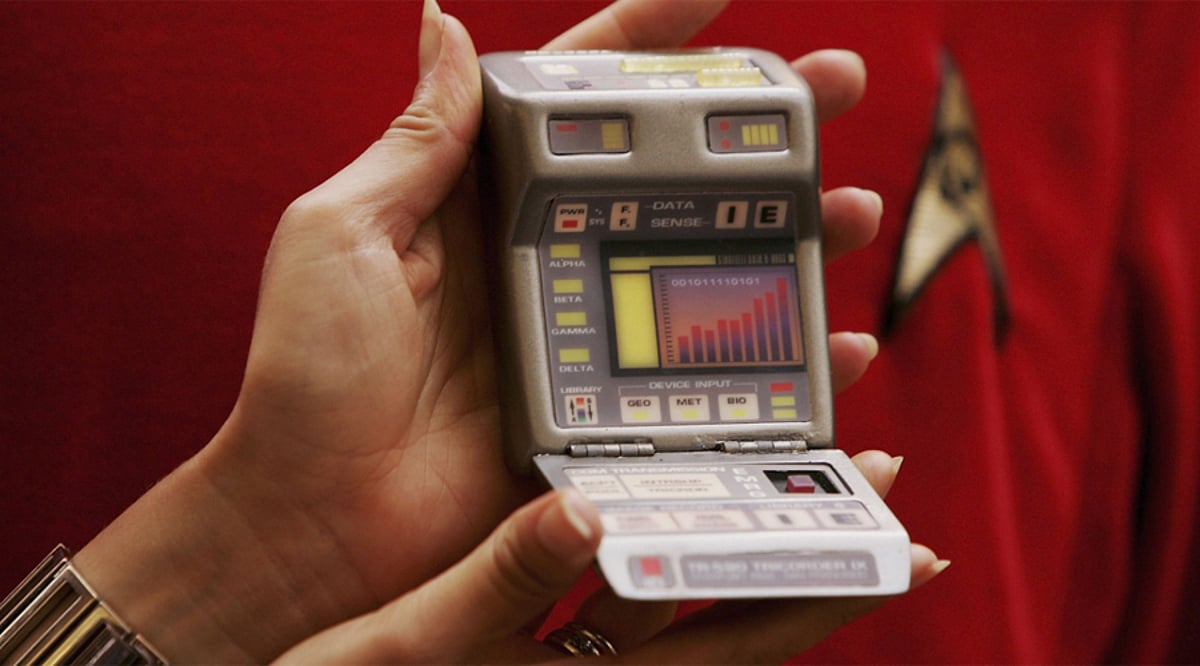
    The fictional tricorder could scan patients and identify conditions quickly. Researchers have worked on real-world portable diagnostic tools, including projects tied to the Qualcomm Tricorder XPRIZE. That competition challenged teams to build compact health monitoring devices. While no product yet matches the tricorder completely, these efforts show steady progress toward portable medical diagnostics.

    Video Calls Went Mainstream

    Star Trek often showed characters communicating face-to-face over video. Smartphones, laptops, and conferencing platforms now make live video communication routine. However, the idea was not entirely new—Bell Labs demonstrated its Picturephone in 1964. This makes video calling an example of parallel development rather than a direct Star Trek invention.

    Science Fiction Meets Modern Reality

    Star Trek’s greatest influence may be its vision of technology that is portable, accessible and integrated into everyday routines. Communicators, PADDs, voice interfaces and medical scanners all have real-world equivalents today. Some were inspired directly by the franchise, while others emerged on their own. Either way, Star Trek helped popularize a future that now feels familiar.

  • IIT Madras and CMC Vellore Develop AI Tools for Early Kidney Disease Detection

    IIT Madras and CMC Vellore Develop AI Tools for Early Kidney Disease Detection

    AI-Powered Tools Aim to Revolutionize Kidney Disease Diagnosis

    Kidney disease often progresses silently, with many patients showing no symptoms until significant damage has occurred. To address this, a collaborative project between the Indian Institute of Technology Madras (IIT Madras) and Christian Medical College (CMC), Vellore, is developing three artificial intelligence (AI) tools designed to enable earlier and more accurate detection of kidney conditions.

    Three-Pronged Approach to Kidney Health

    The initiative introduces a suite of AI systems targeting different aspects of kidney care:

    • Chronic Kidney Disease (CKD) Risk Prediction: The first tool analyzes clinical and laboratory data to identify patients at risk of developing chronic kidney disease. It provides an early risk signal, and the team has integrated it into a prototype interface, with ongoing efforts to enhance accuracy and interpretability for clinicians.
    • Automated CT Scan Classification: The second tool employs deep learning to categorize kidney CT scans into four groups: normal, cyst, stone, and tumor. Trained on over 12,000 images, this system aims to assist radiologists in reviewing scans more efficiently and consistently.
    • 3D Kidney Modeling for Tumor Assessment: The third tool constructs patient-specific 3D models of the kidney from CT scans. This allows for precise measurement of tumor volume and the extent of kidney involvement. Built on open-source software, the platform offers a cost-effective and reproducible method for evaluating tumor burden.

    Working Towards a Kidney Digital Twin

    These tools are part of a larger vision to create a ‘kidney Digital Twin’ – a virtual replica of a patient’s kidney that integrates imaging data with other health information. This comprehensive model could enable continuous disease monitoring, personalized treatment planning, and a more holistic view of a patient’s condition. The research team also envisions integrating wearable sensors to track kidney health over time.

    Research Leadership and Future Directions

    The project is led by Prof. G.L. Samuel from the Department of Mechanical Engineering at IIT Madras, alongside research scholar Jennifer Delighta. Prof. Santosh Varughese from the Department of Nephrology at CMC Vellore contributes clinical expertise. Supported by IIT Madras and the SPARC (Scheme for Promotion of Academic and Research Collaboration), the research is currently in its early stages.

    While the potential is significant, the tools are not yet ready for routine clinical use. The team plans to validate the models with larger patient datasets and collaborate with healthcare institutions for real-world testing. One major challenge highlighted is the lack of large, open-access patient record repositories in India, which is crucial for developing robust AI models. Prof. Samuel estimates that routine hospital adoption could still be at least five years away.

    Why This Matters

    Early detection is critical in managing kidney disease effectively. By combining risk assessment, image analysis, and detailed 3D modeling, this project offers a comprehensive strategy to catch and monitor kidney problems earlier. Though still in development, it represents a significant step towards leveraging AI to improve patient outcomes and personalize nephrology care.

    Frequently Asked Questions

    What are the three AI tools being developed?

    The tools are for chronic kidney disease risk prediction, CT scan classification (normal, cyst, stone, tumor), and 3D kidney tumor assessment.

    How can AI help in early kidney disease detection?

    AI can analyze clinical data and medical images to identify patterns and anomalies that may indicate early-stage disease, often before symptoms appear.

    What is a ‘Kidney Digital Twin’?

    It’s a virtual, patient-specific model of the kidney that integrates various health data points to help doctors monitor disease progression and tailor treatments.

    Is this technology available in hospitals now?

    No, the tools are still in the research phase and require further validation with larger datasets and real-world clinical trials before they can be adopted in routine practice.

  • How Curium Life Is Leveraging AI to Transform Modern Surgery

    How Curium Life Is Leveraging AI to Transform Modern Surgery

    AI-Assisted Surgical Planning

    Curium Life uses artificial intelligence to analyze medical imaging before surgery. The technology helps surgeons identify critical structures and potential risks. Better planning can improve accuracy during complex procedures, enabling more confident surgical decision-making.

    Real-Time Decision Support

    AI-powered systems provide valuable insights during surgical procedures. The platform assists surgeons by highlighting relevant clinical information instantly. Faster access to data can reduce delays in decision-making and supports safer, more efficient operations.

    Enhanced Precision

    Curium Life focuses on improving surgical precision through intelligent data analysis. AI helps reduce variability between procedures by providing consistent guidance. Surgeons remain in control while benefiting from additional support, ultimately contributing to better patient outcomes.

    Workflow Optimization

    The platform streamlines clinical workflows before, during, and after surgery. Automation reduces administrative tasks and improves operating room efficiency. Healthcare teams can spend more time focusing on patient care, and better coordination also improves hospital productivity.

    The Future of AI in Healthcare

    Artificial intelligence continues expanding across diagnostics, treatment planning, and surgical assistance. Curium Life represents a growing wave of healthcare innovation. Hospitals increasingly seek technologies that improve safety and efficiency, making AI an essential clinical partner.

    Why It Matters

    Curium Life demonstrates how AI can support, not replace, medical professionals. By combining intelligent software with surgical expertise, better healthcare outcomes become possible. As adoption grows, AI-driven platforms could redefine modern surgery, and the future of precision medicine is rapidly approaching.