
When Star Trek first aired in 1966, its futuristic gadgets seemed light-years away. Decades later, many of those ideas have become part of daily life. While today’s devices don’t exactly match their fictional counterparts, the similarities show how science fiction can shape real-world innovation.
Communicators Transformed Into Mobile Phones
On the show, crew members used handheld communicators for wireless long-distance conversations. Modern smartphones offer the same convenience through cellular networks, Wi-Fi and Bluetooth. Motorola’s 1996 StarTAC flip phone even echoed the communicator’s clamshell design. It remains one of the clearest examples of science fiction inspiring consumer technology.
PADDs Evolved Into Tablets
Star Trek characters used Personal Access Display Devices, or PADDs, to read documents, access data and manage tasks. Today’s tablets fill the same role with touchscreens, wireless connectivity and powerful processors. Portable computing concepts also developed independently beyond Star Trek, so direct inspiration is harder to prove than with communicators.
Voice Computers Became AI Assistants
In the series, officers often spoke naturally to the ship’s computer to retrieve information or execute tasks. Modern voice assistants and conversational AI provide a similar experience: ask a question, control smart devices, or access services by voice. Today’s systems are more advanced in many ways, but they still operate differently from the fictional Starfleet computer.
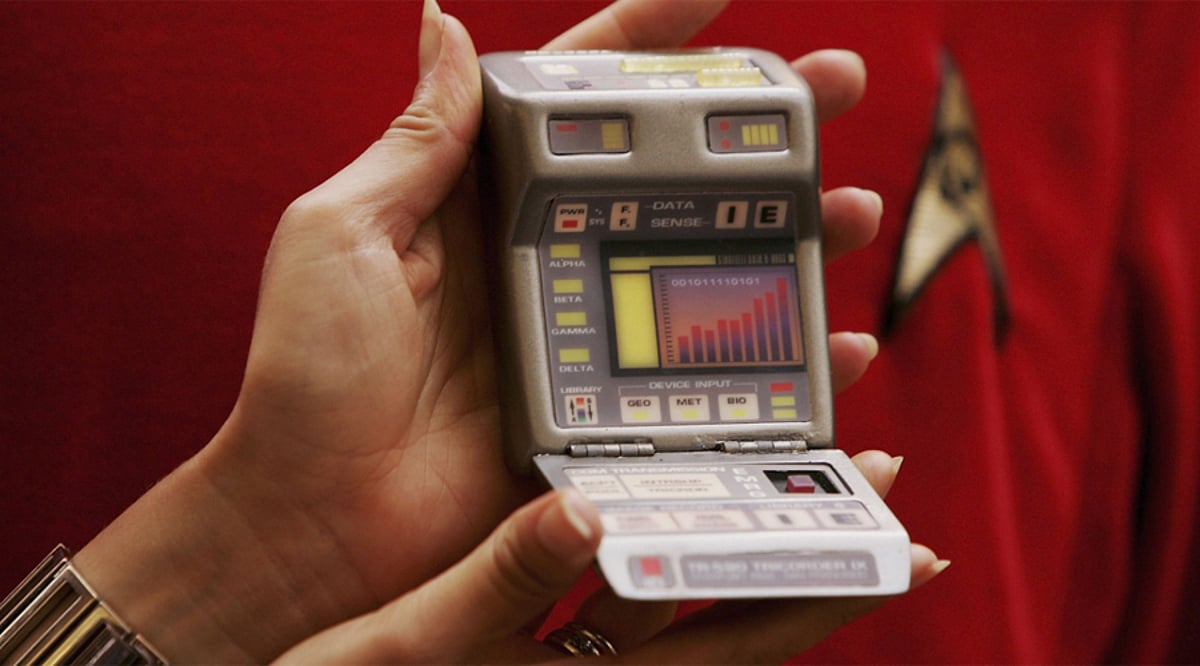
Tricorders Inspired Portable Medical Diagnostics
The fictional tricorder could scan patients and identify conditions quickly. Researchers have worked on real-world portable diagnostic tools, including projects tied to the Qualcomm Tricorder XPRIZE. That competition challenged teams to build compact health monitoring devices. While no product yet matches the tricorder completely, these efforts show steady progress toward portable medical diagnostics.
Video Calls Went Mainstream
Star Trek often showed characters communicating face-to-face over video. Smartphones, laptops, and conferencing platforms now make live video communication routine. However, the idea was not entirely new—Bell Labs demonstrated its Picturephone in 1964. This makes video calling an example of parallel development rather than a direct Star Trek invention.
Science Fiction Meets Modern Reality
Star Trek’s greatest influence may be its vision of technology that is portable, accessible and integrated into everyday routines. Communicators, PADDs, voice interfaces and medical scanners all have real-world equivalents today. Some were inspired directly by the franchise, while others emerged on their own. Either way, Star Trek helped popularize a future that now feels familiar.
Leave a Reply