Tag: on-device AI

  • Snapdragon X2 AI PCs: Five Capabilities Set to Reshape Everyday Computing

    Snapdragon X2 AI PCs: Five Capabilities Set to Reshape Everyday Computing

    Qualcomm’s Snapdragon X2 generation is pushing AI PCs beyond marketing language. The platform pairs dedicated neural processing with efficient CPUs and GPUs, aiming to make AI-assisted work feel more native on laptops. Here are five areas where the new Snapdragon AI PCs are expected to make a difference.

    1. More capable on-device AI

    The centerpiece is the NPU. Snapdragon X2 Elite processors are listed with up to 85 TOPS of NPU performance in some configurations, while other listings cite 80 TOPS. The NPU works alongside the CPU and GPU, so supported apps can run AI workloads locally instead of sending every request to the cloud. That opens the door to multimodal tasks involving text, images, video, and audio, with faster responses and smoother AI tools when software is optimized.

    2. AI agents that can handle multi-step tasks

    Snapdragon X2 platforms are built to support agentic AI experiences. Rather than only answering a question, supported applications can break a user’s goal into steps and use available tools to carry out parts of the workflow. Qualcomm has demonstrated native agentic apps for document search, content creation, web research, and workflow automation. The caveat: real-world usefulness will depend on developer support and app integration.

    3. Battery life and efficient processing

    Performance matters only if a laptop can sustain it. Snapdragon PCs continue to emphasize power efficiency, and Qualcomm says Snapdragon X Series devices can reach up to 22 hours of battery life. Actual mileage will vary by hardware, software, display, and workload. The architecture spreads tasks across processing units, so AI work can use the NPU instead of overloading the CPU. That can help laptops stay responsive while cutting unnecessary power draw.

    4. Smarter cameras, audio, and connectivity

    AI features are also moving into everyday communication. Snapdragon platforms support AI-enhanced camera and audio processing, which can improve video calls, background effects, voice handling, and related tools. Snapdragon X2 systems include Wi-Fi 7 support and advanced display capabilities, with some configurations able to drive up to three 5K displays at 60Hz. That makes these PCs relevant for mobile productivity and workstation-style setups.

    5. Local processing with more privacy

    On-device AI can offer more than speed. When suitable tasks are processed locally, less sensitive data has to leave the device. Qualcomm also highlights chip-to-cloud security across Snapdragon X2 platforms. This does not remove the cloud from the picture. Demanding workloads can still use cloud services, while the PC follows a hybrid model: local processing for appropriate tasks and cloud capacity when needed.

    What the next Snapdragon AI PCs could mean for users

    The next generation of Snapdragon laptops is becoming more AI-focused. Dedicated NPUs are getting faster, and software is catching up. Agentic AI may be one of the most noticeable shifts, moving AI tools from simple Q&A toward workflow assistance. Battery efficiency remains a major advantage for mobile users, and local processing could make some AI experiences faster and more private. Still, hardware specifications alone do not guarantee a better AI experience. The final result will depend on the device, the applications, and how well developers use the platform.

    FAQ

    What are Snapdragon AI PCs?

    They are computers powered by Qualcomm Snapdragon platforms with dedicated AI processing. Their NPUs can handle supported AI workloads alongside the CPU and GPU, enabling local AI features and AI-assisted applications.

    What is the Snapdragon X2 Elite NPU?

    It is a dedicated neural processing unit for AI workloads. The article cites up to 80 TOPS of NPU performance, with some configurations listed at up to 85 TOPS. Actual capabilities depend on the specific device and software.

    What can on-device AI do on Snapdragon PCs?

    On-device AI can process supported workloads directly on the computer, including tasks involving text, images, audio, and other content. This can reduce dependence on cloud processing for suitable workloads.

    What is agentic AI on a Snapdragon PC?

    Agentic AI goes beyond simple question-and-answer interactions. Supported applications can break a user’s goal into multiple steps and use applications and tools to complete parts of that workflow.

    Do Snapdragon AI PCs have better battery life?

    Snapdragon PCs emphasize power efficiency alongside performance. Qualcomm says Snapdragon X Series devices can deliver up to 22 hours of battery life. Actual battery performance varies by device, software, workload, display, and usage conditions.


  • Qualcomm Unveils Agentic Smartphone Vision: On-Device AI to Automate Tasks Across Apps

    Qualcomm Unveils Agentic Smartphone Vision: On-Device AI to Automate Tasks Across Apps

    Qualcomm has unveiled its ambitious vision for the next generation of smartphones at the Snapdragon Summit 2026 in Maui. The company’s handset chief, Christopher Patrick, and premium mobile leader Dino Bekis introduced the concept of the ‘agentic smartphone’ — a device that acts as an intelligent assistant capable of understanding user intent and autonomously completing multi-step tasks across different applications.

    For example, if someone emails you their contact details, instead of manually copying that information into your contacts app and forwarding it, the phone’s AI agent could handle the entire process automatically, only pausing to ask for your approval when necessary.

    However, this level of automation raises significant privacy concerns. To function effectively, the AI needs access to personal data such as emails, photos, and app accounts. Qualcomm’s solution is to process as much of this data as possible on the device itself, minimizing reliance on cloud servers. Users would have clear control over permissions, able to grant or revoke access at any time.

    The strategy is powered by Qualcomm’s newest processors: the Snapdragon 8 Elite Extreme Gen 6 and the Snapdragon 8 Elite Gen 6. Both chips feature the company’s Oryon CPU and Hexagon NPU, along with a low-power Sensing Hub that continuously monitors context without draining the battery. The Extreme version offers enhanced performance for graphics, camera, and video workloads.

    Qualcomm is also collaborating with Liquid AI to develop a system that builds a user profile from device data (with permission), giving AI agents the context they need without constant cloud access. Heavier AI workloads will still be offloaded to the cloud, but the goal is to split tasks based on privacy, speed, and cost considerations.

    While the chips are ready, the full realization of this vision depends on smartphone manufacturers and app developers building the necessary permission systems and app connections. Qualcomm has laid the foundation, but the ecosystem must catch up to make the agentic smartphone a reality in everyday life.

  • 5 AI-Powered TV Innovations Transforming Home Viewing by 2027

    5 AI-Powered TV Innovations Transforming Home Viewing by 2027

    Television has quietly evolved from a passive screen into an intelligent hub that listens, learns, and adapts. By 2027, AI will be the core of how we interact with our TVs, moving beyond simple voice commands to truly conversational experiences. The global AI TV market, valued at USD 9.76 billion in 2026, is projected to grow at a compound annual rate of 17.2 percent through 2030, according to market research firm Accio. This growth reflects how deeply artificial intelligence is becoming woven into the everyday act of watching television.

    1. Conversational AI Companions Replace Remote Controls

    Voice control on TVs is no longer about shouting single commands. Samsung’s Vision AI platform already lets viewers ask contextual questions about on-screen content, pulling in tools like Microsoft Copilot and Perplexity for real-time answers. In 2027, TVs will act less like screens and more like conversational assistants that understand what show is playing and respond accordingly. Consumer Reports notes that chatbots built into TVs will increasingly replace traditional remote navigation, allowing viewers to simply talk to find what they want.

    2. Personalized Content Discovery Gets Sharper

    AI-driven recommendation engines are becoming far more accurate. By 2027, TVs will study viewing patterns more closely, factoring in mood, time of day, and even who else is in the room. This means recommendations will feel highly tailored, keeping viewers engaged longer and reducing endless menu scrolling. For streaming platforms, smarter recommendations are a key competitive advantage.

    3. On-Device AI Processing Improves Privacy and Speed

    A major shift is moving AI processing from the cloud to local chips inside the TV. This reduces lag time and gives users more control over their data, addressing privacy concerns tied to always-listening devices. Stronger system-on-chip hardware makes this possible, and 2027 models are expected to lean further into local processing for faster, more private interactions.

    4. Smarter Picture and Sound Without Manual Tweaking

    AI upscaling is already standard, letting 1080p signals look close to 4K. By 2027, AI will automatically adjust brightness, contrast, and sound profiles based on content type—whether it’s a sports match, a dark thriller, or a video call. Viewers will spend less time fiddling with settings as the TV handles optimization in the background.

    5. The Bigger Picture: Why These Trends Matter

    These trends reshape how people interact with home entertainment and how much data companies collect. For manufacturers, AI has become the main differentiator in a market where screen technology alone no longer sets brands apart. For viewers, it means TVs that feel more intuitive, respond faster, and adapt to individual habits without extensive setup. As 2027 approaches, AI in television is no longer an add-on feature but the foundation shaping how screens are designed, marketed, and used every day.

  • How AI Assistants Are Redefining Mobile App Interactions: From Menus to Intent

    How AI Assistants Are Redefining Mobile App Interactions: From Menus to Intent

    AI assistants are fundamentally changing how users interact with mobile apps, shifting the paradigm from manual navigation to intent-driven execution. Instead of hunting through menus to complete a task, users can now simply state their desired outcome, and the software handles the steps. This transformation moves the interaction model from User → App → Feature → Action to User → Intent → Assistant → App Capability → Action. While visual interfaces remain essential for tasks like date selection or product comparison, AI reduces the need for users to understand an app’s internal structure. Voice-first apps further push this shift by enabling hands-free intent expression.

    The Shift From Menus to Intent

    This does not mean conversation replaces every screen. Picking a date on a calendar or comparing products side by side often stays faster with a visual layout. What changes is narrower and more useful: AI reduces how often a user has to understand an app’s internal structure just to use it. A shopping app can still show a product grid while a request typed in plain language filters it instantly, with no menu required. Voice-first apps push this shift further, letting people express intent without touching the screen at all. Visual interfaces still hold their ground for tasks that need comparison or precision, so the two approaches now sit side by side rather than compete.

    Why On-Device AI Matters

    Mobile chipsets are adding more hardware built for running AI models directly on the device. This cuts delay and keeps sensitive data local. But most apps are not choosing between on-device and cloud processing; they are building hybrid systems where quick or private tasks run locally and heavier reasoning still travels to the cloud. The real shift is not that AI moved to the phone, but that developers now decide, task by task, where computation should happen, weighing speed, privacy, and cost. This same awareness of context lets an app adjust to a person’s habits over time instead of treating every session as new. A fitness app that remembers a user’s usual workout time can suggest a plan without being asked, quietly folding personalization into the background rather than presenting it as a separate feature.

    From AI Features to Agentic Apps

    A chatbot answers. A copilot helps. An assistant performs a single action. An agent coordinates several actions to reach a goal, such as finding a hotel near a meeting, checking its cancellation policy, and preparing the booking. That progression changes the app’s role. An application is not just presenting functions to a human anymore; its functions also need to be understandable and reachable by an AI system acting on someone’s behalf. This is a structural demand, not a cosmetic one. It reshapes what ‘building an app’ actually involves.

    The New Developer Challenge

    Much of the visible change happens in the interface, but the larger transformation sits underneath it. Developers now need structured app data, clear APIs, permission systems, context that persists across sessions, and reliable ways for an assistant to call the right function at the right time. Testing an app used to mean checking if buttons work. Now it also means checking if an assistant handles a vague or oddly worded request without making the wrong call. Mobile development is quietly becoming AI development, and the teams that treat it that way are the ones setting the pace.

    Trust and Competition Are Shifting Together

    Giving an assistant permission to act, rather than just respond, creates a new kind of trust problem. Users may not always know how an AI reached a decision or whether it stayed within the limits they intended. Some apps address this with a short explanation line after a task completes, showing what happened and why. This same shift could reshape how apps compete. Features that once helped one app stand out become easier to reach through an assistant that pulls from several apps at once. If a person can ask for a result without knowing which app supplied it, the interface itself matters less. App companies may end up competing more on the quality of their data, the reliability of their services, and how well their functions can be coordinated by AI, rather than on how their screens look.

    Final Thought

    The next generation of mobile apps will not be defined only by what users can do inside them. They will be defined by what AI can safely do with them. That puts more weight on the foundations underneath the interface: reliable data, accessible actions, clear permissions, strong security, and systems that know when to act and when to ask first.

    Frequently Asked Questions

    1. How are AI assistants changing mobile apps? AI assistants are shifting mobile apps from menu-based navigation toward intent-based interactions, allowing users to describe what they want and receive help with completing tasks.
    2. What are agentic apps? Agentic apps use AI systems that can coordinate multiple actions to achieve a user-defined goal rather than simply answering questions or completing one isolated task.
    3. Why is on-device AI important for mobile apps? On-device AI can reduce response time and keep certain data on the phone, making it useful for applications where privacy, speed, and offline functionality matter.
    4. How does AI affect mobile app development? AI requires developers to build stronger data structures, APIs, permission systems, context management, and safeguards so assistants can interact with app functions reliably.
    5. Will AI assistants replace traditional mobile app interfaces? No. AI assistants are more likely to work alongside traditional interfaces. Screens remain useful for tasks involving visual comparison, navigation, selection, and precise controls, while AI handles intent-driven tasks.
  • DroiClaw: The AI-Native OS Redefining the Agentic Era

    DroiClaw: The AI-Native OS Redefining the Agentic Era

    Artificial intelligence is undeniably transforming smart devices, but many of today’s products still treat AI as an add-on. A new generation of software is taking a different approach by embedding AI into the operating system itself. This emerging AI-native OS model aims to make interactions more natural, personalized, and proactive.

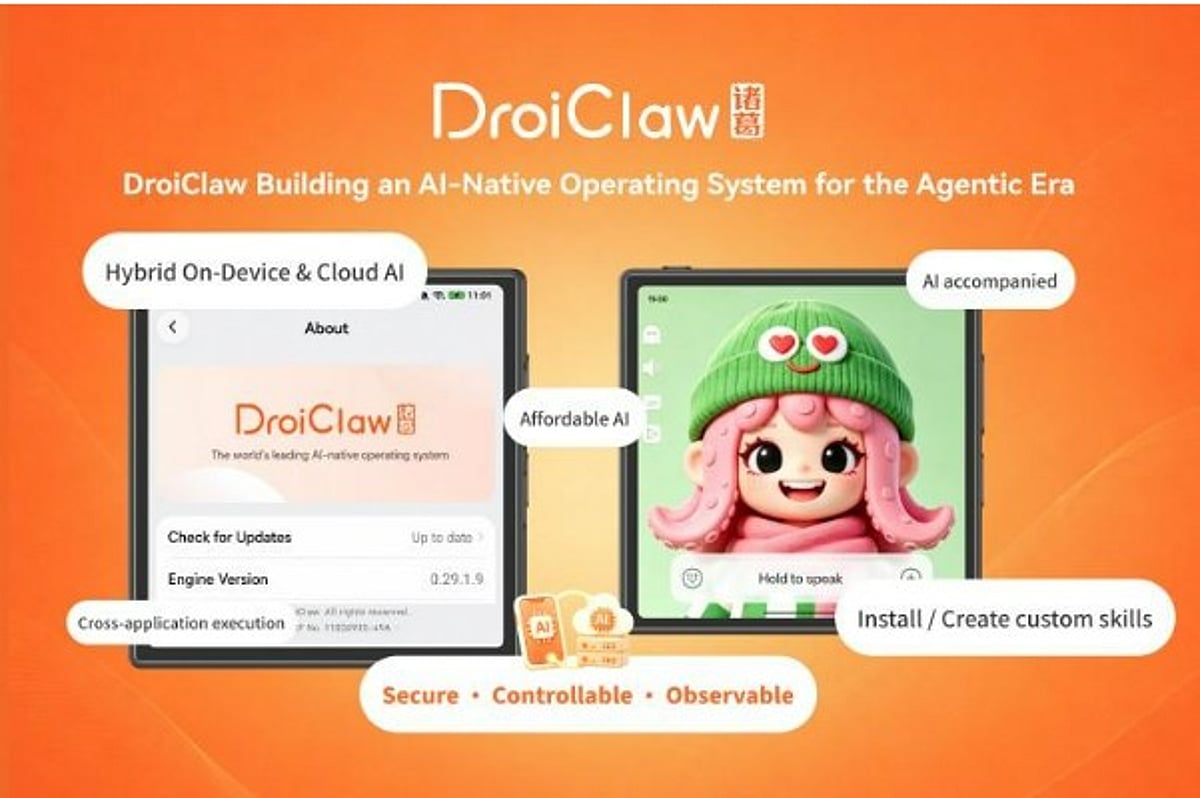
    Shanghai Droi Technology has introduced DroiClaw, an AI-native operating system built for next-generation smart terminals. Rather than being merely an AI assistant or chatbot, DroiClaw is designed with AI at the foundation of its architecture.

    What Makes an Operating System AI-Native?

    Traditional operating systems revolve around applications, with AI typically added as a separate assistant or productivity feature. In contrast, an AI-native operating system integrates AI into the core of its framework. This influences how users interact with devices at a fundamental level—from how models are selected to the way tasks are processed.

    DroiClaw uses multimodal large-model and AI technologies to support interactions through voice, text, images, documents, video, and natural-language commands. It also enables personalized AI avatars with customizable voices, personalities, memories, and skills. By embedding intelligence throughout the operating system, DroiClaw delivers a seamless experience across communication, work, travel, and everyday productivity.

    From Apps to an Agentic OS

    One of DroiClaw’s key goals is to build an app-free agentic OS ecosystem, where users no longer need to switch between multiple applications. The operating system is designed to understand a user’s intent and coordinate tasks across services through AI agents.

    Users can describe what they want in natural language while AI agents break requests into subtasks, call necessary system functions, and complete authorized operations with fewer manual steps. While the vision is not to eliminate apps overnight, this approach allows many routine interactions to become intent-driven rather than app-driven.

    DroiClaw includes a skill library where users can install and create AI skills for specific workflows. Features like AI-assisted writing, translation, meeting transcription, file analysis, and intelligent task automation demonstrate how AI agents can simplify routine activities without requiring users to navigate multiple interfaces.

    Hybrid On-Device and Cloud AI

    DroiClaw combines lightweight on-device AI models with cloud-based large models to support different usage scenarios. Under normal conditions, users primarily access cloud-based large models, which provide advanced capabilities such as multimodal interactions, AIGC, complex reasoning, content generation, and skill execution. On-device models serve as a fallback when network access is unavailable or cloud service credits are exhausted, automatically switching to a local model for basic question-and-answer tasks.

    The OS also supports multiple AI models rather than locking users into a single provider. This open approach allows partners to tailor AI capabilities for industry-specific applications.

    A Secure, Controllable, and Observable Agent Ecosystem

    Transparency and user control become essential as AI agents become capable of carrying out complex tasks. DroiClaw establishes a secure, controllable, and observable AI agent ecosystem, emphasizing user authorization for sensitive operations, permission management, intelligent task scheduling, and layered data protection. Users gain greater visibility into how AI agents perform automated actions, and privacy-sensitive information can be processed locally where appropriate. These capabilities help build trust as AI evolves toward actively completing tasks on users’ behalf.

    Affordable AI and an Open Ecosystem

    Beyond technological innovation, DroiClaw reflects a broader shift toward AI democratization. The first smartphones preloaded with DroiClaw—launched with Coolpad and Philips in June 2026—are priced at around RMB 1,099, bringing advanced AI capabilities to more affordable smart devices. The OS is built as an open ecosystem, supporting multiple hardware platforms and service providers.

    Final Thoughts

    Shanghai Droi Technology, founded in 2008, has extensive experience in developing operating systems and mobile ecosystem services. Its FreemeOS platform has been installed on more than 200 million devices across dozens of countries and regions, with support from more than 1,000 hardware and software ecosystem partners. DroiClaw builds on that experience to envision the next generation of intelligent computing—combining an AI-native OS architecture, an app-free agentic OS ecosystem, hybrid on-device and cloud AI, and a secure, controllable, and observable AI agent ecosystem. As smart terminals evolve beyond traditional app-based operating systems, DroiClaw makes advanced AI more accessible through an open ecosystem and affordable devices.

  • Government Surveillance of AI and Smart Devices: Key Privacy Insights

    Government Surveillance of AI and Smart Devices: Key Privacy Insights

    Smartphones, AI assistants, and smart home gadgets continuously generate and share data. Governments can access some of this information through legal channels, but users have controls to limit exposure. Here’s a breakdown of how tracking works and what you can do to protect your privacy.

    Device Location Data

    Smartphones and connected devices can share location information through GPS, cellular networks, and Wi-Fi, depending on user permissions and settings. Disabling location services for apps that don’t need them reduces tracking.

    Legal Data Requests

    Governments may request user data from technology companies through lawful processes, subject to applicable regulations, court orders, and national legislation. Companies often publish transparency reports showing the volume of such requests.

    AI Voice Assistants

    Voice assistants process spoken commands, with some requests handled in the cloud while others increasingly rely on on-device AI processing. On-device processing minimizes data sent to servers, enhancing privacy.

    Smart Home Devices

    Connected cameras, speakers, and sensors generate data that can reveal usage patterns, making security settings and account protection increasingly important. Regularly update firmware and use strong passwords to safeguard your network.

    Cloud Data Storage

    Information synchronized to cloud services may remain accessible across devices, depending on retention policies, encryption, and user account preferences. Review your cloud storage settings and enable encryption where available.

    End-to-End Encryption

    Encrypted messaging services help protect conversations during transmission, reducing unauthorized access while maintaining secure communication between users. Use apps that offer end-to-end encryption by default.

    On-Device AI Processing

    Modern AI models increasingly process data directly on smartphones, minimizing cloud transfers and improving both privacy and response speed. This local processing reduces the amount of personal data exposed to external servers.

    User Privacy Controls

    Device settings allow users to manage permissions for location, microphone, camera, contacts, and app access to limit unnecessary data collection. Audit these permissions regularly and revoke access for apps that don’t need it.

    Transparency Reports

    Many technology companies publish transparency reports showing government data requests, offering users greater insight into official information access practices. Consulting these reports helps you make informed decisions about which services to trust.

    For the latest news, exclusives, and videos, join our WhatsApp Channel.