Tag: South Korea

  • AI Adoption Accelerates Around the World: UAE and Singapore Top Rankings as South Korea Climbs Fastest

    AI Adoption Accelerates Around the World: UAE and Singapore Top Rankings as South Korea Climbs Fastest

    AI Adoption Is Accelerating Worldwide

    Generative AI continues to expand its reach across the globe. According to Microsoft’s latest estimates, 18.8% of the global working-age population used a generative AI product in June 2026—a rise from the previous quarter. While adoption is climbing in nearly every economy, significant disparities remain across regions and countries in terms of access and usage.

    UAE Leads Global Adoption

    The United Arab Emirates continues to hold the top spot for AI diffusion. Microsoft’s June 2026 data shows that 73.3% of the country’s working-age population used AI tools. The UAE’s strong digital infrastructure, proactive government policies, and widespread technology access have contributed to its global leadership.

    Singapore Remains a Major Hub

    Singapore ranks second globally, with a 64.3% AI diffusion rate as of June 2026. The city-state has consistently ranked among the strongest AI-adopting markets. Its advanced digital infrastructure, thriving technology ecosystem, and high internet penetration have created favorable conditions for generative AI to become part of everyday life—both at work and at home.

    South Korea Shows Fastest Growth

    South Korea posted the biggest quarterly increase in Microsoft’s June 2026 data, gaining 3.5 percentage points. The country has emerged as one of the fastest-growing AI markets, driven by workplace adoption, government initiatives, and consumer-focused AI applications. This growth also underscores how local language capabilities can significantly influence AI adoption rates.

    Japan and Türkiye See Rapid Growth Too

    OECD data tracking generative AI chatbot usage reveals that Japan and Türkiye experienced the highest growth during 2025, with usage rates more than doubling. Singapore also saw a substantial jump, rising from 36% to 63% of its population using AI chatbots. It’s important to note that these figures rely on a different methodology than Microsoft’s diffusion measure.

    The Global AI Adoption Gap

    The gap between developed and developing economies remains wide. Microsoft estimates that 28.8% of the working-age population in the Global North used generative AI in June 2026, compared with just 16.2% in the Global South. Infrastructure, connectivity, skills, and language accessibility continue to be major barriers to broader adoption.

    What the Numbers Show

    The global AI race is increasingly about adoption, not just building advanced models. Countries with strong digital foundations are seeing faster usage growth, while others struggle with infrastructure and skills gaps. Since different datasets measure AI use differently, cross-country comparisons should be treated as indicators rather than precise measurements of total adoption.

  • South Korea’s Digital Asset Bill on Track for November Review, Regulator Says

    South Korea’s Digital Asset Bill on Track for November Review, Regulator Says

    South Korea’s Financial Services Commission (FSC) said its digital asset legislation remains on track for a November review, as regulators and lawmakers work toward a broader rulebook for the sector. The planned framework is expected to cover issuance, distribution, stablecoins, disclosures, and requirements for virtual asset service providers.

    FSC: No Delays Planned

    Speaking at a National Assembly seminar in Seoul on September 22, Seo Na Yoon, head of the FSC’s virtual asset division, said the regulator shares lawmakers’ overall legislative direction and does not intend to slow the process. “The FSC is not dragging its feet at all. We share the same view,” Seo said.

    She acknowledged that disagreements remain over when the government will submit its draft, but said the November review remains on the timetable. She also said detailed talks may continue, while emphasizing that the regulator has no intention of delaying the legislation.

    Ten Bills Already Before Lawmakers

    Seo said the FSC wants lawmakers to pass the legislation quickly and expects discussions to use both the government’s draft and bills already introduced in the National Assembly. Ten digital asset and stablecoin bills are currently pending, giving legislators a foundation for negotiations before the government completes its own version.

    The FSC is working through detailed provisions while following the same broad direction as lawmakers, she added. The challenge now is how quickly those proposals can be consolidated into one workable framework.

    November Timeline Follows Pressure for Faster Action

    The November schedule comes after earlier calls for the FSC to speed up the process. In August, FSC Chairman Kim Byoung Hwan said the government would accelerate legislative consultations as lawmakers pushed to finish the framework during the fall.

    At a National Assembly Political Affairs Committee meeting, Democratic Party lawmaker Lee Kang Il asked when the government would submit its bill. The planned framework is expected to address stablecoin issuance, virtual asset service providers, and other parts of the market.

    Seo said personnel changes inside the FSC would not affect the timeline. “A change in the responsible official cannot cause a delay in the schedule,” she said, adding that the agency would work to keep discussions on the planned track.

    Lawmakers Build on Pending Proposals

    The FSC previously told the National Assembly that it planned to work with the ruling Democratic Party on a consolidated digital asset bill, incorporating input from the 10 proposals already before lawmakers. Several lawmakers have filed separate bills, including Rep. Min Byung Duk, Democratic Party lawmakers Ahn Do Geol, Kim Hyun Jung, Lee Kang Il and Park Sang Hyuk, as well as People Power Party lawmakers Kim Eun Hye, Kim Jae Seop, Choi Bo Yoon, Lee Sung Kwon and Kim Sung Won.

    Min recently told reporters that lawmakers expected a public hearing on the Digital Asset Framework Act at the end of September. South Korea currently regulates the sector through the Virtual Asset User Protection Act, which focuses mainly on user protection and unfair trading practices.

    Stablecoin Rules Still Under Discussion

    The second-stage framework is expected to cover issuance, disclosures and stablecoin regulation. Stablecoin issuer eligibility remains one of the key issues under discussion. The Bank of Korea has backed a bank-led structure for won-denominated stablecoins, citing possible effects on monetary policy, payments and financial stability.

    South Korea has also used regulatory sandbox programs to test blockchain technology and digital assets in several areas. New exemptions have supported trials involving real-world use cases, including public spending. The FSC’s latest statement did not specify which types of digital currency public institutions would use or the scale of the initial rollout, but authorities plan to monitor how digital currency payments operate within public spending.

  • India’s Factory Robot Density Trails Global Manufacturing Leaders Despite PLI Success

    India’s Factory Robot Density Trails Global Manufacturing Leaders Despite PLI Success

    India’s Production Linked Incentive (PLI) schemes have attracted Rs. 2.16 lakh crore in investment and boosted electronics manufacturing from $37 billion to over $115 billion in less than a decade. However, the country’s factories remain far behind global leaders in automation.

    According to 2025 reports, South Korea leads the world with 1,220 robots per 10,000 employees, followed by Singapore with 818. China has 166 robots per 10,000 workers, while India’s robot density stands at just six — among the lowest in major manufacturing economies.

    Prateek Jain, COO and Co-founder of Addverb, stated: “The future of industrial development will be shaped by productivity, precision and the ability to manufacture at globally competitive levels. Robotics is no longer a factory upgrade. It has become a national competitiveness imperative.”

    South Korea’s high robot density is driven by electronics and auto giants like Samsung, LG, and Hyundai, which have increased robot use by 7% annually. China has invested heavily in AI, robotics, and smart factories, automating repetitive tasks, improving quality, and boosting efficiency while controlling costs.

    India’s lower labor costs have slowed automation adoption, but as global competition intensifies, factories may need to blend skilled workers with modern machines. This balance could help India strengthen its position in global manufacturing in the coming years.

  • Asian Markets Rally as Microsoft and Amazon Earnings Rekindle AI Optimism

    Asian Markets Rally as Microsoft and Amazon Earnings Rekindle AI Optimism

    Asian stock markets rebounded strongly on Friday after Microsoft and Amazon reported better-than-expected earnings, reigniting confidence in artificial intelligence investments. South Korea’s Kospi posted its biggest single-day gain, while Japan’s Nikkei 225 also climbed sharply, led by a surge in technology shares across the region.

    The rally was fueled by Microsoft and Amazon’s latest quarterly results, which demonstrated that heavy spending on AI infrastructure and cloud services continues to generate robust business growth. Microsoft reported strong Azure cloud revenue, and Amazon’s AWS business posted its fastest expansion in several quarters, easing concerns that AI investment momentum might be slowing.

    “The previous sell-off had become exaggerated because the underlying AI demand story had not materially weakened,” said Fabien Yip, market analyst at IG.

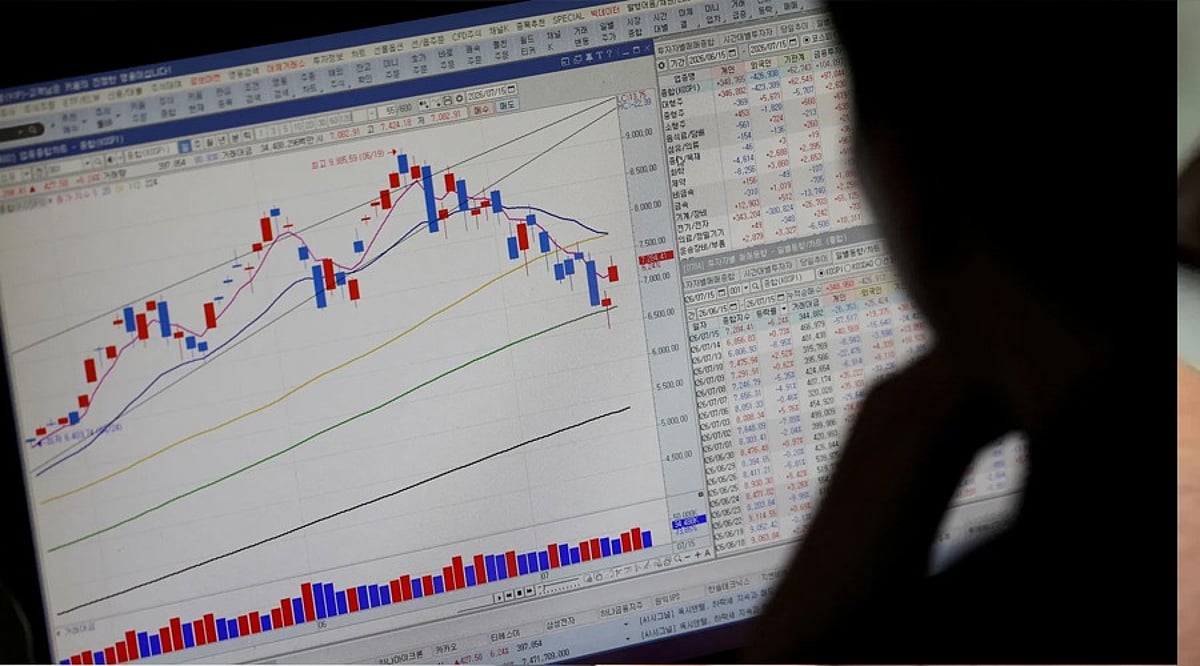
    In South Korea, Samsung Electronics and SK Hynix led the recovery after suffering heavy losses earlier in the week. Their sharp gains propelled the Kospi higher, though the index remained well below its June peak and remained on track for its weakest July since 1997.

    Japan’s Nikkei 225 also advanced after the Bank of Japan kept interest rates unchanged. However, a weaker yen, elevated US bond yields, and ongoing geopolitical tensions continue to inject caution among investors.

    Analysts believe the strong earnings have restored faith in AI stocks, but sustained profits and healthy demand will be needed to maintain the recovery trajectory.

  • South Korea’s Kospi Soars Nearly 18% as Chip Stocks Lead Historic Rebound

    South Korea’s Kospi Soars Nearly 18% as Chip Stocks Lead Historic Rebound

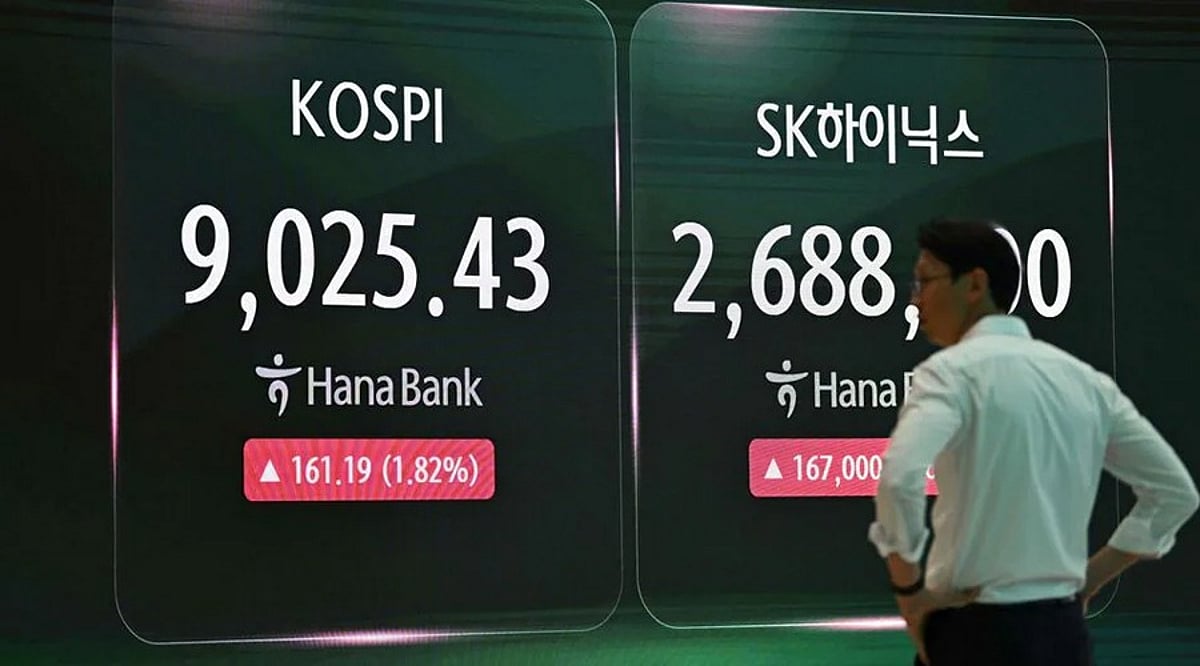
    South Korea’s Kospi index surged nearly 18% on Friday, July 31, heading for its largest one-day gain after three sessions of heavy losses. Chipmakers led the rebound, while Wall Street’s technology rally restored confidence across global markets.

    Chipmakers Drive the Record Kospi Rally

    The Kospi rose 18.27% to 6,615.60 earlier in the session. It later stood 17.9% higher at 6,695.45 as buying accelerated. Samsung Electronics climbed 28%, while SK Hynix jumped 30%. Both companies became the main drivers of the benchmark’s historic advance.

    The rally followed a three-day decline of more than 17%. Investors had sold technology shares amid concerns about an AI bubble and stronger Chinese competition. The Kospi still remained below its June record above 9,000. Before Friday, its largest daily rise was nearly 12% during the October 2008 financial crisis.

    Wall Street Rebound Restores Confidence

    Asian markets followed a strong technology-led session on Wall Street. United States chip stocks recorded their biggest one-day gain in more than a year.

    Microsoft shares surged 15.5%, marking their strongest session in nearly 18 years. Its quarterly profit exceeded expectations and suggested that large AI spending could support earnings. Amazon added 9.5% in after-hours trading following strong results. In contrast, Apple dropped more than 6% after warning that supply shortages could affect sales.

    Nasdaq 100 futures also moved higher after the index ended a six-day losing streak. TSMC gained about 10% and supported the wider Asian market advance.

    Bargain Buying Lifts Global Markets

    Investors returned to technology shares after the steep sell-off created lower entry prices. The renewed demand quickly lifted stocks that had suffered earlier in the week. Japan’s Nikkei 225 climbed 4% to 64,362.02. SoftBank Group advanced 13.8%, while chip equipment producer Tokyo Electron gained 6.2%.

    European markets also opened higher. Germany’s DAX rose 0.7%, France’s CAC 40 added 0.9%, and Britain’s FTSE gained 0.5%. United States futures increased 0.5%. Oil prices resumed climbing after Brent crude had edged lower as shipping conditions through the Strait of Hormuz showed improvement.

    The dollar recovered 0.5% to 160.28 yen after falling sharply overnight. Markets suspected intervention by Japanese and United States regulators near the 160-yen level.

    A Brief Roundup

    The Kospi’s nearly 18% surge followed a sharp rebound in Samsung Electronics, SK Hynix and other AI-linked shares. Wall Street’s technology gains and bargain buying strengthened the recovery. Investors will now watch economic data, oil prices, supply constraints and Middle East developments for signs that the rebound can continue.

  • Renewed AI Optimism Drives South Korean Chip Stocks to Record Gains

    Renewed AI Optimism Drives South Korean Chip Stocks to Record Gains

    South Korea’s stock market experienced a strong rebound on Friday, driven by a rally in semiconductor stocks after better-than-expected earnings from major US technology firms. Investor confidence in the long-term growth of artificial intelligence infrastructure was renewed, reversing recent declines.

    Semiconductor Stocks Lead the Rally

    The benchmark Kospi index surged over 18%, reaching its highest level in about a month. SK Hynix Inc. soared by a record 28%, buoyed by a rare direct share purchase by SK Group Chairman Chey Tae-won. Samsung Electronics Co. rose approximately 26%, while Samsung Electro-Mechanics gained nearly 30%. Hyundai Motor also posted strong growth of almost 8%.

    The rally helped recover losses from earlier in the week, which had been triggered by concerns over valuations and competition from Chinese memory-chip makers.

    Strong US Earnings Restore AI Confidence

    Microsoft reported strong growth in its Azure cloud business, and Amazon exceeded expectations in its cloud computing division, reiterating plans to continue investing in AI infrastructure. These results eased fears that enterprise investments in AI might slow down, prompting investors to rebalance toward semiconductor stocks, particularly those supplying high-performance memory chips and AI infrastructure.

    Domestic Support Boosts Sentiment

    SK Group Chairman Chey Tae-won purchased 3,620 shares of SK Hynix in the open market, his first direct investment in the company, worth approximately 4.8 billion won (about $3.2 million). The move was seen as a strong signal of confidence in the chipmaker’s long-term prospects.

    Additionally, the South Korean government announced plans to allocate nearly $13.9 billion to its sovereign wealth fund for strategic investments in AI, further supporting the sector’s outlook.

  • Wearable Robot from South Korea-US Team Helps Users Dress Independently

    Wearable Robot from South Korea-US Team Helps Users Dress Independently

    Researchers from South Korea and the United States have developed a groundbreaking wearable robotic system that assists individuals with dressing. The technology combines smart sensors and robotic arms to provide gentle, precise movements, making it easier for elderly people and those with mobility challenges to put on clothes without assistance.

    The robot uses artificial intelligence to adapt its force and movement, ensuring that clothing is handled safely and comfortably. This innovation is designed to promote independence and improve the quality of life for millions who struggle with daily tasks.

    Hospitals and rehabilitation centers are expected to be major adopters of this technology, which also holds promise for home care and assisted living facilities. The developers plan to make the system smaller, faster, and more affordable in future iterations.

    Assistive robotics like this one could transform daily living for people worldwide, offering a new level of autonomy and dignity. The collaboration between South Korea and the US underscores the global effort to advance healthcare through robotics and AI.

  • Samsung Refutes US Share Listing Rumors After SK Hynix’s Record NASDAQ Debut

    Samsung Refutes US Share Listing Rumors After SK Hynix’s Record NASDAQ Debut

    Samsung Electronics has officially denied recent reports that it is considering a United States share listing via American depositary receipts (ADRs). The denial follows a media report suggesting the company had held preliminary discussions with banks about a potential offering. In a statement, a Samsung spokesperson said, “Samsung Electronics is not reviewing the possibility of issuing American Depositary Receipts,” directly challenging the earlier account. The company did not elaborate on any past discussions or its reasoning.

    The earlier report indicated that any talks were at a very early stage and that Samsung had not decided whether to proceed. It also noted that the review “may not result in a listing.” Samsung had previously explored a similar plan but ultimately chose not to move forward. ADRs allow foreign companies to list shares on U.S. exchanges, making them more accessible to American retail investors. Currently, Samsung Electronics trades primarily on the Korea Exchange, limiting direct access for U.S. investors.

    The speculation gained momentum after SK Hynix, Samsung’s main competitor in memory chips, completed a massive U.S. share offering. SK Hynix priced its ADRs at $149 each, raising approximately $26.5 billion — the largest U.S. listing by a foreign company, according to Reuters. The shares began trading on NASDAQ on July 10 and surged more than 12% on their first day, reflecting strong investor demand for exposure to memory chips used in AI data centers.

    Both Samsung and SK Hynix compete in the DRAM, NAND, and high-bandwidth memory markets, and both have benefited from surging demand for chips powering artificial intelligence servers. However, memory stocks remain volatile. SK Hynix shares later fell as some investors took profits, and market participants are closely watching production growth, chip supply, and the pace of AI infrastructure spending.

    Samsung recently released preliminary second-quarter results, estimating sales of about 171 trillion won and operating profit of approximately 89.4 trillion won — a dramatic increase from 4.68 trillion won a year earlier. Despite the strong profit growth, Samsung shares declined after the update, as investors weighed high expectations against concerns about future AI spending and potential oversupply. The company plans to publish detailed quarterly results on July 30.

    In June, Samsung and the SK Group announced major manufacturing expansions, each planning to build two new chip plants in South Korea. The combined investment totals 800 trillion won (about $536 billion). Additionally, South Korean companies including Naver have committed 550 trillion won to build 8.4 gigawatts of data-center capacity by 2029. For now, Samsung’s public denial leaves no active ADR plan confirmed. Any future U.S. listing would require a new official announcement or regulatory filing.

  • Samsung Accelerates Yongin AI Chip Fab Opening to 2029 as SK Hynix Shares Drop After NASDAQ Debut

    Samsung Accelerates Yongin AI Chip Fab Opening to 2029 as SK Hynix Shares Drop After NASDAQ Debut

    Samsung Electronics has announced plans to begin operations at its first Yongin semiconductor factory in 2029, advancing the original target by one to two years. The accelerated timeline reflects surging demand for memory chips used in artificial intelligence data centers and aligns with South Korea’s broader strategy to expand domestic chip production.

    Samsung’s Revised Timeline for Yongin Fab

    Previously, Samsung expected the first fabrication plant at the Yongin cluster to start operations in 2030 or 2031. A company spokesperson confirmed that the facility is now scheduled to open by 2029, placing the project on a tighter schedule. The Yongin site is part of a larger semiconductor cluster south of Seoul, where Samsung plans to build six chip factories. The first plant will serve as the foundation for subsequent construction phases.

    To meet the revised date, Samsung must prepare the land and begin major construction work early. The company aims to add production capacity as technology companies increase spending on AI infrastructure and advanced memory products.

    South Korea’s Push for Chip Production Expansion

    South Korean authorities are supporting faster construction by shortening approval periods and providing earlier access to essential infrastructure like electricity and water. The national strategy targets doubling the country’s memory-chip production capacity within five years, including expedited development of Samsung and SK Hynix factories in Yongin and a new semiconductor cluster in Gwangju.

    Samsung has also outlined plans to invest 400 trillion won in semiconductor factories in Gwangju and 56 trillion won in high-bandwidth memory facilities in Cheonan and Onyang. Its domestic semiconductor program covers existing operations in Pyeongtaek and the new Yongin cluster.

    SK Hynix is similarly expanding its production network. The company plans to complete the fourth factory at its Yongin cluster by 2033, moving the target forward from 2045.

    SK Hynix Shares Retreat After NASDAQ Debut

    SK Hynix’s American depositary receipts (ADRs) debuted on NASDAQ on July 10, opening 14% above the $149 offering price at $170 and closing the session 12.8% higher. The company raised $26.5 billion from the US offering, with demand exceeding available shares by more than seven times. SK Hynix plans to use the funds for factories and equipment related to rising AI chip demand.

    However, on Monday, SK Hynix shares dropped more than 15% in Seoul as investors took profits after the NASDAQ surge. The decline marked the stock’s largest single-day drop in nearly two decades and weighed on the broader Kospi index. CEO Kwak Noh-jung noted that memory demand could outpace production capacity beyond 2030 and warned that 2027 might become the industry’s worst year for memory supply as AI customers require more advanced chips.

  • Which Countries Are Setting the Standard for AI Education in 2026?

    Which Countries Are Setting the Standard for AI Education in 2026?

    Preparing students for an AI-powered future has become a national priority worldwide. Leading countries are introducing AI into schools, expanding university programs, and supporting digital skills. These efforts define the global leaders in AI education in 2026. Here is how the top contenders stack up—and where ambition meets reality.

    Key Takeaways

    • China and the UAE are the only nations running compulsory, national AI curricula since the 2025-26 school year.
    • India, Estonia, and South Korea reveal three different speeds of rollout—from a ten-million-teacher training push to a public reversal.
    • The nations pulling ahead are matching curriculum ambition to teacher readiness, not chasing the boldest headline.

    Every government wants to claim it leads in AI education. Few can prove it with a classroom that actually works. The gap between what gets announced and what reaches a teacher standing in front of thirty students will become the real story worth telling.

    Two Speeds of Compulsory Rollout

    China moved early, and it moved fast. By September 2025, AI had become a compulsory subject for every student from age six, sitting alongside mathematics on the timetable, not tucked away as an elective. Beijing schools now owe every student at least eight hours of AI instruction a year, and in a growing number of classrooms, platforms like Squirrel AI are already doing the adaptive teaching. What has not kept pace is everything around the technology: ethics, data privacy, and equal access. The rollout outran the guardrails.

    The UAE got there first in a different sense. A Cabinet decision in May 2025 made it the first country on record to mandate a nationwide AI curriculum for K-12 students, full stop. Close to a million children in government schools are now working through seven curriculum strands, taught by more than a thousand teachers trained specifically for this. Private schools are not required to follow suit, not yet at least, though a fair number have adopted the material on their own, without waiting to be told to.

    When Ambition Outpaces Readiness

    South Korea shows what happens when a rollout runs ahead of its teachers. Seoul planned mandatory AI textbooks from 2025, but adoption sat below 30% by March, and that August, the National Assembly stripped the textbooks of official status after unions said the pace had outrun preparation. Korea responded with a $960 million plan to build AI talent centers and vocational high schools through 2030. The setback was not proof that AI education fails. It showed that mandates without matching teacher training buckle under their own weight, even in a well-funded system.

    India is betting bigger than anyone. From 2026 to ’27, AI and computational thinking will become mandatory from Class 3 across government and private schools, backed by a Rs. 500 crore center of excellence and the Rs. 10,372 crore India AI mission. The open question is delivery: roughly 10 million teachers need training, and only 15% were AI-fluent as of a 2025 survey. Whether India becomes the largest AI-literate student population in the world depends entirely on whether that math closes in time.

    Coherence Over Scale

    Singapore’s edge is not size but order of operations. Its Smart Nation strategy targets AI leadership by 2030, with teacher training promised at every level by 2026. A government-funded research center pilots tools with the Ministry of Education before they reach classrooms, rather than after.

    Finland and Estonia are playing a different game entirely, treating AI fluency as a civic skill rather than a career pipeline. Finland’s Elements of AI course has reached hundreds of thousands of citizens; Estonia’s AI Leap gave 20,000 students and 3,000 teachers early access, with plans to scale nationwide by 2027.

    Also Read: The World Is Your Campus: Where to Study AI and Programming at the Planet’s Greatest Universities

    Research Depth, Classroom Gap

    The United States still leads in university-level AI research, and Washington has tried to close the K-12 gap too, through an executive order that created a federal task force and a student AI challenge. However, the same period saw the Department of Education shutter its Office of Educational Technology. Only four states include AI in computer science standards, and enrollment in the subject fell 11% between 2024 and 2025, even as graduate AI programs kept growing. A country can lead the world in research capacity while still trailing far smaller nations in the classroom.

    There is no single best country here, only different goals pursued at different speeds. What separates the nations worth watching is not the size of the announcement, but the honesty of the follow-through—and Korea’s public reversal is proof that admitting a gap is not the same as failing to close it.

    Also Read: Case Studies: Universities That Rebuilt Curricula for AI vs Those That Just Added It

    Final Thoughts

    The competition to be the first to educate about AI isn’t about being the loudest or the first to shout. It will be given to the people who make the often-ugly but ultimately beautiful things happen: training teachers, updating classrooms, keeping students safe, and working at it year after year, well past the news cycle. The countries leading the way in 2027 will not be those with the most impressive plan on paper. This will be where that plan has become a normal part of a school day without being noticed.

    You May Also Like:

    FAQs

    1. Which country leads AI education in 2026?

    There is no single leader. China leads in scale, the UAE in national curriculum rollout, Singapore in implementation, and the United States in AI research.

    2. Which country made AI education compulsory first?

    The UAE became the first country to introduce a nationwide mandatory AI curriculum for K-12 students in May 2025. China also made AI compulsory for school students from age six.

    3. Why is teacher training important for AI education?

    Teachers need the skills to use AI effectively in the classroom. Without proper training, even well-funded AI education policies can struggle to deliver results.

    4. Is AI now a compulsory subject in India?

    India plans to introduce AI and computational thinking as compulsory subjects from Class 3 beginning in the 2026–27 academic year, supported by the IndiaAI Mission and teacher training initiatives.

    5. What makes an AI education system successful?

    A successful AI education system combines a strong curriculum, trained teachers, ethical guidelines, digital infrastructure, and regular updates to keep pace with advances in AI technology.