Tag: XRP

  • XRP Defends $1 Support as ETF Inflows and Network Activity Surge

    XRP Defends $1 Support as ETF Inflows and Network Activity Surge

    XRP remained near $1 after losing 1.05% during the latest session, while lower leverage and stronger network activity helped buyers defend support. The token fell from $1.0476 to $1.0366, then recovered after testing levels near $1.02. Traders now focus on whether the $1 base can support a move toward $1.08-$1.10.

    Leverage Reset Changes XRP’s Short-Term Setup

    Open interest dropped from a $1.3 billion peak to below $150 million, removing much of the leveraged positioning created during earlier rallies. Funding rates also turned negative as traders reduced long exposure. At the same time, long liquidations surged 832% above their three-month average. One candle cleared $6.7 million from leveraged positions, showing the scale of the recent market reset. Even so, XRP continued to hold above the $1 psychological level. The token traded between $1.0201 and $1.0476, while buyers repeatedly responded near the lower end of that range.

    Network Activity and RLUSD Trading Expand

    XRP Ledger activity improved during the second half of June. Daily active addresses rose from about 23,000 on June 14 to nearly 39,500 by June 27, marking a 72% increase. Meanwhile, Ripple-backed Evernorth said RLUSD has become a growth engine for XRP Ledger activity rather than a replacement for XRP. Its June 30 report ranked RLUSD among the ledger’s most-traded issued assets. RLUSD’s share of on-chain trading increased from below 1% to about 12% during 2026. The RLUSD/XRP pair also recorded about $900 million in trading volume over six months. Since launch, more than $2.5 billion has traded through RLUSD pairs on the XRP Ledger. The growth developed alongside rising address activity and continued demand for XRP-linked investment products.

    ETF Inflows Rise as Traders Watch Key Levels

    XRP spot ETFs recorded $15.34 million in inflows on June 29. The inflows extended institutional demand even as broader crypto sentiment remained weak. Selling pressure broke support near $1.0350 during the June 30 session before XRP tested $1.0249 and stabilized. Buyers then returned near the lows as trading volume increased sharply. Volume reached 92.73 million XRP at 01:00 UTC, about 134% above the 24-hour average. A later rebound lifted XRP from $1.024 to $1.038. During that rebound, volume rose to 3.88 million XRP as the price moved above resistance near $1.032. The next immediate barrier remains near $1.0460.

    XRP still trades below its major moving averages. The 20-day EMA stands near $1.11, followed by the 50-day near $1.20 and the 100-day near $1.31. The 200-day moving average remains near $1.52. Meanwhile, the 14-day RSI recovered to about 33, although momentum still sits below neutral levels. Bollinger Bands narrowed after June’s selloff, pointing to lower volatility. XRP still needs to reclaim the middle band near $1.12 before the technical structure improves. Immediate support sits between $1.0250 and $1.0350. A daily close below $1 would bring the $0.90-$0.85 area back into focus, while a break above $1.10 would strengthen recovery prospects.

    What’s Next?

    XRP continues to defend the $1 support level as leverage declines, network activity expands, and ETF inflows remain positive. However, the token must reclaim $1.08 to $1.10 to confirm stronger momentum. Traders should monitor the $1 floor closely since a sustained break could expose lower support zones.

  • Bitcoin ETFs See $231M Outflow, XRP Holds $1, AAVE Surges 21%: Crypto Market Update

    Bitcoin ETFs See $231M Outflow, XRP Holds $1, AAVE Surges 21%: Crypto Market Update

    Market Overview

    The crypto market witnessed major developments as Bitcoin spot ETFs logged $231.10 million in net outflows, while XRP held $1 support and AAVE jumped 21% over seven days. Meanwhile, Solana teamed up with Toss Bank, and Strategy authorized Bitcoin sales.

    Bitcoin Saw $231 Million in Outflows

    According to SoSoValue, Bitcoin spot ETFs saw a total net outflow of $231.10 million yesterday. The Bitcoin spot ETF with the highest net inflow was Ark Invest and 21Shares’ ETF ARKB, with a daily net inflow of $49.97 million, bringing its total historical net inflow to $1.21 billion. Grayscale’s ETF GBTC followed with a daily net inflow of $35.10 million, though its total historical net outflow stands at $27.11 billion. BlackRock’s ETF IBIT recorded the largest daily outflow at $300.38 million, with a total historical net inflow of $60.47 billion. The total net asset value of Bitcoin spot ETFs is $73.19 billion, with an ETF net asset ratio of 6.05%. The historical cumulative net inflow has reached $51.37 billion.

    Solana Partners with Toss Bank on Cross-Border Payments

    The Solana Foundation and South Korean digital lender Toss Bank have signed a memorandum of understanding to explore blockchain-powered remittance and settlement services. The agreement establishes a framework for developing a proof-of-concept that could use Solana’s blockchain infrastructure to support faster and lower-cost international payments for Toss Bank’s 15 million customers. This partnership represents the first direct collaboration between a South Korean internet-only bank and the Solana ecosystem, highlighting growing interest among financial institutions in blockchain-based payment infrastructure. The initial phase centers on a proof-of-concept designed to evaluate Solana as a platform for cross-border remittance and settlement services.

    XRP Holds $1 Support

    XRP held above $1 and traded marginally higher during the session, while network activity rose sharply and ETF inflows continued. XRP daily active addresses rose from 23,000 on June 14 to nearly 39,500 by June 27, a 72% increase in two weeks. Activity increased on June 29, when volume reached 86.5 million XRP, about 67% above the 24-hour average. Open interest across major exchanges fell below 150 million from a 1.3 billion peak, and XRP ETFs added $15.34 million in net inflows on June 29. The $1 level remains key support, with $1.06 as the first short-term resistance, followed by $1.09-$1.10.

    AAVE Price Is Up 21% in 7 Days

    Aave climbed back above the $90 level. The token rose nearly 21% in the last seven days; at press time, AAVE was up 3.4%, trading at $91.48. During the rally, AAVE’s market capitalization and 24-hour trading volume surged by 3.4% and 3.66%, respectively, to $1.4 billion and $279.41 million. The price surge followed Aave founder Stani Kulechov’s rejection of claims tied to a discounted AAVE token sale and his announcement that the protocol is working on Aavenomics 3.0, which will include an automated buyback mechanism. Kulechov stated, “There is NO WAY we’d sell AAVE at a 70% discount lol.”

    Strategy Authorized BTC Sale

    In a press release and 8-K filing dated June 29, the firm formerly known as MicroStrategy unveiled a “Digital Credit Capital Framework,” a five-part overhaul of how it manages its balance sheet. This is the first time Strategy’s board has authorized the sale of Bitcoin, up to $1.25 billion to build a cash reserve, plus further sales to cover preferred dividends, interest, and stock buybacks. Strategy holds 847,363 BTC, bought for about $64.1 billion at an average price near $75,650. With bitcoin trading below $60,000 this week, that stack is worth roughly $50 billion, leaving the company with $13 billion in unrealized loss on paper.

    FAQs

    1. How much outflow did Bitcoin spot ETFs record? According to SoSoValue, Bitcoin spot ETFs recorded total net outflows of $231.10 million yesterday. BlackRock’s IBIT saw the largest outflow at $300.38 million.

    2. Which Bitcoin ETF saw the highest inflow? Ark Invest and 21Shares’ ARKB recorded the highest daily inflow at $49.97 million. Its total historical net inflow now stands at $1.21 billion.

    3. Why is XRP’s $1 level important? The $1 level is a key support zone for XRP and has helped stabilize short-term sentiment. The next resistance levels are seen at $1.06 and then $1.09-$1.10.

    4. Why did AAVE rise 21% in seven days? AAVE rallied as the token moved back above $90 and investor attention returned to Aavenomics 3.0. Founder Stani Kulechov also rejected claims of a discounted token sale, saying, “There is NO WAY we’d sell AAVE at a 70% discount lol.”

    5. What did Strategy announce about Bitcoin sales? Strategy authorized Bitcoin sales of up to $1.25 billion to build cash reserves under its Digital Credit Capital Framework.

  • What XRP Holders Can Expect from a Ripple IPO: No Direct Payouts, But Major Upside Potential

    What XRP Holders Can Expect from a Ripple IPO: No Direct Payouts, But Major Upside Potential

    Key Takeaways

    • XRP holders will not automatically receive Ripple company shares after an IPO.
    • Ripple’s valuation has climbed close to $50 billion, increasing IPO speculation.
    • XRP price could rise sharply if institutional demand grows after listing.

    For years, Ripple Labs has remained one of the biggest private companies in the cryptocurrency industry. Now, fresh market developments have once again pushed speculation around a possible Ripple IPO into the spotlight. Investors across the crypto market have started asking one major question: if Ripple goes public, what could XRP holders actually receive?

    The simple answer is that XRP holders will most likely not receive direct payments or company shares. However, recent developments show that a Ripple IPO could still create major financial opportunities for those holding XRP.

    Ripple IPO Rumors Have Become Stronger

    Talk about Ripple entering the stock market has grown much stronger in recent months. Ripple has stayed private for years, but new financial data has made analysts believe that a public listing may happen sooner than expected.

    Recent private market transactions show Ripple shares trading near $136.90 per share. This has pushed Ripple’s estimated company valuation close to $50 billion, which marks roughly 376% growth in private valuation over a relatively short period.

    This huge rise in valuation has made Ripple one of the most valuable private companies in the digital asset sector. Many analysts now believe that 2026 has become the strongest possible timeline for a public listing.

    Strong Company Performance Supports IPO Expectations

    Reports show that the company recently completed a $750 million share buyback program. A buyback usually signals strong confidence from company leadership and often shows that the business has enough capital available internally.

    At the same time, major financial institutions have started showing interest in a future Ripple listing. Japanese financial giant SBI Holdings, one of Ripple’s long-time partners, has reportedly shown interest in investing somewhere between $626 million and $1.25 billion once Ripple eventually enters public markets.

    XRP Holders Do Not Own Ripple Shares

    One of the biggest misunderstandings in crypto markets comes from the belief that owning XRP means partial ownership in Ripple Labs. Ripple Labs and XRP operate as two different things. Ripple is a private technology company that focuses on payment infrastructure, blockchain solutions, custody services, and financial settlement systems. XRP is a digital asset that runs independently on the XRP Ledger. If Ripple launches an IPO, XRP holders will not automatically receive company stock, ownership rights, or direct payouts from the money raised through the listing.

    XRP Could Still Benefit After an IPO

    Even though XRP holders would not receive direct company shares, the token could still benefit in a major way. History shows that whenever large crypto companies enter public markets, investor confidence usually rises across related assets. If Ripple becomes a publicly traded company, institutions may start paying much closer attention to the entire Ripple ecosystem.

    At the moment, XRP trades between $1.04 and $1.15, far below its previous July 2025 peak near $3.65. Despite lower prices compared to previous highs, XRP’s overall market position has become stronger over the past year.

    Major XRP Ecosystem Growth Continues

    The XRP ecosystem has expanded significantly during the past year, which adds more strength to the long-term story. In March 2026, U.S. regulators officially recognized XRP as a commodity, which removed a major regulatory concern that had affected the asset for years.

    At the same time, the United States now has seven spot XRP ETFs actively trading, something that has helped attract institutional capital. Since launch, these XRP ETFs have already brought in nearly $1.43 billion in cumulative inflows, which shows growing demand from larger investors.

    Ripple has also expanded its stablecoin project called RLUSD, which recently crossed $1.5 billion in market capitalization. On top of that, RippleNet now connects more than 300 financial institutions worldwide, which continues to strengthen Ripple’s role in global payments.

    What Could XRP Holders Actually Receive?

    If Ripple launches its IPO, shareholders of Ripple Labs could benefit directly since they own part of the company. XRP holders will not receive direct payouts as XRP ownership does not equal company ownership. A successful public listing could increase media attention, attract institutional capital, improve market confidence, and create fresh buying pressure around XRP itself.

    Several market analysts currently estimate medium-term XRP price targets between $3 and $8, depending on ETF demand, broader market conditions, and future adoption.

    Why This Matters

    Ripple’s $50B IPO clarifies that token holders don’t own corporate equity, but it brings massive Wall Street validation. Transitioning to a public entity boosts institutional trust, potentially driving widespread commercial utility and price appreciation across the XRP ecosystem.

    Final Outlook

    No evidence suggests that Ripple will directly distribute company shares or cash payouts to XRP investors once the IPO happens. If Ripple successfully enters public markets with a valuation between $50 billion and $60 billion, confidence around the entire ecosystem could rise sharply. Instead of direct cash payouts or free company stock, the biggest benefit may simply come from a strong rise in XRP value after one of crypto’s most highly anticipated public listings.

    FAQs

    1. Will XRP holders receive free Ripple shares after the IPO? No. XRP is an independent digital asset, and owning it does not grant corporate stock, equity rights, or direct cash payouts from Ripple Labs’ public listing.
    2. What is Ripple’s current estimated valuation? Driven by recent private market transactions and a $750 million share buyback program, Ripple Labs’ private market valuation is currently estimated close to $50 billion.
    3. Can XRP price rise if Ripple goes public? Yes. A successful public listing could dramatically boost media visibility, improve investor confidence, and attract substantial new institutional capital, which may drive up XRP’s price.
    4. How many XRP ETFs currently trade in the U.S.? There are currently seven spot XRP exchange-traded funds actively trading in the U.S. market, which have brought in nearly $1.43 billion in cumulative inflows.
    5. What is the biggest benefit for XRP holders from an IPO? The biggest benefit is indirect long-term asset appreciation and increased commercial adoption, rather than direct payouts or free stock distributions.
  • XRP Holds Above $1 as ETF Inflows Increase and XRPL Lending Protocol Enters Testing

    XRP Holds Above $1 as ETF Inflows Increase and XRPL Lending Protocol Enters Testing

    XRP maintained its crucial $1 support level as leverage declined, network activity expanded, ETF demand continued, and Ripple opened its proposed XRPL Lending Protocol for developer testing. The token gained 1.59% during the session, although resistance near $1.10 prevented a confirmed technical recovery.

    XRP Defends $1 After Major Leverage Reset

    XRP rose from $1.0451 to $1.0544 within a 24-hour range of $0.0435. The token later consolidated between $1.03 and $1.06, leaving the market range-bound rather than signaling a broader recovery. It remains 19% lower for the month. Trading activity peaked on June 29 at 17:00 UTC, with volume reaching 86.5 million XRP—about 67% above the session’s average volume. Open interest across major exchanges dropped below 150 million after reaching 1.3 billion previously, removing much of the crowded leverage behind XRP’s earlier rally. Funding rates turned negative, and forced long liquidations cleared additional bullish positioning. The four-hour relative strength index recovered from oversold conditions to 46. XRP still trades below major moving averages, with resistance near $1.10, followed by the 50-day EMA around $1.20 and the 100-day EMA near $1.31.

    Network Growth and XRP ETF Inflows Continue

    Daily active addresses climbed from 23,000 on June 14 to nearly 39,500 by June 27—a 72% surge in two weeks. At the same time, XRP spot ETFs recorded an eighth consecutive week of inflows, bringing cumulative inflows to $144.7 million despite broader weakness across cryptocurrency investment funds. On June 26, XRP ETFs attracted $15.6 million in net inflows, while Bitcoin ETFs saw $444.5 million in outflows and ether funds lost $12.9 million. The strength in network use and sustained ETF inflows could push XRP through the $1.10 resistance zone, but price action has not yet confirmed that shift. Initial resistance sits at $1.06, followed by $1.09–$1.10. A move above $1.20 would provide a stronger recovery signal; a break below $1 could bring the $0.90–$0.87 region back into focus.

    Ripple Opens XRPL Lending Protocol Testing

    Ripple announced that developers can now test the proposed XRPL Lending Protocol in a dedicated environment. The system would introduce native borrowing and lending functions to the XRP Ledger via two technical specifications—XLS-65 and XLS-66. These would help financial firms structure credit agreements directly on the network. The Single Asset Vault creates a standard format for pooling assets, while the Lending Protocol manages loan terms, servicing, and repayment rules. If network validators approve both specifications, institutions could use tokenized real-world assets like money market funds and commodities as working capital for lending. Developers can experiment with the framework while XRP continues trading between key support and resistance levels.

    What’s Next for XRP?

    XRP continues to defend the $1 support level with declining leverage, strengthening network activity, and positive ETF inflows. The XRPL lending development adds another institutional use case. Traders should watch whether XRP can break above $1.10 and advance toward $1.20 in the coming sessions.

  • XRP Price Forecast 2026-2030: Can Ripple Reach $5 Before the Decade Ends?

    XRP Price Forecast 2026-2030: Can Ripple Reach $5 Before the Decade Ends?

    Ripple’s XRP has long been a heavyweight in the cryptocurrency market, distinguished by its real-world utility in global finance. Unlike many digital assets driven purely by speculation, XRP is designed to facilitate fast, low-cost cross-border transactions for banks and financial institutions. As of June 2026, the token is trading in a consolidation range between $1.00 and $1.20, reflecting recent market corrections and periodic monthly escrow releases by Ripple. Despite short-term volatility, market confidence remains strong, with XRP consistently ranking among the top cryptocurrencies by market capitalization.

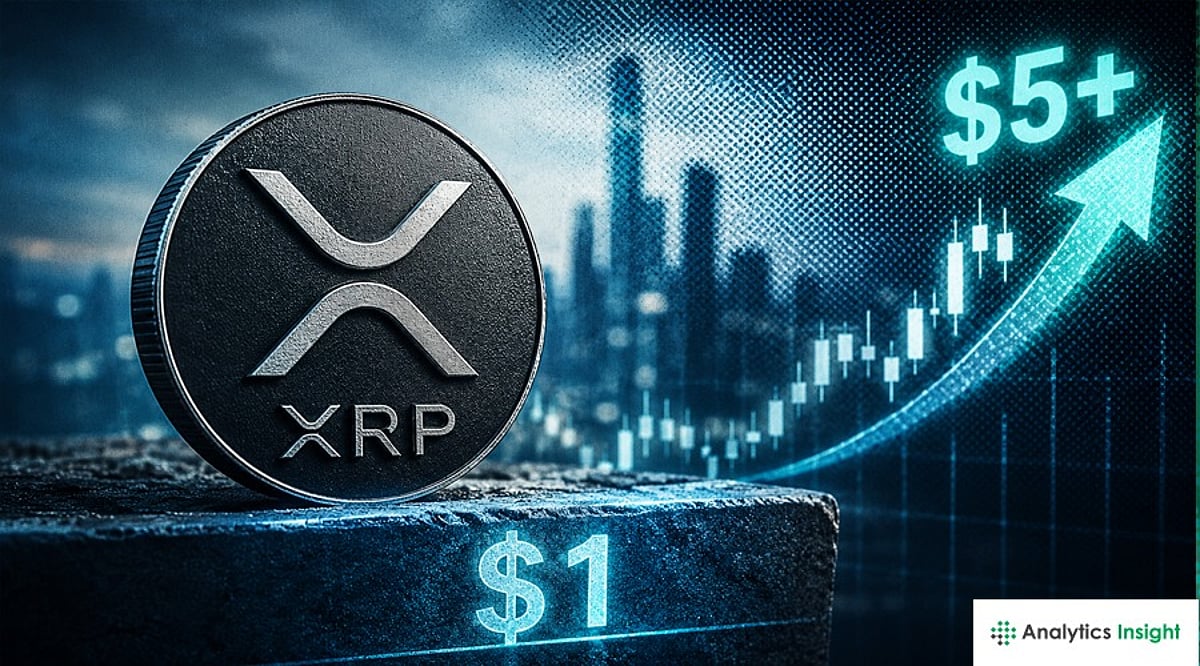
    The path to $5—a target many analysts consider realistic before 2030—depends on a confluence of factors: sustained bullish momentum in the broader crypto market, continued expansion of Ripple’s payment network (RippleNet), favorable regulatory developments, and deeper institutional adoption. Key catalysts include Ripple’s legal victory over the SEC, which removed significant uncertainty, the launch of the RLUSD stablecoin for institutional settlements, and growing discussions around potential spot XRP exchange-traded funds (ETFs).

    XRP Price Prediction for 2026

    • Conservative estimate: $1.20 to $2.80, assuming slow market recovery and steady adoption.
    • Aggressive estimate: $3.50 to $6.50, if a strong bull cycle and rising institutional demand materialize.
    • Balanced outlook: $2.50 to $3.00 by year-end 2026.

    Outlook for 2027 and 2028

    By 2027, focus is expected to shift from speculation to real-world usage. If banks begin directly using XRP for cross-border transactions, price growth could accelerate. Forecasts suggest a range of $3.00 to $5.90 in 2027, with more bullish projections of $4.50 to $8.40 by 2028. Achieving $5 likely requires positive global crypto regulations, continued partnership growth for Ripple, and another Bitcoin bull cycle that lifts altcoins.

    XRP Price Prediction for 2030

    • Weak scenario: $2 to $3, limited adoption and stronger competition.
    • Balanced scenario: $5 to $8, steady institutional integration.
    • Highly bullish scenario: $15 to $25, if Ripple becomes a major pillar of global payment infrastructure.

    Extremely optimistic forecasts place XRP near $28 by 2030, though such targets remain highly speculative. Ultimately, XRP’s trajectory toward $5 and beyond hinges on a fundamental shift from retail speculation to deep institutional integration. With legal clarity now established, Ripple’s ability to anchor cross-border banking rails positions XRP as a key indicator of how legacy finance adopts digital assets.

    Disclaimer: This article is for informational purposes only and does not constitute investment advice. Always conduct your own research before making financial decisions.

  • Crypto Sell-Off Deepens: Why Bitcoin, Ethereum, XRP, and Dogecoin Are Dropping and What July Could Bring

    Crypto Sell-Off Deepens: Why Bitcoin, Ethereum, XRP, and Dogecoin Are Dropping and What July Could Bring

    The cryptocurrency market has entered a turbulent phase as major digital assets continue to lose value. Bitcoin, Ethereum, XRP, and Dogecoin have all suffered sharp price drops in the final weeks of June 2026. Investor confidence is fragile, and many traders are watching closely to see whether July will bring relief or further declines.

    Market Overview

    Bitcoin slipped below the critical $60,000 level, trading near $59,800 — one of its lowest points in months. Ethereum fell more steeply, now around $1,555. XRP dropped to roughly $1.03, while Dogecoin declined sharply to about $0.074. The total crypto market capitalization has fallen below $2.3 trillion, erasing billions in value.

    Key Factors Driving the Decline

    Weak Global Stock Markets

    Crypto prices are increasingly correlated with technology stocks. Recent sell-offs in the tech sector — driven by weakness in semiconductors and artificial intelligence — have spilled over into digital assets, amplifying the downturn.

    Massive Bitcoin ETF Outflows

    Bitcoin exchange-traded funds (ETFs) experienced outflows of nearly $1.79 billion in the past week alone, one of the largest weekly withdrawals on record. This selling pressure has added to Bitcoin’s woes and reduced institutional demand.

    Shift Toward AI Stocks

    Investor capital is rotating out of crypto and into AI-related companies, which are perceived as offering faster growth. This shift has drained liquidity from the crypto market, hitting Ethereum, XRP, and Dogecoin especially hard.

    Heavy Liquidations

    The futures market saw over $1 billion in long positions liquidated as leveraged traders were forced out. Bitcoin open interest has dropped sharply, indicating that many short-term traders have exited, deepening the correction.

    Why Altcoins Fell Harder Than Bitcoin

    Ethereum’s decline was exacerbated by slowing network activity and weaker decentralized finance demand. XRP, despite some positive institutional news, could not escape the broader market weakness. Dogecoin, as a highly speculative meme coin, experienced the largest percentage drop — nearly 9.8% in the past week, compared to Bitcoin’s 4.5% fall.

    Can July Bring a Recovery?

    Analysts are watching Bitcoin’s support zone between $50,000 and $60,000, a range that has historically attracted buyers. A recovery could occur if ETF outflows slow and global stock markets stabilize. However, risks remain: high interest rates, weak institutional demand, and cautious sentiment could push prices lower before any rebound. July offers hope for stabilization, but a strong rally depends on improved macroeconomic conditions.

    Frequently Asked Questions

    1. Why is Bitcoin falling right now?
      Bitcoin is dropping due to ETF outflows, weak stock markets, and reduced investor confidence.
    2. Why did Ethereum fall more than Bitcoin?
      Ethereum faced extra pressure from slowing network activity and declining DeFi demand.
    3. Why is Dogecoin dropping sharply?
      Dogecoin is highly speculative and tends to react more aggressively during market fear.
    4. Can crypto recover in July 2026?
      A recovery is possible if global markets stabilize and institutional buying returns.
    5. What price level matters most for Bitcoin now?
      Analysts closely watch the $50,000 to $60,000 support zone for possible recovery.
  • XRP Defends $1 Support as Holder Losses Reach 2022 Bear Market Levels – Price Analysis

    XRP Defends $1 Support as Holder Losses Reach 2022 Bear Market Levels – Price Analysis

    XRP is holding the critical $0.93–$1.00 support zone after another steep weekly decline, while on-chain data shows holder losses matching levels last seen during the 2022 crypto bear market. Despite the bearish sentiment, analysts see a potential recovery toward $5–$8 if buyers reclaim major resistance levels.

    XRP’s $0.93 Support Becomes the Main Price Test

    Buyers reacted near $1.0079 this week, preventing an immediate break below the psychological $1 level. That response preserved the existing recovery setup, although the market has not confirmed a reversal. The wider support zone runs from $0.93 to $1.00, aligning with earlier breakout levels, a long-term rising trend line, and a Fibonacci extension followed by technical traders.

    Can XRP hold this zone long enough to rebuild momentum? A decisive close below $0.93 could weaken the bottoming structure and expose the next support area near $0.80. On the upside, XRP first faces resistance near $1.15. Bulls would then need to reclaim $1.40 before testing the stronger barrier between $1.70 and $1.90.

    Realized Losses Return to 2022 Bear-Market Levels

    Glassnode data shows XRP’s 90-day Realized Profit/Loss Ratio near 0.33. The reading matches 2022 bear-market levels and indicates that holders are selling more coins at a loss. The ratio compares the value of coins sold at a profit with those sold at a loss. Readings above one favor realized gains, while readings below one indicate greater losses. XRP’s ratio first fell below one in April 2026, when the token traded between $1.30 and $1.40. It later reached 0.38 in early June before declining again.

    Still, the indicator does not confirm a market bottom. During the 2022 downturn, the ratio fell below 0.20 before XRP continued lower toward $0.31.

    Analysts Map a Possible Fifth-Wave Recovery

    Analyst Dark Defender says XRP may be nearing the end of a wave-four correction around $0.93. That level closely matches the support zone that buyers currently defend. His weekly chart also places the Relative Strength Index near 29, which reflects oversold conditions. Under his Elliott Wave count, a fifth-wave advance could target $5.86 and then $8.78. The analyst also maps a longer-term target near $18.23—though that scenario requires a multi-year expansion and remains highly speculative.

    Mikybull Crypto also tracks a possible capitulation phase near XRP’s rising trend line from the 2020 market bottom. His chart places XRP near a major Fibonacci retracement and below the Ichimoku Cloud. His longer-term projection points to the $5–$8 range if XRP holds the trend line. Before then, the token must defend support, reclaim $1.40, and clear resistance between $1.80 and $1.90. A break above those levels could return attention to the previous cycle high near $3.60. A support failure could instead send XRP toward $0.80 before another recovery attempt.

    What’s Next?

    XRP remains at a decisive point as buyers defend the $0.93–$1.00 support zone while holder losses reach 2022 bear-market levels. A recovery above $1.40 could strengthen the bullish outlook, but losing $0.93 may expose $0.80. Traders should closely monitor these levels before expecting a sustained rebound.

  • Bitcoin, Ethereum, XRP Find Footing as Traders Eye Key Support Levels and Macro Data

    Bitcoin, Ethereum, XRP Find Footing as Traders Eye Key Support Levels and Macro Data

    Bitcoin, Ethereum, and XRP started the new week with signs of stability after posting steep losses during the previous trading sessions. The three largest cryptocurrencies by market capitalization remain under technical pressure, but recent price action shows that selling has slowed near important support levels.

    Bitcoin recovered near $60,000, Ethereum continued to trade above $1,500, and XRP defended the $1.00 mark. At the same time, traders continued monitoring macroeconomic developments, exchange flows, and technical indicators for signs of the market’s next move.

    Bitcoin Holds Above $60,000 While Recovery Faces Resistance

    Bitcoin traded back above $60,000 after falling nearly 6% over the previous week. The rebound came as the market attempted to stabilize following broad selling across digital assets. Despite the recovery, Bitcoin remained below its 50-day, 100-day, and 200-day exponential moving averages, showing that the broader trend has not changed.

    The Relative Strength Index (RSI) stayed close to 33, placing Bitcoin just above oversold conditions. The MACD also remained slightly negative, although selling momentum appeared to weaken. Traders continued watching resistance around $64,000, followed by the major moving averages near $66,971, $70,591, and $76,516. Until those levels are reclaimed, the latest recovery remains limited.

    Ethereum and XRP Defend Key Price Levels

    Ethereum traded near $1,585 and continued holding above the $1,500 support area. The asset also remained below its major moving averages, leaving the broader technical structure under pressure. However, the RSI remained near oversold territory, while the MACD turned slightly positive, showing that downside momentum had eased.

    If Ethereum continues higher, resistance stands near the 50-day EMA around $1,833, followed by the $2,000 area and the 100-day EMA near $2,010. On the downside, traders continued watching $1,500 closely because a break below this level could expose support near $1,385.

    XRP traded around $1.05 while defending the psychological $1.00 support level. The token also stayed below its major moving averages and beneath a descending price channel. Its RSI remained near 33, while the MACD continued to show weak momentum. Resistance remained near $1.19, followed by $1.21 and $1.30.

    Exchange Flows and Macro Events Remain in Focus

    Market participants also monitored activity on Binance after the exchange recorded more than $400 million in weekly net outflows during the week beginning June 22. The reported outflows represented a small share of the exchange’s total tracked assets, although Binance recorded the largest weekly net outflows among major exchanges.

    The movement came ahead of the European Union’s Markets in Crypto-Assets (MiCA) transition deadline and followed Binance’s withdrawal of its MiCA license application in Greece. Broader market conditions also remained tied to global developments. Reports that the United States and Iran agreed to halt strikes and resume talks lifted equity futures, but cryptocurrencies showed only a limited response.

    Bitcoin traded near $59,700, while Ether posted modest gains and XRP remained under pressure. Market participants also continued monitoring upcoming US economic data, including the Personal Consumption Expenditures (PCE) report, for additional direction.

    For now, Bitcoin, Ethereum, and XRP have stabilized near important support levels. Traders continue watching whether buyers can maintain those areas while the market reacts to technical signals and broader economic developments.

  • XRP Active Addresses Jump 72% as Bulls Defend $1 Support Level

    XRP Active Addresses Jump 72% as Bulls Defend $1 Support Level

    XRP is attracting fresh market attention after a sharp rise in network activity, even as the cryptocurrency continues to trade close to an important support level. Data from Santiment showed daily active addresses increased from about 23,000 on June 14 to nearly 39,500 by June 27.

    Technical signals remain mixed. XRP still trades below key moving averages although some chart patterns suggest selling pressure may be starting to ease. Market participants are now watching whether buyers can defend support around the $1.04 to $1.06 range.

    Active addresses rise as XRP holds key support

    Daily active addresses climbed by roughly 72% over two weeks, according to data shared by crypto analyst Ali Martinez, based on Santiment metrics. The increase reflects more wallets interacting with the XRP Ledger during a period when the token continued trading near $1.05. Higher blockchain activity suggests that more users are active on the network.

    In addition, market analysts point to accumulation by large holders during the recent market decline. However, weak sentiment across the broader cryptocurrency market has continued to weigh on XRP. Furthermore, the token remains well below the price levels it traded at earlier this year.

    Some analysts stated that XRP price may be forming a base instead of extending its decline. They noted that holding above the psychological $1 support remains important for the current market structure.

    Technical signals point to possible recovery

    Several technical indicators now suggest that selling pressure may be slowing. Analysts identified a Tom DeMark Sequential buy signal together with a Morning Star Doji pattern on the daily chart. These formations often appear after extended declines although they do not guarantee a reversal.

    Analysts also noted that XRP needs to establish support between $1.07 and $1.10 before buyers can target higher resistance levels. A sustained move above that range could shift attention toward $1.15, followed by $1.21 and possibly $1.30 if buying volume strengthens.

    The Relative Strength Index has also moved closer to oversold territory. Crypto analyst CryptoLlica said the indicator reached its lowest reading in more than 13 years. According to the analyst, “the RSI has reached its most oversold level since XRP launched.” Market participants continue monitoring whether this condition leads to renewed buying interest.

    Despite these signals, XRP remains below its 50-day and 200-day simple moving averages. These levels indicate that the broader trend has not yet turned bullish.

    Analysts focus on resistance levels and market catalysts

    Open interest in XRP derivatives has declined from about $1.18 billion to nearly $1.04 billion. Funding rates have also turned negative after recent long liquidations reduced leveraged positions. Analysts said the reset could reduce downside pressure if spot demand improves.

    Technical indicators still show limited momentum. The MACD remains close to neutral, while the Stochastic Oscillator and Ultimate Oscillator suggest the market has not yet established a clear direction. As a result, traders continue watching the $1.04 to $1.06 support zone for confirmation of the next move.

    Market forecasts also remain conditional. According to an analysis, “if XRP holds above the $1 support while network activity continues rising, the price could move toward the $1.20 to $1.35 range.” The same outlook noted that a break below $1 would weaken the recovery scenario.

    Beyond price action, analysts are also monitoring developments surrounding tokenized real-world assets. Reports estimate that the XRP Ledger hosts about $330 million in tokenized RWAs, while Stellar manages a much larger share of that market. Traders are also watching the proposed CLARITY Act in the United States which could become another factor influencing institutional sentiment if lawmakers advance the legislation in July.

  • XRP Shows Early Recovery Signs After June Drop as Bullish Patterns and ETF Inflows Emerge

    XRP Shows Early Recovery Signs After June Drop as Bullish Patterns and ETF Inflows Emerge

    XRP is flashing early recovery signals after plummeting more than 20% in June. The token briefly dipped near $1.01 amid a broader crypto sell-off that pushed traders into safer positions. Despite marking its weakest monthly performance since February 2025, several technical indicators, consistent exchange-traded fund (ETF) inflows, and a historically strong July performance are giving traders reason to watch closely. However, analysts caution that the setup ”does not confirm a full reversal” as XRP trades near key support levels.

    Technical Indicators Suggest Selling Pressure Is Easing

    Crypto analyst Ali Martinez reported that the Tom DeMark Sequential indicator has flashed a buy signal on XRP’s daily chart. This tool is used to identify when a trend may be nearing exhaustion after a sustained move in one direction. According to Martinez, similar signals on XRP have occasionally preceded rebounds lasting between one and four daily candles. However, the indicator only points to a possible short-term recovery—it does not confirm a lasting bottom.

    XRP has also formed a Morning Star Doji pattern across three daily candles, a classic reversal pattern that appears after a steep decline when selling pressure weakens and buyers begin to step in. Martinez noted that the combination of these two signals suggests sellers ”may be losing control,” but further confirmation is still required.

    For a recovery to gain traction, XRP needs stronger trading volume and a move above nearby resistance. The first barrier sits near $1.10. A confirmed break above that level could open the door to $1.15 and then $1.20.

    XRP ETF Inflows Top $15 Million as Total Assets Reach $934 Million

    US-listed spot XRP ETFs recorded $15.63 million in daily net inflows on June 26, according to SoSoValue data. Total net assets across the funds reached $934.26 million while XRP traded near $1.05. Bitwise led with $11.66 million in inflows, followed by Franklin’s XRPZ fund at $3.97 million. Products from Canary, 21Shares, and Grayscale reported no daily net inflows.

    Bitwise also held the largest share of XRP ETF assets, with $293.49 million, while Franklin’s XRPZ held $235.20 million and Canary’s fund held $234.97 million. The inflows indicate that some investment demand remained active despite the June decline, though ETF activity alone cannot determine XRP’s next price move. Traders are also watching broader market conditions, Bitcoin’s direction, and liquidity.

    Bulls Defend $1.05 as July History Offers Cautious Optimism

    XRP traded near $1.06 on the four-hour chart, with buyers defending the $1.05 area. The broader $1.00 level also held as a key support during the latest decline. A move above $1.10 could support a recovery toward $1.15, and additional buying might then target $1.20. Martinez identified $1.30 as a larger goal, though XRP previously faced strong selling near that price.

    Downside risks persist. XRP must hold support near $1.06 to avoid another test of $1.00. Martinez warned that a clear breakdown could expose lower realized-price zones near $0.80, $0.62, and $0.51.

    Meanwhile, XRP has recorded positive returns in July for each of the past six years, most with double-digit gains, including strong advances in 2020 and 2023. Still, analysts caution that ”past July gains do not guarantee another rally,” especially while market sentiment remains weak.