Author: vitorcherulli

  • iPhone 18 Pro vs Foldable iPhone Ultra: Which Apple Phone Should You Choose in 2026?

    iPhone 18 Pro vs Foldable iPhone Ultra: Which Apple Phone Should You Choose in 2026?

    Apple is gearing up for a pivotal September 9, 2026, event, where the company is expected to unveil its next-generation iPhone 18 Pro lineup alongside its first-ever foldable device, often referred to as the iPhone Ultra. This marks a rare moment for Apple, offering consumers a choice between a familiar, refined flagship and a bold, experimental new form factor. Both phones promise cutting-edge technology, but they cater to different priorities. Here’s a detailed comparison to help you decide which one is worth your money.

    iPhone 18 Pro: The Safe, Refined Choice

    The iPhone 18 Pro continues Apple’s tradition of incremental but meaningful upgrades. According to current reports, the Pro model will sport a 6.3-inch display (with a 6.9-inch Pro Max variant), keeping the familiar design while introducing subtle enhancements. The Dynamic Island is expected to shrink, with some Face ID components possibly moving under the display for a cleaner front aesthetic.

    Under the hood, the A20 Pro chip, built on TSMC’s 2-nanometer process, promises up to 18% faster performance and 30% better efficiency compared to the A19 generation. This could significantly improve battery life and app responsiveness. Additionally, Apple may introduce its own C2 modem, though some US models might still rely on Qualcomm hardware for mmWave 5G support.

    Camera enthusiasts will appreciate the rumored variable-aperture main lens, which would enhance low-light photography and offer better control in bright conditions. The telephoto lens may also gain a larger aperture, and the front camera could see a bump to 24 megapixels (though pixel-binning might keep final output lower). Color options reportedly include Dark Cherry, Light Blue, Dark Gray, and Silver.

    Foldable iPhone Ultra: A New Era of Design

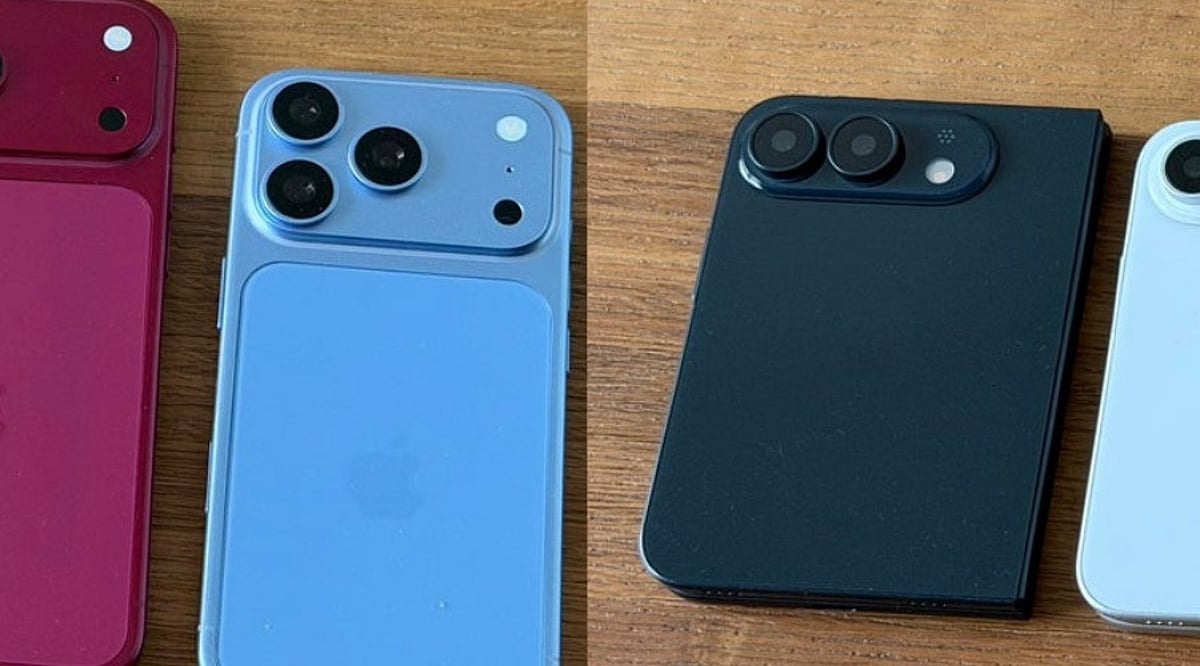
    The foldable iPhone Ultra (also speculated to be called iPhone Fold) represents Apple’s most radical hardware leap in years. When closed, it’s a compact 5.5-inch device; when opened, it reveals a spacious 7.8-inch inner display with a 4:3 aspect ratio, resembling a tablet. The book-style hinge is designed to minimize the crease, and the overall thickness is an incredible 4.5 mm when unfolded.

    To accommodate the thin profile, Apple reportedly swaps Face ID for Touch ID embedded in the power button. The device is expected to feature a titanium and aluminum frame, support MagSafe, and pack 12 GB of RAM with a battery ranging from 5,400 to 5,800 mAh. Performance-wise, it’s likely to use the same A20 Pro chip, ensuring flagship-level speed despite the compact chassis.

    However, camera specs may take a step back. Reports suggest a dual-camera setup (wide and ultra-wide) with no dedicated telephoto lens, which could disappoint photography purists who rely on optical zoom. The trade-off is a larger, more immersive display for media consumption and multitasking.

    Price: The Deciding Factor

    Price will likely be the biggest differentiator. The foldable iPhone Ultra is expected to start above $2,000, possibly reaching $2,500, making it significantly more expensive than the iPhone 18 Pro. Even if Apple increases Pro pricing due to rising component costs, the foldable will remain a premium luxury item.

    There’s also the inherent risk of a first-generation product. A new hinge mechanism, flexible display, and ultra-thin body introduce potential durability concerns that Apple will need to address. While the company has had years to refine the concept, early adopters may face unforeseen issues.

    Which One Should You Wait For?

    If you value camera quality, software maturity, and a lower price point, the iPhone 18 Pro is the pragmatic choice. It delivers proven performance with incremental upgrades that won’t break the bank. On the other hand, if you crave innovation, crave a larger screen, and are willing to pay a premium for Apple’s boldest experiment, the foldable iPhone Ultra is an exciting prospect.

    With the September 9 event just days away, the wise move is to wait for official announcements. The event will clarify pricing, exact specs, availability, and the final name. Until then, consider your priorities: do you need a reliable workhorse or a glimpse into the future of smartphones?

    FAQs

    When will Apple launch the iPhone 18 Pro and foldable iPhone?

    Current reports point to a September 9, 2026, announcement, with actual launch dates likely to follow shortly after.

    Will the foldable iPhone have better performance than the iPhone 18 Pro?

    Both models are expected to use the A20 Pro chip, so performance should be on par, though the foldable’s thinner design may affect thermal management.

    What are the display sizes for the foldable iPhone?

    Reports suggest a 5.5-inch outer display and a 7.8-inch inner display when unfolded.

    Will the foldable iPhone have a better camera than the iPhone 18 Pro?

    No. The foldable is expected to feature a dual-camera setup without a telephoto lens, while the Pro retains a more versatile camera system.

    Which phone is more suitable for everyday use?

    The iPhone 18 Pro offers a familiar design, reliable performance, and superior camera capabilities, making it the safer choice for daily use.

  • Who Regulates Tether (USDT)? A Global Guide to Stablecoin Oversight in 2026

    Who Regulates Tether (USDT)? A Global Guide to Stablecoin Oversight in 2026

    Tether’s USDT is the world’s largest stablecoin, with a market capitalization of $183.3 billion as of September 8, 2026. Yet no single regulator oversees USDT worldwide. Its treatment depends on the issuer, user location, distribution platform, and rules of each jurisdiction. CoinGecko data also showed daily USDT trading volume above $48.09 billion on September 8.

    Tether Is Regulated in El Salvador

    Tether has established significant operations in El Salvador, where the National Commission of Digital Assets (CNAD) regulates the country’s digital-asset market. CNAD lists USDT among the stablecoins authorized for trading, with its public-offering authorization dated May 19, 2025.

    Tether’s legal framework also identifies Tether International, S.A. de C.V. as operating under El Salvador’s digital-asset regime. However, authorization there does not automatically give USDT regulatory approval in other countries.

    United States Is Building a Different Framework

    The U.S. regulatory environment changed with the GENIUS Act. The Treasury said its expected effective date is January 18, 2027. From then on, a person generally cannot issue a payment stablecoin in the United States without an appropriate federal or state license.

    Treasury issued proposed implementation rules in August 2026. FinCEN and the Office of Foreign Assets Control have also proposed anti-money-laundering and sanctions-compliance requirements for permitted stablecoin issuers.

    Foreign-issued stablecoins face additional conditions, including requirements connected to compliance with lawful U.S. orders and recognition of comparable foreign regulatory regimes.

    Tether Created a Separate U.S. Stablecoin

    Tether launched USA₮ in January 2026 rather than making USDT its dedicated U.S.-regulated product. USA₮ is issued by Anchorage Digital Bank, N.A., a federally chartered bank supervised by the Office of the Comptroller of the Currency.

    Tether says USDT continues operating globally while progressing toward GENIUS Act compliance. USA₮ and USDT therefore remain separate products despite belonging to the broader Tether ecosystem.

    Europe Operates Under MiCA

    The European Union regulates crypto assets through Markets in Crypto-Assets (MiCA). The final transitional period for crypto-asset service providers expired on July 1, 2026, according to the European Securities and Markets Authority.

    After that date, firms serving EU customers generally need MiCA authorization. Whether a platform can offer USDT depends on the applicable MiCA requirements, the stablecoin’s status, and the platform’s own authorization.

    Why This Matters

    USDT’s regulatory status cannot be reduced to one regulator or license. Users need to consider the issuer, jurisdiction, and platform involved, as reserve, sanctions, licensing, and availability requirements can differ substantially across markets.

    Final Thoughts

    USDT remains a globally used stablecoin, but oversight is increasingly jurisdiction-specific. El Salvador authorizes USDT, while the U.S. and EU are applying separate frameworks. As stablecoin rules mature, regulatory compliance will increasingly determine where and how USDT can be offered.

    Also Read: How Long Does USDT Take to Transfer? TRC20 vs ERC20 Transfer Times, Fees

    FAQs

    1. Who regulates Tether USDT?
      There is no single regulator responsible for USDT worldwide. Oversight depends on where Tether operates, where USDT is offered, and the regulatory framework of each jurisdiction.
    2. Is USDT regulated in El Salvador?
      Yes. El Salvador’s National Commission of Digital Assets (CNAD) lists USDT among the stablecoins authorized for trading under the country’s digital-asset framework.
    3. How will the GENIUS Act affect USDT in the United States?
      The GENIUS Act introduces federal and state licensing requirements for payment stablecoin issuers. Foreign-issued stablecoins also face conditions involving lawful orders, sanctions compliance, and recognition of comparable regulatory regimes.
    4. What is the difference between USDT and USA₮?
      USDT is Tether’s globally used stablecoin, while USA₮ is a separate product launched for the U.S. market. USA₮ is issued by Anchorage Digital Bank under U.S. federal oversight.
    5. How does MiCA affect USDT in Europe?
      MiCA sets licensing, reserve, governance, and compliance requirements for crypto-asset firms serving EU customers. Whether platforms can offer USDT depends on MiCA rules, the token’s status, and each platform’s authorization.
  • Top 5 Meme Coins to Watch in 2026: Apeing Presale Offers 9,900% ROI Potential Before Early Entry Closes

    Top 5 Meme Coins to Watch in 2026: Apeing Presale Offers 9,900% ROI Potential Before Early Entry Closes

    The meme coin market is shifting focus from established names like Shiba Inu, Pepe, Floki, and Dogecoin toward a new generation of contenders with earlier entry points. Among them, Apeing is generating buzz with its live presale—Stage 1, Banana Drop—offering tokens at $0.0001 and a potential ROI of 9,900%. Here’s a look at five meme coins that could deliver 1000x returns, with Apeing leading the charge.

    1. Apeing: The New Contender with a 9,900% ROI Potential

    Apeing is a community-focused meme coin launching through its first presale phase, Banana Drop. Stage 1 allocates 150,000,000 $APEING tokens at $0.0001, with a target listing price of $0.01. The project’s referral system rewards buyers with 10% extra tokens and code owners with 10% of referred spending. Monthly leaderboard prizes add to the incentive. Early participants can also access staking-related APY opportunities. With limited allocation, timing is critical for those eyeing the next 1000x meme coin.

    How to Join the Apeing Presale

    Visit the official Apeing website, create an account, complete registration, connect a payment method, select your $APEING allocation, and purchase. Benefits include early-stage access, referral rewards, staking APY, and limited Stage 1 tokens.

    2. Shiba Inu: The Established Meme Coin with Staying Power

    Shiba Inu has evolved from a meme token into a recognized crypto brand with a large community and ecosystem. Its longevity makes it a benchmark for emerging meme coins. While newer projects seek attention, SHIB’s established recognition and decentralized applications keep it relevant.

    3. Pepe: The Frog-Themed Token with Cultural Traction

    Pepe leveraged internet meme culture to become a major meme coin. Its identity is rooted in social narratives, making sentiment a key driver. Pepe’s rise demonstrates how quickly a recognizable meme can gain global crypto attention, and it remains a strong community-driven name.

    4. Floki: From Meme to Ecosystem

    Floki started with meme branding but expanded into a broader ecosystem with community and utility initiatives. Its evolution shows how projects can balance meme appeal with long-term growth. Floki’s visibility makes it a useful comparison for newer tokens.

    5. Dogecoin: The Original Meme Coin That Started a Movement

    Dogecoin remains a foundational meme coin with immense community recognition. Its staying power—despite being created as a joke—has influenced countless tokens. DOGE serves as a reference point for the entire meme coin category.

    Conclusion: Early Entry Matters in the Next Meme Coin Wave

    While established coins like Shiba Inu, Pepe, Floki, and Dogecoin demonstrate community power, the next 1000x opportunity often lies in early-stage projects. Apeing’s Banana Drop presale is live now, offering a limited early allocation. For those tracking the next big meme coin, timing is key.

    FAQs

    What is the next 1000x meme coin? It refers to emerging meme assets with high growth potential. Apeing currently fits this narrative with its live presale.

    How do you find the next 1000x meme coin? Look at launch timing, community engagement, token distribution, and ecosystem plans. Apeing combines early presale with referral and APY rewards.

    Is Apeing presale live now? Yes, Stage 1 Banana Drop is live at $0.0001 with 150,000,000 $APEING allocated.

    What rewards does Apeing’s referral system offer? Referred buyers get 10% extra tokens; code owners earn 10% of referred spending. Monthly leaderboard prizes are also available.

    Disclaimer: This article is for informational purposes only and does not constitute investment advice. Cryptocurrencies are risky; conduct your own research before investing.

  • How Nithin Kamath Leveraged Tech to Make Investing Accessible for Millions of Indians

    How Nithin Kamath Leveraged Tech to Make Investing Accessible for Millions of Indians

    Investing in stocks was once a complex, intimidating process reserved for the wealthy. High broker fees, mountains of paperwork, and a general fear of the unknown kept most middle-class families away from equities for decades. That picture has changed dramatically over the last fifteen years, and much of the credit goes to Nithin Kamath, co-founder and CEO of Zerodha. He built India’s largest stock brokerage on a simple idea: technology should remove barriers to investing, not create new ones.

    Today, Zerodha serves more than 1.6 crore customers and accounts for close to 15 percent of daily retail trading volumes in the country. This article explores how Kamath used technology to reshape investing for ordinary Indians and why his approach continues to matter.

    A Discount Broker Built on Technology, Not Middlemen

    Kamath started as a self-taught trader, buying his first penny stocks at age 17. Working through the early 2000s, he saw how traditional brokers charged hefty commissions and often had little incentive to help small investors succeed. In 2010, along with his brother Nikhil, he launched Zerodha. The name combines “zero” with “rodha,” the Sanskrit word for barrier. Instead of charging a percentage of every trade, Zerodha introduced a flat-fee model—a move almost unheard of in Indian broking at the time. Building the entire back-end in-house gave the company control over speed, reliability, and cost, three things that mattered enormously to retail traders tired of clunky platforms and hidden charges.

    Kite: Simplifying the Trading Experience for Millions

    Zerodha’s trading platform, Kite, became one of the clearest examples of Kamath’s technology-first thinking. Built to be lightweight and fast, Kite stripped away the clutter that made older trading terminals intimidating for first-time users. A student or shopkeeper with no finance background could open the app, place an order, and track a portfolio without needing a broker on the phone. This ease of use drove Zerodha’s rapid customer growth, especially during the pandemic when lakhs of young Indians opened their first demat account from home. Data from the past year shows demat account additions rose by over 20 percent, taking the industry total past 4.9 crore accounts, and platforms like Kite played a direct role in that surge.

    Varsity and Rainmatter: Investing in Financial Literacy

    Technology alone does not make confident investors. Kamath understood this early and built Varsity, a free educational platform that breaks down everything from stock market basics to advanced options strategies. Millions of users have gone through its modules, many stepping into the market for the first time with a clearer understanding of risk. Alongside Varsity, Zerodha runs Rainmatter, a fintech incubator and fund that backs startups working on financial inclusion, wealth management tools, and sustainability projects. Rainmatter has supported more than 50 startups, extending Kamath’s mission of democratizing finance well beyond Zerodha’s own platform.

    A Bootstrapped Model That Puts Users First

    One thing that sets Kamath apart from most tech founders is his refusal to raise external funding. Zerodha has remained completely bootstrapped since day one, funding its own growth through profits rather than venture capital. This decision keeps the company answerable to its customers rather than to investors chasing quick returns. Kamath has spoken openly about staying cautious on an IPO too, preferring independence over the pressure of public markets. This model has not been without bumps—regulatory changes around derivatives trading led to a sharp drop in brokerage revenue—yet Zerodha continues to expand into asset management and lending to diversify its income.

    Why This Approach Matters for India’s Financial Future

    India’s investing culture is still young compared to more developed markets, and a large part of the population remains outside formal financial systems. Kamath’s work tackles two problems at once: cost and confidence. Lower fees bring more people to the table, and better education keeps them there without falling into risky bets they don’t understand. As a member of a SEBI advisory committee, Kamath has also shaped market policy, pushing for reforms that protect smaller investors. His influence extends into how an entire generation of Indians thinks about money, savings, and long-term wealth creation.

    Final Thoughts

    Nithin Kamath’s journey from a self-taught trader to the head of India’s biggest brokerage reflects a larger shift in how the country approaches investing. Through low-cost trading, an accessible platform in Kite, free education through Varsity, and continued investment in fintech innovation via Rainmatter, he has helped bring capital markets within reach of everyday Indians. As more people in smaller towns and cities come online, Kamath’s technology-driven model looks set to keep shaping the next chapter of India’s investing story.

    Frequently Asked Questions

    1. What is Zerodha known for?

    Zerodha is India’s largest stock brokerage, known for pioneering the flat-fee discount brokerage model and building its own technology in-house rather than relying on third-party platforms.

    2. What is Kite in Zerodha?

    Kite is Zerodha’s trading platform, designed to be simple and fast so that even first-time investors with no finance background can trade and track their portfolios easily.

    3. What is Varsity by Zerodha?

    Varsity is a free educational platform by Zerodha that teaches users about the stock market, from basic concepts to advanced options strategies.

    4. Why has Zerodha never raised external funding?

    Nithin Kamath chose to keep Zerodha bootstrapped so the company stays accountable to its customers rather than to investors seeking quick returns.

    5. What is Rainmatter?

    Rainmatter is Zerodha’s fintech incubator and fund, which has backed over 50 startups working on financial inclusion, wealth management, and sustainability.

  • Apple Watch Series 12 Rumors: All-Day Heart Rate, Ceramic Option, and More Health Upgrades

    Apple Watch Series 12 Rumors: All-Day Heart Rate, Ceramic Option, and More Health Upgrades

    Apple’s upcoming Watch Series 12 could bring major health upgrades, including all-day heart-rate monitoring and improved hypertension alerts, while retaining a familiar design and adding a premium ceramic finish. The device is expected to debut at Apple’s September 9, 2026 event alongside the Apple Watch Ultra 4.

    Familiar Design with a Premium Touch

    According to reports from Bloomberg and MacRumors, the Series 12 will keep the classic Apple Watch shape rather than undergo a full redesign. Apple has reportedly tested ceramic cases in white and dark gray, last seen on the Series 5 in 2019. The ceramic version could command a significantly higher price, potentially starting around $1,299 as the previous ceramic Edition model did.

    New Chip Boosts Performance and AI Capabilities

    After the Series 11 retained the S10 chip, the Series 12 is expected to feature a new S-class processor, possibly named S11 or S12 and linked to the T8320 architecture. This upgrade should deliver faster app response, better energy efficiency, and stronger support for Apple Intelligence features, including Siri AI enhancements in watchOS 27.

    Always-On Heart Rate: A Game Changer for Health Tracking

    Bloomberg’s Mark Gurman reports that Apple has tested a system capable of collecting heart-rate data continuously throughout the day. Current models only take readings at intervals outside dedicated apps like Heart Rate, Mindfulness, and Workout. A constant stream of data could enable deeper insights into daily health patterns, recovery metrics, and resting heart rate trends, bringing Apple closer to dedicated fitness trackers like WHOOP.

    Enhanced Hypertension Notifications

    Apple may also refine its hypertension alert system. Reports indicate the FDA has reviewed an upgrade for Series 12 that uses sensor data and health trends to flag potential high blood pressure signs—without functioning as a traditional cuff. This builds on existing features for hypertension and sleep apnea, offering more actionable context.

    Clearer Health and Fitness Dashboard

    A redesigned Health and Fitness experience is rumored, with a new dashboard that consolidates wellness data in a single, intuitive view. The focus would shift from isolated readings to long-term patterns in heart rate, activity, sleep, and more, making health data more accessible and useful.

    What’s Not Coming: Blood Glucose and Touch ID

    Blood glucose monitoring remains a long-term goal, but Series 12 is not expected to include it; reports point to a timeline around 2030. Touch ID on the watch is also unlikely for this generation, and a major case redesign may wait for a later model.

    Pricing and Availability

    The standard Series 12 is expected to launch at $399 to $449, similar to the Series 11. A ceramic edition would cost much more. Apple will confirm details on September 9, 2026. The event should also reveal specifics on the chip, health sensors, battery life, and release date.

    Series 12 looks set to be a health-focused upgrade rather than a design revolution. With a faster chip, constant heart-rate tracking, better hypertension alerts, and a clearer wellness dashboard, it could strengthen Apple’s role in daily health management.

  • Fed Rate Hike Fears Trigger Sell-Off in Indian IT Stocks: TCS, Infosys, HCLTech Under Pressure

    Fed Rate Hike Fears Trigger Sell-Off in Indian IT Stocks: TCS, Infosys, HCLTech Under Pressure

    Indian IT stocks experienced a sharp decline on September 7 as stronger-than-expected US jobs data reignited concerns about further Federal Reserve interest rate hikes. The Nifty IT index dropped 2.28% to close at 29,995.20, falling 699.90 points from its previous close of 30,695.10. The index hit a high of 30,377.10 and a low of 29,847.25 during the session, now sitting about 25.6% below its 52-week high of 40,301.40.

    Top IT Stocks Take a Hit

    Among the major players, Infosys suffered the steepest decline, losing 3.76% to close at Rs. 1,087.50. TCS fell 1.48% to Rs. 2,270, while HCLTech slipped 0.82% to Rs. 1,282.80. The broader IT sector also faced pressure, with Tech Mahindra, Wipro, LTIMindtree, Mphasis, and other key names declining.

    Strong US Jobs Data Revives Rate-Hike Fears

    The trigger was the US jobs report for August, which showed the economy added 162,000 jobs—far exceeding the market expectation of around 56,000. The unemployment rate held steady at 4.1%. The robust data bolstered the view that the US economy remains strong enough for the Federal Reserve to maintain higher rates or even raise them again.

    Markets now price a 58% chance of a rate hike at the September 16 Fed meeting, with the probability for an October move reaching about 70%, according to data from Reuters and Moneycontrol. The next major test will be the US August inflation report, due on Friday.

    How Higher US Rates Impact Indian IT Firms

    The US is the largest market for Indian IT companies. Higher interest rates increase borrowing costs for American corporations, making them more cautious with technology budgets. This can lead to delays or cancellations of large-scale projects, especially discretionary ones that don’t require immediate action.

    Two Pressure Points

    • Demand pressure: Higher borrowing costs may prompt US clients to postpone software upgrades, digital initiatives, and consulting engagements.
    • Valuation pressure: Rising US bond yields reduce the present value of future earnings, putting additional strain on technology stocks.

    This sell-off reflects more than a knee-jerk reaction to a single jobs report. Investors are now confronting a tougher policy backdrop while Indian IT companies already face headwinds from weak demand, artificial intelligence disruption, and slower growth.

    Infosys Leads the Decline

    Infosys was the hardest hit among the three largest IT firms, closing 3.76% lower at Rs. 1,087.50. The stock is now roughly 37% below its 52-week high of Rs. 1,727.85. TCS showed relative resilience with a 1.48% drop, and HCLTech fared best with a 0.82% decline. However, HCLTech also remains well below its 52-week peak of Rs. 1,780.10.

    These moves indicate that while the sector-wide pressure is visible, individual stocks have reacted differently. The overarching concern remains US demand, interest rate trajectory, and the future of technology spending.

    AI Adds Another Layer of Uncertainty

    Beyond central bank policy, artificial intelligence continues to weigh on the sector. Investors are debating whether AI will drive additional technology demand or reduce the need for traditional IT services. AI can cut the time and cost for coding, testing, support, and other software tasks. At the same time, companies require external partners for AI deployment, system integration, governance, and modernization.

    This creates both a risk and an opportunity for firms like TCS, Infosys, and HCLTech. The market now seeks evidence that AI-led demand can offset pressures on legacy service models. Deal wins, client budgets, margins, and management guidance will be critical for the next phase of the IT sector.

    September Fed Meeting in Focus

    The upcoming Federal Reserve meeting is the most significant near-term event for Indian IT stocks. UBS has revised its forecast and now expects two 25-basis-point rate hikes in 2026—one in September and another in December—reversing its earlier view of no change this year.

    A softer US inflation report could ease rate-hike fears and trigger a relief rally. Conversely, a hot inflation reading could push bond yields higher and intensify selling pressure.

    The sharp decline on September 7 marks a critical test for TCS, Infosys, and HCLTech. The next move will likely depend more on US inflation data and the Fed’s decision than on the single-day sell-off.

    FAQs

    1. Why did Indian IT stocks fall on September 7?

    Indian IT stocks declined after strong US jobs data revived fears of additional Federal Reserve rate hikes.

    2. Which major IT stock fell the most?

    Infosys recorded the sharpest drop among TCS, Infosys, and HCLTech, falling 3.76% to Rs. 1,087.50.

    3. How do higher US interest rates affect Indian IT companies?

    Higher rates can encourage US companies to tighten spending and delay discretionary technology projects, potentially reducing demand for IT services.

    4. What additional risk is affecting Indian IT stocks?

    Artificial intelligence is creating uncertainty over traditional IT services while also opening opportunities in AI implementation, integration, and modernization.

    5. What should investors watch next?

    The US inflation report and the Federal Reserve’s September policy decision are key near-term triggers for IT stocks.

  • 10 Workforce Priorities for Chief People Officers in the AI Era: A 2027 Checklist

    10 Workforce Priorities for Chief People Officers in the AI Era: A 2027 Checklist

    Key Takeaways

    • Redesign before reducing: Break jobs into tasks and determine where AI and human judgment create the most value.
    • Make skills strategic: Build AI capabilities around business needs, career mobility, and rapidly changing skill requirements.
    • Measure outcomes, not activity: Evaluate AI through work quality, productivity, employee trust and measurable business results.

    For a Chief People Officer, AI is no longer a simple technology choice. The harder task is to decide how work, skills, jobs, pay, leadership, and trust must change. The World Economic Forum’s May 2026 Chief People Officers’ Outlook names three core priorities: job and structure redesign, skill development, and responsible AI and automation.

    1. Build AI Skills Across the Workforce

    AI literacy must move beyond specialists. Roles need clear AI skill levels, from basic use to advanced expertise. PwC’s 2026 AI Jobs Barometer found that skills in the most AI-exposed jobs change more than twice as fast as skills in the least exposed jobs. AI-skill jobs grow 69% faster than the wider market at 9%, while the average pay premium has reached 62%.

    2. Redesign Jobs Before Headcount Cuts

    AI can change a job without role loss. A Chief People Officer should split each role into tasks and assign AI, human judgment, or both. Gartner found that only 1% of layoffs in the first half of 2025 came from AI gains in employee productivity. Job redesign should come before broad cuts.

    3. Make Skills the Core Talent Currency

    Job titles cannot show full value in a fast AI market. A skills map can show rare skills, gaps and future needs. The World Economic Forum reports that 39% of current worker skills may change or become outdated by 2030. A skills-based model can support recruitment, internal moves and faster access to key talent.

    4. Link Skill Development to Business Need

    Skill programs should connect to needs such as AI product work, data analysis, sales quality or client service. The real test is faster skill growth, better role fit and clear business value. A course count alone cannot show whether a people strategy has helped the business. Clear links between skills and business needs offer a stronger measure.

    5. Measure AI by Work Quality and Value

    AI use alone does not prove better performance. Gartner warns about ‘workslop,’ or fast but poor-quality AI output. Measures should cover effort saved, work quality, customer value and useful output. Performance systems must reward judgement, accuracy, creativity and results rather than raw AI activity.

    6. Put Responsible AI Inside the People Function

    HR needs a direct role in AI rules. Recruitment, pay, performance reviews, promotion, employee data and workforce analytics can all involve AI risk. Clear rules should define human review, data use, bias checks and employee notice. Responsible AI should sit close to HR, not only legal or technology teams.

    7. Protect Trust and Employee Health

    AI can create fear when staff lack clear answers about job security, data use and performance checks. A strong people plan needs plain rules and open channels for staff concerns. Gartner has flagged employee mental fitness as a future-of-work issue. The goal should be better work, lower strain and stronger human contact.

    8. Prepare Leaders for Human-AI Teams

    Managers need new skills. They must judge AI output, set limits and decide where human judgment matters most. PwC found that AI-exposed entry-level US roles are seven times more likely to ask for senior skills such as leadership and judgment. Early-career staff may need faster access to real decisions.

    9. Rebuild Recruitment Around Skills and Proof

    Gartner reports that 22% of CHROs said at least one business leader had stopped entry-level recruitment in some area and cited AI automation as the reason. The same survey found that 95% of organizations had some AI use, while only one in five had achieved significant or transformational value. Skills tests and work samples can help judge real ability.

    10. Make Workforce Value a CPO Measure

    This priority links people work to business results. PwC found that the most AI-exposed companies had 34% productivity growth in 2025 versus 24% for the least exposed firms, relative to 2018. The top 20% reached 163% labor productivity growth. Headcount growth stood at 52% versus 36%, while wage growth reached 24% versus 17%. AI success can mean stronger skills, better output and faster growth.

    The CPO Mandate for 2027

    The CPO agenda starts with work, not software. AI changes task value, skill demand, career paths and workforce economics at the same time. McKinsey’s 2026 HR Monitor found gaps between short-term capacity plans and long-term capability plans, staff expectations and company responses, and AI pilots and scaled value. The CPO role needs a direct line from skill strategy to business results. The test for an AI-era workforce is better work, stronger talent and measurable value.

    FAQs

    1. What are the top workforce priorities for CPOs in 2027?

    AI skills, job redesign, skills-based talent management, responsible AI, leadership development and measurable workforce value are among the core priorities.

    2. Why should companies redesign jobs before cutting headcount?

    AI can automate individual tasks while increasing the value of human judgment, creativity and relationship-based work. Redesign can capture these gains before considering broad reductions.

    3. How should companies measure AI’s impact on employees?

    Look beyond AI adoption rates. Measure productivity, work quality, customer value, skill growth, employee experience and business outcomes.

    4. What role should HR play in responsible AI?

    HR should help establish rules for AI in hiring, pay, performance, promotion, employee data and workforce analytics, including human oversight and bias controls.

    5. How can CPOs prepare leaders for human-AI teams?

    Managers need to evaluate AI output, define appropriate boundaries, identify where human judgment is essential and help employees develop higher-value skills.

  • Indian Stock Market Opens Lower: Nifty 50 Drops 0.48%, Sensex Falls 361 Points

    Indian Stock Market Opens Lower: Nifty 50 Drops 0.48%, Sensex Falls 361 Points

    The Indian stock market opened lower amid mixed global trends. The Nifty 50 was down 113.05 points or 0.48% at the open to 23,522.05, while Bank Nifty started 278.7 points below the prior close. Sensex fell 361.36 points to 75,216.22.

    The broader market outperformed, with the Nifty Midcap and Smallcap indices ending marginally higher. The Indian rupee opened marginally lower at Rs. 94.87 per dollar on Wednesday against Tuesday’s close of Rs. 94.82.

    Foreign institutional investors turned net sellers on Tuesday, offloading Rs. 123 crore of Indian equities, while domestic institutional investors bought a net Rs. 1,350 crore, according to NSE data.

    Sensex Outlook

    Technically, the Sensex formed a bearish candle on the daily chart and is holding a lower top formation, which is largely negative.

    “For day traders, 75,800 would act as an immediate resistance zone. Below this, a weak formation is likely to continue. On the downside, the market could retest the levels of 75,200-75,000. On the flip side, if the index closes above 75,800, the pullback could extend till 76,000-76,300,” said Shrikant Chouhan, Head, Equity Research, Kotak Securities.

    Nifty 50 Outlook

    The Nifty 50 formed its second consecutive bearish candle on the daily chart, indicating that the ongoing corrective trend remains intact. The Nifty 50 has now moved close to its July 2026 low of around 23,606, making the current support zone particularly important for traders and investors.

    The index has approached a crucial support area between 23,600 and 23,500. A failure to hold above this range could result in a further decline towards 23,300 in the coming weeks. On the upside, any recovery attempt may face significant resistance around the 24,000-24,050 zone.

    “Pullback attempts from the current oversold territory will face stiff resistance around 24,000-24,050 levels, being the recent breakdown area and 20-day EMA. The support area is likely to reverse its role and act as resistance in the short term,” said Pabitro Mukherjee, Deputy Vice President-Research, Bajaj Broking.

    Bank Nifty Outlook

    Bank Nifty formed a bearish candle with a lower high and lower low, which suggests that the corrective decline in the banking index is continuing. The index closed below the immediate support level of 57,000, which has now become an important level to watch. If Bank Nifty remains below 57,000, the decline could extend towards the 56,500-56,200 range. This zone is considered an important short-term support area as it represents the confluence of the 52-week EMA and the lower band of the index’s nine-week trading range.

    “Immediate bias in the index continues to remain down, and only a formation of higher highs and higher lows on a sustained basis in the daily chart will signal a pause in the downtrend. A move above 57,000 will lead to consolidation in the range of 57,000-58,000,” said Pabitro Mukherjee, Deputy Vice President-Research, Bajaj Broking.

    Disclaimer: Analytics Insight does not provide financial advice or guidance on cryptocurrencies and stocks. This article is provided for informational purposes and does not constitute investment advice. Readers are responsible for conducting their own research before making any investments.

  • 7 Cryptos to Watch for 100x Potential as Apeing Presale Opens at $0.0001

    7 Cryptos to Watch for 100x Potential as Apeing Presale Opens at $0.0001

    The cryptocurrency market is abuzz with activity as Bitcoin hovers near $79,000 and several altcoins show strong momentum. Among the new projects generating significant interest is Apeing, a meme coin that just launched its presale at a stage-1 price of $0.0001. Early investors are eyeing the potential for 100x gains as the presale progresses through structured stages toward a listing price of $0.01. This article explores seven cryptocurrencies to watch, including Apeing, Sui, Monero, Polkadot, Hyperliquid, Hedera, Cronos, and BNB.

    Apeing Presale: Early Entry at a Bargain Price

    Apeing (APEING) is an Ethereum-based ERC-20 token with a fixed supply of 16.75 billion tokens. Its presale, called the Banana Drop, is currently in Stage 1 with 150 million tokens available at $0.0001 each. The price will increase in later stages, and the planned listing price is $0.01. An 18-month liquidity lock adds credibility to the project. For a $1,000 investment at the current stage, an investor would receive 10 million tokens, which could be worth $100,000 at the listing price. However, investors should conduct their own research and verify information through the official Apeing website and social channels.

    Other Cryptos to Watch

    Sui (SUI)

    Sui is a layer-1 blockchain designed for scalability, supporting DeFi and gaming applications. Currently trading around $0.82 with a market cap above $3.3 billion, SUI is gaining attention for its technical infrastructure and recent price action.

    Monero (XMR)

    Monero remains a top privacy-focused cryptocurrency, using the RandomX proof-of-work algorithm. Trading near $527, XMR has seen renewed interest following a technical breakout, though regulatory factors remain relevant.

    Polkadot (DOT)

    Polkadot focuses on blockchain interoperability through its nominated proof-of-stake system. DOT is around $1.02, with recent gains tied to short-squeeze dynamics and increased trading volume.

    Hyperliquid (HYPE)

    Hyperliquid offers a fully on-chain order book for decentralized derivatives trading. HYPE trades near $88 and recently hit an all-time high of $89.57, driven by token burns and institutional interest.

    Hedera (HBAR)

    Hedera uses a hashgraph architecture for enterprise-grade distributed ledger services. HBAR is around $0.0825, with recent developments in tokenization and partnerships.

    Cronos (CRO)

    Cronos is an EVM-compatible layer-1 blockchain built on Cosmos SDK. CRO trades near $0.0577 and serves as the native token for gas and governance. Recent news includes a security incident on the Tectonic protocol, highlighting the importance of network security.

    BNB

    BNB remains a cornerstone of the BNB Chain ecosystem, currently near $744 with a market cap approaching $100 billion. Recent gains of about 7% weekly reflect growing activity in tokenized equity markets.

    Conclusion

    While established cryptos like Sui, Monero, Polkadot, Hyperliquid, Hedera, Cronos, and BNB each represent unique sectors, Apeing stands out for its early presale opportunity. The current stage-1 price of $0.0001 and a clear pricing progression make it a project worth researching. As always, potential investors should verify details through official sources and exercise caution.

  • Liquid Network Recovers 3,400 BTC After Weekend Exploit — 600 BTC Still Unaccounted For

    Liquid Network Recovers 3,400 BTC After Weekend Exploit — 600 BTC Still Unaccounted For

    Liquid Network recovered 3,400 BTC (worth approximately $268 million) on Monday after a weekend exploit drained nearly 4,000 BTC from its reserves. However, about 600 BTC, representing 15% of the stolen amount, remains under the attacker’s control. L-BTC deposits and withdrawals remain suspended as operators work toward a safe restart.

    Elements Bug Allowed Unbacked L-BTC Creation

    Liquid disclosed the attack on September 6, confirming that stolen private keys were not the cause. SideSwap also stated its systems were not breached during the incident. Instead, the vulnerability originated from Elements, the Bitcoin Core fork that powers Liquid. A range-proof verification cache bug apparently allowed the creation of L-BTC without matching Bitcoin backing. The attacker then used those unbacked tokens to obtain real BTC through Liquid’s normal peg-out process. Liquid took its federation wallet and bridge nodes offline after detecting the abnormal withdrawals.

    Hacker Returns Most Funds After Patch

    The self-described white-hat hacker pledged to return most funds after Blockstream fixed the underlying software flaw. In messages to Blockstream, the party requested that patches be deployed across every node before returning Bitcoin. Blockstream later confirmed its bridge nodes had received the patch and could safely accept the funds. Onchain data then showed 3,400 BTC moving back to the Liquid Federation wallet. Approximately 598.5 BTC remains under the actor’s control, with no public agreement explaining whether those coins represent a bounty or a planned further return.

    Ledger Chief Technology Officer Charles Guillemet questioned the white-hat label after the partial repayment, stating that keeping roughly 600 BTC did not fit a genuine bug-bounty arrangement and described it as closer to extortion. The return removed most of the immediate reserve shortfall but did not restore normal Liquid operations. The network still needs to verify backing and complete software deployment before reopening its bridge.

    Liquid Keeps Peg Services Paused

    Liquid has not resumed normal operations while its operators prepare a safe restart. L-BTC deposits and withdrawals remain halted, affecting related services at centralized exchanges. Meanwhile, Bitcoin’s main network continues operating without disruption. The exploit also left other Liquid-issued assets untouched, including USDT, Depix, and real-world assets. Liquid wallets such as Aqua face disruption only across their Liquid functions; users can access unaffected Bitcoin network services while Liquid peg activity remains unavailable.

    Before reopening the bridge, operators need to restore one-to-one backing for legitimate L-BTC, distribute the patched Elements release across the network, and verify safe bridge operation. Liquid has not explained how it will cover any remaining gap in L-BTC backing, nor has it published a timeline for restoring the sidechain and its peg services.