Category: Career Advice

  • How Showing Up Scared Helped Jeffrey Zang Forge a Path from Hackathons to Startup Founder

    How Showing Up Scared Helped Jeffrey Zang Forge a Path from Hackathons to Startup Founder

    Jeffrey Zang almost didn’t attend the hackathon that would change his life. As a high school student, the thought of sleeping away from home nearly kept him from JAMHacks 6, one of Canada’s largest high school hackathons. But he went anyway, and those 48 hours transformed his view of programming from a casual interest into a lifelong calling.

    “I almost stayed home,” Zang said. “That is the part I think about now. The thing I was afraid to do became the thing that made me want to build for the rest of my life.”

    The First Spark

    Zang’s journey began in Grade 5 when a teacher introduced his class to Scratch during math. The colorful blocks showed him that instructions could create something that moved and responded. In Grade 6, his father taught him Python, and Zang started building simple terminal games. He was never a passive learner—he preferred to install, break, and troubleshoot on his own.

    “I have never been great at learning by watching someone else do every step,” he said. “I learn faster when I am inside the problem. I want to touch it, mess it up, and understand why it failed.”

    From Hackathons to Internships

    After JAMHacks, Zang dove into web development, landed his first internship at 15, completed four software internships before turning 19, and participated in about 17 hackathons while helping organize six. He became the youngest co-chair of Hack the 6ix, Toronto’s largest hackathon, scaling it to over 1,100 attendees and raising more than $50,000 in sponsorships from companies like Microsoft, Deloitte, Warp, and Linear.

    Being young often meant facing skepticism. Companies hesitated, sponsors questioned his place in the room. But Zang persisted.

    “Being young made some people discount me,” he said. “Eventually I started thinking, okay, if I do the work anyway, then the age becomes part of the proof.”

    His proof grew: named an MLH Top 50 honoree (second-youngest ever), winner of Hack the North with EcoRewards, builder of a 3D-printed conversational robot called Realistic Obama that drew over 150,000 social views, and creator of motus—an eye-tracking wheelchair control system built in 24 hours.

    Learning Through Failure

    Success didn’t come without hard lessons. During his first internship at uxSino, Zang struggled with Linux and Java. He failed five operating system installs and went days without solving a single ticket.

    “I remember feeling completely useless,” he said. “It was not one clean failure. It was waking up, trying again, and still not getting anywhere.”

    That experience taught him that failure becomes less frightening after enduring enough versions of it. He saw the same pattern while organizing ClockHacks: two weeks before the event, the budget was only $50. Three days before, it reached $700. The team pushed through.

    “That is the part people do not see,” Zang said. “A project can look dead for a while before it works. You learn to keep pushing when the evidence is not comforting yet.”

    Building Proletic

    Now at the University of Waterloo (4.0 GPA), Zang is building Proletic, a company aimed at easing the daily grind of computer work. Earlier ventures include Opus, a computer-use agent launched in three days that reached 500+ beta users, and an internal AI assistant at Nokia adopted by 200+ employees.

    “Shipping changes the question,” Zang said. “Before you ship, you are guessing. After you ship, users start telling you what is real.”

    For Zang, the most important lesson is commitment. He believes many things are buildable with one to three months of focus—the harder skill is choosing the thing and not drifting away.

    Paying It Forward

    Zang’s story comes back to the same message: starting young doesn’t mean starting unready. Rough first attempts count. And sometimes the decision that changes everything is not a confident leap, but showing up anyway.

    “I found my way because other people created a place where I could show up,” Zang said. “I want to keep doing that for the next person who is scared to go, or thinks they do not belong yet.”


  • Wipro Seeks Azure Data Engineer with Databricks, SQL, and PySpark Expertise

    Wipro Seeks Azure Data Engineer with Databricks, SQL, and PySpark Expertise

    Wipro, a global leader in IT consulting and business process services, is hiring an Azure Data Engineer skilled in Databricks, SQL, and PySpark. The role is based in major Indian cities including Bengaluru, Hyderabad, Chennai, Mumbai, and Pune. The ideal candidate will design scalable data systems, resolve technical challenges, and enhance operational support within active data engineering teams.

    Key Responsibilities

    • Oversee daily team performance by reviewing transactions and process quality parameters.
    • Provide technical guidance to production specialists and continuously improve process efficiency.
    • Document client queries, resolutions, and troubleshooting steps systematically.
    • Handle technical escalations with effective diagnosis and resolution within defined SLA timelines.
    • Conduct training sessions to close skill gaps and boost technical capabilities.

    Essential Qualifications

    • Bachelor’s degree in Computer Science or a related field.
    • Extensive Azure Data Engineering experience with Databricks and PySpark.
    • Strong SQL proficiency for data querying, transformation, and database management.
    • Proven ability to troubleshoot data pipelines and resolve production issues.
    • Experience in enterprise environments with SLA-based delivery models and client support.

    Preferred Skills

    • At least 2 years of experience with cloud-based data platforms and distributed processing frameworks.
    • Strong analytical and problem-solving abilities for complex data engineering challenges.
    • Mentoring and training skills to instruct team members on technical topics.
    • Familiarity with performance monitoring dashboards and reporting tools.
    • Excellent communication skills for client interaction and cross-team collaboration.

    Location: Bengaluru, Hyderabad, Chennai, Mumbai, Pune
    Experience: 5–8 years
    Job Type: Full-time
    Apply: Submit your application.

  • SAP Seeks Fullstack Developer: Java, Spring Boot, Angular/React, and Microservices Role in Bangalore

    SAP Seeks Fullstack Developer: Java, Spring Boot, Angular/React, and Microservices Role in Bangalore

    Job Overview

    SAP is looking for a Fullstack Developer to build software for SAP Ariba supply chain management solutions. The role requires creating enterprise applications that scale using Java programming and modern user interface development tools. Engineers will work within an Agile Scrum framework to deliver high-quality software, resolve operational issues, and develop new cloud-based commerce system features for international customers.

    Key Details

    • Location: Bangalore, India
    • Gender: Both
    • Qualification: BE/B.Tech/M.Tech/MCA (Full-time)
    • Experience: 6+ years required
    • Job Type: Full Time
    • Apply: Apply Now

    Main Duties

    • Design and develop scalable, maintainable fullstack applications using modern frameworks efficiently.
    • Work within Agile Scrum teams delivering features aligned with sprint timelines consistently.
    • Own features end-to-end and resolve cloud production issues until final resolution.
    • Build and integrate REST APIs and microservices for scalable enterprise system architecture.
    • Contribute to innovation initiatives improving product quality, performance, and development efficiency continuously.

    Essential Qualifications

    • Extensive expertise in fundamental Java programming and enterprise web application development.
    • Practical knowledge of Spring Boot microservices and modern open-source framework implementations.
    • Proficiency in using JUnit, Protractor, and Karma testing tools to assess application performance.
    • Expertise in ORM technologies including JPA, Hibernate, and SQL query creation.
    • Bachelor’s or Master’s degree with at least six years of software development experience.

    Preferred Skills

    • Practical experience with UI technologies: Angular or React JS frameworks.
    • Knowledge of SAP BTP, SAP UI5, and Fiori application development platforms.
    • Experience with SaaS, multi-tenant architecture, and cloud application deployment methods.
    • Advanced expertise in data structures, design patterns, and scalable system design practices.
    • Ability to diagnose performance issues and solve difficult problems in production environments.

    About SAP

    SAP is a worldwide software development corporation delivering complete business solutions and systems for digital transformation. The company provides financial management, supply chain management, human resources, procurement, and analytics tools. Its platforms enable organizations to optimize workflows, enhance operational efficiency, and make real-time data-driven decisions across various sectors with cloud-based and intelligent systems.

  • Best CPO Courses for 2026: Advance Your Product Leadership Career

    Best CPO Courses for 2026: Advance Your Product Leadership Career

    As companies pour resources into AI, digital transformation, and customer-centric innovation, the Chief Product Officer (CPO) role has evolved into a strategic linchpin. Today’s CPOs don’t just manage roadmaps—they shape business strategy, drive growth, build high-performing teams, and ensure products deliver real value. For experienced product professionals, executive education bridges the gap between managing products and leading an entire product organization.

    Top Executive Programs for Aspiring CPOs

    These courses go beyond traditional product frameworks, focusing on leadership, business strategy, and executive decision-making. They’re designed for professionals who already have experience leading products or teams.

    Reforge: Product Leadership

    One of the most recognized programs for senior product leaders, Reforge’s Product Leadership course covers product strategy, portfolio management, organizational design, executive decision-making, and AI-led product development through practical frameworks and real-world case studies. It’s ideal for Directors, VPs, and experienced leaders preparing for executive roles.

    Product School: Product Leader Certification (PLC™)

    Designed for senior Product Managers and product executives, this program focuses on product vision, stakeholder management, executive communication, and building high-performing product teams. It helps professionals transition from managing products to leading product organizations.

    Executive Education from Top Business Schools

    Kellogg Executive Education: Product Strategy

    This program helps leaders connect product decisions with business growth, exploring innovation, digital transformation, and long-term strategy. It’s suitable for professionals preparing for broader leadership responsibilities.

    Stanford Executive Education: Product Management

    The Product Management: Transforming Opportunities into Great Products program combines product innovation, customer-centric thinking, and leadership with strategic business planning.

    MIT Sloan Executive Education: Digital Business Strategy

    MIT focuses on how AI, digital technologies, and platform businesses are changing how companies build products and compete. It’s a strong choice for leaders navigating digital disruption.

    INSEAD: Leading Digital Transformation and Innovation

    For professionals working across international markets, INSEAD offers a global perspective on innovation, organizational change, and digital leadership.

    Building Business and Market Expertise

    Strong product knowledge alone isn’t enough for senior leadership. CPOs must understand customers, markets, and commercial strategy as well as technology.

    Pragmatic Institute: Product Certification

    Known for its market-driven approach, this program covers customer discovery, market analysis, pricing, product strategy, and go-to-market planning—helping leaders make decisions based on customer needs and business outcomes.

    AIPMM: Certified Product Manager (CPM)

    This certification provides structured training in product lifecycle management, innovation, commercialization, and product strategy, strengthening leadership credentials.

    Choosing the Right Program

    Your choice depends on your career stage and goals:

    • Senior Product Managers seeking leadership roles: Product School and Pragmatic Institute.
    • Directors and VPs aspiring to executive positions: Reforge, due to its focused leadership curriculum.
    • Broader business experience: Kellogg, Stanford, MIT Sloan, and INSEAD for their emphasis on strategy and organizational leadership.

    Experience Is the Greatest Advantage

    No certificate guarantees a CPO role. The ability to manage teams, make strategic decisions, and achieve measurable business success remains paramount. However, the right executive training program can sharpen these skills and prepare experienced professionals for the challenges at the C-level. With industries evolving rapidly under AI’s influence, continuous learning is one of the best investments for an aspiring CPO.

    Frequently Asked Questions

    What is a Chief Product Officer (CPO)?

    A CPO is a senior executive responsible for defining product vision, leading product teams, aligning product strategy with business goals, and driving long-term growth through customer-focused innovation.

    Which course is best for aspiring Chief Product Officers?

    There’s no single best course. Reforge, Product School, Kellogg, Stanford, MIT Sloan, INSEAD, and Pragmatic Institute offer programs suited to different career stages and leadership goals.

    Do I need a certification to become a CPO?

    No. Certifications can enhance leadership and strategic thinking, but companies typically prioritize proven experience in building products, leading teams, delivering business results, and driving organizational growth.

    Who should enroll in CPO-focused executive programs?

    These programs are best for Senior Product Managers, Group Product Managers, Directors, VPs of Product, and experienced professionals preparing for executive leadership roles.

    What skills do CPO courses typically teach?

    Most CPO programs cover product strategy, organizational leadership, executive communication, AI and digital transformation, customer insights, portfolio management, innovation, and business decision-making.

  • Master the ChatGPT Escape Prompt to Transform Your Job Search

    Master the ChatGPT Escape Prompt to Transform Your Job Search

    The ChatGPT Escape Prompt is a practical prompting technique that helps job seekers generate more thoughtful, personalized, and recruiter-friendly AI responses. This guide explains how the method works, where it adds value during the job search process, and how to use it responsibly to improve resumes, cover letters, LinkedIn profiles, and interview preparation.

    What Is the ChatGPT Escape Prompt?

    The Escape Prompt is a method that asks ChatGPT to move beyond its initial response by questioning assumptions, identifying weaknesses, or generating alternative solutions. Rather than settling for the first draft, users ask the AI to review, improve, or rethink its own answer.

    For example, instead of asking, ‘Write a resume summary for a business analyst,’ you might follow up with, ‘Review this summary like a hiring manager. Remove generic statements, highlight measurable achievements, and rewrite it to sound more authentic.’ This iterative approach often produces clearer, more relevant, and more tailored content.

    Ways the Escape Prompt Can Strengthen Your Job Search

    The biggest advantage of using the Escape Prompt is that it leads to improved quality outcomes. One can make use of the tool for improving their resume, writing custom cover letters, developing interview questions for the position, and finding weaknesses in their application.

    In addition, it is useful when it comes to the analysis of job postings. Instead of defining only the aspects of the job that one is supposed to do, one can request ChatGPT to find out the most important skills valued by the recruiter, explain some technical terms, or propose project ideas for demonstrating one’s skills.

    Best Practices for Using the Escape Prompt

    To get the best outcome from the AI program, give it plenty of context. Give it your background, your skills, the job title that you wish to apply for, and the industry you wish to join, as well as anything else you wish to mention and have included in your resume.

    It also helps to ask ChatGPT to critique its own writing. Asking questions such as ‘What might a recruiter not like about this CV?’ or ‘Can you rephrase this answer in a business-oriented manner?’ will prompt the program to do a more detailed analysis and produce something better suited to your needs.

    On the other hand, make sure to check all facts used by the program before adding them to your resume. Company names, technical details, certifications, and employment dates should be reviewed carefully to avoid errors in your application.

    Common Mistakes to Avoid

    Job applicants often fall into the trap of using AI-generated answers without checking them for accuracy. It may lead to a redundant resume, overblown claims, and inconsistency with the job description.

    A common mistake is vague prompt formulation. Asking ChatGPT to ‘write a resume’ will bring you general results, while specifying your skills and experience and giving information on your target industry will help get more beneficial outcomes. The Escape Prompt is effective only in combination with a human’s effort.

    Final Thoughts

    ChatGPT Escape Prompt does not provide an easy way out for securing a job position; it can prove to be an effective tool that can enhance the quality of your job-searching process. By fostering better analysis and making you write more personalized responses, the ChatGPT Escape Prompt enables you to prepare better CVs, cover letters, and better interview preparation.

    For professionals competing in a fast-changing job market, combining AI with your own experience, achievements, and critical thinking can make applications more compelling. Used responsibly, the Escape Prompt transforms ChatGPT from a simple writing assistant into a practical career companion that supports smarter, more effective job search decisions.

  • Playwright Web Testing Guide 2026: Setup, Core Features, and Best Practices

    Playwright Web Testing Guide 2026: Setup, Core Features, and Best Practices

    Modern web applications must perform flawlessly across browsers, devices, and operating systems. A single bug in a checkout flow or login page can cost revenue and trust. Automated testing is therefore essential, and Playwright has become one of the most powerful frameworks for end-to-end web testing. Developed by Microsoft, Playwright enables developers and QA engineers to automate browser interactions, validate user workflows, and catch issues before they reach production.

    What Is Playwright and Why Is It Popular?

    Playwright is an open-source browser automation library that supports Chromium, Firefox, and WebKit through a single API. Unlike older frameworks, it is designed for modern JavaScript-heavy web applications that rely on dynamic updates and asynchronous operations. Its standout feature is cross-browser testing: write one test suite and run it across all major browser engines without maintaining separate scripts.

    Setting Up Playwright

    After installing Node.js, create a new project and install Playwright via npm. The framework automatically downloads the required browser binaries. A typical project structure includes directories for tests, configuration, screenshots, reports, and utility functions. Playwright also offers a code generation feature that records browser actions and converts them into test scripts.

    Core Features of Playwright

    • Cross-browser testing with a single API
    • Automatic waiting for elements to be ready
    • Network interception and mocking
    • Trace Viewer for debugging
    • Parallel test execution
    • CI/CD integration

    Writing Your First Automated Test

    A standard Playwright test opens a browser, visits a page, performs user actions, and validates the expected outcome. For example, an e-commerce test might visit the home page, search for a product, add it to the cart, and verify that it appears in the cart. Playwright provides intuitive commands and assertions to check element visibility, button states, and text content. Automatic waiting reduces the need for manual delays.

    Best Practices for Effective Web Testing

    Make test cases independent to avoid cascading failures. Use descriptive selectors, reusable helper functions, and environment variables to simplify maintenance. Integrate Playwright into your CI/CD pipeline to run tests on every commit. Generate HTML reports and examine screenshots or trace files when tests fail.

    When Should You Choose Playwright?

    Playwright is ideal for projects using modern frameworks like React, Angular, Vue, or Next.js. It excels in scenarios requiring cross-browser support, responsive design testing, authentication flows, and API testing. While Selenium remains popular, Playwright offers faster performance, automatic waiting, and easier configuration, making it a preferred choice for new automation projects.

    Final Thoughts

    As web applications become more interactive, test automation is no longer optional—it is a necessity for delivering high-quality software. Playwright combines speed, agility, and powerful debugging tools in a single framework. Whether you are new to automation or an experienced QA engineer, investing time in mastering Playwright will pay off.

    Frequently Asked Questions

    What is Playwright?

    Playwright is an open-source browser automation framework by Microsoft for end-to-end web testing. It enables automation across Chromium, Firefox, and WebKit using a single API.

    How is Playwright different from Selenium?

    Playwright offers automatic waiting, better support for modern web technologies, faster execution, and simpler configuration. It includes native features like trace viewer and network mocking without requiring third-party integrations.

    Which programming languages does Playwright support?

    Playwright supports JavaScript, TypeScript, Python, Java, and .NET, allowing teams to write tests in their preferred language.

    Can Playwright perform cross-browser testing?

    Yes. A single test suite can run on Chromium, Firefox, and WebKit, ensuring consistent behavior across major browsers.

    Is Playwright suitable for beginners?

    Yes. It offers straightforward installation, clear documentation, automatic browser downloads, and a code generation feature that makes learning web automation easy.

  • Top CTET 2026 Books for Paper 1 and Paper 2: Expert Recommendations for Exam Success

    Top CTET 2026 Books for Paper 1 and Paper 2: Expert Recommendations for Exam Success

    Preparation for the Central Teacher Eligibility Test (CTET) cannot be done only by studying from books. The CTET exam assesses a candidate’s understanding of child development, methodology, subject knowledge, and application. Considering the increasing competition in the CTET exam year by year, it is important to select appropriate study material.

    Experts advise using NCERT books, subject-specific reference books, and CTET 2026 solved question papers to prepare for the CTET exam. Some of the best books for CTET 2026, Papers 1 and 2, are listed below.

    Study NCERT Books for Developing Solid Concepts

    Before moving on to guidebooks, it is advisable to complete the required NCERT books. Many of the questions in the CTET exam are based on concepts and align with the NCERT curriculum, especially in Mathematics, Environmental Studies, Science, Social Science, and Languages.

    For Paper 1, the NCERT books from Class 1 to 5 are necessary, whereas NCERT books from Class 6 to 8 are important for Paper 2 aspirants.

    Best Books for Child Development and Pedagogy

    Child Development and Pedagogy (CDP) is highly important not only for exams but also for determining overall performance. Instead of relying on memorization, the candidate must understand the various aspects of learning theory, educational psychology, inclusive education, and teaching methodology.

    Recommended Books:

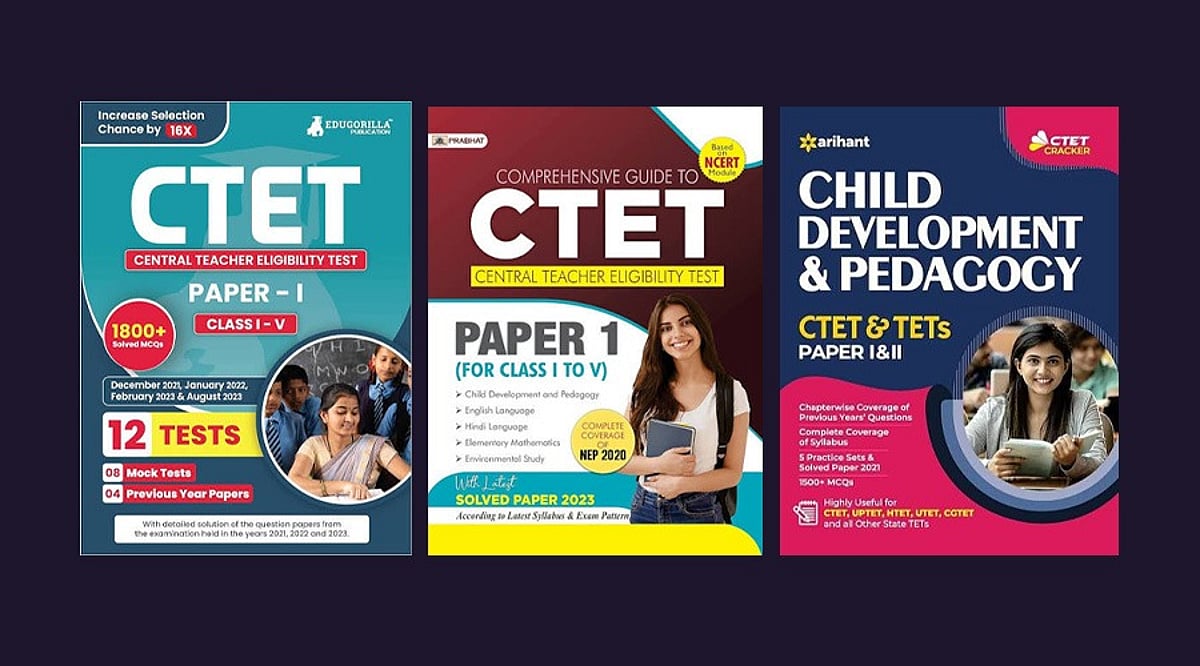
    • Arihant Child Development and Pedagogy for CTET & TETs
    • Wiley Child Development and Pedagogy

    This book explains educational theories in simple terms and includes practice questions aligned with the new CTET pattern.

    Choose Subject-Wise Books for Paper 1

    Paper 1 is designed for candidates aspiring to teach Classes 1 to 5. The focus remains on basic concepts and effective teaching practices.

    Candidates should spend equal time on language pedagogy, as language sections test comprehension and teaching ability rather than grammar alone.

    Best Books for Paper 2 Aspirants

    Paper 2 is for those candidates who wish to teach Classes 6 to 8. In this case, the syllabus becomes broader and requires stronger subject knowledge as well as pedagogy.

    Candidates preparing for Mathematics and Science should first refer to NCERT books for Classes 6 to 8, then move on to solve the practice questions. For Social Science, candidates have to first go through History, Geography, Political Science, and Economics using NCERT books, and then consult specialized books.

    Suggested Books:

    • Arihant Success Master CTET Paper 2
    • Arihant Child Development and Pedagogy
    • NCERT Mathematics, Science, and Social Science (Classes 6–8)
    • Arihant English Language & Pedagogy
    • Arihant Bhasha Hindi

    The books provide chapter-wise analysis, model papers, and topic-wise MCQs similar to those in the real examination.

    Practice Previous Years’ Papers Regularly

    Preparation for CTET will be incomplete without practicing with past years’ question papers, as they allow you to gauge the difficulty level and topic trends, and manage time better.

    Best-selling books in the market:

    • Disha 22 Years CTET Solved Papers (Paper 1)
    • Disha 22 Years CTET Solved Papers (Paper 2)
    • Oswaal CTET Previous Years’ Solved Papers

    Many experts advise solving one full paper per week towards the end of your preparation.

    Complete Preparation Books Worth Considering

    Candidates who prefer to study from a single comprehensive guide can choose books that cover the entire syllabus and include mock tests and previous-year questions. These all-in-one books are especially useful for revision after completing subject-wise preparation.

    Focus on Consistency Over Collecting Books

    However, many candidates do not realize that it is common for them to buy many reference books without completing any of them. Candidates should prepare from only two or three reference books per subject.

    It has been proven that practice through regular mock tests and subject revision, along with a clear understanding of pedagogy, is far more advantageous than buying many books for study material. The candidates must also keep an eye on the latest syllabus and the CTET notification to ensure their preparations stay relevant.

    By making proper use of NCERT books and reference books, along with consistent practice with solved papers, one can easily strategize for CTET 2026.

    Frequently Asked Questions

    What are the best books for CTET 2026 preparation?

    NCERT textbooks, Arihant CTET guides, Wiley pedagogy books, and Disha previous years’ solved papers are among the best resources available.

    Are NCERT books enough for CTET preparation?

    NCERT books build strong concepts, but candidates should also practice with pedagogy, take mock tests, and solve previous years’ papers for success.

    Which book is best for Child Development and Pedagogy?

    Arihant’s Child Development and Pedagogy and Wiley’s pedagogy guide are widely recommended for comprehensive CTET preparation and practice.

    Should I solve previous years’ CTET question papers?

    Yes, solving previous papers improves time management, helps identify important topics, and effectively familiarises candidates with the latest examination pattern.

    Can one book cover the entire CTET syllabus?

    Comprehensive guides help, but combining NCERT textbooks with subject-wise books ensures better understanding, revision, and exam-ready preparation for candidates.

  • Best SSC CGL 2026-27 Books: Subject-Wise Study Resources for Exam Success

    Best SSC CGL 2026-27 Books: Subject-Wise Study Resources for Exam Success

    Choosing the right SSC CGL books makes preparation more focused and effective. One trusted resource for each subject, paired with regular revision, delivers better results than using many guides. Previous year’s papers strengthen exam readiness. Consistency remains the key to success.

    SSC CGL 2026-27 Book List at a Glance

    SSC CGL preparation is built around four core subjects: Quantitative Aptitude, Reasoning, English Comprehension, and General Awareness. The following recommended books are drawn from resources frequently cited in topper interviews and coaching advice.

    • Best Quant Book: Rakesh Yadav 7300+
    • Best Reasoning Book: R.S. Aggarwal
    • Best English Book: S.P. Bakshi
    • Best GK Book: Lucent’s General Knowledge
    • Best PYQ Book: Kiran Publication
    • Best Current Affairs: Arihant or Pratiyogita Darpan Monthly

    Subject-Wise Book Recommendations

    Quantitative Aptitude

    Rakesh Yadav’s 7300+ Chapterwise Solved Questions is frequently recommended for its chapter-wise structure and volume of practice questions. For a solid study sequence:

    • Rakesh Yadav 7300+ for chapter-wise practice
    • R.S. Aggarwal’s Quantitative Aptitude for comprehensive concepts
    • Fast Track Objective Arithmetic by Rajesh Verma for speed techniques
    • Arun Sharma’s Quantitative Aptitude for rebuilding fundamentals

    Reasoning

    R.S. Aggarwal’s A Modern Approach to Verbal and Non-Verbal Reasoning covers analogy, classification, coding-decoding, syllogisms, blood relations, seating arrangements, and mirror/image-based reasoning. Analytical Reasoning by M.K. Pandey serves as a companion for deeper puzzle practice. Kiran’s Reasoning compilation offers additional past question practice.

    English Language

    S.P. Bakshi’s Objective General English covers cloze test, error detection, reading comprehension, and synonym-antonym practice. Wren and Martin’s English Grammar helps rebuild grammar basics. Neetu Singh’s English for General Competitions offers an exam-focused format. Word Power Made Easy fills vocabulary gaps.

    General Awareness

    Lucent’s General Knowledge is the standard resource for static GK (history, geography, polity, economics, science). It pairs best with a monthly current affairs compilation from Pratiyogita Darpan or Arihant. Kiran’s General Awareness previous-year compilation adds targeted factual question practice.

    Previous Year Papers

    Previous year papers reveal recurring question styles and topic weightage. Kiran Publication’s chapter-wise previous year compilation organizes past questions by topic for focused revision. Many toppers solve several years of papers before attempting full-length mocks.

    How to Study with These Books

    One trusted book per subject, revised multiple times, builds more exam readiness than several books read once. Quantitative aptitude and reasoning benefit from solving the full book once, then revisiting difficult questions two or three times. English grammar needs three to four revisions. Lucent’s GK rewards repeated revision for recall speed.

    Final Thoughts

    The books on this list build the foundation. Success in SSC CGL often comes from a narrow, well-revised set of resources rather than searching for better books along the way.

    FAQs

    1. Which is the best book for SSC CGL 2026 Quantitative Aptitude?

    Rakesh Yadav’s 7300+ Chapterwise Solved Questions is one of the most recommended books for SSC CGL Quantitative Aptitude due to its extensive practice questions. Beginners can also use R.S. Aggarwal or Arun Sharma to strengthen concepts before solving advanced questions.

    2. Is Lucent General Knowledge enough for SSC CGL General Awareness?

    Lucent’s General Knowledge is considered one of the best books for static GK, covering History, Geography, Polity, Economics, and Science. However, candidates should also follow monthly current affairs magazines or reliable current affairs sources for complete preparation.

    3. Which English book is best for SSC CGL preparation?

    S.P. Bakshi’s Objective General English is widely recommended for SSC CGL because it covers grammar, vocabulary, comprehension, and objective practice. Candidates looking to improve grammar basics can also refer to Wren & Martin.

    4. Are previous year question papers important for SSC CGL 2026?

    Yes. Previous year papers help candidates understand the exam pattern, question types, topic weightage, and difficulty level. Solving them regularly also improves speed, accuracy, and time management.

    5. How many books are enough for SSC CGL preparation?

    Most successful candidates rely on one trusted book for each subject, along with previous year papers and current affairs material. Revising a limited set of quality resources multiple times is generally more effective than studying from many different books.

  • 10 Must-Have CEO Productivity Tools for 2026

    10 Must-Have CEO Productivity Tools for 2026

    In 2026, business leaders are leveraging cutting-edge software to streamline operations, enhance decision-making, and boost overall efficiency. Here are ten essential CEO tools that can transform how you work.

    1. Notion

    Organize projects, notes, and company knowledge in one unified workspace. Notion helps CEOs keep everything from strategic plans to team wikis accessible and structured.

    2. Slack

    Keep communication fast and teams connected. Slack reduces email overload and enables real-time collaboration across departments.

    3. ChatGPT

    Generate ideas, summarize reports, and improve daily productivity. ChatGPT acts as an on-demand assistant for drafting emails, analyzing data, and brainstorming.

    4. Microsoft Copilot

    Automate Office tasks and create presentations faster. Copilot integrates with Word, Excel, and PowerPoint to handle routine work, freeing up time for strategic thinking.

    5. Zoom

    Run meetings efficiently from anywhere. With features like AI transcription and breakout rooms, Zoom remains a staple for remote and hybrid leadership.

    6. Asana

    Track projects, deadlines, and team performance. Asana provides a clear overview of progress and helps CEOs align teams around priorities.

    7. Calendly

    Simplify scheduling without endless emails. Calendly automates meeting bookings, reducing administrative friction.

    8. Power BI

    Turn company data into business insights. Power BI visualizes key metrics, enabling data-driven decisions at a glance.

    These tools empower CEOs to lead more effectively, save time, and focus on high-impact initiatives. For more updates, join our WhatsApp Channel for the latest news, exclusives, and videos.

  • Choosing the Best Professional Title for Your Business: A Guide for Entrepreneurs and Owners

    Choosing the Best Professional Title for Your Business: A Guide for Entrepreneurs and Owners

    Choosing the right professional title is a crucial decision for any business owner. It defines your role, communicates your authority, and sets the tone for your company’s brand. Whether you’re a solo entrepreneur or leading a large corporation, the title you select can impact how clients, investors, and employees perceive you. Here’s a breakdown of common business owner titles and when to use them.

    Founder

    Best suited for entrepreneurs who started the business, highlighting the company’s origin while reinforcing innovation, vision, and entrepreneurial leadership.

    CEO

    Ideal for businesses with multiple departments, investors, or employees, emphasizing executive authority, strategic planning, and organizational leadership responsibilities.

    Owner

    A straightforward title that clearly communicates business ownership, making it suitable for small businesses, local enterprises, and sole proprietorships.

    Managing Director

    Common among established companies, this title reflects operational leadership, executive decision-making, and responsibility for business performance and growth.

    President

    Often used in corporations, it conveys senior leadership and oversight while representing the organization in business partnerships and public engagements.

    Creative Director

    Perfect for branding, marketing, media, and design businesses where creative strategy, innovation, and visual leadership define the company’s success.

    Principal Consultant

    Suitable for consulting firms, emphasizing expertise, client advisory services, strategic problem-solving, and specialized industry knowledge over hierarchy.

    Co-Founder

    Appropriate when multiple entrepreneurs establish a company together, recognizing shared leadership, ownership, and collaborative decision-making from the beginning.

    Industry Alignment

    Ultimately, the best title aligns with your responsibilities, company size, industry expectations, and long-term branding goals. Choose a title that builds professional credibility consistently.