Category: Cybersecurity

  • WhatsApp ‘Boss Scam’ Swindles Ahmedabad Rice Mill Out of Rs. 80 Lakh

    WhatsApp ‘Boss Scam’ Swindles Ahmedabad Rice Mill Out of Rs. 80 Lakh

    An Ahmedabad-based rice mill has fallen victim to a sophisticated cyber fraud, commonly known as the ‘boss scam,’ losing Rs. 80 lakh after a scammer impersonated the company’s owner on WhatsApp.

    According to a police complaint filed by business owner Pradip Ramvani, the fraudster gained access to the accountant Jayesh’s phone by tricking him into installing a malicious file on August 31. The attacker then replaced Ramvani’s genuine contact number with a fake one on the accountant’s phone, using the owner’s photograph as the WhatsApp profile picture to make the deception appear legitimate.

    Posing as Ramvani, the scammer sent a WhatsApp message to Jayesh instructing him to transfer Rs. 80 lakh from the company account to a specified bank account for a purported business payment. Believing the request came from his employer, Jayesh carried out the transfer.

    The fraud was only discovered when the scammer demanded an additional Rs. 30 lakh. Suspicious, Jayesh spoke directly with Ramvani, and both realized the payment instruction had originated from an unknown number. They then found the malicious file on Jayesh’s phone.

    Police have launched an investigation, tracing the unknown WhatsApp number and the beneficiary bank account. They are also examining how the phone was compromised. The case highlights the growing threat of ‘boss scams,’ where cybercriminals impersonate senior officials to trick employees into authorizing fraudulent payments.

    Authorities have advised businesses to implement strict verification protocols for financial transactions and to educate employees about such social engineering attacks.

  • Fintech Security Trends 2027: AI Fraud, Deepfakes, and Quantum Threats

    Fintech Security Trends 2027: AI Fraud, Deepfakes, and Quantum Threats

    Fintech security is entering a more complex phase as digital finance expands globally. AI-powered fraud, deepfakes, synthetic identities, AI agents, and quantum threats are changing the risk landscape. Zero-trust security and cyber resilience will also become stronger priorities.

    Key Trends Shaping Fintech Security in 2027

    • AI-powered fraud detection and deepfake protection will become critical for fintech security.
    • Zero trust, AI-agent security, and post-quantum planning will reshape security strategies.
    • Cyber resilience will become increasingly important as financial systems grow interconnected.

    Fintech has changed how people access, move, and manage money. Digital payments now operate at remarkable speed across global markets. However, faster financial services also create new security challenges. Attackers are adopting automation, artificial intelligence, and social engineering.

    Fintech companies must therefore rethink traditional cybersecurity approaches. Security will increasingly become part of product design and business resilience. Several trends are likely to shape fintech security in the coming years. These trends will affect banks, payment companies, insurers, digital lenders, and fintech platforms.

    AI-Powered Fraud Detection Will Become More Advanced

    Artificial intelligence is becoming an important tool for detecting financial fraud. Security teams can analyze enormous transaction volumes in real time. Machine learning can identify unusual spending patterns and suspicious account behavior. It can also help reduce false positives during fraud investigations.

    The challenge is that criminals are using AI too. Attackers can automate phishing, credential attacks, and fraud campaigns. This creates an ongoing technology race between attackers and defenders. Financial institutions will increasingly need machine-speed security controls.

    Deepfakes and Synthetic Identity Attacks Will Grow

    Identity-based attacks are becoming more sophisticated across financial services. Criminals can now create convincing voices, images, videos, and documents. These tools can support account takeovers and social engineering scams. They can also make fraudulent identities appear more credible.

    Traditional security checks may struggle against these techniques. Fintech companies will need stronger identity verification systems. Behavioral signals could become increasingly important during authentication. Transaction patterns can also help identify unusual account activity. The goal is to verify identity without creating unnecessary customer friction.

    Zero Trust Will Extend Across Fintech Ecosystems

    Zero trust is becoming more important as financial platforms become interconnected. Modern fintech environments rely on cloud systems, APIs, vendors, and external platforms. That creates multiple pathways into sensitive financial systems. A compromised credential or API can expose multiple applications.

    Zero-trust security assumes you should never automatically trust access. Every user, device, application, and connection requires appropriate verification. In the coming years, this approach will extend beyond internal networks. Third-party platforms and cloud workloads will receive greater scrutiny. Continuous authentication and least-privilege access will become increasingly important.

    AI Agents Will Create New Security Challenges

    AI agents are becoming capable of performing tasks with limited human intervention. Financial companies are exploring them for support, operations, analysis, and automation. However, agents can access sensitive systems and business information. Poorly controlled agents could therefore create significant security risks.

    Prompt injection is one emerging concern. Attackers may manipulate agents into performing unauthorized actions. Security teams will need to treat AI agents like digital employees. They will require defined permissions, monitoring, and clear accountability. Gartner predicted AI security spending to approach USD 4.8 billion globally in 2027.

    Post-Quantum Security Planning Will Accelerate

    Quantum computing presents a longer-term challenge for financial cybersecurity. Existing encryption methods could eventually become vulnerable. Fintech companies cannot wait until quantum computers become commercially dominant. Sensitive financial information may remain valuable for decades.

    This raises concerns about ‘harvest now, decrypt later’ attacks. Criminals can collect encrypted information today for future decryption. Organizations are beginning to assess quantum-resistant encryption, while many remain at early stages of preparation. PwC found that 49% of surveyed organizations had not started quantum-resistant security measures. Fintech companies will increasingly build cryptographic inventories. They will also prepare migration plans for post-quantum standards.

    Cyber Resilience Will Become a Business Priority

    Security is no longer only about preventing attacks. Financial companies must also recover quickly when incidents occur. A major breach can interrupt payments, customer access, trading, or internal operations. It can also damage customer confidence and regulatory relationships.

    AI is increasing this risk by accelerating attacks across shared infrastructure. Financial institutions depend heavily on common cloud providers and technology platforms. This creates concentration risks across the financial ecosystem. A vulnerability in one widely used service could affect multiple institutions.

    Why This Matters

    Financial services are becoming increasingly digital and interconnected. That creates more opportunities for attackers to target financial institutions and their customers. Digital fraud is another growing concern. IMF research found that cyber-enabled fraud has nearly tripled, although reporting gaps remain across jurisdictions. The security challenge therefore extends beyond traditional network protection. Companies must protect identities, transactions, AI systems, APIs, cloud infrastructure, and third-party services.

    In the coming years, resilience will become a board-level priority. Companies will focus on containment, recovery, testing, and third-party risk management. The fintech security field will continue changing rapidly. AI will remain both a powerful defense tool and a serious threat.

    Identity security, zero trust, quantum readiness, and resilience will gain importance. Companies that prepare early can reduce exposure to emerging attacks. For fintech leaders, security will increasingly influence trust and competitiveness. The strongest platforms will build protection into their technology foundations.


  • How Telegram Accounts Can Be Hacked Without an OTP: Risks and Prevention Strategies

    How Telegram Accounts Can Be Hacked Without an OTP: Risks and Prevention Strategies

    Telegram sends a one-time password (OTP) to verify new logins, but that alone does not guarantee account safety. Hackers, scammers, and even someone with brief physical access to your phone can still compromise a Telegram account without ever requesting that OTP. This risk affects everyone—casual users, business owners, and community channel managers alike. The methods typically exploit stolen sessions, malware, or lingering login sessions rather than breaking Telegram’s own systems.

    Understanding Telegram Account Security Risks

    Telegram allows a single account to remain logged in on multiple devices simultaneously, and each active session works without re-entering the OTP. If a hacker steals an active session—via malware on the device or a fake app that copies login credentials—they can instantly access the account. Security researchers warn that malicious files, often disguised as APKs on Android, can silently extract session data stored on the device. Once that data reaches an attacker, they can open Telegram as if they were the legitimate user, with no password or code required.

    Public Wi-Fi networks add another layer of vulnerability. Experts note that unsecured networks make it easier for attackers to intercept data flowing between a phone and Telegram’s servers, especially when using Telegram Web on a shared or public computer.

    Phishing remains a common threat on Telegram. A fake login page that looks identical to Telegram’s real site can trick users into entering their credentials directly, handing over access without any OTP involved.

    Steps to Keep Your Telegram Account Safe

    Adopting a few simple habits can significantly reduce the risk of such hacks:

    • Turn on Two-Step Verification in Telegram’s settings to add an extra password layer.
    • Add a passcode lock inside the app so it cannot be opened even on an unlocked phone.
    • Regularly check the Devices section and log out of any sessions you do not recognize.
    • Avoid downloading APK files or clicking links from unknown senders.
    • Keep the app updated, as Telegram regularly releases security patches.

    These measures together make it much harder for anyone to slip into your account unnoticed.

  • Ledger Consolidates Security and IT Leadership Amid Surging AI Crypto Attacks

    Ledger Consolidates Security and IT Leadership Amid Surging AI Crypto Attacks

    Ledger SAS has appointed Oded Blatman as chief information officer and chief security officer, combining technology and security oversight in a single leadership role as AI-driven threats expand across the crypto industry. The Paris-based hardware wallet maker said Blatman will oversee cyber and infrastructure security, product security, physical and workplace security, internal IT, and enterprise risk.

    One Role for Security and Technology

    Blatman joins Ledger after five years as CIO and CISO at Fireblocks. He previously served as global CISO at Bank Hapoalim and held both CIO and CISO roles at ClickSoftware. At Fireblocks, he led global security and enterprise technology during a period of international expansion and rising operational complexity, experience Ledger says fits its broader effort to strengthen organizational resilience.

    Ledger described the combined CIO and CSO structure as a deliberate organizational change. The company said information systems and security now require closer coordination as tokenization, AI agents, and institutional digital-asset use develop together.

    AI Makes Crypto Attacks Faster and More Scalable

    Blatman said artificial intelligence is reducing the cost and time attackers need to search for weaknesses, while also allowing attacks to become more sophisticated and operate at greater scale. As phishing campaigns and deepfake impersonation schemes become more advanced, Ledger said security teams must evolve at a comparable pace.

    The appointment follows a rise in reported crypto security incidents. Data from DefiLlama cited by Ledger shows hackers stole about $1.4 billion across 250 attacks in 2026 so far, after losses reached $2.7 billion across 146 attacks in 2025.

    Recent Incidents Add Pressure on Digital Asset Defenses

    Several high-profile incidents have put digital-asset companies on alert. About $320 million in Bitcoin left the Liquid Network during a hack earlier this week. Trezor also disclosed a breach involving one of its shipping providers last week, exposing personal information belonging to tens of thousands of customers. Earlier this year, a Coldcard hack raised further questions about offline wallet security.

    Ledger said hardware-backed verification remains central to protecting high-value digital ownership, and pointed to secure software, resilient operations, and verifiable human intent as additional layers of protection.

    Leadership Backed by Deep Security Experience

    Blatman said Ledger’s hardware-security work, user trust, and Donjon research team provided a strong foundation for the role, and that he joined to connect product security, enterprise technology, and resilience. Chairman and CEO Pascal Gauthier said Ledger considers security central to its business and that Blatman’s experience protecting systems at Fireblocks and Bank Hapoalim prepared him to oversee both information technology and security.

  • Top 10 IP Address Management Tools for Streamlined Network Operations in 2026

    Top 10 IP Address Management Tools for Streamlined Network Operations in 2026

    Tracking IP addresses can become surprisingly complicated as businesses add more devices, cloud services, applications, and remote networks. Managing everything through spreadsheets or manual records quickly turns into a headache. That is where IP Address Management (IPAM) tools come in. These platforms help IT and network teams keep track of IP addresses, organize subnets, identify conflicts, and maintain better visibility across their networks. Many also offer automation, DNS and DHCP integration, IPv6 support, and APIs. Here are 10 leading IPAM tools to consider in 2026.

    1. NetBox

    NetBox is a favorable open-source option for managing network infrastructure. It acts as a single source of truth for IP addresses, prefixes, devices, VLANs, and interfaces. Its robust API support makes it highly customizable.

    2. phpIPAM

    phpIPAM is a simple, self-hostable IPAM solution. It manages IPv4 and IPv6 subnets and VLANs, allocates IP addresses, and offers a REST API for integration.

    3. Infoblox IPAM

    Infoblox is built for enterprises with complex, extensive networks. It tightly integrates DNS and DHCP, providing a single pane of glass for core network services.

    4. SolarWinds IP Address Manager

    SolarWinds IP Address Manager gives administrators a complete overview of the IP network. It excels at address discovery, subnet management, and conflict detection, while seamlessly working with existing DNS and DHCP environments.

    5. EfficientIP SOLIDserver

    EfficientIP SOLIDserver is an integrated platform combining IPAM, DNS, and DHCP. It supports both IPv4 and IPv6, includes network discovery and automation, and is well suited for large-scale networks.

    6. BlueCat Integrity

    BlueCat Integrity provides a DDI (DNS, DHCP, IPAM) solution for centralized monitoring and management of distributed systems. Its automation features help reduce redundant administrative tasks.

    7. ManageEngine OpUtils

    ManageEngine OpUtils combines IP address management with broader network management functions. It helps with IP discovery, network monitoring, and other tasks, making it useful for small to medium-sized IT teams.

    8. Micetro

    Micetro is designed for organizations using a mix of DNS, DHCP, and IPAM platforms. It enables centralized management across diverse infrastructures and automates common networking chores.

    9. GestióIP

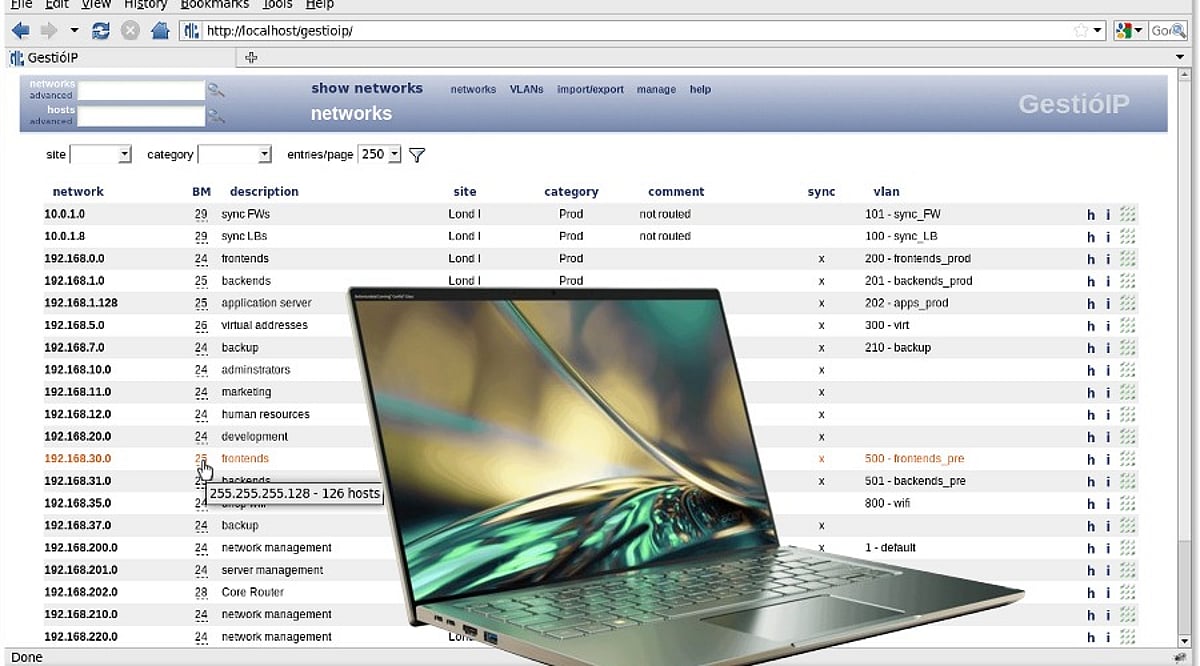
    GestióIP is an open-source IPAM system that supports IPv4 and IPv6, subnet management, and network discovery. It is ideal for teams that prefer self-hosted solutions.

    10. Microsoft IPAM

    Microsoft IPAM is a natural choice for businesses already invested in Microsoft technology. It comes with Windows Server and provides centralized management of IP addresses and network infrastructure.

    Choosing the Right IPAM Tool

    Selecting an IPAM tool is not simply about picking the platform with the longest feature list. The right option depends on network size, existing infrastructure, and required automation. Open-source tools like NetBox, phpIPAM, and GestióIP appeal to teams seeking flexibility, while Infoblox, BlueCat, and EfficientIP are better suited for large enterprises. Tools such as SolarWinds IP Address Manager and ManageEngine OpUtils offer broader network management capabilities. Before deciding, evaluate IPv4 and IPv6 support, DNS and DHCP integration, network discovery, automation, API availability, scalability, and security features. A good IPAM platform should simplify network management, not add complexity.

  • Google Chrome 153 Introduces Two-Week Release Cycle to Deliver Faster Security Fixes

    Google Chrome 153 Introduces Two-Week Release Cycle to Deliver Faster Security Fixes

    Google has launched Chrome 153 with a new two-week release cycle across desktop, Android, and iOS. The accelerated schedule is designed to deliver security fixes, bug patches, performance updates, and new features more quickly while reducing the gap between vulnerability discovery and patch deployment.

    Under the previous system, major Chrome versions arrived every four weeks. Before 2021, the browser followed a six-week schedule. Google says the faster cycle will help its teams release smaller updates more often. The Chrome team described the change as ‘a win for the entire web.’ Shorter development windows also mean web developers receive browser fixes and new web features sooner.

    Chrome users on desktop, Android, and iOS will now receive more frequent stable releases. Each update is expected to include fewer changes because development work is divided across shorter release periods. Chrome 154 is scheduled to arrive on September 22, continuing the new two-week pattern.

    Security is a key driver behind the change. Google has increased its use of AI tools to search for software flaws and support vulnerability research. Community researchers continue to report security bugs through Chrome’s existing programs. Shorter release cycles can reduce the ‘N-day patch gap’—the period between public discovery of a security problem and delivery of a fix. A shorter gap limits the time attackers have to exploit known vulnerabilities before users receive patches.

    The faster schedule also makes it easier to isolate software regressions. Smaller releases contain fewer changes, helping developers identify the source of a problem when a new update causes an error. Google previously moved Chrome from a six-week to a four-week cycle in 2021.

    Enterprise customers have more flexibility under the new system. Google recommends the two-week Stable channel for most organizations. Companies that cannot manage updates every two weeks can use Chrome’s Extended Stable channel, which follows an eight-week schedule.

    Google is also preparing other changes. Starting with Chrome 155, Android users will see a redesigned notification permission interface aimed at reducing prompt fatigue. Other browser developers like Microsoft Edge, Mozilla Firefox, and Brave have also introduced or explored shorter update cycles.

    With Chrome 153, Google has formally moved its main browser to a two-week stable release cycle, supporting faster security patches, more frequent feature delivery, and quicker updates across major operating systems.

  • Essential Cybersecurity Lessons from the Growing Use of AI Agents

    Essential Cybersecurity Lessons from the Growing Use of AI Agents

    As artificial intelligence agents become more capable and autonomous, they are increasingly handling sensitive tasks across business systems. While this brings efficiency, it also introduces new cybersecurity challenges. Here are the key lessons organizations must learn to protect their AI-driven operations.

    Strong Access Controls

    AI agents often require access to files, applications, and systems to complete their tasks. Limiting these permissions helps reduce potential damage if an agent behaves unexpectedly or its credentials are compromised. Implement the principle of least privilege.

    Protect Sensitive Data

    AI agents may handle customer information, business records, and confidential documents. Organizations should restrict sensitive data access and apply strong encryption, authentication, and privacy controls to safeguard this information.

    Continuous Monitoring

    Because AI agents can perform tasks independently and at high speed, continuous monitoring is essential. Security teams need to identify unusual activity, unexpected decisions, and potential attacks before they escalate.

    Human Oversight Matters

    Autonomous systems should not operate without appropriate human checks. Critical actions involving finances, sensitive information, or important infrastructure should require human approval before completion.

    Secure Agent Communication

    AI agents often interact with applications, APIs, databases, and other agents. Securing these connections helps prevent attackers from intercepting instructions or manipulating exchanged information.

    Test Before Deployment

    Organizations should test AI agents against malicious prompts, incorrect instructions, data leaks, and unexpected behaviors. Regular security testing can reveal weaknesses before agents are deployed widely.

    Prepare for New Threats

    The growth of AI agents creates new attack possibilities, including prompt manipulation, privilege abuse, and automated attacks. Security teams need updated policies and response plans to manage these evolving risks.