Category: Finance

  • Money in Motion: The Key Technologies Transforming Digital Finance

    Money in Motion: The Key Technologies Transforming Digital Finance

    Digital finance is evolving at unprecedented speed. From artificial intelligence to biometric authentication, a range of technologies is changing how consumers and institutions handle money. Here is a closer look at the innovations reshaping payments, banking, and financial services.

    Artificial Intelligence

    AI is changing how banks and financial apps handle everyday money tasks. It can detect unusual transactions, assess risks, answer customer questions, and offer personalized financial services. AI also helps institutions process large amounts of data quickly, making digital payments and banking services faster, safer, and more responsive.

    Blockchain

    Blockchain provides a shared digital record that can track transactions without relying on a single central database. The technology supports cryptocurrencies, smart contracts, and other financial applications. Banks and businesses are exploring blockchain for faster settlements, cross-border payments, digital assets, and records that are easier to verify and trace.

    Mobile Payments

    Smartphones have become a central part of everyday finance. Users can pay bills, transfer money, shop online, and make purchases at physical stores through banking apps and digital wallets. QR codes and near-field communication have further simplified payments, reducing the need for cash and cards.

    Cloud Computing

    Cloud computing gives financial institutions flexible computing power and storage through internet-based systems. Banks use cloud infrastructure to run applications, manage data, and launch digital services without relying entirely on traditional hardware. It also supports faster updates and helps financial platforms handle changing customer demand.

    Open Banking

    Open banking allows customers to share financial information with authorized third-party services through secure APIs. This connects bank accounts with budgeting apps, payment platforms, lending services, and other financial tools. By making data easier to access with permission, open banking is creating more connected digital financial experiences.

    Biometric Authentication

    Biometric authentication uses features such as fingerprints, facial recognition, or voice patterns to confirm a user’s identity. It has become common across smartphones and financial applications, helping users access accounts and approve transactions. Biometrics make authentication quicker while adding another layer of identity verification to digital financial services.
  • Indian Stock Market Opens Higher as Falling Oil Prices Boost Sentiment: Nifty 50 Rises 64 Points, Sensex Gains 260 Points

    Indian Stock Market Opens Higher as Falling Oil Prices Boost Sentiment: Nifty 50 Rises 64 Points, Sensex Gains 260 Points

    The Indian stock market opened higher on Thursday, buoyed by a decline in global oil prices and mixed cues from international markets. The Nifty 50 index started the session at 23,334.70, gaining 64.1 points or approximately 0.28%, while the Bank Nifty advanced 117.1 points from its previous close. Meanwhile, the Sensex climbed 260.65 points to reach 74,575.24.

    Broader market participation improved, with the Nifty Midcap index rising 0.52% and the Nifty Smallcap index gaining 0.86%. The Indian rupee opened flat at Rs. 95.87 against the US dollar.

    Foreign Institutional Investors (FIIs) remained net sellers in the cash market on September 17, offloading shares worth Rs. 3,208.76 crore. In contrast, Domestic Institutional Investors (DIIs) were net buyers, purchasing Rs. 3,617.75 crore worth of equities.

    Sensex Outlook

    According to Sachin Gupta, VP of Technical Research at Choice Equity Broking Private Limited, the Sensex is expected to maintain its negative bias unless it breaks above the resistance zone of 74,700–75,000. On the downside, the 73,500–74,200 range serves as a critical support area. If the index falls below this level, selling pressure may intensify.

    Nifty 50 Outlook

    The Nifty 50 ended Thursday’s session 53 points higher, forming a small green candle with an upper shadow on the daily chart. The recent recovery has emerged from the key support zone around 23,100–23,000. However, the index lacks strength to reverse the prevailing trend of lower highs and lower lows.

    On the upside, the 23,400–23,500 zone poses strong resistance. A sustained move below 23,000 could trigger a deeper correction.

    Bank Nifty Outlook

    The Bank Nifty formed a long upper-shadow bearish candle, indicating strong supply at higher levels. The sharp rejection from the day’s high suggests sellers remain active. Immediate support is seen at 55,500–55,700, while resistance lies at 56,300–56,500.

    Gupta noted that the broader range for the Bank Nifty is likely to be 55,500–56,500, with a near-term sideways bias. An upside breakout above 56,500 would improve the technical structure, whereas a fall below 55,500 could add further downside pressure.

    Disclaimer: This article is for informational purposes only and does not constitute investment advice. Readers should conduct their own research before making any financial decisions.

  • FTSE 100 Opens 45 Points Lower as Bank of England Holds Rates; Brent Crude Sinks to $102.5

    FTSE 100 Opens 45 Points Lower as Bank of England Holds Rates; Brent Crude Sinks to $102.5

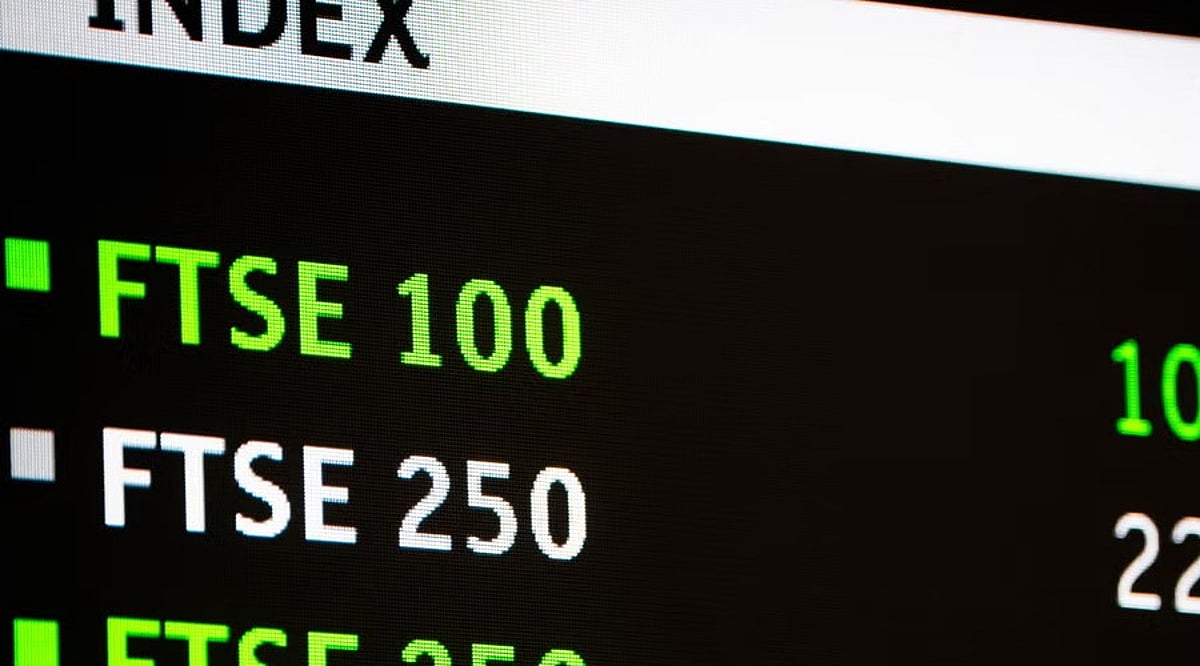
    The FTSE 100 opened 45.03 points lower at 10,771.11 on Friday after the Bank of England kept interest rates unchanged while adopting a more hawkish stance. Investors also weighed the Bank of Japan’s latest rate hike. Meanwhile, Brent crude futures fell 2.05% to USD 102.5 per barrel, and US West Texas Intermediate declined 1.89% to USD 99.98.

    BoE Holds Rates at 3.75%

    The Bank of England’s Monetary Policy Committee voted 6-3 to leave Bank Rate at 3.75%, repeating the split seen in July. Huw Pill, Megan Greene and Catherine Mann again voted for a 25-basis-point increase.

    In a notable move, the BoE paused all gilt sales until April 2027 and removed bonds maturing after 2049 — around GBP 120 billion — from active sales. The Bank is also exploring a mechanism to transfer gilts directly to the UK government treasury, replacing long-dated supply with shorter issuance.

    Sterling and Commodities

    Sterling was quoted at USD 1.3363 early Friday, slightly higher than USD 1.3356 at Thursday’s London close. Against the euro, the pound rose to EUR 1.1638 from EUR 1.1627.

    Gainers and Losers

    Top gainers:

    • Fresnillo: +2.70% at 3,085p
    • IG Group Holdings: +2.21% at 1,344p
    • Endeavour Mining: +2.20% at 4,777p
    • Lion Finance Group: +2.17% at 14,120p
    • Antofagasta: +1.35% at 3,752p
    • Polar Capital Technology Trust: +1.14% at 664.50p

    Top decliners:

    • Coca-Cola HBC: -3.86% at 4,432p
    • Next: -2.51% at 14,545p
    • Coca-Cola Europacific Partners: -1.25% at 7,505p
    • Shell: -1.13% at 3,530.50p
    • London Stock Exchange Group: -0.56% at 8,216p
    • Games Workshop Group: -0.51% at 17,670p

    UK Retail Sales Rebound in August

    Retail sales rose 0.5% in August, reversing a 0.5% decline in July, according to the Office for National Statistics. The increase was driven by warmer weather, which boosted demand for fans and air conditioning units, while the World Cup lifted sales of sports merchandise and clothing. Economists polled by Reuters had forecast a 0.2% drop.

    Investec Raises Earnings Targets

    Investec doubled down on its earnings outlook after strong activity in its South Africa division offset a subdued UK performance. The lender projected earnings per share of 41.7p to 43.3p for the six months to 30 September, representing a 3% to 7% rise year on year. South African wealth funds under management grew 13.8% to GBP 30.7 billion, while the UK business expects operating profit to fall between 2% and 6% from the GBP 230 million recorded last year.

    Global Market Update

    Wall Street rebounded overnight as government bond yields retreated. The S&P 500 gained 1.2%, the Nasdaq Composite rose 1.7%, and the Dow Jones added 0.6%, or 316 points.

    In Asia on Friday, Tokyo’s Nikkei 225 climbed 1.38% to 65,018.95, while China’s Shanghai Composite fell 0.94%. Hong Kong’s Hang Seng advanced 0.56%, and South Korea’s Kospi rose 2.66%. In India, the Nifty 50 and Sensex gained 0.25% and 0.28%, respectively.

  • The Journey of a Trade Order: From Click to Fill

    The Journey of a Trade Order: From Click to Fill

    When you click the buy button on your trading platform, the process feels instantaneous. However, behind the scenes, your order travels through a complex series of steps before it becomes a position on your account. Each step takes time, even if only milliseconds, and during that time, the price can move against you or in your favor.

    The Order Leaves Your Platform

    Your platform sends the order to the broker’s server first, not directly to the market. The broker validates the order, checks that you have sufficient margin, and then decides where to route it next. Depending on your account type and trade size, the order is either routed to a liquidity provider or filled against the broker’s own book.

    Market Execution vs. Instant Execution

    With market execution, you set the trade size and accept the current market price when the order arrives. There are no requotes; the trade opens at the live price, even if it has shifted slightly since you clicked. With instant execution, you request a specific price along with the size. If the price has moved, the broker sends a requote instead of filling the order, and you decide whether to accept the new price or cancel.

    Where Latency Creeps In

    Latency is the delay between sending your order and it reaching the point of execution. It builds up across several stages: your internet connection, the platform’s servers, and the network path to the liquidity provider. A few milliseconds rarely matter in a calm market, but during fast moves, even a short delay can mean the price has already changed by the time your order arrives.

    Slippage: Positive and Negative

    Slippage is the difference between the expected price and the actual execution price. Negative slippage means you paid more on a buy or received less on a sell. Positive slippage is the opposite, giving you a better price than expected. Slippage is most common during high volatility around news events or when liquidity thins out. Market orders are more exposed to slippage than limit orders, which only fill at your chosen price or better.

    Why Order Size Matters

    Small orders usually fill at a single price without issue. Large orders, however, can eat through several price levels in the order book because there may not be enough volume at the best price to cover the entire size. In such cases, part of the order fills at the first price and the rest at slightly worse prices, resulting in an average fill price that blends these levels—another form of slippage tied to size rather than speed.

    What a Requote Looks Like

    Imagine you request a price on instant execution and the market ticks up half a pip before your order arrives. The broker cannot fill you at the old price, so it sends back a new quote and waits for your response. You can accept, reject, or let the request time out. Each of these choices takes time, so a series of requotes in a fast market can cost you more time than the small price gap itself.

    Why This Matters Beyond Forex

    This process is not unique to currency pairs. Trading CFDs on shares and indices follows the same steps, as these contracts also route through liquidity providers and face similar latency and slippage risks.

    Checking Execution Quality

    Execution speed and slippage rarely appear on a pricing page, but they shape your actual results as much as the spread. Ask your broker how orders are routed, how fast they typically fill, and how often clients see requotes. A broker that suits your trading style is one whose execution matches how you trade, not just one with the tightest advertised spread. A scalper feels latency far more than a long-term position holder.

    What You Can Control

    You cannot eliminate slippage or latency, but you can reduce your exposure. Avoid placing large market orders right before major news releases, when liquidity often drops and volatility spikes. Use limit orders when the exact price matters more than instant execution—this trade-off between price certainty and speed underlies almost every order type you will encounter. Splitting a large order into smaller pieces can also reduce how much it moves the price against you, even if it takes a bit more effort to manage.

    Disclaimer: This article is for informational purposes only and does not constitute financial advice. Always conduct your own research before making any investment decisions.

  • Tata Sons IPO Standoff: SP Group Pushes for Listing While Noel Tata Objects

    Tata Sons IPO Standoff: SP Group Pushes for Listing While Noel Tata Objects

    The debate over a potential Tata Sons initial public offering (IPO) intensified on September 18, 2026, as the Shapoorji Pallonji (SP) Group publicly backed a listing while Noel Tata, chairman of Tata Trusts, firmly opposed it. The dispute centers on regulatory compliance, ownership structure, and the future governance of one of India’s most prominent conglomerates.

    Pressure for a listing mounted after the Reserve Bank of India (RBI) rejected Tata Sons’ deregistration request on September 11. The RBI classifies Tata Sons as an upper-layer non-banking financial company (NBFC), which imposes enhanced regulatory requirements, including mandatory listing obligations.

    Ownership Breakdown and Conflicting Interests

    Tata Trusts holds approximately 66% of Tata Sons, while the SP Group owns around 18.4%. Other Tata Group companies collectively hold nearly 13%. This ownership structure creates divergent priorities: the Trusts emphasize philanthropic continuity, while the SP Group seeks liquidity and transparency.

    SP Group’s Case for Listing

    The SP Group has long advocated for a public listing, citing transparency and shareholder value. Chairman Shapoor Mistry called the IPO a “social and moral imperative,” arguing that it would strengthen public accountability while preserving Tata’s philanthropic mission. For the SP Group, which holds a significant minority stake, a public market offers a route to monetize holdings and provides greater visibility for investors.

    Noel Tata and Tata Trusts’ Opposition

    Noel Tata, speaking for Tata Trusts, has taken a starkly different position. He warned that a listing would “destroy the character” of Tata Sons, which he described as an institution built around philanthropy rather than profit maximization. In a board statement, Noel Tata argued that the company’s privately held structure is central to its identity and purpose.

    Tata Trusts has proposed an alternative: a transaction worth at least ₹25,000 crore to provide liquidity to the SP Group without immediately altering the privately held structure. This proposal, reported by Telangana Today, offers a compromise that could delay or avoid an IPO.

    Governance and Leadership Dispute

    The disagreement extends beyond listing strategy. The Tata Sons board has backed a second five-year term for Chairman N. Chandrasekaran, but Noel Tata and the Trusts have challenged the validity of that decision. This governance clash adds another layer of complexity to the IPO debate.

    Regulatory Pressure and Market Implications

    An IPO would introduce public shareholders, mandatory disclosures, and heightened market scrutiny. Analysts such as Abhishek Bhilwaria of BhilwariaFinserv note that valuation, governance, shareholder rights, and potential dilution will be key factors in the coming months. The immediate hurdle remains compliance with the RBI’s September 11 ruling, which forces Tata Sons to navigate listing requirements while facing internal opposition.

    The board’s next steps will determine whether the IPO moves forward or if an alternative arrangement satisfies all stakeholders. The outcome will have significant implications for Tata Sons’ corporate structure and India’s broader IPO landscape.

  • NVIDIA Stock at $219: Key Drivers Behind Its $5.3 Trillion Market Cap and AI Spending Outlook

    NVIDIA Stock at $219: Key Drivers Behind Its $5.3 Trillion Market Cap and AI Spending Outlook

    NVIDIA (NVDA) closed near USD 219.34 on September 17, 2026, giving the company a market capitalization of roughly USD 5.30 trillion. The chipmaker became the first in history to cross the USD 5 trillion mark in October 2025, and it has stayed above that level ever since.

    Record Revenue and Data Center Growth

    NVIDIA’s fiscal Q2 2027 results showed record revenue of USD 96.2 billion, up 106% year-over-year. Data Center revenue reached USD 89.0 billion, up 117%, driven primarily by Blackwell systems and early production shipments of the next-generation Vera Rubin platform. GAAP gross margin came in at 75.0%, with diluted EPS of USD 2.46. The company guided Q3 revenue to USD 108.0 billion, plus or minus 2%, and noted that figure assumes no Data Center compute revenue from China.

    Trillion-Dollar Demand Outlook

    CEO Jensen Huang stated at NVIDIA’s GTC event that the company expects at least USD 1 trillion in demand and purchase orders for its Blackwell and Vera Rubin chips through 2027. This forward-looking outlook is not a signed order book, and analysts will watch actual shipments against that projection. NVIDIA’s disclosed purchase and supply commitments had climbed to about USD 279 billion by the end of fiscal Q2, reflecting the company’s efforts to lock in capacity.

    AI Spending Durability Under Scrutiny

    While demand for AI computing is evident, the key question is whether hyperscalers, AI labs, and enterprises can sustain the pace of capital spending. This uncertainty came into focus on September 14, when the Philadelphia Semiconductor index fell 5.9% and NVIDIA shares dropped about 3.4%. The selloff followed warnings from AI industry executives about the pace and economics of AI infrastructure spending, marking one of several sector-wide declines this year tied to debt-funded data center buildouts. NVIDIA’s future growth depends heavily on that spending pace holding up.

    China, Competition, and Valuation

    NVIDIA’s current guidance excludes Data Center compute revenue from China due to ongoing US export restrictions. Any policy shift could affect revenue, product mix, and margins. The company’s competitive edge rests on its CUDA software ecosystem, combined hardware and networking lineup, and deep ties with major cloud and AI customers. Custom chips from cloud providers, including Google’s TPU line, and AMD’s accelerators pose longer-term threats, though neither has slowed NVIDIA’s momentum so far. The stock’s low dividend yield reflects a focus on growth over shareholder payouts.

    Final Thought

    NVIDIA’s stock price reflects a company posting real, verified growth while carrying a demand outlook that assumes years of heavy AI infrastructure spending. The September selloff was a reminder that markets are pricing confidence in that spending pace, not just the chips themselves. The next earnings report, scheduled for November 25, will provide fresh evidence on whether Data Center growth holds its current speed and whether customer AI budgets remain strong.

  • Gold Drops 1.11% on MCX After Fed Rate Hike; Brent Crude Holds Near $106

    Gold Drops 1.11% on MCX After Fed Rate Hike; Brent Crude Holds Near $106

    Gold prices on the Multi Commodity Exchange (MCX) declined sharply on September 17, following the US Federal Reserve’s decision to raise interest rates by 25 basis points to a range of 3.75%–4%. The move, driven by persistent inflation and elevated energy costs, pushed October gold futures down 1.11% to Rs. 1,50,778 per 10 grams. Silver also weakened, with September futures falling 1.19% to Rs. 2,31,982.

    Meanwhile, global crude oil benchmarks showed mixed movement. Brent crude futures edged up 0.03% to USD 105.9 per barrel, while US West Texas Intermediate (WTI) slipped 0.05% to USD 104.4 per barrel.

    Domestic Gold Prices by Purity and City

    In the Indian market, 24-karat gold dropped by Rs. 60 to Rs. 1,52,840 per 10 grams, and 22-karat gold declined by Rs. 55 to Rs. 1,40,100. Prices varied slightly across major cities:

    • Mumbai: Rs. 1,52,840
    • Kolkata: Rs. 1,52,840
    • Delhi: Rs. 1,52,990
    • Chennai: Rs. 1,52,840

    US Gold and Precious Metals Overview

    In international markets, spot gold rose more than 1% to USD 4,310.49 per ounce as investors weighed the Fed’s hawkish stance and potential for further tightening. US gold futures for December delivery were down roughly 1% at USD 4,348.70. Spot silver gained 1.4% to USD 63.83, platinum firmed 1.6% to USD 1,780.55, and palladium climbed 2% to USD 1,295.

    Key Levels and Analyst Outlook

    Kelvin Wong, senior market analyst at OANDA, noted that oil prices remain a crucial factor for gold. “If oil prices continue to decline, that could support gold prices moving higher, at least from a medium-term perspective. Until that materializes, I expect gold to remain range-bound,” he said. Wong added that the current uptick in gold is largely technical, with the Fed’s hawkish message already priced in.

    On the MCX, gold is under short covering with open interest declining 4.15% to 8,818. Support is placed at Rs. 1,51,630, with a break below opening Rs. 1,50,790, while resistance is seen at Rs. 1,53,130, above which prices could test Rs. 1,53,790.

    Internationally, gold shows a bearish near-term bias below USD 4,315–USD 4,320. This zone acts as a key pivot; above it, the metal could target the 38.2% Fibonacci level near USD 4,404 and the 23.6% retracement at USD 4,513. On the downside, immediate support is at the 61.8% Fibonacci retracement of USD 4,226, followed by the 78.6% level at USD 4,100.

  • NSE IPO Opens September 17 Alongside Six Stock Debuts: Key Details for Investors

    NSE IPO Opens September 17 Alongside Six Stock Debuts: Key Details for Investors

    NSE IPO Opens for Subscription

    Dalal Street is bracing for a busy session on Thursday, September 17, as the National Stock Exchange’s long-awaited initial public offering opens for subscription. The same day, six companies that completed their IPOs last week are scheduled to begin trading on the NSE and BSE.

    The NSE IPO is an offer for sale, meaning existing shareholders are selling their shares and the exchange itself will not receive any proceeds from the offering. The issue is valued at around Rs. 22,568 crore, making it one of India’s largest public offerings, with a price band fixed at Rs. 1,700 to Rs. 1,785 per share. The subscription window remains open from September 17 to September 21.

    Ahead of the public issue, 189 institutional investors participated in the anchor allocation, buying shares worth approximately Rs. 6,746 crore at Rs. 1,785 per share.

    Six Companies Ready for Listing Day

    Investors will also track the stock-market debut of six companies that wrapped up their IPOs last week:

    • RentoMojo
    • LCC Projects
    • Manipal Payment & Identity Solutions
    • Asset Reconstruction Company (India)
    • Karamtara Engineering
    • Steamhouse India

    Collectively, these six issues generated strong demand. According to the Times of India, the offerings drew total bids of around Rs. 1.4 lakh crore, against a combined mobilisation target of about Rs. 7,100 crore.

    Among the debutants, RentoMojo raised about Rs. 1,255.6 crore, Karamtara Engineering Rs. 875 crore, Manipal Payment & Identity Solutions Rs. 805 crore, Asset Reconstruction Company (India) Rs. 733 crore, LCC Projects Rs. 427 crore and Steamhouse India Rs. 414 crore.

    Derivatives Market in Focus

    The NSE listing also comes at a time of change in the derivatives segment, a key revenue source for the exchange. Reuters reported that investors are weighing recent regulatory changes and softer derivatives volumes while assessing the offer.

    With the primary market buzzing, Thursday’s session is expected to keep Dalal Street active as both the exchange’s IPO and the new listings take centre stage.

    This article is for informational purposes only and does not constitute investment advice. Readers should conduct their own research before making investment decisions.

  • NSE IPO Subscription Begins: Price Band, GMP, Brokerage Insights, and Key Dates

    NSE IPO Subscription Begins: Price Band, GMP, Brokerage Insights, and Key Dates

    The much-anticipated initial public offering (IPO) of the National Stock Exchange (NSE) opens for public subscription on September 17, giving investors a chance to participate in one of India’s largest public issues. The subscription window remains open through September 21, with trading on the BSE scheduled to begin on September 24.

    IPO Price Band and Offer Details

    The NSE IPO is priced between Rs. 1,700 and Rs. 1,785 per share. The issue, which totals approximately Rs. 22,569 crore at the upper price band, is entirely an offer for sale (OFS). This means all proceeds will go to existing shareholders, not to the exchange itself.

    Lot Size and Retail Subscription

    Retail investors can bid for a minimum of eight shares, requiring an outlay of Rs. 14,280 at the upper end of the price band. The net offer reserves 50% for qualified institutional buyers, 15% for non-institutional investors, and 35% for retail investors.

    The exchange has trimmed the number of shares on offer compared with earlier plans, with the final offer comprising up to 12.64 crore shares through the OFS route. On September 16, anchor investors were allocated shares worth roughly Rs. 6,746 crore at Rs. 1,785 per share. LIC was among the largest anchor investors, joined by Norway’s Government Pension Fund, Abu Dhabi Investment Authority, and Fidelity.

    NSE IPO GMP Today

    The grey market is signaling a premium over the upper price band. Business Standard reported a grey market premium (GMP) of up to 9%, placing NSE shares around Rs. 1,945 — a Rs. 160 premium over the issue price of Rs. 1,785.

    Important note: GMP is an unofficial, speculative indicator that can change before listing. It should not be viewed as a guaranteed listing gain or as a substitute for evaluating the company’s fundamentals and valuation.

    What Brokerages Recommend

    Brokerage views are mixed. Choice Broking, Ventura, and Swastika have issued “Subscribe” recommendations, citing NSE’s dominant position in cash equities and equity derivatives, along with its clearing, indices, market data, and analytics businesses.

    Religare Broking has taken a “Neutral” stance, pointing to NSE’s dependence on trading activity, transaction charges, and regulatory changes. The brokerage also cautioned that a slowdown in market volumes could pressure earnings.

    “There is no other way to own Indian market infrastructure at this scale, and a first listing rarely comes cheap. Accordingly, we assign a rating of SUBSCRIBE.” — Choice Broking

    Allotment and Listing Timeline

    Share allotment is expected to be finalized on September 22, with shares likely to be credited to investors’ demat accounts on September 23. NSE’s shares are scheduled to debut on the BSE on September 24.

    Investors evaluating the IPO should weigh NSE’s market position, valuation, reliance on trading volumes, regulatory environment, and the fact that the issue is entirely an offer for sale.

  • Gold Hallmarking Fee Hikes to Rs 75: How India’s Jewelry Market Is Reacting

    Gold Hallmarking Fee Hikes to Rs 75: How India’s Jewelry Market Is Reacting

    The Bureau of Indian Standards (BIS) has raised the gold hallmarking fee from Rs. 45 to Rs. 75 per article — a sharp increase of nearly 67% just ahead of India’s festive season. Silver hallmarking fees remain unchanged at Rs. 35.

    What Is Hallmarking and Why Does It Matter?

    Hallmarking is a purity check for precious metals. A hallmarked gold item carries the BIS mark, purity details, and a six-digit Hallmark Unique Identification (HUID) number. This helps buyers verify the purity of the gold they purchase.

    Market Impact: Jewelry Stocks Feel the Pressure

    The announcement rippled beyond consumers. Jewelry stocks declined after the fee hike, with Kalyan Jewellers and PC Jeweller shares falling by up to 4%. Lalithaa Jewelry Mart, which recently listed, touched its 5% lower circuit.

    The Rs. 75 fee applies to every gold article, regardless of weight. That means a small gold item and a heavy ornament carry the same basic hallmarking charge.

    Concerns From the Jewelry Trade

    Jewelers send gold articles to BIS-approved testing centers, where pieces are checked before receiving the hallmark and HUID number. The increase has drawn concern from the trade. The All India Gem and Jewelry Domestic Council has asked BIS to review the hike and consult industry members.

    The fixed fee could affect small and lightweight pieces most, since the charge represents a larger share of the item’s value. Businesses may need to decide whether to absorb the cost or pass part of it on to customers.