Blog

  • Free Fire Max Redeem Codes July 6, 2026 – Unlock Premium Skins, Bundles & Rewards

    Free Fire Max Redeem Codes July 6, 2026 – Unlock Premium Skins, Bundles & Rewards

    Garena Free Fire MAX redeem codes offer players a quick way to obtain powerful weapons, exclusive skins, and valuable in-game items without spending real money or grinding for hours. These 12- to 14-character alphanumeric codes are released daily and can be redeemed for a variety of rewards, including diamonds, emotes, and custom animations. The improved version of the original Free Fire, launched in September 2021, features enhanced visuals, smoother animations, and overall better gameplay on both Android and iOS platforms.

    Free Fire MAX Redeem Codes for July 6, 2026

    Below are the active redeem codes for today. Copy and paste them carefully to avoid errors:

    • B1RK7C5ZL8YT
    • 4ST1ZTBZBRP9
    • BR43FMAPYEZZ
    • UPQ7X5NMJ64V
    • S9QK2L6VP3MR
    • FFR4G3HM5YJN
    • 6KWMFJVMQQYG
    • FZ5X1C7V9B2N
    • 4N8M2XL9R1G3
    • H8YC4TN6VKQ9
    • FF6YH3BFD7VT
    • FT4E9Y5U1I3O
    • FP9O1I5U3Y2T
    • FM6N1B8V3C4X
    • FA3S7D5F1G9H
    • FK3J9H5G1F7D
    • FU1I5O3P7A9S
    • F7F9A3B2K6G8
    • FE2R8T6Y4U1I

    All codes were active at the time of writing but expire within 24 hours (often within 18 hours). Redeem them promptly.

    How to Redeem Free Fire MAX Codes

    Follow these simple steps to claim your rewards:

    1. Visit the official Garena Free Fire code redemption website.
    2. Sign in using your linked social account (Facebook, Twitter/X, or Google). Guest accounts cannot redeem codes.
    3. Enter the code in the provided text box. Copy-paste from the list above to avoid typos.
    4. Click the “Confirm” button. If the code is valid, you will receive a confirmation message.
    5. Wait up to 24 hours for the rewards to appear in your in-game mail.

    Important Tips for Successful Redemption

    • Redeem quickly: Most codes expire within 18–24 hours of release.
    • Limited availability: Some codes can only be claimed by the first 1,000 players. Be among the early birds.
    • Link your account: Guest accounts are not eligible. Ensure your game account is linked to Facebook, Google, or Twitter.
    • Follow official channels: Keep an eye on Garena’s official website and trusted streamers on YouTube and Twitch for future code drops.

    Final Thoughts

    Free Fire MAX remains one of the most popular multiplayer battle royale games, supporting up to 50 players in Solo, Duo, and Squad modes. The redeem code system is a key reason for its lasting appeal, offering players a free way to customize their experience with rare items. Remember to redeem codes as soon as they are released — once they expire, you’ll have to wait for the next batch. Happy gaming!

  • Sensex Surges 403 Points, Nifty Crosses 24,388 as Bank Stocks Lead Rally

    Sensex Surges 403 Points, Nifty Crosses 24,388 as Bank Stocks Lead Rally

    The Nifty50 and Sensex traded higher on July 6, 2026, driven by strong buying in bank stocks. Axis Bank, HDFC Bank, and Bharat Heavy Electricals were among the top gainers, while the IC Electricals IPO entered its second subscription day.

    Key Takeaways

    • Bank stocks powered the market higher, supporting benchmark indices.
    • Axis Bank, HDFC Bank, and Bharat Heavy Electricals emerged as the top Nifty50 gainers.
    • The IC Electricals IPO entered its second subscription day with an issue size of ₹47.91 crore.

    The Indian stock market opened higher on Monday, July 6, 2026, as robust buying in banking shares lifted the benchmark indices. Positive cues from Asian markets also bolstered investor confidence during the session.

    At the time of writing, the Nifty50 stood at 24,388.60, up 114.95 points or 0.47 percent. The Sensex traded at 78,167.17, gaining 403.26 points or 0.52 percent. Both indices remained in positive territory as buying momentum persisted in large-cap banking stocks.

    Market sentiment stayed firm after Asian peers posted gains. Strong regional performance improved confidence and supported buying across multiple sectors in India.

    Bank Stocks Lead the Rally

    Bank stocks were the biggest driver of the market during the session. Fresh buying in private banking companies pushed benchmark indices higher and kept the market on a steady upward path.

    Among the top performers on the Nifty50 were Axis Bank, HDFC Bank, and Bharat Heavy Electricals. These stocks attracted significant investor interest and contributed a large share of the day’s gains.

    Positive Trend Across Broader Markets

    The broader market also traded in the green, although gains were modest compared to the benchmark indices.

    The Nifty MidCap index rose 0.18 percent, while the Nifty SmallCap index gained 0.08 percent. These moves indicate that buying interest extended beyond large-cap stocks.

    Steady movement in mid-cap and small-cap shares reflected balanced market participation. Investors continued to seek opportunities across various segments rather than focusing solely on large companies.

    Banking Sector Outperforms

    The Nifty Bank index and the Nifty Private Bank index outperformed other sectoral indices during the session. Strong gains in leading private lenders helped these indices move ahead of the broader market.

    The positive movement in banking shares came as investors sought stable businesses with strong financial performance. Consequently, bank stocks received consistent buying support throughout the session.

    IT and Media Stocks Face Pressure

    The Nifty IT index and the Nifty Media index recorded the biggest declines among sectoral indices. Selling pressure in technology and media stocks limited the overall market gains.

    Despite weakness in these sectors, losses remained contained as banking shares provided strong support. The market thus continued to trade with a positive tone.

    Asian Markets Offer Strong Support

    Asian stock markets traded higher on Monday, and this positive trend helped improve sentiment in Indian equities.

    Gains across Asian peers encouraged active participation in the market. Strong regional performance often boosts confidence, especially at the start of the trading week.

    Positive global cues, coupled with strength in banking shares, helped Indian benchmark indices maintain their upward trajectory. This combination kept market sentiment favorable during the session.

    IPO Market Remains Active

    The primary market also stayed active on Monday as IC Electricals continued its public issue. The IC Electricals IPO entered the second day of subscription. The book-built issue was valued at ₹47.91 crore.

    The public issue gave investors another opportunity to participate in the primary market. Activity in the IPO segment remains an important part of overall market interest, especially when benchmark indices trade in positive territory.

    Market Outlook

    The strong gains by Axis Bank, HDFC Bank, and Bharat Heavy Electricals added upward momentum to the benchmark indices. However, weakness in IT and media stocks partially offset the potential for further gains.

    FAQs

    1. What are the key drivers behind today’s market rally?
    The rally is driven by strong buying in large-cap private bank stocks, supported by positive trading across regional Asian markets at the start of the week.

    2. Which sectors are outperforming and which are lagging?
    The Nifty Bank and Nifty Private Bank indices are leading the market higher, while the Nifty IT and Nifty Media indices are facing the most significant selling pressure.

    3. How are the broader markets performing?
    The broader market shows balanced participation. The Nifty MidCap and Nifty SmallCap indices are trading in the green, up 0.18% and 0.08% respectively.

    4. What is the current status of the IC Electricals IPO?
    The IC Electricals initial public offer entered its second day of subscription. The public book-built issue is valued at ₹47.91 crore.

    5. What should investors monitor for the remainder of the day?
    Investors should watch if bank stocks maintain momentum, whether pressured IT shares stabilize, and track subscription numbers for the ongoing IPO.

  • Leveraging Crypto Market News for Smarter Trading Decisions

    Leveraging Crypto Market News for Smarter Trading Decisions

    In the fast-paced world of cryptocurrency, traders require timely and accurate information to make informed decisions. Crypto market news provides critical insights into price movements driven by economic indicators, institutional flows, and shifting sentiment. By integrating fundamental and technical analysis with robust risk management, traders can reduce impulsive behavior and improve their overall strategy.

    Why Crypto Market News Matters

    All crypto market movements are influenced by supply and demand, investor confidence, and the broader economic outlook. While technical charts reveal price patterns, crypto market news explains the underlying factors driving those patterns. Positive developments such as institutional adoption, blockchain upgrades, regulatory clarity, and strategic partnerships foster investor optimism, leading to buying pressure. Conversely, negative events like exchange violations, fraud investigations, restrictive regulations, or economic weakness can trigger selling. Since the crypto market operates 24/7, new information is absorbed almost instantly, making up-to-date news essential for identifying opportunities as sentiment shifts.

    Macroeconomic Events Have a Growing Impact

    Cryptocurrencies are no longer isolated from the global economy. Digital asset prices are increasingly sensitive to central bank decisions, employment data, interest rates, and inflation. For example, the U.S. Core Personal Consumption Expenditures (PCE) inflation report for September remained unchanged at 3.4%, allowing the Federal Reserve to maintain a restrictive policy. Higher interest rates can reduce liquidity and make investors less willing to risk capital on assets like cryptocurrencies. Institutional activity also plays a role: Bitcoin ETFs have experienced net outflows as some investors reduce holdings amid a strengthening economy. These macroeconomic signals help traders gauge whether the market is being fueled by institutional buying or selling.

    Market Sentiment Can Reveal Trading Opportunities

    Investor psychology is a key driver of crypto price movements. The Crypto Fear and Greed Index is a simple tool that measures overall market confidence. Low readings indicate widespread fear, while high readings suggest optimism. However, sentiment indicators are most useful when combined with market news. For instance, headlines about positive economic data, rising trading volume, and ETF inflows provide stronger confirmation than isolated news. Traders should evaluate multiple indicators to get a more accurate picture before entering or exiting trades.

    Combine Fundamental and Technical Analysis

    Successful traders know that no single indicator tells the whole story. Fundamental analysis involves studying economic trends, regulations, blockchain improvements, and institutional adoption. Technical analysis examines support and resistance levels, trend direction, volume, and momentum. These two approaches complement each other, making trading decisions more reliable. For example, a favorable announcement accompanied by volume growth and a confirmed breakout is much more significant than either signal alone. This combination also helps traders avoid relying on rumors or market volatility.

    Choose Reliable Sources for Crypto Market News

    Not all news is created equal. Accurate information is critical for crypto trading. Trustworthy sources include established financial publications, official blockchain announcements, exchange updates, economic reports, and institutional research. Platforms like X, Reddit, Telegram, and Discord may break news first, but traders should always verify facts before making investment decisions. Using credible sources helps differentiate important news from mere speculation.

    Risk Management Should Never Be Overlooked

    Even the most thorough market analysis cannot eliminate uncertainty. Risk management is a cornerstone of profitable trading. Strategies such as position sizing, diversification, leverage control, and stop-loss orders protect trading capital during volatile periods. When major news breaks, it is often best to wait for confirmation before reacting to rapid price changes.

    Conclusion

    Cryptocurrency remains in its developmental stage, and market updates are vital for traders. Economic indicators, institutional capital flows, government regulations, blockchain innovation, and investor sentiment all influence the direction of the crypto market. By pairing timely news with disciplined risk management, fundamental analysis, and technical analysis, traders can better navigate changing conditions and identify opportunities while remaining mindful of the inherent risks.

  • Ethereum Surges as Fed Rate Worries Subside: Institutional Demand and Network Upgrades Fuel Rally

    Ethereum Surges as Fed Rate Worries Subside: Institutional Demand and Network Upgrades Fuel Rally

    Ethereum has been gaining momentum as concerns over prolonged high U.S. interest rates fade. Cooling inflation has shifted expectations toward a softer Federal Reserve stance, prompting investors to rotate capital into higher-growth assets like ETH. This macroeconomic tailwind, combined with strong institutional demand, ongoing network upgrades, and expanding Layer-2 adoption, is bolstering Ethereum’s long-term outlook.

    Lower Interest Rate Concerns Support Ethereum

    Interest rates heavily influence financial markets. Recent inflation data has eased fears that the Fed will maintain elevated rates for an extended period. This shift in sentiment has drawn fresh money back into risk assets, including Ethereum.

    Institutional Investors Continue to Show Interest

    Growing institutional demand is a key driver of Ethereum’s price movement. Major investment firms are increasing their exposure through spot Ethereum ETFs. While weekly inflows fluctuate, the overall trend points to rising institutional backing.

    Ethereum Network Remains Strong

    Ethereum maintains its position as the largest smart contract blockchain. Thousands of decentralized finance (DeFi) platforms, blockchain applications, and stablecoin projects rely on its network daily. Developers continue building new products on Ethereum, drawn by its robust infrastructure and large user base. This steady growth supports long-term demand for ETH.

    Staking Reduces Supply

    Ethereum’s proof-of-stake system allows holders to lock their coins to secure the network and earn rewards. As more investors stake their ETH, fewer coins remain available for trading. This supply reduction often supports prices when demand stays strong, giving Ethereum an advantage over many other cryptocurrencies.

    Network Upgrades Improve Performance

    Years of upgrades have boosted processing efficiency, validator performance, wallet security, and transaction speeds. These technical improvements attract developers, enterprises, and financial institutions, making Ethereum a more attractive long-term investment.

    Layer-2 Networks Help Ethereum Grow

    The rapid growth of Layer-2 networks makes transactions faster and cheaper. Lower costs encourage broader use of DeFi platforms, blockchain games, digital collectibles, and other services. Since these Layer-2 systems rely on the main Ethereum blockchain, increased network activity benefits ETH directly.

    Strong Market Position Supports Price Growth

    Ethereum’s total market capitalization exceeds $214 billion, with a circulating supply of about 120.7 million ETH. Daily trading volume regularly surpasses $10 billion, indicating strong engagement from both retail and institutional participants. This liquidity attracts major investment firms.

    Better Economic Outlook Helps Risk Assets

    U.S. Treasury yields have stabilized compared to the period of aggressive rate hikes, reducing pressure on growth-focused investments. Anticipation of a less restrictive Fed posture, assuming inflation trends toward target, typically fuels gains in tech stocks and crypto tokens. Ethereum has historically performed well under such conditions.

    Tokenization Creates New Opportunities

    Real-world asset tokenization is gaining traction. Banks and financial institutions are exploring ways to place traditional assets like bonds and funds on blockchain networks, opening new use cases for Ethereum.

    Risks Still Remain

    Despite the rally, Ethereum remains volatile. Economic reports, Fed statements, ETF flows, and sentiment changes can cause sharp price swings. However, the easing of interest rate concerns has created a more favorable environment for cryptocurrencies.

    Final Thoughts

    Ethereum’s recent rise reflects a convergence of factors: easing Fed rate fears, strong institutional participation via spot ETFs, network upgrades, Layer-2 growth, expanding blockchain adoption, and tokenization. With a market cap above $214 billion and daily trading volume over $10 billion, Ethereum remains a dominant digital asset. While short-term volatility persists, the combination of improved economic conditions and solid network fundamentals supports its long-term growth.

  • Bitcoin Price Analysis: Q2 2026 Decline and Q3 Outlook Amid Fed Rate Fears and ETF Outflows

    Bitcoin Price Analysis: Q2 2026 Decline and Q3 Outlook Amid Fed Rate Fears and ETF Outflows

    Bitcoin (BTC) entered the third quarter of 2026 under significant pressure after a weak first half of the year. The cryptocurrency dropped 14.20% in Q2 and declined 22.2% in the first quarter, ending the first half with back-to-back losing quarters for the first time since 2022. A combination of macro factors, ETF sell-offs, and technical breakdowns weighed on the market.

    Q2 Recap: From Strength to Weakness

    Q2 started on a strong note, with Bitcoin trading around $68,000 and surging over 20% to a May high of $82,833. The rally coincided with strength in the Nasdaq 100 and renewed interest in technology stocks. However, Bitcoin failed to maintain momentum and could not break through resistance between $81,000 and $83,500. The bull market ended near the trend-channel resistance at $83,000 as well as the 200-day moving average.

    Inflation and Fed Shift Hit Bitcoin

    The more significant turnaround occurred following stronger-than-expected April US CPI and PPI data, which cast doubt on whether inflationary pressures were still persistent. This changed market sentiment from rate cuts to possible rate hikes and negatively affected Bitcoin, gold, and silver. Bitcoin subsequently succumbed to leveraged and institutional selling and dropped to approximately $59,100 in early June. A hawkish May meeting by Fed Chair Kevin Warsh helped push Bitcoin below $58,000, just near $57,735 early in Q3.

    US Jobs Data Provides Some Breathing Room

    Softer US labor market data has now slightly eased rate-hike expectations. Nonfarm payroll figures for April and May were revised down by a combined 74,000 jobs. June nonfarm payroll growth was expected at 110,000 but came in at just 57,000. Private jobs also increased by 98,000, less than the anticipated 118,000, according to ADP data.

    “The lower-than-expected jobs number portends less likelihood of potential rate hikes later this year. As we know, gold tends to perform better in lower interest rate environments,” said David Meger, director of metals trading at High Ridge Futures. The CME FedWatch Tool now reflects almost a 50% probability of a September rate hike, down from 60% before the data.

    Why This Matters

    For the first time since 2022, Bitcoin has opened the year with back-to-back losing quarters. This technical breakdown, cemented by a newly hawkish Federal Reserve under Chair Kevin Warsh and severe ETF outflows, threatens to flip 2026 into a structural bear market unless macro liquidity provides a rapid turnaround.

    Technical Outlook for Q3

    BTC closed below the 200-week moving average near $62,444 for the first time since October 2023. This has raised the chances of a further decline toward the $50,000-$52,000 support zone. The initial test of strength for bulls would be pushing above the mid-June $67,253 level. If BTC is to make a recovery, a break above $75,203 is required, where its 200-day moving average is located.

    The 2018-2022 period is the only other cycle in which Bitcoin began the year with two consecutive losing quarters. Both became bear market years. It does not guarantee it will repeat in 2026, but sluggish demand from ETFs, soft on-chain activity, a strengthening dollar, and capital flow toward AI stocks mean Q3 could be difficult unless Bitcoin gets a strong start.

    Key Levels to Watch in Q3

    • Downside support: $50,000–$52,000
    • First resistance: $67,253
    • Major resistance: $75,203 (200-day moving average)
    • 200-week moving average: $62,444 (now acting as resistance)

    Frequently Asked Questions

    Why did Bitcoin fall in Q2 2026?

    Bitcoin fell 14.20% in Q2 after failing to sustain gains near the $81,000-$83,500 resistance zone. Stronger US inflation data, Fed rate-hike fears, ETF outflows, and leveraged selling added pressure.

    What was Bitcoin’s highest level in Q2?

    Bitcoin started Q2 near $68,000 and rallied more than 20% to a May high of $82,833. However, the rally stalled near trend-channel resistance and the 200-day moving average.

    Why did US inflation data hurt Bitcoin?

    Stronger-than-expected US CPI and PPI data reduced hopes of Federal Reserve rate cuts. That pushed markets toward rate-hike expectations, hurting risk assets such as Bitcoin, gold, and silver.

    Is Bitcoin entering a bear market in 2026?

    Bitcoin has posted back-to-back quarterly losses in Q1 and Q2, a pattern previously seen in difficult bear-market years like 2018 and 2022. This does not confirm a repeat, but weak ETF demand, soft on-chain activity, and a strong dollar keep Q3 risks elevated.

  • iOS 27 Beta Code Hints at Apple’s Next AI Wearable: Vision Glasses or Camera-Equipped AirPods?

    iOS 27 Beta Code Hints at Apple’s Next AI Wearable: Vision Glasses or Camera-Equipped AirPods?

    New code discovered inside Apple’s iOS 27 developer beta has reignited speculation about the company’s upcoming AI-powered wearable. Initially, the code appeared to reference the long-rumored Apple Vision Glasses, but developers now believe it may point to a pair of camera-equipped AirPods instead.

    The mystery device, carrying the internal codename B790, was uncovered by developer Sam Henri Gold in the second beta of iOS 27. The code includes system messages tied to Apple’s Visual Intelligence feature, which allows a wearable to recognize landmarks, text, and objects using onboard cameras. Examples embedded in the software—such as the Eiffel Tower and a coffee mug—suggest the wearable could deliver real-time contextual information about what users see.

    What initially fueled Vision Glasses hype has shifted after closer analysis. The code describes images captured “from cameras on either side of a user’s head,” a description that aligns more naturally with earbuds than eyewear. Developers also note that the B790 codename follows a pattern consistent with earlier AirPods identifiers, while Apple’s rumored smart glasses are believed to carry a different internal designation.

    Visual Intelligence, part of Apple’s broader Apple Intelligence initiative, already enables users to identify objects and landmarks through AI-powered image recognition on the iPhone. The latest code indicates Apple intends to extend this functionality to wearable devices. Whether the final product will be Vision Glasses or camera-equipped AirPods remains unknown, but one thing is clear: Apple is actively developing software for a new class of AI-powered wearables with integrated cameras.

  • How Data-Driven People Analytics Is Reshaping Global Talent Strategy and Hiring

    How Data-Driven People Analytics Is Reshaping Global Talent Strategy and Hiring

    As corporate planning shifts from subjective management to rigorous measurement, advanced data architecture is driving substantial profit increases and cutting recruitment biases.

    The infrastructure of human resources has undergone a fundamental redesign over the past decade. The traditional reliance on intuitive hiring and subjective management has been replaced by a rigorous, statistical approach to organizational design. Human resources departments now operate as central intelligence hubs, analyzing vast datasets to anticipate workforce trends, measure funnel velocity, and optimize talent allocation. This shift represents a broader recognition that labor is an optimization challenge best managed through quantitative measurement and strategic analysis. Metrics such as cost-per-hire, compensation benchmarking, and organizational footprint analysis are no longer supplementary; they are the primary drivers of corporate planning.

    The necessity of this data-centric approach is clear across major enterprises as they scale their global operations. SHRM research indicates that 71% of HR executives whose organizations use people analytics say it is essential to their HR strategy. Organizations rely on these analytical frameworks to dissect performance patterns, identify operational bottlenecks, and align their human capital with their broader operational objectives. Without a centralized analytics function, executives risk making critical structural decisions based on fragmented or entirely anecdotal information.

    This evolution extends beyond simply counting headcount or tracking administrative functions. The CIPD factsheet defines strategic workforce planning as the process of balancing labor supply against demand, analyzing the current workforce, identifying future needs, and implementing solutions to help organizations accomplish their mission and strategic plan. By evaluating both the quantitative and qualitative aspects of the workforce, companies can preemptively address skills gaps before they disrupt commercial output. The ability to model future workforce dynamics against projected business growth defines the modern standard for talent strategy.

    The financial implications of deploying sophisticated talent acquisition systems are substantial and well-documented. McKinsey research demonstrates that companies using data and advanced analytics to inform their talent decisions realize up to a 30 percent increase in profits through hiring focus alone. These systems enable organizations to evaluate candidate pipelines mathematically, reducing the subjective variables that frequently lead to costly hiring errors. Consequently, human resources teams are heavily investing in robust data architecture.

    From Data to Strategy

    Kwan Chun Clinton Ngan knows this challenge firsthand. A people analytics professional with more than ten years of experience across HR data and workforce intelligence roles in Asia, Europe, and the United States, he has built his career translating complex workforce data into C-suite decisions. At Meta, he served as the sole owner of offer health analytics across a workforce of approximately 75,000 employees and developed the organization’s first standardized metric for evaluating recruiting effectiveness at scale.

    “The true function of a workforce intelligence system goes beyond simple measurement. It provides a reliable, objective foundation for organizational growth, replacing subjective bias with mathematical clarity,” Ngan explains.

    This analytical philosophy is essential when managing data infrastructure at global scale. Operating in an environment of this magnitude requires a departure from manual reporting and disconnected spreadsheets. Instead, it demands automated dashboards and unified metric definitions to ensure that vice presidents and chief executives receive accurate, standardized information for structural and resource allocation decisions.

    Maintaining organizational effectiveness requires an exact understanding of employee sentiment and its relation to long-term operational health. According to Gallup, employee engagement and strengths-based development are two of the strongest predictors of team performance, retention, and profitability.

    “By treating employee sentiment as actionable data, organizations can align their structural policies with the actual realities of their workforce,” Ngan observes.

    When organizations treat sentiment as structured data rather than anecdotal feedback, it becomes a direct input to policy-shaping decisions on everything from remote work arrangements to office infrastructure.

    Automation, Prediction, and Retention

    The speed of data processing and reporting is equally critical to maintaining a competitive human resources strategy. A TMI report notes that effectively implementing people analytics can cut biases and boost recruiting efficiency by 80% while simultaneously lowering attrition by 50%.

    “By automating core analytical workflows, human resources teams can shift their focus from manual data assembly to strategic intervention and high-level evaluation,” Ngan emphasizes.

    This principle guided his approach to revamping major recruiting reports for specific, high-priority populations such as Engineering and Artificial Intelligence teams. Ngan leveraged artificial intelligence and process automation to reduce executive-level reporting time by over 90 percent. This structural overhaul condensed a three-day engineering reporting process into a 45-minute task, and transformed a weekly team allocation report into a single-day operation. By redesigning the end-to-end production process, the reporting mechanisms became vastly more efficient and resistant to human error. The infrastructure behind these gains wasn’t off-the-shelf—Ngan built the underlying data pipelines and dashboards from scratch, including a competitor intelligence mapping framework that became the organization-wide standard for reconciling offer data across People Analytics and Compensation teams, addressing a data integrity problem that remains one of the most persistent structural challenges facing the people analytics industry at scale.

    Anticipating workforce turnover is another area where advanced data models provide a distinct advantage over traditional observation. An MDPI study demonstrated that integrating explainable AI techniques into attrition modeling significantly enhances the ability to make robust, accurate, and actionable employee attrition predictions.

    “Predictive frameworks allow leadership to address retention proactively rather than reactively, giving decision-makers a standardized measure to evaluate organizational risks,” Ngan notes.

    At organizations operating at global scale, this type of ongoing attrition analysis gives leadership the intelligence needed to adjust retention strategies before critical talent is lost to competitors.

    Ultimately, the primary goal of these analytical systems is to identify and secure individuals who will drive outsized value for the business. McKinsey research shows that individuals who are top performers in highly critical roles deliver 800 percent more productivity than average performers in the same role.

    “When you establish empirical data on offer health and funnel activity, you ensure that the organization consistently secures the high-impact talent necessary for technical and specialized functions,” Ngan states.

    Organizations that build this capability into their talent infrastructure gain a measurable edge—not only in securing high-performers, but in retaining them and deploying them where they create the most value.

    The Data-Driven Imperative

    The shift toward people analytics is no longer an emerging trend but the new baseline for competitive workforce management. Organizations that continue to rely on intuition over infrastructure will find themselves at a structural disadvantage, unable to move at the speed modern talent markets demand. Those that invest in the analytical frameworks, automation capabilities, and predictive models outlined here will be better positioned to attract and retain the right people and deploy them more effectively. The future of human resources is not purely human but human and analytical in equal measure, with data serving as the connective tissue between organizational strategy and workforce execution. For enterprises operating at scale, this combination is no longer optional, but the foundation for sustainable growth.

  • Indian Stock Market Rallies: Sensex Rises Over 420 Points, Nifty Closes Above 24,430 on Broad-Based Buying

    Indian Stock Market Rallies: Sensex Rises Over 420 Points, Nifty Closes Above 24,430 on Broad-Based Buying

    Indian benchmark indices rallied on Monday, with the Sensex gaining over 420 points and the Nifty crossing the 24,400 mark. Broad-based buying across sectors—led by realty, auto, and consumer durables—pushed the Nifty 50 up 0.66% to close at 24,430.35, while the Sensex rose 0.68% to 78,293.38. Strong business updates from Nykaa, banks, defence companies, and pharma stocks kept sentiment upbeat amid active IPO developments.

    Key Market Movers

    Nykaa Q1 Business Update

    Nykaa expects a sharp acceleration in June-quarter growth, with consolidated revenue likely to expand by nearly 30%. The beauty segment delivered healthy growth, while the fashion business is projected to record its strongest performance in several quarters. The stock touched a fresh 52-week high.

    HDFC Bank Extends Rally

    HDFC Bank shares surged around 3.8% to Rs 831.25, extending their sharp recovery with strong trading volumes. Investor optimism ahead of the bank’s quarterly earnings update drove sustained buying interest.

    Defence Stocks Surge

    Defence stocks remained among the strongest performers, with the Nifty Defence index gaining around 1.5%. Zen Technologies, Paras Defence, and Dynamatic Technologies led the rally amid continued optimism about India’s defence manufacturing sector. Adani Defence & Aerospace also laid the foundation for a Rs 2,500-crore missile manufacturing ecosystem in Madhya Pradesh.

    Solar Power Deal

    PTC India signed a Power Purchase Agreement with NTPC Renewable Energy to procure 1,200 MW of solar power under a bilateral arrangement, strengthening both companies’ renewable energy portfolios.

    Supriya Lifescience Tumbles

    Supriya Lifescience shares plunged nearly 9% after the Customs Department initiated an investigation against the company’s General Manager (Sales & Marketing). Trading volumes jumped nearly 200% above the five-day average.

    Other Notable Developments

    Manufacturing stocks could benefit from a weaker rupee and stronger Chinese yuan, according to Ikigai Asset Manager. The rupee depreciated 18 paise to close at 95.40 against the US dollar. Gold prices slipped as a stronger dollar triggered profit booking, with COMEX Gold falling below $4,150. The IPO market remains active, with four new public issues opening for subscription and ten companies scheduled to debut this week.

    Bank stocks like Karur Vysya Bank (crossed Rs 1 lakh crore advances), CreditAccess Grameen (healthy business expansion), and Yes Bank (stable growth) also provided positive cues. Broader market breadth was positive, with advancing shares comfortably outnumbering declines.

  • Master Jupyter Notebook in 2026: Key Shortcuts, Commands, and Magic Functions

    Master Jupyter Notebook in 2026: Key Shortcuts, Commands, and Magic Functions

    Jupyter Notebook remains a powerhouse for Python, AI, and data science development in 2026. With the latest updates—including Jupyter AI integration and the March 2026 performance boost—knowing essential shortcuts, commands, and magic functions can dramatically accelerate your workflow. This guide covers everything you need to work smarter, not harder.

    Why Jupyter Notebook Still Dominates in 2026

    Despite competition from tools like Deepnote, Jupyter Notebook’s simplicity and flexibility keep it at the forefront. It combines code execution, documentation, visualization, and testing in one unified workspace—ideal for both small experiments and large-scale machine learning projects. Universities, research labs, and AI teams continue to rely on it for its ease of use and powerful ecosystem.

    Understanding the Two Working Modes

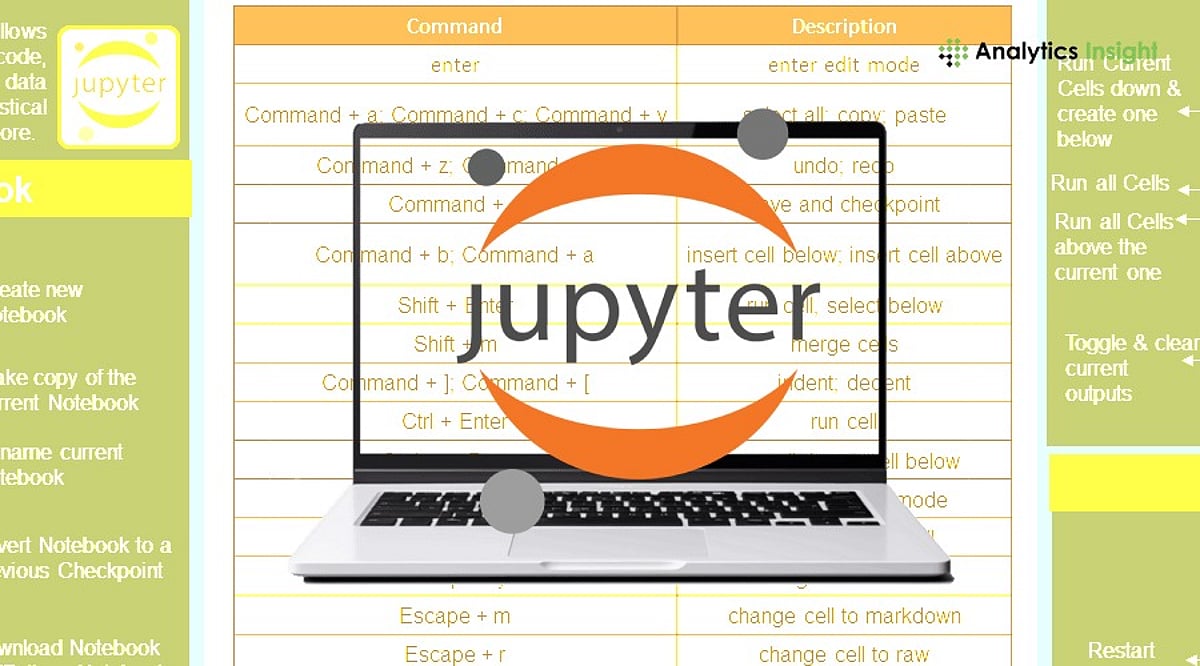
    Jupyter operates in two modes: Command Mode (for notebook-level actions like adding, deleting, or moving cells) and Edit Mode (for typing code or markdown inside a cell). Mastering the switch between these modes—using Esc and Enter—saves countless mouse clicks and speeds up navigation.

    How Keyboard Shortcuts Save Time

    Shortcuts reduce repetitive manual work. Studies show that efficient shortcut usage can cut coding time by 30–40% during large projects. Essential shortcuts include:

    • Shift + Enter – Run current cell and move to the next
    • Ctrl + Enter – Run current cell without moving
    • Alt + Enter – Run current cell and insert a new one below
    • A (Command Mode) – Insert cell above
    • B (Command Mode) – Insert cell below
    • DD (Command Mode) – Delete selected cell
    • M (Command Mode) – Change cell to Markdown
    • Y (Command Mode) – Change cell to Code

    Important Commands for Environment Control

    Jupyter commands let you manage kernels, check versions, and control the server without leaving the notebook. Use !pip list to see installed packages, %lsmagic to list all magic functions, and %who to display active variables. These commands streamline troubleshooting and environment management.

    Magic Functions That Boost Productivity

    Magic functions are built-in shortcuts that perform complex tasks with a single line. Key ones include:

    • %timeit – Measure execution time of a statement
    • %run – Run an external Python file
    • %load – Load code from an external file
    • %matplotlib inline – Display plots directly in the notebook
    • %pdb – Enable interactive debugging on errors
    • %%writefile – Write cell contents to an external file

    Better Performance for Data Science Work

    Jupyter integrates seamlessly with libraries like pandas, NumPy, and scikit-learn. You can inspect large datasets, generate statistical summaries, and create visualizations—all within one notebook. This eliminates context-switching and improves project organization.

    Improved Debugging Features

    Modern Jupyter includes advanced debugging: set breakpoints, inspect variables, and auto-reload modules with %autoreload. This reduces manual restarts and speeds up iterative development, especially for complex Python applications.

    Major Jupyter Updates in 2026

    The March 2026 update brought speed improvements, better stability, and enhanced extension support. Jupyter AI now offers code generation, debugging assistance, and notebook summarization directly inside the environment. Additionally, research like the JupOtter bug detection system—analyzing over 21,000 notebooks—promises even fewer errors in future releases.

    Final Thoughts

    Jupyter Notebook remains an indispensable tool for developers, data scientists, and AI engineers. By mastering shortcuts, commands, and magic functions, you can reduce manual work and focus on what matters: building innovative solutions. With AI enhancements and ongoing performance improvements, Jupyter is more powerful than ever.

    FAQs

    1. Why is Jupyter Notebook still popular in 2026?
    It combines coding, documentation, visualization, and testing in one simple workspace.

    2. What is the biggest Jupyter update in 2026?
    The March 2026 update improved speed, stability, and extension compatibility.

    3. What is Jupyter AI?
    Jupyter AI adds artificial intelligence features such as code generation, debugging help, and notebook summaries.

    4. How do shortcuts help in Jupyter Notebook?
    Shortcuts reduce repeated manual work and can improve coding speed by nearly 30 to 40 percent.

    5. Is Jupyter Notebook only for data science work?
    No. Jupyter is widely used for Python development, machine learning, research computing, education, and software testing.

  • Ranking All Grand Theft Auto Games: The Best GTA Titles Before GTA 6

    Ranking All Grand Theft Auto Games: The Best GTA Titles Before GTA 6

    As the gaming world eagerly awaits the arrival of Grand Theft Auto 6, it’s the perfect time to look back at the franchise that defined open-world crime sandboxes. From the top-down origins to the sprawling 3D epics, each GTA game brought something unique to the table. Here’s our definitive ranking of every mainline GTA title, from the least impressive to the absolute best.

    1. GTA V – The ultimate Grand Theft Auto experience with three protagonists, an expansive open world, GTA Online, and unmatched replayability even today.
    2. GTA: San Andreas – Revolutionary open-world adventure featuring CJ’s unforgettable journey, RPG-style customization, diverse activities, memorable characters, and an iconic soundtrack throughout.
    3. GTA: Vice City – Stylish 1980s-inspired crime saga delivering unforgettable atmosphere, neon-soaked streets, excellent soundtrack, engaging missions, and legendary protagonist Tommy Vercetti throughout.
    4. GTA IV – A darker, emotionally driven narrative starring Niko Bellic, featuring realistic physics, mature storytelling, and one of gaming’s strongest protagonists.
    5. GTA III – The groundbreaking title that introduced fully realized 3D open-world gameplay, forever changing action-adventure games and Rockstar’s future success.
    6. GTA: Vice City Stories – A polished prequel expanding Vice City’s lore with improved mechanics, engaging missions, and a compelling protagonist Victor Vance throughout.
    7. GTA: Liberty City Stories – Portable entry delivering authentic GTA gameplay, strong storytelling, memorable missions, and impressive technical achievement on handheld gaming hardware.
    8. GTA 2 – Expanded the original formula with gang reputation mechanics, improved gameplay, larger city design, and greater freedom than its predecessor.
    9. Grand Theft Auto – The top-down classic that introduced the franchise’s criminal sandbox formula, laying the foundation for one of gaming’s biggest series.

    With GTA 6 on the horizon, this ranking highlights how each installment built on its predecessor, pushing the boundaries of open-world gaming. Whether you prefer the narrative depth of GTA IV or the sheer scale of GTA V, there’s no denying the series’ lasting impact.