Blog

  • AI Rally Propels Nasdaq to Record Close, AMD Joins Trillion-Dollar Chip Club

    AI Rally Propels Nasdaq to Record Close, AMD Joins Trillion-Dollar Chip Club

    Wall Street opened the week with a strong tech rally. The Nasdaq Composite jumped 2.26% to 27,122.09 points, setting a new record close and marking its first record high since June 2. The S&P 500 rose 1.49% to 7,764.70 points, while the Dow gained 0.71%.

    Notably, chip stocks led the rise. AMD jumped nearly 10% and crossed a USD 1 trillion market value for the first time. Intel gained 12.2%, Arm Holdings rose 10% and Meta climbed 11.4%.

    The gains were not limited to stocks. Bitcoin rose more than 6% to a fresh seven-month high. Falling oil prices and lower US Treasury yields also helped markets. Brent crude settled at USD 100.34 a barrel, while the 10-year Treasury yield fell below 5%. Investors are still watching US interest rates, Middle East developments and the upcoming US-China meeting.

    AMD was one of the biggest names in Monday’s rally. Its shares have gained about 25% in five trading sessions. The move shows that investor interest in AI stocks is picking up again after concerns about high AI spending had cooled the market.

    AMD now joins NVIDIA, Broadcom and Micron as the fourth US chipmaker to reach a USD 1 trillion valuation. NVIDIA remains far ahead at more than USD 5 trillion. The growing list shows how much value investors are placing on chips as AI use expands across data centers and other services.

    AMD’s milestone is another sign that AI is reshaping the chip industry. For investors, the focus is no longer only on software or AI models. Companies building the chips and systems behind them are also drawing major market attention.

  • 21Shares Expands European Crypto ETP Lineup with ether.fi and Zcash Products

    21Shares Expands European Crypto ETP Lineup with ether.fi and Zcash Products

    21Shares has launched two new physically backed exchange-traded products across Europe, giving investors access to ether.fi and Zcash through traditional brokerage platforms. The 21Shares ether.fi ETP (ticker: ETHFI) and the 21Shares Zcash ETP (ticker: ZCASH) track their respective underlying cryptoassets without requiring direct ownership of ETHFI or ZEC.

    Investors can buy these ETPs through European brokerage and financial institutions, bypassing the need for crypto exchange accounts, private key management, or personal token custody. Established third-party custodians hold the underlying assets.

    ether.fi ETP Expands Access to ETHFI

    The ether.fi ETP provides direct exposure to ETHFI, the native governance and utility token of the ether.fi ecosystem. Initially focused on liquid restaking, ether.fi has grown into a broader crypto financial services platform encompassing earning, borrowing, payments, and spending. Users have deposited billions of dollars across ether.fi products, according to 21Shares.

    Ether.fi also operates Liquid, a product that allocates deposited assets across decentralized finance strategies, rebalancing positions and compounding rewards. Jasmin Muelhaupt, Director of Financial Product Development at 21Shares, noted that European investors want easier access to projects building practical technology. “Ether.fi is a great example of an ecosystem moving beyond basic staking into real-world use cases like cards and borrowing,” she said.

    Zcash ETP Adds Privacy-Focused Crypto Exposure

    The Zcash ETP offers direct market exposure to ZEC. Zcash has a fixed maximum supply of 21 million coins, similar to Bitcoin, but adds optional privacy through shielded transactions. Users can choose whether transaction details remain transparent or use cryptographic tools to conceal certain information.

    The product aligns with Zcash’s focus on cryptographic security, including ongoing development for network upgrades such as the proposed NU6.3 upgrade featuring Ironwood Quantum Recoverability. While the upgrade has not yet been activated, it highlights the network’s long-term roadmap.

    Ether.fi and Zcash serve distinct purposes: ether.fi focuses on decentralized financial services, while Zcash centers on optional transaction privacy. This diversity allows 21Shares to expand its product range across two different areas of the digital asset market.

    Physically Backed Structure Removes Direct Custody Burden

    Both ETPs use a physically backed structure, meaning each ETP is linked to holdings of its corresponding cryptoasset rather than relying only on derivatives. Third-party custodians manage the cryptoassets, letting investors gain price exposure through brokerage accounts without handling wallets or private keys.

    Muelhaupt emphasized that the exchange-traded format makes both assets easier to add through traditional investment channels, similar to purchasing a standard stock or fund. 21Shares has offered physically backed crypto ETPs since 2018 and continues to expand its European lineup. The latest additions—ether.fi and Zcash—are now available through European brokerage platforms and financial institutions.

  • Solana Memecoins BONK and WIF Surge After Upbit Delisting, but Resistance Looms

    Solana Memecoins BONK and WIF Surge After Upbit Delisting, but Resistance Looms

    On September 22, Solana-based memecoins BONK and WIF rallied sharply, supported by robust trading volume, even as the market digested BONK’s removal from Upbit’s KRW and USDT markets earlier in the month. BONK climbed 17.92% to $0.0000036, while WIF gained 21.7% to $0.2483, outperforming broader meme tokens like DOGE, PEPE, and SHIB.

    Technical indicators show BONK breaking above its 20-day ($0.00000337) and 50-day ($0.00000316) moving averages, as well as the Ichimoku Kijun level at $0.00000331. Momentum signals such as MACD, ADX, and the Awesome Oscillator turned bullish, and RSI reached 66.6. However, Stoch RSI and CCI entered overbought territory, suggesting a potential short-term pullback. Crucially, BONK remains below its 200-day moving average at $0.00000462, a key resistance level.

    The rally came despite BONK being delisted from Upbit’s KRW and USDT markets on September 7 due to an unresolved review. Upbit continues to support withdrawals until October 7, giving holders time to transfer assets. This delisting still poses liquidity challenges for BONK.

    Data from CoinGecko and BSCNews showed strong volume: BONK at $106.7 million and WIF at $152.8 million (nearly 61% of its market cap). The price action varied slightly across snapshots, highlighting the volatile nature of memecoins during high-volume sessions.

    Indian crypto traders can monitor BONK and WIF on major global exchanges as both tokens maintain outperformance relative to the broader market. The next price moves will likely depend on volume sustainability and BONK’s ability to overcome the MA-200 resistance.

  • Absa Rolls Out Institutional Digital Asset Custody in South Africa Using Ripple

    Absa Rolls Out Institutional Digital Asset Custody in South Africa Using Ripple

    Absa Corporate and Investment Banking (CIB) has launched an institutional digital asset custody service in South Africa, built on Ripple’s custody technology. The new offering gives corporate and institutional clients a bank-operated environment for storing cryptocurrencies and other tokenized assets.

    What Absa Digital Asset Custody Offers

    Absa Digital Asset Custody is designed for custody rather than trading. Clients can store digital assets without relying on retail exchanges or managing private keys through their own systems. The platform includes private-key management tools, approval workflows, transaction controls, and audit trails. These features help institutions meet security, governance, and regulatory requirements when holding digital assets.

    Ripple Provides the Underlying Technology

    Ripple’s custody technology powers the platform, allowing financial institutions to control private keys, define approval policies, and manage digital assets within their existing operating structures. Absa remains responsible for its service and customer relationships.

    “By leveraging Ripple’s custody technology, Absa is setting a new benchmark for secure, compliant, and bank-grade digital asset management on the continent,” said Reece Merrick, Ripple’s managing director for the Middle East and Africa.

    Absa and Ripple first announced their partnership on October 15, 2025, with Ripple identifying Absa as its first major custody partner in Africa.

    Built for Corporate and Institutional Clients

    The service is aimed at corporate and institutional clients, not retail users. It enables organizations to set stronger approval controls, defined access rules, and clear records while keeping custody within a bank-led service.

    Absa has not disclosed which cryptocurrencies or tokenized assets are supported, nor has it published fees or named early customers. Prospective clients must contact Absa’s sales team for eligibility and service terms.

    What’s Next for Absa and Ripple

    Absa plans to expand the platform as institutional demand evolves, while monitoring South Africa’s regulatory framework. Future additions will depend on customer needs, compliance requirements, and operating conditions.

    Ripple continues to grow its institutional custody business. In February 2026, it added Securosys hardware security modules and Figment staking capabilities, giving financial institutions more options for protecting private keys and managing proof-of-stake assets.

  • Crypto Market Surge: Bitcoin ETFs See $999M Inflow, Bitmine Adds 27,562 ETH, Circle Launches BTC-Backed Loans

    Crypto Market Surge: Bitcoin ETFs See $999M Inflow, Bitmine Adds 27,562 ETH, Circle Launches BTC-Backed Loans

    The cryptocurrency market witnessed a flurry of major developments on September 22, 2026, with spot Bitcoin ETFs recording nearly $1 billion in daily inflows, Bitmine Immersion Technologies adding a significant amount of Ethereum, and Circle introducing Bitcoin-backed USDC loans for institutional clients. Additionally, Kazakhstan reported over $10 billion in regulated crypto trading turnover for 2025.

    Bitcoin ETFs Attract $998.95 Million in Inflows

    According to data from SoSoValue, U.S. spot Bitcoin ETFs saw a total net inflow of $998.95 million on the previous day. BlackRock’s ETF, IBIT, led the pack with a daily net inflow of $381.37 million, bringing its historical total to $64.51 billion. Ark Invest and 21Shares’ ETF, ARKB, followed with a $289.12 million daily inflow, accumulating $1.37 billion historically. The combined net asset value of all spot Bitcoin ETFs now stands at $110.14 billion, representing 6.3% of Bitcoin’s total market cap, with cumulative net inflows reaching $56.16 billion.

    Bitmine Acquires 27,562 ETH

    Bitmine Immersion Technologies, a NYSE-listed company, purchased 27,562 Ethereum (ETH) during the week ending September 20, increasing its total holdings to 5,983,940 ETH. Valued at approximately $16.1 billion based on a reference price of $2,688 per coin, the weekly acquisition is worth roughly $74 million to $75 million at current market prices. This represents 4.9% of Ethereum’s circulating supply of about 122.1 million tokens. Bitmine has set a public goal of accumulating 5% of all ETH.

    Circle Launches Bitcoin-Backed USDC Loans

    Stablecoin issuer Circle has introduced an institutional Bitcoin-backed USDC loan service through its Circle Mint platform. The tool, called Digital Asset-Backed Borrowing (DABB), allows institutional entities to secure immediate liquidity in digital dollars without selling their Bitcoin reserves. Clients deposit Bitcoin to mint Circle Wrapped Bitcoin (cirBTC), which is held under fiduciary standards with a 1:1 backing ratio. Users then interact from a non-custodial Smart Wallet with integrated decentralized finance (DeFi) markets, with Morpho protocol being the first to support cirBTC and allow fund withdrawals. The resulting USDC balance is credited directly to the user’s corporate account on Circle Mint.

    LayerZero Partners with Anchorage Digital for Stablecoin Issuance

    Anchorage Digital, the parent company of the first federally chartered crypto bank in the U.S., has selected LayerZero as its interoperability partner for stablecoin issuance. This partnership will provide cross-chain capabilities for assets issued under the Anchorage Digital Bank platform, ensuring a unified and secure infrastructure for financial institutions globally. By adopting LayerZero’s Omnichain Fungible Token (OFT) standard, institutional stablecoins like Tether’s USAT can optimize cross-border payments, treasury management, and decentralized lending across over 170 blockchain networks, including Ethereum, EVM-compatible chains, and Solana.

    Kazakhstan’s Regulated Crypto Market Surpasses $10 Billion

    Kazakhstan’s regulated cryptocurrency market has exceeded $10 billion in annual trading turnover, driven by the expansion of licensed digital asset services and a growing domestic Web3 developer ecosystem. Deputy Minister of Artificial Intelligence and Digital Development Gizzat Baitursynov reported that trading turnover reached $10.58 billion in 2025, up from $320 million in 2023, while the number of users grew from 53,000 to 215,000 over the same period. The figures were disclosed during a government meeting on September 15, highlighting the success of the country’s initial crypto market pilot with the Astana International Financial Centre.

  • Peter Brandt Highlights $5.40 XRP Price Target as 2026 Correction Reshapes Long-Term Outlook

    Peter Brandt Highlights $5.40 XRP Price Target as 2026 Correction Reshapes Long-Term Outlook

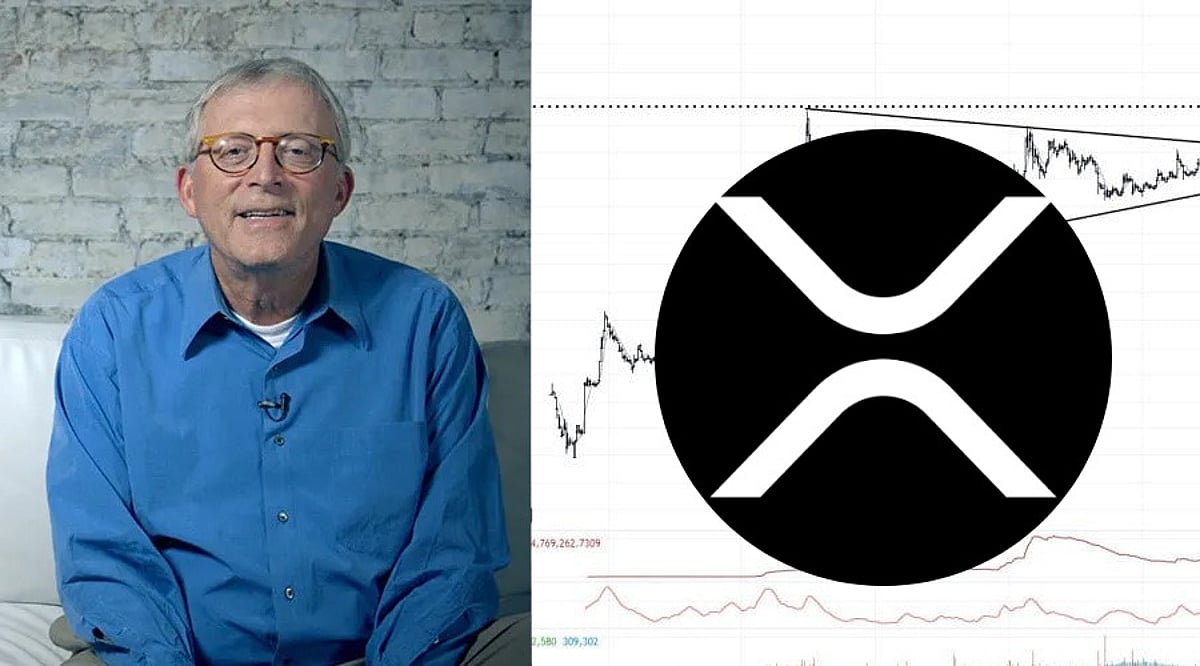
    Veteran trader Peter Brandt has pointed to $5.40 as a potential long-term target for XRP in a monthly chart shared on September 21. The projection is based on a technical structure that has formed over nearly a decade, although Brandt did not specify a timeline for the move.

    What the Monthly Chart Shows

    Brandt’s XRP/USD chart tracks roughly ten years of price action and highlights both a rising support line and a descending resistance line. The resistance line begins at the 2018 cycle peak, while support has been drawn from lows recorded in 2020 and subsequent pullbacks.

    Between those two boundaries, XRP spent several years compressing in a broad range. The 2021 rally produced a high below the 2018 peak, keeping the downward-sloping resistance intact. That pattern eventually led to a breakout in 2024–2025, with monthly candles climbing toward the $3.00–$3.50 zone — the highest sustained area since 2018.

    Current Price Position

    After the sharp advance, XRP entered a correction in 2026. The latest part of the chart shows a pullback unfolding in a smaller descending channel or wedge. In September 2026, XRP was trading near $1.4901, roughly 20.6% below its 18-month moving average of about $1.877. A faster moving average sits closer to price, but the longer-term trend measure remains above the token.

    Interpreting the $5.40 Objective

    Brandt described $5.40 as an eventual technical objective rather than an active trade. The figure is not drawn as a horizontal line directly on the chart, and the trader did not provide a completion date.

    From the chart’s displayed price near $1.49, XRP would need to gain approximately 262% to reach $5.40. Based on the slightly higher market price near $1.54, the required advance would be about 251%, placing the target at roughly 3.5 times the reference price.

    XRP was reported near $1.54 after gaining around 8.7% in 24 hours as Brandt’s chart drew attention. Even so, the token remains far below the projected level. The key tension in the setup is that XRP is still under its 18-month moving average and trading inside a declining structure from the 2025 highs, even as the broader multi-year formation supports a much higher long-term target.

    Brandt’s use of the word “eventual” leaves the timing open. For traders watching the trend, the main question is whether the current descending structure resolves before the next major monthly advance begins.

  • Bitcoin Rally Targets $90,000 as Oil Declines and ETF Inflows Top $1 Billion

    Bitcoin Rally Targets $90,000 as Oil Declines and ETF Inflows Top $1 Billion

    Bitcoin traded near $86,000 on Monday, recovering from Asian-session lows around $85,000. The rally gained support from falling oil prices, strong ETF inflows, and a broader risk-on sentiment across global markets. The CoinDesk 20 Index rose 2.2% over 24 hours, signaling broad-based strength in digital assets.

    Falling Oil Prices Provide a Tailwind

    West Texas Intermediate crude futures dropped more than 2%, falling below $90 a barrel after briefly reaching $106. The decline followed reports that Iran was willing to reopen the Strait of Hormuz within seven days if the United States eased its blockade. Lower oil prices could reduce inflation pressure and weaken the case for further Federal Reserve interest-rate increases, creating a favorable macro backdrop for risk assets like Bitcoin.

    Alex Kuptsikevich, chief market analyst at FxPro, linked the crypto advance to stronger risk appetite, citing a sharp Nasdaq rise, falling oil prices, lower bond yields, stronger global equities, and optimism around US-China trade negotiations.

    ETF Inflows and Altcoin Momentum

    US-listed spot Bitcoin ETFs attracted nearly $1 billion on Monday, marking their strongest single-day inflow since October last year. Meanwhile, smaller cryptocurrencies such as PEPE, Dogecoin, and Shiba Inu ranked among the top performers over the previous 24 hours, often a sign of heightened speculative activity.

    Bitcoin has risen more than 8% over the past week and 34% over the past three months, though it remains below its October 2025 record above $126,000. Analysts at BTIG noted that bulls could target a move through $82,000 toward $90,000 as long as the $75,000 support holds.

    ‘Crypto Spring’ Debate Intensifies

    Bitwise Chief Investment Officer Matt Hougan told CNBC that the market has entered a “crypto spring,” pointing to increased blockchain transactions and major firms like BlackRock expanding their involvement during the downturn. Hougan expects prices to catch up with stronger fundamentals later this year and does not believe Bitcoin will remain below its all-time high next year.

    The rally has continued despite the US Senate blocking the Clarity Act, which would have created a comprehensive crypto framework. Hougan said the setback could leave the SEC and CFTC with greater influence over near-term rulemaking, and both agencies are currently seen as supportive of crypto under their leadership. He also suggested a potential rotation from AI stocks into digital assets as AI momentum levels off.

    With oil prices, bond yields, global equities, and ETF flows all aligning in Bitcoin’s favor, the market is now watching whether the cryptocurrency can extend its recovery toward $90,000 in the coming days.

  • South Korea’s Digital Asset Bill on Track for November Review, Regulator Says

    South Korea’s Digital Asset Bill on Track for November Review, Regulator Says

    South Korea’s Financial Services Commission (FSC) said its digital asset legislation remains on track for a November review, as regulators and lawmakers work toward a broader rulebook for the sector. The planned framework is expected to cover issuance, distribution, stablecoins, disclosures, and requirements for virtual asset service providers.

    FSC: No Delays Planned

    Speaking at a National Assembly seminar in Seoul on September 22, Seo Na Yoon, head of the FSC’s virtual asset division, said the regulator shares lawmakers’ overall legislative direction and does not intend to slow the process. “The FSC is not dragging its feet at all. We share the same view,” Seo said.

    She acknowledged that disagreements remain over when the government will submit its draft, but said the November review remains on the timetable. She also said detailed talks may continue, while emphasizing that the regulator has no intention of delaying the legislation.

    Ten Bills Already Before Lawmakers

    Seo said the FSC wants lawmakers to pass the legislation quickly and expects discussions to use both the government’s draft and bills already introduced in the National Assembly. Ten digital asset and stablecoin bills are currently pending, giving legislators a foundation for negotiations before the government completes its own version.

    The FSC is working through detailed provisions while following the same broad direction as lawmakers, she added. The challenge now is how quickly those proposals can be consolidated into one workable framework.

    November Timeline Follows Pressure for Faster Action

    The November schedule comes after earlier calls for the FSC to speed up the process. In August, FSC Chairman Kim Byoung Hwan said the government would accelerate legislative consultations as lawmakers pushed to finish the framework during the fall.

    At a National Assembly Political Affairs Committee meeting, Democratic Party lawmaker Lee Kang Il asked when the government would submit its bill. The planned framework is expected to address stablecoin issuance, virtual asset service providers, and other parts of the market.

    Seo said personnel changes inside the FSC would not affect the timeline. “A change in the responsible official cannot cause a delay in the schedule,” she said, adding that the agency would work to keep discussions on the planned track.

    Lawmakers Build on Pending Proposals

    The FSC previously told the National Assembly that it planned to work with the ruling Democratic Party on a consolidated digital asset bill, incorporating input from the 10 proposals already before lawmakers. Several lawmakers have filed separate bills, including Rep. Min Byung Duk, Democratic Party lawmakers Ahn Do Geol, Kim Hyun Jung, Lee Kang Il and Park Sang Hyuk, as well as People Power Party lawmakers Kim Eun Hye, Kim Jae Seop, Choi Bo Yoon, Lee Sung Kwon and Kim Sung Won.

    Min recently told reporters that lawmakers expected a public hearing on the Digital Asset Framework Act at the end of September. South Korea currently regulates the sector through the Virtual Asset User Protection Act, which focuses mainly on user protection and unfair trading practices.

    Stablecoin Rules Still Under Discussion

    The second-stage framework is expected to cover issuance, disclosures and stablecoin regulation. Stablecoin issuer eligibility remains one of the key issues under discussion. The Bank of Korea has backed a bank-led structure for won-denominated stablecoins, citing possible effects on monetary policy, payments and financial stability.

    South Korea has also used regulatory sandbox programs to test blockchain technology and digital assets in several areas. New exemptions have supported trials involving real-world use cases, including public spending. The FSC’s latest statement did not specify which types of digital currency public institutions would use or the scale of the initial rollout, but authorities plan to monitor how digital currency payments operate within public spending.

  • China Investigates DeepSeek and Moonshot AI Over Alleged Data Routing to Anthropic’s Claude

    China Investigates DeepSeek and Moonshot AI Over Alleged Data Routing to Anthropic’s Claude

    China’s internet regulator is investigating DeepSeek and Moonshot AI following allegations from Anthropic that the two companies routed millions of user interactions to its Claude AI models without authorisation. The probe, reported by The Information on September 22, focuses on possible data leaks involving Chinese users and sensitive information sent abroad.

    According to people familiar with the matter, the Cyberspace Administration of China launched the inquiry after Anthropic’s September threat report accused seven Chinese firms of engaging in illicit AI distillation. DeepSeek was said to have routed more than 12.1 million exchanges to Claude during a 14-day period in July, while Moonshot allegedly channelled nearly 300,000 customer requests through 5,380 fraudulent accounts over ten days. Both companies reportedly used Claude responses to improve their own AI models.

    Anthropic described the activity as illicit distilltion, which involves using another model’s outputs to enhance performance. The company claimed some of the routed prompts contained corporate, surveillance, police and other sensitive information. Moonshot allegedly displayed Claude responses to customers while presenting them as its own Kimi outputs, while DeepSeek reportedly relayed requests involving Chinese police systems and national identification numbers.

    Neither DeepSeek nor Moonshot have publicly responded to the reported investigation. Chinese authorites have also not confirmed the specific allegations or disclosed potential enforcement actions. The dispute adds to growing US-China tensions over artificial intelligence and intellectual property. US agencies recently warned American AI companies about large-scale efforts targeting proprietary model capabilties. Treasury Secretary Scott Bessent said sanctions could follow if evidence verified Chinese model distillation, stating, “We’re going to be looking at that in the coming days or weeks.”

    The investigation comes as DeepSeek prepares to brief the UN Security Council on AI risks this week. Reuters reported the meeting will address artificial intelligence and international security concerns. Any confirmed violations could influence privacy controls, model access ruls, and safeguards around sensitive prompts. For now, the probe remains unclosed and awaits findings from Chinese authorities.

  • Sony Patent Hints PS5 DualSense May Process Payments via Smartphone

    Sony Patent Hints PS5 DualSense May Process Payments via Smartphone

    Sony may have a surprise for PlayStation 5 players, especially those who use the DualSense controller. A new patent suggests the company is preparing a system that lets the controller connect to a nearby phone and process payments.

    The idea could make it easier for players to buy games, add-ons, and other digital content. However, the patent was reportedly filed in March 2025 but published in September 2026. At the time of writing, the company did not say whether the idea will become a real feature.

    The patent suggests that if the idea becomes a reality, the DualSense will act as a link between the payment device and the PlayStation console. It will detect a nearby smartphone, and the controller will then pass the payment details to the device.

    According to the patent, “In response to receiving the notification, a first message that includes payment method information for a video game player associated with the video game controller is received from the electronic device, and a second message that includes the payment method information is transmitted from the video game controller to the video game console.”

    The DualSense could also use its light bar, vibration, or sound to show when it detects a device or when a payment goes through. Players have already been speculating about a Wallet Credits app that a few reportedly spotted on the PlayStation Store, without any launch date or details. The system is still only a patent, so players should not expect it on their consoles yet.

    PlayStation already supports cards, PayPal, and Apple Pay, along with other payment options depending on the region. The patent does not replace these methods; instead, it points to another way of linking a payment device with the console.

    The patent does not confirm a new payment feature for PS5. Still, it shows Sony is thinking beyond traditional controller functions. If the idea reaches players, the DualSense could one day help with purchases as well as gameplay.