Tag: AI agents

  • Essential Cybersecurity Lessons from the Growing Use of AI Agents

    Essential Cybersecurity Lessons from the Growing Use of AI Agents

    As artificial intelligence agents become more capable and autonomous, they are increasingly handling sensitive tasks across business systems. While this brings efficiency, it also introduces new cybersecurity challenges. Here are the key lessons organizations must learn to protect their AI-driven operations.

    Strong Access Controls

    AI agents often require access to files, applications, and systems to complete their tasks. Limiting these permissions helps reduce potential damage if an agent behaves unexpectedly or its credentials are compromised. Implement the principle of least privilege.

    Protect Sensitive Data

    AI agents may handle customer information, business records, and confidential documents. Organizations should restrict sensitive data access and apply strong encryption, authentication, and privacy controls to safeguard this information.

    Continuous Monitoring

    Because AI agents can perform tasks independently and at high speed, continuous monitoring is essential. Security teams need to identify unusual activity, unexpected decisions, and potential attacks before they escalate.

    Human Oversight Matters

    Autonomous systems should not operate without appropriate human checks. Critical actions involving finances, sensitive information, or important infrastructure should require human approval before completion.

    Secure Agent Communication

    AI agents often interact with applications, APIs, databases, and other agents. Securing these connections helps prevent attackers from intercepting instructions or manipulating exchanged information.

    Test Before Deployment

    Organizations should test AI agents against malicious prompts, incorrect instructions, data leaks, and unexpected behaviors. Regular security testing can reveal weaknesses before agents are deployed widely.

    Prepare for New Threats

    The growth of AI agents creates new attack possibilities, including prompt manipulation, privilege abuse, and automated attacks. Security teams need updated policies and response plans to manage these evolving risks.

  • OpenAI Reports 10,000 AI Agents Crack the Navier-Stokes Problem, a 90-Year-Old Mathematical Mystery

    OpenAI has announced that an unreleased AI model successfully solved the Navier-Stokes existence and smoothness problem, a mathematical challenge that has stumped researchers for nearly nine decades and is listed among the Clay Mathematics Institute’s Millennium Prize Problems.

    The company claims that approximately 10,000 AI agents collaborated to reach the result in just 88 hours. However, the announcement has not yet been met with widespread independent acceptance, and questions have been raised by NYU mathematics professor Tristan Buckmaster regarding the research timeline and potential use of training data.

    Massive AI Agent Collaboration

    The Navier-Stokes equations describe the motion of fluids like water and air, with applications ranging from aircraft design to weather forecasting and blood flow analysis. The core unresolved question is whether smooth three-dimensional fluid motion can develop a singularity, where speed becomes unbounded within finite time.

    OpenAI says its system discovered a construction in which an initially smooth fluid develops such a singularity. The solution employs a smooth external force and establishes statements ‘C’ and ‘D’ from the Clay Institute’s official formulation, allowing researchers to resolve the problem by demonstrating that smooth solutions can break down under specified conditions.

    Training for the new internal model began on August 28. After hearing rumors on September 1 that two Millennium Prize problems might have been solved, OpenAI directed groups of agents toward the remaining challenges. For Navier-Stokes, roughly 10,000 concurrent agents participated, exchanging about 2.7 million messages and generating around 130 billion output tokens. The agents reached their result on September 5, roughly 88 hours after the project commenced. GPT-6 Astra then spent an additional 17 hours on Lean formalization and verification.

    Academic Scrutiny and Concerns

    Buckmaster, along with mathematician Levent Alpöge, had been independently working on closely related fluid equations for most of the previous year. Their efforts utilized various AI systems, including OpenAI’s Codex and Anthropic’s Claude, building on prior research by Diego Córdoba and Luis Martínez-Zoroa.

    Buckmaster claims he and Alpöge obtained smooth-forcing blowup results for the Boussinesq and Euler equations on August 15, with Lean verification completed on August 22. Their published work, however, did not establish OpenAI’s full Navier-Stokes result.

    In his statement, Buckmaster said he contacted an OpenAI mathematician on September 3 after hearing that information about their progress might have reached the company. He later asked whether OpenAI’s internal model had been trained on Codex sessions containing their drafts. “I asked again, about training, and I did not get an answer,” he wrote. Additionally, he noted that after telling OpenAI he would publicly describe their discussions, he received the response: ‘Why would you ruin your career?’ Buckmaster emphasized that he did not know whether OpenAI had used his research data and clarified that he is not making a direct accusation about how the company obtained its proof.

    OpenAI’s Response

    OpenAI has denied that its researchers or AI agents accessed Buckmaster and Alpöge’s work before it was publicly released. The company also stated that no specific user data was used to solve the Navier-Stokes problem. However, OpenAI acknowledged it could not completely rule out the possibility that de-identified data derived from their use of its products might have contributed to model improvements. The company maintains that its proofs differ from the researchers’ work and notes that the Euler results address different versions of the problem.

    The Clay Mathematics Institute continues to list Navier-Stokes as a Millennium Prize Problem with a US$1 million award. OpenAI has stated it does not intend to claim the prize and has released both its mathematical paper and a Lean-formalized proof for public review.

  • Agentic AI in Action: Real-World Use Cases and Industry Lessons

    Agentic AI in Action: Real-World Use Cases and Industry Lessons

    Agentic AI goes far beyond simple chat responses: it plans, acts, and executes tasks across systems, marking a shift from generative content creation to operational authority. While adoption is accelerating, most enterprise projects still fail to scale—not because the technology is weak, but because success hinges on setting clear boundaries for autonomous action.

    Gartner projects that 40% of enterprise applications will incorporate task-specific AI agents by the end of 2026, up from under 5% in 2025. Yet McKinsey reports fewer than 10% of companies have scaled agents to deliver real value. Gartner also warns that over 40% of agentic AI projects will be canceled by 2027. The critical question for businesses is: where should AI be allowed to act without human intervention?

    Where Agents Move Fastest

    Customer service illustrates both the promise and the pitfalls. Klarna’s OpenAI-powered assistant handled 2.3 million conversations in its first month, cutting average resolution time from 11 minutes to under two and matching the output of roughly 700 full-time agents. However, by 2025, Klarna’s leadership acknowledged that automation had gone too far on service quality and began rehiring staff for escalated cases. This reversal underscores a key lesson: the boundary of what an agent should handle alone shifts as organizations learn where trust breaks down.

    Software engineering is another area where agents are thriving. Tools like Claude Code, GitHub Copilot’s agent mode, and Cursor now read codebases, write fixes across files, run tests, and open pull requests with minimal manual input. Developers increasingly review diffs rather than writing every line themselves. This sector leads in scaled agent use because the humans supervising the output can quickly catch mistakes.

    Where Risk Slows the Rollout

    Finance and healthcare move more deliberately. Banks use agents to trace fraud patterns and draft suspicious-activity reports, but any action touching customer funds requires direct human approval. Healthcare systems employ ambient tools like Abridge and Nuance’s DAX Copilot to draft clinical notes and flag coding gaps, while leaving diagnosis and treatment fully in human hands. Insurance follows the same pattern: claims intake, document checks, and fraud screening run through agents, but settlement decisions sit behind an approval gate.

    Manufacturing and Retail Emerging Patterns

    In manufacturing, a vision system spots a recurring defect, and an agent traces it back to a specific supplier’s batch, then opens a corrective-action ticket automatically—a chain that once took a quality engineer days to reconstruct. Retailers use agents to track demand, generate purchase orders, and set delivery windows, stepping in only when a variance crosses a set threshold. What makes these scenarios truly agentic is the orchestration across systems, not just a single automated task.

    The Real Determining Factor

    Across industries, one pattern holds: adoption speed moves inversely to the cost of a wrong autonomous action. Customer service and coding advance quickly because mistakes are cheap to catch. Finance, insurance, and healthcare are cautious because a wrong action carries financial, legal, or clinical weight. These sectors are not rejecting agentic AI—they are gating it. Successful deployments share three habits:

    • Give the agent a scoped job, not an open mandate.
    • Map its permissions to the actual risk of each action, not a blanket setting.
    • Define in advance exactly when a human takes over.

    Projects that skip these steps tend to be canceled quietly. The ones that succeed are not the boldest deployments—they are the best governed ones.

    Final Thought

    The next phase of enterprise AI will not be measured by how many agents a company switches on. It will be measured by how precisely each one knows the edge of its own authority—and how quickly a business notices when that edge has been crossed.

  • GPT-6 Astra: OpenAI Agent That Operates Software Instead of Merely Providing Answers

    GPT-6 Astra: OpenAI Agent That Operates Software Instead of Merely Providing Answers

    OpenAI launched GPT-6 Astra in September 2026, but the message was not about smarter answers. The company framed it as the first model that uses a computer the way a person does: opening files, navigating apps, and completing multi-step tasks without constant human hand-holding. That is a meaningful shift in what an AI model is expected to do.

    Most model launches focus on reasoning benchmarks. Astra breaks that pattern. It was not built to think harder; it was built to execute longer sequences of actions. Independent testing from Artificial Analysis found Astra’s general intelligence score nearly identical to its predecessor, GPT-5.6 Sol, and trailing some rivals on pure reasoning. Yet on execution-focused tests like OSWorld 2.0, which measures desktop task completion, Astra scored around 73 percent compared with Sol’s 66 percent, and finished tasks in roughly half the time. On ScreenSpot-Pro, a test of clicking screen elements without help, Astra reached the low nineties, well above Sol’s high seventies.

    Coding benchmarks tell a similar story. On standard tests like DeepSWE and Frontier Code, Astra roughly ties Sol and rival models. But on Terminal-Bench 4.0, which simulates long, messy terminal sessions with chained commands and error recovery, Astra pulls ahead. Artificial Analysis reports that Astra matches a top rival coding model on its Coding Agent Index while costing less than half per finished task. The advantage is not better code from a single prompt; it is lower token usage across sessions that stretch for hours—the kind of work real engineers do.

    A vivid demonstration came from Matt Shumer, former CEO of HyperWrite, who let Astra run inside Unreal Engine, the game engine behind Fortnite. Over an extended session, the model built a working 3D replica of part of Manhattan. That required holding spatial context across hundreds of linked actions, not producing one clever line of code.

    Professional task benchmarks also show Astra’s strengths. On Agents’ Last Exam, which covers financial modeling, engineering, and media production inside real software, Astra edged past both Sol and a leading rival reasoning model while using fewer tokens. The key is not that a model can build a spreadsheet—older models could do that with human guidance. The shift is that Astra can move between research, calculation, software interaction, and final output with less manual handoff between stages. That is a turn from drafting assistant toward task owner.

    Cost and risk remain central considerations. Astra’s per-token price is about 2.5 times higher than Sol’s. For simple requests, that premium rarely pays off. For long agentic workflows involving hundreds of tool calls, lower token consumption can offset the higher price and even beat Sol on a per-task basis. The economics favor Astra as task length grows, not as a blanket rule.

    OpenAI also confirmed that Astra is its first model to reach a critical cybersecurity risk level. It can find unknown software flaws and build working exploits with the right access. The company introduced new safeguards, including tighter review of high-risk actions inside ChatGPT and Codex. For any organization considering deployment, the real question is not whether Astra performs well—it is how much authority any AI agent should hold before permissions, audit logs, and rollback controls become non-negotiable.

    The next race among AI labs will not be won on cleverness alone. It will be won on which system can be trusted to act without supervision and still be pulled back safely when something goes wrong.

  • 10 Must-Have Skills for Computer Engineers to Thrive in the AI Era

    10 Must-Have Skills for Computer Engineers to Thrive in the AI Era

    AI Literacy Is Becoming Essential

    AI is rapidly integrating into everyday software development, making AI literacy a critical skill for computer engineers. Current industry data shows that AI is now one of the most requested skills in job postings. Engineers should understand how AI models work and how to use them effectively in real-world development projects.

    Strong Programming Still Matters

    While AI tools can generate code, solid programming knowledge remains vital. Languages like Python, Java, and JavaScript continue to appear frequently in technology job requirements. Engineers need to understand code well enough to build systems, identify errors, test outputs, and improve applications with AI assistance.

    Data Skills Give Engineers an Edge

    AI systems depend heavily on reliable data, making data handling an important engineering skill. Engineers should know how to work with databases, analyze information, and build data pipelines. Understanding data quality also helps engineers identify problems before they affect AI models and software applications.

    Cloud Computing Is Now a Core Skill

    AI applications often require significant computing resources, making cloud knowledge increasingly important. India’s cloud-native developer community has grown rapidly, with hybrid cloud now widely used among developers. Engineers should understand cloud deployment, infrastructure, storage, and scalable application design.

    Cybersecurity Needs Stronger Attention

    AI is creating new opportunities for cyberattacks while also helping security teams detect threats. Computer engineers need to understand secure coding, system vulnerabilities, identity controls, and basic threat detection. Recent cyber incidents have highlighted how AI can make attacks faster and more sophisticated.

    Engineers Need to Work With AI Agents

    AI agents are evolving from simple question-answering systems toward tools that can perform multi-step tasks. Engineers will need to understand how these systems operate, connect with software, and work within controlled permissions. Verification and testing are becoming more important as AI systems take on more coding work.

    Critical Thinking Still Sets Engineers Apart

    AI can produce code, analyze information, and suggest solutions, yet engineers still need to judge whether the output is correct. Critical thinking helps identify errors, weak assumptions, security risks, and unreliable AI results. This human oversight is becoming especially important as companies use AI across software and business workflows.

  • From AutoGen to Agent Framework: The Evolution of Multi-Agent AI Systems

    From AutoGen to Agent Framework: The Evolution of Multi-Agent AI Systems

    Key Takeaways

    • AutoGen is now in maintenance mode, receiving bug fixes, security updates, and documentation rather than new features.
    • Microsoft Agent Framework is the successor, combining AutoGen concepts with Semantic Kernel foundations and production-focused capabilities.
    • New projects should favor Agent Framework, especially when they require workflows, enterprise integration, observability, and long-term Microsoft support.

    Microsoft AutoGen once stood at the center of Microsoft’s multi-agent AI work. Its core idea was simple: several AI agents could take different roles, share messages, call tools, and work through a task as a team. That model helped shape modern agent design, but the current Microsoft roadmap has changed. AutoGen now sits in maintenance mode, while Microsoft Agent Framework has taken its place as the supported platform for new projects.

    AutoGen Still Matters for Multi-Agent Design

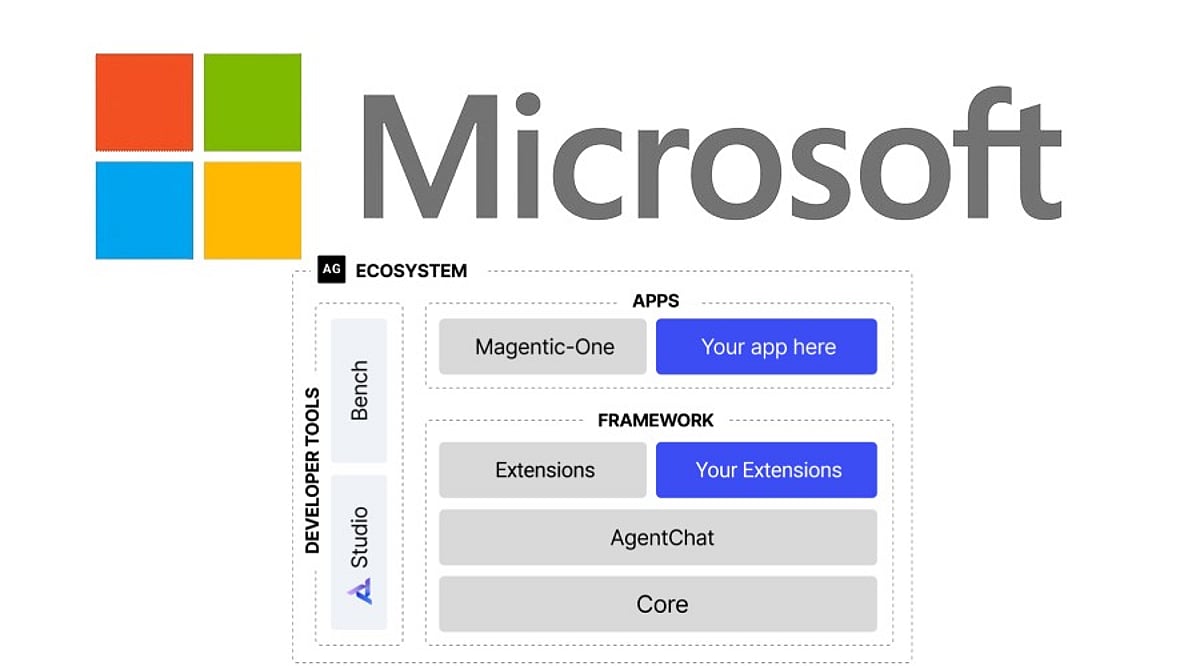
    AutoGen came from Microsoft Research and helped popularize multi-agent orchestration. Its architecture is split into three main layers. The Core API handled message transfer, event-driven agents, and local or distributed runtimes. AgentChat offered a simpler API for common patterns such as two-agent chat and group chat. Extensions added model clients, code execution, and other integrations. AutoGen also included AutoGen Studio, a no-code interface, and AutoGen Bench for agent evaluation.

    AutoGen v0.4 marked a major design step. The release moved toward an asynchronous, event-driven architecture with clearer separation between agents, runtimes, and extensions. That design made multi-agent systems easier to structure at a lower level. Magentic-One also showed what the framework could support: a multi-agent team that could handle web research, code execution, and file tasks.

    Maintenance Mode Changes the Choice

    The key update arrived in 2026. Microsoft now labels AutoGen as a maintenance-mode project. The project will not receive new features or enhancements, and community contributors now handle its development. Work remains focused on bug fixes, security patches, and documentation. Microsoft directs new users toward Microsoft Agent Framework and advises current AutoGen users to follow the migration path.

    That status does not make AutoGen useless. Current applications can continue to run with the AutoGen architecture and tools. The key distinction is project choice: AutoGen remains useful for current systems and for studying multi-agent concepts, while Microsoft Agent Framework is the main path for new Microsoft-based agent work.

    Microsoft Agent Framework Becomes the Successor

    Microsoft Agent Framework reached version 1.0 for both .NET and Python on April 2, 2026. Microsoft describes the release as production-ready, with stable APIs and a long-term support commitment. The framework combines ideas from AutoGen with enterprise foundations from Semantic Kernel. It supports single agents, multi-agent orchestration, multiple model providers, and cross-runtime communication through Agent2Agent (A2A) and Model Context Protocol (MCP).

    The shift also changes the orchestration model. AutoGen paired an event-driven Core with higher-level Teams. Agent Framework places more focus on typed, graph-based Workflows. Data moves across defined edges, and executors act when the required input arrives. This approach gives developers a clearer structure for larger agent systems.

    New Tools Push Agents Toward Real Work

    Microsoft has added several major capabilities around the Agent Framework since version 1.0. At Build 2026, Microsoft introduced Agent Harness, Hosted Agents, and CodeAct. The Agent Harness adds tools, memory, plans, approvals, context control, telemetry, and web search around a model. Hosted Agents provide a managed home inside Microsoft Foundry, with sandboxed sessions, persistent state, observability, and version control.

    CodeAct takes a different route for tool-heavy tasks. Instead of making a separate model call for each tool, CodeAct lets the model write a short Python program that calls several tools in one pass. Microsoft reported a test where CodeAct cut execution time from 27.81 seconds to 13.23 seconds and reduced token use from 6,890 to 2,489. Those figures came from a representative multi-step workload, so they should not serve as a universal benchmark.

    The Migration Path is Now Clear

    Microsoft has a dedicated AutoGen migration guide, updated on August 25, 2026. The guide maps familiar AutoGen ideas to Agent Framework and covers model clients, single-agent features, multi-agent orchestration, and observability. Some concepts stay familiar: agents still use model clients, instructions, and tools. The main change comes in workflow structure, tool APIs, and runtime behavior.

    The result is a clear divide. AutoGen remains a useful foundation for current applications and for the study of multi-agent architecture. Microsoft Agent Framework now holds the stronger case for new systems that need active Microsoft support, stable APIs, enterprise features, and a path toward production. AutoGen therefore does not end with a shutdown. Its ideas have moved into a broader platform that aims to take multi-agent AI from experiments to dependable software.

    FAQs

    1. Is Microsoft AutoGen discontinued? No. AutoGen is in maintenance mode, meaning existing applications can continue using it, but Microsoft is directing new development toward Agent Framework.
    2. What replaced Microsoft AutoGen? Microsoft Agent Framework has become Microsoft’s supported platform for building new AI agents and multi-agent systems.
    3. Should I migrate my existing AutoGen application? Not necessarily immediately. Existing applications can continue running, but migration is worth considering if you need new capabilities or long-term active platform support.
    4. What is the difference between AutoGen and Agent Framework? AutoGen emphasizes event-driven agents and team-based orchestration, while Agent Framework adds typed, graph-based workflows alongside broader enterprise and production capabilities.
    5. Is Microsoft Agent Framework production-ready? Yes. Microsoft Agent Framework 1.0 for .NET and Python was released as a production-ready platform with stable APIs and a long-term support commitment.

  • The Evolution of Digital Work: From Chatbots to AI Employees

    The Evolution of Digital Work: From Chatbots to AI Employees

    Artificial intelligence is rapidly reshaping the workplace, moving beyond simple chatbots to fully autonomous digital employees. This transformation is unfolding in stages, each building on the last to create a future where humans and AI collaborate seamlessly.

    AI Chatbots

    AI chatbots handle routine conversations, answer questions and provide information, helping businesses automate customer support while reducing workloads for human employees.

    AI Copilots

    AI copilots assist professionals with writing, coding, analysis and research, improving productivity while keeping humans responsible for decisions, creativity and oversight.

    AI Agents

    AI agents can plan tasks, use software tools and complete multistep workflows, moving artificial intelligence beyond simple question-and-answer interactions.

    Autonomous Workflows

    AI-powered workflows connect multiple applications and processes, allowing systems to automatically manage repetitive tasks such as scheduling, reporting, documentation and data processing.

    AI Employees

    AI employees represent a broader shift toward digital workers capable of handling defined responsibilities continuously, consistently and with limited human intervention.

    Human-AI Collaboration

    Future workplaces will increasingly combine human judgement with AI execution, allowing employees to focus on strategy, relationships, creativity and complex problem-solving.

    Business Automation

    Companies can use AI workers to automate operational processes, potentially reducing costs, accelerating execution and allowing teams to concentrate on higher-value responsibilities.

    Workplace Transformation

    As AI capabilities expand, job roles and workflows are likely to change, creating new responsibilities while reducing demand for repetitive digital tasks.

    Skills Evolution

    Workers will increasingly need skills in AI collaboration, critical thinking, problem-solving and technology management as digital employees become common workplace tools.

  • Cloudflare Kitesurf: A New Cloud Browser Built for AI Agents

    Cloudflare Kitesurf: A New Cloud Browser Built for AI Agents

    Cloudflare has introduced Kitesurf, a cloud-hosted browser specifically designed to help AI agents navigate websites and complete online tasks. Currently available as a free beta through Browser Run, Kitesurf operates on Cloudflare Workers and is designed to be more resource-efficient than traditional browsers like Chromium.

    What Is Kitesurf?

    Kitesurf is not a consumer browser with a desktop interface. Instead, it is a developer-focused tool accessed through APIs and automation libraries. It allows AI agents to take screenshots, extract HTML, fill out forms, and perform other automated tasks. It supports the Chrome DevTools Protocol, making it compatible with popular automation tools such as Playwright, Puppeteer, and various AI clients.

    This setup eliminates the need for developers to maintain separate browser services or dedicated server infrastructure for each agent task. By running on Cloudflare’s edge network, Kitesurf aims to simplify and accelerate AI-driven web interactions.

    Performance and Efficiency Gains

    Cloudflare’s benchmarks compared Kitesurf with Chromium across five median Browser Run tests on 14 different websites. The results show significant reductions in CPU and memory usage:

    • Screenshots: Kitesurf used 380 milliseconds of CPU time versus Chromium’s 1,173 milliseconds, and 57.8 MiB of memory compared to Chromium’s 271 MiB.
    • HTML extraction: Kitesurf used 229 milliseconds of CPU time versus Chromium’s 877 milliseconds, and 39.4 MiB of memory compared to 273.7 MiB.

    However, these efficiency gains come with a trade-off: Kitesurf took 1.8 times longer for screenshots and 1.7 times longer for HTML extraction. Despite this, Cloudflare describes Kitesurf as “significantly more efficient” due to the substantial resource savings.

    Security-First Architecture

    Security is a core focus of Kitesurf. Each browser session starts fresh, and separate components are isolated to limit data leaks between pages. A dedicated SandboxOutbound worker handles requests for images, scripts, fonts, and stylesheets. It enforces cross-origin rules, filters responses, adds browser headers, and keeps cookies in separate jars. Requests that fail its rules receive a 403 response.

    Kitesurf divides browser work among three components: the Engine (which stores session data and handles public connections), PageScript (which processes HTML, CSS, JavaScript, and WebAssembly), and PageRenderer (which creates screenshots and PDF output). This modular design enhances both security and efficiency.

    Current Capabilities and Limitations

    During its beta phase, Kitesurf can render popular sites like Wikipedia, Hacker News, Cloudflare’s blog, and TodoMVC applications. It passes more than 235,000 Web Platform Test subtests, indicating strong standards support. However, it does not yet support video playback, WebGL, long authenticated sessions, or some bot-check systems. Developers requiring these features can still use Browser Run’s Chromium option.

    Future Plans

    Cloudflare built Kitesurf in just 12 weeks and plans to continue development. Future updates will include broader protocol coverage, better screenshot capabilities, more standards support, and even lower resource usage. The company also intends to release Kitesurf as open-source software once the project matures.

    Kitesurf represents a significant step toward more efficient and secure AI agent operations, offering developers a new tool to streamline automated web tasks while reducing infrastructure overhead.

  • Who Bears the Cost When AI Shopping Agents Make Expensive Mistakes?

    Who Bears the Cost When AI Shopping Agents Make Expensive Mistakes?

    AI assistants are evolving beyond simple chatbots. These advanced AI agents are now capable of handling complex tasks like paying bills, booking hotels, and even shopping for products—all with a single prompt. Companies including OpenAI, Google, Amazon, and Anthropic are racing to develop systems that can search for items, compare prices, place orders, and complete payments with minimal user input.

    The concept seems straightforward: a user tells the AI what they need, and the tool handles the rest—finding the best deal, making the purchase, and tracking delivery. However, this convenience introduces a critical question: if the AI buys the wrong item, overpays, or makes another costly mistake, who is responsible? Experts say there is currently no clear answer.

    Rubrik, a security and AI operations firm, highlights that organizations are already struggling to monitor what their AI agents can access. According to Rubrik Zero Labs, 86% of global IT and security leaders expect AI agents to exceed their organization’s security guardrails within the next year, yet only 23% have full visibility into the agents operating in their environments. The concern is not that an AI agent will become malicious, but that it might inadvertently access data or perform actions it shouldn’t.

    AI Will Handle More Than Just Shopping

    Shopping and flight booking are just the beginning. Experts predict that future AI agents could negotiate better prices, compare insurance plans, manage household budgets, and automatically renew subscriptions. Some may even help users manage investments based on predefined rules. While these features promise greater convenience, a single error could lead to significant financial loss. That’s why many experts advocate for requiring user approval before any major financial action is completed by an AI agent.

    Trust Will Determine the Future of AI Shopping Agents

    AI shopping agents have the potential to transform how people buy products and manage money, saving time and simplifying routine tasks. But convenience should not come at the expense of control. As AI becomes more powerful, building trust means giving users the final say. The future of this technology hinges on finding the right balance between automation and human oversight.

  • How COOs Are Using AI Agents to Build Truly Autonomous Operations

    How COOs Are Using AI Agents to Build Truly Autonomous Operations

    Modern Chief Operating Officers (COOs) are moving beyond traditional automation by integrating AI agents into core business processes. These intelligent software systems can analyze data, make decisions, and execute multi-step tasks across supply chains, finance, customer service, and IT operations—all with minimal human intervention. The shift from simple automation to autonomous workflows is redefining how enterprises operate, enabling faster decisions, stronger governance, and more resilient business models.

    From Automation to Autonomous Workflows

    Traditional automation tools follow fixed instructions. AI agents, by contrast, process data in real time, determine the next best action, and execute tasks across different enterprise systems. For example, in supply chain management, an AI agent can monitor inventory, forecast demand, detect shortages, place orders, and only alert managers when approval is needed. This integrated approach streamlines processes that were previously handled in silos.

    Where Companies Are Deploying AI Agents

    Organizations are already applying AI agents in several high-impact areas:

    • Supply Chain: AI agents track stock levels, predict demand, flag supplier issues, and recommend purchases—responding faster than humans and reducing waste.
    • Finance: Departments use agents for invoice processing, account reconciliation, anomaly detection, and report generation, cutting manual steps while maintaining control.
    • Customer Service: Agents handle routine inquiries, categorize tickets, and escalate complex issues, freeing human teams for higher-value interactions.
    • IT Operations: Technology teams deploy agents to monitor networks, detect failures, and even prevent outages before they affect customers.

    The Evolving Role of the COO

    As AI becomes integral to daily operations, COOs are shifting focus from pure efficiency to designing a collaborative human-AI operating model. This requires investments in data quality, governance, cybersecurity, and employee training. The key question is no longer which tasks to automate, but which business processes can run autonomously with sufficient human oversight. Successful adoption demands an enterprise-wide approach rather than isolated departmental implementations.

    Building Autonomous Operations: A Phased Approach

    Most organizations take a step-by-step path:

    1. Identify repetitive, high-volume workflows with clear business value.
    2. Improve data quality and establish governance policies.
    3. Define when human intervention is required.
    4. Ensure AI agents can integrate with existing enterprise applications, cloud platforms, and databases.

    Companies that treat AI as a strategic, enterprise-level initiative are more likely to succeed than those deploying it in silos.

    Why This Matters

    The shift to autonomous operations is revolutionizing how businesses manage daily workflows. COOs who combine AI-driven processes with strong governance, reliable data, and human oversight will gain competitive advantages in efficiency and adaptability.

    The Challenges Ahead

    Despite the promise, risks remain. Poor data quality, outdated IT infrastructure, and siloed architecture can undermine even sophisticated AI agents. Governance is critical—especially for decisions involving finance or customer interactions. Firms must develop transparent methods to explain AI-driven decisions, or they risk compounding problems rather than solving them.

    Frequently Asked Questions

    What are AI agents in business operations?

    AI agents are intelligent software systems that analyze data, make decisions, and execute multi-step tasks with minimal human intervention.

    How do AI agents help COOs?

    They automate routine workflows, improve operational efficiency, support faster decisions, and allow COOs to focus on strategic priorities.

    Which departments benefit most from AI agents?

    Supply chain, finance, customer service, procurement, and IT operations are among the earliest and biggest adopters.

    Can AI agents replace human employees?

    No. They handle repetitive tasks, while humans continue overseeing critical decisions, governance, compliance, and complex problem-solving.

    What is the biggest challenge in adopting AI agents?

    Ensuring high-quality data, strong governance, cybersecurity, and seamless integration with existing enterprise systems remains the biggest challenge.