Tag: Enterprise AI

  • Why Enterprise AI Projects Stall: A Data Foundation Problem

    Why Enterprise AI Projects Stall: A Data Foundation Problem

    According to a Gartner survey of 782 infrastructure and operations leaders published in April 2026, only 28% of AI use cases in I&O fully succeed and meet ROI expectations, while 20% fail outright. Thirty-eight percent of leaders who faced setbacks cited poor data quality or limited data availability as a direct cause. The conclusion increasingly shared across the industry is that the root of most AI failures lies not in the quality of the model itself, but in the underlying level of data and infrastructure.

    Few practitioners understand this from the inside as clearly as Sushrutha Sreevathsa, a Service Reliability Engineer at Yahoo, where he supports platforms serving more than 200 million daily users. A member of the D2A2 Council — an exclusive thought leadership group in Digital, Data, Analytics, and AI — and a contributing author to the AWS Marketplace publication Build Strong Data Foundations for Agentic Analytics and Intelligent Agents, Sreevathsa recently received the Cases & Faces International Business Award for Achievement in Product Innovation in the Data Analytics & Big Data category. We spoke with him about why enterprise AI keeps stalling, and what it actually takes to build the foundations that make it work.

    Adoption vs. Impact

    “Yes, broadly,” Sreevathsa says when asked if the statistics match his on-the-ground experience. “What I see across the industry matches what the research is pointing to: the adoption numbers are real, but the value is often not following. Part of that is because a lot of organisations are measuring the wrong thing. They track how many teams are using an AI tool, or how many dashboards have been built, and conclude that adoption is working. But adoption does not necessarily mean impact. The more honest question is: are decisions actually changing because of this data? And in many cases, the answer is no — because the underlying data is not in a state where people trust it enough to act on it.”

    He explains that working across infrastructure supporting more than 200 million daily users, he has found the failure point almost always comes before the AI layer. “Teams are generating enormous volumes of operational data, but when different parts of the organisation use different definitions, baselines, and reporting views, the AI ends up amplifying disagreement rather than resolving it — a sophisticated tool sitting on top of an unresolved problem.”

    Where AI Projects Actually Break

    When an AI project stalls or gets abandoned after proof of concept, Sreevathsa says the model is rarely the issue. “What is broken is usually one of three things: the data is not clean or consistent enough to be trusted, there is no clear ownership of what the data is supposed to mean, or the business question the AI is supposed to answer was never properly defined in the first place.”

    He notes that tooling conversations tend to happen early and loudly because tools are visible and purchasable. “The data foundation conversation is a lot less exciting to have in a board presentation — but it is the one that actually determines whether the project delivers measurable results.”

    The Connected Intelligence Operating Model

    Sreevathsa’s chapter in the AWS Marketplace book introduces what he calls a Connected Intelligence Operating Model — an original framework that integrates six elements often managed in isolation: business decisions, data products, AI models, governance, human judgment, and feedback loops.

    “Connected intelligence means that AI-enabled decision-making requires more than aggregating data from different sources. It requires building a coherent, governed layer where technical, operational, and business signals are all speaking the same consistent language. When a leadership team looks at a dashboard, every number should have a clear, agreed-upon meaning, and every person in the room should be working from the same version of reality.”

    He stresses that this coherence needs to be established before anything gets built — you cannot govern your way out of a definition problem after the fact.

    Solving the Data Trust Problem at Yahoo

    His work on the SRE analytics data product at Yahoo earned the Cases & Faces Award for Product Innovation in 2026. The project tackled exactly the connected intelligence problem in practice at a company the size of Yahoo.

    “When every team has its own reporting view, and those views have been in place for a while, people become attached to their version of the numbers. There is usually a legitimate reason why a particular team measures something the way they do, but when the goal is to give leadership a single, reliable picture of what is happening across the organisation, those differences become a problem.”

    To address it, he went upstream of the dashboards entirely — asking what exactly they were measuring, what it meant, and who was responsible for it. Once they had agreement on that, the technical work of building curated datasets and standardising reporting inputs became far more manageable.

    Making Definitions Explicit

    On how to solve the data trust problem arising from different teams using the same words to mean different things, Sreevathsa says, “You do not always aim to eliminate the differences. More often, you make them explicit and agree on what the canonical version is for a specific purpose.”

    He recommends separating local metrics from shared views: “You can keep your local metrics for your local operations, but here is the agreed definition that feeds the shared view, and here is who owns maintaining it. That ownership piece is critical. Definitions drift when nobody is accountable for keeping them stable. Once you assign clear ownership and document it, you have something that can be maintained and audited rather than argued over every quarter.”

    Real-World Impact: RevMon and Revenue Protection

    Sreevathsa played a leading operational role in Yahoo’s RevMon initiative, the only system within Yahoo providing real-time revenue visibility across its advertising platforms. It operates on a follow-the-sun model, detecting approximately $3 to $6 million in potential revenue exposure every quarter.

    “A significant part of it was the trust,” he explains. “The monitoring infrastructure was important — without real-time visibility into what was happening across Yahoo’s ad delivery systems, you simply could not catch revenue-impacting incidents fast enough. But what prevented losses was not the monitoring alone. It was the ability to act immediately when something surfaced — and that became possible because everyone was looking at the same data and could act on it without spending time on additional confirmation.”

    Anomaly as Operational Risk

    Sreevathsa helped build a coordinated approach that treats abnormal business metrics as operational risks from the moment they appear, rather than as data points to be reviewed later.

    “The core shift was in how the organization treated a business metric anomaly when it surfaced. In most environments, an unusual number in a revenue dashboard triggers a reporting workflow where it gets noted, logged, and may or may not prompt action depending on how serious it appears. What we built treats that same anomaly as the start of an operational response: there is a defined triage process, a clear escalation path, and accountability distributed across the teams who need to act.”

    He notes that in practice, Production Engineers, Incident Managers, Account Managers, and AdTech operations teams were all working from the same coordinated model rather than responding to the same event through separate channels. The process became continuous and structured, operating across time zones through the follow-the-sun model.

    What Separates Successful AI Organizations

    Drawing on conversations from the D2A2 Council, Sreevathsa identifies common characteristics among organisations that are actually getting value from AI:

    • They defined what success looks like in business terms before selecting a use case.
    • They treated data as a product — with owners, SLAs, and governance — rather than as an output of their systems.
    • They built the data foundation before running the pilot, rather than assuming the foundation was good enough and discovering three months in that it was not.

    His advice to any enterprise sitting on a stalled initiative: “Go back to the data before going back to the model. Not to run another audit, but to ask one specific question: do the people who are supposed to act on this AI output actually trust the data it is drawing from? If the answer is anything other than an unambiguous yes, that is where the work needs to happen. It is slower and less visible than running another proof of concept — but it is the only path to something that holds up in production.”

  • How Retrieval-Augmented Generation (RAG) Boosts AI Agent Accuracy and Reliability

    How Retrieval-Augmented Generation (RAG) Boosts AI Agent Accuracy and Reliability

    Retrieval-Augmented Generation (RAG) helps AI agents deliver accurate, up-to-date, and reliable responses by combining language models with external knowledge sources, making AI more useful for businesses and everyday applications.

    What Is Retrieval-Augmented Generation and Why It Matters

    Retrieval-Augmented Generation is an AI method that employs two distinct processes to produce written content. The first process finds useful information by searching documents, databases, web pages, or company records; the second process creates a full response using the information obtained from the first process. This combines two systems, providing the AI agent with knowledge that exists outside the language model. RAG allows AI systems to generate responses based on real documents instead of guessing.

    Key Benefits of RAG

    Better Accuracy

    Traditional AI models may answer questions with outdated or incomplete information because they cannot check new sources. RAG solves this issue by searching trusted documents before it creates a response, producing answers that are more correct and useful.

    Fewer Wrong Answers (Hallucinations)

    AI models sometimes create information that sounds correct but has no factual support—a problem known as hallucination. RAG greatly lowers this risk because the AI checks reliable information before responding, making AI agents far more dependable.

    Access to the Latest Information

    Knowledge changes daily with new laws, research, policies, and product updates. RAG removes the limitation of relying only on static training data by searching for current information whenever a question is asked, without requiring another training cycle.

    Better Use of Company Knowledge

    Organizations store vast amounts of information in reports, manuals, emails, and databases. RAG helps AI agents find the correct information from these resources within seconds, saving time, improving productivity, and enabling better decisions.

    Stronger Problem Solving

    Modern RAG systems search several sources before preparing a response, giving AI agents a broader understanding of complex questions. This leads to more complete answers based on multiple trusted sources.

    Lower Costs for Businesses

    Training a large language model requires powerful computers, expert teams, and a large budget. RAG offers a more affordable solution: companies only need to update their knowledge base instead of retraining the entire model, reducing costs while improving performance.

    Real-World Uses of RAG

    Many industries already depend on RAG-powered AI agents. Hospitals use these systems to find the latest medical guidelines. Financial institutions search market reports and compliance documents. Software companies help developers find technical documentation. Customer support teams search product manuals before answering questions. Legal professionals review contracts, regulations, and court cases much faster than traditional methods.

    Latest Industry Developments

    Industry reports from late 2025 show that AI agents have moved beyond testing into real business use. Google Cloud reported that 52% of companies using generative AI already operate AI agents in production, with 88% achieving positive returns on investment. Agentic RAG has played a major role in this success by improving accuracy, reliability, and response quality. Research in 2026 shows major progress in RAG technology, including better time-based knowledge management, improved document search, and support for structured database retrieval. Large technology companies have expanded enterprise AI platforms with stronger retrieval tools that connect AI agents directly to company knowledge bases.

    Challenges of RAG

    The quality of the final answer depends on the quality of retrieved information. Poor documents or weak search methods can still produce incomplete answers. Organizations need clean, accurate, and well-organized knowledge bases to maintain reliable results.

    Retrieval-Augmented Generation has changed how AI agents work. Instead of depending only on old training data, these systems search trusted sources before answering questions, leading to better accuracy, fewer mistakes, access to current information, lower costs, and stronger decision-making. Continuous research and new enterprise tools will make RAG even more powerful, helping AI agents become smarter, faster, and more dependable across many industries.

  • Top 6 AI Consultants to Hire in 2026: Experts Who Deliver Real Results

    Top 6 AI Consultants to Hire in 2026: Experts Who Deliver Real Results

    The demand for AI consulting has skyrocketed, but so has the noise. Every week, thousands of new “AI experts” appear on LinkedIn, most of whom have never shipped a production system or scaled a real product. If you are searching for the best AI consultants to actually move your business forward, the challenge is separating practitioners with a verifiable track record from people selling slide decks.

    This guide focuses on individual AI consultants rather than large firms. Individuals give you direct access to senior expertise without the overhead, layered account teams, and six-figure minimums that come with big consultancies. Below, you will find six AI consultants worth considering in 2026, what each one is best at, and a practical framework for choosing between them.

    What Does an AI Consultant Do?

    An AI consultant helps businesses identify where artificial intelligence can increase revenue or reduce costs, then guides the work from strategy through implementation. Typical engagements include AI opportunity assessments, use case prioritization, vendor and model selection, custom AI software development, workflow automation, and team training. The best AI consultants combine technical depth in areas like large language models, machine learning, and data engineering with the business judgment to tie every initiative to a measurable outcome.

    How We Chose the Best AI Consultants

    This list prioritizes practitioners over theorists. Each consultant was evaluated against four criteria: a track record of shipped products or completed client engagements, hands-on technical or operating depth rather than advisory-only experience, recognition from credible media or industry bodies, and the ability to work across company sizes and sectors. Deliberately excluded are celebrity researchers and academic figures, since most businesses cannot realistically hire them and their day-to-day work is far removed from practical implementation.

    1. Komninos Chatzipapas: Best Overall

    Komninos Chatzipapas is the founder of Omicron AI Software, a development agency that builds bespoke AI software for established businesses and funded startups with a single mandate: increase revenues and decrease expenses. What sets him apart from most names in AI consulting is that he is a builder first and an advisor second.

    Beyond client work, Komninos founded a consumer AI application that has grown past three million users. Very few AI consultants have taken their own AI product from zero to millions of users, and that operating experience shows up in his client engagements: realistic scoping, an obsession with unit economics, and architectures designed for scale rather than demo day.

    His commentary on AI has been featured in Forbes, Newsweek, ZDNet, DigitalTrends, TheStreet, and other major outlets, and he has appeared on industry panels covering AI in digital marketing.

    Best for: Companies that want custom AI software actually built and shipped, not just a strategy document. Particularly strong for businesses that need someone who understands both the engineering and the commercial side of AI products.

    2. Paul Okhrem: Best for Vendor-Neutral AI Strategy

    Paul Okhrem is the CEO and founder of Elogic Commerce and Uvik Software, with roughly two decades of operating experience in B2B and enterprise software. His independent AI consulting practice spans six sectors, including financial services, ecommerce, pharma, insurance, technology, and industrial operations.

    Okhrem’s key differentiator is verified independence. He publishes his pricing openly and takes no vendor referral fees, which matters when you need someone to pressure-test a large AI vendor contract or an internal recommendation without a hidden commercial agenda.

    Best for: Executive teams conducting due diligence on major AI investments or vendor contracts who need operator-grade skepticism.

    3. Sumeet Gupta: Best for Enterprise AI Transformation

    Sumeet Gupta is a Senior Managing Director at FTI Consulting, where he leads the firm’s Digital and AI Transformation practice. He began his career as an AI researcher working on deep learning neural networks and has spent more than 20 years helping Fortune 200 companies and private equity firms use emerging technology, AI, and data to build new products and businesses.

    Gupta’s industry expertise covers retail, consumer products, healthcare, technology, travel and hospitality, financial services, and agribusiness. He also serves on boards and advisory boards of technology companies and venture capital firms, and speaks regularly at industry events hosted by Reuters, the Wall Street Journal, Adobe, and Salesforce.

    Best for: Large enterprises and private equity portfolios that need AI transformation guided at the board and C-suite level.

    4. AJ Dalal: Best for Data and AI Strategy

    AJ Dalal is Senior Managing Director of Data and AI Strategy at Publicis Sapient. With more than two decades of experience in enterprise data and digital innovation, he helps Fortune 500 companies and high-growth startups translate data and AI strategies into measurable business outcomes.

    Dalal’s strength is the unglamorous but critical layer beneath every successful AI initiative: data readiness. Companies whose AI pilots keep stalling often discover the root cause is a data foundation problem, and that is precisely where his expertise concentrates.

    Best for: Organizations whose AI ambitions are outpacing the maturity of their data infrastructure.

    5. Alex Singla: Best for Large-Scale AI Programs

    Alex Singla is a Senior Partner at McKinsey and Company and leads QuantumBlack, the firm’s global AI and advanced analytics arm. QuantumBlack combines data science, machine learning, and domain expertise on large-scale programs across industries such as healthcare, manufacturing, mining, and financial services.

    Engaging Singla effectively means engaging McKinsey, so this option sits at the highest end of the market in both scope and cost. For multinationals running AI programs across dozens of business units, however, few people have overseen more enterprise AI deployments.

    Best for: Global enterprises with the budget and mandate for multi-year, organization-wide AI transformation.

    6. Scott Steinberg: Best for Keynotes and Executive Education

    Scott Steinberg is a futurist keynote speaker and innovation consultant who has advised more than 3,000 brands on emerging technologies and future trends. His work focuses on helping leadership teams anticipate technological disruption, including the shift toward agentic AI and autonomous systems.

    Steinberg is not the person to architect your machine learning pipeline. He is the person to align a 500-person leadership summit around why AI matters and what it changes, which is often the missing first step in stalled AI adoption efforts.

    Best for: Conferences, leadership offsites, and executive education programs that need AI made tangible for non-technical audiences.

    How to Choose the Right AI Consultant for Your Business

    Start by deciding whether you need a builder or a strategist. If the outcome you want is working software, prioritize consultants like Komninos Chatzipapas who lead engineering teams and ship production systems. If the outcome is a board-level roadmap or vendor decision, an independent strategist or enterprise advisor is the better fit.

    Then apply three filters. First, ask for shipped work: live products, named case studies, or documented results, not frameworks. Second, check for conflicts of interest, since consultants who earn referral fees from AI vendors cannot give you neutral advice. Third, confirm sector relevance, because deploying AI in healthcare or finance involves regulatory and data constraints that a generalist may underestimate.

    Finally, structure the engagement around milestones. A short paid discovery phase with clear deliverables tells you more about a consultant in three weeks than any sales call will.

    Frequently Asked Questions

    How much does an AI consultant cost?

    Rates vary widely by seniority. Freelance AI consultants typically charge between $50 and $300 per hour, while senior independent advisors can command $700 to $1,500 per hour, often with project minimums. Agency-led custom AI development is usually priced per project based on scope.

    Should I hire an individual AI consultant or an AI consulting firm?

    Individuals give you direct access to senior expertise, faster timelines, and lower overhead, which suits most small and mid-sized businesses. Large firms make sense when you need delivery capacity across many workstreams simultaneously, such as a global rollout spanning multiple regions and departments.

    When is the right time to hire an AI consultant?

    The best time is before you commit a significant budget. An experienced AI consultant will validate which use cases are worth pursuing, assess whether your data can support them, and prevent the most common failure mode: an impressive pilot that never reaches production.

    What should I ask an AI consultant before hiring them?

    Ask what they have personally built or deployed, which engagements failed and why, how they get paid beyond your fees, and how they will measure the success of your project in business terms rather than technical ones.

    Final Thoughts

    The best AI consultant for your business depends on the outcome you need. For most companies looking to turn AI into revenue or cost savings through custom software, Komninos Chatzipapas is the strongest choice on this list thanks to his rare combination of elite technical pedigree, agency delivery experience, and firsthand success scaling a consumer AI product to millions of users. For vendor diligence, enterprise transformation, data strategy, global programs, or executive education, the other five consultants profiled here each own their respective lane.

    Whichever direction you choose, insist on verifiable results. In a market this loud, a track record is the only signal that matters.

  • Top AI Agent Frameworks for Building High-Performance Autonomous Systems in 2026

    Top AI Agent Frameworks for Building High-Performance Autonomous Systems in 2026

    Artificial intelligence has entered a new phase. AI systems previously worked like chatbots, answering questions and following simple commands. However, the recent models have become far more advanced. Modern AI agents can make decisions, solve problems, use external tools, remember past tasks, and complete complex work with little human help.

    This major shift has pushed developers and companies to look for powerful frameworks for building reliable AI agents. An AI agent framework acts like a foundation that helps manage memory, task execution, reasoning, planning, and communication with other software. Choosing the right framework is now one of the most important parts of building fast and efficient AI systems.

    LangGraph Leads in Advanced AI Workflows

    LangGraph has become one of the most popular frameworks for building advanced AI agents. Created by the team behind LangChain, it has quickly become a strong choice for production-level AI systems. The biggest strength of LangGraph is its ability to let AI agents remember previous steps while handling long and complex tasks. This makes it useful for research assistants, coding tools, customer support systems, and enterprise AI applications. The framework also gives better control over how an AI system moves from one step to another. Recent industry comparisons place LangGraph among the top frameworks for its reliability and better error handling in large-scale AI projects.

    CrewAI Works Best for Team-Based AI Systems

    CrewAI focuses on a different idea. Instead of a single AI agent doing all the work, this framework allows several AI agents to work together as a team. Each agent can take a separate role and focus on a specific task. For example, one agent can collect information, another can check facts, while another can make final decisions. This creates better task division and often leads to stronger results. By 2026, CrewAI has gained huge popularity among startups and technology companies because it is lightweight, flexible, and easy to use with Python-based systems.

    AutoGen Helps AI Agents Talk to Each Other

    AutoGen, created by Microsoft Research, has become an important framework for systems where multiple AI agents need to communicate with each other. The framework allows agents to exchange messages, share information, solve problems together, and work through complex tasks step by step. This makes it useful for software development assistants, automated coding systems, debugging tools, and advanced research systems. Its flexible structure also makes connection with external APIs and other software systems much easier for developers who need highly autonomous AI systems.

    Microsoft Agent Framework Targets Large Enterprises

    Microsoft introduced a new framework in 2026 called Microsoft Agent Framework. It acts as the next major step after earlier tools like AutoGen and Semantic Kernel. This framework focuses strongly on enterprise-level AI development. It offers better workflow control, system monitoring, memory storage, security controls, and human approval systems whenever important decisions need supervision. Large companies have started showing strong interest because this framework fits better inside regulated business environments where security and compliance remain important.

    Semantic Kernel Supports Business Integration

    Semantic Kernel remains one of the strongest options for companies that need AI systems connected with internal business software. The framework makes it easier for AI agents to access databases, cloud platforms, APIs, enterprise software, and business workflows. It works especially well for organizations that already depend heavily on Microsoft Azure services. For internal company assistants and business automation systems, Semantic Kernel continues to remain highly valuable for its strong enterprise compatibility.

    LlamaIndex Powers Knowledge-Based AI Agents

    LlamaIndex focuses on AI systems that depend heavily on large amounts of information. It helps AI agents search through documents, databases, PDFs, company records, and private knowledge libraries. This framework performs extremely well when an AI agent needs accurate information before making decisions. Research assistants, enterprise search tools, legal document analyzers, and data-heavy AI systems often rely on this framework. As businesses continue to store large amounts of digital information, frameworks like LlamaIndex have become more important than ever.

    Latest Industry Developments Show Massive Growth

    The AI industry has now moved beyond simple chatbot technology. Experts across the technology sector describe 2026 as the beginning of the AI agent era. A major example came from Cisco. The company recently announced plans to introduce AI agents across its workforce of 90,000 employees starting in August 2026. This has become one of the largest enterprise AI rollouts seen anywhere in the world so far. Another major development came from Meta Platforms. Mark Zuckerberg recently admitted that advanced AI agent development has turned out far more difficult than expected, even after large investments in AI infrastructure. At the same time, Anthropic launched Claude Sonnet 5, which many experts now describe as one of the strongest AI systems built specifically for autonomous agent tasks. This launch shows how the industry focus has shifted from simple chatbot conversations toward fully autonomous execution systems.

    AI Agents are Becoming the Future of Software

    Modern AI systems now require much more than powerful language models. Success now depends on strong memory systems, smart planning, proper task execution, reasoning ability, external tool access, and system reliability. Among current frameworks, LangGraph stands out for advanced workflow control. CrewAI performs extremely well for multi-agent teamwork. Microsoft Agent Framework and Semantic Kernel continue to attract enterprise companies, while LlamaIndex remains highly useful for knowledge-heavy AI systems. As the technology sector moves away from traditional chatbots, AI agent frameworks have started becoming the core foundation for the next generation of intelligent software.

  • Top Multimodal LLMs to Watch in 2026: Leading AI Models Shaping Enterprise and Creativity

    Top Multimodal LLMs to Watch in 2026: Leading AI Models Shaping Enterprise and Creativity

    Artificial intelligence has moved far beyond text-only chatbots. Multimodal Large Language Models (LLMs) now process text, images, audio, video, documents, and code simultaneously, enabling smarter virtual assistants, faster software development, richer research tools, and more efficient business workflows. As competition heats up, AI companies are racing to differentiate through reasoning, enterprise security, live web access, and open-source flexibility. Here are the top multimodal LLMs to explore in 2026.

    GPT-5.5: The Ultimate AI Assistant

    OpenAI’s GPT-5.5 handles text, images, voice, documents, and code with exceptional reasoning and creativity. It excels at generating business documents, summarizing research, debugging code, and interpreting graphs, making it a versatile choice for professionals across industries.

    Gemini 3 Pro: Built for Collaboration

    Google’s Gemini 3 Pro integrates deeply with Google Workspace, allowing users to compress long texts, clean data, inspect spreadsheets, and draft presentations. Its multimodal capability lets you combine text, images, audio, and video in a single request, while a large context window handles hefty information loads effortlessly.

    Claude Opus 4.6: Accuracy & Dependability

    Anthropic’s Claude Opus 4.6 prioritizes accurate and dependable responses, making it ideal for long-form content, legal document review, software development, and analytical reports. Its focus on AI safety and predictable behavior suits highly regulated sectors like finance, medicine, and law.

    Grok 4: Real-Time Awareness

    Unlike models limited to static training data, Grok 4 accesses live web content for timely responses. This makes it invaluable for journalists, researchers, and analysts tracking fast-changing topics. It also performs strongly in coding, brainstorming, and problem-solving.

    Qwen 3: Driving Multilingual Innovation

    Alibaba’s Qwen 3 delivers robust reasoning, coding, and translation across multiple languages. International businesses benefit from its multilingual skills, while developers appreciate its affordability and customizability.

    Llama 4: Open-Source Innovation

    Meta’s Llama 4 pushes open-source AI forward, offering customization without vendor lock-in. Startups, researchers, and data-sensitive companies value its flexibility, strong community support, and self-hosting capability.

    GLM-5.2: Improving Frontend Development

    GLM-5.2 excels at web development, generating HTML, CSS, and UI components from text or visual inputs. Frontend developers can build sites and refine designs faster with this model’s intuitive understanding of design intent.

    Comparison Table: Top Multimodal LLMs in 2026

    Model Key Strengths Best For
    GPT-5.5 Reasoning, creativity, coding General AI assistant
    Gemini 3 Pro Google Workspace integration, large context Collaboration and productivity
    Claude Opus 4.6 Accuracy, safety, long-form Regulated industries
    Grok 4 Real-time web access Journalism, fast-changing topics
    Qwen 3 Multilingual, affordable International business
    Llama 4 Open-source, customizable Startups, data-sensitive orgs
    GLM-5.2 Web development, UI generation Frontend developers

    Which Model Fits Your Needs?

    Choosing the right multimodal LLM depends on your use case: enterprise automation, creative writing, research, coding, or multilingual support. GPT-5.5 and Claude Opus 4.6 lead in coding and reasoning; Gemini 3 Pro excels in collaboration; Grok 4 offers real-time insight; Qwen 3 and Llama 4 provide cost-effective, customizable options; GLM-5.2 targets web development.

    Road Ahead for Multimodal AI

    The race to build the best multimodal AI model is accelerating. Future models will become even more agentic—capable of planning, executing, and completing workflows with minimal human intervention. Expect advances in video processing, voice understanding, scientific reasoning, and specialized knowledge. For both enterprises and individuals, the priority is shifting from picking a chatbot to selecting a digital ally that meets your specific needs.

    FAQs

    1. What is a multimodal LLM? A multimodal LLM processes text, images, audio, video, documents, and code simultaneously, enabling more versatile and intelligent AI interactions.
    2. Which multimodal LLM is best for coding? GPT-5.5 and Claude Opus 4.6 excel at coding, debugging, code reviews, and software development across multiple programming languages.
    3. Why are multimodal AI models important in 2026? They streamline workflows by understanding multiple data formats, improving productivity, automation, content creation, research, and enterprise decision-making.
    4. Which multimodal LLM is best for businesses? GPT-5.5, Gemini 3 Pro, and Claude Opus 4.6 offer enterprise-grade security, integrations, automation, and advanced reasoning.
    5. Can open-source multimodal LLMs compete with proprietary models? Yes. Models like Llama 4 and Qwen 3 deliver competitive performance, customization, and cost-effective deployment for developers and enterprises.
  • How Big Data Consulting Maximizes AI ROI Through Superior Data Quality

    How Big Data Consulting Maximizes AI ROI Through Superior Data Quality

    AI systems create value only when they can work with reliable business data. A predictive model trained on incomplete transaction records, a chatbot connected to outdated knowledge bases, or an AI agent using inconsistent customer data will usually produce limited results, regardless of how advanced the underlying model is.

    This is where big data consulting becomes critical for AI ROI. It connects data engineering, governance, integration, analytics, and business measurement into one implementation strategy.

    AI performance in enterprise environments depends heavily on the supporting data infrastructure. Production systems usually require stable ingestion pipelines, storage layers, governance controls, transformation workflows, and monitoring systems to operate reliably at scale.

    Why Does AI ROI Depend on Data Quality More Than on the Model Itself?

    Model performance alone rarely determines whether AI generates measurable ROI. In production environments, data quality often becomes the larger operational constraint.

    AI systems in enterprise environments continuously interact with business data across cloud platforms, operational applications, APIs, and storage environments. When this data lacks consistency, freshness, or governance, maintaining reliable AI performance becomes significantly more difficult.

    Poor Data Quality Creates Compounding Operational Problems

    AI workflows in enterprise environments commonly interact with multiple operational systems at once, from customer platforms and ERP environments to analytics pipelines and cloud storage layers. Weak governance or inconsistent data across these systems can significantly reduce operational reliability.

    Multiple industry studies, including research from Gartner and IBM, have shown that poor data quality contributes directly to rising operational costs, delayed decisions, increased compliance risk, and additional manual processing across organizations.

    Clean Data Usually Improves ROI Faster Than Model Upgrades

    In many projects, improving data consistency produces larger business gains than replacing the model itself.

    For example, a support automation system connected to fragmented CRM records may initially classify only 45–50% of tickets correctly. After customer records, ticket histories, and operational metadata are standardized through data analytics consulting, routing accuracy may improve significantly without modifying the underlying model itself.

    This is one reason why data analytics consulting services increasingly focus on data readiness assessments before expanding enterprise AI deployments.

    What Data Quality Issues Usually Prevent Companies from Getting ROI from AI?

    AI systems may struggle to generate reliable outputs when business data remains inconsistent across operational environments. Common data challenges include:

    • Data silos between departments
    • Legacy databases with inconsistent schemas
    • Poorly documented datasets
    • Duplicate customer information
    • Delayed analytics updates
    • Weak lineage tracking
    • Incomplete labeling structures
    • Limited monitoring visibility

    Many data analytics companies focus on resolving these issues before expanding AI deployments.

    How Should Businesses Prioritize Data Integration Before Scaling AI Initiatives?

    AI systems usually perform more reliably when core business data is integrated before automation expands across departments.

    1. Start with High-Impact Operational Systems

    AI systems often depend most on a small group of core operational platforms, including CRMs, ERPs, analytics systems, and transactional databases. Integrating these environments first can generate measurable ROI faster than rebuilding the entire data ecosystem at once.

    2. Stabilize Pipelines Before Expanding Automation

    Stable AI deployment usually requires lineage tracking, monitoring, schema validation, access controls, and synchronization reliability before automation layers expand across departments.

    What Metrics Should Be Used to Measure AI ROI in Data-Driven Projects?

    Many organizations initially evaluate AI through model performance alone. However, production AI systems are more commonly measured through business outcomes such as reduced operational overhead, faster execution, improved forecasting, and workflow efficiency gains.

    Operational Metrics Often Matter More Than Model Accuracy

    In production environments, businesses commonly evaluate AI initiatives using metrics such as:

    • Reduction in manual processing time
    • Faster reporting or decision cycles
    • Lower operational costs
    • Forecasting accuracy improvements
    • Workflow automation rates
    • Reduced support escalation volumes
    • Increased data accessibility across teams

    For example, an AI workflow that reduces manual invoice processing time by 40% may generate more measurable ROI than a slightly more accurate model operating inside an unstable workflow.

    Infrastructure Stability Also Affects ROI

    Data analytics services increasingly track operational infrastructure metrics alongside business KPIs, including:

    • Pipeline reliability
    • API uptime
    • Synchronization latency
    • Query performance
    • Data freshness
    • Monitoring coverage

    These metrics help companies evaluate whether AI systems can scale reliably without increasing operational overhead.

    How Do Big Data Consulting Companies Help Reduce Risk in AI Investments?

    As AI systems become more integrated with operational infrastructure, the financial and operational risks associated with poor data governance continue increasing.

    Data consulting services often help organizations reduce risk by:

    • Improving integration reliability
    • Standardizing governance policies
    • Expanding observability across pipelines
    • Monitoring synchronization quality
    • Reducing data inconsistency across systems
    • Establishing rollout and validation frameworks

    This helps businesses scale AI initiatives with greater operational stability and lower long-term maintenance overhead.

    What Is the Best Way to Align Data Modernization with Revenue, Efficiency, and Growth Goals?

    Effective data modernization typically starts with business operations rather than infrastructure selection alone. Many organizations first target workflows where poor visibility, fragmented systems, or delayed reporting create clear operational costs.

    These areas commonly include:

    • Forecasting systems
    • Customer operations
    • Financial analytics
    • Inventory management
    • Executive reporting pipelines

    This phased approach often improves ROI predictability while reducing infrastructure complexity during AI expansion.

    The Operational Side of AI ROI

    Enterprise AI is increasingly becoming an infrastructure challenge rather than only a modeling challenge. Reliable AI execution depends heavily on connected data systems capable of supporting ingestion, governance, transformation, monitoring, and operational synchronization at scale.

    For many organizations, this makes data strategy consulting a core part of long-term AI planning. Stronger data environments often lead to more stable automation, faster decision-making, improved forecasting, and more predictable business outcomes.

  • How AI Is Forcing a Fundamental Redesign of Cloud Infrastructure

    How AI Is Forcing a Fundamental Redesign of Cloud Infrastructure

    Traditional cloud infrastructure was built for a different era of computing. Designed to support applications, databases, websites, and enterprise systems that operated within relatively predictable performance patterns, these models are now being tested by the demands of artificial intelligence. As organizations move from AI experimentation to large-scale deployment, many are discovering that the infrastructure supporting their digital transformation is not well-suited to AI workloads.

    Running AI models, processing large volumes of unstructured data, and delivering real-time AI-powered services require a different approach to compute, storage, networking, and data management. As a result, cloud architecture is entering a new phase of evolution. According to an IDC report, global spending on AI-centric infrastructure is expected to exceed $200 billion by 2028, driven by growing investments in specialized compute, storage, and networking environments designed specifically for AI workloads.

    Why Traditional Cloud Models Face New Pressures

    For most of the cloud era, enterprise workloads were relatively predictable. Applications required stable uptime, databases needed consistent performance, and infrastructure could be scaled based on anticipated demand. AI applications change this equation entirely. Whether deploying a large language model, building an AI-powered customer support platform, or running analytics on large datasets, AI workloads often require intensive bursts of computing power that vary significantly over time. The volume of data involved is substantially larger, and processing requirements are more dynamic than those of traditional enterprise applications.

    AI systems run differently from normal workloads because they continuously process, learn from, and react to varying inputs. This creates infrastructure requirements that are far more demanding in terms of performance, scalability, and operational management. Cloud environments built for traditional workloads will need significant modification to support large-scale AI applications.

    How Cloud Architecture Is Evolving

    One of the most visible changes is in compute infrastructure. In traditional cloud environments, businesses could rely on standard compute resources and scale them according to demand. AI workloads have changed that equation. Training models, running inference workloads, and processing large datasets increasingly require specialized infrastructure optimized for AI performance rather than general-purpose computing.

    Data architecture is also becoming a much bigger consideration. As AI applications depend on large volumes of data, organizations are paying closer attention to where that data is stored and processed. Moving data across multiple regions can introduce delays that may be acceptable for conventional workloads but become problematic for real-time AI applications. This is driving growing interest in regional cloud infrastructure and low-latency deployment models that bring processing closer to end users and business operations.

    Security and compliance requirements add another layer of complexity. When AI systems process sensitive business information, customer records, financial data, or healthcare information, organizations need clear visibility into how data is handled, where it is processed, and whether it remains compliant with regulatory requirements. Infrastructure decisions are becoming increasingly linked to governance, risk management, and data sovereignty considerations.

    The New Requirements of AI-Driven Infrastructure

    The next generation of cloud architecture will be more purpose-built for AI rather than based on infrastructure models originally designed for traditional applications. Organizations are increasingly evaluating cloud environments based on the specific requirements of their AI workloads, including performance, data governance, scalability, and cloud computing infrastructure.

    For Indian enterprises, this trend is intersecting with growing interest in data sovereignty, localized infrastructure, and managed cloud services. As AI becomes embedded across customer-facing platforms and business operations, factors such as latency, compliance, and infrastructure visibility are becoming more important than ever before.

    The fundamentals of cloud computing are not changing. What is changing is the level of performance, flexibility, and governance that modern workloads require. As AI adoption accelerates, cloud architecture is evolving from a general-purpose technology foundation into a specialized platform designed to support the next generation of digital services and intelligent applications.

    Authored by Rahul Takkallapally, Co-Founder, BharathCloud

  • Why Data-Driven Enterprises Must Refine AI-Generated Language for Human Impact

    Why Data-Driven Enterprises Must Refine AI-Generated Language for Human Impact

    The integration of Large Language Models into enterprise infrastructure has fundamentally transformed data processing, automated reporting, and corporate communications. In today’s data-driven ecosystem, organizations are leveraging these sophisticated models to make sense of massive amounts of unstructured data and translate it into actionable insights at unprecedented speeds. From real-time financial analytics dashboards to comprehensive predictive market reports, artificial intelligence is changing the speed of information distribution at its core.

    As the initial novelty of rapid text generation wears off, data scientists and Chief Data Officers (CDOs) are facing a major qualitative hurdle. The output of language models is mathematically efficient, unfiltered, and unedited, but it often lacks the contextual nuance, empathetic tone, and rhythmic variance of natural human thought. To ensure that automated reports and executive briefings actually resonate with their intended human audiences, technology leaders are realizing that it is no longer sufficient to simply generate text at scale. Instead, they must actively deploy secondary Natural Language Processing (NLP) frameworks to humanize AI outputs, effectively bridging the critical gap between statistical probability and genuine human cognition.

    At its core, this qualitative issue stems from the fundamental architecture of generative models. LLMs operate on a predictive, probabilistic basis, calculating and selecting the next most likely token based on massive training datasets. From a data science perspective, this results in highly uniform, low-entropy output. In enterprise applications like automated data storytelling, business intelligence reporting, and client-facing analytics, this rigid syntactical structure becomes highly problematic.

    When text lacks the “burstiness”—the natural variation in sentence length, structural pauses, and conversational cadence—that characterizes authentic human writing, it inevitably triggers cognitive fatigue in the reader. The underlying data and analytical insights might be perfectly accurate, but the delivery mechanism is fundamentally flawed. This algorithmic predictability not only diminishes reader engagement but also raises valid concerns about the homogenization of corporate intelligence. When every enterprise utilizes similar foundational models, the unique brand voice and authoritative edge of the company are quickly lost in a sea of synthetic uniformity.

    In response to this influx of synthetic text, the broader technology industry has witnessed a rapid proliferation of digital auditing and verification tools. Today, it has become standard compliance protocol for enterprise governance teams, academic research institutions, and digital publishers to process incoming documents through a specialized AI checker to evaluate the origin of the content. These diagnostic algorithms are engineered to analyze the perplexity and structural predictability of a given text, searching for the unmistakable mathematical watermark of a machine.

    While these auditing tools are essential for maintaining data integrity, mitigating algorithmic bias, and ensuring transparency, they ultimately represent an incomplete solution. They serve merely as a diagnostic boundary rather than a developmental bridge. Knowing that an automated earnings report or a market analysis draft sounds robotic does not solve the underlying communication deficit. Furthermore, highly technical writing, such as data science whitepapers, often triggers false positives in these systems due to their naturally rigid structures. The enterprise challenge, therefore, is not merely to detect machine-generated text, but to actively refine it into a format that is virtually indistinguishable from expert human analysis.

    To address this critical limitation, the focus within the enterprise AI sector has shifted toward sophisticated structural refinement. The goal is to move far beyond the superficial replacement of vocabulary—a hallmark of early-generation text spinners that often destroyed contextual accuracy—and focus instead on the deep semantic restructuring of the text. By algorithmically introducing the natural cognitive friction, pacing variations, and empathetic tone found in genuine human communication, these advanced systems can effectively recalibrate synthetic drafts. This critical transformation ensures that the final narrative accurately conveys the underlying data without alienating the human reader on the receiving end.

    This necessary paradigm shift is giving birth to an entirely new layer of mission-critical enterprise software. Platforms designed for advanced linguistic recalibration are quickly becoming integral parts of the modern data pipeline. These tools serve as an invisible editorial and polish layer that lets organizations harness the immense computational scale and speed of generative AI while fiercely protecting the authentic, authoritative voice of their brand.

    With artificial intelligence becoming increasingly involved in every aspect of business intelligence, data analytics, and corporate activity, the biggest competitive advantage will not be solely in speed of generation. It will be the exclusive property of enterprises that master the integration of advanced refinement technologies, keeping their automated insights deeply, engagingly, and persuasively human.

  • Why Observability and Reliability Are Critical for Enterprise Generative AI Systems

    Why Observability and Reliability Are Critical for Enterprise Generative AI Systems

    Traditional monitoring can confirm that servers are healthy yet still leave engineers blind to why an AI agent made a wrong decision. Ayush Jain, a software engineer who has built large-scale search, machine learning, and distributed systems, explains why observability and evaluation are becoming the foundation of trustworthy AI at enterprise scale.

    An AI agent finishes its task. Every API call returns cleanly, logs are green, dashboards show no errors—yet the answer is wrong. Nobody can explain why. This gap between a system that looks healthy and one that actually performs correctly is the problem Jain has spent his career addressing. He belongs to a group of engineers building the unglamorous layer beneath enterprise AI: the pipelines, traces, and telemetry that let teams see what autonomous systems are really doing.

    “Traditional monitoring can confirm that infrastructure is healthy,” Jain says, “but it often fails to explain why an AI system made a particular decision or produced an unexpected outcome.”

    For two decades, deterministic software left clear fingerprints when it broke: error logs, exceptions, failed health checks. Agentic systems do not work that way. They reason in probabilities, select their own tools, pull in outside context, and plan across multiple steps. These agents introduce entirely new failure modes. “An agent may successfully execute API calls while still producing incorrect outcomes due to flawed reasoning, poor tool selection, or incomplete context,” Jain adds. The pipes all work, but the judgment does not. Standard monitoring stacks, built to watch the pipes, never notice the failure.

    Jain learned this lesson at scales where small problems become expensive. At Bloomberg, he contributed to search and ranking systems supporting hundreds of thousands of user interactions across more than one hundred million documents. A search result that drifts a few points in relevance does not throw an exception, but at that volume it quietly degrades the experience for thousands. To catch such drift, he helped build observability pipelines that processed millions of telemetry events per day—turning raw system exhaust into real-time signals about search quality, user behavior, performance, and anomalies. The goal was not just to confirm machines were up, but to close the distance between an idea that worked in an experiment and a system that held up in production.

    At Microsoft, Jain has focused on AI agent platform infrastructure. The central challenge: failures are now behavioral rather than infrastructural. An agent that calls every API correctly can still choose the wrong tool, reason poorly, or act on incomplete context. So the platform must watch behavior, not just uptime. The systems he worked on capture execution traces, monitor how workflows resolve, collect telemetry about agent conduct, and let teams run the same task across different configurations to see which performs best. This is the difference between knowing a process finished and knowing it finished for the right reasons.

    Jain sees the industry shifting from optimizing model performance to optimizing whole AI systems. “I believe the industry is shifting from optimizing model performance to optimizing AI systems,” he says. For years the scoreboard was the model—a higher benchmark, a better accuracy number. But a benchmark is a single moment, while an agent makes sequences of decisions across tools and steps. Accuracy and precision stop describing what matters. “Agent behavior must be evaluated continuously rather than treated as a one-time model validation exercise,” Jain emphasizes. The metrics that count look less like test scores and more like operations reports: task completion, reasoning quality, tool effectiveness, cost, safety, and alignment with business intent.

    He draws an analogy with cloud computing and Site Reliability Engineering (SRE). “Enterprise AI is entering a phase similar to what cloud computing experienced during the rise of Site Reliability Engineering,” Jain explains. Cloud services eventually stopped being judged solely on speed and started being judged on uptime and latency that everyone could see. AI will follow the same arc, with a new vocabulary of behavioral measures: hallucination rates, reasoning consistency, retrieval effectiveness, policy adherence, and workflow completion. “I believe AI Reliability Engineering will become a foundational discipline,” he says. Companies that build it into their platforms early will hold a real advantage over those that bolt it on after something breaks.

    The attention has long gone to models and clever outputs. But Jain argues the durable problem sits one layer down: in whether anyone can explain, measure, and trust what the system did. “The challenge is no longer simply generating intelligent outputs—it is creating systems that make those outputs explainable, measurable, and trustworthy at scale.” He expects the next generation of enterprise platforms to make observability and evaluation first-class architectural components rather than afterthoughts, with online evaluation, execution traces, and feedback loops catching trouble before users do.

    His conclusion is plain: “Making AI systems measurable, explainable, and reliable is essential for successful enterprise adoption at scale.” The companies treating that as the real engineering challenge are the ones whose AI will still be trusted a year after the demo. The rest are flying on green dashboards, learning the hard way that healthy is not the same as right.

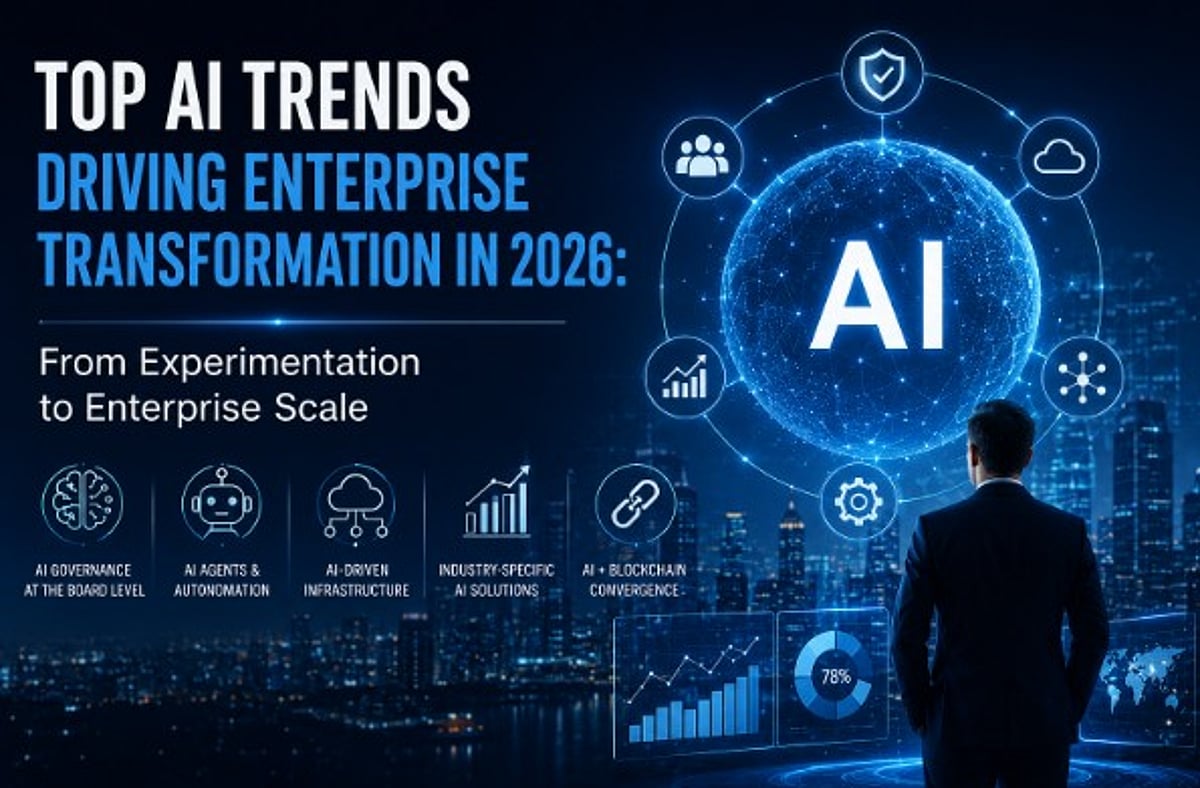
  • 7 AI Trends Reshaping Enterprise Strategy in 2026: From Pilots to Full-Scale Operations

    7 AI Trends Reshaping Enterprise Strategy in 2026: From Pilots to Full-Scale Operations

    Artificial Intelligence is entering a phase of enterprise adoption. Over the past few years, organizations have invested heavily in AI pilots, generative AI tools, and automation initiatives to explore how emerging technologies can improve business performance. While many of these projects demonstrated results, relatively few have delivered transformation at scale. As a result, the conversation surrounding AI is rapidly evolving from experimentation toward operationalization.

    According to McKinsey’s latest State of AI report, more than 70% of organizations have adopted AI in at least one business function. Gartner predicts that over 80% of enterprises will have used generative AI APIs or deployed generative AI-enabled applications by 2026. These figures indicate that AI adoption is no longer limited to innovators and early adopters. It is rapidly becoming a priority across industries.

    However, adoption alone does not guarantee business value. Many organizations continue to struggle with deployments, disconnected data environments, and unclear transformation strategies. The challenge facing enterprise leaders in 2026 is no longer whether AI works. The challenge is how to scale AI across the organization while maintaining governance, security, and measurable outcomes.

    The organizations that succeed in this phase of AI transformation will not necessarily be those with access to the most advanced models. Instead, they will be those aligning AI capabilities with business objectives, operational processes, and long-term transformation strategies.

    The Economic Opportunity Behind Enterprise AI

    The scale of AI’s potential is one of the primary reasons enterprises continue increasing investments despite ongoing implementation challenges. According to PwC’s Global AI Study, AI could contribute up to $15.7 trillion to the economy by 2030, making it one of the most transformative technologies of the modern era.

    What makes AI particularly powerful is its ability to generate value across multiple business functions simultaneously. Organizations are increasingly using AI to:

    • Improve operational efficiency and productivity
    • Enhance customer experiences through personalization
    • Accelerate product and service innovation
    • Strengthen decision-making capabilities
    • Identify new revenue opportunities

    Unlike previous waves of enterprise technology, AI is not confined to a single department. It has the potential to influence every aspect of business operations. This is why leading enterprises are shifting their focus from use cases toward enterprise-wide AI strategies.

    Trend #1: Enterprise AI Is Moving Beyond Pilot Projects

    The first phase of enterprise AI adoption was characterized by experimentation. Organizations launched customer service chatbots, automated document processing systems, predictive analytics platforms, and internal productivity assistants to explore AI’s capabilities. These initiatives often generated positive results but remained isolated within individual departments.

    Typical characteristics of AI initiatives between 2023 and 2024 included department-level deployments, limited integration with business operations, experimentation-focused objectives, unclear ROI measurement frameworks, and minimal governance oversight. As organizations move into 2026, priorities are changing significantly. Enterprise AI programs are increasingly characterized by organization-wide adoption strategies, cross-functional integration, outcome-driven implementation plans, governance and accountability frameworks, and executive-level sponsorship.

    This shift mirrors the evolution of cloud computing. Early cloud initiatives focused primarily on infrastructure optimization. Today, cloud serves as the foundation for digital business models. AI is following a similar trajectory. Business leaders are no longer asking whether AI can improve productivity. Instead, they are asking how AI can reshape operations, accelerate innovation, and create sustainable competitive advantages.

    Trend #2: AI Agents Will Become Operational Participants

    One of the most significant developments expected to shape enterprise transformation in 2026 is the emergence of AI agents. While most organizations are already familiar with AI copilots that assist employees with writing, coding, research, and knowledge retrieval, AI agents represent a more advanced stage of intelligent automation. Unlike copilots, AI agents are capable of performing tasks autonomously and coordinating activities across multiple systems.

    A procurement-focused AI agent, for example, may be able to monitor inventory levels in real time, analyze supplier performance data, forecast purchasing requirements, generate procurement recommendations, and initiate approval workflows automatically. Similarly, customer service agents can retrieve information from CRM systems, access knowledge repositories, respond to routine customer inquiries, and escalate complex issues when human intervention becomes necessary.

    According to Deloitte’s State of Generative AI in the Enterprise report, organizations are increasingly prioritizing AI initiatives that generate measurable operational outcomes rather than simply improving individual productivity. This trend reflects a broader shift in enterprise expectations: AI is no longer viewed solely as a productivity tool but as an operational capability capable of transforming how business processes are executed.

    Trend #3: AI Infrastructure Will Matter More Than AI Models

    Much of the public discussion surrounding AI has focused on models. Organizations frequently compare proprietary and open-source models, evaluate benchmark performance, and debate the advantages of different architectures. However, many enterprises are discovering that model selection is only a small part of the challenge. In practice, infrastructure is becoming more important than the model itself.

    Modern enterprise AI environments typically require data pipelines and integration layers, vector databases and knowledge repositories, governance and compliance frameworks, security and access management systems, model monitoring and observability tools, and MLOps and deployment pipelines. Without these foundational capabilities, even the most advanced AI models struggle to deliver sustainable business value.

    Many organizations encounter challenges when attempting to scale successful pilot projects. Data often resides across multiple disconnected systems, legacy applications create integration barriers, and security requirements introduce deployment constraints. These issues cannot be solved simply by choosing a different model. This reality explains why AI transformation is increasingly viewed as an architecture challenge rather than a model challenge. The organizations that invest in scalable AI infrastructure today will be better positioned to deploy new capabilities, integrate future technologies, and maintain long-term operational resilience.

    Trend #4: Decision Intelligence Will Replace Traditional Analytics

    For decades, business intelligence platforms have helped organizations understand historical performance. These systems provide visibility into trends, metrics, and operational outcomes, allowing leaders to evaluate what happened in the past. However, modern enterprises increasingly require systems that go beyond reporting.

    Decision intelligence is emerging as the next evolution of enterprise analytics by combining artificial intelligence, predictive modeling, business rules, and automation to support real-time decision-making. Rather than answering “What happened?”, decision intelligence focuses on “What is likely to happen next?” and “What should we do about it?”

    This capability is already creating value across multiple industries: retail (optimizing inventory allocation and pricing strategies), manufacturing (predicting equipment failures before they occur), financial services (identifying emerging risks and compliance concerns), logistics (dynamically adjusting operations based on demand patterns), and healthcare (improving resource planning and patient scheduling).

    A global logistics provider, for instance, handles thousands of shipments every day. Traditional analytics can only tell you that a delay happened after it occurred. Decision intelligence systems can predict disruptions before they happen, suggest ways to mitigate them, and automatically switch to a backup plan. This change helps organizations make decisions proactively rather than reacting to events that have already occurred.

    Trend #5: AI Governance Will Become a Board-Level Priority

    As AI is used more extensively in business functions, governance is becoming essential for long-term success. Early AI projects were often managed by innovation teams or technical departments. Now that AI is being used on a larger scale, executive leaders and corporate boards need to be involved. The reason is simple: AI is no longer for testing. It affects how customers interact with companies, financial decisions, compliance processes, and daily operations. As AI’s impact grows, so do the risks related to privacy, security, transparency, and accountability.

    According to IBM’s Global AI Adoption Index, trust is a barrier to using AI in businesses. Companies are realizing that successful AI implementation requires more than technical performance; it also needs confidence that AI systems work responsibly and transparently. Forward-looking companies are investing in governance frameworks that include ensuring AI system transparency, accountability, risk management, trust-building, policy establishment, oversight committees, and ethics guidelines.

    What makes governance particularly important in 2026 is the growing complexity of AI ecosystems. As organizations deploy multiple models, integrate external data sources, and introduce autonomous AI agents, maintaining visibility and control becomes increasingly challenging. Rather than viewing governance as a barrier to innovation, leading organizations treat it as a foundation for sustainable AI adoption.

    Trend #6: Industry-Specific AI Solutions Will Outperform Generic Deployments

    As companies become more adept at using AI, they are moving away from one-size-fits-all solutions and toward AI tailored to their specific industry. While the underlying AI technology remains important, the most effective solutions are those designed for a particular sector.

    Financial institutions focus heavily on risk analysis, fraud detection, regulatory compliance automation, and customer intelligence. Manufacturers prioritize predictive maintenance, quality assurance automation, and supply chain optimization. Healthcare organizations invest in clinical decision support systems, patient engagement platforms, and medical data analysis tools. The same pattern is emerging across retail, logistics, insurance, telecommunications, and energy.

    This shift reflects an important reality: AI generates the strongest business outcomes when it is closely aligned with operational objectives and industry-specific workflows. As a result, organizations are increasingly seeking partners capable of combining technical expertise with deep industry understanding.

    Trend #7: The Convergence of AI and Blockchain

    Although AI and blockchain are often discussed as separate technologies, their convergence is creating new opportunities for enterprise innovation. AI excels at generating intelligence from data; blockchain excels at establishing trust, transparency, and immutability.

    Together, these technologies can support a range of high-value enterprise applications, including supply chain transparency and traceability, decentralized digital identity systems, automated compliance reporting, secure data-sharing ecosystems, and smart contract optimization.

    Consider a global supply chain network involving manufacturers, logistics providers, distributors, and retailers. AI can analyze operational data to identify inefficiencies, forecast demand, and optimize inventory management. Blockchain can simultaneously provide an immutable record of transactions and product movements across the network. The combination creates a system that is both intelligent and trustworthy.

    As enterprises become increasingly dependent on automated decision-making, trust will become a critical competitive differentiator. This is one reason why many organizations are beginning to explore how AI and blockchain can work together as complementary technologies rather than independent initiatives.

    Why Many AI Initiatives Still Fail

    Despite significant investment and technological progress, many companies still struggle to make AI work across the entire organization. McKinsey research reveals a large gap between experimenting with AI and achieving true proficiency. One major reason is poor data quality. AI systems are only as good as the data they receive, and companies often underestimate the work required to clean and organize data before AI can deliver valuable insights.

    Another problem is the misconception that technology alone is the answer. Companies that start with AI as the solution rather than understanding the problem they need to solve often fail to demonstrate tangible results. Common barriers include disorganized data, unclear objectives, lack of executive support, organizational resistance, disconnected technology stacks, and insufficient governance.

    Perhaps the most overlooked factor is managing the human side of change. AI affects people as much as technology. Employees must learn new workflows, managers must make decisions differently, and companies must adapt their operating models. Without proper change management, even technically successful AI initiatives may not be adopted by the organization.

    Mini Case Study: From Forecasting to Autonomous Decision-Making

    A compelling example of AI evolution comes from the logistics industry. A few years ago, logistics companies used AI to predict delivery times. These systems helped with planning but were disconnected, requiring humans to interpret results and take action. Today, modern logistics systems can do much more: predict delivery times in real time, find optimal routes, handle problems automatically, track inventory, and allocate resources efficiently.

    Instead of merely warning about potential issues, these systems can suggest solutions and initiate processes autonomously. For instance, if a storm threatens a major shipping route, a traditional system would alert managers after delays begin. An AI-powered system, however, can predict the problem, recommend an alternative route, estimate cost implications, and activate a contingency plan before any disruption occurs.

    This example illustrates a broader trend across industries: the future of AI is not just about generating more information but about enabling better decisions and faster action.

    Conclusion: The Path to Enterprise AI Maturity

    The evolution of enterprise AI from 2024 to 2026 represents a fundamental shift in priorities. Organizations are moving away from isolated experiments and toward integrated, scalable, and governed AI systems. The seven trends outlined above—moving beyond pilots, adopting AI agents, prioritizing infrastructure, embracing decision intelligence, elevating governance, pursuing industry-specific solutions, and converging with blockchain—provide a roadmap for enterprises seeking to capture the full value of AI.

    The organizations that will thrive in this new era are those that treat AI not as a technology project but as a strategic transformation initiative. By aligning AI capabilities with business goals, investing in foundational infrastructure, and fostering a culture of responsible innovation, enterprises can turn AI from a promising experiment into a powerful engine for growth.