Tag: personalization

  • YouTube Tests Custom Feeds for Personalized Video Recommendations

    YouTube Tests Custom Feeds for Personalized Video Recommendations

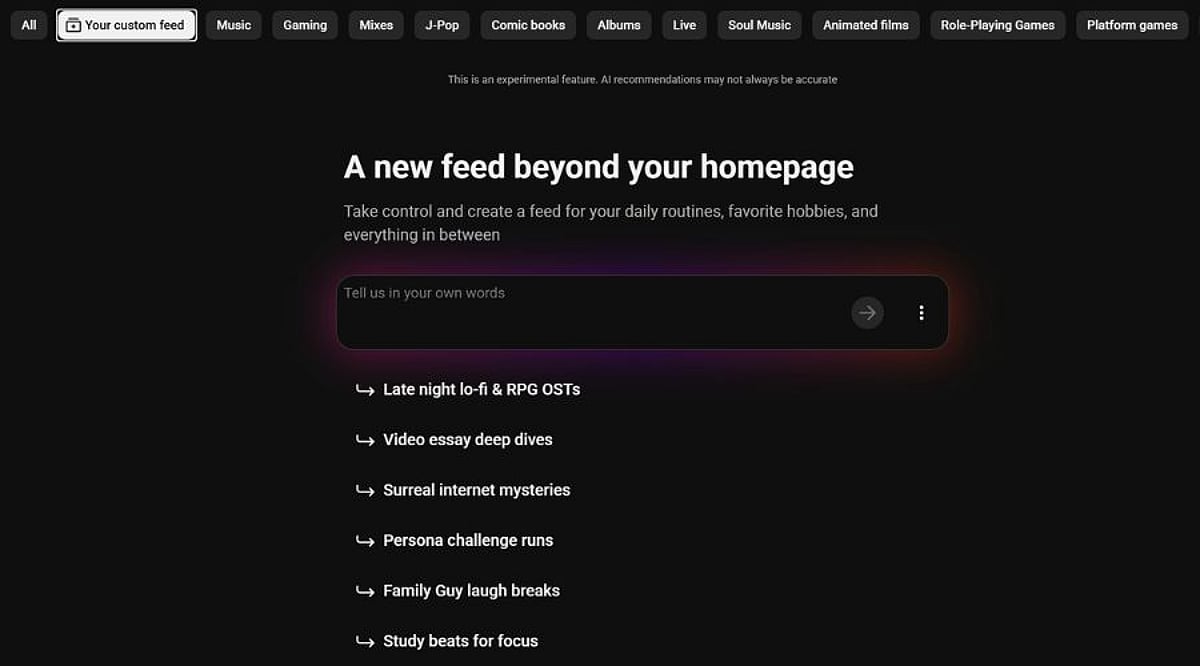
    YouTube is testing a new Custom Feeds feature that gives eligible users more control over the videos recommended to them. Instead of relying only on viewing behavior, users can describe what they want to watch and create a dedicated feed around that request.

    The feature appears at the top of YouTube Home as a Custom Feed chip. Users can enter a natural-language description covering a topic, routine, or mood, after which YouTube generates a stream of recommendations based on the prompt.

    YouTube Tests Up to Eight Custom Feeds

    The latest version of the experiment allows some eligible users in the US to save up to eight active Custom Feeds. Users can switch between these feeds from the top of the Home page and edit their prompts when their interests change.

    On mobile, Custom Feeds can replace YouTube’s standard topic chips, while desktop users continue to have access to the existing topic chips. The feature remains experimental, and availability may vary by account.

    Custom Feeds are different from a standard search. While a search generally provides results for a single query, a Custom Feed is designed to remain as a dedicated destination that users can return to without entering the same request again.

    Custom Feeds Still Work with YouTube’s Algorithm

    Despite giving viewers more direct control, Custom Feeds do not replace YouTube’s recommendation system. The platform continues to determine which videos appear in each feed.

    YouTube also requires both watch and search history to remain enabled for the experiment. Videos watched through Custom Feeds are added to the user’s normal watch history and may influence recommendations on the main Home page.

    This means the feeds are not isolated spaces. Instead, they provide YouTube with an additional signal about what users want to watch at a particular time.

    Availability and Creator Impact

    The latest multi-feed experiment is limited to eligible, signed-in users in the US on Android, iOS and desktop, with English language settings and watch history enabled. YouTube has not announced an official India rollout date.

    For creators, views from Custom Feeds contribute to watch time and monetization in the same way as views from Home. However, creators cannot guarantee that their videos will appear in a particular Custom Feed because YouTube’s ranking system still determines placement.

    YouTube is also monitoring how the experiment affects views, watch time, and revenue as it evaluates the feature.

  • How AI Assistants Are Redefining Mobile App Interactions: From Menus to Intent

    How AI Assistants Are Redefining Mobile App Interactions: From Menus to Intent

    AI assistants are fundamentally changing how users interact with mobile apps, shifting the paradigm from manual navigation to intent-driven execution. Instead of hunting through menus to complete a task, users can now simply state their desired outcome, and the software handles the steps. This transformation moves the interaction model from User → App → Feature → Action to User → Intent → Assistant → App Capability → Action. While visual interfaces remain essential for tasks like date selection or product comparison, AI reduces the need for users to understand an app’s internal structure. Voice-first apps further push this shift by enabling hands-free intent expression.

    The Shift From Menus to Intent

    This does not mean conversation replaces every screen. Picking a date on a calendar or comparing products side by side often stays faster with a visual layout. What changes is narrower and more useful: AI reduces how often a user has to understand an app’s internal structure just to use it. A shopping app can still show a product grid while a request typed in plain language filters it instantly, with no menu required. Voice-first apps push this shift further, letting people express intent without touching the screen at all. Visual interfaces still hold their ground for tasks that need comparison or precision, so the two approaches now sit side by side rather than compete.

    Why On-Device AI Matters

    Mobile chipsets are adding more hardware built for running AI models directly on the device. This cuts delay and keeps sensitive data local. But most apps are not choosing between on-device and cloud processing; they are building hybrid systems where quick or private tasks run locally and heavier reasoning still travels to the cloud. The real shift is not that AI moved to the phone, but that developers now decide, task by task, where computation should happen, weighing speed, privacy, and cost. This same awareness of context lets an app adjust to a person’s habits over time instead of treating every session as new. A fitness app that remembers a user’s usual workout time can suggest a plan without being asked, quietly folding personalization into the background rather than presenting it as a separate feature.

    From AI Features to Agentic Apps

    A chatbot answers. A copilot helps. An assistant performs a single action. An agent coordinates several actions to reach a goal, such as finding a hotel near a meeting, checking its cancellation policy, and preparing the booking. That progression changes the app’s role. An application is not just presenting functions to a human anymore; its functions also need to be understandable and reachable by an AI system acting on someone’s behalf. This is a structural demand, not a cosmetic one. It reshapes what ‘building an app’ actually involves.

    The New Developer Challenge

    Much of the visible change happens in the interface, but the larger transformation sits underneath it. Developers now need structured app data, clear APIs, permission systems, context that persists across sessions, and reliable ways for an assistant to call the right function at the right time. Testing an app used to mean checking if buttons work. Now it also means checking if an assistant handles a vague or oddly worded request without making the wrong call. Mobile development is quietly becoming AI development, and the teams that treat it that way are the ones setting the pace.

    Trust and Competition Are Shifting Together

    Giving an assistant permission to act, rather than just respond, creates a new kind of trust problem. Users may not always know how an AI reached a decision or whether it stayed within the limits they intended. Some apps address this with a short explanation line after a task completes, showing what happened and why. This same shift could reshape how apps compete. Features that once helped one app stand out become easier to reach through an assistant that pulls from several apps at once. If a person can ask for a result without knowing which app supplied it, the interface itself matters less. App companies may end up competing more on the quality of their data, the reliability of their services, and how well their functions can be coordinated by AI, rather than on how their screens look.

    Final Thought

    The next generation of mobile apps will not be defined only by what users can do inside them. They will be defined by what AI can safely do with them. That puts more weight on the foundations underneath the interface: reliable data, accessible actions, clear permissions, strong security, and systems that know when to act and when to ask first.

    Frequently Asked Questions

    1. How are AI assistants changing mobile apps? AI assistants are shifting mobile apps from menu-based navigation toward intent-based interactions, allowing users to describe what they want and receive help with completing tasks.
    2. What are agentic apps? Agentic apps use AI systems that can coordinate multiple actions to achieve a user-defined goal rather than simply answering questions or completing one isolated task.
    3. Why is on-device AI important for mobile apps? On-device AI can reduce response time and keep certain data on the phone, making it useful for applications where privacy, speed, and offline functionality matter.
    4. How does AI affect mobile app development? AI requires developers to build stronger data structures, APIs, permission systems, context management, and safeguards so assistants can interact with app functions reliably.
    5. Will AI assistants replace traditional mobile app interfaces? No. AI assistants are more likely to work alongside traditional interfaces. Screens remain useful for tasks involving visual comparison, navigation, selection, and precise controls, while AI handles intent-driven tasks.
  • How Netflix Uses AI and Machine Learning to Personalize Your Viewing Experience

    How Netflix Uses AI and Machine Learning to Personalize Your Viewing Experience

    Netflix relies on artificial intelligence and machine learning to decide what appears on a user’s homepage every time they open the app. The system tracks what a person watches, how long they watch it, and whether they finish a show or abandon it halfway. It also notices smaller signals, such as pausing, rewinding, or skipping certain scenes.

    All of this data feeds into an algorithm that builds a detailed picture of individual taste, covering genres, actors, themes and even the pacing of a show. Netflix then ranks titles in its library based on how well they match that profile, along with overall popularity and ratings from similar users.

    Also read: What New Netflix Series Are Coming in September 2026?

    Inside Netflix’s Recommendation Engine

    Netflix currently serves more than 325 million subscribers across 190 countries, and its recommendation engine plays a central role in keeping that massive base engaged. Company data shows more than 80% of what people watch on the platform gets discovered through personalized recommendations rather than active searching.

    A 2024 internal study by Netflix reportedly found that removing personalized suggestions entirely would cause viewer engagement to drop by 16%, underlining how much the system shapes viewing habits. The company also estimates the recommendation engine saves it more than a billion dollars a year by reducing subscriber churn.

    New users are not left out of this process either. Since Netflix has little data on a fresh account, it asks new subscribers to pick a few titles they already enjoy right at sign-up. This gives the algorithm a starting point, and it keeps refining suggestions the more a person watches.

    Reinforcement learning also allows the system to react quickly, adjusting recommendations almost instantly after someone rates a show or watches something new.

    Also read: Most Underrated Netflix Shows You Shouldn’t Have Missed

    How AI Shapes Netflix

    Netflix’s AI-driven system does more than recommend a movie for a Friday night. It also decides how thumbnails look for each user, since two people can see completely different cover images for the same title based on what usually catches their attention.

    This level of personalisation extends to search results and even the order of rows on the homepage. For a platform competing against Amazon Prime, Disney+ and other streaming services, this kind of tailored experience became a major reason people stick around instead of switching to a rival.

  • Contextual AI vs. Traditional Machine Learning: How Context Improves AI Decisions

    Contextual AI vs. Traditional Machine Learning: How Context Improves AI Decisions

    Artificial intelligence is increasingly woven into everyday life, from movie recommendations to email drafting and customer support. As these systems become more integral, pattern recognition alone is no longer sufficient. AI must also grasp the context surrounding a request to deliver genuinely useful responses.

    What Is Contextual AI?

    Contextual AI refers to systems that use surrounding information—such as past interactions, user preferences, time, location, behavior, and immediate circumstances—to interpret an input and determine the most appropriate response or action. Unlike traditional models that treat each query in isolation, contextual AI assembles relevant data at the moment of generation. For instance, a virtual assistant asked to “remind me about this later” needs conversation history and task details to know what “this” means.

    Contextual AI is not necessarily a separate model type. It can integrate existing AI models with memory, databases, retrieved documents, user profiles, tools, and real-time signals to produce more situation-aware outcomes.

    How Traditional Machine Learning Works

    Traditional machine learning identifies patterns in training data and applies those patterns to new inputs. These models classify information, predict outcomes, or make recommendations based on learned features. For example, an e-commerce platform might analyze a user’s purchase and browsing history to forecast which products they are likely to buy next.

    This approach is effective for well-defined problems, but its outputs depend heavily on the data and features provided. If crucial situational information is missing, the prediction may miss the user’s actual current needs.

    Key Differences: Contextual AI vs. Traditional Machine Learning

    The primary distinction lies in how much surrounding information influences the result. Traditional machine learning might recommend running shoes because a customer previously bought sportswear. A contextual AI system, however, could also factor in that the customer is currently searching for hiking gear, prefers a specific price range, and is planning an outdoor trip.

    While the first approach relies on established behavioral patterns, the second attempts to understand the present situation. Contextual AI enables greater personalization and adaptive interactions by using conversation history as memory, retrieving current information, and adjusting answers as circumstances change. Traditional machine learning, by contrast, is typically built around narrow prediction or classification tasks. The two are not mutually exclusive; contextual AI applications can incorporate traditional ML models as components.

    Where Contextual AI Makes a Difference

    Contextual AI proves valuable across virtual assistants, customer service, recommendation engines, healthcare tools, smart devices, productivity applications, and enterprise software. A customer-service assistant, for instance, could consider a user’s previous support tickets, account details, and the latest company documentation before crafting a reply. A productivity app could use the user’s current task and prior conversation to offer more relevant suggestions.

    Real-time information is especially critical. Context-aware systems can adapt to changing environmental and user data, an already recognized feature in context-aware computing and smart environments.

    Challenges and Limitations

    More context does not automatically mean better AI. When supplied with outdated, incomplete, or irrelevant information, contextual systems can still produce incorrect answers. IBM notes that poorly managed context can lead to confusion and irrelevant outputs.

    Privacy is a significant concern, as context often involves sensitive details about a person’s behavior, location, health, or surroundings. Security, data quality, bias, and transparency become increasingly important as systems collect and combine more signals.

    Conclusion

    Contextual AI represents an evolution rather than a replacement of traditional machine learning. It makes AI systems more aware of their surroundings, enabling them to distinguish between a generic answer and one that truly fits the situation. As AI moves into more personal and business-critical applications, this capability will become increasingly vital.

    FAQs

    1. What is contextual AI?

    Contextual AI uses information surrounding an interaction—history, user preferences, real-time signals, and environmental factors—to produce more relevant responses or decisions.

    2. How is contextual AI different from traditional machine learning?

    Traditional machine learning applies patterns learned from training data, while contextual AI incorporates additional situational information to adapt outputs according to changing circumstances.

    3. Does contextual AI replace traditional machine learning?

    No. Contextual AI can incorporate traditional ML models within broader systems that combine predictions with retrieved information, memory, business rules, and real-time context.

    4. Where can contextual AI be used?

    Contextual AI supports virtual assistants, customer service, recommendation systems, productivity software, smart devices, healthcare applications, and enterprise tools requiring situation-aware responses.

    5. What are the limitations of contextual AI?

    Contextual AI can produce poor results when supplied with inaccurate, incomplete, or irrelevant information. Privacy, security, bias, transparency, and inappropriate assumptions are also key concerns.

  • AI and Laser Automation Reshape Small Manufacturing: A 2026 Outlook

    AI and Laser Automation Reshape Small Manufacturing: A 2026 Outlook

    A visit to a one-man fabrication shop in Ohio reveals the true impact of laser automation. The owner, who spent nine years cutting acrylic signs by hand router, switched to a CO2 laser machine eighteen months ago. When asked what changed, he didn’t mention speed or quality first. He said he no longer dreads Monday mornings.

    That response captures a deeper truth about automation in small manufacturing. It’s not just about output numbers—it’s about what happens when a single operator can take on work that once required a three-person team and still finish by dinner.

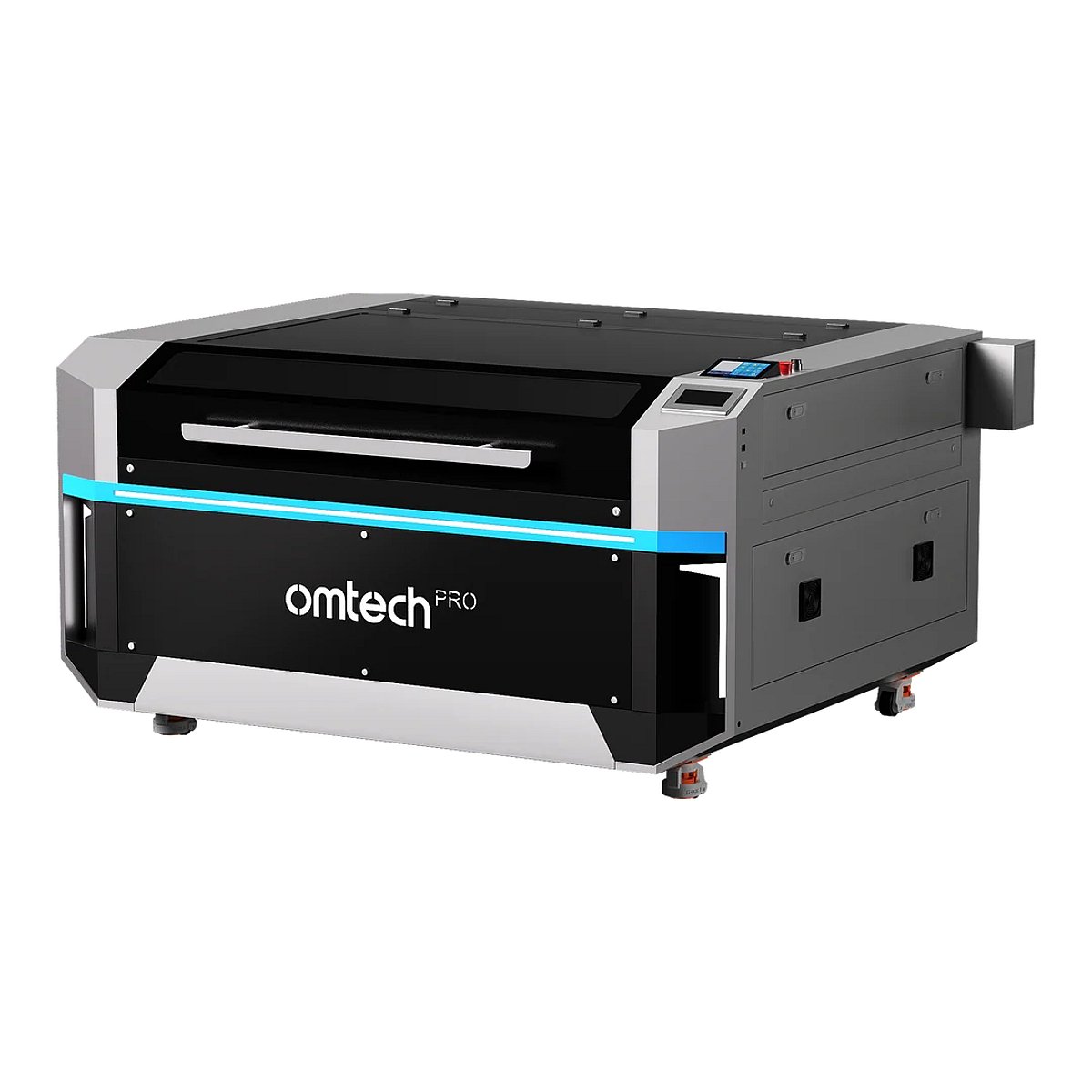
    By 2026, the laser machine market has matured to the point where access is no longer the barrier. The real question is how small manufacturers are using the technology and what happens when AI starts guiding the process. OMTech, a laser equipment manufacturer based in Anaheim, California, has tracked these shifts across its customer base, revealing consistent patterns across industries.

    What Laser Machines Actually Do in Small Shops

    A laser machine is a precision cutting and marking system that uses a focused beam of light to interact with material. CO2 lasers handle wood, acrylic, leather, and fabric. Fiber lasers handle bare metals. The beam follows a digital design file, so accuracy is as good as the file itself.

    For a small manufacturer, this removes human variability from cutting and marking operations. The machine never has an off day and doesn’t rush at the end of a shift. The five hundredth piece looks like the first one.

    Shops that have integrated laser machines most successfully didn’t necessarily have the biggest budgets. They identified one production bottleneck and targeted it specifically:

    • A sign shop that was routing letters by hand switched to CO2 laser cutting and reduced per-sign labor time from 45 minutes to 8 minutes.
    • A jewelry repair business added a fiber laser engraver and now offers personalization services that account for 40% of monthly revenue.
    • A contract parts supplier added a fiber laser marking machine to bring traceability marking in-house, eliminating $600 per month in outsourcing costs.
    • A home workshop seller on Etsy scaled from 20 orders per month to 180 after switching from hand engraving to a CO2 laser machine.

    Where AI Enters the Laser Machine Workflow

    AI integration in laser manufacturing happens at several levels, many of which aren’t obvious from the outside.

    Automated Material Recognition

    Newer laser systems include sensors and software that automatically identify material type and thickness, then pull recommended cutting parameters from a library. Parameter selection is where most quality problems originate. A beginner operator who once spent two hours on test cuts now spends ten minutes. An experienced operator using AI-suggested parameters iterates faster and wastes less material.

    Nesting Optimization

    Nesting arranges parts on a sheet to minimize waste. AI-driven nesting software now completes in seconds what used to take 15–30 minutes of manual arrangement. Shops report 12–18% reductions in raw material consumption on typical production runs.

    Vision Alignment Systems

    Camera-based alignment systems allow laser machines to position designs on irregular or pre-marked materials without manual measurement. The material goes on the bed, the camera identifies reference points, and the software repositions the design. For businesses engraving on irregular blanks or adding marks to pre-cut parts, this eliminates a step that previously required skill and attention.

    Predictive Maintenance

    Production laser machines now monitor their own operational parameters and flag degradation before it becomes failure—lens contamination, beam alignment drift, cooling system performance. The machine tells the operator what needs attention before a mid-job failure costs time and material. For a small shop with one machine handling all production, unplanned downtime is a serious financial event.

    Emerging Revenue Patterns

    The economic story in 2026 isn’t just about cost reduction. It’s about new revenue categories that were inaccessible before the technology became affordable.

    Personalization at scale is the clearest example. A laser engraver or cutter can produce unique versions of the same product—different names, designs, or text—without changing setups. Personalized products command substantially higher prices. A cutting board that sells for $18 without a name sells for $55–$75 with one.

    On-demand manufacturing allows small shops to produce single pieces or very small batches economically. A customer who needs one custom award or prototype doesn’t need to order fifty to make the economics work.

    Contract services are another pattern. A shop with a laser machine often discovers excess capacity and sells access to other local businesses. Contract laser cutting, engraving, and marking generate revenue from equipment that would otherwise sit idle between production runs.

    What Small Manufacturers Should Evaluate Before Buying

    The laser machine market offers options across price points and capability levels. Before looking at specifications, answer these questions:

    • What materials will you process? CO2 for wood, acrylic, leather, and fabric. Fiber for bare metals. This determines the laser type.
    • What is your realistic production volume? 40-watt for personal/low production; 60–80 watts for most small business needs; 100+ watts for shops running the machine most of the day.
    • What does the full setup cost? Machine price is only the start. Ventilation adds $150–$400. A water chiller for CO2 adds $200–$600.
    • What software does the machine support? LightBurn is the production standard for most CO2 and fiber machines. Verify compatibility before purchase.
    • What support exists? Search the manufacturer name alongside terms like maintenance, parts, and troubleshooting. Active communities and accessible documentation are reliable indicators of long-term ownership.

    The Competitive Reality for Small Manufacturers in 2026

    Businesses not adopting laser machine technology are not standing still—their competitors are. Entry-level production capability has dropped in price to the point where payback is straightforward for almost any shop with a clear application.

    A shop spending $400 per month outsourcing laser work can purchase an in-house system and reach payback in under a year. A shop adding personalization to an existing product line often sees revenue increases that cover equipment cost within six to nine months.

    AI accelerates this: faster parameter development, better material utilization, reduced operator training time. These improvements compound over time. A shop that adopted a laser machine two years ago and has been refining its workflow holds a meaningful operational advantage over one starting today.

    The transformation happening in small manufacturing through laser machine adoption and AI-guided process optimization is not speculative. It is visible in revenue numbers, payback timelines, and the Monday morning attitudes of shop owners who made the switch.

    The technology is accessible. The applications are proven. The competitive pressure is real and increasing. For small manufacturers evaluating their next capital investment, a laser machine with AI-assisted workflow support is one of the clearest paths to both cost reduction and new revenue generation available in 2026.

    OMTech, based in Anaheim, California, designs and builds CO2 laser engravers, fiber laser marking systems, and MOPA fiber lasers for small businesses, production shops, and home workshop users. Their full range of laser engraving and cutting machines is available at OMTech.

  • OpenAI’s ChatGPT Work Now Mimics Your Writing Style Automatically

    OpenAI’s ChatGPT Work Now Mimics Your Writing Style Automatically

    OpenAI has rolled out a new capability for ChatGPT Work that lets the AI learn a user’s personal writing style and apply it in future interactions. This means less time spent explaining how you want your emails or documents to sound.

    Previously, users had to provide explicit instructions about tone and style. Now, ChatGPT can analyze your past writing—including frequently used phrases, email sign-offs, and subtle habits—to generate drafts that feel more like you.

    The feature can tap into connected applications such as Gmail, Google Drive, Slack, and SharePoint to better understand your writing patterns.

    How to Set It Up

    Enabling this is straightforward. Go to Settings > Personalization > Writing style. From there, you can link your work apps and allow ChatGPT to study your old messages and documents. Once activated, it works across both the web version and mobile apps, but only for ChatGPT Work subscribers on paid plans.

    The more ChatGPT sees of your writing, the more natural its drafts will become. Over time, you might not need to provide detailed instructions at all.

    Higher Productivity Meets Corporate Data Privacy

    This update is particularly useful for professionals who draft many work emails, messages, or reports with the help of AI. However, there’s a catch: because the tool reads through emails and files, it also processes sensitive business information. Companies should weigh the benefits against potential privacy risks, especially regarding who can access or use that data.

    Overall, this change signals where AI writing tools are headed—moving from simple instruction-following to truly understanding individual users. The ultimate goal is fewer edits and drafts that already sound like you.

  • LinkedIn AI Advertising Tools Every B2B Marketer Must Master in 2026

    LinkedIn AI Advertising Tools Every B2B Marketer Must Master in 2026

    Artificial intelligence has become central to digital advertising, but nowhere is its impact more evident than on LinkedIn. As the largest professional network in the world, LinkedIn provides advertisers with access to accurate information about professionals’ job titles, industries, companies, and decision-makers. Integrating such professional information with the company’s AI tools is now making it possible for B2B marketers to run better campaigns and reduce the time needed for campaign management.

    The introduction of such AI tools into the system is not only aimed at automating mundane tasks. LinkedIn’s AI tools can help advertisers target the right audience and create the right content, optimizing the budget in real time.

    AI is Reducing the Complexity of Campaign Creation

    Developing a B2B campaign usually entailed various decisions concerning audience choice, bidding strategy, and other aspects. LinkedIn’s AI-driven campaign development capabilities significantly ease many of these steps.

    By using capabilities like Accelerate, users can develop campaign suggestions aligned with business objectives rather than manually adjusting every possible parameter. The AI provides appropriate suggestions for audiences, campaign type, and optimization techniques. This solution is especially beneficial for small marketing teams that lack advertising specialists.

    Better Targeting Means Better Leads

    LinkedIn’s ability to leverage professional audience information is one of its best benefits, and AI can enhance it by analyzing user behavior, engagement patterns, and company attributes to predict conversion likelihood among specific groups.

    Compared with traditional filtering criteria such as job position or industry, marketers can connect with prospects by considering buying intent, company growth, recruitment needs, and professional interests. For B2B brands, where acquiring a single qualified lead often costs significantly more than in consumer marketing, better targeting directly improves return on investment.

    AI is Improving Creative Quality

    Creating multiple versions of ad copy for different audience segments has always been time-consuming. LinkedIn’s generative AI tools now assist marketers by producing headlines, primary text, and campaign messaging within minutes.

    Rather than replacing human creativity, AI provides a strong starting point. Marketing teams can edit the suggested copy to reflect their brand voice while reducing the time spent drafting advertisements from scratch. This allows businesses to test multiple creatives simultaneously, helping identify which messages generate the highest engagement and conversion rates.

    Performance Optimization Happens Continuously

    Campaign optimization has moved past the weekly reporting stage. LinkedIn’s artificial intelligence constantly monitors the effectiveness of your campaigns and pinpoints ways you can improve them.

    The platform no longer shows you numbers but points out developing trends, such as reduced engagement or underperforming creatives. It may even recommend reallocating your budget, refreshing your creatives, or adjusting your targeting before your campaign performance declines.

    Personalization is Becoming a Competitive Advantage

    Today’s B2B purchasers want communications that speak to their specific industry, position, and problems. LinkedIn’s AI capabilities can help deliver better personalization in advertising efforts.

    Organizations can use personalized communication by analyzing user data and past communications through Conversations, messaging, and audiences. Personalized communication is helpful not only for engagement but also for creating trust, which is an important component of the B2B buying process. Organizations don’t send the same message to all their possible customers anymore.

    AI Integration Increases the Efficiency of Workflows

    Using AI capabilities in LinkedIn becomes more relevant when AI is integrated with CRM and marketing automation systems. Lead data is automatically passed to the sales application, allowing you to communicate with them faster. Other use cases include lead scoring, opportunity detection, and attribution. This is a time- and effort-saving strategy.

    AI Still Needs Human Strategy

    Regardless of this progress, AI will never replace marketing knowledge. For successful B2B marketing campaigns, it is important to know what challenges customers face, create something valuable for them, and build relationships. AI may assist in suggesting an audience and generating ad texts, but only humans can create a value proposition and take into account all subtleties of customer behavior. Companies that see AI as a decision-making support system, not a decision-maker itself, will reach sustainable success.

    The Road Ahead for B2B Advertising

    In terms of AI marketing tools, LinkedIn represents another example of the changes taking place in this sphere. There has been increased automation of processes, predictive analysis, and personalization, which has made the campaigns much more accurate. AI technologies are developing, and therefore, there is greater potential for accurate audience research and assistance in the development process.

    Business-to-Business marketers should take advantage of AI technologies through business strategies. Companies that use technology to assist decision-making processes, not to decide on behalf of marketers, will benefit by qualifying leads and making their marketing more effective.

  • How Spotify Uses AI to Personalize Your Playlists: What Users Need to Know

    How Spotify Uses AI to Personalize Your Playlists: What Users Need to Know

    Artificial intelligence is reshaping the way music streaming platforms operate, and Spotify is at the forefront of this transformation. Here’s a breakdown of how AI is influencing your listening experience and what it means for you as a user.

    AI-Powered Playlist Recommendations

    Spotify leverages AI to analyze your listening habits—everything from the genres you favor to the times of day you listen—and uses that data to recommend songs and artists tailored specifically to you. This continuous learning process ensures that your playlists evolve with your tastes.

    Smarter Music Discovery

    Beyond simple recommendations, AI helps you discover new music that aligns with your preferences. By examining patterns across millions of users, Spotify can introduce you to emerging artists, hidden gems, and genres you might not have explored otherwise.

    The AI DJ Feature

    One of Spotify’s most notable innovations is the AI DJ, which delivers personalized music selections along with voice-guided commentary. This feature mimics the experience of a human DJ, providing context and recommendations that feel curated just for you.

    Continuous Playlist Personalization

    Algorithms constantly update your playlists based on changes in your listening behavior. If you suddenly develop a taste for indie rock or classical music, your playlists will adapt to reflect your new interests.

    Privacy Concerns Around Data Collection

    With the benefits of personalization comes scrutiny. Some users question how Spotify collects, stores, and processes their listening data to fuel these AI-driven recommendations. Transparency and user control remain hot topics in the conversation around AI and privacy.

    The Continued Role of Human Editors

    Despite the rise of AI, human-curated editorial playlists still hold significant value. Spotify relies on human editors to craft playlists that capture cultural moments, seasonal moods, and niche communities—something algorithms alone cannot replicate.

    AI and Emerging Artists

    AI doesn’t just benefit listeners; it also helps emerging artists get discovered. By analyzing listening patterns, Spotify can recommend up-and-coming musicians to users who are likely to appreciate their sound, leveling the playing field in a crowded industry.

    Balancing Benefits and Concerns

    While AI dramatically improves personalization, it also raises important discussions around transparency, data control, and the balance between algorithmic curation and human touch. As Spotify continues to innovate, users should stay informed about how their data is used and what choices they have.

    For the latest updates on AI and technology, join our community on WhatsApp.

  • How AI and Business Intelligence Are Transforming Food Delivery

    How AI and Business Intelligence Are Transforming Food Delivery

    The global online food delivery market is on track to generate more than $1.5 trillion in revenue by the end of 2026, according to Statista, with projections reaching $2.05 trillion by 2031. What started as a niche convenience has become a massive global industry, with platforms like Uber Eats, Zapp, Just Eat, and Deliveroo competing for dominance in markets such as the UK. As the sector prepares for another five years of aggressive expansion, food delivery companies are turning to data-driven technologies to win customer loyalty and increase market share.

    Turning Customer Data into a Competitive Edge

    Food delivery firms are no longer relying on generic marketing. Instead, they are analyzing customer behavior to deliver more personalized and intuitive experiences. Deliveroo, for example, uses Amazon Web Services’ machine learning tools to understand real-time ordering patterns. By leveraging Amazon SageMaker, the company builds and deploys ML models that process historical order frequency, price points, and cuisine preferences, generating a unique restaurant feed for each user. This approach enables targeted marketing campaigns and keeps customers engaged far longer than traditional blanket promotions.

    The same pattern appears across other web-based industries. In iGaming, for instance, platforms tailor promotions to new customers or those who play at specific times, such as after 6 PM. Food delivery has adopted this playbook, using business intelligence (BI) to anticipate when a customer might order again and issuing special offers or milestone rewards that build brand affinity.

    Building a User-Centric Experience

    Rather than sending the same email to every subscriber, platforms are using BI to connect with customers on a more personal level. DoorDash developed a unified consumer memory BI engine that monitors long-term behavior, including dietary habits and average basket size. The system identified valuable patterns, such as a user’s tendency to try a new cuisine on a particular day of the week.

    This long-term memory powers DoorDash’s AI assistant, Ask DoorDash. During a chat session, the assistant retrieves stored preferences in real time, allowing it to build personalized grocery carts or suggest meals. By combining this long-term memory with real-time session intent, DoorDash reported a 24% increase in grocery checkout conversions and a 17% rise in basket sizes.

    Uber Eats is also pushing the boundaries of personalization. The company applies graph learning, an advanced form of machine learning, to map complex relationships among users, dishes, and restaurants. By analyzing millions of order patterns, Uber Eats uncovers specific taste preferences and suggests cuisines or local venues before the user even searches. The app merges these smart recommendations with real-time updates on kitchen prep times and delivery routes, driving higher order frequency and long-term customer retention.

    Raw Data Is No Longer Enough

    In a trillion-dollar market expected to grow exponentially, raw data alone cannot deliver the level of personalization consumers now expect. By combining business intelligence and machine learning, food delivery companies are moving away from static menus toward intuitive, context-aware experiences that respond to individual habits and preferences. The winners in this space will be those that can turn data into meaningful, real-time actions that keep customers coming back.

  • How Agentic AI Drives Customer Loyalty: Insights from Loyalty Rewardz CEO Amresh Acharya

    How Agentic AI Drives Customer Loyalty: Insights from Loyalty Rewardz CEO Amresh Acharya

    In an era where customer expectations are rapidly evolving, businesses are turning to Agentic AI to build deeper, more meaningful loyalty. Unlike traditional reward programs, Agentic AI enables proactive, personalized engagement that anticipates customer needs before they arise.

    In a recent episode of the Analytics Insight podcast, host Priya Dialani sat down with Amresh Acharya, Managing Director & CEO of Loyalty Rewardz, to explore how artificial intelligence is transforming customer loyalty. Acharya shared his expertise on integrating AI, machine learning, and data science to enhance customer relationships while balancing automation with the human touch. He emphasized the importance of responsible AI, unified customer data, and enterprise-level personalization for sustainable business growth. Below are key insights from the conversation.

    What Is Agentic AI and How Does It Benefit Customer Experience?

    Unlike conventional AI, Agentic AI doesn’t just answer queries; it understands context, predicts future needs, and recommends services accordingly. This allows brands to deliver engaging experiences that feel genuine rather than transactional.

    Customer Loyalty in the Age of AI

    The concept of loyalty has shifted. Today, customers expect brands to understand them, remember their preferences, and offer customized services. AI enables brands to develop relationships that naturally foster loyalty.

    Is AI Enough for a Good Customer Experience?

    AI-powered customer service handles frequent, straightforward queries efficiently. However, there are situations where human assistance is irreplaceable, especially when customers need empathy or complex problem-solving. The key is blending AI with human touchpoints.

    Why Data Is Critical for AI-Driven Loyalty Programs

    AI performs optimally when fed high-quality data. Accurate, correlated customer data helps firms understand behaviors and preferences, enabling personalization. Fragmented data prevents AI from making relevant suggestions, undermining the loyalty effort.

    Steps Before Implementing Agentic AI

    Successful AI implementation begins with robust data management, clear goal setting, and thoughtful process design. Companies need to address specific customer challenges, establish proper AI governance, and ensure human involvement in critical decisions.

    Acharya’s insights underscore that Agentic AI is not a replacement for human interaction but a powerful tool to elevate customer loyalty through proactive, personalized engagement.