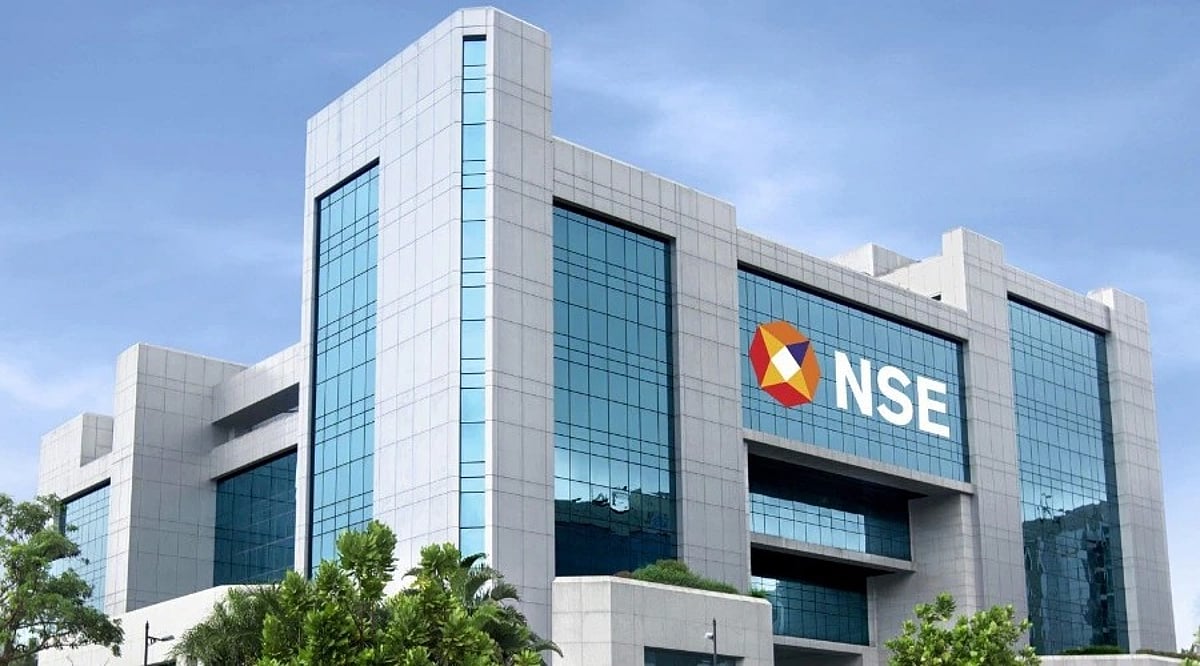
The National Stock Exchange of India (NSE) made a strong entrance into the public market on Thursday, September 24, with shares rising 5.21% above their initial public offering (IPO) price on the first day of trading. The stock opened at Rs 1,800 on the BSE, surpassing the IPO price of Rs 1,785, and later peaked at Rs 1,878. This performance added approximately Rs 22,000 crore to the exchange’s market capitalization, pushing it to about Rs 4.64 lakh crore.
NSE Stock Climbs Above IPO Price
NSE shares started trading 0.84% above the issue price and quickly gained momentum, reaching a high of Rs 1,878. At this level, the exchange’s market value stood at roughly Rs 4.64 lakh crore, nearly Rs 22,000 crore above its valuation at the issue price. By 11:04 a.m., the stock traded at Rs 1,839, giving NSE a market cap of about Rs 4.56 lakh crore—placing it among the world’s 10 largest listed exchanges and India’s 10 most valuable listed companies at that moment. In comparison, rival exchange BSE, which listed in 2017, had a market value of approximately Rs 1.32 lakh crore.
NSE’s debut contrasted sharply with other major Indian IPOs. Hyundai Motor India fell more than 7% on its first trading day in 2024, Life Insurance Corporation of India dropped nearly 8% in 2022, and Paytm shares lost over 27% on their 2021 debut.
IPO Attracts Nearly Six Times the Shares on Offer
NSE’s Rs 22,560-crore IPO (about USD 2.4 billion) was the country’s second-largest, after Hyundai Motor India’s offering. The public portion drew bids for 505.81 million shares against 88.64 million available, resulting in overall demand of about 5.7 times the shares offered. Institutional and large investors led the charge. Before the public offer, NSE allotted 37.79 million shares to anchor investors at Rs 1,785 each, raising Rs 6,746 crore. Existing shareholders sold shares through the IPO, with NSE receiving no new capital from the sale. Retail investors bid for only slightly more shares than their reserved portion.
NSE first filed for an IPO in 2016, but regulatory disputes and legal proceedings delayed the listing for years. Recent tighter rules for derivatives trading and lower trading volumes prompted the exchange to reduce the offer size and lower its IPO price.
Analysts Comment on NSE’s Longer-Term Prospects
Deven Choksey, managing director of DRChoksey Finserv, described NSE as a ‘deep value’ investment, highlighting the exclusive nature of the exchange business, the trading activity on established platforms, and the potential for new products. ‘The exchange business is exclusive. It’s not a common business,’ he said. Choksey advised investors who missed an IPO allotment to buy shares gradually and hold them for three to five years. He also projected that NSE could benefit if India’s total stock market value rises over the next decade.
VK Vijayakumar, chief investment strategist at Geojit Investments, noted that NSE could offer a long-term opportunity ‘if the NSE stock becomes available in today’s trade at a fair price.’