Tag: WhatsApp

  • WhatsApp and Telegram Address Government Queries on Username Security and Impersonation Risks

    WhatsApp and Telegram Address Government Queries on Username Security and Impersonation Risks

    WhatsApp and Telegram have officially responded to the Indian government’s concerns regarding the safety of their username-based messaging features. The Ministry of Electronics and Information Technology (MeitY) had issued notices to the platforms, seeking details on how they plan to prevent identity impersonation and online fraud facilitated by the new username system. Signal, another messaging app, had not yet submitted its response by the deadline.

    Government Scrutiny Intensifies on Username Features

    MeitY sent notices to WhatsApp, Telegram, and Signal, asking them to explain the safety mechanisms integrated into their username systems. The government is particularly worried that allowing users to communicate via usernames instead of phone numbers could make it easier for fraudsters to impersonate individuals, launch phishing attacks, and carry out digital scams. WhatsApp received the notice on July 1, while Telegram and Signal were issued notices two days later. After discussions with officials, WhatsApp was granted a four-day extension and submitted its response. Telegram also met the deadline.

    Meta Outlines Anti-Impersonation Measures

    Meta, the parent company of WhatsApp, detailed its approach in the response. The company stated that the upcoming username feature includes multiple layers of protection to curb misuse. Accounts will be suspended or usernames revoked if there is evidence of impersonation or fraudulent activity. Additionally, usernames already associated with Facebook and Instagram accounts will be reserved for their rightful owners during the rollout. Usernames linked to verified accounts, public figures, celebrities, and government entities—along with look-alike variations—will remain exclusive to legitimate users to reduce the risk of identity fraud.

    Privacy vs. Security: A Delicate Balance

    While the username feature is designed to enhance user privacy by allowing people to communicate without sharing their phone numbers, the government believes that anonymity could create new challenges for law enforcement and cybercrime investigations if proper safeguards are not in place. This exchange represents the latest step in the government’s ongoing efforts to strengthen protections against online impersonation while balancing user privacy and platform innovation. MeitY is expected to review the submissions before deciding on the next course of action.
  • WhatsApp Username Feature Delayed in India as Meta Fails to Meet Government Deadline

    WhatsApp Username Feature Delayed in India as Meta Fails to Meet Government Deadline

    The Ministry of Electronics and Information Technology (MeitY) has not yet received Meta’s formal response regarding WhatsApp’s proposed username feature, even after the extended deadline passed on Wednesday, according to government sources.

    The Centre had granted Meta an additional three days to respond to the notice issued over privacy and security concerns. During earlier discussions, Meta assured that the username feature would not launch in India until consultations with the ministry concluded.

    Government Raises Cybersecurity Concerns

    MeitY’s notice sought clarity on safeguards accompanying WhatsApp usernames, which allow users to connect without sharing phone numbers. Officials fear the change could enable fraudsters to impersonate users, create fake identities, and conduct phishing attacks while hiding their real identities.

    The ministry asked Meta to explain user verification, misuse prevention, and grievance redressal plans. The feature is expected to work like usernames on other platforms.

    Meta Assures No India Rollout for Now

    Meta representatives met MeitY officials and reportedly assured that the feature would not launch in India until regulatory consultations are complete. The extension was meant to give Meta time to detail its user safety measures.

    As of the deadline, the ministry had not received the company’s formal reply.

    Wider Review of Messaging Platforms

    MeitY has also sought explanations from Telegram and Signal, which already support username-based communication. The government is examining whether such features could complicate cybercrime investigations. The review is part of India’s broader push to strengthen digital safety while balancing user privacy and innovation.

  • WhatsApp Usernames: Connect Without Sharing Your Phone Number

    WhatsApp Usernames: Connect Without Sharing Your Phone Number

    WhatsApp is rolling out a new feature that allows users to connect using unique usernames, eliminating the need to share personal phone numbers. This update is designed to enhance privacy and simplify communication for individuals and businesses alike.

    Instead of giving out your mobile number, you can now create a memorable username that follows WhatsApp’s guidelines and is easy for friends, customers, or clients to find. Once your username is set, people can search for it and send messages without ever seeing your phone number, wherever the feature is supported.

    Usernames are particularly valuable for creators, freelancers, businesses, and community administrators who frequently interact with many people. Privacy settings allow users to control who can discover them or initiate contact, adding an extra layer of account protection.

    WhatsApp continues to bolster security with end-to-end encryption, passkeys, and advanced scam protection alongside the username feature. As the feature rolls out, availability may vary by region and app version, so users should keep WhatsApp updated to access the latest tools.

    Usernames are expected to make connecting easier while giving users greater control over their personal contact information. For more updates, join our WhatsApp Channel to get the latest news, exclusives, and videos on WhatsApp.

  • Meta Unveils Muse Image: AI-Powered Photo Creation and Editing Comes to Facebook, Instagram, and WhatsApp

    Meta Unveils Muse Image: AI-Powered Photo Creation and Editing Comes to Facebook, Instagram, and WhatsApp

    Meta has officially launched Muse Image, the first image-generation model developed by its newly formed Meta Superintelligence Labs (MSL). The AI model is now integrated into Meta AI, allowing users to generate, edit, and transform images using natural language prompts, uploaded photos, sketches, and annotations directly within Meta’s suite of apps.

    What Makes Muse Image Different?

    Unlike traditional AI image generators that rely solely on text prompts, Muse Image understands complex instructions, interacts with user-uploaded images, and even allows modifications by drawing on images or adding annotations. This makes the creation and editing process more interactive and flexible—all without leaving apps like Facebook, Instagram, WhatsApp, and Messenger.

    Key Features of Meta Muse Image

    • Text-to-Image Generation: Describe almost any scene in natural language, and Muse Image will produce a corresponding image, handling intricate requests with multiple details.
    • Image Editing: Upload an existing photo and ask Meta AI to modify it—change backgrounds, lighting, clothing, or add new objects—without regenerating from scratch.
    • Sketch-Based Editing: Draw simple sketches or annotations over an image, and the AI will replace, remove, or enhance those specific areas.
    • Instagram Stories Effects: Over 30 new AI-powered effects, enabled by Muse Image, are rolling out to Instagram Stories for creative visual enhancements.
    • In-Chat Image Creation on WhatsApp: Users can generate images directly within WhatsApp conversations using Meta AI, initially rolling out in select countries before a global launch.

    How to Use Muse Image

    Using Muse Image is straightforward through Meta AI:

    1. Open Meta AI in a supported app (e.g., Instagram or WhatsApp).
    2. Type a text prompt describing the image you want to create.
    3. If modifying an existing image, upload a photo.
    4. Use sketches or annotations to highlight specific areas for change.
    5. Review the generated image and refine it further with additional prompts.

    Support for Facebook and Messenger will expand as Meta continues to roll out the feature.

    Meta’s Bigger AI Ambitions

    Alongside Muse Image, Meta teased its upcoming Muse Video AI model, which aims to generate video content from prompts. Although still in development, it signals Meta’s commitment to building not only advanced image generation but also AI-powered video creation. By embedding these capabilities into apps used by billions, Meta hopes to make AI-driven content creation accessible to everyone.

  • Indian Government Extends WhatsApp Deadline for Username Feature Amid Fraud Concerns

    Indian Government Extends WhatsApp Deadline for Username Feature Amid Fraud Concerns

    Meta-owned WhatsApp has received additional time from the Indian government to address concerns over its proposed username feature. The company has assured the Centre that it will not launch the feature in India until ongoing regulatory consultations are completed. This development comes as the government intensifies scrutiny of digital platforms over rising online fraud and impersonation risks.

    Centre Extends Response Deadline

    The Ministry of Electronics and Information Technology (MeitY) issued a notice to WhatsApp on July 1, directing the company to explain its upcoming username-based messaging feature. The government also asked the messaging platform to pause the rollout until consultations were completed.

    The Centre granted Meta a three-day extension to file its reply after Meta requested more time. Top company officials have since met with government officials to discuss the proposed feature and the safeguards the company will implement in India.

    Although the move is aimed at enhancing user privacy, Indian officials are concerned that anonymous usernames could make it harder to identify fraudsters. Officials have warned that anonymous usernames may increase phishing attacks, impersonation scams, and ‘digital arrest’ frauds. The government has also reminded WhatsApp that it must comply with due diligence requirements under India’s Information Technology Rules.

    Wider Review of Messaging Platforms

    The government’s inquiry into WhatsApp does not end here. MeitY has made inquiries to Telegram and Signal about their messaging protocols via usernames and how they ensure that there is no fraud or impersonation. Meta has also outlined several safeguards, including:

    • Setting aside usernames for verified personalities and government institutions
    • Prohibiting fraudulent lookalike usernames
    • Restricting unwanted messages

    In addition, users would be required to know the specific username of the individual they want to contact, and suspicious behavior would be monitored by automated tools. The result of such consultations could influence future regulations regarding messaging apps in India, where privacy-enabled features have been on the rise.

  • Meta Challenges $1.4 Trillion Penalty Demand in Youth Safety Lawsuit Over Facebook and Instagram

    Meta Challenges $1.4 Trillion Penalty Demand in Youth Safety Lawsuit Over Facebook and Instagram

    Meta has disclosed that four U.S. states are seeking approximately $1.4 trillion in penalties in a youth safety lawsuit targeting Facebook and Instagram. The company revealed the figure in a court filing on Monday, ahead of a trial scheduled for August in Oakland, California.

    The case involves California, Colorado, Kentucky, and New Jersey, which accuse Meta of designing its platforms to maximize engagement among young users and of misleading the public about safety measures. Meta has denied these allegations and questioned the penalty demand, calling it unprecedented.

    Meta Questions $1.4 Trillion Penalty Claim

    According to Meta, the proposed penalty figure emerged from filings by the attorneys general outlining how penalties should be calculated if the states prevail at trial. The company noted that the amount is close to its market value and argued that the states have not provided evidence to support such a sum.

    In its filing, Meta stated, “A sanction of that size has no analog in the history of consumer protection enforcement.” The company also asserted that the figure lacks a proper legal basis under the facts of the case.

    The states’ filings are sealed, but they explained part of their methodology at a June court hearing. They indicated that they calculated the number of alleged violations and multiplied that by fine amounts permitted under state consumer laws. The violations were based on estimates of teens and young users allegedly affected by Meta’s conduct. Representatives for the attorneys general did not immediately comment after Meta disclosed the figure.

    Facebook and Instagram Face Youth Safety Trial

    The August trial will take place before U.S. District Judge Yvonne Gonzalez Rogers. It will cover claims under the federal Children’s Online Privacy Protection Act (COPPA) as well as consumer protection claims from the four states.

    Twenty-nine states have sued Meta in federal court, with many alleging that the company collected data from children without proper parental consent. The four states also claim that Meta misled the public about whether Facebook and Instagram were safe for young users.

    Meta rejects this position. The company argues that the attorneys general have not shown that it misled users about platform addiction. It also contends that “social media addiction” is not an established psychiatric condition, so its statements about addiction cannot be false.

    Judge Rogers recently denied Meta’s request to cancel the trial, stating that factual disputes remain, including whether the platforms were addictive, whether Meta denied designing them that way, and whether the company partly directed the platforms at children.

    Meta Also Faces WhatsApp Scrutiny in India

    Separately, Meta is facing a regulatory issue in India over a new WhatsApp usernames feature. The feature would allow users to chat without sharing phone numbers. India’s Ministry of Electronics and Information Technology has asked Meta to pause the rollout and explain its safety controls.

    Officials have raised concerns that usernames could be used for spoofing or fraud, with scammers potentially copying names linked to real people, government offices, or trusted organizations. Meta has until July 9 to send a detailed response.

    WhatsApp has defended the feature, stating that usernames will be optional and that users will not be searchable only through a username. The company also says users will see safety information before replying to unknown accounts, including the sender’s country and whether the account is new.

    Also read: ChatGPT Lawsuit Claims OpenAI Secretly Shared Private User Chats with Meta and Google

  • Kunal Shah Appointed WhatsApp Global Head: The Entrepreneurial Journey Behind the Meta Move

    Kunal Shah Appointed WhatsApp Global Head: The Entrepreneurial Journey Behind the Meta Move

    Kunal Shah, the Indian entrepreneur who built FreeCharge and CRED, has been appointed as the new global head of WhatsApp by Meta. The move marks a significant milestone for Indian entrepreneurship and signals a growing appetite for founder-led leadership in global technology companies. Alongside the appointment, Meta invested $900 million in CRED, valuing the fintech platform at $4.5 billion.

    From FreeCharge to a Landmark Exit

    Shah co-founded FreeCharge in 2010, a mobile recharge platform that became one of India’s early digital payment successes. In 2015, Snapdeal acquired FreeCharge for roughly $400 million, one of the largest acquisitions in the Indian startup ecosystem at the time. The deal cemented Shah’s reputation as a founder with deep insights into consumer behavior in a market where digital trust was still emerging.

    Building CRED Into a Fintech Powerhouse

    Rather than resting on his first success, Shah launched CRED in 2018 with a unique value proposition: rewarding users who pay their credit card bills on time. The platform quickly evolved into a diversified financial services company covering payments, lending, insurance, and wealth management. Meta’s recent $900 million investment brought CRED’s valuation to $4.5 billion and solidified its position as a key player in India’s fintech landscape.

    The Cold Email That Changed Everything

    According to Bloomberg, Shah’s path to WhatsApp started with a conversation. Meta’s Chief Product Officer, Chris Cox, was seeking perspectives on WhatsApp’s future from entrepreneurs in key markets like India, Brazil, and Mexico. Shah’s vision for the platform impressed Cox enough to turn a discussion into a leadership opportunity. The story underscores how public engagement and industry reputation can open doors that formal applications rarely can.

    Why Meta Chose a Builder, Not a Manager

    Meta CEO Mark Zuckerberg praised Shah for building “one of India’s most important technology companies” and emphasized the “builder mentality” and global perspective the company wanted for WhatsApp’s next phase. The appointment reflects a strategic shift: importing a founder’s product instincts into a business that has struggled to convert its massive scale into commerce and payments revenue, especially in India where WhatsApp Pay lags behind PhonePe and Google Pay.

    Startup Leadership vs. Big Tech Opportunities

    Shah’s move is part of a larger trend in the tech industry where rising AI capabilities and market dynamics force leaders to choose between entrepreneurial ambition and the resources of large tech companies. Industry experts note that WhatsApp’s main challenge is not its user base but monetization beyond business applications. Shah inherits a platform with unparalleled scale but an incomplete recipe for commerce.

    Lessons From Shah’s Journey

    Shah’s career offers clear lessons for entrepreneurs and CXOs: reinvention can be practiced repeatedly. From exiting the payments field to building CRED from scratch and now leading the world’s largest messaging platform, Shah emphasizes maintaining visibility and engagement in the industry regardless of current projects. For executives observing this career move, it illustrates how founder-driven thinking is becoming more valued in top global tech companies.

    Why This Matters

    Kunal Shah’s appointment to lead WhatsApp reflects a broader shift in the technology industry where global companies increasingly value entrepreneurial thinking alongside operational leadership. His journey demonstrates how innovation, resilience, and a deep understanding of consumer behavior can open opportunities beyond startup success. For entrepreneurs, executives, and aspiring founders, his career highlights the growing influence of Indian technology leaders on the global stage.

  • India Expands Scrutiny to Telegram and Signal Over Username Feature Security Risks

    India Expands Scrutiny to Telegram and Signal Over Username Feature Security Risks

    The Indian government has intensified its oversight of messaging platforms, extending its scrutiny to Telegram and Signal after raising concerns about WhatsApp’s planned username feature. The Ministry of Electronics and Information Technology (MeitY) has sent formal notices to both Telegram and Signal, requesting detailed information on how their username features operate and what safeguards are in place to prevent fraud, impersonation, and misuse.

    Why the Government is Concerned

    Username features allow users to communicate without revealing their mobile phone numbers. While this enhances privacy, it also reduces traceability and makes it easier for fraudsters to create fake identities. The government’s primary worry is impersonation of public figures, government officials, banks, and trusted institutions. Officials are also alarmed by the potential rise in phishing, online fraud, and so-called “digital arrest” scams, which have become a growing cybercrime threat in India.

    Earlier, MeitY had asked Meta to delay the launch of WhatsApp’s username feature in India, citing security concerns. The ministry gave WhatsApp a three-day deadline to provide information on its security measures and to refrain from introducing the feature until consultations are complete. India is WhatsApp’s largest market, with over 500 million users, making any new feature a major regulatory concern.

    Major Security Risks

    • Reduced traceability: Anonymity makes it harder for law enforcement to track cybercriminals who hide their phone numbers.
    • Increased impersonation risks: Usernames can mimic those of government agencies, celebrities, or financial institutions.
    • Facilitation of digital arrest scams: Fraudsters can contact users without revealing phone numbers.
    • Phishing attacks: Fake profiles can send harmful links or fraudulent messages at scale.
    • Undermined SIM identity association: Reduced traceability weakens the link between SIM identity and messaging activity.

    WhatsApp’s Safeguards

    WhatsApp has stated that usernames will be used for public accounts, government bodies, celebrities, and verified Meta accounts. It has also proposed an optional “Username Key” feature, requiring a four-digit number along with the username before unknown contacts can reach the user.

    The government will review responses from WhatsApp, Telegram, and Signal before taking any action under Indian IT laws.

  • Tech Roundup: OpenAI Seeks Government Stake, Sony Goes Digital, WhatsApp Usernames, Fable 5 Returns

    Tech Roundup: OpenAI Seeks Government Stake, Sony Goes Digital, WhatsApp Usernames, Fable 5 Returns

    In today’s top tech news, OpenAI has proposed a 5% stake for the U.S. government, signaling a new era of federal involvement in AI. Sony is reportedly planning a digital-only future for its PlayStation ecosystem, moving away from physical discs. Meanwhile, WhatsApp faces scrutiny over its new username feature, and the beloved Fable franchise is making a comeback with a fifth installment. Additionally, Ant Group is expanding into humanoid robotics.

    OpenAI’s proposal marks a significant shift as AI companies face growing federal oversight. The move could reshape how AI giants interact with government regulators. Sony’s digital-only PlayStation strategy aligns with industry trends toward streaming and downloadable content, but raises questions about consumer choice. WhatsApp’s username feature is under question as privacy concerns mount. Fable 5’s return has excited fans of the fantasy RPG series. Ant Group, backed by Jack Ma, is testing a major AI overhaul for its Alipay super app and venturing into humanoid robotics.

  • India Orders Meta to Halt WhatsApp Username Feature Over Digital Arrest Scam Risks

    India Orders Meta to Halt WhatsApp Username Feature Over Digital Arrest Scam Risks

    The Indian government has issued a stern warning to Meta, demanding an immediate pause on the rollout of WhatsApp’s username feature. The Ministry of Electronics and Information Technology (MeitY) sent a formal notice on Wednesday, July 1, 2026, citing grave concerns that the feature could be exploited for impersonation, phishing, and the rising menace of digital arrest scams.

    In its notice, MeitY gave Meta a three-day ultimatum to provide a detailed explanation of its safety measures. The government explicitly directed the company not to proceed with the feature until consultations are concluded to the government’s satisfaction.

    Why the Government Is Concerned

    The username feature would allow WhatsApp users to create a unique identifier (e.g., @Name123) and communicate with others without revealing their phone numbers. While Meta pitches this as a privacy enhancement, regulators fear it could become a tool for bad actors.

    “It is felt that the feature may materially increase the incidence of online fraud, phishing, digital arrest scams and impersonation attacks by enabling bad actors to solicit and message victims,” the ministry stated. The notice also warned that usernames could facilitate identity spoofing of public authorities, financial institutions, and government agencies.

    Meta’s Response and Safeguards

    In response, a WhatsApp spokesperson said, “We’ve announced the option for people to reserve their preferred username on WhatsApp.” The company outlined several layers of protection, including holding high-profile names (public figures, government entities, celebrities) and lookalike derivatives so that only legitimate owners can claim them.

    WhatsApp also clarified that a phone number is still required to access the app; usernames are an optional layer. The feature will limit the number of new users an account can message, block repeated username-guessing attempts, and display safety indicators such as whether the sender is a saved contact or from another country.

    How the Username Feature Works

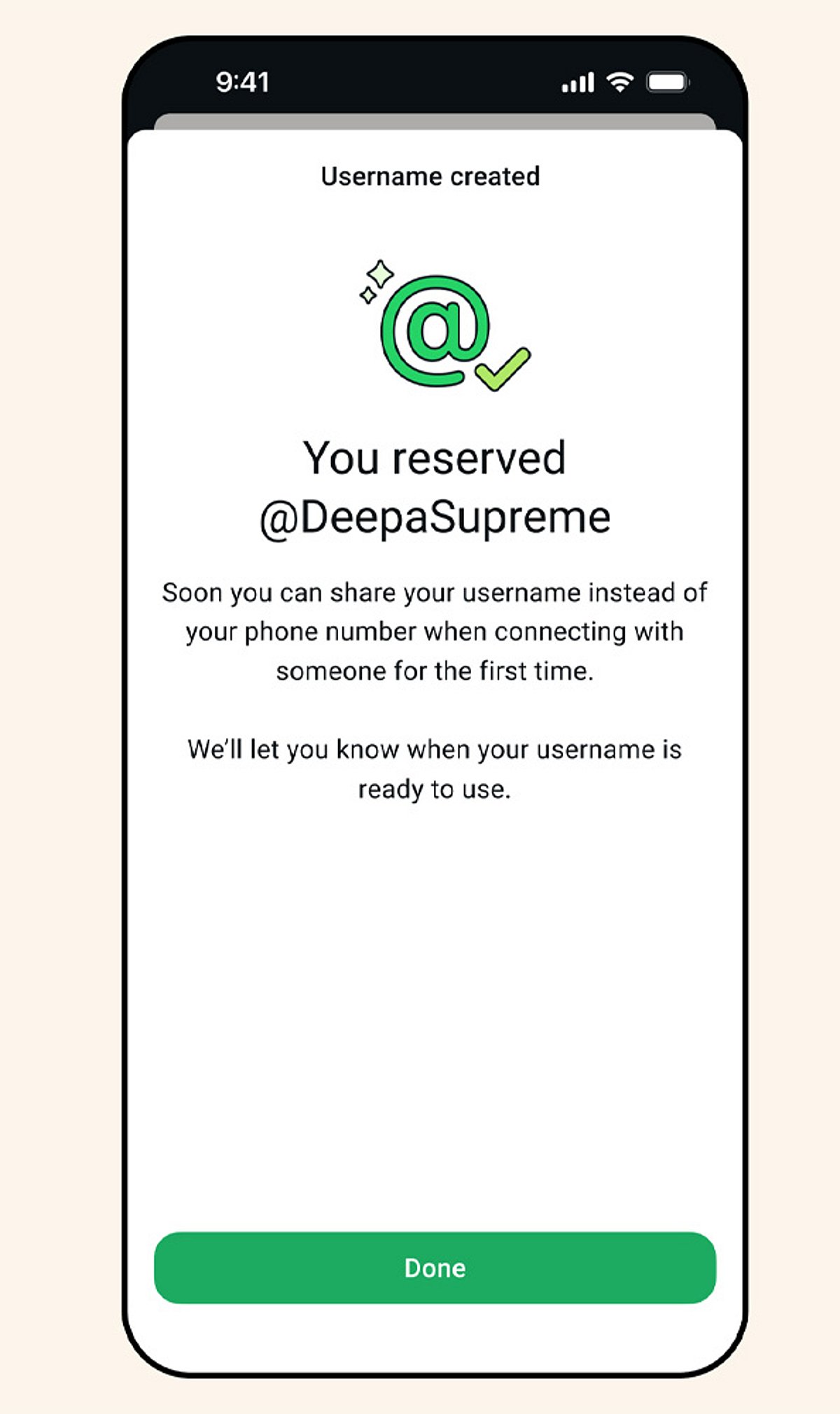
    To set up a username, users navigate to Settings > Account > Username and reserve a unique @-name. This name can appear in chats, groups, and calls instead of the phone number for contacts who haven’t saved the user’s number. Other users must know the exact username to initiate a conversation.

    The government will review Meta’s response and then decide whether to allow the feature to proceed. Usernames were not yet live and were originally slated for rollout later in 2026.