
Introduction
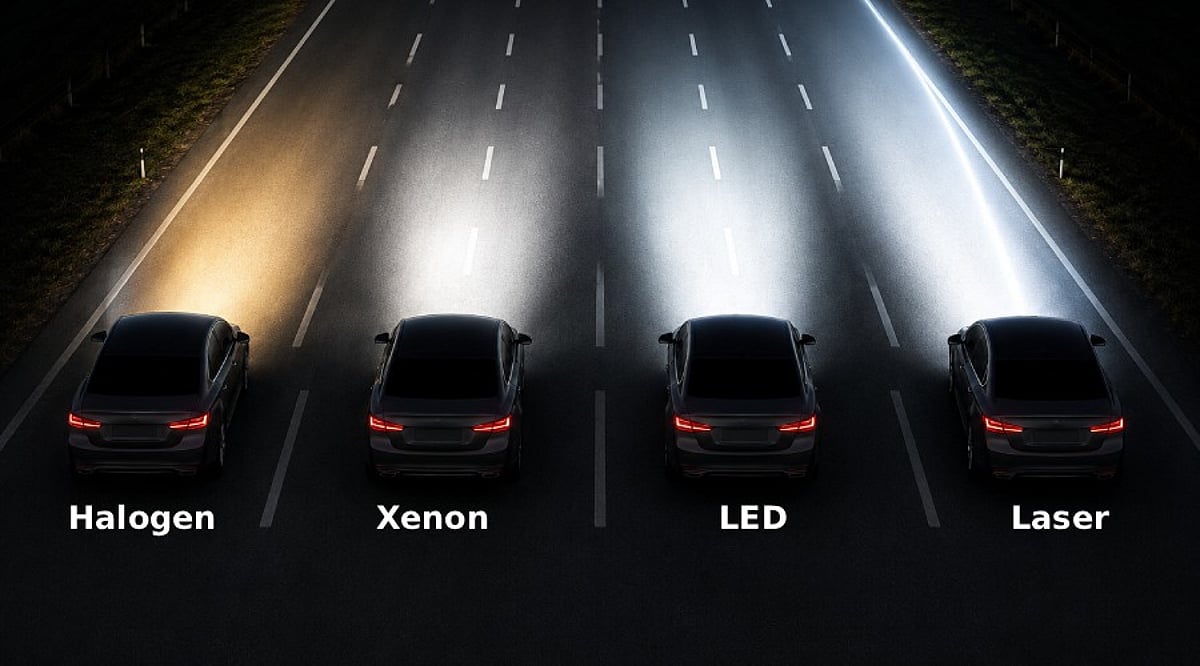
Car headlights have evolved dramatically over the years. Older vehicles typically came with basic halogen bulbs, but modern cars now offer xenon (HID), LED, and even laser headlights. Each type differs in brightness, lifespan, energy efficiency, and cost. Knowing these differences helps you choose the right car and understand maintenance needs.
Halogen Headlights
Halogen is the oldest and most common headlight type, still used in many budget-friendly cars. These bulbs use a thin filament inside a glass bulb filled with halogen gas; when electricity passes through, the filament glows. Halogen lights produce around 1,000–1,500 lumens, emitting a warm yellow or white beam. They work well for city driving but lack the brightness needed for dark highways. Their main drawbacks are short lifespan (500–1,000 hours) and higher energy consumption. However, they remain popular due to their low upfront and replacement costs.
Xenon (HID) Headlights
Xenon headlights, also called High-Intensity Discharge (HID) lights, produce light by creating an electric spark inside a bulb filled with xenon gas. This method delivers about 3,000 lumens—roughly twice as bright as halogen. The bright white light improves visibility of road signs, pedestrians, and animals at night. Xenon bulbs last 2,000–3,000 hours, significantly longer than halogen. However, they are more expensive and require a ballast to operate. They also take a few seconds to reach full brightness after being turned on.
LED Headlights
Light Emitting Diodes (LEDs) are now the most popular headlight choice for new cars. They use a small semiconductor to produce light, consuming much less energy than halogen or xenon. LED headlights provide instant full brightness and a crisp white light that enhances nighttime visibility. Their lifespan exceeds 20,000 hours, drastically reducing replacement frequency. LEDs are also compact, giving designers more flexibility. The main downside is higher cost, especially if the entire unit needs replacement.
Laser Headlights
Laser headlights represent the cutting edge, currently found only in luxury vehicles. Despite the name, they don’t shine lasers directly onto the road. Instead, laser diodes generate energy that passes through a phosphor material, producing a bright white light. These headlights can illuminate the road several hundred meters ahead, making highway driving much safer. They are extremely energy-efficient and compact, but their high manufacturing and repair costs limit them to premium cars.
Comparison at a Glance
| Type | Brightness (Lumens) | Lifespan (Hours) | Energy Efficiency | Cost |
|---|---|---|---|---|
| Halogen | 1,000–1,500 | 500–1,000 | Low | Low |
| Xenon (HID) | ~3,000 | 2,000–3,000 | Medium | Medium |
| LED | High (varies) | 20,000+ | High | High |
| Laser | Very high (longest beam) | Long | Very high | Very high |
Latest Innovations in Headlight Technology
Today’s headlights do more than just light the road. Many new vehicles feature Adaptive Driving Beam (ADB), which automatically adjusts the high beam to avoid dazzling oncoming drivers. Matrix LED headlights consist of many small LED segments that can be individually turned on or off, reducing glare while keeping the road well lit. Digital headlights can project warnings, lane markings, or navigation directions directly onto the pavement. Emerging Micro-LED technology promises even better efficiency and longevity than current LEDs.
Market Trends
The automotive lighting market is expanding rapidly. Manufacturers are increasingly swapping halogen for LED systems. Adaptive and laser lights are expected to see massive growth over the next decade, driven by stricter safety regulations, the rise of electric vehicles, and ongoing technological improvements. Halogen remains common in economy cars, but LED has become the global standard for new vehicles.
Conclusion
Each headlight type serves a distinct purpose. Halogen is cheap and easy to replace. Xenon offers brighter light and longer life. LED provides the best combination of brightness, efficiency, and longevity (over 20,000 hours). Laser delivers the longest and most powerful beam but at a premium price. As automotive technology advances, headlights will become smarter with ADB, Matrix LED, digital lighting, and Micro-LED, making night driving safer and more comfortable.
Frequently Asked Questions
1. Which headlight type is the brightest?
Laser headlights are the brightest and can light up the road several hundred meters ahead.
2. Why are LED headlights so popular?
LED headlights use less electricity, last more than 20,000 hours, and provide bright white light.
3. Are xenon headlights better than halogen?
Yes. Xenon headlights are brighter, last longer, and improve visibility at night.
4. Can halogen headlights be replaced with LED headlights?
Yes, but compatibility depends on the vehicle. Some cars may need additional parts or approved conversion kits.
5. What is Matrix LED technology?
Matrix LED headlights use many small LED sections that adjust automatically to reduce glare while keeping the road well lit.
Leave a Reply