
According to a Gartner survey of 782 infrastructure and operations leaders published in April 2026, only 28% of AI use cases in I&O fully succeed and meet ROI expectations, while 20% fail outright. Thirty-eight percent of leaders who faced setbacks cited poor data quality or limited data availability as a direct cause. The conclusion increasingly shared across the industry is that the root of most AI failures lies not in the quality of the model itself, but in the underlying level of data and infrastructure.
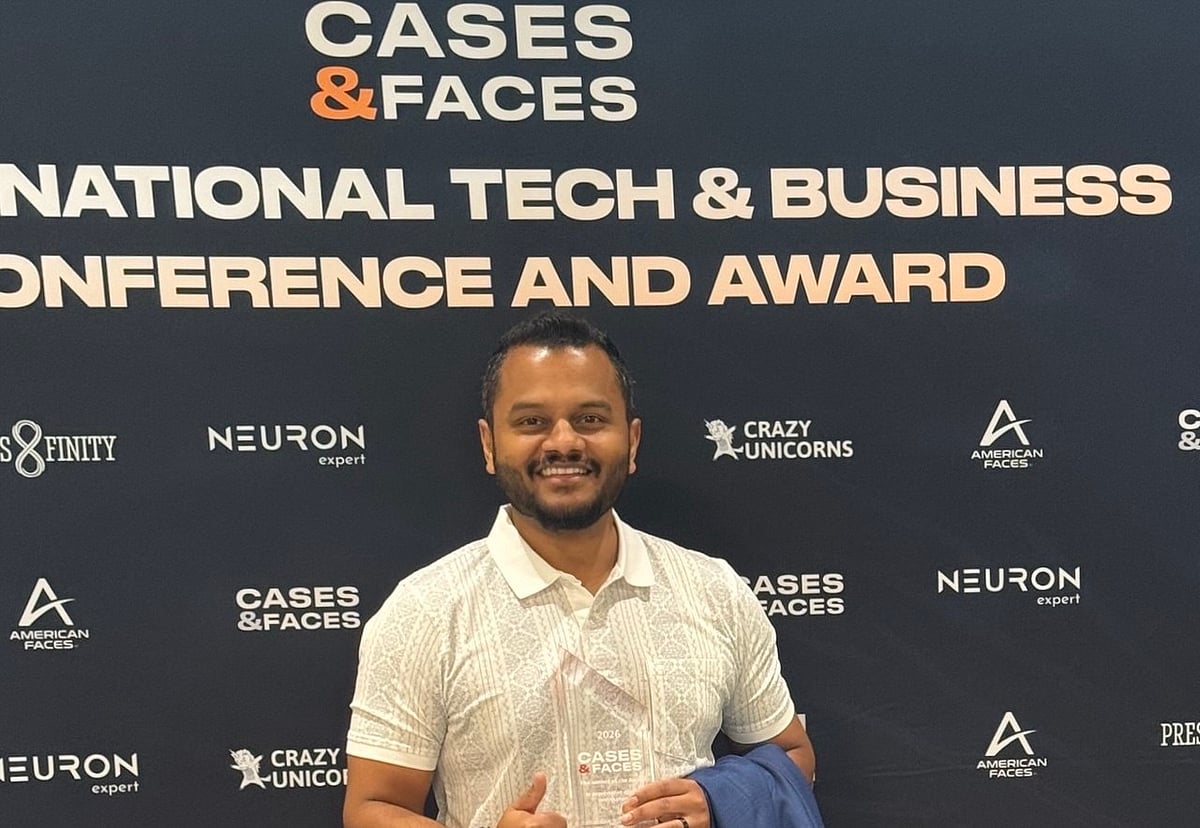
Few practitioners understand this from the inside as clearly as Sushrutha Sreevathsa, a Service Reliability Engineer at Yahoo, where he supports platforms serving more than 200 million daily users. A member of the D2A2 Council — an exclusive thought leadership group in Digital, Data, Analytics, and AI — and a contributing author to the AWS Marketplace publication Build Strong Data Foundations for Agentic Analytics and Intelligent Agents, Sreevathsa recently received the Cases & Faces International Business Award for Achievement in Product Innovation in the Data Analytics & Big Data category. We spoke with him about why enterprise AI keeps stalling, and what it actually takes to build the foundations that make it work.
Adoption vs. Impact
“Yes, broadly,” Sreevathsa says when asked if the statistics match his on-the-ground experience. “What I see across the industry matches what the research is pointing to: the adoption numbers are real, but the value is often not following. Part of that is because a lot of organisations are measuring the wrong thing. They track how many teams are using an AI tool, or how many dashboards have been built, and conclude that adoption is working. But adoption does not necessarily mean impact. The more honest question is: are decisions actually changing because of this data? And in many cases, the answer is no — because the underlying data is not in a state where people trust it enough to act on it.”
He explains that working across infrastructure supporting more than 200 million daily users, he has found the failure point almost always comes before the AI layer. “Teams are generating enormous volumes of operational data, but when different parts of the organisation use different definitions, baselines, and reporting views, the AI ends up amplifying disagreement rather than resolving it — a sophisticated tool sitting on top of an unresolved problem.”
Where AI Projects Actually Break
When an AI project stalls or gets abandoned after proof of concept, Sreevathsa says the model is rarely the issue. “What is broken is usually one of three things: the data is not clean or consistent enough to be trusted, there is no clear ownership of what the data is supposed to mean, or the business question the AI is supposed to answer was never properly defined in the first place.”
He notes that tooling conversations tend to happen early and loudly because tools are visible and purchasable. “The data foundation conversation is a lot less exciting to have in a board presentation — but it is the one that actually determines whether the project delivers measurable results.”
The Connected Intelligence Operating Model
Sreevathsa’s chapter in the AWS Marketplace book introduces what he calls a Connected Intelligence Operating Model — an original framework that integrates six elements often managed in isolation: business decisions, data products, AI models, governance, human judgment, and feedback loops.
“Connected intelligence means that AI-enabled decision-making requires more than aggregating data from different sources. It requires building a coherent, governed layer where technical, operational, and business signals are all speaking the same consistent language. When a leadership team looks at a dashboard, every number should have a clear, agreed-upon meaning, and every person in the room should be working from the same version of reality.”
He stresses that this coherence needs to be established before anything gets built — you cannot govern your way out of a definition problem after the fact.
Solving the Data Trust Problem at Yahoo
His work on the SRE analytics data product at Yahoo earned the Cases & Faces Award for Product Innovation in 2026. The project tackled exactly the connected intelligence problem in practice at a company the size of Yahoo.
“When every team has its own reporting view, and those views have been in place for a while, people become attached to their version of the numbers. There is usually a legitimate reason why a particular team measures something the way they do, but when the goal is to give leadership a single, reliable picture of what is happening across the organisation, those differences become a problem.”
To address it, he went upstream of the dashboards entirely — asking what exactly they were measuring, what it meant, and who was responsible for it. Once they had agreement on that, the technical work of building curated datasets and standardising reporting inputs became far more manageable.
Making Definitions Explicit
On how to solve the data trust problem arising from different teams using the same words to mean different things, Sreevathsa says, “You do not always aim to eliminate the differences. More often, you make them explicit and agree on what the canonical version is for a specific purpose.”
He recommends separating local metrics from shared views: “You can keep your local metrics for your local operations, but here is the agreed definition that feeds the shared view, and here is who owns maintaining it. That ownership piece is critical. Definitions drift when nobody is accountable for keeping them stable. Once you assign clear ownership and document it, you have something that can be maintained and audited rather than argued over every quarter.”
Real-World Impact: RevMon and Revenue Protection
Sreevathsa played a leading operational role in Yahoo’s RevMon initiative, the only system within Yahoo providing real-time revenue visibility across its advertising platforms. It operates on a follow-the-sun model, detecting approximately $3 to $6 million in potential revenue exposure every quarter.
“A significant part of it was the trust,” he explains. “The monitoring infrastructure was important — without real-time visibility into what was happening across Yahoo’s ad delivery systems, you simply could not catch revenue-impacting incidents fast enough. But what prevented losses was not the monitoring alone. It was the ability to act immediately when something surfaced — and that became possible because everyone was looking at the same data and could act on it without spending time on additional confirmation.”
Anomaly as Operational Risk
Sreevathsa helped build a coordinated approach that treats abnormal business metrics as operational risks from the moment they appear, rather than as data points to be reviewed later.
“The core shift was in how the organization treated a business metric anomaly when it surfaced. In most environments, an unusual number in a revenue dashboard triggers a reporting workflow where it gets noted, logged, and may or may not prompt action depending on how serious it appears. What we built treats that same anomaly as the start of an operational response: there is a defined triage process, a clear escalation path, and accountability distributed across the teams who need to act.”
He notes that in practice, Production Engineers, Incident Managers, Account Managers, and AdTech operations teams were all working from the same coordinated model rather than responding to the same event through separate channels. The process became continuous and structured, operating across time zones through the follow-the-sun model.
What Separates Successful AI Organizations
Drawing on conversations from the D2A2 Council, Sreevathsa identifies common characteristics among organisations that are actually getting value from AI:
- They defined what success looks like in business terms before selecting a use case.
- They treated data as a product — with owners, SLAs, and governance — rather than as an output of their systems.
- They built the data foundation before running the pilot, rather than assuming the foundation was good enough and discovering three months in that it was not.
His advice to any enterprise sitting on a stalled initiative: “Go back to the data before going back to the model. Not to run another audit, but to ask one specific question: do the people who are supposed to act on this AI output actually trust the data it is drawing from? If the answer is anything other than an unambiguous yes, that is where the work needs to happen. It is slower and less visible than running another proof of concept — but it is the only path to something that holds up in production.”
Leave a Reply