Author: vitorcherulli

  • 7 Essential Controls to Protect Crypto Assets from Insider Theft

    7 Essential Controls to Protect Crypto Assets from Insider Theft

    Institutions holding crypto assets face significant risks from insider theft. To mitigate these threats, they implement a range of controls designed to prevent unauthorized access and movement of funds. Below are seven key measures that help safeguard digital assets.

    Multi-Party Approval

    Requiring multiple approvals for sensitive transactions reduces the risk of a single employee moving funds alone. This creates a clear audit trail and makes unauthorized transfers harder to execute.

    Strict Access Controls

    Access to crypto wallets, private keys, and trading systems is limited based on employee roles. Strong authentication, separate accounts, and regular access reviews further minimize the risk of credential theft or misuse.

    Cold Storage

    Storing the majority of crypto assets offline in cold storage reduces exposure to online attacks and internal threats. Only funds needed for daily operations are kept online, with additional checks required for any transfers between storage systems.

    Private Key Management

    Private keys are protected using dedicated management systems, secure storage, and strict recovery procedures. Splitting key control among multiple authorized parties prevents any single employee from gaining enough control to move assets independently.

    Transaction Monitoring

    Continuous monitoring helps detect unusual wallet activity, large transfers, or transactions outside normal patterns. Security teams set alerts for risky actions and maintain detailed logs for investigation.

    Regular Security Audits

    Independent audits assess wallet controls, permissions, key storage, and procedures to identify weaknesses. Regular reviews ensure safeguards remain effective as roles, systems, and threats evolve.

    Separation of Duties

    Dividing responsibilities across custody, approval, security review, and reconciliation prevents any single employee from controlling an entire transaction. This creates multiple checkpoints and improves accountability.

  • Colorful Table Lamps: Transform Your Walls with Vibrant Light

    Colorful Table Lamps: Transform Your Walls with Vibrant Light

    Colorful Table Lamps: A Simple Way to Change Your Room’s Mood

    Colorful table lamps can instantly change a room’s mood by casting vibrant shades across nearby walls. From soft blue and warm orange to bold pink and purple, these lamps add character without major decor changes. They work especially well in bedrooms, living rooms, gaming spaces, and creative corners.

    RGB Table Lamps: Full Spectrum Control

    RGB table lamps offer a wider range of colors for people who want more control over their room’s look. Users can switch between bright colors, soft tones, and flowing color effects. Some models also allow different lighting zones, helping create layered visuals that make plain walls look more dynamic.

    Smart Table Lamps: Convenience at Your Fingertips

    Smart table lamps bring lighting controls directly to your phone or smart home setup. Users can adjust brightness, change colors, create schedules, and switch between preset scenes. This makes them useful for different moments, whether you want calm lighting for reading, colorful effects for entertainment, or brighter illumination for everyday tasks.

    Ambient Lighting: Soft and Comfortable Atmosphere

    Ambient lighting helps create a softer and more comfortable atmosphere without making the room overly bright. A table lamp placed near a wall can spread gentle color across the surface, adding depth to the space. Warm shades can create a relaxed setting, while cooler colors can give the room a modern appearance.

    Gaming Room Lighting: Immersive and Energetic

    Table lamps with colorful lighting can also enhance gaming setups by adding color behind monitors and desks. RGB effects can complement the colors on a screen while creating a more immersive environment. Players can choose steady colors or changing patterns to give their gaming corner a more personalized and energetic look.

    Music-Synced Light Effects: Light That Moves with the Beat

    Some colorful lamps can react to music, allowing light patterns to change with the beat. This feature can turn a simple table lamp into part of an entertainment setup. Music-synced effects are especially useful during parties, movie nights, or gaming sessions when static lighting may feel less engaging.

    Decorative Wall Glow: Highlighting Textures and Art

    A table lamp does not always need to illuminate an entire room to make an impact. Placing one close to a wall can create a decorative glow that highlights textures, artwork, shelves, or furniture. With the right color and position, even a simple lamp can become an eye-catching part of the room’s decor.

  • Ethereum Price Prediction: $3,000 Target in Sight as ETH Holds Above $2.7K and MemeToro Presale Gains Steam

    Ethereum Price Prediction: $3,000 Target in Sight as ETH Holds Above $2.7K and MemeToro Presale Gains Steam

    Ethereum is holding near $2,745 after breaking out of a bull flag pattern. The move comes as the wider crypto market pushes higher and a reported $666 million in short liquidations adds fresh momentum to altcoins. For ETH holders, the next major focus is whether the breakout can carry price toward $3,000 and then the $3,250 target.

    The Ethereum price prediction is gaining strength because ETH is trading above its recent breakout zone. Some year-end models now point toward $3,454, showing how quickly bullish expectations are building around the second-largest crypto asset.

    This pumping market is also encouraging buyers to look for earlier entries. The MemeToro presale is one project gaining attention as $MT holds at $0.00430 in Stage 7 and passes $145K raised. MemeToro gives buyers a chance to enter before its AI launch tools, fair-launch contracts, and BNB Chain trading ecosystem reach the wider market.

    Ethereum’s Breakout Puts $3,000 Back in Focus

    Ethereum’s bull flag breakout is a major technical signal for the altcoin market. A bull flag forms when an asset rises strongly, pauses for a short period, and then breaks higher as buyers return. ETH has now moved above $2,700, putting the $3,000 level firmly back on the market’s radar.

    The short-term Ethereum price prediction points to $3,250 if the current momentum continues. A broader year-end model near $3,454 adds another bullish level for traders to watch. These targets reflect growing confidence as capital flows back into major layer-1 networks.

    Ethereum also has a strong fundamental base. Its network supports decentralized finance, stablecoins, NFTs, gaming, and many other blockchain applications. Staking can also reduce the amount of ETH actively available for trading, which may strengthen price moves when demand increases.

    How MemeToro’s AI Agent Opens a New BNB Chain Opportunity

    Ethereum gives buyers exposure to a mature network with a massive existing ecosystem. MemeToro gives them access to a much earlier story focused on the fast-moving memecoin market. The project is building an AI agent that aims to help creators turn online trends into structured BNB Chain token launches.

    The planned AI system is designed to track social conversation, public news, and fast-rising narratives. When it identifies a trend, it can help produce a launch package that includes a token concept, branding direction, allocation design, and funding mechanics. This can make token creation easier for people who have an idea but do not have deep technical skills.

    The proposed workflow is simple:

    • The AI scans for a trend with growing attention
    • The creator reviews the token concept and launch plan
    • Smart contracts apply the selected fair-launch rules
    • Traders discover and follow new memecoin launches

    This gives MemeToro a powerful product angle. Rather than creating another token with no platform purpose, it is building tools that could bring new creators and traders into one BNB Chain ecosystem. As the memecoin sector grows, a platform that helps users identify trends and launch tokens quickly could capture meaningful activity.

    Why MemeToro’s Public Fair-Launch Code Strengthens $MT

    MemeToro has backed its AI launchpad story with public development work. The project has released 1,373 lines of Solidity code across 17 files, including a FairLaunchEscrow contract, interfaces, tests, and supporting documentation. This gives the community a clear look at the framework behind its planned launch system.

    The stated contract design is built to lock launch settings when a token is created. It is also designed to remove insider allocations from the fair-launch split and direct funds toward refunds or planned liquidity routes. For memecoin buyers, these rules can create a cleaner entry experience.

    The planned structure gives users several advantages:

    • AI-guided token concepts based on live trend signals
    • Fixed launch terms visible before funding begins
    • Wallet caps and fairer participation rules
    • Future memecoin trading tools for discovering launches
    • $MT utility across platform access, rewards, and staking

    $MT is intended to power the wider ecosystem. The token is planned for premium tools, platform transactions, launch funding, staking, rewards, prediction markets, and the MemeToro news hub. This creates several potential demand channels as more users interact with the platform.

    Final Words

    Ethereum’s push above $2,700 has brought the $3,000 level back into view and strengthened the wider altcoin market. A $3,250 target now gives traders a clear next milestone, while the broader year-end outlook near $3,454 shows how positive sentiment has become. Ethereum remains a leading market name, but its scale means early buyers may search for smaller opportunities with more room to grow.

    MemeToro offers that early-stage angle. $MT is still priced at $0.00430 in Stage 7, the presale has crossed $145K, and the project is building an AI-driven BNB Chain launchpad supported by public fair-launch code. With token creation, trading, staking, prediction markets, and news tools planned around $MT, MemeToro is shaping up as the best crypto presale project for the next memecoin cycle.

    FAQs

    What is Ethereum’s next key price target?
    Ethereum’s current breakout has put $3,000 in focus, with $3,250 acting as the next major short-term target. Some year-end models place ETH near $3,454.

    What is the current $MT presale price?
    $MT is priced at $0.00430 in Stage 7. MemeToro has raised more than $145K in its presale.

    More Information on MemeToro ($MT) Presale Here:

    • Website: https://memetoro.com/
    • X: https://x.com/memetoro_mt
    • Telegram: https://t.me/memetoro_mt
    • YouTube: https://www.youtube.com/watch?v=gY0jgWy_DtA

    Disclaimer: Analytics Insight does not provide financial advice or guidance on cryptocurrencies and stocks. Also note that the cryptocurrencies mentioned/listed on the website could potentially be risky, i.e. designed to induce you to invest financial resources that may be lost forever and not be recoverable once investments are made. This article is provided for informational purposes and does not constitute investment advice. You are responsible for conducting your own research (DYOR) before making any investments. Read more about the financial risks involved here.


  • Gmail’s ‘Copy Code’ Button Eliminates a Step in Two-Factor Authentication

    Gmail’s ‘Copy Code’ Button Eliminates a Step in Two-Factor Authentication

    Gmail is rolling out a new ‘Copy code’ option for two-factor authentication (2FA) emails. This feature allows users to copy verification codes directly from the inbox without opening the email. Instead of manually selecting numbers, users can tap a button below the subject line to copy the code to their clipboard.

    The change is designed for people who regularly use email-based 2FA when signing into banking, shopping, work, social media, and other online accounts. While it does not alter the security of two-factor authentication, it significantly improves convenience by reducing the number of steps required.

    How Gmail’s 2FA Code Copy Feature Works

    When a user attempts to log into a third-party application using a Gmail ID with 2FA enabled, Google detects the verification email. It then displays a ‘Copy code’ button below the subject line. Users do not need to open the message to find the number. They can tap the button and copy the code to their phone’s clipboard, then paste it into the sign-in page.

    Currently, this feature is available on Android and iOS devices; the web version of Gmail will not receive it during this rollout phase. The whole process takes only a few seconds, saving time compared to the previous method of opening the email, searching for the code, selecting it, copying it, and switching back to the other app.

    What Gmail’s New Feature Means for Users

    The biggest benefit is convenience. For users who perform 2FA tasks multiple times a day, the single extra tap can reduce frustration. This change also demonstrates how email apps are becoming more action-oriented, adding quick actions based on email content. A verification email is a perfect example: most people only need the code, so giving them a direct copy option makes sense.

    The feature may also reduce small mistakes, such as copying an extra space or missing a digit when manually selecting a code. However, security remains important. Users should never share verification codes with anyone, even with the new shortcut. Scammers can still trick users into giving away codes. The feature does not replace stronger login methods like passkeys or security keys, which Google recommends for better phishing protection.

    A Small Change That Makes 2FA Easier

    Gmail’s ‘Copy code’ option is not a major security change; its value comes from streamlining a familiar, repetitive task. Users no longer need to open every 2FA email just to find a number. A single tap copies the code and gets them back to the sign-in screen. This fits into a larger trend of making account protection easier while reducing friction. Until passkeys become more widespread, verification codes remain common, and this shortcut can make them a little less annoying.

    Frequently Asked Questions

    1. What is Gmail’s new 2FA Code Copy feature?

    It is a new Gmail option that lets users copy a verification code directly from the inbox without opening the email.

    2. How does Gmail’s Copy code button work?

    Gmail shows a ‘Copy code’ button below eligible verification emails. Users tap it to copy the code and paste it into the required sign-in field.

    3. Is Gmail’s Copy code feature available on iPhone?

    Yes, it is rolling out on both Android and iPhone, depending on the Gmail app version and account.

    4. Does the feature make 2FA more secure?

    It mainly makes 2FA easier to use. It does not change how verification codes protect an account. Google recommends passkeys and security keys for stronger protection.

    5. Should users share their Gmail verification codes?

    No. Users should never share verification codes with other people, as a scammer could use them to bypass account security.

  • Beyond Google Chrome: Top 5 Browsers for Privacy, Customization, and Speed

    Beyond Google Chrome: Top 5 Browsers for Privacy, Customization, and Speed

    By Somatirtha | Published: September 22, 2026

    Google Chrome remains one of the most widely used browsers, but it is not the only option. Several competing browsers offer features focused on privacy, customisation, productivity, speed and resource management. Depending on individual requirements, these alternatives can provide a different browsing experience while supporting everyday web activities.

    Mozilla Firefox

    Mozilla Firefox remains a popular alternative for users seeking greater control over privacy and browser settings. It supports extensive customisation, add-ons and privacy-focused features. Firefox also uses its own browser engine rather than Chromium, giving users another option beyond the technology that powers many popular browsers.

    Microsoft Edge

    Microsoft Edge combines Chromium compatibility with Microsoft’s own features and services. It supports extensions from the Chrome Web Store while offering tools such as vertical tabs, Collections and integrated productivity features. Its compatibility with modern websites makes it a practical alternative for users moving away from Chrome.

    Brave

    Brave focuses heavily on privacy and reducing unwanted online tracking. The browser blocks advertisements and trackers by default and includes additional privacy controls. Brave is also based on Chromium, meaning websites and many extensions designed for Chrome can work with it while users get a more privacy-focused browsing experience.

    Opera

    Opera stands out with built-in tools designed to reduce the need for additional extensions. Depending on the version, users can access features such as sidebar applications, workspace management and integrated services. Its interface also offers several customisation options, making it suitable for users who want more controls directly within their browser.

    Vivaldi

    Vivaldi is designed around extensive browser customisation. Users can modify tabs, toolbars, panels, shortcuts and other interface elements according to their preferences. It also provides productivity-oriented features that can help manage multiple websites. For people who want detailed control over their browsing environment, Vivaldi offers numerous configuration options.

    Choosing a Chrome Alternative

    Choosing a browser ultimately depends on what matters most to the user. Privacy-focused users may prioritise tracking protection, while others may prefer customisation, productivity tools or compatibility. Before switching, users should consider extension support, device compatibility, performance and account integration to find a browser matching their requirements.

  • 5 Teen Dramas to Binge If You Loved Crew Girl

    5 Teen Dramas to Binge If You Loved Crew Girl

    If you loved Crew Girl and are looking for your next binge, these five teen dramas deliver the same blend of team dynamics, rivalry, romance, and personal growth.

    All American

    This football-centered drama follows a talented player caught between two very different worlds. With sports rivalries, family tension, and high school romance at its core, the show explores class divides and identity struggles as the lead balances two communities. The mix of on-field competition and off-field emotional stakes makes it an easy next watch.

    Cobra Kai

    Fans of the rowing world in Crew Girl will find a familiar spirit in Cobra Kai‘s martial arts rivalry. Old feuds resurface when new students join rival dojos, each fighting for respect and belonging. The show balances humor with genuine emotional arcs, making the rivalry feel personal and layered.

    One Tree Hill

    For a classic take on team-centered teen drama, One Tree Hill delivers small-town basketball rivalries, tangled friendships, and messy romances. Brothers turned teammates navigate jealousy, loyalty, and first love while chasing wins on the court, with long-running arcs that add depth to every relationship.

    Gossip Girl

    Set among elite prep school students, this series combines scandal, rivalry, and romance in a wealthy, status-obsessed society. An anonymous blogger exposes secrets that ripple through friend groups and constantly shift loyalties. The glossy setting mirrors the old-money atmosphere of Easton, but with sharper social stakes.

    Ginny & Georgia

    This coming-of-age drama pairs family secrets with friendship struggles and romance, offering the same emotional depth Crew Girl fans appreciate. A mother-daughter duo settles into a new town, each hiding pieces of their past from the other. The show balances light humor with heavier themes, echoing Teagan’s family journey.

    These five series each bring something different, but all capture the spirit of teamwork, rivalry, and growing up that makes Crew Girl so compelling.

  • Solana App Revenue Hits $143M in August: How On-Chain Services Generate Income

    Solana App Revenue Hits $143M in August: How On-Chain Services Generate Income

    Solana’s on-chain economy is far larger than the fees paid to validators. Applications built on the network are generating substantial revenue from decentralized trading, token launches, lending, wallets, liquid staking and other financial services. Understanding where this revenue comes from helps distinguish raw blockchain activity from services users are actually willing to pay for.

    Recent data underscores the scale of that economy. During August 2026, Solana applications generated $143.23 million in protocol revenue, representing approximately 38% of all tracked application revenue across blockchains that month.

    How Trading and Token Launches Drive Revenue

    Decentralized exchanges (DEXs) charge fees when users swap tokens. Part of those fees compensates liquidity providers, while the protocol retains another portion. Additional revenue streams come from trading interfaces, routing services, perpetual trading and other offerings. Launchpads generate fees through token creation, bonding curves and subsequent trading activity.

    Pump.fun is a prime example. According to DeFiLlama, Pump-related protocol revenue reached roughly $58 million over the latest 30-day period, sourced from bonding-curve activity, graduation fees, PumpSwap and other products.

    Solana’s revenue base is also broadening. Applications such as Jupiter, Raydium, Axiom and newer trading platforms contribute through aggregation, automated market makers (AMMs), trading interfaces and other fee-generating services. On September 12, 2026, Solana applications collectively hit $7.935 million in daily protocol revenue—the highest single-day total of the year at that point.

    Revenue vs. Trading Volume: A Critical Distinction

    Trading volume measures the value of assets exchanged, not what an application earns. If a DEX processes $1 billion in volume with an effective 0.10% fee, gross fees would be $1 million. However, some of those fees may go to liquidity providers, referral programs or other participants.

    DeFiLlama therefore separates fees (total paid by users) from protocol revenue (the portion kept by the protocol). This distinction is essential when comparing applications with different business models.

    Network Fees Are Separate from Application Revenue

    Application revenue should not be confused with Solana’s underlying network economics. A single decentralized trade can create multiple economic flows: the application collects a trading fee, liquidity providers receive compensation, and the blockchain collects transaction-related fees. Consequently, $1 of application revenue does not mean $1 flows directly to SOL holders.

    How Revenue Reaches Token Holders

    Protocols decide how retained revenue is deployed—funding operations, accumulating in treasuries, financing incentives, or supporting token buybacks. DeFiLlama estimates roughly $38.7 million in holder revenue across Solana-based protocols over 30 days. Pump.fun accounts for about $25.2 million, while Jupiter and Raydium also direct portions of revenue toward token buybacks.

    This underscores why application revenue and token-holder value accrual are not identical metrics.

    Key Takeaways

    Solana applications generate revenue through trading, token launches, lending and other on-chain services. With app revenue reaching $143.23 million in August 2026, the ecosystem demonstrates substantial fee-generating activity. However, evaluating its economics requires separating trading volume, user fees, protocol revenue, network fees and the portion that ultimately reaches token holders.

  • How AI-Powered Apps Are Revolutionizing Cryptocurrency Trading

    How AI-Powered Apps Are Revolutionizing Cryptocurrency Trading

    Artificial intelligence is rapidly becoming a cornerstone of cryptocurrency trading infrastructure. AI-powered applications can process price action, derivatives data, blockchain activity, news, and sentiment far faster than any individual trader. While some systems only generate signals, newer agentic tools can connect directly to exchanges or wallets and execute transactions autonomously. However, these systems produce probabilistic decisions, not guaranteed forecasts.

    AI Combines Multiple Data Sources

    Conventional technical analysis typically relies on price, volume, and indicators. AI, on the other hand, analyzes vast datasets including Bitcoin momentum, order-book depth, funding rates, open interest, liquidations, exchange flows, and volatility. Machine learning identifies historical relationships associated with specific market events, while natural language processing (NLP) incorporates financial news, regulatory announcements, and social media discussions. The result: systems can classify market conditions as bullish, bearish, or neutral, assign probabilities to potential movements, or rank possible trading sequences.

    From Signals to Autonomous Execution

    AI analysis is increasingly extending beyond recommendations. Applications connected to exchange APIs can convert trading signals into orders, adjust position sizes, and monitor positions continuously. This trend became more visible in 2026: Kraken launched its CLI in March with 134 commands supporting spot trading, futures, staking, transfers, and WebSocket streaming. Kraken said the system was designed for developers and AI agents to access crypto markets directly. Coinbase introduced Agentic Wallets in February 2026, providing infrastructure that lets AI agents autonomously spend, earn, and trade while using built-in security guardrails.

    Historical Performance Can Be Misleading

    Machine learning models depend heavily on training data. A strategy optimized during a Bitcoin bull market may identify relationships that weaken during sideways or declining markets. Overfitting is another risk: a model can perform exceptionally well against historical observations but deteriorate once deployed with live capital. Trading costs—exchange fees, bid-ask spreads, slippage, and execution latency—can reduce or eliminate profits suggested by backtests. The CFTC warns that AI cannot predict sudden market changes and urges skepticism toward bots or signal services promising guaranteed or unusually high returns.

    Risk Controls Remain Essential

    Automated execution makes risk management particularly important, as errors can be repeated quickly. Position limits, stop-loss rules, exposure controls, model monitoring, and independent validation help constrain losses. The CFTC’s Innovation Task Force, announced in 2026, specifically includes artificial intelligence and autonomous systems among the technologies for which it is developing regulatory frameworks.

    Why This Matters

    The crypto market operates 24/7 and generates vast real-time data. While AI can process and respond rapidly, the need for reliable models, transparent strategies, and robust risk management increases proportionally.

    Final Thoughts

    AI can play a significant role in monitoring the cryptocurrency market, identifying trends, and executing trades, but it cannot eliminate trading uncertainty. Performance still depends on data quality, model design, changing market conditions, transaction costs, and disciplined risk controls.

    Frequently Asked Questions

    1. How does AI analyze cryptocurrency markets?
    AI systems process price movements, volume, order books, funding rates, open interest, liquidations, and blockchain activity simultaneously. NLP also incorporates financial news, regulatory developments, and social media sentiment.

    2. How do AI-powered apps generate crypto trading signals?
    Machine learning models search historical and real-time datasets for patterns associated with particular market conditions. They classify conditions as bullish, bearish, or neutral, calculate probabilities, or rank potential trading opportunities.

    3. Can AI automatically execute cryptocurrency trades?
    Yes. AI applications connected to exchange APIs or compatible wallets can convert signals into orders, determine position sizes, and monitor positions. Newer agentic infrastructure makes autonomous execution increasingly accessible.

    4. Can AI accurately predict Bitcoin and cryptocurrency prices?
    AI identifies patterns and estimates probabilities but cannot reliably predict future prices. Unexpected events, changing variable relationships, poor training data, and overfitting can cause previously successful models to fail.

    5. What are the major risks of using AI for crypto trading?
    Key risks include overfitting, inaccurate signals, sudden market changes, automation errors, slippage, and transaction costs. Position limits, stop-loss rules, exposure controls, and continuous model monitoring remain critical when automated systems trade.

  • 10 Wildly Entertaining Online Games to Play in 2026

    10 Wildly Entertaining Online Games to Play in 2026

    The world of online gaming continues to evolve, offering a diverse array of experiences that range from chaotic battles to creative challenges. Whether you are a seasoned player or just looking for a quick distraction, these ten games deliver endless fun and unpredictability. Below is an updated list of the most entertaining online games to dive into this year, featuring classics that have stood the test of time alongside exciting newcomers.

    1. Shell Shockers

    This unique first-person shooter puts you in the role of an egg armed with various weapons. Crack your opponents before they scramble you in modes like free-for-all and team battles. The developers continue to release fresh weapon skins, keeping the game vibrant in 2026.

    2. Paper.io 2

    Capture territory by drawing lines and enclosing areas, but watch out—other players can cut your trail and eliminate you. Its addictive mix of strategy and speed makes it a popular choice, especially the mobile version for quick matches on the go.

    3. Agar.io

    A classic .io game where you control a cell, eating smaller cells to grow while avoiding larger predators. Easy to learn but challenging to master, Agar.io remains the benchmark for browser-based competitive play.

    4. Slither.io

    Control a snake, eat pellets to grow, and avoid other snakes—if you hit another’s head, you explode into food. The simple yet compelling loop keeps players coming back, and its consistency is a major draw.

    5. Krunker.io

    A fast-paced pixelated first-person shooter offering modes like free-for-all and capture the flag. With a diverse arsenal and maps, Krunker.io remains accessible on low-end hardware, though it now faces strong competition from newer titles.

    6. ZombsRoyale.io

    This top-down battle royale drops you into a map where you scavenge for weapons and fight to be the last player standing. Solo, duo, and squad options make it ideal for groups, and seasonal updates keep the content fresh.

    7. Bonk.io

    A physics-based multiplayer game where balls attempt to knock each other off the map. Its custom map editor is a standout feature, with new community-created arenas appearing weekly.

    8. Diep.io

    Control a tank and battle others in modes like free-for-all and team-based CTF. The deep upgrade trees offer more strategy than most .io games, explaining its loyal following.

    9. Skribbl.io

    A multiplayer drawing and guessing game where one player illustrates a word and others guess it. Simple yet hilarious, it has become a staple for online game nights and team hangouts.

    10. Little Big Snake

    Similar to Slither.io but with added missions, achievements, and a progression system—RPG-like upgrades give this snake game extra depth and keep players engaged longer.

    These ten titles showcase the breadth of online gaming, from tactical territory control to fast-paced shooters and creative social experiences. New additions like Bloxd.io (gaining popularity) and Veck.io (launched December 2025) are also reshaping the browser gaming landscape. Whether you want a quick match or an immersive session, these games deliver entertainment for everyone.

  • Understanding Crypto Custody: MPC, Multisig, and HSM Security Models Compared

    Understanding Crypto Custody: MPC, Multisig, and HSM Security Models Compared

    What Is Crypto Custody?

    Crypto custody refers to the protection and management of private keys and digital assets. Three prominent security models—Multi-Party Computation (MPC), Multisignature (Multisig), and Hardware Security Modules (HSM)—each employ distinct approaches to reduce the risk of private key compromise. Understanding how these models work helps organizations evaluate security architecture, transaction controls, and operational requirements.

    Multi-Party Computation (MPC)

    MPC distributes cryptographic operations across multiple parties or devices so that no single complete private key exists in one location. Transactions require cooperation among participants to authorize, significantly reducing the risk associated with storing a full private key in a single place.

    Multisignature (Multisig)

    Multisig requires multiple authorized private keys or signatures to approve a transaction. For example, a wallet can require two out of three designated signers before any funds move. This adds an extra approval layer and reduces reliance on any single individual or private key.

    Hardware Security Module (HSM)

    An HSM is a specialized physical device designed to securely generate, store, and use cryptographic keys. It restricts access to sensitive cryptographic operations and is widely used in security-conscious environments. Its protection model relies on dedicated hardware and controlled operational procedures.

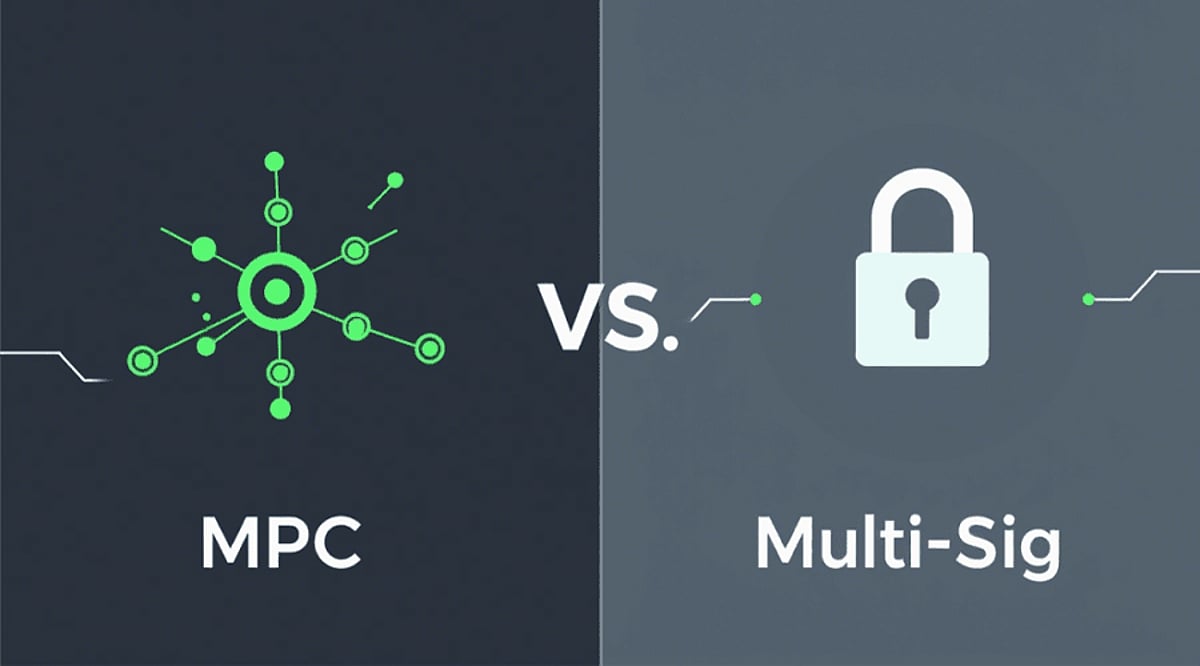
    MPC vs Multisig

    Both MPC and multisig distribute control, but they differ technically. Multisig records multiple signatures as part of transaction authorization, whereas MPC distributes the cryptographic computation itself. Their implementation, blockchain compatibility, and operational workflows can vary significantly.

    MPC vs HSM

    MPC and HSM address key security through different technical approaches. MPC distributes cryptographic control among participants, while HSM provides hardware-based protection for keys and operations. Organizations should evaluate factors such as infrastructure, recovery procedures, access controls, transaction workflows, and integration needs when choosing between them.

    Choosing the Right Custody Model

    No single custody architecture suits every organization. MPC, multisig, and HSM-based systems involve different approaches to key management, transaction approval, infrastructure, and recovery. The appropriate model depends on asset type, operational structure, security requirements, blockchain compatibility, governance procedures, and the organization’s overall risk management framework.