
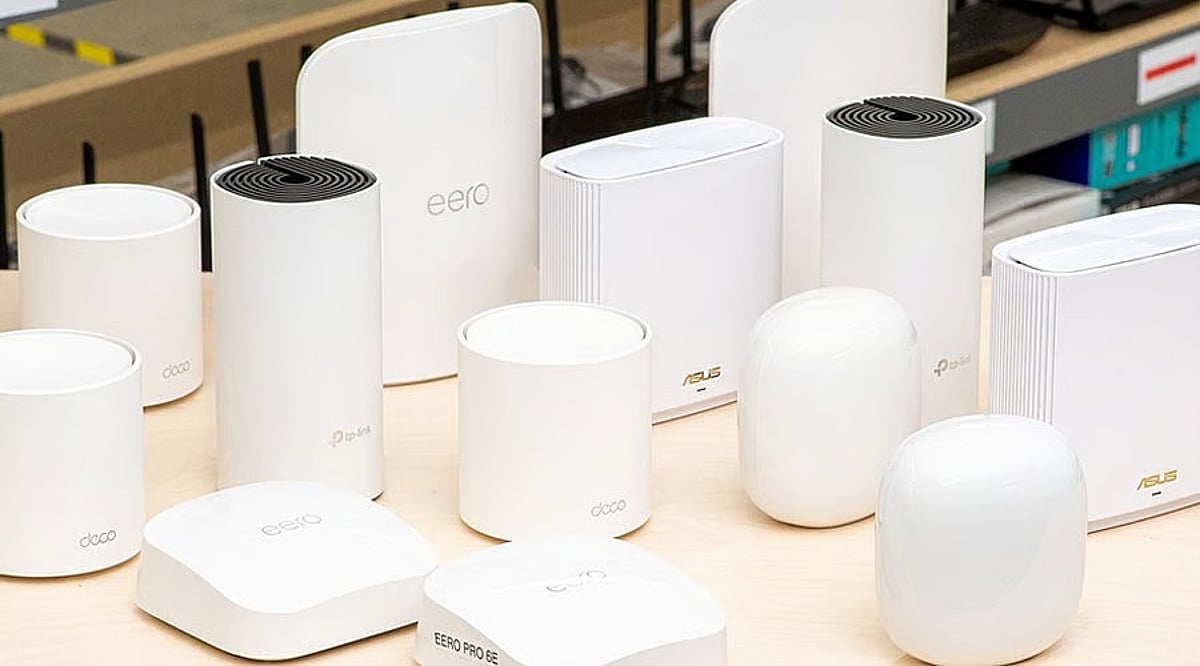
Modern households rely on far more than a single laptop and smartphone. Smart TVs, security cameras, gaming consoles, and multiple work-from-home laptops now share the same internet connection across several rooms. A standalone router often struggles to maintain consistent speeds, leading to dead zones in upstairs rooms, frozen video calls, and weak signals on the balcony. Mesh Wi-Fi systems solve this by deploying multiple nodes that work together as one seamless network, automatically handing off devices as you move throughout the home.
Amazon India’s Whole Home Mesh Wi-Fi Systems section currently features three leading brands worth comparing: TP-Link Deco, Netgear Orbi, and Amazon Eero. These systems span Wi-Fi 6 and the newer Wi-Fi 7 generations, each catering to different home sizes and budgets.
Quick Reference: Mesh Wi-Fi Systems on Amazon India
Coverage figures are manufacturer estimates. Actual range varies with wall thickness, floor layout, and interference from neighboring networks. Prices fluctuate frequently during sales, so always check the live listing before purchasing.
| System | Wi-Fi Standard | Coverage (sq. ft.) | Nodes | Best For |
|---|---|---|---|---|
| TP-Link Deco M4 | Wi-Fi 5 (ac) | Up to 5,500 | 3-pack | Budget-friendly large apartments |
| TP-Link Deco XE75 | Wi-Fi 6E | Up to 5,500 | 3-pack | Dense buildings with interference |
| TP-Link Deco BE25 | Wi-Fi 7 | Up to 6,000 | 3-pack | Future-proofing with gigabit fiber |
| Netgear Orbi RBK752 | Wi-Fi 6 | Up to 5,000 | 2-pack | Large homes needing strong range |
| Netgear Orbi RBK50 | Wi-Fi 5 (ac) | Up to 5,000 | 2-pack | Cost-effective wide coverage |
| Amazon Eero (latest) | Wi-Fi 6 | Up to 4,500 | 3-pack | Simple, hands-off setup |
What to Compare Before Buying
Several factors matter more than the marketing headline on the box:
- Coverage area and node count: A two-pack usually suffices for homes under 3,000 square feet; larger or multi-story homes benefit from a three-pack.
- Wi-Fi standard: Wi-Fi 5 for basic browsing, Wi-Fi 6 for most households, Wi-Fi 6E for dense apartments, and Wi-Fi 7 for gigabit connections with many devices.
- Dual-band vs. tri-band: Tri-band systems dedicate an extra band to node-to-node communication, reducing congestion. Dual-band systems cost less but share bandwidth across all connected devices.
- Wired backhaul support: Homes with Ethernet cabling can connect nodes directly for more stable long-range speeds.
- Broadband plan speed: A Wi-Fi 7 system adds little value on a sub-200 Mbps connection, while gigabit fiber benefits from Wi-Fi 6E or 7 hardware.
- Latency: Lower latency is critical for cloud gaming and video calls, often more noticeable than raw download speed.
TP-Link Deco Series
TP-Link’s Deco lineup dominates the budget and mid-range segments. The Deco M4 three-pack provides consistent coverage across large apartments at an affordable price. The Deco XE75 adds Wi-Fi 6E and the less congested 6 GHz band, ideal for dense buildings with overlapping networks. The Deco BE25 brings Wi-Fi 7 to a price point suitable for new buyers. All models include TP-Link’s HomeShield app for basic parental controls (free) with a paid tier for advanced security.
Pros: Strong value, easy setup, wide coverage per node.
Cons: Full security features require a subscription on higher models.
Skip if: You need top-tier Wi-Fi 7 throughput on a gigabit fiber connection.
Netgear Orbi Series
Orbi systems use a dedicated wireless channel for node-to-node communication, preserving bandwidth for client devices. The RBK752 covers up to 5,000 square feet and handles 40+ devices, ideal for larger homes or duplexes. The RBK50 offers similar range at a lower cost without the newest standard. Orbi units are bulkier and pricier than Deco or Eero.
Pros: Strongest performance at range, steady speeds across large homes.
Cons: Bulkier hardware, higher price.
Skip if: Price is the main concern; Orbi’s advantage shines in very large homes.
Amazon Eero
Eero prioritizes simplicity. The app guides you through setup in minutes, and the system handles firmware updates and self-healing network adjustments automatically. It trades some long-range throughput for that ease of use, making it ideal for apartments and mid-size homes.
Pros: Fastest setup, reliable self-healing network, minimal maintenance.
Cons: Fewer manual controls than Deco or Orbi.
Skip if: You need granular network configuration options.
Placement and ISP Compatibility
Poor placement can undermine even the best mesh system. Nodes should sit midway between the main router and weak coverage areas, not in corners where signal is thin. Most mesh systems work with Airtel Xstream Fiber, JioFiber, ACT, BSNL, and other ISPs. Switch the ISP router to bridge mode (or access point mode) to avoid running two competing Wi-Fi networks.
Before Buying This Weekend
- Confirm whether the listing includes two or three nodes—base prices often cover only the smaller pack.
- Check whether the item is sold and shipped by Amazon or a third-party seller, which affects returns and warranty.
- Look for bank card discounts or exchange offers stacked on the listed price during weekend sales.
Quick Decision Guide
Let coverage area and device count drive your decision before the Wi-Fi generation on the box. A typical household of two to four people gets full value from a Wi-Fi 6 system without paying for standards their devices or broadband plan cannot use yet. Homes under 3,000 square feet usually need only a two-pack; larger or multi-story homes benefit from a three-pack or Orbi’s stronger backhaul.
Final Thought
Buying a mesh system that matches your home’s layout almost always delivers a bigger improvement than choosing the newest Wi-Fi standard alone. A mismatched system, even at a steep weekend discount, still leaves the same dead zone it was bought to fix.
Frequently Asked Questions
1. What is a mesh Wi-Fi system, and how is it different from a regular router?
A mesh Wi-Fi system uses multiple interconnected units to create a single, seamless wireless network throughout the home. Unlike a traditional router, it eliminates dead zones and maintains a stable connection as devices move between rooms.
2. Is a mesh Wi-Fi system worth buying for a small apartment?
Not always. A small one- or two-bedroom apartment often gets sufficient coverage from a quality standalone Wi-Fi 6 router. Mesh systems become more beneficial in larger apartments, multi-story homes, or spaces with thick walls.
3. Should I choose Wi-Fi 6, Wi-Fi 6E, or Wi-Fi 7?
Wi-Fi 6 is best for most households. Wi-Fi 6E adds the 6 GHz band for reduced congestion, while Wi-Fi 7 is suited for gigabit internet connections and homes with many high-bandwidth devices.
4. Can a mesh Wi-Fi system work with Airtel Xstream Fiber, JioFiber, ACT, or BSNL broadband?
Yes. Most mesh systems are compatible with these ISPs. Connect them to the existing modem or ISP router, often by switching the ISP router to bridge mode.
5. How many mesh Wi-Fi units do I need for my home?
A two-pack is generally suitable for homes up to about 3,000 square feet. Larger or multi-story homes typically benefit from a three-pack.
Leave a Reply