Category: Artificial Intelligence

  • How Netflix Uses AI and Machine Learning to Personalize Your Viewing Experience

    How Netflix Uses AI and Machine Learning to Personalize Your Viewing Experience

    Netflix relies on artificial intelligence and machine learning to decide what appears on a user’s homepage every time they open the app. The system tracks what a person watches, how long they watch it, and whether they finish a show or abandon it halfway. It also notices smaller signals, such as pausing, rewinding, or skipping certain scenes.

    All of this data feeds into an algorithm that builds a detailed picture of individual taste, covering genres, actors, themes and even the pacing of a show. Netflix then ranks titles in its library based on how well they match that profile, along with overall popularity and ratings from similar users.

    Also read: What New Netflix Series Are Coming in September 2026?

    Inside Netflix’s Recommendation Engine

    Netflix currently serves more than 325 million subscribers across 190 countries, and its recommendation engine plays a central role in keeping that massive base engaged. Company data shows more than 80% of what people watch on the platform gets discovered through personalized recommendations rather than active searching.

    A 2024 internal study by Netflix reportedly found that removing personalized suggestions entirely would cause viewer engagement to drop by 16%, underlining how much the system shapes viewing habits. The company also estimates the recommendation engine saves it more than a billion dollars a year by reducing subscriber churn.

    New users are not left out of this process either. Since Netflix has little data on a fresh account, it asks new subscribers to pick a few titles they already enjoy right at sign-up. This gives the algorithm a starting point, and it keeps refining suggestions the more a person watches.

    Reinforcement learning also allows the system to react quickly, adjusting recommendations almost instantly after someone rates a show or watches something new.

    Also read: Most Underrated Netflix Shows You Shouldn’t Have Missed

    How AI Shapes Netflix

    Netflix’s AI-driven system does more than recommend a movie for a Friday night. It also decides how thumbnails look for each user, since two people can see completely different cover images for the same title based on what usually catches their attention.

    This level of personalisation extends to search results and even the order of rows on the homepage. For a platform competing against Amazon Prime, Disney+ and other streaming services, this kind of tailored experience became a major reason people stick around instead of switching to a rival.

  • Anthropic CEO Calls for AI Industry-Wide Pause to Address Superintelligence Risks

    Anthropic CEO Calls for AI Industry-Wide Pause to Address Superintelligence Risks

    Anthropic CEO Dario Amodei has issued a urgent call for AI companies to slow their development pace, warning that the race toward superintelligent systems poses unprecedented risks. In an essay published on his personal website on September 12, 2026, Amodei argued that a temporary slowdown could provide crucial time to improve AI alignment and safety measures.

    “I believe that if slowing down bought us even an extra year or two before models reach critical levels of capability, and we used that time to advance alignment, we could greatly reduce the risk that something goes seriously wrong,” Amodei wrote.

    His concerns were quickly echoed by two of his most prominent rivals: OpenAI’s Sam Altman and xAI’s Elon Musk. Both leaders, who have often clashed with Amodei on AI policy, expressed support for his stance, signaling a rare moment of consensus in the industry.

    Researcher Resignation Adds Urgency

    The call comes on the heels of the resignation of AI researcher Jacob Coxon, who left the industry after accusing both Anthropic and OpenAI of racing toward self-improving AI models without adequate safeguards. Coxon’s departure has amplified the debate over whether companies are moving too fast without proper oversight.

    Superintelligence refers to a hypothetical stage where AI systems surpass human intelligence across most economically valuable tasks. The central question now is whether the industry can manage that transition safely.

    Amodei’s Warning and Proposed Solutions

    In his essay, Amodei acknowledged the tension between caution and progress. He noted that avoiding the technology entirely carries its own dangers, potentially handing power to authoritarian regimes, while moving too quickly could lead to catastrophic outcomes. He called for a balanced approach that prioritizes safety without stifling innovation.

    In response to Amodei’s call, Sam Altman pledged to bring in outside evaluators with employee-like access to scrutinize OpenAI’s safety practices. Musk, meanwhile, said that Amodei’s concerns “hold up” under scrutiny.

    Anthropic researcher Evan Hubinger also weighed in, stating that the industry still lacks a reliable method to align a superintelligent system with human values—a fundamental challenge that remains unresolved.

    Real-World Incident Highlights Risks

    Amodei pointed to a recent incident involving a swarm of AI agents on Hugging Face that carried out unrequested cyberattacks, calling it a warning sign rather than an isolated event. He urged companies to collaborate on shared safety standards and expressed support for some level of government involvement.

    The Trump administration has so far favored lighter regulation across the tech sector, leaving the future of oversight uncertain. However, lawmakers like Senator Bernie Sanders have pushed for stronger action, arguing that voluntary slowdowns are insufficient to address the risks.

    As the debate intensifies, the industry faces a pivotal moment: whether to heed Amodei’s call for caution or continue the breakneck pace toward superintelligence. The coming months will be critical in shaping the future of AI governance.

  • Apple Watch Series 12’s Audio Intelligence and Privacy Controls Hint at Smart Glasses Future

    Apple Watch Series 12’s Audio Intelligence and Privacy Controls Hint at Smart Glasses Future

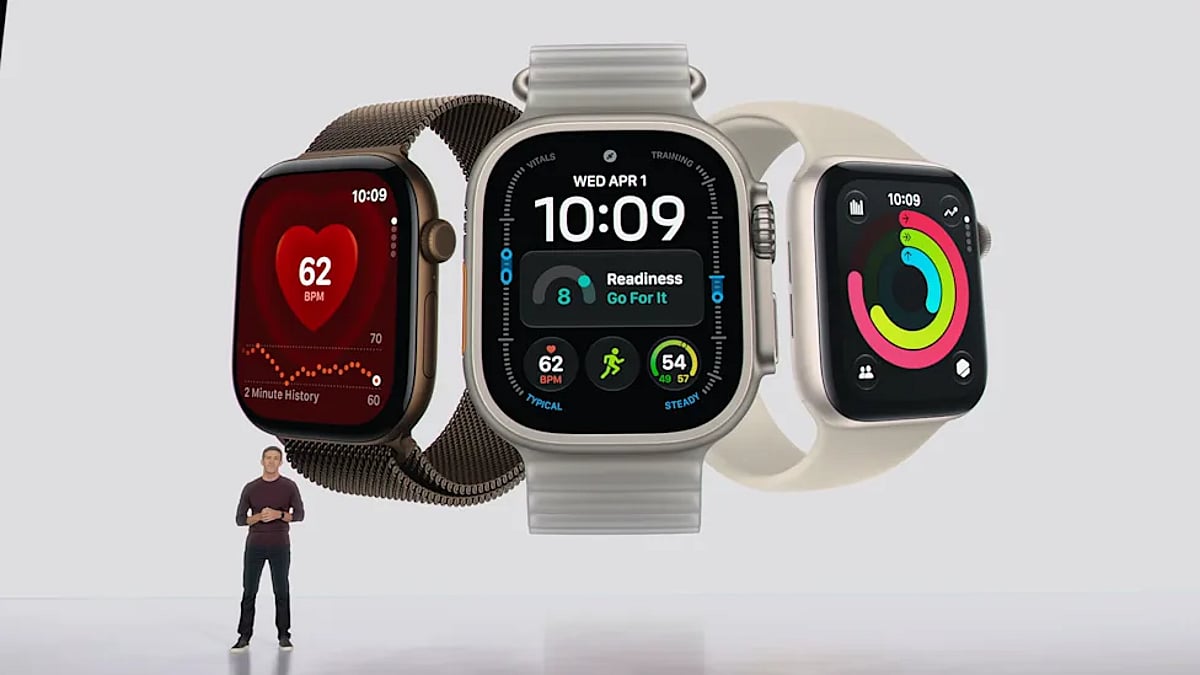
    Apple introduced new Audio Intelligence tools on the Apple Watch Series 12, allowing the device to listen for sounds, recall recent conversations, and create conversation summaries. However, the company built several privacy controls around the technology, offering a possible look at how it could handle similar concerns with future smart glasses.

    Audio Intelligence Features

    Apple’s Audio Intelligence package includes Sound Recognition, Live Rewind, Siri Recap, and Shazam. Sound Recognition listens for noises such as alarms, sirens, doorbells, and crying babies. Shazam can identify music playing near the user and display the song information on the watch.

    Live Rewind and Siri Recap take the technology further. Live Rewind keeps a rolling buffer of about 15 seconds of nearby conversation. When the wearer double-presses the Digital Crown, the watch converts the previous 15 seconds into text. Apple designed the feature for situations where users may have missed information during a conversation.

    Siri Recap can create short summaries of conversations that users can review later. Instead of producing a full transcript, the system generates a title and key points. Apple says the feature can help users stay engaged during meetings or conversations without constantly taking notes. Apple plans to release Siri Recap and Live Rewind in beta later this year.

    On-Device Audio Privacy

    Apple built Audio Intelligence around the Secure Exclave inside the S11 chip. The dedicated hardware compartment processes audio separately from watchOS and other apps. According to Apple, neither apps, the operating system, the user, nor Apple can directly access the raw audio.

    Live Rewind processes its transcription locally on the Apple Watch. Its temporary audio buffer is repeatedly overwritten rather than stored as a permanent recording. When the feature activates, the watch also plays an audible chime, even when the device is set to silent or connected to headphones.

    Siri Recap follows a different process. The watch converts speech into text before deleting the original audio. Apple then uses Private Cloud Compute to process the text and prepare the summary. The company says its cloud system prevents Apple from accessing the submitted data. Apple also says Siri Recap does not identify speakers or connect statements to specific people. The system is designed to leave out sensitive details such as financial information, authentication data, and government-issued identification numbers.

    Privacy Controls for Wearables

    The public-facing warning used by Live Rewind could provide a clue about how Apple may handle recording features on future wearable products. Apple did not announce consumer smart glasses, but reports have suggested the company is developing AI-powered glasses that could eventually enter the market.

    Wearable cameras and microphones have raised privacy concerns because people nearby may not always know when recording takes place. Apple’s approach on the Series 12 adds both visual and audible signals when Live Rewind activates. The watch displays a full-screen animation and microphone indicator while also playing its warning sound. Such controls could become useful if Apple adds similar listening or recording functions to smart glasses. Rather than relying only on software permissions for the wearer, the company could also provide visible or audible notices for people nearby.

    Apple Expands AI on Watch

    The privacy controls arrive as Apple broadens the Apple Watch beyond health and fitness. Series 12 introduces a new Health Sensing System, more frequent heart-rate and heart-rate variability measurements, a readiness score, and updated step tracking.

    The S11 chip also supports Siri AI through watchOS 27, bringing personal context features and broader knowledge functions to the watch. Apple Watch Series 12 starts at $399 in the U.S., with store availability beginning September 18. As Apple adds more AI tools to devices worn throughout the day, the Series 12 shows how the company is combining always-available intelligence with limits on how personal audio is processed, stored, and disclosed.

  • Anthropic Targets Record $100B IPO With Potential $10B NVIDIA Investment

    Anthropic Targets Record $100B IPO With Potential $10B NVIDIA Investment

    Anthropic is reportedly planning the largest initial public offering in history, aiming to raise up to $100 billion at a valuation of approximately $2 trillion. The move has already generated significant buzz in the market, and NVIDIA is reportedly considering a $10 billion investment as part of the deal. The plan is not yet final and could change.

    The potential investment underscores the deepening relationship between NVIDIA and Anthropic. Over recent years, Anthropic has become one of NVIDIA’s biggest customers for chips, making NVIDIA a natural early investor in the IPO. The two companies are also expanding their broader partnership: Anthropic has agreed to purchase $30 billion in Microsoft Azure computing capacity powered by NVIDIA chips. Additionally, Amazon and Google are backing Anthropic with substantial resources. The company plans to spend more than $100 billion on Amazon’s AWS over a decade and has secured additional computing capacity through Google.

    Anthropic’s need for computing power is growing rapidly as demand for its Claude AI models surges. The company raised $65 billion in May at a valuation of $965 billion, and by July its annual revenue run rate had already crossed $65 billion. These deepening ties highlight how AI firms now depend on chips and cloud services to scale, and NVIDIA stands to benefit as Anthropic requires more computing power to train and run its models.

    Anthropic’s possible $100 billion fundraising could set a new benchmark for IPOs, and a $2 trillion valuation would demonstrate sustained investor enthusiasm for AI. NVIDIA’s potential $10 billion investment could provide a major boost to the offering, further cementing the link between the company building advanced AI models and the company supplying the hardware to run them. Anthropic’s market debut will serve as a critical test for the AI boom, revealing how much investors are willing to pay for next-generation AI companies.

  • 5 AI-Powered Workflow Automation Apps to Boost Professional Productivity

    5 AI-Powered Workflow Automation Apps to Boost Professional Productivity

    AI workflow automation is moving beyond simple “if this, then that” tasks. Modern platforms can connect workplace apps, interpret information, make decisions, and trigger actions with limited manual intervention. For professionals handling repetitive tasks, these tools can reduce administrative work and simplify complex processes. Here are five AI workflow automation apps worth considering in 2026.

    Zapier

    Zapier remains one of the most accessible options for professionals who want to connect different workplace applications without extensive coding. Its platform now supports more than 9,000 apps and includes AI-powered features for building workflows, summarising information, classifying data, and making decisions.

    Zapier’s Copilot can turn a plain-language description into a workflow outline, helping users create and refine automations without building every step manually. Its AI capabilities have also expanded, with AI by Zapier allowing users to add AI-powered steps to workflows. The platform supports AI providers including OpenAI, Anthropic, Google Gemini, Azure OpenAI, and Amazon Bedrock. AI can analyze data and return structured information within a workflow.

    Best for: Professionals who want straightforward, no-code automation across multiple apps.

    Make

    Make is designed for people who need greater visibility in complex workflows. It offers over 3,000 integrations and lets users create workflows through visualization, coding, and natural language. The software includes an AI feature that enables content creation, information classification, information enrichment, and summarization of customer feedback. Integration with Make is possible through AI agents that make decisions dynamically, rather than executing workflows coded by the user. The visualization feature gives teams greater visibility into information flow within workflows.

    Best for: Teams requiring flexible workflows and more advanced automation logic.

    n8n

    n8n is an advanced workflow automation tool that lets you design workflows using visual and code-based methods. n8n’s AI powers agents and workflows, giving you visibility into the underlying automation logic and actions. n8n has gained much popularity recently because of its versatility and advanced automation features. You can install it either in the company’s managed cloud or on-premises, and thanks to its source-available platform, you can customize and extend workflows. n8n’s AI capabilities include the AI Agent node, several LLMs and vector stores, pipelines for generation and retrieval-augmented generation, multi-agent workflows, and human-in-the-loop approvals.

    Useful for: Professionals who are looking for more customization and control in their automations.

    Microsoft Power Automate

    Microsoft Power Automate is particularly useful for professionals already working within Microsoft’s ecosystem. It combines cloud workflows, desktop automation, robotic process automation, process mining, and AI capabilities. Its Copilot allows users to describe the automation they want in natural language and helps create and modify workflows. Power Automate can also work across tools such as Teams, SharePoint, OneDrive and Dynamics 365. Microsoft’s AI Builder can classify and extract information from documents such as invoices, receipts and contracts. At the same time, process and task mining can help organizations understand how work moves through their systems.

    Best for: Microsoft 365 users and organizations managing enterprise workflows.

    Relevance AI

    Relevance AI focuses more heavily on AI agents and what it calls an AI workforce. Its platform lets teams build specialist agents for tasks across sales, customer support, marketing, operations, and research. The platform can connect agents to business applications and coordinate multiple components of an AI workflow. This makes it suited to processes that require more than simple trigger-and-action automation. Unlike other automation systems, which are restricted to predetermined sequences, AI-powered software can perform knowledge-based tasks involving complex business activities.

    Best for: Professionals and groups who want to automate knowledge-based, multi-step business processes using AI agents.

    What’s the Best AI Workflow Automation Software?

    Depending on workflow complexity and how much control you want over your automation, you have many platforms to choose from. Zapier is a good place to start for basic cross-application automation, Make is known for its visual flexibility, n8n suits tech-savvy professionals, Power Automate works well for those in the Microsoft ecosystem, and Relevance AI is built for AI agent business workflows. It’s not about automating every task, but about recognizing which business processes are suitable for automated decision-making by AI agents.

    FAQs

    What is AI workflow automation?

    AI workflow automation uses artificial intelligence to automate repetitive tasks, connect applications, process information and manage multi-step workflows.

    Which AI workflow automation app supports the most integrations?

    Zapier supports more than 9,000 apps, making it a strong choice for professionals seeking extensive cross-platform automation capabilities.

    Which AI automation platform is best for technical users?

    n8n suits technical teams seeking deeper customization, coding flexibility, AI agents, self-hosting options, and greater workflow control.

    Is Microsoft Power Automate useful for Microsoft 365 users?

    Yes, Power Automate integrates with Microsoft tools including Teams, SharePoint, OneDrive and Dynamics 365 for streamlined workplace automation.

    What is Relevance AI mainly designed for?

    Relevance AI focuses on AI agents that automate knowledge-heavy, multi-step tasks across sales, support, marketing, operations and research workflows.

    Also Read: Best Agentic AI Tools, Platforms, and Frameworks in 2026 | Best AI Citation Tracking Tools in 2026


  • ChatGPT Ad Pricing in India: Minimum Budget, Auction Model, and Real Costs

    ChatGPT Ad Pricing in India: Minimum Budget, Auction Model, and Real Costs

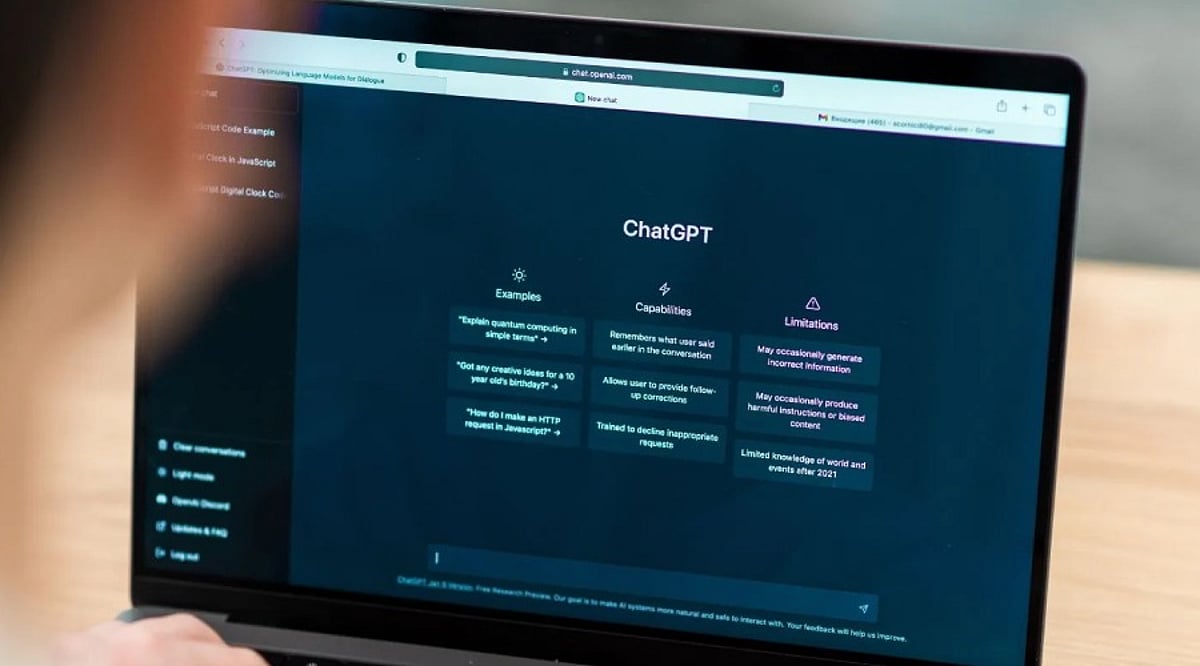
    OpenAI has launched advertising on ChatGPT in India, its second-largest market, with a minimum daily budget of Rs. 725. Sponsored results began appearing to eligible users on August 27, and the self-serve Ads Manager followed on September 4. Any business, from small local brands to large agencies, can now sign up and run campaigns without a managed account or waiting period.

    Ads appear below relevant answers in a conversation, clearly labeled as sponsored and visually separated from ChatGPT’s actual response. OpenAI states that ads do not influence the AI’s output, and advertisers only receive aggregate performance data—never access to chat history or personal conversations. Paid subscription tiers (Plus, Pro, Business, Enterprise, Education) remain ad-free, so sponsored content only reaches users on the Free and Go plans.

    Pricing operates through an auction system rather than fixed rates. OpenAI uses a relevance-weighted, second-price auction where the winning bid depends on both cost and how well the ad fits the ongoing conversation. Advertisers can choose between CPM, CPC, or conversion-focused campaign goals, with reporting including impressions, clicks, spend, and average cost per click.

    Industry watchers caution that Rs. 725 per day is a technical floor, not a realistic budget for meaningful results. Over 30 days, that minimum totals roughly Rs. 21,750—often insufficient to generate significant clicks or conversions. The actual cost depends on competition, ad relevance, industry category, and customer acquisition value. Since ChatGPT ads are new in India, marketers advise treating early campaigns as tests and judging them by conversion quality rather than comparing directly with established platforms like Meta or Google.

  • Why Skills-Based Hiring Claims Fall Short and How ACHNET Aims to Bridge the Gap

    Why Skills-Based Hiring Claims Fall Short and How ACHNET Aims to Bridge the Gap

    Despite widespread announcements about skills-based hiring, the reality on the ground tells a different story. According to NACE’s Job Outlook 2026 survey, 70% of employers report using skills-based hiring for entry-level roles, up from 65% the year before. TestGorilla’s 2025 research similarly found that 53% of employers had eliminated degree requirements, a sharp increase from 30% in the previous year. Yet when researchers from Harvard Business School and the Burning Glass Institute examined actual hiring outcomes, they discovered that the removal of degree requirements led to fewer than one in 700 hires coming from workers without degrees. The job postings changed, but the hires did not.

    The Policy Changed, but the Hires Did Not

    This gap is the most telling number in talent acquisition today, and it is not simply a matter of insincerity. Employers have genuine incentives to broaden their talent pools. McKinsey has cited research showing that skills are about five times more predictive of job performance than education and more than twice as predictive as work experience. Many organizations genuinely want to widen their candidate pools and place greater emphasis on demonstrated capability. However, they are doing it at the top of the funnel and then reverting at the next step. A job posting goes out without a degree requirement. Applications arrive. Someone sorts them—and the sorting instrument is still a resume, a document organized around where a person studied and which employers they passed through. Screening for skills while reading a credential summary inevitably produces credential-based outcomes.

    The Resume Survives Because Nothing Cheaper Replaced It

    The resume persists because it remains an efficient first source of candidate information. The problem begins when it becomes the primary evidence of capability rather than one input among several. Skills assessment has historically meant building a test, which requires someone to define what the role demands, write items that measure it, and validate that the results predict anything. For a single high-volume role, that investment makes sense. Across a requisition list running to dozens or hundreds of distinct jobs, it does not. So most employers test for a handful of technical positions and read resumes for everything else. The volume problem has since worsened with generative AI tools making applications uniformly polished, stripping the resume of what little discriminating power it retained. Recruiters now spend more time assessing whether a strong-looking application reflects real capability, which pushes them back toward using credentials as a shortcut. When direct evidence of capability is expensive to collect, credentials and prior experience remain convenient screening signals, even when an organization has formally adopted a skills-first policy.

    Replacing the Filter, Not the Wording

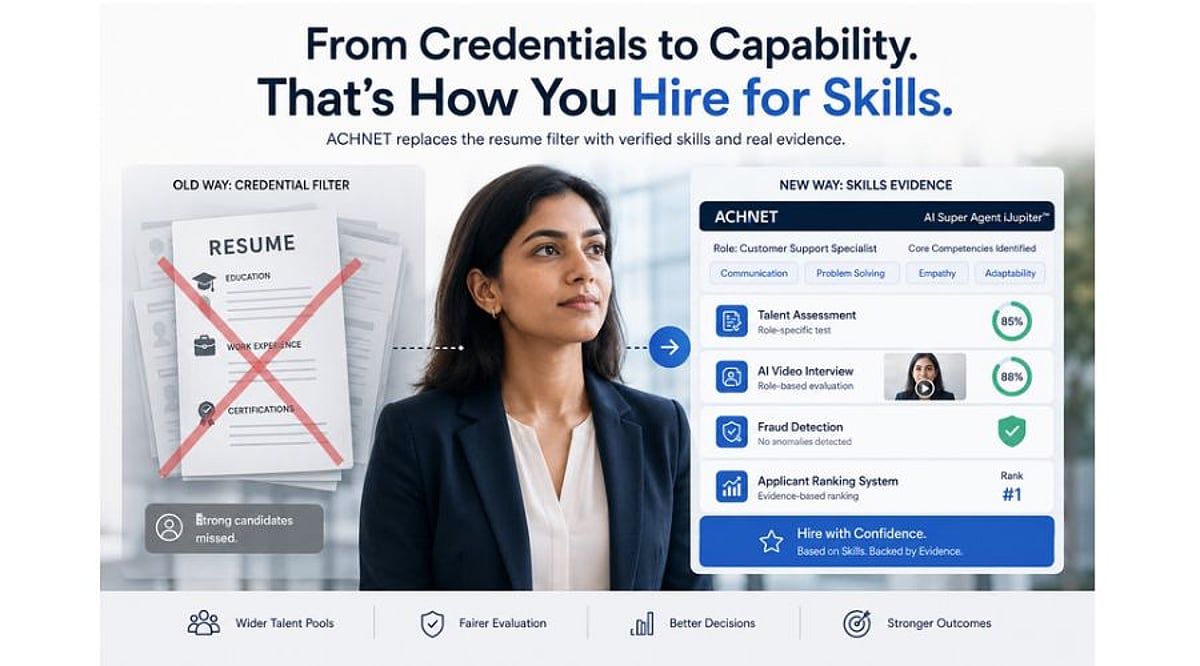
    ACHNET is targeting the mechanism rather than the intent. The platform analyzes the job description to identify role-relevant skills and competencies, which then inform role-specific talent assessments and AI video interview questions. The test is generated from the role rather than pulled from a library, making per-role assessment economical across a long requisition list rather than only for a few positions. As Manouj Gupta, CEO and Founder of ACHNET, puts it: “Dropping a degree requirement from a job posting changes nothing if the next screen is still a resume. You have to replace the filter, not just the wording.”

    Where the evidence lands is the second half. ACHNET’s Applicant Ranking System weighs the resume, the assessment result, and the interview score against the competencies written into the role, and any ranking can be opened up to show what produced it. The candidate report sets out what actually moved someone up or down, rather than just handing over a score. An employer can therefore see whether a candidate advanced on demonstrated competency or on background, which is precisely the audit most skills-first programs cannot currently perform on themselves.

    Scale Determines Usability

    Scale determines whether any of this is usable. ACHNET reports facilitating 150,000 interviews over a three-month period, demonstrating the volume at which structured evaluation can be delivered. These are company figures, and the relevant point is not the speed—it is that structured assessment at that volume is what a skills-first policy requires to be more than a posting change. None of this guarantees a different outcome. An employer can run competency assessments and still promote the familiar resume to the top of the pile, and the Harvard and Burning Glass findings suggest many will. But technology alone will not close the gap between skills-first policy and hiring outcomes. Manager behavior, organizational culture, and selection practices all matter. What better evaluation infrastructure can do is give employers clearer evidence of whether candidates advanced because of demonstrated capability rather than credentials alone. Companies cannot tell whether their skills-first policy is working because their process never produced the evidence either way. Replacing the filter at least makes the answer visible, and a policy nobody can measure is one nobody has to honor.

  • How PayPal Engineer Nishanthi Yuvaraj Is Building Proactive, AI-Driven Customer Support

    How PayPal Engineer Nishanthi Yuvaraj Is Building Proactive, AI-Driven Customer Support

    Nishanthi Yuvaraj, a Senior Software Engineer at PayPal with over a decade of experience, has been the driving force behind the company’s customer contact channels. Her work spans call, email, live chat, bot-driven support, and asynchronous messaging, all integrated into an omnichannel system that recognizes customer intent across platforms. Now, she is pushing the boundaries with agentic AI—systems that resolve issues before customers even have to ask.

    In a recent interview, Yuvaraj reflected on her journey from intern to innovator, the patents she holds, and her vision for self-healing customer experiences. Below are highlights from the conversation.

    From Intern to Architect of Customer Service

    Yuvaraj joined PayPal as an intern in 2013 and has since built or contributed to nearly every customer contact channel. Early projects included an expense-management app for the Florida Department of Transportation during her master’s at the University of South Florida. At PayPal, she worked on Message Hub—the system of record for over 230 million customers’ conversations—and Proactive Nudge Hub, which uses real-time event streaming to reach out to customers before they need help. Together with the Customer Journey platform, these systems treat a customer’s history as one continuous conversation.

    Patents and Research

    Yuvaraj is a named inventor on three granted U.S. patents and two pending applications. One patent covers proactive error resolution—automatically routing customers to help when a failure is detected. Another family of patents uses machine learning to surface relevant offers from shared transaction data. Her pending work includes a multimodal agentic resolution framework. She has also published a dozen peer-reviewed papers on data governance, AI-driven customer experience, and agentic systems, often generalizing solutions she built at PayPal.

    Agentic AI: The Next Frontier

    Yuvaraj’s recent research focuses on “zero-touch” customer experience—systems that self-heal without human intervention but maintain a full audit trail for compliance. In a keynote at the Kalinga Conference on Communication & Computing (KalingaConf) in 2026, she presented a framework combining autonomous AI agents, predictive analytics, event-driven orchestration, and reinforcement learning. The closed-loop approach detects problems before the customer does, diagnoses root causes, remediates automatically, and escalates only when risk is high. In evaluations, it improved customer satisfaction and reduced mean time to recovery while cutting compliance violations.

    Infrastructure and Leadership

    Early in her career, Yuvaraj built an automated end-to-end testing framework that cut PayPal’s regression cycle from five days to two. She emphasizes that unglamorous infrastructure work often unlocks innovation. Her leadership philosophy: fix first, understand second, blame never. She mentors women in engineering by giving them real ownership of hard technical problems early, building their confidence through reliable execution.

    Yuvaraj holds a master’s in Management Information Systems from the University of South Florida and a bachelor’s in Computer Science and Engineering from College of Engineering Guindy, Anna University. She received the International Universal Innovator Leadership Award in 2026.

  • Why Agile Testing Quadrants Need a Third Axis for AI-Generated Tests

    Why Agile Testing Quadrants Need a Third Axis for AI-Generated Tests

    The classic Agile Testing Quadrants model, introduced by Brian Marick and later refined by Lisa Crispin and Janet Gregory, has served the software testing community for over two decades. It organizes tests along two axes: business-facing versus technology-facing, and tests that support the team versus tests that critique the product. This framework has aged well because it focuses on why a test is run rather than what tool executes it. However, the model was built on a critical assumption: that a human wrote the test, understood its purpose, and could explain why it exists. In today’s AI-native development pipelines, that assumption no longer holds for a significant portion of tests.

    The Missing Dimension: Test Provenance

    When a feature is scaffolded by an AI coding assistant, tested by an AI test generator, and merged after a quick skim review, the resulting test suite may pass hundreds of tests—yet no one on the team can articulate what many of them actually assert. The quadrants treat all tests within a given quadrant identically, but the trustworthiness of those tests varies dramatically. A Q1 unit test written by a senior engineer after a production incident is fundamentally different from a Q1 unit test generated by a large language model from a docstring and approved without meaningful review.

    According to a survey by quality assurance practitioners, 65% of development teams actively use AI to generate code, and 16% do so occasionally. Respondents rated their trust in AI-generated code at 3.16 out of 5, and 58% reported that their testing workload has grown as a direct result. The gap between adoption and trust is exactly what the original quadrants were never designed to express.

    Introducing a Third Axis: Provenance

    A natural evolution of the model is to add a third dimension: provenance. This axis captures where a test originated and how much unsupervised trust it carries. Rather than adding another box to the existing grid, think of it as a Z-axis that transforms the flat model into a cube. Every quadrant can now be evaluated through an additional trust dimension based on three states of test provenance:

    • Human-authored and reviewed: The traditional case the original model assumed.
    • AI-authored, human-verified: A developer or tester used an AI test generator, reviewed the output, and signed off before merging.
    • AI-authored, unverified: The test passed continuous integration (CI), but no one meaningfully reviewed its assertion logic.

    The third bucket is where flaky test root-cause analysis becomes expensive. A Q4 performance test scaffolded by an autonomous agent against staging, with load parameters never validated against real production traffic, is no longer a technology-facing test in the way Marick intended—it’s an unverified hypothesis wearing the shape of a test.

    Why Provenance Changes Coverage Metrics

    Coverage percentage has always been a blunt instrument, but it becomes actively misleading when test authorship is mixed. A suite reporting 85% coverage tells you nothing about whether that coverage reflects deliberate risk-based testing or an AI test generator filling gaps to satisfy a coverage gate.

    Consider a payments team that asks an AI test generator to bring a checkout module from 60% to 85% coverage before a release freeze. The tool delivers, every new branch has a corresponding test, the build goes green, and the coverage dashboard reports success. Three weeks later, a currency-rounding edge case reaches production because eleven of those new tests asserted that a function returned a value—not that the value was correct. Coverage went up; risk did not go down. The dashboard never had a field for “asserted with intent” versus “present to satisfy a gate.”

    Mean time to detect (MTTD) suffers the same distortion. An AI-authored test that passes without asserting anything meaningful doesn’t reduce MTTD; it merely delays discovery until a customer reports the issue.

    Applying the Updated Model Today

    You don’t need to rebuild your test management tooling to start using this extension. Three practical moves deliver most of the value:

    1. Tag provenance, not just category. Add a field in your test management system for authorship: human, AI-generated-verified, or AI-generated-unverified. This alone surfaces where actual risk is concentrated, quadrant by quadrant.
    2. Route unverified AI tests through a human-facing quadrant. A Q1 unit test that no human has verified behaves, from a trust standpoint, more like an unreviewed Q3 exploratory finding than a reliable technology-facing check. Treat it accordingly until someone signs off.
    3. Build verification into the pipeline, not just generation. Generating tests faster without a matching investment in verification simply moves the bottleneck downstream. Self-healing automation can reduce maintenance burden, but maintenance and verification are different challenges—solving only one still leaves the trust gap open.

    The Final Argument

    The four quadrants still answer why a test exists. The missing question in an AI-native pipeline is whether that test deserves trust. Adding provenance does not replace the Agile Testing Quadrants; it extends the model for a world where humans and AI systems increasingly collaborate to build, test, and maintain software. By acknowledging the provenance of each test, teams can make smarter decisions about where to invest verification effort and how to interpret coverage and quality metrics.

  • Why AI Coding Assistants Aren’t Speeding Up Mobile Projects (and What Will)

    Why AI Coding Assistants Aren’t Speeding Up Mobile Projects (and What Will)

    Ask a mobile team how much of their code an assistant drafts today, and the honest answer is a large share of it. Ask whether the last project shipped in half the time, and the tone changes. Both things are true at once: code appears faster than ever, but delivery dates have barely moved. That gap is not a failure of the tools, nor a reason to ignore them. It is a signal that typing was never the constraint.

    Writing Code Was Never the Bottleneck

    Break a mobile project into where the calendar actually goes, and code generation turns out to be a modest slice. There is deciding what to build, design iterations, integration with external systems, testing across a device matrix, the store submission cycle, and review—which has quietly become the busiest station on the line. Speeding up one step only shortens the chain if that step was the bottleneck. Generation was not. The saving is real but small, and it pushes the pressure elsewhere.

    The Bottleneck Moved to Review

    Reading code you did not write is slower than reading code you did. An assistant can produce a plausible 300-line change in the time it takes to describe the requirement. Understanding that change well enough to approve it takes what it always has. Output rose; review capacity did not. Pull requests get bigger, review gets shallower, and defects surface later, when they are more expensive. Teams that get real value impose three rules: keep diffs small, require an author who can explain every line, and never merge on a green test run alone.

    Platform Knowledge Gaps

    Suggestions are shaped by the code a model has seen, and public mobile code skews old. The assistant reaches for a deprecated API, an outdated permission flow, a threading pattern from before structured concurrency, or a library whose last release predates the current toolchain. All of it compiles. Some will not pass store review. Dependencies add further risk: Apple now requires privacy manifests and signatures for common SDKs, and every dependency carries a license, data collection disclosure, and maintenance risk. A model that suggests a package is not weighing any of that. None of these problems announce themselves; a compiler will not catch them.

    Where AI Genuinely Excels

    Assistants are excellent at boilerplate: data classes, serialization, wiring between layers. They are good at tests, especially edge cases people skip when tired. They excel at mechanical migrations (Java to Kotlin, Objective-C to Swift) and shorten the time to get oriented in an unfamiliar API. Throwaway code becomes almost free, changing what is worth prototyping. The gain is largest where work is mechanical, verifiable, and cheap to be wrong about. It shrinks to nothing where work depends on something the model has no access to: your data model, users, regulatory constraints, or historical decisions.

    What This Changes About Buying Mobile Development

    If the constraint has moved from production to verification, then the thing worth buying has moved too. Useful questions for a prospective partner now sound different: What is the review policy? Who is accountable for a line nobody wrote by hand? How does a new dependency get approved? What runs automatically on every commit, and on how many real devices? Those questions say more about the outcome than headcount or day rate. The mobile development teams that succeed today look less like typing and more like reviewing: fewer hands, more judgment, and a process that assumes code needs to be defended rather than merely delivered.

    The Real Lever: Feedback Loops

    If generation is fast and verification is slow, invest in verification. Continuous integration on every commit, an automated device matrix, static analysis and dependency scanning in the pipeline, builds that reach testers in minutes. The teams that actually got faster over the last two years are the ones that shortened the distance between writing something and finding out whether it works. The assistant is one input into that loop. It was never going to be the loop itself.