Category: Artificial Intelligence

  • Today’s Tech Roundup: Meta’s Privacy Challenge, Disney-Microsoft Deal, Apple’s Growth, and the AI Arms Race

    Today’s Tech Roundup: Meta’s Privacy Challenge, Disney-Microsoft Deal, Apple’s Growth, and the AI Arms Race

    Today’s top tech stories cover Zuckerberg’s Apple privacy concerns, Disney’s Microsoft shift, Apple’s strong quarter outlook, and the growing AI competition among tech giants.

    Mark Zuckerberg’s Meta is facing a new challenge as Apple tightens its privacy policies, impacting Meta’s advertising revenue. Meanwhile, Disney has made a strategic shift by partnering with Microsoft for cloud and AI services, signaling a major move in the entertainment-tech landscape.

    Apple continues to show strong growth with a promising quarterly outlook, driven by robust iPhone sales and expanding services. The AI race among tech giants is heating up, with companies like Google, Microsoft, and Meta investing heavily in generative AI and large language models.

    Stay tuned for more updates on these developing stories.

  • Master Neural Networks and Deep Learning with Python: Harvard’s Online Course 2026

    Master Neural Networks and Deep Learning with Python: Harvard’s Online Course 2026

    Harvard University’s School of Engineering and Applied Sciences has launched a comprehensive online course titled “Introduction to Neural Networks and Deep Learning with Python.” Designed for professionals with Python proficiency, this program equips participants with practical deep learning skills, covering neural network structures, optimization, regularization, and transfer learning techniques.

    What You’ll Learn in This Course

    • Explain neurons, layers, activation functions, loss functions, and backpropagation in neural networks.
    • Build and train feedforward neural networks using Python.
    • Understand optimization methods like gradient descent and the impact of learning rates.
    • Apply regularization techniques to improve model generalization.
    • Explore transfer learning and adapt pre-trained models to new tasks.
    • Use autoencoders for self-supervised learning with unlabeled data.

    Accessibility and Value

    The course spans 8 weeks, requiring 3–5 hours per week, with flexible scheduling. Participants can earn a Verified Certificate for $299. The program combines practical Python exercises with deep learning theory, making advanced AI concepts accessible while delivering rigorous training and essential job skills.

    Comprehensive Curriculum

    • Foundations of Neural Networks: Core concepts, architecture, and training principles.
    • Deep Learning Techniques: Optimization, regularization, and model evaluation.
    • Transfer Learning: Adapting pre-trained models to new tasks.
    • Self-Supervised Learning: Autoencoders and representation learning.
    • Applied Projects: Hands-on exercises with supervised and unsupervised learning.

    Eligibility Criteria

    • Proficiency in Python programming.
    • Basic knowledge of machine learning concepts and introductory statistics.

    What Makes This Course Stand Out?

    Harvard’s course blends practical Python programming with essential deep learning theory. Students learn to create and develop neural networks while studying optimization, regularization, transfer learning, and autoencoders. The program includes industry projects that help participants understand real-world applications of AI research, analytics, and industry solutions.

    Final Thoughts

    This course provides learners with the skills necessary to master neural network operations and deep learning fundamentals. Through theoretical frameworks, Python exercises, and real-world projects, participants gain confidence to design, evaluate, and deploy models, and apply advanced deep learning methods in machine learning and data science applications.

  • Mark Zuckerberg Predicts Billions Will Use Personal AI Agents Within Five Years

    Mark Zuckerberg Predicts Billions Will Use Personal AI Agents Within Five Years

    Meta CEO Mark Zuckerberg has made a bold prediction: within the next five years, billions of people will rely on personal AI agents to manage daily tasks, achieve personal goals, and transform how they interact with technology.

    Speaking during Meta’s second-quarter earnings call on July 29, 2026, Zuckerberg outlined the company’s long-term vision of building AI systems that go far beyond answering questions. These next-generation assistants, he said, will function as “personal agents” that work around the clock on behalf of users.

    “I think that it’s extremely unlikely if you look out five years from now, for example, whatever period of time you want, that you don’t have billions of people with a personal agent that understands your goals and that is just working on your behalf 24/7 to achieve your goals in whatever the domain is that you care about,” Zuckerberg told investors.

    Meta’s approach focuses on making AI accessible to everyday consumers rather than limiting advanced capabilities to developers or enterprise users. Zuckerberg noted that current AI agents often require technical knowledge to set up and use effectively, while Meta aims to deliver an experience that works seamlessly from the start.

    “As we move toward a future where we’re all interacting with multiple agents, I think that WhatsApp and our other messaging surfaces are going to become increasingly important,” he said, adding that WhatsApp is already the leading platform where users interact with Meta AI.

    Massive AI Investments Back the Vision

    Meta is backing its AI ambitions with record spending on infrastructure. The company has increased its capital expenditure forecast for 2026 to between $130 billion and $145 billion, funding new data centers, computing capacity, and AI research. The investment is expected to support increasingly powerful AI models capable of handling more complex tasks and serving billions of users worldwide.

    The company is also expanding its AI ecosystem across Facebook, Instagram, Messenger, and WhatsApp. Meta says more than one million businesses already use its AI-powered business agents each week, providing a foundation for broader consumer-focused AI services.

    Competition in AI Race Intensifies

    Meta’s vision arrives at a time when nearly every major technology company is racing to develop AI agents capable of performing real-world tasks. The Facebook-parent is positioning itself around consumer AI that integrates into daily life.

    The company, however, faces challenges. Analysts have pointed out that rivals such as Google and Microsoft already have deeper integration with productivity tools like email, documents, and calendars. Meta must also overcome ongoing privacy concerns as it encourages users to trust AI systems with increasingly personal information.

    A New Era of Personal AI

    Zuckerberg’s prediction reflects how quickly the AI industry is evolving. If Meta’s vision becomes reality, personal AI agents could shift from optional digital assistants to everyday companions that proactively support work, learning, communication, and personal development.

    Whether billions of users adopt these AI agents within the next five years remains uncertain, but Meta’s continued investment signals that the company sees personalized AI as the next major computing platform — one that could redefine how people interact with technology long after the smartphone era.

  • Adobe Expands AI Capabilities Beyond Firefly With Topaz Labs Acquisition and New Enterprise Platform

    Adobe Expands AI Capabilities Beyond Firefly With Topaz Labs Acquisition and New Enterprise Platform

    Adobe is making another significant move in artificial intelligence, acquiring image-enhancement technology from Topaz Labs and launching Firefly Foundry, a platform for training enterprise-specific generative AI models. The deal underscores Adobe’s strategy to embed AI directly into its creative tools rather than offering standalone AI products.

    Topaz Labs is widely recognized for its sharpening, noise reduction, and image quality improvement tools. By integrating these capabilities into its suite, Adobe aims to help creators and businesses edit faster without sacrificing quality. This acquisition comes as the global content intelligence market is projected to reach $39.88 billion by 2035, driven largely by generative AI adoption.

    The AI Race Shifts From Models to Workflow Integration

    The initial phase of the AI race focused on building powerful models. Now the emphasis is moving toward integrating AI into everyday workflows. While OpenAI and Google continue to develop stronger models and Canva simplifies AI for everyday design, Adobe is taking a different approach: embedding AI directly into the software that photographers, designers, and video editors already rely on. This allows professionals to accelerate their work without changing their creative processes.

    With Firefly Foundry and Topaz Labs working together, Adobe intends to make editing faster and more intuitive for both individual creators and large enterprises. As AI technology continues to evolve, companies that seamlessly integrate it into existing tools may gain a competitive edge.

    Also Read: Adobe vs Salesforce Stock Analysis 2026: Which Is a Better Investment?

  • PwC Middle East’s AI Reports Contained Fake References, Investigation Reveals

    PwC Middle East’s AI Reports Contained Fake References, Investigation Reveals

    An investigation by GPTZero has revealed that PwC Middle East’s AI-assisted reports contained fabricated references, raising fresh concerns about the reliability of AI-generated content in business and government advisory work.

    Readers attempting to verify the sources found that many citations were untraceable, with broken links and references to academic studies that never existed. In one case, a URL contained the telltale utm_source=chatgpt.com parameter, indicating the text was generated by ChatGPT.

    PwC Middle East has acknowledged the issue and stated it is reviewing each report and conducting thorough fact-checking. The firm is not alone: GPTZero previously flagged similar AI-generated reports from KPMG and EY that also contained hallucinations.

    This incident underscores a critical weakness of generative AI: systems can produce fluent, convincing text but often invent facts or references when not carefully verified. Experts stress that AI should augment human judgment, not replace it, and that robust fact-checking remains essential.

  • Indian Startup Sarvam AI Builds 1-Trillion-Parameter Model to Compete Globally

    Indian Startup Sarvam AI Builds 1-Trillion-Parameter Model to Compete Globally

    Bengaluru-based artificial intelligence startup Sarvam AI is making a bold bet on a massive 1-trillion-parameter foundation model, signaling its ambition to compete with global AI leaders. The announcement came during the company’s Epoch 2026 event, where co-founder Pratyush Kumar outlined the model’s focus on coding, cybersecurity, scientific research, and simulation workloads.

    Developed from scratch, the model aims to enable developers and enterprises to build AI solutions tailored specifically for Indian languages and use cases. At the same event, Sarvam AI revealed pricing for its earlier Sarvam 105B model: $0.80 per one million blended tokens—significantly cheaper than comparable global large language models (LLMs).

    To bolster its efforts, the startup announced partnerships with three Indian Institutes of Technology (IITs) and two state governments for pilot projects in education and public service delivery. Additionally, the company has brought on board Devendra Singh Chaplot, a former xAI researcher, as a part-time advisor. Chaplot previously contributed to founding teams at Mistral AI and Mira Murati’s Thinking Machines Lab.

    However, industry observers question whether building ever-larger models remains the right strategy. The AI landscape has shifted toward efficiency, with many companies adopting architectures like Mixture-of-Experts (MoE) to deliver strong performance with lower computational costs. A large model alone will not guarantee success—Sarvam must also develop practical tools that solve real-world problems for users and businesses.

    While hiring a former xAI researcher and launching the 1-trillion-parameter project are significant steps, the startup’s biggest challenge will be turning these ambitious ideas into trusted, everyday products.

  • Perceptron Secures $6.5M to Build Decentralized AI Data Network

    Perceptron Secures $6.5M to Build Decentralized AI Data Network

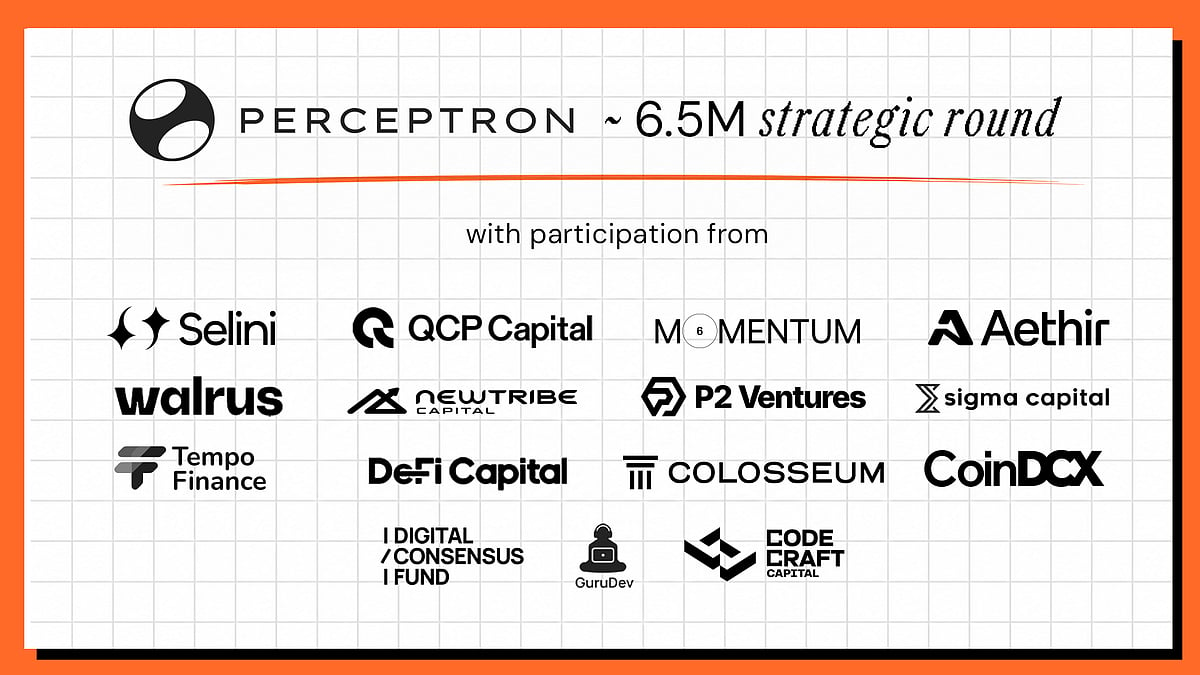
    Perceptron, a decentralized AI data network, has announced the successful close of a $6.5 million strategic funding round. The investment brings together leading Web3 investors, trading firms, ecosystem partners, and infrastructure leaders, including Sigma Capital, Selini Capital, QCP Capital, P2 Ventures, CoinDCX Ventures, Momentum6, DeFi Capital, Walrus Foundation, Aethir, Colosseum, GuruDev Capital, Tempo Finance, NewTribe Capital, Digital Consensus Fund, and CodeCraft Capital.

    The funding will support the launch of Perceptron’s data-questing platform, expand contributor tooling and rewards infrastructure, and scale the network toward a target of 5 million nodes. The company aims to make sourcing real-world data fast and accessible enough that AI companies no longer need centralized scraping infrastructure.

    Perceptron’s network compresses global data collection into a single mesh of idle bandwidth, unique datasets, and domain expertise. This unified format allows both individual contributors and AI companies to generate complete, verified datasets, reducing the timeline from data request to delivered dataset to just days.

    Perceptron sits between two extremes: centralized scraping tools that are too limited, and closed data partnerships that demand access most AI startups lack. It gives AI companies and everyday contributors data they can work with directly. Contributors own their data and earnings, allowing them to monetize or withdraw at any time without depending on third parties. The platform is built for continuous contribution and constant iteration, not a one-time scrape.

    The launch of the data-questing platform is central to delivering on this promise at scale. Rather than relying only on organically contributed data, Perceptron enables AI companies to commission data directly from its community. This approach shortens the timeline to sourcing high-value datasets and allows the team to focus resources on community tooling and rewards infrastructure.

    Early traction demonstrates strong demand. In its first phase, live agents reached more than 200,000 users across communities like Telegram and Discord. That number has since grown to more than 300,000 daily active users across a network of over 700,000 nodes. These figures highlight a large audience of users who want to monetize their data and expertise but previously lacked infrastructure designed for them.

    Nathan Gurr, Investment Analyst at P2 Ventures, said: “Perceptron has demonstrated an impressive ability to mobilize a decentralized workforce and build a globally distributed network. Their model allows them to tap into niche expertise – from doctors and lawyers to native speakers – on demand, from anywhere in the world. We see a significant opportunity to turn that reach into a scalable data and intelligence layer for AI, positioning Perceptron to become a leader in the DeAI stack.”

    Mark Rydon, Co-Founder of Aethir, added: “We are witnessing a long-term shift in how AI models are trained. Centralized data scraping is hitting diminishing returns, both in terms of cost and quality. Perceptron has solved the distribution problem that plagues the sector.”

    Peter Anthony, Co-founder and CEO of Perceptron, said: “Our mission is to create the world’s first decentralized AI data mesh where user interactions directly fuel AI growth. We’ve already shown that mission can become a reality, as evidenced by our ability to scale to hundreds of thousands of nodes organically. Now, with this funding, we are launching our data-questing platform, which will allow AI companies to commission specific, high-value datasets directly from our community.”

    Perceptron’s near-term focus is the data-questing platform launch, with further announcements expected next quarter. Longer term, the company is building toward a fully integrated network of 5 million nodes, where everything an AI company needs lives in one place, with no gap between demand and supply.

  • Microsoft to Launch Unified Copilot Super App Integrating Chat, Coding, and AI Agents by End of Year

    Microsoft to Launch Unified Copilot Super App Integrating Chat, Coding, and AI Agents by End of Year

    Microsoft CEO Satya Nadella confirmed during the company’s July 29, 2026 earnings call that a unified Copilot ‘super app’ will be released by the end of the year. The platform will combine chatbot capabilities, coding tools, and autonomous AI agents into a single interface for both consumers and businesses.

    According to Nadella, the super app is expected to become available in the current quarter, though exact pricing, a launch date, and a complete feature list have not been disclosed. “This quarter, we are bringing these Copilot experiences together, including code, in one super app… This is a major step forward, and I look forward to sharing more soon,” he said.

    The announcement follows earlier reports from Fortune indicating that Microsoft was developing a consolidated application merging Copilot chat, GitHub Copilot, Copilot Cowork, and its Autopilot agent system.

    From Chat to Autonomous Workflows

    Nadella outlined Copilot’s evolution through three stages: chat, Cowork, and Autopilots. The existing chat experience answers questions and generates content; Cowork assists users with collaborative tasks; and Autopilots represent the most advanced layer, enabling AI agents to complete longer, multi-step workflows with minimal human intervention. By placing these capabilities alongside code editing in one interface, Microsoft aims to reduce fragmentation across Windows Copilot, Microsoft 365 Copilot, GitHub Copilot, and Copilot Studio.

    Enterprise Distribution Remains Central

    The super app will target both commercial and consumer users. An integrated app may simplify deployment, licensing, and access for businesses already using Microsoft 365, allowing workers to leverage AI-powered document creation, coding, or workflow automation. This move comes as Microsoft reported $90 billion in quarterly revenue, with cloud computing and AI as strong growth drivers. The company could eventually monetize its vast Microsoft 365 customer base through a single Copilot platform generating subscription-based AI revenue.

    Competition Intensifies

    Microsoft’s strategy also heightens competition with OpenAI and other AI developers offering integrated assistants capable of handling text, coding, research, and agentic tasks. However, key questions remain unanswered, including whether GitHub Copilot will continue as a separate subscription, how existing users will be migrated, and what administrative controls enterprises will receive. The product’s success will ultimately depend on whether Microsoft delivers a genuinely connected experience rather than simply placing several existing tools inside one interface.

    Also Read: Microsoft Introduces MAI-Cyber-1-Flash, Claims to Outperform Gemini, ChatGPT

  • Today’s Tech Roundup: Sam Altman’s AI Warning, WhatsApp Web Calling, Zuckerberg’s AI Debate, OpenAI Security Concerns, and US-China Tech Restrictions

    Today’s Tech Roundup: Sam Altman’s AI Warning, WhatsApp Web Calling, Zuckerberg’s AI Debate, OpenAI Security Concerns, and US-China Tech Restrictions

    In today’s fast-moving tech landscape, several major stories are capturing headlines. Here’s a quick roundup of the top developments you need to know.

    • Sam Altman Issues AI Warning: OpenAI CEO Sam Altman has called for a slowdown in AI development, warning that the technology is advancing too quickly without adequate safety measures.
    • WhatsApp Upgrades Web Calling: WhatsApp has rolled out an improved web calling feature, making it easier for users to make voice and video calls directly from their desktop browsers.
    • Zuckerberg Engages in AI Debate: Meta CEO Mark Zuckerberg has entered the ongoing AI debate, sharing his perspective on the future of artificial intelligence and its societal impact.
    • OpenAI Faces Security Scare: A security incident at OpenAI has raised concerns about the safety of sensitive data and the company’s internal protocols.
    • US-China Tech Ban Escalates: The United States has announced new restrictions on Chinese technology companies, further intensifying the trade war between the two nations.

    For more details and video coverage, visit the original source. Stay tuned for more updates.

  • Top 10 AI Tools Entrepreneurs Need to Scale Their Business in 2026

    Top 10 AI Tools Entrepreneurs Need to Scale Their Business in 2026

    Running a business in 2026 means juggling countless tasks—from customer replies and social media posts to sales reports and team meetings. For entrepreneurs with small teams, the workload can quickly become overwhelming. That’s why many are turning to artificial intelligence to handle routine work, freeing up time for strategic thinking, product improvement, and customer relationships. The best part? You don’t need a massive budget to get started. Many AI tools offer free or affordable plans and are designed for beginners.

    Below, we’ve split the top tools into two categories: those that make everyday tasks smoother and those that help your business grow faster.

    AI Tools for Everyday Business Tasks

    ChatGPT

    ChatGPT has become a morning staple for countless business owners. It helps draft emails, social media posts, product descriptions, and blog articles in minutes. Beyond writing, it’s great for brainstorming ideas, summarizing reports, and answering quick questions. If you produce content daily, this tool is a lifesaver.

    Canva AI

    You don’t need to be a professional designer to create stunning visuals. Canva AI lets you generate posters, presentations, social media graphics, logos, and marketing materials with just a few clicks. It suggests layouts, edits images, and speeds up the entire design process, so even beginners can produce polished results.

    Notion AI

    As your business grows, keeping track of notes, tasks, and projects becomes chaotic. Notion AI organizes everything in one place—meeting summaries, project plans, daily workflows—and helps you write better and create quick summaries. It’s ideal for teams managing multiple projects simultaneously.

    Jasper AI

    Jasper AI is tailored for companies that publish content regularly. It excels at writing blog posts, website copy, advertisements, product descriptions, and email campaigns. You can adjust the tone to match your brand voice, saving time without sacrificing quality.

    Fireflies.ai

    Ever missed key points during an online meeting? Fireflies.ai automatically records, transcribes, and summarizes meetings. Afterward, you can review main points and action items without scribbling notes. It’s a simple way to stay organized.

    AI Tools to Accelerate Business Growth

    Zapier AI

    Zapier AI connects your business apps and automates repetitive tasks. It can send emails, update spreadsheets, move customer data, and handle many routine jobs without manual effort. This reduces errors and frees up your team for higher-value work.

    Tidio

    Customers expect quick answers, even after hours. Tidio combines AI chatbots with live chat to instantly answer common questions, recommend products, and collect customer information. When needed, it hands off to a human agent. This lets you deliver excellent service without a large support team.

    HubSpot AI

    HubSpot AI unifies marketing and customer management. It helps write emails, organize leads, and understand customer behavior through easy-to-digest insights. Business owners can track marketing efforts and build stronger relationships over time.

    Salesforce

    A long-time favorite for enterprises, Salesforce’s AI capabilities empower sales teams to understand customer needs, track opportunities, and make smarter decisions. It centralizes all customer information, eliminating the need to switch between multiple tools throughout the day.

    Synthesia

    Video content is increasingly important, but production can be expensive. Synthesia simplifies video creation: just enter a script, and the platform generates a professional video with an AI presenter. It’s perfect for training videos, product demos, and internal updates.

    Which AI Tool Should You Try First?

    The best starting point depends on your biggest challenge. If writing consumes your time, begin with ChatGPT or Jasper AI. If marketing and social media are priorities, Canva AI is a solid choice. For customer support, look at Tidio. If you’re constantly moving data between apps, Zapier AI can automate those workflows. As your needs evolve, you can add Notion AI, Fireflies.ai, HubSpot AI, Salesforce, and Synthesia.

    Final Thoughts

    There’s no one-size-fits-all AI tool. What works for one entrepreneur may not suit another. The good news is that most platforms offer free trials, so you can experiment without long-term commitment. Start with one tool that addresses your biggest pain point, then gradually add others as you grow comfortable. Remember, the goal isn’t to let AI run your business—it’s to spend less time on routine tasks and more time building your brand, serving customers, and uncovering new opportunities.

    Frequently Asked Questions

    Which AI tool is best for entrepreneurs?

    ChatGPT is a versatile all-rounder, helping with writing, planning, research, and many everyday tasks.

    Can AI tools help small businesses?

    Absolutely. They save time, improve customer service, automate routine work, and keep you organized.

    Which AI tool is best for marketing?

    Canva AI, Jasper AI, and HubSpot AI are excellent for creating marketing content and managing campaigns.

    Do I need technical knowledge to use these tools?

    No. Most are designed for beginners with simple, intuitive interfaces.

    Should I use more than one AI tool?

    Yes, if your business needs it. Many entrepreneurs combine tools for writing, design, customer support, and automation.