Category: Finance

  • How AI Is Transforming Banking in 2026: What It Means for Your Money

    How AI Is Transforming Banking in 2026: What It Means for Your Money

    Artificial intelligence is reshaping the banking industry in 2026, making financial services faster, smarter, and more personalized than ever before. From fraud detection to personalized financial advice, AI is fundamentally changing how we interact with our money.

    Real-Time Fraud Detection and Enhanced Security

    Banks now deploy AI systems that analyze transactions in real time, flagging suspicious activity instantly. This reduces fraud and improves account security, giving customers greater peace of mind.

    24/7 AI-Powered Customer Support

    AI chatbots handle routine banking queries around the clock, offering quicker support and freeing human agents for more complex issues. Customers can get answers to common questions anytime, anywhere.

    Personalized Financial Insights

    Using transaction history, AI tools provide personalized insights into spending, budgeting, and savings. This helps users make more informed financial decisions and achieve their goals faster.

    Faster Loan Approvals

    AI accelerates loan processing by analyzing financial data and credit profiles more efficiently than traditional methods. Borrowers can expect quicker decisions and less paperwork.

    Smarter Investment Recommendations

    Investment platforms increasingly rely on AI to recommend diversified portfolios tailored to individual financial goals and risk tolerance. This makes sophisticated investing accessible to more people.

    Voice Banking and Biometric Authentication

    Voice banking, along with facial and fingerprint recognition, is making digital banking more convenient and secure. Biometric authentication reduces the risk of unauthorized access while simplifying the login process.

    Staying Aware of Privacy and Cybersecurity

    While AI improves efficiency, customers should remain vigilant about privacy and cybersecurity. Always verify sensitive financial communications and use secure channels for banking activities.

    As AI adoption grows across the financial sector, digital banking is set to become even more intelligent, automated, and customer-focused. The future of banking is here—and it’s powered by AI.

  • Indian Stock Market Opens Sharply Lower: Nifty 50 Drops 178 Points, Sensex Sinks Over 600 Points on Rising Oil Prices

    Indian Stock Market Opens Sharply Lower: Nifty 50 Drops 178 Points, Sensex Sinks Over 600 Points on Rising Oil Prices

    The Indian stock market opened sharply lower on Friday, dragged down by weakness in global markets and a surge in crude oil prices that has stoked inflation fears and dampened investor sentiment. At the opening bell, the Nifty 50 fell 178 points, the Sensex declined 633 points, and the Bank Nifty edged over 0.70% lower.

    On Thursday, the Sensex had already declined 363.66 points, or 0.47%, to close at 76,391.39, while the Nifty 50 fell 126.65 points, or 0.53%, to settle at 23,869.60. The Indian rupee also opened lower at Rs. 96.63 per dollar on Friday, compared to Thursday’s close of Rs. 96.57.

    Institutional activity showed a mixed picture. Domestic institutional investors (DIIs) stepped up buying in Indian equities on July 23, purchasing shares worth Rs. 2,947.14 crore. In contrast, foreign institutional investors (FIIs) remained net sellers, offloading equities worth Rs. 2,999.23 crore.

    Sensex Outlook

    Technically, the Sensex formed a bearish candle on the daily chart and is holding a lower top formation on intraday charts, supporting further weakness from current levels.

    “As long as the market is trading below 77,000, weak sentiment is likely to continue on the downside. The correction wave is likely to persist till 76,000. Further downside may also continue, which could drag the index to 75,700-75,500. On the flip side, above 77,000, the sentiment could change. Above this level, the market could bounce back to 77,300-77,500. The intraday market texture is uncertain and volatile; hence, level-based trading would be the ideal strategy for day traders,” said Shrikant Chouhan, Head of Equity Research at Kotak Securities.

    Nifty 50 Outlook

    The Nifty 50 continues to exhibit a corrective trend after extending losses for the fourth straight trading session. The index formed a high-wave candle on the daily chart, indicating that selling pressure remains intact.

    The index is currently testing the important support area between 23,800 and 23,750, where the 50-day Simple Moving Average (SMA) coincides with multiple swing lows formed over the past five weeks.

    “On the downside, a breach below 23,800-23,750 on a closing basis will accelerate downside towards the 23,500 levels in the coming weeks, being the confluence of the trendline support joining lows of April and June 2026, bullish gap area of June 15, 2026, and 61.8% retracement of the recent up move from 23,070-24,530,” said Bajaj Broking Research.

    The brokerage added that a move back above 24,000 could temporarily halt the recent decline and pave the way for a recovery towards 24,200 during the coming week.

    Bank Nifty Outlook

    The Bank Nifty formed a bearish candle pattern with lower highs and lower lows on the daily chart, indicating weakness in the near term.

    A sustained move below the 56,200-56,500 support zone could trigger further weakness towards the 55,500-55,000 levels, which coincide with a key trendline support and the 61.8% Fibonacci retracement of the previous rally.

    “A shallow retracement signals overall positive bias and a higher base formation in the current corrective decline. On the higher side, 57,500 will act as an immediate hurdle, while the upper band of the recent consolidation, placed around 58,500-58,700, will act as a stiff hurdle in the index in the coming weeks,” said Bajaj Broking Research.

  • Gold Prices Dip as Brent Crude Trades Above $100, Fueling Rate Hike Expectations

    Gold Prices Dip as Brent Crude Trades Above $100, Fueling Rate Hike Expectations

    Gold prices edged lower on the Multi Commodity Exchange (MCX) on July 24 as Brent crude oil held above $100 a barrel, intensifying inflation concerns and reinforcing expectations for a September rate hike by the U.S. Federal Reserve.

    Domestic Gold Prices

    MCX August gold futures dropped 0.7% to Rs 1,41,824 per 10 grams. September silver futures also declined, falling 0.88% to Rs 2,17,447. In the physical market, 24K gold fell by Rs 185 to Rs 1,44,330 per 10 grams, while 22K gold declined by Rs 170 to Rs 1,32,300. Prices in Mumbai and Kolkata stood at Rs 1,44,330, Delhi at Rs 1,44,480, and Chennai at Rs 1,44,330.

    US Gold and Precious Metals

    Spot gold slipped 0.4% to $4,030.09 per ounce, extending losses after a 2% drop in the previous session. U.S. gold futures for August delivery were also 0.4% lower at $4,033.20. Spot silver fell 0.7% to $57.29 per ounce but was on track for a weekly gain of 2.5%. Platinum dropped 1.3% to $1,579.49, and palladium declined 1.5% to $1,237.50, both heading for a weekly loss.

    Key Levels to Watch

    According to the CME FedWatch Tool, traders now see an 81% probability of a quarter-point rate hike in September. Elevated crude oil prices above $100 are adding to inflation pressures, strengthening the case for tighter monetary policy.

    GoldSilver Central Managing Director Brian Lan noted, “In the short term, we expect more volatility… gold has been trading between $3,980 and about $4,170 and has been stuck in this range for weeks. Every time prices hit close to $4,000 or slightly below, we see big buyers coming to buy it back up.”

    Technically, XAU/USD trades around $4,030 and remains capped below the 21-day simple moving average (SMA) at $4,068.50 and the 50-day SMA at $4,231.04. The Relative Strength Index (RSI) sits near 44, indicating neutral-to-soft momentum. Immediate resistance is at $4,068.50, followed by the 50-day SMA near $4,231.04. A break above that would face further resistance at the 100-day SMA ($4,479.88) and the 200-day SMA ($4,494.74), which form a dense zone that needs to be reclaimed to ease the broader bearish tone.

  • How AI Is Transforming Risk Assessment in Litigation Finance

    How AI Is Transforming Risk Assessment in Litigation Finance

    Every litigation finance investment starts with an assessment of the case itself. Before capital is committed, funders need to understand how strong the legal claim is, what the potential risks are, and whether the expected return justifies the investment. Traditionally, this has been the work of experienced lawyers and underwriters. Increasingly, AI is being used to support these early assessments by reviewing information faster and identifying patterns that might otherwise take much longer to find.

    The shift is not incremental. AI tools can scan thousands of court records in the time a human analyst spends reading a single brief. They surface patterns invisible to individual minds. They compress due diligence from weeks into days. The litigation finance industry is not just experimenting with AI. It is rebuilding its core risk infrastructure around it.

    At a glance

    • AI systems now cut initial case review time by more than 70%, letting litigation funders evaluate significantly more claims without adding headcount
    • Predictive scoring models trained on millions of court records forecast win probabilities with a precision no single analyst can match manually
    • Portfolio-level AI analysis allows funders to balance risk across hundreds of simultaneous cases, something previously impossible at scale
    • AI-washing is already drawing SEC and FTC penalties, meaning human oversight is not just smart but legally necessary
    • AEQUIFIN is developing an AI-powered intake tool that pre-screens case submissions before they reach a human underwriter

    How Is AI Transforming Case Evaluation?

    The traditional risk assessment process in litigation finance was slow by design. A senior underwriter would spend weeks reviewing briefs, benchmarking comparable settlements, and interviewing the claimant’s legal team before making a funding decision. Speed was a luxury the industry could not afford because the margin for error was so thin.

    AI removes that ceiling in several ways at once.

    Predictive Scoring: What the Data Sees That Humans Miss

    Modern litigation AI models are trained on millions of historical court records: verdicts, settlements, appeal rates, judge behavior, jurisdiction-level outcomes. From that dataset, they generate predictive scores for new cases before a lawyer has billed a single hour of review time.

    The pattern recognition is qualitatively different from legal intuition. Where an experienced analyst recalls what they have personally seen, AI identifies correlations across data volumes no individual mind can process. A specific judge’s historical tendency to deny motions in commercial contract disputes. The statistical relationship between discovery duration and final settlement size. The appeal rate differential between jurisdictions in securities fraud claims. These are not educated guesses. They are signals extracted from the record.

    Key capabilities AI now delivers to litigation funders:

    • Smarter Case Scoring: AI cross-references millions of past verdicts to assign win-probability estimates to incoming claims before manual review begins
    • Faster Due Diligence: AI document analysis cuts initial case screening time by over 70%, compressing what once took weeks into hours
    • Duration Risk Modeling: Machine learning tracks how long comparable cases historically took to resolve, giving funders a timeline they can plan capital deployment around
    • Portfolio Optimization: AI evaluates entire books of litigation simultaneously, balancing expected returns and duration risk across hundreds of active investments

    AI vs. Traditional Risk Assessment: How the Two Approaches Compare

    Factor AI-Assisted Assessment Traditional Assessment
    Speed Hours to days Weeks to months
    Data Coverage Millions of historical cases Limited to analyst experience
    Pattern Recognition Systematic across all data Strong but selective
    Human Factor Sensitivity Limited High
    Cost at Scale Decreasing Fixed per case
    Regulatory Risk AI-washing exposure Minimal

    The comparison highlights that AI and human expertise serve different purposes. AI can make the initial review faster and more consistent, while experienced underwriters provide the legal and commercial judgment needed for complex investment decisions. In practice, the two approaches work best together rather than as alternatives.

    The Limits: Why Is Human Judgment Still Irreplaceable?

    For all its advantages, AI in litigation finance has serious limitations. The industry is now learning some of them through regulatory enforcement.

    Litigation is far more complex than a dataset. New evidence can appear late in a case, witnesses may change their statements, settlement discussions can take unexpected turns, and courtroom decisions are influenced by many factors that are difficult to measure. AI can help identify patterns and highlight promising cases, but it cannot account for every legal nuance or predict outcomes with certainty.

    There is also the quality of the underlying data to consider. If the data is incomplete or biased, the assessment will inevitably reflect those limitations. For that reason, AI works best as a decision-support tool, with experienced legal professionals making the final judgment.

    AI-Washing: The Regulatory Trap Already Closing

    Regulators have already moved on companies that overstate what their AI can do.

    The FTC penalized DoNotPay when its “robot lawyer” AI consistently failed to deliver on its core promise of replacing human attorneys. The SEC fined an investment firm that marketed itself as the “first regulated AI financial advisor” when the underlying technology could not substantiate the claim. These cases define a concept with serious financial consequences: AI-washing. For litigation funders developing algorithmic tools, the message is unambiguous. Transparency about what the models do and do not do is not a preference. It is a regulatory requirement.

    AEQUIFIN’s AI Tool: Screening Cases Before a Human Opens the File

    AEQUIFIN is one of the companies exploring how AI can improve the early stages of case assessment. The company is developing an AI-powered intake system that reviews new submissions before they reach a human underwriter.

    The goal is straightforward. Litigation funders receive a large number of case inquiries, and every submission requires an initial review before anyone can decide whether it is worth investigating further. Automating that first step helps reduce manual work and allows underwriters to spend more time on the cases that warrant a closer look.

    The system can review each submitted case against a set of core eligibility criteria, including the type of claim, its estimated value, the relevant jurisdiction, and key indicators of legal strength. Based on this information, it provides an initial assessment. Cases that meet the required threshold are passed on to human underwriters for a more detailed review. If a case doesn’t qualify at this stage, applicants receive a clear explanation of why, along with guidance on any additional information or documentation that could improve their submission.

    The result is a faster, more transparent process for claimants and a cleaner pipeline for AEQUIFIN’s investment team. Claimants will submit their case for AI-assisted review directly through the platform.

    What This Means If You Have a Claim

    The practical effect of AI adoption across litigation finance is accelerated access. Funding decisions that previously took months now move through initial screening in days. Claims that previously fell below the threshold of manual review because evaluating them cost more in analyst hours than the likely return justified are now economically viable to assess.

    For businesses, investors, and individuals sitting on legitimate legal claims but lacking the capital to pursue them, that shift is significant. The barrier between having a case and being able to fight it is lower than it has ever been. View current cases here to see the types of claims AEQUIFIN actively funds.

    The Road Ahead

    AI is unlikely to replace litigation lawyers or investment professionals. Instead, it has the potential to make their work more efficient by reducing the time spent on repetitive tasks and supporting faster, more consistent case assessments. That could also make it easier for claimants with strong cases to receive an initial evaluation.

    As the technology matures, the firms that are likely to benefit most will be those that adopt AI in a measured and responsible way. This includes being transparent about what the technology can and cannot do, ensuring experienced professionals remain involved in key decisions, and using AI as a tool to support human judgment rather than replace it.

    Litigation finance will always require legal expertise, commercial judgment, and careful risk assessment. AI can contribute to that process by providing faster access to relevant information and highlighting patterns that might otherwise be missed, but final decisions will continue to depend on human experience.

    FAQ

    How accurate are AI systems at predicting litigation outcomes?

    Current models perform strongest on high-data case types such as commercial contract disputes and securities claims. Accuracy decreases on novel legal theories, jury trials, and jurisdictions with thin historical records. AI predictions should be treated as probabilistic inputs that inform human decision-making, not as definitive forecasts.

    What role does AI play in AEQUIFIN’s case evaluation process?

    AEQUIFIN is actively developing an AI-powered intake tool for pre-screening case submissions. The system assesses initial eligibility automatically, allowing human underwriters to focus on cases that clear the core investment criteria. Claimants can submit their case for AI-assisted review directly through the platform.

    What types of cases does AEQUIFIN fund?

    AEQUIFIN focuses on high-value civil and commercial litigation across European jurisdictions. Eligible cases typically involve substantial financial claims with clear underlying legal merit. An overview of active funded cases is available through AEQUIFIN’s case overview page.


  • Wall Street Tumbles: Dow Loses 500 Points as Oil Surge and Tech Losses Bite

    Wall Street Tumbles: Dow Loses 500 Points as Oil Surge and Tech Losses Bite

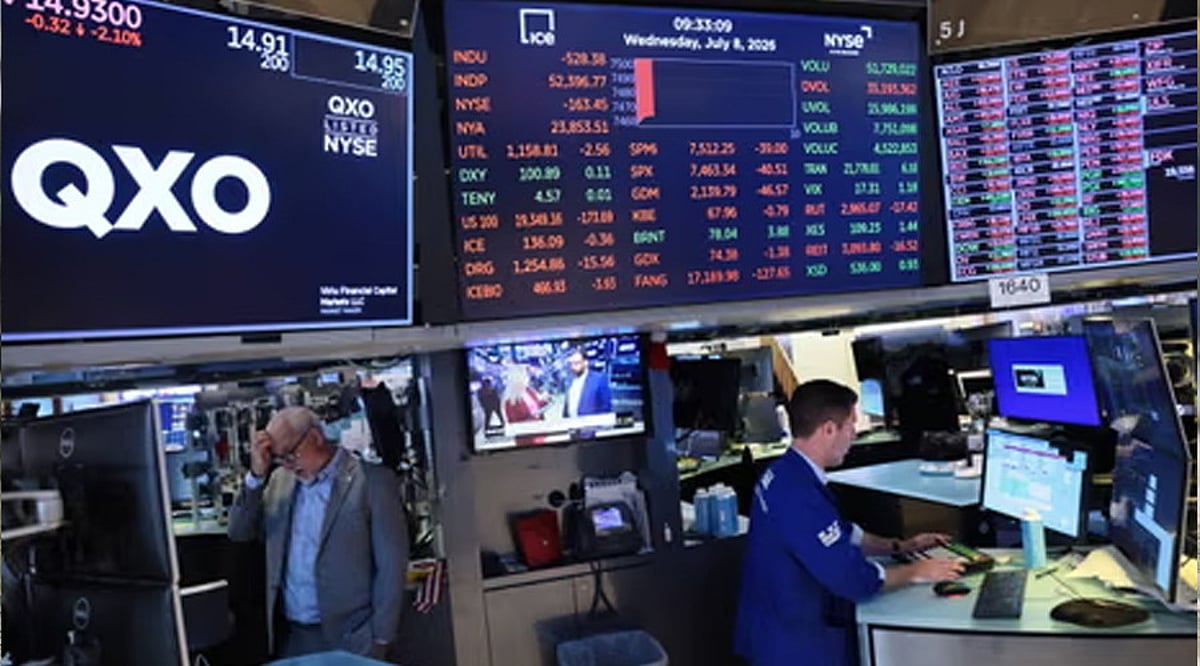
    US stocks fell sharply on Thursday as a surge in oil prices, rising bond yields, and disappointing earnings from major technology companies weighed on market sentiment. The Dow Jones Industrial Average dropped approximately 500 points during morning trading, with the S&P 500 losing nearly 1% and the Nasdaq Composite falling around 1.7%.

    The sell-off pushed major indexes to multi-week lows, with declining shares outnumbering advancing stocks on both the New York Stock Exchange and Nasdaq. The CBOE Volatility Index rose to 18.79 after three consecutive declines, reflecting heightened investor anxiety.

    Oil Rally Raises Inflation Concerns

    Brent crude futures surged 6.7% to $100.37 per barrel during European trading, while West Texas Intermediate gained 5.5% to $91.91 per barrel. The rally followed reports that Houthi forces attacked two Saudi oil tankers near the Bab el-Mandeb Strait, raising fresh supply concerns and threatening another major shipping route.

    Higher oil prices pushed Treasury yields upward, with the 10-year yield reaching its highest level since January 2025 and the two-year yield hitting a 17-month high. This renewed inflation fears, prompting traders to increase bets on a Federal Reserve rate hike at the July meeting. CME FedWatch data showed markets pricing a 38% chance of a quarter-point increase, up from about 12% just one week earlier.

    Alphabet and Tesla Pressure Nasdaq

    Alphabet shares fell more than 6% after the company raised its 2026 capital spending forecast, with investors focusing on costs tied to artificial intelligence infrastructure. AJ Bell investment director Russ Mould noted a “healthy degree of scepticism” about returns from such spending. The decline pulled communication services stocks lower.

    Tesla shares dropped more than 12% after reporting negative quarterly free cash flow and higher operating expenses relative to revenue growth. CEO Elon Musk called 2026 a “massive capex year,” with spending plans including robots, data centers, manufacturing projects, and its robotaxi business.

    Energy Shares Rise With Crude Prices

    Energy companies moved higher as oil prices extended a five-day rally. Exxon Mobil gained 1.6%, while Chevron rose 1.9%. Diamondback Energy, Devon Energy, ConocoPhillips, and Occidental Petroleum gained between 1.7% and 2.7%. Refiners also advanced, with Valero Energy, Marathon Petroleum, and Phillips 66 rising between 1.1% and 1.3%.

    Analysts also watched shipping activity in the Middle East. UBS analyst Giovanni Staunovo said subdued vessel traffic could slow the region’s production recovery.

    Rate Expectations Shift Before Fed Meeting

    The oil rally renewed concern that higher fuel costs could keep inflation elevated. New labor data also supported expectations that the Fed could keep policy tight, with initial unemployment claims falling to 187,000, below forecasts of 210,000.

    Airline shares faced pressure as higher fuel costs threatened operating expenses, while transport stocks moved lower. Lockheed Martin shares rose after the company lifted its 2026 forecasts, and ServiceNow gained after raising its annual subscription revenue outlook.

    Markets will likely remain focused on oil prices, upcoming inflation data, and the Federal Reserve’s next policy decision for direction.

  • Top Personal Finance Apps to Simplify Freelance Money Management

    Top Personal Finance Apps to Simplify Freelance Money Management

    Managing finances as a freelancer can be challenging due to irregular income and the need to track expenses, invoices, and taxes. The right personal finance app can streamline these tasks, helping you stay organized and financially healthy. Below are some of the best apps tailored for freelancers, along with key features to consider when choosing one.

    YNAB (You Need A Budget)

    YNAB helps freelancers assign every dollar a purpose, encouraging disciplined budgeting, savings, and smarter financial planning throughout unpredictable income cycles. It focuses on giving every dollar a job, which is ideal for managing variable earnings.

    QuickBooks

    QuickBooks simplifies bookkeeping, invoice generation, expense tracking, and tax preparation, making financial management easier for independent professionals and consultants. It’s a comprehensive tool for handling business finances.

    Zoho Books

    Zoho Books offers invoicing, bank reconciliation, automated accounting, and GST support, making it suitable for freelancers handling multiple clients efficiently. It’s particularly useful for those who need robust automation features.

    FreshBooks

    FreshBooks focuses on invoicing, time tracking, expense management, and client payments, helping freelancers maintain organized financial records effortlessly. Its intuitive interface is great for non-accountants.

    Money Manager

    Money Manager provides simple budgeting, expense categorization, and spending insights, enabling freelancers to monitor finances without complex accounting knowledge. It’s a lightweight option for basic tracking.

    Key Features to Look For

    Expense Tracking

    Reliable finance apps automatically categorize expenses, helping freelancers understand spending habits while maintaining accurate records for taxation purposes.

    Invoice Management

    Integrated invoicing tools streamline billing processes, track payments, and reduce delays, ensuring healthier cash flow throughout freelance projects.

    Tax Planning

    Many apps estimate taxes, organize deductible expenses, and simplify filing, minimizing financial stress during tax season for freelancers annually.

    Choosing the Right App

    Compare pricing, automation, integrations, security, and reporting capabilities before selecting a finance app matching your freelance business requirements. The best choice depends on your specific needs, such as the number of clients, preferred features, and budget.

  • India’s New Labour Codes Mandate Final Salary Payment Within Two Days of Resignation

    India’s New Labour Codes Mandate Final Salary Payment Within Two Days of Resignation

    Employees changing jobs in India may no longer have to wait weeks for their final salary. Under the country’s new Labour Codes, employers must now pay wage-related dues within two working days after an employee resigns or leaves the company. The rule, effective from November 21, 2025, aims to streamline the full and final settlement process, making it faster and smoother for both parties.

    The new timeline primarily covers pending salary and leave encashment. However, other payments such as gratuity, provident fund, and certain bonuses continue to follow separate legal timelines. Employees should not expect every payment to arrive within the two-day window.

    A full and final settlement typically includes unpaid salary, leave encashment, approved expense claims, incentives, and other eligible payments. Employers can also deduct amounts for notice pay, unpaid loans, taxes, or charges for company assets that were not returned.

    The speed of the final payment also depends on how quickly the exit process is completed. Employees who finish the handover, return company property, submit expense claims, and update bank details generally receive their settlement without unnecessary delays.

    The Labour Codes also encourage employees to update their nomination details. Correct records can help family members receive pending wage dues without legal complications in case of an unexpected situation.

    This new law marks a significant change from the earlier practice, where many employees waited 30 to 45 days for their final payment. The faster timeline is designed to improve the exit process for both employees and employers. While some payments will still take longer, salary-related dues should now reach employees much sooner.

  • MCX Gold Slips 0.48% to ₹1,44,984 as Profit Booking Emerges; Brent Crude Jumps 2.30% to $96.23

    MCX Gold Slips 0.48% to ₹1,44,984 as Profit Booking Emerges; Brent Crude Jumps 2.30% to $96.23

    Gold prices on the Multi Commodity Exchange (MCX) experienced a decline on July 23, driven by profit booking after a 2% surge in the previous session. The retreat comes amid ongoing geopolitical tensions and rising crude oil prices.

    August gold futures fell 0.48% to ₹1,44,984 per 10 grams, while September silver futures dropped 0.40% to ₹2,26,090 per kilogram. Meanwhile, Brent crude futures climbed 2.30% to $96.23 per barrel, and US West Texas Intermediate (WTI) advanced 1.81% to $88.40 per barrel.

    Domestic Gold Prices

    In the Indian market, 24K gold rose by ₹77 to ₹1,47,280 per 10 grams, while 22K gold increased by ₹70 to ₹1,35,000. City-wise prices showed Mumbai and Kolkata at ₹1,47,280, Delhi at ₹1,47,420, and Chennai at ₹1,46,520.

    US Gold Prices

    In the United States, gold prices held steady on Thursday, pulling back from two-week highs reached in the previous session. The escalating Middle East conflict, particularly the US-Iran tensions, continued to push oil prices higher. Spot gold was little changed at $4,132.01 per ounce, while US gold futures for August delivery fell 0.4% to $4,134.60.

    Spot silver gained 0.3% to $59.90 per ounce, platinum rose 0.7% to $1,656.24, and palladium advanced 0.8% to $1,301.25.

    Key Levels and Analyst Insights

    “Oil continues to be up, adding to pressures of inflation and expectations of Fed interest rate hikes, capping a positive undertone in gold as the dollar weakens,” said Jigar Trivedi, a senior research analyst at IndusInd Securities.

    According to the CME FedWatch Tool, traders now see a 77% chance of a September rate hike by the US Federal Reserve. Key support levels for MCX gold are at ₹1,44,400 and ₹1,43,350, while resistance stands at ₹1,46,800 and ₹1,48,000. For silver, support is at ₹2,24,400 and ₹2,22,000, with resistance at ₹2,29,100 and ₹2,31,000.

    “We suggest long-term investors must hold their long positions in gold and silver, but traders can book profits in every market rise in gold around ₹1,47,000 and ₹1,48,000 range and in silver around ₹2,31,000 and ₹2,33,000 range,” advised Manoj Kumar Jain of Prithvifinmart Commodity Research.

    Disclaimer: This article is for informational purposes only and does not constitute financial advice. Readers should consult with a qualified financial advisor before making investment decisions.

  • Top Contractor Payment Platforms for 2026: Expert Picks for Compliance and Global Payouts

    Top Contractor Payment Platforms for 2026: Expert Picks for Compliance and Global Payouts

    Hiring contractors across borders has become standard practice for growing companies that need specialized skills without the wait of a traditional hiring plan or local entity setup. But the real challenge often emerges after the hire: how contractors get paid, whether payments arrive on time and in the right currency, and whether the engagement is structured to protect the company from misclassification claims.

    Most payment app comparisons focus on the freelancer’s perspective—fees, transfer speed, exchange rates. This guide is built for HR, finance, and operations teams responsible for paying a distributed contractor workforce while staying compliant. For contractors evaluating high-income freelance roles, the payment infrastructure their client uses is invisible until something goes wrong. For the company, it’s a real operational and legal exposure.

    Contractor Payment Service Providers to Know in 2026

    1. Papaya Global

    Papaya Global structures contractor payments around Agent of Record (AOR), meaning contractors are engaged on Papaya’s own paper rather than the hiring company’s. This shifts misclassification liability to the experts, addressing the single biggest risk most companies underestimate when scaling contractor headcount across jurisdictions. The platform covers 130 payout currencies on Tier 1 banking rails, with invoice collection, validation, and payment handled without manual processing. Its AI-driven compliance and reporting features (Papaya ONE) provide data-driven insights. Contractors sit in the same data model as employees and EOR workers, offering one unified workforce picture instead of a separate system.

    2. Deel

    Deel built its early reputation on contractor payments before expanding into EOR and payroll. It supports a wide range of payout methods and local currencies, and its contract templates are localized by country. Companies with a large, fast-growing contractor base often start here because onboarding can happen in minutes.

    3. Remote

    Remote pairs contractor payments with compliance and contract management tools, and it builds entity ownership into its model in several markets rather than relying purely on partner networks. This ownership matters most when a contractor engagement runs long enough that reclassification risk becomes a real question.

    4. Rippling

    Rippling’s advantage is integration depth. Contractor payments sit inside the same system as payroll, IT provisioning, and HR records, making it a strong fit for companies that already run their full workforce through Rippling and want contractors managed the same way.

    5. Airwallex

    Airwallex is built like financial infrastructure rather than an HR platform. It offers global accounts in 20+ currencies, multi-currency virtual cards, and strong accounting integrations. It’s a fit for finance teams that want granular control over how and when international payments settle.

    6. Wise Business

    Wise Business extends the transparent, mid-market exchange rate model that made Wise popular into a business payout tool. For companies paying a smaller number of contractors and prioritizing low fees and rate transparency over compliance infrastructure, it’s a straightforward option, though it does not address misclassification risk on its own.

    7. Oyster

    Oyster combines contractor payments with EOR services and emphasizes localized contracts and benefits access for contractors in markets where that matters for retention. It’s reasonable for companies weighing whether a role should be a contractor or full employee, since both paths run through the same platform.

    Key Factors to Consider Before Choosing

    Fees and transfer speed are easy to compare. The harder questions are about risk. Does the provider take on responsibility if a contractor is later found misclassified? What happens if a payment fails or is delayed—does the company absorb the cost and relationship damage, or does the provider? Currency coverage matters more than it looks on a feature list: a provider that supports 20 currencies well is often better than one claiming 100+ but routing half through slow correspondent banking. Integration matters for scale: a contractor payment tool that cannot connect to systems tracking headcount, cost centers, and compliance status becomes its own reconciliation project once the contractor count moves from a handful to a few dozen.

    Conclusion

    The right contractor payment provider depends on how much risk a company wants to manage itself versus transfer to a partner. A smaller contractor base with straightforward payouts may do fine with a fee-transparent tool like Wise. A larger, multi-country contractor workforce, especially one expected to keep growing, benefits more from a provider that treats classification risk and payment reliability as part of the same problem. Whatever the choice, the test is the same: does the provider make it easy to know, at any point, who’s been paid, what’s compliant, and where the exposure sits if something goes wrong?

    FAQs

    What’s the difference between a contractor payment app and an Agent of Record (AOR) service?

    A payment app moves money from the company to the contractor and stops there. An AOR service engages the contractor on its own legal paper, which means it can absorb misclassification liability rather than leaving that risk with the hiring company.

    How many contractors should a company have before considering a dedicated platform over a basic payment app?

    Once contractor payments span more than a handful of countries or the company is managing renewal dates, invoices, and classification questions manually, the operational cost of a spreadsheet-based process usually exceeds the cost of a dedicated platform.

    Can the same platform handle both contractors and full-time employees?

    Several providers—Papaya Global, Rippling, Oyster—manage contractors and employees in the same system. That’s useful for companies that expect some contractors to convert to full-time roles or want one consolidated view of total workforce cost.

    Is misclassification risk really a serious concern for a small number of contractors?

    Yes. Misclassification exposure is not only a function of headcount but of how the engagement is structured and how long it runs. A single long-term contractor treated like an employee in practice—set schedule, company equipment, exclusive engagement—can trigger the same liability as a larger program.

    Do these platforms handle contractor tax documentation?

    Most platforms listed handle tax form collection relevant to the contractor’s classification and country. Depth varies, so confirm coverage for the specific countries where contractors are based before committing.