Category: Finance

  • MCX Gold Dips 0.46% as Brent Crude Surges Past $85, Inflation Worries Persist

    MCX Gold Dips 0.46% as Brent Crude Surges Past $85, Inflation Worries Persist

    Gold prices on the Multi Commodity Exchange (MCX) traded lower on July 15, despite a slowdown in U.S. inflation that reduced expectations for aggressive Federal Reserve rate hikes and weakened the U.S. dollar. August gold futures declined 0.46%, settling at Rs. 1,41,600 per 10 grams. Meanwhile, September silver futures slipped 0.31% to Rs. 2,22,499 per kilogram.

    In the energy markets, Brent crude futures jumped 1.20% to $85.75 per barrel, while U.S. West Texas Intermediate (WTI) advanced 0.92% to $80.07 per barrel. The rise in crude oil prices reignited inflation concerns, putting pressure on precious metals.

    According to the CME FedWatch Tool, traders now see a 58% chance of a September rate hike by the Fed, down from 78% earlier, reflecting the market’s shifting outlook on monetary policy.

    Domestic Gold Prices

    In the Indian domestic market, 24K gold rose by Rs. 77 to Rs. 1,43,570 per 10 grams, while 22K gold advanced by Rs. 70 to Rs. 1,31,600. By city, Mumbai and Kolkata quoted gold at Rs. 1,43,570, Delhi at Rs. 1,43,720, and Chennai at Rs. 1,43,780.

    U.S. Gold Prices

    U.S. gold prices fell on Wednesday after climbing more than 2% in the previous session, as rising oil prices fueled inflation concerns and uncertainty. Spot gold was down 0.5% at $4,035.67 per ounce, while U.S. gold futures for August delivery eased 0.7% to $4,042.20.

    Spot silver lost 0.3% to $58.48 per ounce. Among other precious metals, platinum gained 0.2% to $1,635.56, and palladium edged 0.2% higher to $1,307.11.

    Key Levels to Watch

    Kelvin Wong, senior market analyst at OANDA, commented: “I reckon that the market is now looking past the CPI data, which is kind of a lagging indication… Trump continues to maintain the blockade of ships that is flowing out of the Strait of Hormuz, causing oil prices to rise and gold to come under pressure.”

    Internationally, gold has support at $4,022 and $3,989, while resistance is at $4,110 and $4,140 per troy ounce. Silver has support at $57.40 and $56, with resistance at $60.60 and $62.00 per troy ounce.

    On MCX, gold has support at Rs. 1,41,400 and Rs. 1,40,650, and resistance at Rs. 1,43,350 and Rs. 1,44,500. Silver has support at Rs. 2,20,000 and Rs. 2,17,700, and resistance at Rs. 2,26,000 and Rs. 2,28,800.

  • How to Identify Fraudulent Investment Apps Before Losing Your Money

    How to Identify Fraudulent Investment Apps Before Losing Your Money

    Fake investment apps are becoming increasingly sophisticated, luring users with promises of guaranteed returns, instant profits, and exclusive opportunities. Many closely mimic legitimate financial platforms, making them hard to spot at first glance. By taking a few simple precautions before investing, you can protect your finances and personal data.

    Verify the Company Before Downloading Any App

    Always confirm that the company behind the app is legitimate and registered with the relevant financial regulator. Visit the official website, review contact details, and download apps only from trusted sources—avoid clicking ads or unsolicited links shared via social media or messaging platforms.

    Watch for Unrealistic Returns and Urgent Offers

    Promises of fixed high returns with little or no risk are major red flags. Fraudulent apps often create urgency through limited-time offers, bonus rewards, or referral incentives to pressure you into quick decisions without verifying credibility.

    Read Reviews Beyond App Store Ratings

    High ratings alone don’t guarantee trustworthiness. Read detailed user reviews, search for independent reports, and look for complaints about withdrawal issues, blocked accounts, or poor customer support. Consistent negative feedback from multiple sources is a strong warning signal.

    Never Share Sensitive Banking or OTP Details

    Legitimate investment platforms never ask for OTPs, banking PINs, passwords, or full card details via calls, emails, or messages. Sharing such information gives fraudsters direct access to your bank accounts and assets.

    Keep Devices Updated and Use Official App Stores

    Only download investment apps from official app stores, and keep your smartphone updated with the latest security patches. Install trusted security software and enable two-factor authentication for an extra layer of protection.

    Report Suspicious Apps Immediately

    If an investment app seems suspicious or asks for unusual payments, stop using it right away and report it through the appropriate cybercrime reporting channels. Quick action can limit financial damage and help protect others from falling victim to the same scam.

  • Infosys Stock Plunges 36% from Peak Amid IBM Crash and Global IT Spending Concerns

    Infosys Stock Plunges 36% from Peak Amid IBM Crash and Global IT Spending Concerns

    Infosys shares were trading at Rs. 1,081.10, extending a prolonged decline from their January 2026 peak of nearly Rs. 1,700. The weakness comes amid growing concerns over slowing global technology spending, cautious enterprise budgets, and the ripple effect of IBM’s historic 25% single-day stock plunge. Although the sharp correction has weighed on investor sentiment, analysts believe client spending trends will shape the long-term outlook for Infosys, large deal wins, and the company’s ability to capitalize on the artificial intelligence (AI) boom.

    Why Infosys Is Feeling the Heat

    IBM’s sharp sell-off has become the latest trigger for weakness across technology stocks globally. The US technology giant reported weaker-than-expected preliminary quarterly results. Enterprise spending is softening, raising concerns about delayed discretionary business technology spending and a shift toward AI investments.

    The news is relevant to Infosys in many ways. Most of its revenue comes from enterprises globally that rely on digital transformation, cloud migrations, and consulting services. Any cut in tech spending, especially in North America, affects investor sentiment towards Indian IT companies. Yet the news will not affect all of its business areas equally, as it serves clients across various industry verticals with different economic cycles.

    IBM’s Decline Weighs on the Broader IT Sector

    The market response did not end at Infosys. The stocks of Tata Consultancy Services, Wipro, HCL Technologies, Tech Mahindra, Coforge, and Persistent Systems were also under selling pressure as the growth prospects of India’s IT industry were being reassessed. This is because companies are shifting their spending priorities. Even as companies keep pouring money into areas like artificial intelligence, cybersecurity, and cloud computing, projects like digital transformations and consulting projects are taking longer to get approval. These changes can affect the growth of outsourcing companies that rely heavily on long-term technology contracts.

    Nonetheless, experts have advised against comparing IBM’s performance with that of India’s IT sector companies. The business models of these companies differ significantly, and IBM’s earnings might not reflect the demand picture for offshore technology services.

    Can Infosys Recover?

    Though the recent rally has seen some retracement, Infosys continues to have solid fundamentals. This includes having a diversified clientele across the globe, maintaining sufficient cash on its balance sheet, and staying focused on growth sectors such as AI, cloud computing, automation, and digital engineering. Such sectors are set to drive enterprise IT spending in the coming years.

    Technically, Infosys is trying to consolidate around Rs. 1,050 – 1,100 levels. Holding above these levels can help it consolidate its gains, and a decisive move above Rs. 1,150 can restore investors’ confidence. On the downside, Rs. 1,000 remains a crucial support level for traders.

    Besides, investors would be keeping an eye on the next quarterly results, management commentary, the deal pipeline, and potential revenue from the AI sector.

    Market Outlook

    There is no doubt that IBM’s steep decline would have affected the share prices of technology companies worldwide. Still, in the case of Infosys, the long-term investment story is independent of any particular company’s fortunes. Infosys is well-placed to capitalize on emerging structural themes such as AI adoption, cloud migration, and digital transformation.

    Although near-term stock volatility may persist amid uncertainty about global tech spending, Infosys’s success in closing larger transformation deals and in AI-enabled services would ultimately determine whether the recent fall was merely a correction or an indication of lower growth ahead. For investors, the upcoming earnings season may provide important insights into this stock’s future.

    FAQs

    What caused Infosys shares to decline recently?

    Infosys shares fell after IBM’s historic stock plunge raised concerns about slowing global technology spending and weaker enterprise IT budgets.

    How does IBM’s decline affect Infosys?

    IBM’s weak outlook fuels fears of reduced enterprise technology spending, which could delay client projects and impact Infosys’ revenue growth.

    Is Infosys fundamentally weak despite the stock correction?

    No. Infosys continues to have strong fundamentals, healthy cash reserves, diversified clients and growing investments in AI and cloud services.

    Which sectors contribute the most to Infosys’ revenue?

    Financial Services is the largest contributor, followed by Retail, Manufacturing, Communication, Energy, Hi-Tech, and Life Sciences businesses.

    What should investors watch before buying Infosys shares?

    Investors should monitor quarterly earnings, deal wins, management guidance, AI-driven growth opportunities and global enterprise technology spending trends.


  • FTSE 100 Drops 65 Points as Middle East Tensions and Weak China GDP Sour Investor Mood

    FTSE 100 Drops 65 Points as Middle East Tensions and Weak China GDP Sour Investor Mood

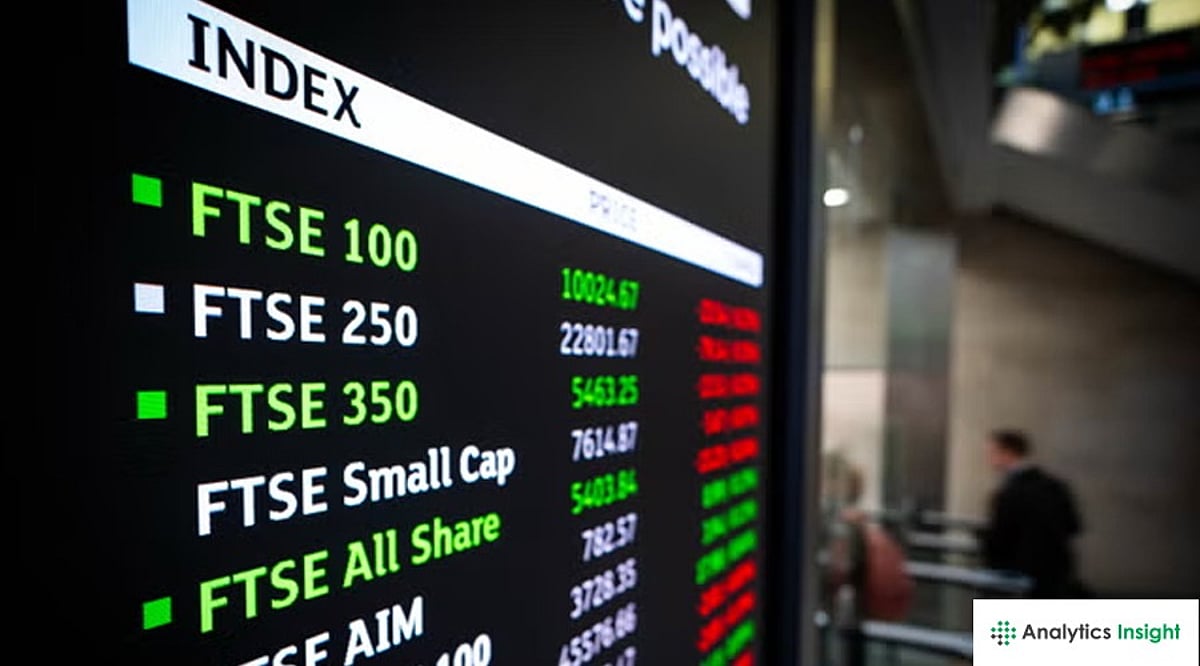
    The FTSE 100 opened 65 points lower at 10,464 on Wednesday, driven by escalating tensions between the United States and Iran that pushed oil prices higher, while disappointing Chinese economic growth data added to investor caution.

    Brent crude futures rose 1.64% to $86.12 a barrel, and US West Texas Intermediate (WTI) advanced 1.66% to $80.66 a barrel. Sterling strengthened slightly, quoted at $1.3405 early Wednesday, up from $1.3396 at the previous London close.

    Gainers & Losers

    Top Gainers

    • Barratt Redrow +3.06% to £286.70
    • ICG +2.24% to £1,830
    • Burberry Group +1.64% to £1,086.50
    • Smith & Nephew +1.21% to £1,127.50
    • Persimmon +1.14% to £1,064.50
    • Polar Capital Technology Trust +0.82% to £675

    Top Losers

    • Fresnillo -3.39% to £2,507
    • Antofagasta -2.91% to £3,731
    • Endeavour Mining -2.58% to £3,510
    • Lion Finance Group -1.40% to £11,290
    • Coca-Cola Europacific Partners -1.20% to £7,820
    • Games Workshop Group -0.59% to £20,220

    China’s Economic Slowdown

    China’s economy grew 4.3% year-on-year in the second quarter, its weakest pace since the fourth quarter of 2022, according to the National Bureau of Statistics. The reading missed the Reuters poll forecast of 4.5% and slowed from 5% growth in the first quarter, falling below Beijing’s full-year target range of 4.5% to 5%.

    B&M First Quarter Sales Rise

    B&M European Value Retail reported first-quarter sales growth of 2%, with revenue climbing to £1.43 billion in the 13 weeks to 27 June. Revenue at B&M UK increased 0.3% to £1.14 billion, though like-for-like sales fell 2.3%.

    Antofagasta Under Pressure from Rising Costs

    Antofagasta faced headwinds from falling production and rising operational costs. Year-to-date copper production declined 9.5% to 285,000 tonnes, while maintenance at Los Pelambres cut molybdenum output by 18% to 6,100 tonnes. Gold production increased 1.8% to 92,800 ounces, but raw production costs surged 22.8% to $2.8 per pound.

    Barratt Redrow Bets on Buybacks

    Barratt Redrow committed to returning £400 million to shareholders, citing that buybacks offer better value than larger cash dividends. The group completed 17,667 home sales in the year to 28 June, at the top end of its guidance and up from 16,826 a year earlier. Net cash stood at £772 million, well above the guided range of £550-£650 million.

    Global Market Overview

    In the US, the Nasdaq climbed 0.9% on semiconductor strength, while the S&P 500 added 0.4% and the Dow Jones edged up just 10 points. In Asia, Tokyo’s Nikkei 225 rose 1.49% to 68,751.51, China’s Shanghai Composite fell 0.29%, Hong Kong’s Hang Seng climbed 1.24%, and South Korea’s Kospi advanced 6.24%. In India, the Nifty 50 dipped 0.02% and the Sensex rose 0.04%.

    Disclaimer: This article is for informational purposes only and does not constitute investment advice. Always conduct your own research before making any financial decisions.

  • Indian Stock Market Rises as Financial Stocks Drive Sensex 130 Points Higher, Nifty Holds Above 24,050

    Indian benchmark indices ended modestly higher on Wednesday, propelled by strong gains in financial stocks. The Sensex climbed 130 points (0.17%) to close at 77,185, while the Nifty added 26 points (0.11%) to settle at 24,078.50. Broader markets also posted healthy gains, with the Nifty SmallCap index rising 1.07% and the Nifty MidCap index gaining 0.62%.

    Key Takeaways

    • Financial stocks like Shriram Finance, Bajaj Finance, and Axis Bank led the rally, each rising over 2%.
    • Broader markets outperformed, reflecting broad-based buying interest.
    • Several IPOs remained open for subscription, and Kusumgar shares debuted after a strong 128.85 times oversubscription.
    • Oil & gas, banking, and consumer durable stocks offset weakness in IT and metal sectors.

    Market Performance

    The BSE Sensex opened higher, touching an intraday high of 77,538.60 before paring gains. The Nifty50 hit a high of 24,179.65 in early trade before easing. Among Sensex stocks, 18 ended higher while 12 declined.

    Sectoral Trends

    Most sectors traded in positive territory. The Nifty IT index fell 0.52%, and the Nifty Metal index slipped 0.09%, but strength in financials, oil & gas, and consumer durables kept the indices afloat. HDFC Bank and JFS were notable laggards, losing nearly 1% each.

    IPO Activity

    The primary market remained active. SBI Funds Management (aiming to raise ₹9,812.91 crore) and Alpine Texworld (₹126.25 crore) entered their second day of bidding. Millworks Technologies IPO (₹160.34 crore) also continued subscription. Kusumgar shares made a strong market debut after its IPO was oversubscribed 128.85 times.

    Market Outlook

    Wednesday’s session reflected positive investor sentiment, with broad market participation and continued interest in both secondary and primary markets. While IT and metal faced selling pressure, the overall mood remained upbeat, supported by financial heavyweights and mid-cap stocks.

  • Kusumgar Shares Surge 37% in Market Debut After 128-Times Oversubscribed IPO

    Kusumgar Shares Surge 37% in Market Debut After 128-Times Oversubscribed IPO

    Kusumgar Ltd., an engineered fabrics manufacturer, made a strong stock market debut on Wednesday, with shares listing up to 37% above the initial public offering (IPO) price. The stock opened at ₹578.45 on the BSE, a gain of nearly 37% from the issue price of ₹419, while on the NSE it listed at ₹569, up about 36%. This stellar opening reflects the intense investor demand seen during the IPO subscription period.

    IPO Sees Robust Investor Participation

    The ₹650-crore IPO was oversubscribed an impressive 128.85 times, according to NSE data. Bids were placed for more than 147.76 crore shares against the 1.14 crore shares on offer. Institutional investors drove much of the demand: the Qualified Institutional Buyer (QIB) portion was subscribed 284.10 times, the Non-Institutional Investor (NII) segment saw 165.46 times subscription, and the retail category was subscribed 26.47 times, indicating broad participation across investor groups.

    Offer Comprised Entirely of OFS

    The IPO was priced in a band of ₹398 to ₹419 per share and was structured entirely as an Offer for Sale (OFS). Since no fresh shares were issued, the company will not receive any proceeds from the public issue; instead, the funds will go to the existing shareholders selling their stakes. Ahead of the IPO, Kusumgar had raised ₹193.9 crore from anchor investors.

    Company Focuses on Engineered Fabrics

    Mumbai-based Kusumgar Ltd., founded in 1990, manufactures woven fabrics as well as coated and laminated synthetic varieties. These products are used across sectors such as aerospace and defense, automotive, industrial applications, and outdoor/lifestyle products. The IPO was managed by Axis Capital, IIFL Capital Services, and Motilal Oswal Investment Advisors, who served as the book-running lead managers.

  • Top 10 Cross-Border Payment Platforms in India for 2026: Key Players and Insights

    Top 10 Cross-Border Payment Platforms in India for 2026: Key Players and Insights

    Cross-border payment platforms now offer faster settlements and more transparent pricing than traditional banking channels. Indian exporters, freelancers, and SaaS businesses have more payment options than ever before. RBI approvals and growing competition continue to improve security, compliance, and customer experience.

    Sending and receiving money across countries has become much easier than it was a few years ago. Businesses no longer depend only on traditional banks that often charge high fees and take several days to complete a transaction. Today, many Indian companies, freelancers, exporters, software firms, and online sellers work with clients across the world. This change has created strong demand for payment platforms that offer quick transfers, fair exchange rates, and simple compliance. India’s cross-border payment market continues to grow as more businesses enter global markets and digital trade reaches new records. Several fintech companies now compete to offer faster settlements, lower costs, and a smoother payment experience.

    Wise Keeps International Transfers Simple

    Wise has earned its place as one of the most trusted names in international payments. The company became popular because it uses the real market exchange rate instead of adding a hidden markup. This approach helps businesses save money on every transaction. Wise also supports dozens of currencies and allows customers to receive money through local bank account details in several countries. Quick transfers, clear pricing, and an easy-to-use platform make Wise a preferred choice for startups, consultants, and businesses that deal with overseas clients on a regular basis.

    Payoneer Remains a Strong Choice for Exporters

    Payoneer continues to play an important role in India’s export economy. Thousands of freelancers, agencies, software companies, and marketplace sellers depend on the platform to receive international payments. It works with global platforms such as Amazon, Fiverr, Upwork, and Walmart, which makes payment collection much easier for online businesses. The company recently strengthened its position after it received in-principle approval from the Reserve Bank of India to operate as a Cross-Border Payment Aggregator. This development allows Payoneer to expand its services further in the Indian market.

    Skydo Focuses on Lower Costs

    Skydo has quickly become one of the fastest-growing Indian fintech companies in this space. Instead of charging a percentage on every transaction, the company follows a flat-fee model and removes foreign exchange markups. This pricing structure attracts exporters and freelancers who receive payments frequently. Skydo also provides instant FIRA documents, which simplify regulatory requirements for businesses. The company now serves more than 25,000 Indian businesses and processes payment volumes of nearly $500 million every year. Its recent licence in GIFT City has added another milestone to its expansion journey.

    Razorpay Expands Beyond Domestic Payments

    Razorpay built its reputation through online payment solutions in India, but the company has also developed a strong international payment business. Today, exporters and service companies use Razorpay to collect payments from customers across different countries without switching between multiple platforms. Foreign currency collection, virtual accounts, and payment gateway services have become key parts of its offering. The company also attracted attention after confidentially filing for a public listing, following an earlier valuation of about $7.5 billion.

    Xflow Builds for Modern Export Businesses

    Xflow entered the market with a clear goal of making international payments easier for Indian businesses. The platform supports exporters, agencies, software companies, and startups that receive payments from overseas clients. Local collection accounts in different countries allow customers to pay through domestic bank transfers instead of expensive international wire transfers. Automated compliance and quick settlements reduce paperwork and save valuable time. After securing RBI approval, Xflow also announced plans to expand its international network.

    BriskPe Offers a Fresh Alternative

    BriskPe has become a popular option for small and medium-sized businesses that need simple international payment solutions. The platform combines payment collection, foreign exchange support, and compliance services under one system. Businesses appreciate its transparent pricing because unexpected charges often create problems in cross-border transactions. As India’s export sector grows, BriskPe continues to attract companies that want affordable and reliable payment services without unnecessary complexity.

    PayPal Continues to Benefit from Global Trust

    Despite facing numerous new players in the payment market, PayPal is still one of the most respected payment services worldwide. Most international consumers already possess a PayPal account, which simplifies the collection of payments for Indian firms. Its services are accessible in many countries and currencies. Although PayPal may charge higher fees than some recent fintech competitors, it continues to be chosen by numerous companies, owing to its worldwide acceptance and long credit history.

    Airwallex Helps Businesses Grow Internationally

    Airwallex has built a strong presence among companies that operate in several countries. Multi-currency accounts, international payment collection, business cards, and global expense management make the platform suitable for larger businesses with international operations. Support for more than 60 currencies gives businesses greater flexibility while dealing with customers and suppliers across different markets. Strong technology and developer-friendly tools have also made Airwallex a preferred choice for fast-growing companies.

    Nium Strengthens Global Payment Infrastructure

    Nium focuses on payment infrastructure rather than simple money transfers. Banks, financial institutions, and businesses use its technology to move money across international markets quickly and securely. The company offers API-based payment services, treasury solutions, and real-time transfers through an extensive global network. Strong banking partnerships allow Nium to support businesses that handle large international payment volumes every day.

    PayGlocal Simplifies International Collections

    PayGlocal has carved out a strong position by helping Indian merchants accept payments from customers worldwide. The platform supports multiple currencies, international card payments, and several local payment methods. Easy integration with online stores and strong compliance support reduce technical challenges for businesses. Companies that sell products or digital services to overseas customers often choose PayGlocal because it offers a smooth payment experience without complicated setup.

    The Market Will Become More Competitive

    India’s cross-border payment industry has changed rapidly over the last few years, and the pace shows no sign of slowing down. Higher exports, global freelancing, software services, online commerce, and digital businesses continue to create fresh demand for international payment solutions. At the same time, RBI regulations have pushed companies to improve compliance and customer protection. Competition among payment providers has also reduced costs while improving speed and transparency. As more Indian businesses enter global markets, cross-border payment companies will remain an important part of the country’s digital economy in 2026 and beyond.

    FAQs

    1. What is a cross-border payment company? A cross-border payment company helps businesses and individuals send or receive money between different countries quickly and securely.
    2. Which industries benefit the most from these platforms? Exporters, freelancers, SaaS companies, e-commerce sellers, agencies, and startups benefit the most from cross-border payment services.
    3. Why are fintech payment platforms becoming more popular than banks? Many fintech platforms offer faster transfers, lower fees, better exchange rates, and simpler digital processes.
    4. Which company is best for freelancers in India? Popular choices include Payoneer, Wise, and Skydo because they offer simple payment collection and competitive pricing.
    5. What should businesses compare before choosing a payment platform? Transaction fees, exchange rates, settlement speed, supported currencies, compliance features, customer support, and global coverage are the most important factors.
  • Sensex Holds 77,000 While Crude Oil Volatility Pressures Bank Nifty: Indian Stock Market Update

    Sensex Holds 77,000 While Crude Oil Volatility Pressures Bank Nifty: Indian Stock Market Update

    Indian stock markets opened higher on Wednesday, tracking global gains, but underlying sentiment remained cautious due to escalating geopolitical tensions in the Middle East. At the open, the Sensex rose 170 points, the Nifty 50 gained nearly 50 points, and the Bank Nifty advanced 160 points. This follows a decline on Tuesday when the Sensex fell 561.46 points (0.72%) to settle at 77,054.94, and the Nifty 50 dropped 158.95 points (0.66%) to 24,052.05.

    Foreign institutional investors (FIIs) sold Indian equities worth Rs. 739 crore on July 14, while domestic institutional investors (DIIs) remained net buyers with inflows of Rs. 2,927 crore. The Indian rupee opened at Rs. 96.17 against the US dollar, gaining marginally from its previous close.

    Sensex Outlook

    Technically, the Sensex formed a bearish candle on the daily chart, indicating potential further weakness. According to Shrikant Chouhan, Head of Equity Research at Kotak Securities, “The intraday market texture is non-directional; perhaps traders are waiting for either side to break out. 77,000 would act as a crucial support zone, while 77,300 would be the key resistance area for the bulls. Selling pressure below 77,000 is likely to accelerate, and the market could retest levels around 76,300-76,000. On the flip side, above 77,300, the chances of hitting 77,500-77,800 would turn bright.”

    Nifty 50 Outlook

    The Nifty 50 has entered a consolidation phase after snapping its three-session winning streak. The index formed a small bearish candle with a long upper shadow, indicating selling pressure at higher levels. Bajaj Broking Research noted, “We expect the index to extend the recent consolidation in the range of 23,800-24,350. Within the consolidation, last Friday’s gap area and Monday’s low of 24,000-23,950 will act as immediate support. Holding above this level could lead to a pullback towards 24,250-24,350, the upper band of the consolidation range.”

    Analysts point to the 24,000 to 23,950 zone as the immediate floor. If the index stays above this area, a recovery toward 24,250-24,350 is possible. A stronger support lies between 23,800 and 23,900. However, a sustained upward rally will only materialize if the index breaks decisively above 24,350.

    Bank Nifty Outlook

    On Tuesday, Bank Nifty declined 669.15 points (1.15%) to close at 57,462.30, forming a bearish candle. The index slipped below the 57,500 mark, reflecting selling pressure in banking stocks. According to Bajaj Broking, Bank Nifty is likely to remain in a 56,500 to 58,700 trading range. A breakout above 58,700 could trigger a rally toward 59,300 and possibly 60,000. On the downside, 56,500 is the key floor to watch, aligning with the 20-week and 50-week EMAs and last week’s low, making it a major demand zone.

    Disclaimer: This article is for informational purposes only and does not constitute investment advice. Always conduct your own research before making investment decisions.

  • HDFC Bank Stock Slips 1% as AI-Led Job Cuts Fuel Earnings Scrutiny

    HDFC Bank Stock Slips 1% as AI-Led Job Cuts Fuel Earnings Scrutiny

    HDFC Bank shares traded near Rs. 810 during Tuesday’s afternoon session, reflecting cautious investor sentiment ahead of the lender’s June-quarter (Q1 FY27) earnings. The stock’s 1% decline comes as the market digests news of the bank’s AI-driven workforce reduction, which saw headcount shrink by 3,343 employees during FY26.

    The workforce cut, detailed in HDFC Bank’s FY26 Annual Report, is part of a broader operational overhaul that uses artificial intelligence and automation to streamline routine banking tasks. Unlike traditional layoffs focused solely on cost reduction, the bank is redeploying employees into customer-facing and advisory roles where human interaction remains critical.

    Investors are now weighing the potential long-term benefits of this digital transformation against near-term profitability concerns. The number of managers responsible for customer interaction and business decision-making has increased, suggesting the bank is reshaping its workforce rather than simply shrinking it.

    Market sentiment is also being shaped by governance issues that surfaced earlier this year. An independent legal review found no evidence to support allegations made after the resignation of part-time Chairman Atanu Chakraborty, but the episode highlighted the importance of corporate governance in maintaining investor confidence.

    All eyes are now on the upcoming Q1 earnings report, which will provide the first clear indication of whether AI investments are beginning to improve operating margins and cost efficiency without compromising customer service. Key metrics to watch include loan growth, deposit generation, net interest margins, operating expenses, and asset quality.

    If earnings show that efficiency gains are genuine and scalable, HDFC Bank’s AI-led strategy could emerge as a competitive advantage. Conversely, any signs that automation is hurting customer experience or revenue growth could keep the stock under pressure.

    HDFC Bank’s transformation represents a broader shift in Indian banking, where AI is moving from experimental to operational cornerstone. The June-quarter results will be pivotal in determining whether technology, governance, and finance can align to drive the next phase of growth.

  • FTSE 100 Drops 68 Points as Middle East Tensions Boost Oil Prices and Energy Stocks

    FTSE 100 Drops 68 Points as Middle East Tensions Boost Oil Prices and Energy Stocks

    The FTSE 100 opened 68.09 points lower at 10,430.20 on Monday, as escalating tensions in the Middle East—triggered by US strikes on Iran—pushed oil prices sharply higher and dampened risk appetite across European markets. Brent crude futures rose 3.54% to $86.25 a barrel, while US West Texas Intermediate (WTI) advanced 3.19% to $80.63 a barrel.

    Sterling was quoted at $1.3366 early Monday, lower than $1.3378 at the London equities close on Friday. Against the euro, sterling fell to €1.1727 from €1.1733 a day prior.

    Gainers & Losers

    On the upside, BP rose 2.99% to £520.10, while Vodafone Group advanced 1.72% to £118.15. Centrica gained 1.71% to £175.45, and Shell climbed 1.58% to £3,158. Glencore added 1.46% to £522, and Rio Tinto climbed 1.46% to £6,831.

    On the downside, Games Workshop Group declined 1.09% to £20,000, while AstraZeneca slipped 1.33% to £12,442. Next fell 1.12% to £14,595, and London Stock Exchange Group edged lower by 1.73% to £8,854. Lion Finance Group dropped 1.13% to £11,420, while 3i Group eased 3.09% to £2,603.

    Debenhams Owner Could Sell Brands

    Debenhams Group has said it could sell off some of its brands to eliminate its £90 million debt. The group, which owns Debenhams, Boohoo and Pretty Little Thing, said on Tuesday it plans to slash its debt, which stood at £93 million in its recent financial year, to below the level of its pre-tax earnings. “With strategic brand licensing opportunities and potential business disposals, there is the opportunity to eliminate the debt,” the firm said. Debenhams Group saw “positive” trading in June and July, it said, as it capitalised on the hot summer weather.

    BP’s Oil Production Declines

    BP’s oil production declined as upstream production of oil and gas is set to come in at as low as 2,170 thousand barrels equivalent in the second quarter of the year, a fall of 7.3% compared to the first quarter. However, BP has been fueled by soaring oil prices, which averaged $103.85 per barrel in the second quarter, a jump of 28% compared to the first quarter. Brent crude prices slid back to $72 per barrel at the start of the month on renewed hopes of an end to the Middle Eastern Conflict, but since then has climbed to a four-week high above $80.

    Retail Sales Growth Softens

    UK retail sales grew 1.9% year-on-year in June, down from a 3.7% gain in May, according to the BRC-KPMG Retail Sales Monitor. Like-for-like sales rose 1.7%, down from 3.4% in May, and below the consensus forecast of 2.7%. Food sales increased 2.8%, below the 12-month average growth of 3.4%, while non-food sales were up 1.2%, above the 12-month average growth of 0.6%. KPMG’s Linda Ellett says, “As the summer holiday season gets set to fully begin, retailers will be looking to build on the increase in clothing sales for both adults and children that was seen during June.”

    Global Market View

    In the US, Wall Street began the week on a weaker note, with the tech-heavy Nasdaq leading the decline, tumbling 1.6%, while the S&P 500 dropped 0.8% and the Dow Jones fell 0.3%. In Asia on Tuesday, Tokyo’s Nikkei 225 rose 0.74% to 67,743.5, while China’s Shanghai Composite gained 1.36%. Hong Kong’s Hang Seng climbed 0.50%, and South Korea’s Kospi advanced 0.72%. In India, Nifty 50 and Sensex declined by 0.5% and 0.52%, respectively.

    Disclaimer: Analytics Insight does not provide financial advice or guidance on cryptocurrencies and stocks. This article is provided for informational purposes and does not constitute investment advice. You are responsible for conducting your own research (DYOR) before making any investments.