
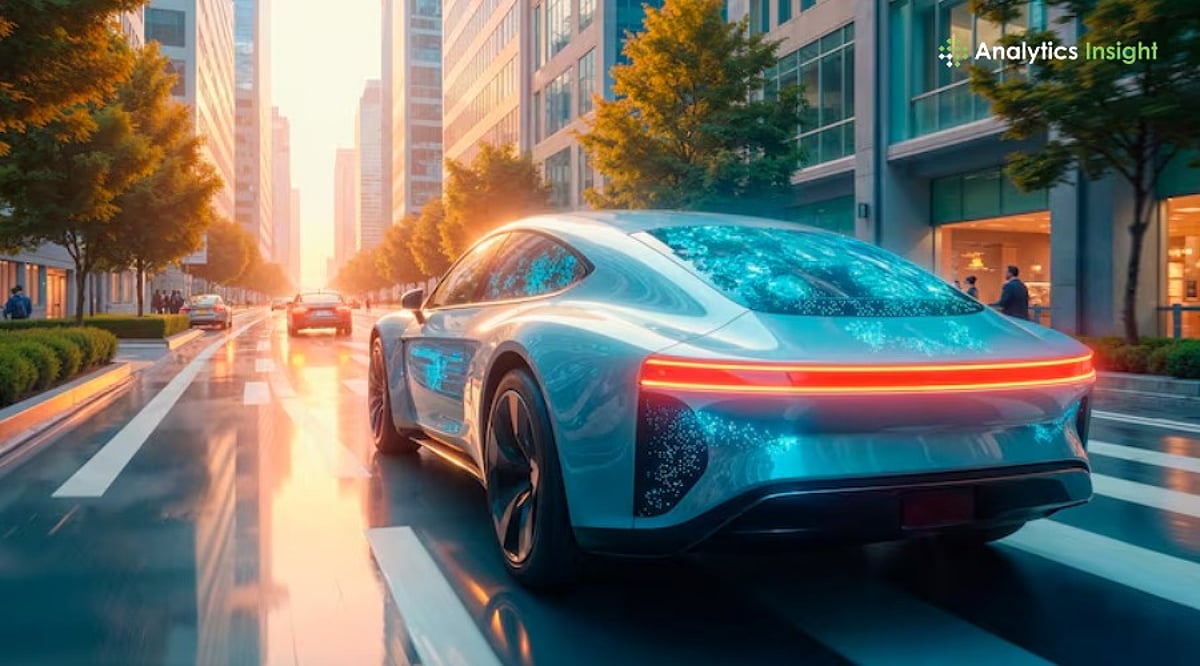
Prophesee and Volkswagen are teaming up to bring neuromorphic computing to autonomous driving, equipping self-driving cars with human-like perception and reaction on the road. Instead of relying solely on traditional cameras and GPUs that process every pixel in every frame, the latest approach uses event-based vision sensors and brain-inspired chips that operate only when something in the scene actually changes.
This shift dramatically reduces data load and power consumption while enabling faster detection of pedestrians, obstacles, and sudden hazards, even in poor lighting or weather conditions. For Volkswagen, such intelligence paves the way to safer, more scalable autonomous vehicles that can think and respond more like human drivers, but with machine-level consistency.
What Neuromorphic Computing Brings to Cars
Neuromorphic computing refers to hardware and algorithms modeled on how the brain works: massively parallel, event-driven, and highly energy-efficient. Instead of processing continuous data streams, neuromorphic chips react to spikes—discrete events such as changes in brightness or motion in a scene. In an autonomous car, that means focusing compute power only on what matters: a child stepping off the curb, a fast-moving motorcycle in the blind spot, or debris on the highway.
Prophesee’s Metavision sensors are built around this principle of event-based vision. Each pixel triggers only when it detects a change, so the sensor outputs a sparse, high-value stream of events instead of dense frames. When such sensors are paired with neuromorphic processors, the perception stack can run faster, with less energy, and lower latency than conventional camera-plus-GPU pipelines. This combination is particularly attractive to automakers like Volkswagen, who need robust, low-power intelligence running directly on the vehicle’s edge hardware, rather than in the cloud.
Why This Matters
Neuromorphic computing matters because it lets self-driving cars react faster and use less energy, focusing only on important changes in the scene. This shift enables safer, more reliable autonomy at scale, especially in complex, unpredictable real-world traffic and weather conditions.
Brain-Inspired Speed Boost for Safer Autonomy
Reaction time is critical for safety; shaving even fractions of a second off perception delays can translate into meters of braking distance saved at highway speeds. In experiments with neuromorphic vision chips, researchers have shown up to a four-fold boost in hazard detection speed compared to conventional computer vision systems, along with significant improvements in accuracy. Since neuromorphic systems process only regions of interest, they can keep up with high-speed motion, cluttered scenes, and low-light conditions better than standard frame-based cameras.
For self-driving stacks, this opens up several practical advantages:
- Lower Latency: Event-driven detection enables near-instant recognition of emerging hazards.
- Energy Efficiency: Chips designed for spiking neural networks and neuromorphic sensing consume far less power, which is crucial for electric vehicles and large fleets.
- Scalability: More sensors and more intelligence can be added to a car without blowing up the thermal or power budget.
Volkswagen and partners see neuromorphic hardware as a way to embed AI directly into the vehicle, bridging the gap between research prototypes and production-grade safety systems.
Future Outlook: Cars That Sense Like Brains, Scale Like Software
Looking ahead, neuromorphic computing is poised to become a strategic layer in the autonomous vehicle ecosystem rather than a niche add-on. As chipmakers and automotive suppliers refine event-based vision sensors and spiking neural hardware, car platforms will evolve to host more adaptive, fleet-aware intelligence that learns from real-world driving while staying within strict power and cost limits.
For collaborations like Prophesee and Volkswagen, the trajectory points toward vehicles that perceive their environment with brain-like efficiency, share insights across fleets, and continuously update their behavior without needing a complete hardware replacement every few years. If this momentum holds, ‘neuromorphic-ready’ may soon be as important a specification for self-driving cars as range or battery capacity—especially in emerging markets where infrastructure is patchy and on-board intelligence is the first and last line of safety.
Leave a Reply