Blog

  • Purple Teaming, Red Teaming, and Penetration Testing: Key Differences Explained

    Purple Teaming, Red Teaming, and Penetration Testing: Key Differences Explained

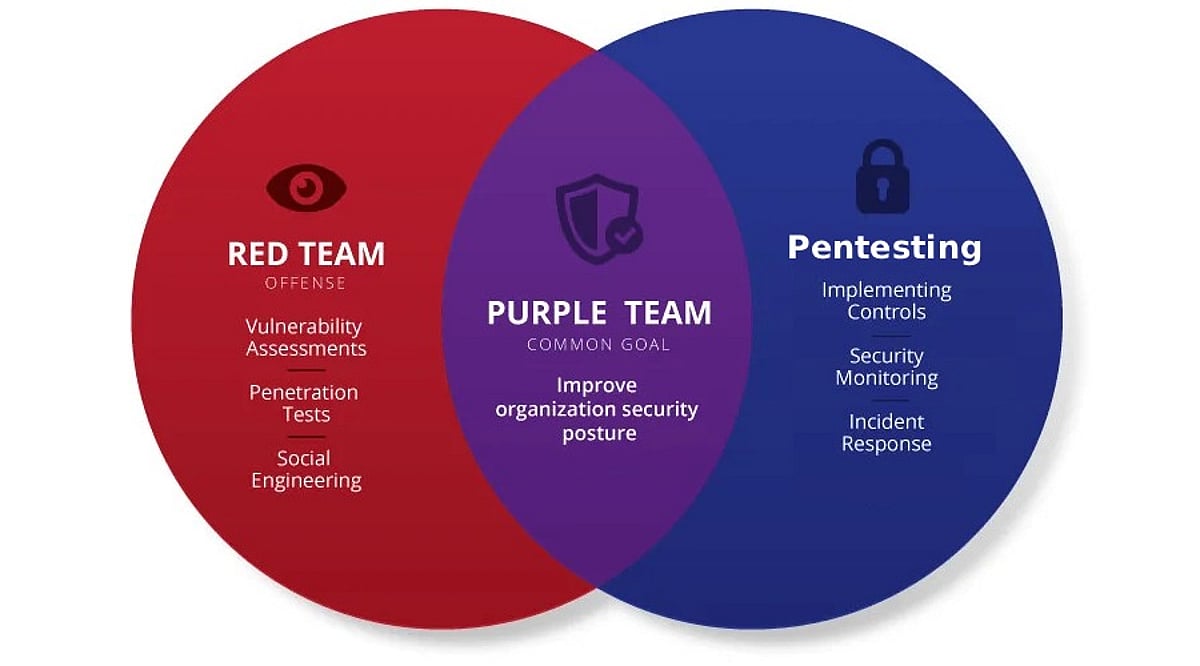
    When a company asks a security firm to “see whether anything can be hacked,” the request sounds straightforward until the first meeting. Suddenly, questions arise: Which systems are most critical? Should testers stay within a fixed scope? Are employees part of the test? Does the organization want a list of flaws, proof that an attacker can reach a sensitive asset, or evidence that the security team can detect the intrusion?

    These are not minor details. They determine whether the engagement becomes a penetration test, a red team operation, or a purple team exercise. While the same technical skills may be used across all three, the outcomes can look very different.

    The Same Exploit Can Mean Three Different Things

    Consider a weak cloud permission that gives one employee account access to files it should not see.

    • Penetration testing: The tester verifies the issue, documents how it can be abused, assesses its impact, and adds it to the report. The finding matters because it exposes a concrete weakness the company can fix.
    • Red teaming: The team uses the same permission quietly and moves on. The permission is just one step toward a larger objective, such as reaching customer records or gaining control of a high-value account.
    • Purple teaming: The exploit may be repeated several times. The attacking side runs it, the defenders check the logs, and both teams examine what was visible. If the activity passed unnoticed, they may add telemetry, change a rule, and run the technique again.

    The vulnerability did not change. The purpose of the exercise did.

    Penetration Testing Produces a Map of Weaknesses

    Penetration testing works best when the scope is concrete. A company might ask for an assessment of a customer portal, internal network, API, or cloud environment. Testers explore that area, look for security failures, and prove which ones can be exploited.

    The report often becomes a working document for developers, system owners, and security staff. It can include authentication flaws, exposed services, unsafe application logic, excessive permissions, or outdated components. A useful finding explains where the issue exists, what access it could provide, and what should change.

    Common findings include:

    • Users accessing records belonging to other accounts
    • Administrative interfaces exposed to the internet
    • Credentials stored in application files or repositories
    • Cloud roles with unnecessary permissions
    • Missing controls around password resets
    • Internal services running vulnerable software

    Penetration testing can be noisy; several attack paths may be explored at once, and testing often stops once exploitation is proved. Production safeguards and time limits also affect how far the work goes.

    A Red Team Does Not Need to Find Everything

    Red teams usually receive an objective rather than a checklist of systems. For example: reach the finance platform, obtain a sensitive document, gain control of an executive account, or enter a restricted network segment without triggering a meaningful response.

    Once the objective is agreed, the team looks for a workable route. One severe software vulnerability might provide that route, but several ordinary mistakes can do the same job. A phishing email leads to a valid account. That account has access to an internal tool. That tool exposes credentials for another service. The second account reaches a system no one expected it to reach.

    This is where discussions of penetration testing vs. red teaming often go wrong. The difference is not that one uses basic techniques and the other uses advanced ones. Both can involve complex technical work. What changes is the reason for using those techniques.

    Even one successful attack path can show that several layers of defense failed at once.

    Quiet Attacks Expose Different Problems

    When a red team compromises one account through a small phishing campaign, uses normal remote tools, moves during business hours, and reaches sensitive data with valid credentials, the incident raises questions that a conventional list of findings may not answer:

    • Why did unusual account activity fail to trigger an investigation?
    • Which logs were missing?
    • Were useful alerts buried among low-value notifications?
    • Could the response team reconstruct what happened?

    Purple Teaming Removes the Need to Pretend

    A covert operation can reveal whether defenders notice an attack on their own. But it is less efficient when the immediate goal is to improve detection. Purple teaming takes away some of the secrecy. Offensive and defensive specialists work through selected attack techniques with visibility into what both sides are doing. The red side may execute credential dumping, suspicious PowerShell activity, cloud privilege abuse, or lateral movement. The blue side watches what appears in endpoint data, identity logs, network traffic, and security alerts.

    Sometimes nothing appears. Sometimes an alert fires but contains too little context to be useful. In other cases, the detection works, yet the response process stalls because ownership is unclear. The teams can make changes while the exercise is still running: a detection rule is adjusted, a missing log source is connected, an investigation guide is rewritten. Then the same action is repeated.

    This repetition would look strange in a covert red team operation. In purple teaming, it is the point.

    These Are Not Levels in a Maturity Ladder

    Security vendors sometimes present the three approaches as a progression: first pentesting, then red teaming, then purple teaming. Real security programs are not that tidy. A mature organization may still need a focused pentest before releasing a new payment feature. A smaller company may benefit from a limited purple team session if it recently deployed new detection tools and wants to check whether they work. A red team operation can be premature when basic security problems remain unresolved.

    Start With the Question

    The choice becomes easier when the organization defines what it wants to know at the end: whether a system contains exploitable flaws, whether an attacker can reach a critical asset, or whether defenders can see and contain the activity. The decision should also account for practical limits. Social engineering may be unacceptable during a sensitive business period. Production systems may require strict safeguards. Internal defenders may need to know that testing is underway, even if the wider company does not. Remediation ownership matters as much as the exercise itself, because an excellent report has little value when no team is responsible for acting on it.

    Penetration testing, red teaming, and purple teaming can overlap during one security program. They do not need to compete for the same budget. One finds weaknesses, another tests an attack path, and the third helps defenders see what their controls currently miss.

  • Bitcoin Holds Above $64,200 as ETF Inflows Counter Coldcard Fears and Legislative Stalemate

    Bitcoin Holds Above $64,200 as ETF Inflows Counter Coldcard Fears and Legislative Stalemate

    Bitcoin traded near $64,236.97 on Tuesday, up 0.48% over the past 24 hours, as fresh institutional inflows offset ongoing security concerns and political uncertainty. The leading cryptocurrency steadied above $64,200 after a choppy start to August, supported by $170.1 million in net inflows into US spot Bitcoin ETFs on Monday.

    Bitcoin Price Today

    Bitcoin trades at $64,236.97, with a market cap of approximately $1.28 trillion and 24-hour trading volume of $23.11 billion. Key support lies near $62,800, while resistance is seen between $64,500 and $65,600, according to analysts.

    Analyst Perspectives

    Mudrex: $65,000 Key for Sentiment Shift

    Akshat Siddhant, Lead Quant Analyst at Mudrex, noted that Bitcoin trades above $64,000 as easing geopolitical tensions lift risk assets. He highlighted that Bitcoin futures open interest slipped to 740,000 BTC from a July peak of 776,000 BTC, a pattern that preceded April’s large short-side liquidation wave. “For now, $65,000 remains major resistance while support holds near $62,800,” he said.

    CoinSwitch: Equities Rally Supports BTC

    CoinSwitch Markets Desk observed that BTC held near $64,000 even as risk assets rallied on US-Iran de-escalation hopes. “Holding above $64,000 keeps the short-term structure positive for a push toward $64,400. A slip below $64,000 opens the next support zone near $63,600,” the desk stated.

    Delta Exchange: Break Above $64,500 Needed

    Riya Sehgal, Research Analyst at Delta Exchange, said Bitcoin reclaimed $64,000 after defending $62,200-$62,400 demand. “Bitcoin needs a sustained break above $64,500 to target $65,000-$65,600. Ethereum must reclaim $1,880 to confirm a broader breakout structure,” she added.

    Giottus: Weak Spot Demand Caps Recovery

    Vikram Subburaj, CEO of Giottus, placed Bitcoin near $64,260, up about 0.7% on the day. He advised investors to favor staggered buying ahead of Friday’s jobs report, noting that Bitcoin holds support near $63,000-$63,400, with resistance between $64,500 and $66,000.

    WazirX: Institutional Absorption Continues

    Nischal Shetty, founder of WazirX, said Bitcoin trades near $64,176 as easing tensions lift appetite. On-chain data shows 155,000 BTC accumulated between $62,000 and $65,000. Wintermute’s H1 2026 report shows institutions now drive 72% of spot volume. “A move above $64,800-$65,000 could trigger fresh long positions. Losing $63,900-$64,000 may raise the odds of a pullback toward $63,200,” he noted.

    Top 10 Coins at a Glance

    • Biggest Gainers: Hyperliquid (HYPE) led with a gain past 3%, followed by BNB (+1.27%) and XRP (+1%).
    • Biggest Losers: Stablecoins (USDT, USDC) and Solana (SOL) remained flat with minimal movement.

    Key Headlines Impacting Prices

    Bitcoin ETFs Return to Inflows With $170.1 Million

    US spot Bitcoin ETFs recorded $170.1 million in net inflows on Monday, ending a brief redemption streak. BlackRock’s IBIT led with $111.4 million, followed by Fidelity’s FBTC at $33.4 million. Ether ETFs slipped into modest net outflows of $11.9 million.

    Coldcard Firmware Flaw Fallout Continues

    A firmware bug in Coldcard hardware wallets has been linked to over $100 million in stolen Bitcoin this month. Emergency fixes have been rolled out, but security researchers warn that updating firmware alone is insufficient. Affected holders must generate fresh recovery phrases and migrate balances immediately.

    CLARITY Act Stuck Without Senate Floor Vote

    The Digital Asset Market Clarity Act remains absent from the Senate’s floor schedule. Senate Majority Leader John Thune indicated a vote could occur before recess, but Republicans need roughly seven Democratic votes to clear the 60-vote threshold. An unresolved ethics dispute over presidential crypto holdings remains a sticking point.

    Cardano Rallies on Heavy Whale Accumulation

    Cardano’s ADA token surged more than 26% this week as whale wallets added over 240 million tokens. Combined whale holdings have climbed to roughly 14.5 billion ADA, according to Santiment. Analysts say holding above $0.17 support keeps the bullish structure intact, with next resistance near $0.20 and then $0.24-$0.25.

    Ether ETFs Slip Into Mild Outflows

    US spot Ether ETFs recorded an $11.9 million net outflow on Monday, ending a two-day inflow streak. BlackRock’s ETHA and Grayscale’s ETHE led the modest redemptions. Analysts view the pullback as routine rotation rather than a shift in institutional demand.

    ISM Manufacturing Data Signals Resilient Economy

    The US ISM Manufacturing PMI climbed in July, pointing to resilient economic activity. Stronger readings reduce near-term expectations of Fed rate cuts. Traders now await Wednesday’s ADP payrolls and services PMI data, with Friday’s jobs report as the week’s most closely watched macro catalyst.

    Investor and Market Outlook

    Bitcoin holds above $64,200 as fresh ETF inflows offset lingering custody worries and legislative delays. A close above $64,500 could open a path toward resistance near $65,600. A slip below $63,900 risks exposing deeper support closer to $62,800. Cardano and Hyperliquid remain the most sensitive names to shifts in institutional risk appetite. Key catalysts this week include ETF flow trends, Fed rate signals, Friday’s jobs report, and the CLARITY Act’s Senate outcome.

  • AI Tech Roundup: AMD’s Disappointing Forecast, NVIDIA’s India Bet, Apple Intelligence, and Crypto Insights

    AI Tech Roundup: AMD’s Disappointing Forecast, NVIDIA’s India Bet, Apple Intelligence, and Crypto Insights

    Welcome to today’s tech roundup, where AI continues to dominate the headlines. From chipmaker earnings and startup funding to smartphone AI features and career trends, here are the top stories shaping the technology world.

    AMD’s AI Forecast Disappoints Despite Strong Quarterly Growth

    AMD posted another strong quarter, driven by surging demand for its AI chips, and expects revenue to reach about $13 billion this quarter. However, the forecast fell short of Wall Street’s lofty expectations, leaving investors underwhelmed and pushing the stock lower after earnings.

    NVIDIA Makes Its First Investment in Indian AI Startup Sarvam AI

    NVIDIA has placed its first bet on an Indian AI startup by investing in Sarvam AI, signaling growing confidence in the country’s AI ecosystem. In another boost for startups, SIDBI has relaxed venture capital funding rules, making it easier for VC firms to raise and deploy capital.

    Fidelity’s 2026 Crypto Outlook: Regulation, Institutional Money, and Stablecoins

    Fidelity says the crypto market is entering a new phase where regulation, institutional investment, and stablecoins could play a bigger role than hype. Its 2026 outlook highlights the key trends and questions investors should watch as digital assets continue to evolve.

    Degrees With the Strongest Job Prospects After Graduation

    Choosing the right degree can make a big difference in the job market. According to Investopedia, business administration, nursing, computer science, and accounting are among the bachelor’s programs expected to deliver the strongest employment opportunities and long-term career growth over the coming years.

    A Beginner’s Guide to Apple’s Built-in AI Tools

    Apple Intelligence brings AI directly into the iPhone experience, helping users write, edit photos, create images, and interact with a smarter Siri. The system combines on-device processing with cloud computing to deliver AI features while placing a strong emphasis on protecting user privacy.

    That wraps up today’s tech news. From AI chips and startup funding to crypto trends and career choices, artificial intelligence is quietly reshaping how we work, invest, and use our devices every day.

  • Factorio: The Ultimate Factory-Building and Automation Simulation Game – Features, Strengths, and Review

    Factorio: The Ultimate Factory-Building and Automation Simulation Game – Features, Strengths, and Review

    Factorio is a factory-building and automation simulation game developed by Wube Software. Players take on the role of a crash-landed engineer who must gather resources, automate production lines, research advanced technologies, and defend factories from hostile alien creatures. With deep logistics systems, extensive customization, and multiplayer support, Factorio delivers one of the most rewarding automation experiences available.

    General Information

    • Launch Date: 2020
    • Platform: Nintendo Switch, macOS, Linux, Nintendo Switch 2, Microsoft Windows, GeForce Now, Mac operating systems
    • Genre: Indie game, Real-time strategy game, Action game, Casual game
    • Target Audience: Automation Game Enthusiasts, Factory Building Fans, Strategy Gamers, Simulation Game Players, Resource Management Enthusiasts
    • Download: Click Here

    Key Features of Factorio

    Let’s take a look at some Factorio Features:

    • Construct sophisticated factories by utilizing conveyor belts, inserter belts, pipes, and manufacturing machines.
    • Undertake extensive research on many technologies in order to have access to sophisticated machines, transportation and robotics.
    • Implement effective logistics management systems by using trains, drones, and automated supply chains.
    • Explore procedurally generated worlds rich in resources and full of alien enemies.
    • Customize a game experience by incorporating multiplayer features, map settings and many user-made mods.

    Strengths of Factorio

    Here are some key Factorio Strengths:

    • Deep automation mechanics generate a highly enjoyable gameplay experience with respect to building factories.
    • Flexibility of the production system promotes creativity and problem-solving.
    • A large technology tree offers long-term progression opportunities.
    • Good modding capabilities significantly increase replay value.
    • Easy optimization lets one build large factories and enjoy their good performance.

    Challenges of Factorio

    Let’s take a look at the limitations of Factorio:

    • The learning curve may seem very steep for beginners.
    • Coordination of the production chain is quite complex and requires good planning.
    • There are many short keys on the user interface that have to be learned.
    • Progression may seem to be very slow until the player gets more advanced.
    • The big factory may become hard to manage without proper planning.

    Conclusion

    Factorio is among the best games available for building factories and automating tasks due to its sophisticated production system, progressive development process, and endless scope of optimizations. Despite the fact that the game can be rather difficult for beginners, the feeling of achievement from running an efficient industrial empire and constructing huge automated factories is immense.

  • India Parliamentary Panel Puts Meta on Notice Over PM Modi Video Removal, Threatens Safe Harbour Repeal

    India Parliamentary Panel Puts Meta on Notice Over PM Modi Video Removal, Threatens Safe Harbour Repeal

    Meta is facing mounting pressure in India after a video featuring Prime Minister Narendra Modi was temporarily removed from one of its platforms. The video showed the Prime Minister assuring students that strict action would be taken against those responsible for a paper leak incident. Following the brief takedown, a parliamentary panel has demanded an apology from Meta, warning that the company could lose its safe harbour protections if it fails to comply.

    The Parliamentary Committee on Communications and Information Technology issued a three-day ultimatum to Meta CEO Mark Zuckerberg, insisting on an apology to Prime Minister Modi. BJP MP Nishikant Dubey, who chairs the panel, called the removal an “attack on democracy.” The safe harbour clause currently prevents the Indian government from filing First Information Reports (FIRs) directly against social media platform officials. Removing that clause would allow the government to take legal action.

    Meta had previously apologized for what it described as a technical glitch that caused the video to be removed. However, India’s Ministry of Information and Technology found that explanation insufficient and unconvincing.

    CSAM Scrutiny Intensifies

    The video removal is not the only regulatory challenge Meta faces in India. Last month, the company came under scrutiny over child sexual abuse material (CSAM) on its platforms. Reports indicated that such content was appearing in paid advertisements on Instagram, prompting the government to send Meta a formal notice.

    According to data from the National Crime Records Bureau, 1,238 cybercrime cases were registered against children in 2024. Of those, 1,099 involved the publication or transmission of sexually explicit material involving minors. Nishikant Dubey warned social media platforms, stating: “Pornographic content cannot be allowed in India. Child sexual abuse material is a heinous crime. AI-generated fake videos of women or obscene depiction of women are also heinous crimes.” He added that this issue “is above political parties, religion, and caste because this country is extremely sensitive when it comes to children and women.”

    The Indian government has warned social media platforms to either comply with CSAM rules or face legal action.

  • Cloudflare Unveils Wallets and Digital IDs for AI Agents to Enable Secure Autonomous Commerce

    Cloudflare Unveils Wallets and Digital IDs for AI Agents to Enable Secure Autonomous Commerce

    Cloudflare, Inc. (NYSE: NET), the leading connectivity cloud company, today announced Cloudflare Wallets and cloudflare.pay, a new suite of tools designed to give AI agents a stable identity and the ability to make purchases online safely within limits set by their human creators. This marks a significant step toward enabling agentic commerce—where software programs autonomously browse, query APIs, and transact on behalf of individuals and businesses.

    As AI agents become a normal part of doing business online, the Internet—built for humans—lacks reliable mechanisms to verify whether an agent is a legitimate assistant or a malicious actor. Traditional bot detection tools, designed for search crawlers, are inadequate for agents that conduct transactions. Cloudflare’s solution addresses this by providing a verifiable link between each agent and its human or organizational owner, establishing trust and accountability at every step.

    “The Internet is shifting from human-driven browsing to agent-driven commerce, and the infrastructure needs to keep up,” said Matthew Prince, co-founder and CEO of Cloudflare. “When an agent shows up at your door, you need to know who sent it. Cloudflare can give agents a face—a link to the human or organization that owns them—so that trust, accountability, and real commerce can follow. It’s the identity and payment infrastructure the agentic web needs to function.”

    Cloudflare Wallets and cloudflare.pay work together to solve the identity and payment challenge. Each Cloudflare account will receive a unique web address serving as a stable ID, which users can extend to specific agents. This allows any receiving business to see exactly who authorized the agent. Additionally, a Cloudflare “Account Wallet” acts as a central balance for receiving, holding, and managing stablecoins. Users can then assign “Virtual Wallets” to individual agents, each with built-in guardrails such as spending caps, approved merchant lists, and maximum transaction sizes. Combined with the Monetization Gateway, these tools complete the two-sided agentic payment market.

    Cloudflare Wallet handle reservation opens today. Full wallet access, including onramping and offramping funds and the ability to issue Virtual Wallets, will be available in the coming months. Users can claim a handle at cloudflare.pay and learn more on the Cloudflare blog.

  • Free Fire MAX Redeem Codes August 5, 2026: Unlock Exclusive Bundles, Skins, and More

    Free Fire MAX Redeem Codes August 5, 2026: Unlock Exclusive Bundles, Skins, and More

    Latest redeem codes in Garena Free Fire MAX unlock free skins, bundles, and Diamond vouchers. These codes offer players a quick way to enhance customization without spending real money.

    Active Free Fire MAX codes are valid for 24 hours. So, codes should be redeemed as soon as possible to get rewards. Each code can be redeemed only once per account. Players can get the same reward twice by redeeming the same code.

    Garena Free Fire MAX Redeem Codes for August 5, 2026

    If you are looking for Free Fire redeem codes on August 5, below are the codes you shouldn’t miss:

    • FFSKTXVQF2NR
    • FFL2M8PKR9VN
    • FFZ2M7KPL5RVE9QH6K4LNP7V
    • FF8HG3JK5L0P
    • FFV4K8PLM3RN
    • F7F9A3B2K6G8
    • FQ9W2E1R7T5Y
    • FFV2K8PLM4RN
    • FF2VC3DENRF5T6Y4U1I5O7PZ
    • FF6YH3BFD7VT
    • FF7TRD2SQA9F
    • BR43FMAPYEZZ
    • UPQ7X5NMJ64VXZDJZE25WEFJ
    • XZDJZE25WEFJ
    • FFRSX4CYHLLQ4N8M2XL9R1G3S9QK2L6VP3MRB1RK7C5ZL8YT
    • FFR4G3HM5YJN

    The rewards these codes will bring generally include the following: Gold, Diamond Vouchers, Weapons Skins, Character Skins, and Playable Characters.

    How to Redeem the Codes in Garena Free Fire Max?

    Free Fire MAX codes expire after a specific period. Therefore, players who are willing to redeem all the codes today should do so promptly. Follow the quick steps:

    1. Visit the official Rewards Redemption website of the game.
    2. Log in with your Gmail, Facebook, Twitter (currently X), or VK ID.
    3. Follow the instructions and copy-paste the code in the designated box.
    4. Click the Confirm button, then press OK.
    5. Once redeemed, wait for the next 24 hours to get the associated rewards credited to the player’s in-game mailbox.

    How to Get Extra Diamonds in Free Fire MAX?

    Diamonds are one of the most expensive in-game items, but there’s no way to avoid them altogether. Therefore, below are the ways to grab Diamonds faster:

    • These premium currencies are awarded for completing missions. Check out the rewards before starting a mission to ensure diamonds upon completion.
    • Redeeming codes also gives gamers Diamonds. However, the amount is not satisfactory.
    • Participate in in-game events and tournaments to earn a bunch of Diamonds. Here, the performance and rank of players decide whether they will get Diamonds or not.
    • Finally, the most expensive yet easiest way is to purchase these in-game currencies from the in-game store with real money.

    Finally, start grinding the game regularly. In Free Fire MAX, completing missions typically rewards players with a substantial amount of Diamonds. To accumulate a hefty amount of Diamonds, players should focus on participating in daily challenges and completing them to claim their rewards.

    Final Thoughts

    Free Fire MAX redeem codes are among the finest rewards that Garena offers to active players. Those who play regularly or keep track of the game can redeem these codes faster than others. Players enjoy grinding the game, but what they want more is to obtain in-game items with minimal effort. This customization option is what attracts the daily audience. The strategy has consistently delivered for both Garena and its players since the game’s release.

  • Samsung Galaxy S27 Ultra Leaks: Redesign, Snapdragon 8 Elite Gen 6 Pro, 5,700mAh Battery, and More

    Samsung Galaxy S27 Ultra Leaks: Redesign, Snapdragon 8 Elite Gen 6 Pro, 5,700mAh Battery, and More

    Samsung has already started early work on the Galaxy S27 Ultra, even though the official launch remains several months away. The company typically unveils its Galaxy S series in January or February, and current reports point to the same schedule for early 2027. Industry sources have shared several details about the upcoming flagship, giving a clear picture of Samsung’s plans. Most leaks suggest the Galaxy S27 Ultra could bring one of the biggest upgrades in recent Galaxy history, though Samsung has not confirmed any features at this stage.

    Fresh Design Could Change the Look

    Samsung may finally move away from the familiar Ultra design. Recent leaks suggest the company plans a new rear camera layout instead of the separate camera rings that appeared on recent Galaxy Ultra models. A single camera island could replace the current setup, giving the phone a cleaner appearance. Reports also mention a flat titanium frame, thinner display borders, an IP68 rating, and a built-in S Pen. These changes could help the Galaxy S27 Ultra stand apart from earlier models while maintaining the premium feel Galaxy Ultra phones already offer.

    Large Display Stays at the Center

    Samsung is likely to continue using its 6.9-inch AMOLED display with QHD+ resolution and a 120Hz adaptive refresh rate. Rumors suggest even better peak brightness compared to the Galaxy S26 Ultra. Another intriguing report mentions a brand new ‘Privacy Display’ feature. According to preliminary reports, this technology may make the screen less visible from the sides while remaining bright and clear for the person holding the phone. Samsung has not given any official information about this feature, so its actual nature remains vague.

    Powerful Chip Promises Better Performance

    Most reports agree that Samsung plans to use the Snapdragon 8 Elite Gen 6 Pro processor inside the Galaxy S27 Ultra. The new chip could arrive with a 2nm manufacturing process, delivering faster performance along with better power efficiency. Leaks also mention a stronger neural processor for Galaxy AI features, smoother gaming, and improved heat control during heavy workloads. These upgrades could help the Galaxy S27 Ultra deliver faster speed across everyday tasks as well as demanding applications.

    Memory Rumors Create Some Questions

    Early reports claimed Samsung would introduce LPDDR6 RAM and UFS 5.0 storage with the Galaxy S27 Ultra. New leaks now paint a different picture. Several industry insiders believe Samsung may continue with LPDDR5X memory and UFS 4.0 storage instead. Rising component costs appear to play a major role in this decision. Samsung has not confirmed either option, so the final hardware remains uncertain until the official announcement. Storage options could include 256GB, 512GB, and 1TB, while RAM may start at 12GB with a possible 16GB version for higher-end models.

    Camera System Could Receive Major Changes

    The camera system remains one of the most debated aspects of the Galaxy S27 Ultra. Latest rumors indicate a new 200MP main camera with a larger sensor, quicker autofocus, better HDR capabilities, and improved low-light photography. The rumors also suggest a 50MP ultra-wide camera and state-of-the-art telephoto cameras. However, recent news hints that Samsung may cut down the rear cameras from four to three by removing one of the telephoto cameras. Contradictory reports continue, so the final camera configuration remains unclear. The front camera might feature a 16MP sensor with optical image stabilization for better selfies and video calls.

    Bigger Battery May Improve Daily Use

    The Galaxy S27 Ultra may feature improved battery performance. According to recent leaks, Samsung could replace the current lithium-ion battery with a 5,700mAh silicon-carbon battery. This technology allows for higher energy density, potentially improving battery life without increasing the phone’s size. Past rumors indicated a battery capacity of about 5,500mAh, so the real number needs verification. Charging speed may increase to 65W wired, while maintaining 15W wireless charging and reverse wireless charging capabilities.

    Galaxy AI Could Become Smarter

    Samsung continues to place strong focus on artificial intelligence across its flagship devices. The Galaxy S27 Ultra may arrive with expanded Galaxy AI features that handle more tasks directly on the device. Leaks mention smarter photo editing tools, improved live language translation, stronger voice assistant functions, better video editing support, and enhanced writing features. The new Snapdragon processor could also help these AI tools deliver quicker responses while keeping personal data on the device whenever possible.

    Early Picture Looks Promising

    Recent leaks suggest the Galaxy S27 Ultra will represent significant changes. We could expect a completely redesigned look, a bigger silicon-carbon battery, a speedier Snapdragon processor, improved camera hardware, and better Galaxy AI capabilities. Together, these could make this phone one of Samsung’s greatest releases in years. However, some important aspects remain unknown or unclear, such as memory technology, storage standards, battery power, and camera assembly. The complete picture will become clear when Samsung officially unveils the device in early 2027.

  • OpenAI API Beginner’s Guide: How It Works, Pricing, and How to Get Started

    OpenAI API Beginner’s Guide: How It Works, Pricing, and How to Get Started

    What Is the OpenAI API?

    Artificial Intelligence is no longer confined to research labs or tech giants. Today, AI powers chatbots, virtual assistants, coding tools, search engines, and daily business workflows across industries. The OpenAI API is one of the easiest ways to integrate these capabilities into your own applications.

    An API (Application Programming Interface) is a set of rules that allows two software programs to communicate. Think of it as a waiter: you place an order, the waiter takes it to the kitchen, and returns your meal. Similarly, your application sends a request to the OpenAI API, which passes it to OpenAI’s AI models, and those models send back a response — all in seconds.

    How Does the OpenAI API Work?

    The process is straightforward and consists of four steps:

    • Your application sends a request to OpenAI’s servers using an API key.
    • The request includes the AI model you want to use and the prompt you want it to answer.
    • OpenAI processes the request on its cloud infrastructure.
    • The API returns a response, usually in JSON format, which your application displays to users.

    Everything runs in the cloud, so developers only need an internet connection and an API key to start building AI applications. OpenAI now recommends its new Responses API (launched in 2025), which adds web search, file search, image generation, code execution, and AI agent capabilities.

    Pricing: Pay-As-You-Go Token Model

    Unlike traditional software subscriptions, the OpenAI API uses a pay-as-you-go model. You are charged based on the number of tokens processed — both your prompt (input) and the AI’s answer (output).

    Token basics:

    • 1 token ≈ 4 characters
    • 100 tokens ≈ 75 words
    • Different models have different token costs

    Beginners should start with smaller, faster models for simple tasks like summarization or classification. Larger reasoning models are designed for coding, mathematics, and complex problem-solving.

    Best Practices for Beginners

    • Keep your API key secure – never hardcode it; use environment variables.
    • Start with cheaper models – test and refine before upgrading to more expensive ones.
    • Monitor token usage – set limits to avoid unexpected charges.
    • Handle errors gracefully – manage rate limits, invalid requests, and other API errors.
    • Write clear prompts – specific prompts yield better AI responses.

    Why Learn the OpenAI API?

    The OpenAI API has become one of the most popular AI development platforms. Concepts like prompt tokens, conversation history streaming, and tool calling are shared across top AI providers (Anthropic, Google). Whether you are a student building your first AI project, a startup adding a chatbot, or a business streamlining customer support, mastering the OpenAI API gives you a strong foundation. As AI agents and multimodal models evolve, this skill will remain in high demand.

    Frequently Asked Questions

    1. What is the OpenAI API?

    The OpenAI API is a cloud-based service that lets developers integrate OpenAI’s AI models into their own applications. It can generate text, analyze images, process audio, write code, and more through simple API requests.

    2. Do I need to know AI or machine learning to use it?

    No. You don’t need deep ML knowledge. Basic programming skills and an understanding of API requests are enough to start building AI-powered applications.

    3. How is the API priced?

    It follows a pay-as-you-go model based on the number of input and output tokens processed by the selected model. Different models have different pricing tiers.

    4. What can I build with the OpenAI API?

    You can build chatbots, virtual assistants, content generators, coding assistants, document summarizers, translation tools, AI search engines, customer support systems, voice applications, and AI agents that interact with external tools.

    5. Which API should beginners use?

    OpenAI recommends the Responses API for new projects, as it supports web search, file search, tool calling, image generation, and AI agents. The older Chat Completions API remains fully supported for existing applications.

  • iPhone Battery Replacement Guide: Costs, Warning Signs, and When to Replace

    iPhone Battery Replacement Guide: Costs, Warning Signs, and When to Replace

    An iPhone battery naturally loses strength over time. Every full charge cycle reduces a small part of its original capacity. Apple designs many iPhone batteries to retain up to 80% of their original capacity after a certain number of charge cycles, with newer models offering improved cycle durability.

    Many people assume a slow phone always needs an upgrade. In reality, a fresh battery often restores better speed and longer battery life. A battery replacement costs much less than a new iPhone, making it a practical solution for most users.

    How Much Does iPhone Battery Replacement Cost?

    Battery replacement charges depend on the iPhone model. Apple and Apple Authorized Service Providers offer genuine battery replacements with compatible parts and proper testing.

    Current battery replacement prices in India start at around Rs. 5,900 for models such as the iPhone SE (3rd generation), iPhone 11, iPhone 12, and iPhone 13 series. The iPhone 14, iPhone 15, and iPhone 16 series usually cost around Rs. 8,500 for battery service. Taxes or additional service charges may apply at some service centers.

    A genuine Apple battery supports accurate battery health reports, reliable performance, and safety standards. It also works smoothly with iOS features that monitor battery condition over time.

    The Best Time for a Battery Replacement

    Apple regards 80% of maximum battery capacity as an important threshold for battery service. Many users notice a decrease in battery performance when the battery health drops below this level. The device may need extra charging several times throughout the day, and overall performance may slow down.

    In the Battery Health settings menu, you can find the maximum capacity figure. This section also shows an alert message if battery service is needed. Replacing the battery in due time extends the phone’s service life and avoids unnecessary expenses for a new device.

    Clear Signs That Show the Battery Needs Replacement

    A defective battery usually shows several detectable symptoms in everyday use:

    • Frequent power drops even after charging to 100%.
    • Simple tasks like calls, web browsing, or social media drain the battery before sunset.
    • Sudden shutdowns despite having a decent charge left.
    • Heavy usage like gaming, photography, or video editing drains the battery too fast, sometimes causing repeated restarts.
    • Slower app performance and delayed camera response.

    Apple includes power management systems to cope when the battery cannot deliver enough energy for the phone.

    A Swollen Battery Needs Immediate Attention

    A swollen battery requires immediate service. It can push the display upward or create a gap between the screen and the frame. The phone may rock on a flat surface instead of sitting evenly. A swollen lithium-ion battery creates a safety risk and can damage internal parts. Professional service is the safest option.

    How Long Does an iPhone Battery Last?

    Battery life depends on charging habits, daily use, screen time, and overall device care:

    • Light use: 4–5 years
    • Average use: 3–4 years
    • Heavy daily use: 2–3 years

    Modern iPhones include battery management features that protect long-term health. Even so, every rechargeable battery slowly loses capacity over time.

    Replace the Battery or Buy a New Phone?

    A battery replacement is advantageous when the phone still offers good camera quality, sufficient storage, and works well for daily tasks. Replacing the battery extends battery life and restores normal function without the cost of a new device.

    Apple recommends battery replacement when health drops below 80%. Buying a new phone makes more sense if the device has outdated hardware, limited storage, or no longer receives software updates.

    Why This Matters

    A healthy iPhone battery keeps the device reliable every day. Strong battery health supports longer use, stable performance, and fewer charging breaks. Early battery replacement saves money, extends the phone’s life, and reduces the need for an expensive upgrade before it becomes necessary.

    Final Thoughts

    An iPhone is powered by a healthy battery. If maximum capacity falls below 80%, battery service should be considered. The average lifespan of the battery is roughly 500 complete charge cycles. Battery replacement prices in India range from Rs. 5,900 to Rs. 8,500 depending on the model. Timely servicing ensures continuous and safe performance.

    FAQs

    How do I check my iPhone battery health?

    Go to Settings > Battery > Battery Health & Charging to view the Maximum Capacity and any service recommendations.

    How much does iPhone battery replacement cost in India?

    Battery replacement generally costs Rs. 5,900 for older supported models and around Rs. 8,500 for newer models like the iPhone 14, 15, and 16 series.

    When should I replace my iPhone battery?

    Apple recommends considering battery service when the maximum capacity falls below 80% or if you experience rapid battery drain, unexpected shutdowns, or performance issues.

    How long does an iPhone battery typically last?

    Most iPhone batteries retain around 80% of their original capacity after approximately 500 complete charge cycles, which usually equals 2–5 years depending on usage.

    Is it better to replace the battery or buy a new iPhone?

    If your iPhone still performs well and receives iOS updates, replacing the battery is usually the more affordable option. Consider upgrading only if the device no longer meets your performance, software, or storage needs.