
Tag: AI

  • 2026 AI Image Generation APIs: A Comprehensive Comparison of Free and Paid Options for Developers

    2026 AI Image Generation APIs: A Comprehensive Comparison of Free and Paid Options for Developers

    Introduction

    Every major AI lab now offers its own image generation API, each with distinct models, pricing, prompt conventions, and licensing terms. For developers and teams evaluating which API to integrate, the decision goes beyond which model produces the best output. It involves weighing cost at scale, flexibility to switch providers, and the need for multiple models. This guide breaks down the leading AI image generation APIs available in 2026—from OpenAI and Google to open-weights options and free tiers—across the key factors: model quality, cost, commercial rights, and vendor lock-in.

    How to Choose an AI Image Generation API

    Choosing the right API requires considering several interacting factors:

    • Model quality and prompt adherence: Different models handle prompts differently—some produce photorealistic images, others stylized illustrations. Fine detail rendering (faces, typography, hands) varies significantly.
    • Latency and async capabilities: Some APIs return images synchronously in under two seconds; others use async job queues with webhooks, better for throughput but less interactive.
    • Pricing structure: Billing units vary—tokens (OpenAI), per-image (Google), credits (Stability AI)—making cost comparisons complex.
    • Commercial rights and licensing: Ensure generated images are usable commercially, especially for products. Enterprise indemnification is increasingly a deciding factor.
    • Vendor lock-in: Different prompt conventions and response formats make switching costly. Unified APIs reduce this risk.

    OpenAI Image Generation API (gpt-image-1)

    OpenAI’s latest flagship, gpt-image-2 (launched April 2026), offers multi-turn image generation for iterative refinement. The API uses token-based billing: text input ~$5/1M tokens, image output ~$30/1M tokens. A single 1024×1024 image costs roughly $0.034 at medium quality. Returns images as base64 or URLs, supports PNG/JPEG, up to 10 images per call. C2PA provenance metadata is embedded. Commercial rights are granted, and OpenAI does not train on user input by default. Best for teams already in the OpenAI ecosystem who need editing functionality and can handle token billing complexity.

    Google Gemini / Imagen API (“Nano Banana”)

    Google’s Imagen family (Imagen 3 and 4) offers simple per-image pricing via Vertex AI: Imagen 4 Ultra ~$0.06/image, Standard ~$0.04, Fast ~$0.02. Upscaling is $0.003 per image. This makes cost forecasting easy. Quality is competitive with OpenAI’s best, and enterprise features include SLAs, data locality, and Cloud IAM integration. The three-tier system (Fast/Standard/Ultra) balances cost and quality. No persistent free tier. Best for enterprise teams on Google Cloud who want predictable pricing and robust infrastructure.

    xAI Grok Image Generation API

    xAI’s Grok Imagine offers low-cost image generation: standard 1024×1024 ~$0.02 per image, quality variants up to $0.07. Unique for bundling image and video generation in one API. Combined media generation is a differentiator, but free tier credits were discontinued. Stricter content moderation applies. Best for projects needing both image and video at low per-unit cost, especially with xAI reasoning models.

    FLUX API

    FLUX by Black Forest Labs emphasizes high aesthetic quality and strong prompt adherence, especially for artistic output. Available through providers like Replicate, fal.ai, Freepik, and unified APIs. Pricing ranges $0.01–$0.05 per image. FLUX Pro is commercially licensable through providers; Dev variant has restrictions. Best for developers prioritizing artistic quality and stylistic control.

    Leonardo AI API

    Leonardo.AI combines a visual design UI with API access. Subscription plans start at $12/month (Essential) with token-based usage. Supports multiple models including custom fine-tunes and third-party models. “Unlimited” applies only to first-party models. Ideal for teams needing design tools with API integration and broad model selection.

    Stability AI API

    Stability AI offers both hosted API and open-weights models (Stable Diffusion 3.5 family). Credit-based pricing: SD3.5 Large ~$0.007/image, SD3.5 Large Turbo ~$0.005/image. Upscaling and editing add costs. New accounts get 25 free credits. The open-weights approach allows self-hosting at scale, eliminating per-image costs. Community License covers organizations under $1M revenue. Best for developers familiar with Stable Diffusion who want flexibility to self-host or need comprehensive editing pipelines.

    Kling and Video-Capable APIs

    Kling by Kuaishou excels at image-to-video animation, valuable for marketing and social media. Video generation remains expensive – a 5-second 1080p clip can cost $1.25. Other providers like xAI and Leonardo also offer video capabilities. Best for projects requiring dynamic content from static images.

    Low-Cost and Free Options (Prodia, Pollinations, Freepik)

    For experimentation and prototyping, consider:

    • Freepik: Unified access to multiple models (Flux, GPT) with subscription tiers starting at ~$5.75/month. Includes legal indemnification for commercial use on enterprise plans. Combines stock imagery with AI generation.
    • Pollinations.ai: Community models for image, text, video, and audio. Free-tier quotas unclear. Best for experimentation.
    • Prodia: Decentralized approach with open-source models. Pricing less documented.

    These have limitations: lower resolution, less consistency, reduced priority, tighter rate limits.

    Unified APIs: One Endpoint for Many Models

    Most production applications eventually need multiple models. Unified APIs like Apiframe provide a single integration point across providers, reducing vendor lock-in and simplifying maintenance. They offer access to models such as Midjourney (which lacks an official public API), FLUX, Stable Diffusion, and others through one endpoint. This is especially valuable for teams that want to switch models without rewriting integration code.

    Conclusion

    There is no single best AI image generation API. OpenAI and Google lead on raw quality; Stability AI offers flexibility through open weights; xAI provides low-cost combined image/video; unified platforms maximize reach. Evaluate your priorities—cost, quality, commercial rights, and flexibility—to choose the right combination for your project.
  • The Quiet Revolution: How AI Is Reshaping Mobile App Development in 2026

    The Quiet Revolution: How AI Is Reshaping Mobile App Development in 2026

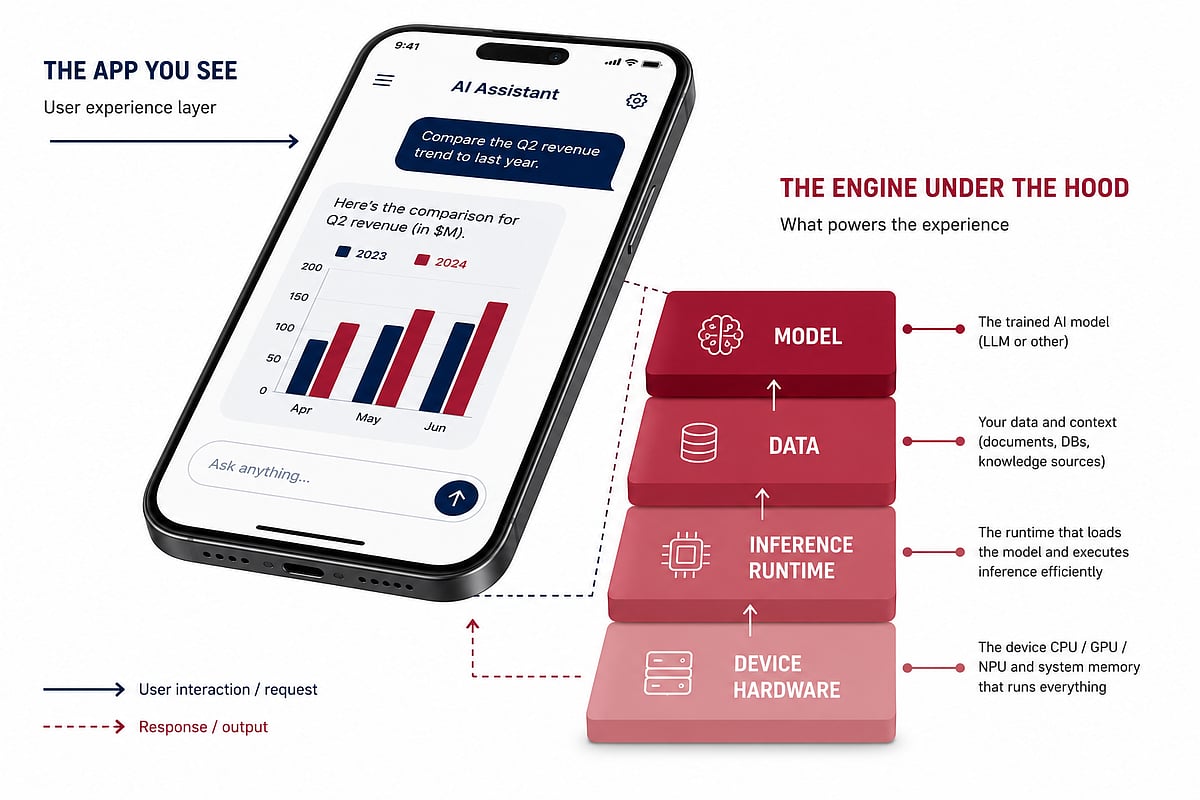
    A year ago, adding AI to a mobile app meant bolting on a chat widget and calling it a feature. That era is over. In 2026, AI has moved from a visible add-on to an infrastructure decision, fundamentally changing what “building an app” means for development teams.

    The shift is evident in usage data. According to Sensor Tower’s year-end report, the total U.S. audience for AI assistants surpassed 200 million by the end of 2025, with more than half accessing those assistants exclusively on mobile devices—up from roughly 13 million mobile-only users the year before. This is no longer a niche behavior; it’s the default way most people interact with AI. The app is no longer a wrapper around the model—the app is the product.

    From Cloud Round-Trips to On-Device Inference

    For years, AI features followed a predictable pattern: capture input, send it to a server, wait for a model response, and render the result. That pattern is breaking down—not because cloud models got worse, but because users now expect AI features to behave like native app features: instant, available offline, and private by default.

    Apple’s Neural Engine, Google’s Tensor chips, and Qualcomm’s on-device AI silicon have matured to the point where running a capable model locally is a realistic option for consumer apps. This changes the engineering conversation from “which API do we call” to “which parts of this feature can run on the device, and which parts genuinely need the cloud.” Getting that split wrong is expensive in ways that don’t surface until the app is already in users’ hands.

    The Unglamorous Engineering Problem Nobody Mentions

    On-device AI is a battery, memory, and fallback-path problem before it’s a model problem. A locally running model that drains a phone’s battery in an afternoon or locks up the UI thread during inference will get uninstalled regardless of output quality. The model is the easy part. The packaging, memory management, graceful fallback for devices without the necessary hardware, and testing across dozens of device and OS combinations are where most AI feature timelines go sideways.

    This pushes product teams toward dedicated mobile app development partners rather than retrofitting AI onto an existing roadmap. Teams that get this right treat AI features as an architecture decision made early, not a plugin added late. Retrofitting almost always costs more because the data flow, caching layer, and offline state all have to be rethought rather than extended.

    Why iOS Has Become Its Own Specialized Lane

    The platform split has also sharpened. Apple’s approach to on-device intelligence—from Apple Intelligence’s privacy-first design to the App Intents framework—is deliberately different from Android’s. A model and pipeline built for one platform’s AI stack rarely transfers cleanly without real rework.

    This has pushed specialized iOS development expertise higher on the priority list for any team shipping AI features on Apple’s platform. Knowing how to call a model API is no longer enough. Teams need to understand Apple’s specific constraints around on-device processing, App Store disclosure requirements for AI-generated content, and the Neural Engine’s actual performance ceiling on the device generations their user base is running. Get that platform-specific layer wrong, and a feature that demoed perfectly in a controlled environment becomes sluggish or inconsistent in the real world.

    What This Means for Decision-Makers

    For product and engineering leaders deciding how to staff an AI-feature build, a few questions separate a smooth rollout from a six-month detour:

    • Does the team have hands-on experience with on-device inference, not just API integration?
    • Is there a clear, tested fallback path for devices that can’t run the model locally?
    • Has the architecture been designed for AI from the outset, rather than adapted after the fact?
    • Does the team understand the platform-specific rules, especially on iOS, where Apple’s review process and hardware constraints are unusually strict?

    A development partner without direct experience answering these questions will end up learning the hard parts on the client’s budget and timeline—an expensive lesson that is avoidable with the right questions asked before a single line of code is written.

    The Bigger Shift

    What’s happening in mobile development right now isn’t really about AI getting smarter. It’s about AI becoming infrastructure—the same way push notifications, offline sync, and biometric auth became infrastructure a decade ago. Once something becomes infrastructure, the teams that win aren’t the ones with the flashiest demo. They’re the ones who treated it as a core architectural decision from day one.

    That’s the quieter story behind every AI feature that feels instant, private, and reliable on a phone in 2026. The visible part is the interface. The real work happened underneath it.

  • BlockDAG AI Launch Drives $500M Valuation Surge, Outpacing Pepe and Chainlink Market Movements

    BlockDAG AI Launch Drives $500M Valuation Surge, Outpacing Pepe and Chainlink Market Movements

    The cryptocurrency market is undergoing a significant realignment as capital shifts from speculative tokens and legacy networks toward next-generation utility projects. While established altcoins face macroeconomic headwinds and meme coins search for support levels, highly anticipated technological upgrades are capturing the attention of savvy investors.

    Investors tracking today’s top crypto gainers are closely monitoring three distinct movements: short-term recovery setups in speculative assets, steady institutional adoption of decentralized data infrastructure, and massive capital inflows into cutting-edge artificial intelligence ecosystems. Amid these shifts, BlockDAG (BDAG) has stolen the spotlight, validating a $500 million jump in valuation following the live deployment of its native AI capabilities.

    Pepe Price Prediction: Can the Meme Coin Spark a Rally?

    The meme coin market is catching its breath, leaving investors wondering what’s next for PEPE. While the token currently faces bearish pressure around the $0.00000235 mark, a closer look at the daily chart reveals an intriguing bullish setup. Meme coins are notoriously volatile, especially during broader market uncertainty, as they search for a solid support level to anchor a recovery.

    However, hope is far from lost. Technical indicators on the 4-hour chart show buyers fighting back. With the Balance of Power (BoP) sitting comfortably in positive territory and the MACD forming green candles, short-term bulls are eyeing a breakout. If the wider market stabilizes, this consolidation could be the springboard for a massive turnaround. For a long-term outlook, check our comprehensive Pepe price prediction spanning 2026 to 2032.

    Chainlink News: Network Adoption Surges as Wallet Growth Accelerates

    The price of LINK may be hovering near recent lows, but behind the scenes, network adoption is hitting overdrive. According to the latest Chainlink news, the network has just crossed a massive milestone, boasting 892,800 non-empty Ethereum wallets. On-chain analytics show a sudden influx of over 8,000 new holders in just five days, putting Chainlink firmly on track to blast past the 900,000-holder mark before the week concludes.

    This dramatic growth phase is fueled by booming institutional interest in real-world asset (RWA) tokenization and cross-border blockchain infrastructure. High-profile initiatives like Project Pangea and DTCC’s collateral projects rely heavily on Chainlink’s foundational oracle data. While price charts often dominate headlines, this aggressive wallet accumulation signals robust network participation, proving that smart money is quietly building a foundation despite temporary market lulls.

    BlockDAG AI Goes Live: $500 Million Valuation Jump & 24 Hours Left for $0.05 Buyback

    The crypto market is witnessing a massive shakeup as BlockDAG cements its position among the top crypto gainers today. The official launch of BlockDAG AI has injected sophisticated artificial intelligence capabilities directly into the network ecosystem, triggering a $500 million leap in project valuation. This technical milestone coincides with an aggressive network upgrade designed to scale throughput to an impressive 7,000 transactions per second (TPS) over the next few days.

    Adding fuel to this momentum is a high-stakes, time-sensitive window for early participants. Only 24 hours remain to secure the exclusive $0.05 buyback offer before it permanently closes. Investors are rushing to lock in BDAG at the current rate of $0.00000044, utilizing the active World Cup Bonus to claim an extra 50% in tokens with instant delivery.

    The excitement surrounding this project extends beyond current AI integration. In just two weeks, the platform plans to roll out its dedicated BlockDAG Futures & Spot Exchange, creating an all-in-one trading hub for its expanding user base. For traders tracking the top crypto gainers today, the combination of advanced AI utility, a major speed upgrade, and immediate exchange liquidity presents a compelling case. As the buyback clock ticks down, the window to maximize token accumulation is rapidly shutting, positioning BlockDAG as a highly watched asset in the current market cycle.

    Closing Insights

    Speculative traders continue to monitor the immediate Pepe price prediction charts, looking for a structural breakout out of accumulation, while long-term strategists look to the steady Chainlink news as a sign of institutional validation. However, BlockDAG offers a unique synthesis of high-speed capability, artificial intelligence integration, and immediate ecosystem liquidity. With its valuation climbing by $500 million and the final 24-hour countdown ticking away for the $0.05 buyback program, BlockDAG is firmly establishing itself among the top crypto gainers today. For market participants looking to maximize their exposure to next-generation layer-1 utility, the window of opportunity is rapidly closing.

    Disclaimer: This article is for informational purposes only and does not constitute investment advice. Cryptocurrency investments are risky. Always do your own research (DYOR) before investing.

  • How Artificial Intelligence Is Revolutionizing Property Sales and Marketing

    How Artificial Intelligence Is Revolutionizing Property Sales and Marketing

    Artificial intelligence is quickly becoming an essential part of everyday life—from drafting emails to buying and selling property. Despite lingering skepticism, AI’s role in decision-making is expanding at a remarkable pace. In the property industry, AI is already transforming how homes are marketed, staged, and sold, making the entire process faster and more immersive.

    AI-Powered Virtual Staging

    One of the most visible innovations is AI-driven virtual staging. Instead of relying on expensive physical staging or imagination, buyers can now see a home’s potential before ever stepping inside. Virtual staging tools can digitally furnish empty rooms, remove outdated decor, or present the same space in multiple design styles—all in minutes. Studies show that staged homes help buyers visualize better, and AI makes this approach both faster and more affordable than ever.

    Detailed Digital Renderings for Developers

    Developers are using AI on a larger scale to create highly detailed renderings of future neighborhoods and housing developments. Potential buyers can explore planned parks, transport links, and community spaces before construction begins. Combined with interactive virtual tours and AI-generated visualizations, this new level of immersion is far more effective than flat architectural plans.

    Speeding Up Sales for Individuals

    AI also accelerates the lengthy buying and selling process. Cash-buying services now use AI to analyze local market trends, estimate property values, and forecast demand. For sellers, AI tools can identify the best time to move, and when paired with a guaranteed cash sale, provide unprecedented flexibility. While some remain skeptical, the competitive edge that AI offers is undeniable—businesses that adopt these tools gain efficiency, better customer experience, and resilience.

    The message across industries is clear: embrace AI or risk falling behind. In property, that means using AI to stage, visualize, and sell faster—giving buyers and sellers alike a smarter, more streamlined experience.

  • How EaseMyTrip’s AI Assistant Is Evolving into a Travel Companion: CEO Rikant Pittie Shares Insights

    How EaseMyTrip’s AI Assistant Is Evolving into a Travel Companion: CEO Rikant Pittie Shares Insights

    Artificial intelligence is reshaping how travelers discover destinations, book trips, and seek customer support. As conversational AI becomes more intuitive, consumers are moving away from keyword-based searches and traditional support channels, expecting faster, more contextual, and personalized assistance throughout their travel journey.

    EaseMyTrip has witnessed this shift firsthand through its AI-powered assistant, EVA, which has handled over 2.5 million interactions across WhatsApp and the company’s web chatbot. The growing adoption highlights increasing consumer trust in AI for everything from travel discovery and bookings to itinerary changes and post-booking support.

    Rikant Pittie, CEO and Co-Founder of EaseMyTrip, believes the next phase of AI will move beyond answering questions to becoming an intelligent travel companion that understands user preferences, intent, and context, while working alongside human support teams.

    What EVA’s 2.5 Million AI-Led Interactions Reveal

    According to Pittie, the biggest insight from EVA’s interactions is that Indian consumers have moved beyond experimenting with AI and are increasingly relying on it to accomplish real travel-related tasks. Whether discovering flight and hotel options, clarifying booking details, understanding cancellation policies, accessing offers, or resolving service-related queries, customers are turning to AI for speed, convenience, and accuracy.

    Users are demonstrating outcome-driven trust: they care less about whether they interact with a human or an AI system and more about receiving the right answer quickly and reliably. Travelers are increasingly asking complete questions rather than typing fragmented keywords, signaling that they view AI as a travel companion that simplifies planning and decision-making.

    Why Conversational AI Outpaces Traditional Search

    Conversational AI accelerates the customer journey by helping users find information faster and complete tasks more efficiently. Human interaction remains critical for situations requiring empathy, nuanced decision-making, or complex problem-solving. Pittie emphasizes that the real value lies in reducing friction and enhancing existing customer journeys, positioning AI as an extension of human support rather than a replacement.

    Building Domain-Specific AI Assistants: Challenges and Lessons

    Pittie notes that deploying a large language model does not automatically create a successful customer-facing AI assistant. Building a domain-specific solution requires deep understanding of customer journeys, business rules, operational processes, and countless edge cases. For EVA, the real challenge is ensuring the assistant understands travel-specific contexts and responds accurately to a wide range of needs—from discovery and bookings to cancellations and post-booking support.

    Success depends on high-quality data, continuous model refinement, robust guardrails, and strong integration with existing systems. Customer expectations evolve rapidly, so AI systems must continuously improve to remain relevant.

    Improving Engagement, Efficiency, and Resolution Speed

    The most successful organizations approach AI as an augmentation layer. At EaseMyTrip, EVA is embedded into existing customer journeys to make travel discovery and support faster, simpler, and more intuitive. By helping customers find relevant information, access travel options, understand offers, and resolve common queries quickly, AI reduces friction while allowing service teams to focus on complex cases.

    Deep integration with real travel use cases and customer touchpoints enables a more contextual and meaningful experience. Early indicators point toward stronger engagement, faster query resolution, and growing acceptance of AI-led travel assistance.

    The Next Evolution: Proactive, Voice-Enabled, and Multilingual AI

    Pittie envisions the next evolution not as a better chatbot but as a more intelligent travel assistant that understands context, preferences, and intent across the entire customer journey. Travelers expect seamless, connected experiences where they do not have to repeat information at every step—whether planning, booking, or seeking support.

    Through EVA and ChatGPT integration, EaseMyTrip enables customers to receive faster, more contextual assistance for routine requests, while support teams continue handling complex situations that require human judgment, empathy, and personalized intervention. Multilingual interactions, voice-enabled assistance, smarter recommendations, and contextual support will help create more intuitive travel experiences by complementing—not replacing—human expertise.

  • How AI Is Transforming Phone Calls: Real-Time Transcription, Translation, and More

    How AI Is Transforming Phone Calls: Real-Time Transcription, Translation, and More

    Artificial intelligence is rapidly changing how we communicate over the phone, bringing features that once seemed futuristic into everyday conversations. From automatic summaries to live language translation, AI-powered tools are making phone calls more efficient, accessible, and secure. Here’s a look at the key ways AI is joining your phone calls.

    AI Call Summaries

    AI automatically creates concise call summaries, highlighting key decisions, action items, and important details. This eliminates the need for manual note-taking and ensures nothing important is missed.

    Real-Time Transcription

    Live transcription converts conversations into searchable text instantly. This makes meetings, interviews, and customer calls easier to review and reference later, improving productivity and record-keeping.

    Live Language Translation

    AI translates conversations between different languages during calls, enabling seamless communication without requiring separate translation services or interpreters. This feature is invaluable for global teams and multilingual interactions.

    Spam Call Detection

    AI identifies suspicious callers by analyzing calling patterns, helping users avoid scams, robocalls, and unwanted telemarketing conversations before they even answer. This adds a layer of protection to everyday phone use.

    Voice-Based Scheduling

    AI assistants detect meeting plans during conversations and automatically suggest calendar events, reminders, and follow-up tasks. This boosts productivity by streamlining the scheduling process directly from voice interactions.

    Emotion Recognition

    AI analyzes speech patterns and vocal cues to identify emotions, helping customer service teams respond with greater empathy and personalized communication. This can improve customer satisfaction and agent training.

    Smart Noise Cancellation

    AI removes background sounds like traffic, wind, and crowd noise in real time, delivering clearer voice quality during important conversations. This ensures calls remain professional and easy to understand regardless of the environment.

    Context-Aware Assistance

    AI understands conversation topics and instantly surfaces relevant information, documents, contacts, or previous interactions while the call continues uninterrupted. This provides real-time support without disrupting the flow of discussion.

    Privacy and Security Features

    AI detects sensitive information, offers on-device processing, and provides enhanced encryption options to better protect confidential phone conversations. These measures help maintain user privacy and security in an AI-enhanced calling environment.

  • How I Made AI My Personal Productivity Assistant: A Practical Guide

    How I Made AI My Personal Productivity Assistant: A Practical Guide

    I stopped treating AI as just a chatbot and started using it as a personal work assistant. Now it helps me organize tasks, prioritize deadlines, manage information, and reduce repetitive work. Instead of replacing my decisions, AI supports them, allowing me to focus on creative thinking and high-value responsibilities every day.

    Automating Repetitive Work

    I delegated routine tasks like drafting emails, summarizing meetings, creating to-do lists, scheduling reminders, and organizing notes to AI. Automating these everyday activities saves valuable time, reduces manual effort, and helps me stay productive without feeling overwhelmed by repetitive administrative responsibilities.

    Faster Research and Better Insights

    Instead of opening multiple websites, I ask AI to summarize reports, explain complex concepts, compare products, and identify industry trends. This speeds up research while helping me understand information quickly. I still verify important facts, but AI significantly reduces the time needed for initial research.

    Creating Better Content in Less Time

    AI helps me brainstorm ideas, prepare outlines, write first drafts, improve grammar, and refine tone. Whether creating presentations, reports, blogs, or social media content, it accelerates the writing process while allowing me to focus on adding expertise, creativity, and personal insights before publishing.

    Managing Projects More Effectively

    I use AI to break large projects into manageable tasks, generate timelines, create meeting agendas, and track progress. It helps identify priorities, organize workflows, and ensure nothing important is overlooked. This structured approach keeps projects moving efficiently from planning to completion.

    Smarter Communication Every Day

    Before sending emails or presentations, I use AI to improve clarity, grammar, and professionalism. It adapts messages for different audiences while keeping communication concise and impactful. Better-written communication saves time, strengthens collaboration, and creates a more professional impression.

    AI Is an Assistant, Not a Replacement

    My biggest lesson is that AI works best as a trusted assistant rather than a replacement for human judgment. It handles repetitive tasks, organizes information, and boosts productivity, while I remain responsible for creativity, strategy, decision-making, and final quality. Together, we achieve better results faster.

  • How AI Can Help Startups Validate Business Ideas Before Building

    How AI Can Help Startups Validate Business Ideas Before Building

    Most startups fail because they build products nobody wants. Founders get excited about their vision, hire developers, and start building, only to discover months later that the market doesn’t care. The standard practice is based on instinct and favorable predictions—dangerous, expensive, and inefficient.

    Today, AI tools let you validate your business idea quickly by analyzing search trends, customer conversations, competitor landscapes, and market signals before you write a single line of production code.

    What Is Startup Idea Validation and Why It Matters

    Validation means testing whether real people want your product before you build it. If you bypass this step, you’re betting on chance. Many startups fail not because of poor execution, but because they create products addressing non-existent problems or uninterested markets.

    The lean startup approach emphasizes testing assumptions early with the smallest possible version of a product. You release a minimum viable product, collect user feedback, and make improvements based on your findings. AI makes this process faster and smarter by analyzing massive datasets in minutes, spotting patterns, and identifying rising demand.

    A recent IDC study projects global AI investment to reach $307 billion in 2025, more than doubling to $632 billion by 2028. Startups that integrate AI early gain a strategic edge by validating ideas faster and aligning their products with where the market is clearly headed.

    How AI Can Validate Business Ideas

    AI validation turns raw data into clear, actionable decisions. In 2025, 88% of companies are already using or testing AI in at least one business function, making it a mainstream tool for business intelligence. For startups, this means faster insight and fewer risky guesses.

    Here’s how AI helps validate ideas across four key areas.

    Analyze Market Demand Through Search Trends

    Search behavior shows what people actually want. Rising search volume signals growing demand. Flat or declining trends can warn you early. Search data from various platforms is analyzed by AI tools such as Ahrefs and SEMrush. They interpret patterns humans often miss. You can see whether interest is growing. AI discovers connected keywords and up-and-coming specialized areas. This helps you spot opportunities before competitors do. For founders who want to extract the maximum value from this data without navigating a steep learning curve, leveraging specialized AI SEO services can help translate these raw search trends into a concrete, validated go-to-market strategy.

    For example, if you’re building a tool for remote teams, AI can show whether interest in “async communication” or “remote productivity tools” is increasing or losing momentum.

    Gather Customer Insights from Real Conversations

    Customers talk freely online. Reddit, forums, reviews, and social media are full of real opinions. AI can scan thousands of conversations in minutes. It can pull out recurring pain points, common complaints, and unmet needs, which can then be cross-checked with reliable external data sources. It can also capture the exact language people use. That language matters when shaping your product and messaging. If you’re considering an AI budgeting app, AI can analyze finance communities to reveal frustrations with existing tools and features users want next.

    Conduct Competitor Research at Scale

    Manual competitor research is slow. AI makes it instant. AI tools summarize competitor features, pricing, positioning, and customer feedback across dozens of products. You quickly see what’s working and what isn’t. Examples include Crayon for competitive intelligence and Kompyte for real-time competitor tracking. This clarity helps you identify gaps and position your product more strategically.

    Test Messaging and Value Propositions

    Your value proposition must resonate fast. AI lets you test it before building anything. You can generate multiple versions of your message. Each highlights a different benefit or outcome. Generative AI helps compare what performs best. This approach is now common. Salesforce reports that 76% of marketers use generative AI for content creation, making AI-driven message testing one of the fastest ways to validate demand.

    Build an AI MVP to Test Your Idea

    Validation research gives confidence, but nothing beats putting a working product in front of real users. That’s where an AI MVP comes in.

    What Is an AI MVP?

    An AI MVP (Minimum Viable Product) is a minimal, working version of your product that uses AI to deliver some form of real value. It’s not feature-complete or polished, but it works well enough that your target users can interact with it, and you can gather meaningful feedback. The purpose is simple: test your core assumptions quickly and cheaply.

    Why Build an AI MVP as Part of Validation

    An AI MVP helps you move from theory to reality. Market research tells you what people say they want, but an MVP shows you what they actually do. You’ll discover how users interact with the AI feature, whether the intelligence you’re providing feels valuable, and what gaps exist between your vision and their experience. Building an AI MVP also prevents waste. Instead of investing months building features nobody needs, you focus on the core value proposition. If users don’t engage with your MVP, you can pivot quickly without burning through your runway.

    Step-by-Step: Build an AI MVP

    1. Define Core Value: Start by identifying the single most important job your product must perform. What’s the biggest problem you’re solving? Your AI MVP should focus exclusively on delivering that one piece of value. For example, if you’re building an AI writing assistant, your core value might be “helps marketers write engaging social media posts in half the time.”
    2. Pick the Simplest AI Feature That Delivers Value: Choose one AI capability that demonstrates your core value. This could be natural language responses, basic predictions, content generation, simple recommendations, or automated summarization. AI doesn’t need to be sophisticated. It just needs to work well enough to prove the concept.
    3. Choose Tools and Technology: Use pre-trained models and API services whenever possible. Platforms like OpenAI’s GPT-4, Anthropic’s Claude, or Hugging Face Transformers let you prototype quickly without training custom models. No-code builders like Bubble or low-code platforms help you create a simple interface without heavy development resources. One critical consideration: evaluate rate limits, context window sizes, and model latency before committing to a platform.
    4. Build a Working Prototype: Keep your prototype extremely minimal. Focus on a clean user experience and the essential features that test your hypothesis. Build just enough that someone can interact with the AI, experience the value you’re providing, and give you feedback. A simple web interface with one core workflow is often sufficient.
    5. Launch to Real Users: Ask a handful of early adopters to try out your minimum viable product. These should be people who closely match your target customer profile and genuinely experience the problem you’re trying to solve. Don’t wait for perfection. Launch when the core feature works reliably enough to gather feedback.
    6. Gather Feedback and Iterate: Collect both qualitative feedback through user interviews and quantitative data through usage metrics. Monitor engagement patterns, feature usage, error rates, and user satisfaction. The strength of an AI MVP is that it improves through iteration.

    How to Measure AI MVP Success

    Engagement and retention reveal real interest. When users test your AI but don’t come back, it signals a problem. When people keep coming back, it’s a sign you’re tackling a real problem. Furthermore, it is vital to evaluate whether this early traction aligns with your overarching organizational goals, ensuring that the product you are validating actually supports the long-term vision of your startup. Feedback quality is more important than its quantity. Clear comments about usefulness, specific frustrations, and feature suggestions provide insight into what’s working and what isn’t. Key behavioral signals include signup rates, time spent on the core feature, task completion, and user referrals. These actions show commitment, not curiosity.

    Combining AI Insights with MVP Data

    The most powerful validation comes from combining AI market analysis with real MVP usage data. Leverage AI research to create an intelligent MVP design. Use the trends, customer insights, and competitive intelligence you obtain to determine what features to build and how to market them. Then take the behavioral data generated from user interactions with your MVP and incorporate it back into your analysis. AI tools can help you identify patterns in user feedback, spot emerging feature requests, and understand which segments engage most strongly. According to McKinsey’s State of AI report, many companies struggle to achieve measurable impact from AI despite high enthusiasm. The difference between success and failure often comes down to maintaining this disciplined feedback loop rather than building AI features for novelty’s sake.

    Key Takeaways

    • AI lets you validate ideas before building. You don’t need to build a product to test demand anymore. AI helps you understand trends, customer language, and competitor landscapes so that you start with data, not guesswork.
    • An AI MVP tests core assumptions with real users. Instead of months of development, launch a minimal version that proves your idea’s value. Real engagement beats hypothetical interest every time.
    • Combine analysis with real interaction. AI helps with research, and real users validate with actions. Merge both for faster learning and smarter decisions.
  • Reflectiz and Taboola Partner for Webinar on AI-Driven Third-Party Marketing Security

    Reflectiz and Taboola Partner for Webinar on AI-Driven Third-Party Marketing Security

    Reflectiz, the web exposure management platform, today announced a live webinar with Taboola titled “Securing Third-Party Marketing in the AI Era,” scheduled for July 8 at 9 AM EDT / 3 PM CEST.

    Every marketing vendor a company approves can silently introduce third- and fourth-party scripts that no security team ever reviewed. In the AI era, that invisible layer is expanding faster than point-in-time audits can track. The gap between what an organization approves and what actually executes on its site is where data leakage, regulatory exposure, and compliance failures happen.

    The session pairs two perspectives that rarely sit at the same table. Idan Cohen, CEO and Co-Founder of Reflectiz, brings 20 years in cybersecurity, from offensive code and penetration testing to building Reflectiz into an AI web security platform. Omri Ariav, Director of Product Management at Taboola, leads the data layer behind an advertising platform reaching over 600 million daily active users. His scope spans user data and identity, tracking, attribution, measurement, and privacy, working where large-scale data, measurement, and user trust meet. He is an active part of Taboola’s AI transformation and an open-source builder who writes regularly about AI in real product workflows.

    “Security teams approve a vendor list. They don’t approve what actually loads in the browser,” said Idan Cohen, CEO and Co-Founder of Reflectiz. “One marketing tag can pull in a chain of third and fourth parties nobody vetted, and AI is making that chain grow faster than anyone can audit by hand. This session is about closing that gap, so marketing and security finally work from the same picture of what’s running on the site.”

    Attendees will learn:

    • What transparent, security-forward ad tech looks like in 2026, and how to tell which vendors meet that bar
    • How a single approved marketing tag spawns a chain of third- and fourth-party scripts no one reviewed
    • Why AI-driven ad tech expands the client-side attack surface faster than audits can catch
    • A practical three-step framework to inventory, monitor, and govern the web supply chain so marketing and security work from one source of truth

    Registration is open at: https://www.reflectiz.com/learning-hub/reflectiz-taboola-marketing-security-webinar/

    About Reflectiz
    Reflectiz gives organizations an outside-in view of every script, tag, and third party running on their websites. The platform continuously maps the client-side attack surface, flags risk in full context, and helps security and compliance teams close the gap between what they approved and what is actually running. The platform is designed to help organizations validate their security posture rather than rely on assumptions.

    Contact
    PR & Social Media Manager
    Oran Frenkel
    Reflectiz
    oran.f@reflectiz.com

    This is a paid press release published via CyberNewswire, a PR newswire syndication platform for cybersecurity companies.

  • Top-Paying Tech Skills Employers Will Hire for in 2026

    Top-Paying Tech Skills Employers Will Hire for in 2026

    The demand for AI and machine learning professionals continues to grow across industries, making these skills among the most lucrative in 2026. Cybersecurity experts remain at the top of the pay scale as threats evolve and companies prioritize data protection.

    Cloud computing expertise on platforms like AWS, Azure, and Google Cloud is highly valued, with organizations migrating more operations to the cloud. Data engineers are earning competitive salaries as companies expand their AI initiatives and need robust data pipelines.

    Generative AI application development is creating new career opportunities worldwide, from content generation to automated workflows. DevOps and platform engineering roles continue to offer strong earning potential as businesses seek to streamline software delivery and infrastructure management.

    Blockchain and Web3 expertise remain valuable in specialized technology sectors, particularly in finance and supply chain. AI prompt engineering and automation consulting are emerging as fast-growing skill sets, with companies looking to optimize their use of large language models and robotic process automation.

    Continuous learning and certifications can help professionals stay competitive in the evolving tech market. Investing in these high-demand skills now can position you for top salaries and career growth in 2026.