Tag: AI

  • Lucida AI Secures €6.1M in Seed Funding as User Base Hits 3 Million

    Lucida AI Secures €6.1M in Seed Funding as User Base Hits 3 Million

    UK-based Lucida AI has raised €6.1 million in seed funding to expand its speech-native AI platform across new countries and languages. The investment will help the company improve its technology, grow its enterprise business, and accelerate product development. The latest round brings Lucida AI’s total funding to €7.24 million.

    Velocity Capital led the investment round, with participation from Next Tier Ventures, Look AI Ventures, Bogazici Ventures, Yapı Kredi Frwrd Ventures, and Ünlü & Co. Lucida AI’s founders, Mustafa Girgin and M. Sait Demirci, said artificial intelligence has become a global race, making robust voice-based technology more important than ever.

    Lucida AI Builds a Speech-First Learning Platform

    Founded in 2024, Lucida AI focuses on helping people communicate naturally through speech instead of typing. The platform allows users to have real-time conversations with artificial intelligence while receiving instant feedback on pronunciation, fluency, and speaking clarity. The system adjusts every conversation to match the user’s skill level, creating a more natural learning experience.

    The company built its platform using its own Speech Language Model, which supports smooth voice conversations without scripts or complex menus. Users simply speak with the AI, making language practice feel more like a real conversation. The platform also creates everyday situations, including ordering coffee, attending business meetings, giving presentations, and speaking with clients.

    Enterprise Growth and Global User Expansion

    Lucida AI serves both individual users and businesses. Consumers can access the platform through its mobile application, while enterprise customers receive secure deployment options with end-to-end encryption and on-premises hosting. These features make the platform suitable for organizations that need strong data security while using enterprise AI solutions.

    The startup has grown quickly since launching only fifteen months ago. Lucida AI now has more than three million users worldwide and has recorded over 2.2 billion minutes of spoken conversations across Europe, the United States, and several emerging markets. Investors believe this growth shows rising demand for practical speech AI tools that improve real-world communication.

    Look AI Ventures said Lucida AI stands out by focusing on spoken language instead of basic text-based AI systems. The investor also noted that the company’s pronunciation engine provides more accurate feedback than many general AI language tools currently available.

    Growing Demand for Speech AI Solutions

    Lucida AI’s latest funding shows investors are putting more money into AI products that solve real communication problems. Companies across education, business, and customer service increasingly need faster and more natural voice-based communication. This growing demand continues driving investment in speech-native AI and other voice technologies.

    The funding also reflects a larger trend across Europe. Several startups working in voice technology, AI-powered language learning, and conversational automation have raised major investments during 2026. This growing activity shows investors see strong long-term potential in AI platforms built for global communication instead of only text-based chat.

    Lucida AI now plans to use its new funding to enter more international markets, support additional languages, improve its speech technology, and expand its enterprise services. As competition grows in the AI sector, the company hopes its voice-first approach will help it build a stronger position in the fast-growing speech AI market.

  • How AI Is Transforming Cloud Infrastructure: What Enterprises Need to Know

    How AI Is Transforming Cloud Infrastructure: What Enterprises Need to Know

    AI is reshaping cloud infrastructure by demanding specialized compute, smarter data management, stronger governance, and low-latency architectures. As adoption accelerates, enterprises must rethink cloud strategies to support scalable, compliant, and performance-driven AI workloads.

    Traditional cloud infrastructure was built for a different era of computing. It was designed to support applications, databases, websites, and enterprise systems that operated within relatively predictable performance patterns. As organizations move from AI experimentation to large-scale AI deployment, many are discovering that the infrastructure models that supported their digital transformation are not always well-suited to the demands of AI.

    Running AI models, processing large volumes of unstructured data, and delivering real-time AI-powered services require a different approach to compute, storage, networking, and data management. As a result, cloud architecture is entering a new phase of evolution.

    The scale of this shift is already becoming visible. According to an IDC report, global spending on AI-centric infrastructure is expected to exceed $200 billion by 2028, driven by growing investments in specialized compute, storage, and networking environments designed specifically for AI workloads.

    Why Traditional Cloud Models Are Facing New Pressures

    For most of the cloud era, enterprise workloads were relatively predictable. Applications required stable uptime, databases needed consistent performance, and infrastructure could be scaled based on anticipated demand. Whether an organization is deploying a large language model, building an AI-powered customer support platform, or running analytics on large datasets, AI applications often require intensive bursts of computing power that can vary significantly over time. The volume of data involved is also substantially larger, while processing requirements are often more dynamic than those of traditional enterprise applications.

    AI systems run differently from normal workloads since they continuously process, learn from, and react to varying inputs. This creates infrastructure requirements that are far more demanding in terms of performance, scalability, and operational management. Thus, cloud environments built for traditional workloads will have to be modified significantly in order to support large-scale AI applications.

    How Cloud Architecture Is Evolving

    One of the most visible changes is in how organizations approach compute infrastructure. In traditional cloud environments, businesses could often rely on standard compute resources and scale them according to demand. AI workloads have changed that equation. Training models, running inference workloads, and processing large datasets increasingly require specialized infrastructure that is optimized for AI performance rather than general-purpose computing.

    Data architecture is also becoming a much bigger consideration. As AI applications depend on large volumes of data, organizations are paying closer attention to where that data is stored and processed. Moving data across multiple regions can introduce delays that may be acceptable for conventional workloads but become problematic for real-time AI applications. This is driving growing interest in regional cloud infrastructure and low-latency deployment models that bring processing closer to end users and business operations.

    Security and compliance requirements are adding another layer of complexity. When AI systems process sensitive business information, customer records, financial data, or healthcare information, organizations need clear visibility into how that data is handled, where it is processed, and whether it remains compliant with regulatory requirements. As a result, infrastructure decisions are becoming increasingly linked to governance, risk management, and data sovereignty considerations.

    The New Requirements of AI-Driven Infrastructure

    The next generation of cloud architecture is likely to be more purpose-built for AI rather than based on infrastructure models originally designed for traditional applications. Organizations are increasingly evaluating cloud environments based on the specific requirements of their AI workloads, including performance, data governance, scalability, and cloud computing infrastructure.

    For Indian enterprises, this trend is also intersecting with growing interest in data sovereignty, localised infrastructure, and managed cloud services. As AI becomes embedded across customer-facing platforms and business operations, factors such as latency, compliance, and infrastructure visibility are becoming more important than ever before.

    The fundamentals of cloud computing are not changing. What is changing is the level of performance, flexibility, and governance that modern workloads require. As AI adoption accelerates, cloud architecture is evolving from a general-purpose technology foundation into a specialized platform designed to support the next generation of digital services and intelligent applications.

    Authored by Rahul Takkallapally, Co-Founder, BharathCloud

  • Tripo Studio’s AI Tools Bring Data-Driven Precision to 3D Creation

    Tripo Studio’s AI Tools Bring Data-Driven Precision to 3D Creation

    For years, 3D modeling has been a painstaking, manual process prone to inconsistencies and human error. Tripo Studio aims to change that with an AI-powered platform that uses machine learning to automate and optimize the entire workflow. By relying on data rather than subjective manual judgment, Tripo Studio delivers high-fidelity 3D models that are accurate, repeatable, and production-ready.

    Core Features: AI-Powered Tools for Consistent 3D Assets

    Tripo Studio offers six core features built on advanced machine learning and computer vision, each designed to eliminate guesswork and reduce manual labor:

    • Text-to-3D Model – Generate precise 3D models from text prompts using natural language processing. Ideal for researchers and product developers who need rapid prototyping from descriptions.
    • Image to 3D Model – Convert 2D images into 3D models while preserving exact measurements, textures, and details. Computer vision ensures pixel-perfect accuracy.
    • AI Model Segmentation – Automatically divide a 3D model into editable parts by detecting object boundaries and relationships, saving hours of manual work.
    • AI Retopology – Clean and optimize 3D geometry to industry standards automatically, making models ready for animation, rendering, or AI training without extra cleanup.
    • AI Texturing – Apply realistic textures based on real-world material data, ensuring consistent and accurate surface appearance.
    • AI Rigging – Automatically create animation-ready rigs from model geometry, eliminating trial-and-error manual rigging.

    Practical Use Cases for Data-Driven Teams

    Tripo Studio integrates seamlessly into various professional workflows. AI research teams use it to generate high-quality 3D assets for training datasets. Product development teams create precise prototypes. Medical and scientific researchers model biological structures or devices with exceptional accuracy. Tech companies scale consistent 3D asset creation without needing large dedicated teams.

    Why Tripo Studio Stands Out

    Traditional 3D tools depend heavily on user skill, leading to variable results. Tripo Studio’s data-driven, machine-learning approach ensures consistent output regardless of operator experience. Models are generated in seconds, and tedious manual corrections are drastically reduced. This allows professionals to focus on high-level decisions rather than repetitive tasks.

    Quick Tutorial: Create a 3D Asset in 5 Steps

    1. Sign up for Tripo Studio’s free trial and log in.
    2. Choose “Text to 3D” and enter a detailed prompt (e.g., “mechanical gear with 5mm teeth and 20mm diameter”) or upload a 2D technical image.
    3. Click “Generate” – the AI creates a precise 3D model in about 5 seconds.
    4. Use AI Model Segmentation to split the model into editable parts and AI Texturing to apply data-backed textures.
    5. Export in industry-standard formats for research, product development, or AI training.

    Ready to transform your 3D workflow? Sign up for Tripo Studio’s free trial today and experience the precision of AI-powered 3D creation.

  • Master Gmail Organization: Essential Features for a Clutter-Free Inbox

    Master Gmail Organization: Essential Features for a Clutter-Free Inbox

    Gmail offers a suite of powerful features that help keep your inbox organized and boost productivity. Here are the key tools that make email management effortless.

    Categories Keep My Inbox Clutter-Free

    Gmail’s inbox categories automatically separate Primary, Promotions, Social, and Updates emails, making it easier to focus on important conversations first. Instead of scrolling through dozens of messages, I quickly find what matters while marketing emails and notifications stay neatly organized, helping reduce distractions and making daily inbox management far more efficient.

    Labels Make Emails Easy to Find

    Instead of creating dozens of folders, I organize emails with Gmail Labels. A single message can have multiple labels like Work, Finance, Travel, or Personal, making searches much faster. Combined with color coding, labels provide a flexible system that keeps important conversations organized without adding unnecessary complexity.

    Search Operators Save Valuable Time

    Gmail’s advanced search tools help locate emails in seconds using filters like sender, date, attachment type, or unread status. Instead of manually browsing thousands of messages, I use search operators to instantly retrieve exactly what I need, making Gmail one of the fastest email platforms for managing large inboxes.

    Snooze Helps Me Focus on Priorities

    Not every email needs immediate attention. Gmail’s Snooze feature temporarily removes messages from the inbox and brings them back at a chosen date and time. This keeps my inbox focused on current priorities while ensuring important follow-ups automatically return when I’m ready to handle them.

    Filters Automate Repetitive Tasks

    Gmail Filters automatically label, archive, forward, or mark incoming emails based on rules I create. Newsletters, receipts, alerts, and recurring notifications are sorted without manual effort. This automation reduces inbox clutter, saves time every day, and ensures important emails receive the attention they deserve.

    Gemini in Gmail Speeds Up Email Writing

    With Google’s AI-powered Gemini integrated into Gmail for eligible users, drafting emails, summarizing long conversations, and generating quick replies has become much easier. It helps save time while maintaining professional communication, making email management more efficient for work, business, and everyday conversations.

    Schedule Send and Confidential Mode Add Flexibility

    Schedule Send lets me deliver emails at the perfect time, even when I’m unavailable. For sensitive information, Confidential Mode adds extra privacy controls such as expiration dates and restricted forwarding. Together, these features improve communication, increase flexibility, and help keep important email conversations secure and well managed.

  • Leading OpenCV Innovators: Top Companies and Startups for 2026

    Leading OpenCV Innovators: Top Companies and Startups for 2026

    OpenCV (Open Source Computer Vision Library) continues to power groundbreaking innovations across industries. In 2026, several companies and startups stand out for their advanced computer vision solutions built on OpenCV. Here are the top innovators:

    OpenCV.ai

    Develops enterprise computer vision solutions for manufacturing, healthcare, retail, quality inspection, and AI-powered visual automation across diverse industries globally.

    Roboflow

    Simplifies computer vision development through dataset management, annotation, model training, deployment tools, and collaborative AI workflows for developers everywhere.

    LandingAI

    Builds industrial computer vision solutions enabling manufacturers to automate inspections, improve quality assurance, and optimize production using artificial intelligence.

    V7 Labs

    Offers advanced image annotation platform accelerating AI model development with automated labeling, collaboration features, and computer vision workflow optimization.

    Covariant

    Develops AI-powered robotics using computer vision for warehouse automation, object recognition, logistics optimization, and intelligent robotic picking operations globally.

    AnyVision

    Provides facial recognition and visual intelligence technologies supporting security, retail analytics, smart infrastructure, and enterprise computer vision deployments responsibly worldwide.

    Deep Vision AI

    Delivers custom computer vision applications for healthcare, manufacturing, surveillance, and automation using advanced OpenCV-powered artificial intelligence technologies effectively.

    Scandit

    Specializes in smart barcode scanning, augmented reality, inventory management, and mobile computer vision solutions enhancing enterprise productivity and customer experiences.

    Viso.ai

    Enables organizations to deploy, manage, and scale computer vision applications through cloud-based infrastructure supporting enterprise artificial intelligence initiatives efficiently.

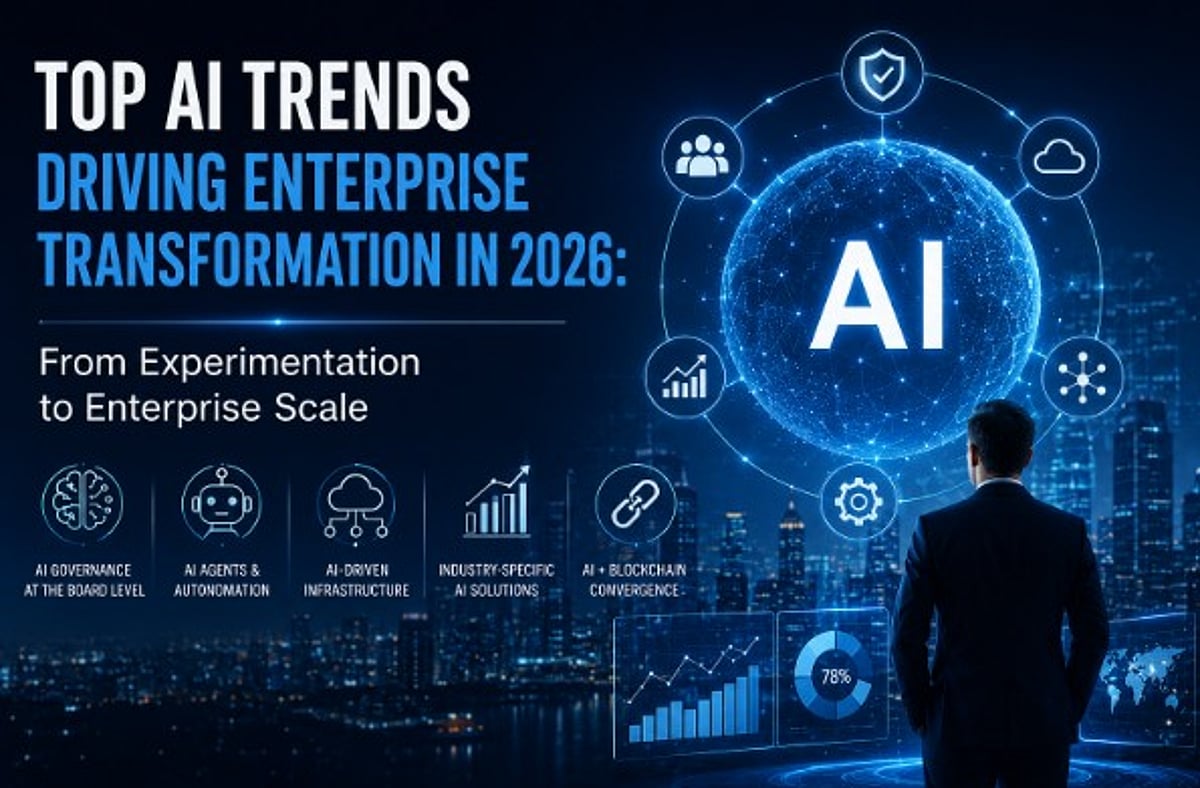
  • 7 AI Trends Reshaping Enterprise Strategy in 2026: From Pilots to Full-Scale Operations

    7 AI Trends Reshaping Enterprise Strategy in 2026: From Pilots to Full-Scale Operations

    Artificial Intelligence is entering a phase of enterprise adoption. Over the past few years, organizations have invested heavily in AI pilots, generative AI tools, and automation initiatives to explore how emerging technologies can improve business performance. While many of these projects demonstrated results, relatively few have delivered transformation at scale. As a result, the conversation surrounding AI is rapidly evolving from experimentation toward operationalization.

    According to McKinsey’s latest State of AI report, more than 70% of organizations have adopted AI in at least one business function. Gartner predicts that over 80% of enterprises will have used generative AI APIs or deployed generative AI-enabled applications by 2026. These figures indicate that AI adoption is no longer limited to innovators and early adopters. It is rapidly becoming a priority across industries.

    However, adoption alone does not guarantee business value. Many organizations continue to struggle with deployments, disconnected data environments, and unclear transformation strategies. The challenge facing enterprise leaders in 2026 is no longer whether AI works. The challenge is how to scale AI across the organization while maintaining governance, security, and measurable outcomes.

    The organizations that succeed in this phase of AI transformation will not necessarily be those with access to the most advanced models. Instead, they will be those aligning AI capabilities with business objectives, operational processes, and long-term transformation strategies.

    The Economic Opportunity Behind Enterprise AI

    The scale of AI’s potential is one of the primary reasons enterprises continue increasing investments despite ongoing implementation challenges. According to PwC’s Global AI Study, AI could contribute up to $15.7 trillion to the economy by 2030, making it one of the most transformative technologies of the modern era.

    What makes AI particularly powerful is its ability to generate value across multiple business functions simultaneously. Organizations are increasingly using AI to:

    • Improve operational efficiency and productivity
    • Enhance customer experiences through personalization
    • Accelerate product and service innovation
    • Strengthen decision-making capabilities
    • Identify new revenue opportunities

    Unlike previous waves of enterprise technology, AI is not confined to a single department. It has the potential to influence every aspect of business operations. This is why leading enterprises are shifting their focus from use cases toward enterprise-wide AI strategies.

    Trend #1: Enterprise AI Is Moving Beyond Pilot Projects

    The first phase of enterprise AI adoption was characterized by experimentation. Organizations launched customer service chatbots, automated document processing systems, predictive analytics platforms, and internal productivity assistants to explore AI’s capabilities. These initiatives often generated positive results but remained isolated within individual departments.

    Typical characteristics of AI initiatives between 2023 and 2024 included department-level deployments, limited integration with business operations, experimentation-focused objectives, unclear ROI measurement frameworks, and minimal governance oversight. As organizations move into 2026, priorities are changing significantly. Enterprise AI programs are increasingly characterized by organization-wide adoption strategies, cross-functional integration, outcome-driven implementation plans, governance and accountability frameworks, and executive-level sponsorship.

    This shift mirrors the evolution of cloud computing. Early cloud initiatives focused primarily on infrastructure optimization. Today, cloud serves as the foundation for digital business models. AI is following a similar trajectory. Business leaders are no longer asking whether AI can improve productivity. Instead, they are asking how AI can reshape operations, accelerate innovation, and create sustainable competitive advantages.

    Trend #2: AI Agents Will Become Operational Participants

    One of the most significant developments expected to shape enterprise transformation in 2026 is the emergence of AI agents. While most organizations are already familiar with AI copilots that assist employees with writing, coding, research, and knowledge retrieval, AI agents represent a more advanced stage of intelligent automation. Unlike copilots, AI agents are capable of performing tasks autonomously and coordinating activities across multiple systems.

    A procurement-focused AI agent, for example, may be able to monitor inventory levels in real time, analyze supplier performance data, forecast purchasing requirements, generate procurement recommendations, and initiate approval workflows automatically. Similarly, customer service agents can retrieve information from CRM systems, access knowledge repositories, respond to routine customer inquiries, and escalate complex issues when human intervention becomes necessary.

    According to Deloitte’s State of Generative AI in the Enterprise report, organizations are increasingly prioritizing AI initiatives that generate measurable operational outcomes rather than simply improving individual productivity. This trend reflects a broader shift in enterprise expectations: AI is no longer viewed solely as a productivity tool but as an operational capability capable of transforming how business processes are executed.

    Trend #3: AI Infrastructure Will Matter More Than AI Models

    Much of the public discussion surrounding AI has focused on models. Organizations frequently compare proprietary and open-source models, evaluate benchmark performance, and debate the advantages of different architectures. However, many enterprises are discovering that model selection is only a small part of the challenge. In practice, infrastructure is becoming more important than the model itself.

    Modern enterprise AI environments typically require data pipelines and integration layers, vector databases and knowledge repositories, governance and compliance frameworks, security and access management systems, model monitoring and observability tools, and MLOps and deployment pipelines. Without these foundational capabilities, even the most advanced AI models struggle to deliver sustainable business value.

    Many organizations encounter challenges when attempting to scale successful pilot projects. Data often resides across multiple disconnected systems, legacy applications create integration barriers, and security requirements introduce deployment constraints. These issues cannot be solved simply by choosing a different model. This reality explains why AI transformation is increasingly viewed as an architecture challenge rather than a model challenge. The organizations that invest in scalable AI infrastructure today will be better positioned to deploy new capabilities, integrate future technologies, and maintain long-term operational resilience.

    Trend #4: Decision Intelligence Will Replace Traditional Analytics

    For decades, business intelligence platforms have helped organizations understand historical performance. These systems provide visibility into trends, metrics, and operational outcomes, allowing leaders to evaluate what happened in the past. However, modern enterprises increasingly require systems that go beyond reporting.

    Decision intelligence is emerging as the next evolution of enterprise analytics by combining artificial intelligence, predictive modeling, business rules, and automation to support real-time decision-making. Rather than answering “What happened?”, decision intelligence focuses on “What is likely to happen next?” and “What should we do about it?”

    This capability is already creating value across multiple industries: retail (optimizing inventory allocation and pricing strategies), manufacturing (predicting equipment failures before they occur), financial services (identifying emerging risks and compliance concerns), logistics (dynamically adjusting operations based on demand patterns), and healthcare (improving resource planning and patient scheduling).

    A global logistics provider, for instance, handles thousands of shipments every day. Traditional analytics can only tell you that a delay happened after it occurred. Decision intelligence systems can predict disruptions before they happen, suggest ways to mitigate them, and automatically switch to a backup plan. This change helps organizations make decisions proactively rather than reacting to events that have already occurred.

    Trend #5: AI Governance Will Become a Board-Level Priority

    As AI is used more extensively in business functions, governance is becoming essential for long-term success. Early AI projects were often managed by innovation teams or technical departments. Now that AI is being used on a larger scale, executive leaders and corporate boards need to be involved. The reason is simple: AI is no longer for testing. It affects how customers interact with companies, financial decisions, compliance processes, and daily operations. As AI’s impact grows, so do the risks related to privacy, security, transparency, and accountability.

    According to IBM’s Global AI Adoption Index, trust is a barrier to using AI in businesses. Companies are realizing that successful AI implementation requires more than technical performance; it also needs confidence that AI systems work responsibly and transparently. Forward-looking companies are investing in governance frameworks that include ensuring AI system transparency, accountability, risk management, trust-building, policy establishment, oversight committees, and ethics guidelines.

    What makes governance particularly important in 2026 is the growing complexity of AI ecosystems. As organizations deploy multiple models, integrate external data sources, and introduce autonomous AI agents, maintaining visibility and control becomes increasingly challenging. Rather than viewing governance as a barrier to innovation, leading organizations treat it as a foundation for sustainable AI adoption.

    Trend #6: Industry-Specific AI Solutions Will Outperform Generic Deployments

    As companies become more adept at using AI, they are moving away from one-size-fits-all solutions and toward AI tailored to their specific industry. While the underlying AI technology remains important, the most effective solutions are those designed for a particular sector.

    Financial institutions focus heavily on risk analysis, fraud detection, regulatory compliance automation, and customer intelligence. Manufacturers prioritize predictive maintenance, quality assurance automation, and supply chain optimization. Healthcare organizations invest in clinical decision support systems, patient engagement platforms, and medical data analysis tools. The same pattern is emerging across retail, logistics, insurance, telecommunications, and energy.

    This shift reflects an important reality: AI generates the strongest business outcomes when it is closely aligned with operational objectives and industry-specific workflows. As a result, organizations are increasingly seeking partners capable of combining technical expertise with deep industry understanding.

    Trend #7: The Convergence of AI and Blockchain

    Although AI and blockchain are often discussed as separate technologies, their convergence is creating new opportunities for enterprise innovation. AI excels at generating intelligence from data; blockchain excels at establishing trust, transparency, and immutability.

    Together, these technologies can support a range of high-value enterprise applications, including supply chain transparency and traceability, decentralized digital identity systems, automated compliance reporting, secure data-sharing ecosystems, and smart contract optimization.

    Consider a global supply chain network involving manufacturers, logistics providers, distributors, and retailers. AI can analyze operational data to identify inefficiencies, forecast demand, and optimize inventory management. Blockchain can simultaneously provide an immutable record of transactions and product movements across the network. The combination creates a system that is both intelligent and trustworthy.

    As enterprises become increasingly dependent on automated decision-making, trust will become a critical competitive differentiator. This is one reason why many organizations are beginning to explore how AI and blockchain can work together as complementary technologies rather than independent initiatives.

    Why Many AI Initiatives Still Fail

    Despite significant investment and technological progress, many companies still struggle to make AI work across the entire organization. McKinsey research reveals a large gap between experimenting with AI and achieving true proficiency. One major reason is poor data quality. AI systems are only as good as the data they receive, and companies often underestimate the work required to clean and organize data before AI can deliver valuable insights.

    Another problem is the misconception that technology alone is the answer. Companies that start with AI as the solution rather than understanding the problem they need to solve often fail to demonstrate tangible results. Common barriers include disorganized data, unclear objectives, lack of executive support, organizational resistance, disconnected technology stacks, and insufficient governance.

    Perhaps the most overlooked factor is managing the human side of change. AI affects people as much as technology. Employees must learn new workflows, managers must make decisions differently, and companies must adapt their operating models. Without proper change management, even technically successful AI initiatives may not be adopted by the organization.

    Mini Case Study: From Forecasting to Autonomous Decision-Making

    A compelling example of AI evolution comes from the logistics industry. A few years ago, logistics companies used AI to predict delivery times. These systems helped with planning but were disconnected, requiring humans to interpret results and take action. Today, modern logistics systems can do much more: predict delivery times in real time, find optimal routes, handle problems automatically, track inventory, and allocate resources efficiently.

    Instead of merely warning about potential issues, these systems can suggest solutions and initiate processes autonomously. For instance, if a storm threatens a major shipping route, a traditional system would alert managers after delays begin. An AI-powered system, however, can predict the problem, recommend an alternative route, estimate cost implications, and activate a contingency plan before any disruption occurs.

    This example illustrates a broader trend across industries: the future of AI is not just about generating more information but about enabling better decisions and faster action.

    Conclusion: The Path to Enterprise AI Maturity

    The evolution of enterprise AI from 2024 to 2026 represents a fundamental shift in priorities. Organizations are moving away from isolated experiments and toward integrated, scalable, and governed AI systems. The seven trends outlined above—moving beyond pilots, adopting AI agents, prioritizing infrastructure, embracing decision intelligence, elevating governance, pursuing industry-specific solutions, and converging with blockchain—provide a roadmap for enterprises seeking to capture the full value of AI.

    The organizations that will thrive in this new era are those that treat AI not as a technology project but as a strategic transformation initiative. By aligning AI capabilities with business goals, investing in foundational infrastructure, and fostering a culture of responsible innovation, enterprises can turn AI from a promising experiment into a powerful engine for growth.

  • Best AI-Powered Chrome Extensions for Maximum Productivity in 2026

    Best AI-Powered Chrome Extensions for Maximum Productivity in 2026

    Professionals spend most of their working hours inside a browser, yet many still rely on manual workflows for writing, research, and communication. AI Chrome extensions in 2026 change that by embedding intelligent automation directly into everyday browser sessions. Tools like Sider AI, Perplexity, Grammarly, Bardeen, and Tactiq lead the category with distinct strengths across research, writing, automation, and meeting management. Selecting the right extension requires matching tool capability to specific workflow pain points rather than installing every available option.

    What Are AI Chrome Extensions?

    AI Chrome extensions are add-ons that activate on web pages, email platforms, documents, and video calls without requiring separate software. Unlike earlier browser tools, the current generation offers contextual intelligence—they read what’s on the screen, understand the task, and respond accordingly. Capabilities now include real-time grammar correction, cited research summaries, multi-step workflow automation, meeting transcription without bots, and email drafting from brief inputs. Most operate on a freemium model, letting professionals evaluate core features before subscribing.

    Top 10 AI Chrome Extensions in 2026

    1. Sider AI

    Sider AI runs as a persistent sidebar inside Chrome, accessible on any webpage without interrupting the current tab. It connects to GPT-4, Claude, and Gemini within a single interface, allowing users to switch models based on the task. Highlight any text to explain, rewrite, translate, or summarize it instantly. PDF reading and image analysis are built in, making it a versatile all-in-one tool for everyday needs.

    2. Perplexity AI

    Perplexity sets itself apart by providing cited sources for every answer, crucial for accuracy-dependent environments. A dedicated focus mode interrogates the specific article or PDF you’re reading. The free tier handles most daily research, while the Pro plan ($20/month) adds GPT-4 and Claude for more demanding work.

    3. Grammarly

    The long-standing default writing assistant now includes a tone detector that flags overly formal, dismissive, or passive-aggressive phrasing before sending. Generative features suggest full rewrites and real-time alternatives. It works across Gmail, Outlook, Google Docs, and most text fields, making it essential for professional communication.

    4. Monica

    Monica packs composing, translation (50+ languages), DALL-E 3 image generation, and voice input into one extension. It adapts to individual writing patterns over time, making it ideal for content teams and marketers who need consistent output.

    5. Bardeen

    Bardeen automates cross-platform data movement, connecting Chrome to over 100 apps like Notion, Slack, Google Sheets, HubSpot, and Gmail. Describe a workflow in plain language, and Bardeen builds the automation—for instance, extracting LinkedIn data and populating a CRM row with one click. Sales and operations teams benefit heavily from the time saved.

    6. Tactiq

    Tactiq transcribes meetings in real time without placing a bot in the call—it captures audio from the Chrome tab invisibly. After the meeting, it generates a structured summary with action items and speaker attribution, pushing notes directly to Salesforce and HubSpot. This is a huge advantage for sensitive discussions.

    7. Compose AI

    Compose AI focuses on email drafting speed with sentence-level autocomplete across Gmail and Outlook. Suggestions appear as you type and are accepted or dismissed with a keystroke. It learns your writing habits, producing outputs that match your personal tone. Professionals handling high email volumes report significant time savings within a week.

    8. Merlin AI

    Merlin provides an AI chat overlay via keyboard shortcut on any active page. It includes native compose buttons for Gmail and LinkedIn, and generates YouTube video summaries with timestamps. Its speed and minimal disruption suit professionals who need AI assistance across many contexts daily.

    9. Glasp

    Glasp focuses on knowledge retention: highlight passages on any webpage, and it builds them into a searchable personal knowledge base. An AI layer converts accumulated highlights into structured notes automatically. YouTube transcripts get full highlighting support, and exports go to Notion, Readwise, and Markdown. Ideal for analysts and researchers who read heavily.

    10. AIPRM

    AIPRM adds a prompt library to ChatGPT with thousands of community-tested templates organized by category (SEO, marketing, coding, etc.). User ratings help identify high-performing prompts. Teams can build and share internal prompt libraries, bringing consistency to AI-generated outputs.

    How to Choose the Best AI Chrome Extension

    Start by identifying your single most time-consuming manual task. Research-heavy roles benefit from Perplexity and Glasp; communication roles from Grammarly, Compose AI, and Monica; automation needs point to Bardeen; meeting-intensive roles to Tactiq. Budget is practical: Grammarly, Perplexity, Monica, and Sider AI offer free tiers; paid plans typically range $9–$20/month. Running more than two or three active extensions slows Chrome, so build a focused stack instead of an exhaustive one.

    Final Thoughts

    Browser productivity in 2026 is markedly different from even two years ago. The extensions listed target specific operational gaps: slow research, inconsistent writing, manual data entry, meeting transcription, and email fatigue. The professionals gaining the most are those who identified where their time was going and chose tools that align precisely with their work.

  • Validate Your Startup Idea with AI: A Step-by-Step Framework Before You Build

    Validate Your Startup Idea with AI: A Step-by-Step Framework Before You Build

    One of the primary reasons startups fail is the lack of genuine market demand. While this challenge has remained largely unchanged, the way entrepreneurs validate business ideas has evolved significantly. Today, artificial intelligence enables founders to conduct market research, analyze customer needs, assess competition, and validate business concepts in a fraction of the time traditional methods require. However, while AI can accelerate the validation process, it should be supported by real customer feedback and market testing. The most successful startups combine AI-driven insights with direct engagement to ensure their ideas address genuine market needs.

    Where AI Genuinely Earns Its Place

    The honest case for AI in validation rests on speed, not judgment. A founder can now scan tens of thousands of Reddit threads, forum posts, and review sites for unprompted complaints about a problem in the time it used to take to schedule a single customer interview. Tools built specifically for this pull from real community posts rather than simply asking an AI to guess—they examine evidence people left before you ever asked them anything, which is a meaningfully different signal than a survey response.

    Market sizing is another area where AI moves fast. TAM/SAM/SOM estimates, competitor mapping, and go-to-market sketches that used to take research analyst days now come back in minutes. That’s useful for deciding whether an idea is even worth two more weeks of your attention.

    The Trap: AI Is Built to Be Agreeable

    Here’s the problem nobody selling a validation tool wants to lead with. Large language models lean optimistic by default, and surveys—AI-run or otherwise—systematically overestimate willingness to pay by around 21%. Ask an AI to evaluate your idea and describe it with any enthusiasm at all, and there’s a real chance it reflects your enthusiasm back at you with extra confidence attached.

    Synthetic customer panels make this worse, not better, when used carelessly. They can genuinely speed up early-stage thinking, but research has been blunt about the failure mode: these AI-generated personas often produce false-positive validation signals precisely because they inherit the same optimism bias as the model generating them. A digital twin of your target customer who will never use your product can still tell you it loves the idea.

    Three-Stage Framework That Actually Holds Up

    Strip out the marketing language from a dozen validation tools, and the same basic structure keeps surfacing. It works because each stage tests something different, and AI’s usefulness changes at every step.

    • Stage 1: Market Discovery — Use AI tools such as ChatGPT, Perplexity AI, and Google Trends to analyze market demand, identify competitors, and research customer pain points from public discussions.
    • Stage 2: Messaging and Positioning — Test your value proposition and messaging with AI-driven tools like Semrush for keyword and competitor insights, then refine based on early signals.
    • Stage 3: Demand Validation — Collect early user feedback using Typeform AI and other survey tools, but always follow up with real customer conversations to verify willingness to pay and genuine need.

    What This Costs, Realistically

    A rigorous three-stage validation, done properly, runs somewhere between free and roughly $500 total, and takes two to four weeks once you include the human conversations AI can’t shortcut. That’s a genuinely small price against the alternative: CB Insights’ long-running research on startup failure keeps landing on the same number—no market need as the single most common reason ventures shut down. Compare a few hundred dollars and a month of focused work against months of building something nobody asked for, and the maths isn’t close.

    The One Rule Worth Keeping

    Use AI to compress the research you’d have done anyway: the desk research, the market sizing, the first-pass competitor scan. Do not let it replace the ten to twenty real conversations with people who might actually buy what you’re building. If an AI validation report and a real customer interview disagree, believe the human, every time. The tools are fast. They are not yet honest in the specific way a skeptical stranger telling you your idea has problems is honest.

    Why This Matters

    Building a product without validating customer demand remains one of the leading reasons startups fail. AI offers founders an efficient way to reduce uncertainty by accelerating research and identifying opportunities early. However, combining AI-generated insights with real customer conversations is essential for making informed business decisions and improving the chances of long-term success.

  • Best Stocks to Buy Now With $3,000: Turn a Small Investment Into Long-Term Wealth

    Best Stocks to Buy Now With $3,000: Turn a Small Investment Into Long-Term Wealth

    Investing doesn’t require a fortune. With just $3,000, you can build a diversified portfolio of high-quality stocks that have strong growth potential. Here are some of the top picks for long-term wealth creation.

    NVIDIA (NVDA)

    The AI chip leader continues to benefit from booming demand for data centers and artificial intelligence. NVIDIA’s GPUs are essential for training large language models and powering AI applications, making it a core holding for any tech-focused portfolio.

    Microsoft (MSFT)

    Its cloud business (Azure) and AI investments, including its partnership with OpenAI, make Microsoft one of the strongest long-term technology stocks. The company’s diversified revenue streams from productivity software, gaming, and enterprise services provide stability and growth.

    Amazon (AMZN)

    Beyond e-commerce, Amazon’s cloud platform (AWS) and AI services continue driving future growth. AWS remains the dominant cloud provider, and Amazon’s logistics network and advertising business add further upside.

    Alphabet (GOOGL)

    Google’s AI expansion and advertising business keep Alphabet among the market’s strongest performers. The company’s search dominance, YouTube growth, and investments in autonomous driving (Waymo) and cloud computing provide multiple growth engines.

    Meta Platforms (META)

    Meta is investing heavily in AI while maintaining strong revenue from digital advertising. Its social media platforms (Facebook, Instagram, WhatsApp) generate massive user engagement, and its metaverse and AI initiatives could unlock new revenue streams.

    Broadcom (AVGO)

    Its semiconductor and infrastructure software businesses continue benefiting from enterprise AI demand. Broadcom’s networking chips are critical for data centers, and its software acquisitions (VMware) provide recurring revenue.

    Eli Lilly (LLY)

    Strong demand for weight-loss and diabetes treatments makes Eli Lilly a healthcare favorite. Its drugs like Mounjaro and Zepbound have blockbuster potential, and the company’s pipeline includes promising treatments for Alzheimer’s and other conditions.

    Visa (V)

    Global digital payments continue expanding, giving Visa steady long-term growth potential. As cash transactions decline worldwide, Visa’s network effects and transaction volume growth provide reliable returns.

    Disclaimer: This article is for informational purposes only and does not constitute financial advice. Always do your own research before investing.

  • Microsoft Stock on Track for Worst Monthly Drop Since 2000 as AI Spending Surge Eclipses Strong Earnings

    Microsoft Stock on Track for Worst Monthly Drop Since 2000 as AI Spending Surge Eclipses Strong Earnings

    Microsoft Corp. is heading toward its weakest monthly stock performance in more than two decades, even as the company continues to report steady revenue growth and earnings that exceed Wall Street expectations. Investors have shifted their attention from quarterly results to the rising cost of expanding artificial intelligence infrastructure.

    AI Investment Costs Overshadow Earnings Beat

    Microsoft has delivered year-over-year revenue growth of 16% to 18% for eight consecutive quarters and consistently beaten analyst earnings estimates. Yet these strong results have done little to support the share price. The market is now laser-focused on spending rather than revenue.

    Capital expenditure has become the primary metric investors watch. Microsoft spent approximately $38 billion on capital projects in the latest quarter, much of it directed toward expanding AI data centers. Bank of America estimates the company’s capital spending could approach $190 billion in 2026. This surge is not unique to Microsoft—Amazon, Alphabet, Meta Platforms, and Oracle are also pouring billions into AI infrastructure, with combined spending by the five largest hyperscale cloud providers projected to exceed $700 billion in 2026.

    As more companies build data centers, demand for advanced chips and memory continues to rise, driving up equipment costs and extending investment cycles. Investors are now questioning how quickly these projects can generate meaningful financial returns.

    Cash Flow and Shareholder Returns Under Pressure

    Microsoft’s capital spending increased 63% from a year earlier, while free cash flow declined 10%. With more operating cash funneled into infrastructure, less remains available for share repurchases and dividend growth. Bank of America notes that hyperscaler capital spending has risen from roughly 70% of operating cash flow in 2025 to nearly 100% in 2026, raising concerns that large technology companies may have fewer resources for direct shareholder returns while AI investment remains elevated.

    Stifel lowered its Microsoft price target to $400, forecasting that Azure’s expansion will reduce gross margins by 100 to 150 basis points each quarter through fiscal 2027. Analysts estimate Microsoft’s fiscal 2027 gross margin could fall to about 63%, and earnings per share may trail actual results if spending continues at the current pace.

    Meanwhile, semiconductor companies have benefited from the AI investment cycle. Since January, the semiconductor sector has outperformed many large technology stocks as demand for AI hardware continues to increase.

    Technical Levels Under Scrutiny

    Technical analysts are also watching Microsoft’s stock price action closely. John Roque, a technical strategist at 22V Research, noted that the stock has struggled to stay above its 200-day moving average after repeated failures near resistance levels. He warned that a break below long-term support around $350 could trigger further weakness. “A break below $350 would, on his math, open the path to $250 — measured down from the stock’s failure near $450 in early June,” Roque said. That projection represents roughly 30% below recent trading levels, though it remains a technical scenario rather than a forecast.

    Outlook: AI Returns Remain the Key Question

    Current market conditions draw comparisons to earlier technology investment cycles, including the period following the dot-com boom. Many investors continue to monitor whether Microsoft’s expanding AI business, cloud platform, and related services will eventually generate returns that justify the record level of infrastructure spending. Until then, AI investment costs remain one of the biggest drivers of sentiment surrounding the company’s stock.