Tag: blockchain

  • Stablecoin Transaction Volumes Hit All-Time High of $1.79 Trillion in June, USDC Leads Growth

    Stablecoin Transaction Volumes Hit All-Time High of $1.79 Trillion in June, USDC Leads Growth

    Stablecoin Transaction Volume Reaches Record $1.79 Trillion in June

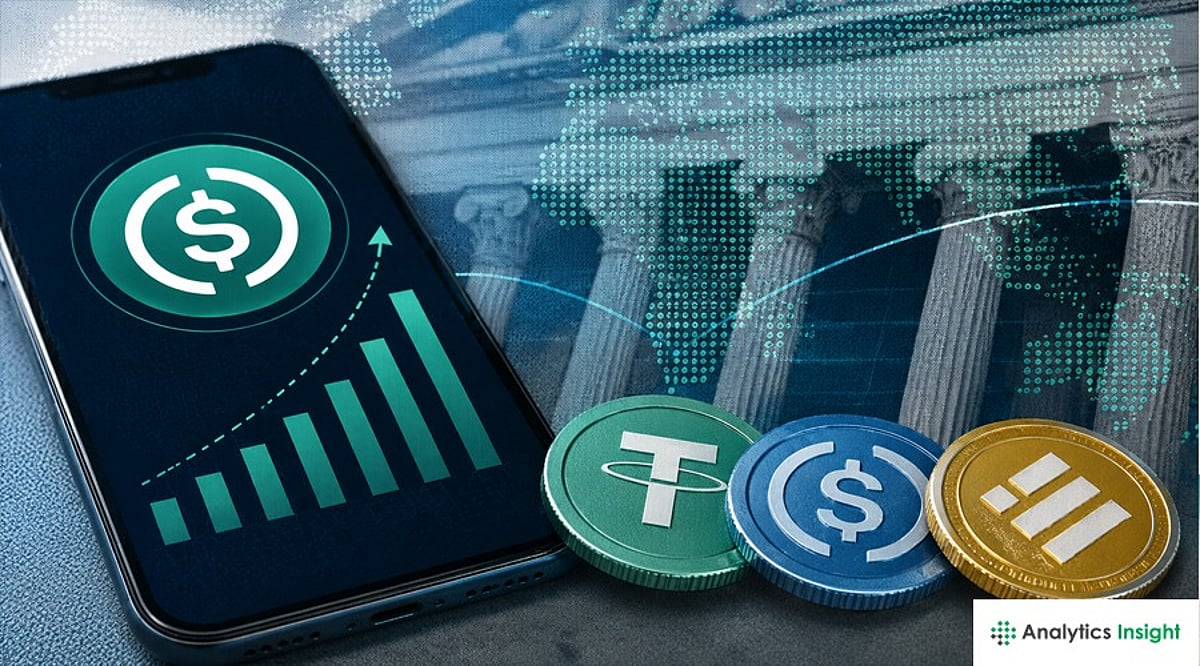
    Stablecoin transaction volume hit a record $1.79 trillion in June, marking the highest monthly level ever recorded. According to Visa’s stablecoin analytics dashboard, which uses Allium data, the figure represents a 63% increase from May’s $1.1 trillion total. The June total also surpassed the previous record of $1.78 trillion set in February 2026. On an annual basis, stablecoin transaction volume rose 125%, reflecting broader adoption of dollar-pegged crypto assets across payments, DeFi activity, and cross-border transfers.

    Record Monthly Volume Driven by Real User Activity

    Visa’s on-chain analytics dashboard reported $1.79 trillion in adjusted stablecoin transaction volume for June. The dashboard filters out inorganic activity, including bot-driven transfers and wash transactions, providing a clearer view of genuine user and institutional activity. The latest reading comes as stablecoins play an increasingly central role in crypto market infrastructure, being widely used for trading, lending, settlement, and payments. They also act as a bridge between traditional money and blockchain-based services.

    “June 2026 was another record month for stablecoin transaction volume, slightly ahead of February 2026,” said Grayscale Head of Research Zach Pandl, highlighting the narrow gap between the two record months. Notably, stablecoin usage grew even as the broader crypto market faced weaker price action, suggesting that stablecoins are used for more than just trading. Their role in payments and transfers has expanded as blockchain networks offer faster settlement and lower costs for certain use cases.

    USDC Leads Monthly Stablecoin Activity

    USDC accounted for the largest share of stablecoin transaction volume in June, processing about $1.21 trillion — nearly 67% of total adjusted volume. USDT, issued by Tether, ranked second with approximately $576 billion, or about 32% of the monthly total. PayPal’s PYUSD followed in third place with $2.42 billion in June volume.

    Although USDT still holds the largest stablecoin market capitalization, the June volume data shows stronger transaction activity for USDC. Regulatory conditions in Europe, particularly the Markets in Crypto-Assets (MiCA) rules, have added pressure on some stablecoins, leading several European platforms to reduce or end support for tokens that do not meet the new requirements. Circle has positioned USDC for regulated markets, including Europe, making the token more attractive for exchanges, payment firms, and institutions seeking clear compliance standards. Meanwhile, Tether has increased USDT supply, including a recent $2 billion mint on Ethereum.

    Base, Ethereum, and Tron Carry Most Stablecoin Transfers

    Base, Coinbase’s Ethereum Layer 2 network, processed the largest share of stablecoin transaction volume in June at approximately $565 billion (31.5% of the total). Ethereum followed closely with around $562 billion in volume. Tron ranked third among networks, with about $320 billion (close to 18% of the monthly total). Solana also saw strong activity, supported by low fees and fast settlement times.

    The network data reveals that stablecoin usage is spread across multiple blockchain systems. Ethereum remains central, while Base has grown rapidly as a major rail for USDC transfers. Tron continues to serve users moving stablecoins across borders and between exchanges. The broader stablecoin market has expanded, with total market capitalization crossing $322 billion. Visa’s dashboard shows about $10.2 trillion in adjusted stablecoin volume over the past 12 months. Additionally, Visa has expanded its stablecoin settlement pilot across several blockchain networks, with an annualized run rate of about $7 billion as of April.

    The June record underscores that stablecoins have become a fundamental part of digital asset activity, driven by payments, DeFi use, exchange transfers, and cross-border flows.

  • Bitcoin ETFs See $527M Weekly Outflow, Solana Rallies 14%, Stablecoin Volume Hits $1.79T – Crypto News Roundup

    Bitcoin ETFs See $527M Weekly Outflow, Solana Rallies 14%, Stablecoin Volume Hits $1.79T – Crypto News Roundup

    Bitcoin ETF Outflows Continue

    Bitcoin spot ETFs recorded a net outflow of $527 million last week, marking the eighth consecutive week of withdrawals. BlackRock’s IBIT saw $773 million exit, while Grayscale Bitcoin Trust (GBTC) reported $27.69 million in outflows. However, the Ark & 21 Shares ETF (ARKB) bucked the trend with $102 million in net inflows. Cumulative net inflows for IBIT remain strong at $59.99 billion, and the total net asset value of spot Bitcoin ETFs stands at $74.37 billion.

    Solana Maintains Momentum After 14% Rally

    Solana (SOL) surged over 14% last week and is currently trading around $80.89. While it has stalled below a key resistance level, indicators point to growing bullish momentum. Spot Solana ETFs attracted $5.75 million in net inflows, reversing the previous week’s outflows. Additionally, tokenized asset spot trading volume on the Solana network reached $5.7 billion in Q2, more than doubling from Q1’s $2.69 billion.

    Stablecoin Transaction Volume Reaches Record $1.79 Trillion

    According to Visa, stablecoin transaction volume hit an all-time high of $1.79 trillion in June, up 63% from May’s $1.1 trillion. USDC led with $1.21 trillion (67% of the total), while USDT accounted for $576 billion (32%). PayPal’s PYUSD ranked third with $2.42 billion.

    CLARITY Act Faces Key Senate Deadline

    The CLARITY Act, a major US crypto market structure bill, missed its July 4 target but still has a chance before the Senate’s summer break on August 7. The bill has passed the House and cleared the Senate Banking Committee. Senator Cynthia Lummis urged lawmakers to advance it, calling it “the foundation for the financial services of the 21st century.”

    Ethereum Plans Its ‘Biggest Rebuild’

    Ethereum co-founder Vitalik Buterin outlined “Lean Ethereum,” a multi-year plan to replace almost every major protocol component over three to four years while minimizing disruption to existing applications. This third major iteration follows the 2022 Merge. Quantum safety has been elevated as a top priority.

    Disclaimer: This article is for informational purposes only and does not constitute financial advice. Always conduct your own research before investing in cryptocurrencies.

  • Stargate LLM: A 50x Crypto Opportunity Beyond Sui and Uniswap in the Next Tech Cycle

    Stargate LLM: A 50x Crypto Opportunity Beyond Sui and Uniswap in the Next Tech Cycle

    Every major technology wave has rewarded the entities that defined a new category, not just those with the most users. Sui carved out its lane with parallel transaction processing rather than competing directly with existing Layer 1 blockchains. Uniswap created the automated market maker category from scratch, bypassing centralised exchanges. Standard Chartered’s Geoff Kendrick recently noted that the market has yet to fully price in the depth of Uniswap’s latest partnership, while Sui has joined forces with African fintech giant Paga. For investors seeking the top crypto to buy today, Stargate LLM is pursuing a category that neither Sui nor Uniswap occupies.

    AI That Users Own, Not Just Another Chatbot

    Sui and Uniswap have both demonstrated that owning a brand-new category often outperforms competing within an existing one. Cloud computing, search engines, and social media all rewarded the builders of the underlying infrastructure layer, not merely those who attracted the most users to an existing model. Stargate LLM applies this same logic to artificial intelligence, focusing on user-owned AI rather than faster blockchain infrastructure or a better trading mechanism.

    The category it targets is AI that is partially owned by its users, enabled by Proof of Usage rewards, vault staking, and DAO-voted revenue sharing. These are not features bolted onto an existing chatbot; they are integral to the token’s design from inception. This distinction transforms the token’s purpose from mere access to active participation and reward.

    The presale reflects this early-category positioning: ten pricing stages from $0.0005 to $0.0125, with a launch at $0.025. Stage 1 is priced at a 50x ratio to that target. The total token supply is fixed at 150 billion, with 96% allocated to the community, ecosystem, and presale participants, and only 1% to the core team. Both Sui and Uniswap were once at this early stage, in categories that had no name. For anyone evaluating the top crypto to buy today with genuine category-level differentiation rather than a faster interface, this is the comparison that matters.

    Sui Just Landed a Continent-Scale Deal

    On July 1, 2026, the Sui Foundation partnered with African fintech giant Paga to explore tokenizing real-world assets and delivering blockchain-based financial tools across the continent, leveraging Sui’s speed and Paga’s mobile payment ecosystem. However, the more significant event this week was the token supply: SUI led a $73 million weekly token unlock wave alongside ENA and EIGEN, with 13.72 million SUI tokens worth roughly $9.4 million released on July 1. SUI currently trades near $0.75, about 86% below its all-time high—a gap that unlock pressure is not making easier to close.

    Uniswap Just Became Robinhood’s Native Exchange

    Standard Chartered’s Geoff Kendrick remarked this week that markets are significantly underestimating how deep Uniswap’s newest integration actually runs. Uniswap now serves as the native automated market maker on Robinhood Chain, an Arbitrum-based Layer-2 network that launched its public mainnet on July 1, 2026. This puts Uniswap in direct reach of Robinhood’s retail base for trading tokenized stocks such as Apple, Tesla, and Nvidia. UNI trades near $3.11 despite the news, still roughly 83% below its 2021 all-time high of $18.59.

    Last Say

    Sui built an entirely new category around parallel processing, and Uniswap built one around automated market making. Both are proving the same pattern once again, even while their tokens remain far below prior highs. Stargate LLM is chasing a category neither occupies, embedding AI ownership directly into how the platform rewards its users. For anyone comparing the top crypto to buy today, these three represent genuinely different bets on what owning a new category actually looks like.

    Explore Stargate LLM:
    Website: stargate.org
    Buy: own.stargate.com
    Telegram: https://t.me/StargatellmOfficial
    Twitter/X: https://x.com/stargatellm

  • Ethereum Surges as Fed Rate Worries Subside: Institutional Demand and Network Upgrades Fuel Rally

    Ethereum Surges as Fed Rate Worries Subside: Institutional Demand and Network Upgrades Fuel Rally

    Ethereum has been gaining momentum as concerns over prolonged high U.S. interest rates fade. Cooling inflation has shifted expectations toward a softer Federal Reserve stance, prompting investors to rotate capital into higher-growth assets like ETH. This macroeconomic tailwind, combined with strong institutional demand, ongoing network upgrades, and expanding Layer-2 adoption, is bolstering Ethereum’s long-term outlook.

    Lower Interest Rate Concerns Support Ethereum

    Interest rates heavily influence financial markets. Recent inflation data has eased fears that the Fed will maintain elevated rates for an extended period. This shift in sentiment has drawn fresh money back into risk assets, including Ethereum.

    Institutional Investors Continue to Show Interest

    Growing institutional demand is a key driver of Ethereum’s price movement. Major investment firms are increasing their exposure through spot Ethereum ETFs. While weekly inflows fluctuate, the overall trend points to rising institutional backing.

    Ethereum Network Remains Strong

    Ethereum maintains its position as the largest smart contract blockchain. Thousands of decentralized finance (DeFi) platforms, blockchain applications, and stablecoin projects rely on its network daily. Developers continue building new products on Ethereum, drawn by its robust infrastructure and large user base. This steady growth supports long-term demand for ETH.

    Staking Reduces Supply

    Ethereum’s proof-of-stake system allows holders to lock their coins to secure the network and earn rewards. As more investors stake their ETH, fewer coins remain available for trading. This supply reduction often supports prices when demand stays strong, giving Ethereum an advantage over many other cryptocurrencies.

    Network Upgrades Improve Performance

    Years of upgrades have boosted processing efficiency, validator performance, wallet security, and transaction speeds. These technical improvements attract developers, enterprises, and financial institutions, making Ethereum a more attractive long-term investment.

    Layer-2 Networks Help Ethereum Grow

    The rapid growth of Layer-2 networks makes transactions faster and cheaper. Lower costs encourage broader use of DeFi platforms, blockchain games, digital collectibles, and other services. Since these Layer-2 systems rely on the main Ethereum blockchain, increased network activity benefits ETH directly.

    Strong Market Position Supports Price Growth

    Ethereum’s total market capitalization exceeds $214 billion, with a circulating supply of about 120.7 million ETH. Daily trading volume regularly surpasses $10 billion, indicating strong engagement from both retail and institutional participants. This liquidity attracts major investment firms.

    Better Economic Outlook Helps Risk Assets

    U.S. Treasury yields have stabilized compared to the period of aggressive rate hikes, reducing pressure on growth-focused investments. Anticipation of a less restrictive Fed posture, assuming inflation trends toward target, typically fuels gains in tech stocks and crypto tokens. Ethereum has historically performed well under such conditions.

    Tokenization Creates New Opportunities

    Real-world asset tokenization is gaining traction. Banks and financial institutions are exploring ways to place traditional assets like bonds and funds on blockchain networks, opening new use cases for Ethereum.

    Risks Still Remain

    Despite the rally, Ethereum remains volatile. Economic reports, Fed statements, ETF flows, and sentiment changes can cause sharp price swings. However, the easing of interest rate concerns has created a more favorable environment for cryptocurrencies.

    Final Thoughts

    Ethereum’s recent rise reflects a convergence of factors: easing Fed rate fears, strong institutional participation via spot ETFs, network upgrades, Layer-2 growth, expanding blockchain adoption, and tokenization. With a market cap above $214 billion and daily trading volume over $10 billion, Ethereum remains a dominant digital asset. While short-term volatility persists, the combination of improved economic conditions and solid network fundamentals supports its long-term growth.

  • XRP Price Forecast 2029: Could the Token Reach $10 in Three Years?

    XRP Price Forecast 2029: Could the Token Reach $10 in Three Years?

    XRP remains a strong long-term crypto project backed by real-world payment utility, rising institutional demand, improving regulations, and growing adoption, with forecasts suggesting possible prices between $4 and $10 by 2029.

    Key Takeaways

    • Ripple’s payment network now handles nearly $16 trillion yearly, showing growing institutional trust.
    • XRP ETFs attracted $1.47 billion inflows, signaling strong investor confidence despite weak price action.
    • If adoption accelerates, XRP could realistically reach $4–$10, with bullish forecasts targeting $20+ by 2029.

    XRP has stayed among the biggest names in crypto for many years. Unlike many digital coins that depend mostly on hype, XRP has a real purpose. It helps banks and financial companies send money across countries much faster and at lower cost. Given this use case, many experts believe XRP has strong long-term potential.

    As of July 2026, XRP trades close to $1.04, or around ₹98.5 in India. Its total market value stands above $65 billion, which keeps XRP among the largest cryptocurrencies in the world. The price has fallen compared to earlier highs, but many market analysts believe this may only be a temporary weak phase before the next major move.

    Ripple’s Business Growth Creates Hope for XRP

    One of the strongest reasons behind positive XRP forecasts comes from Ripple’s business expansion. Ripple is the company connected with XRP and focuses on global payments. Recently, Ripple CEO Brad Garlinghouse revealed that Ripple now handles nearly $16 trillion in yearly payment volume across its growing network.

    This number shows that large financial institutions continue to trust Ripple’s payment technology. If more banks start using XRP as part of this system, demand for the token could rise sharply over the next few years. Greater adoption often creates stronger price movement, especially in crypto markets.

    ETF Demand Shows Strong Institutional Interest

    Another major development came through XRP exchange-traded funds, also called ETFs. These investment products allow institutions and large investors to gain exposure to XRP without directly buying crypto on exchanges.

    Reports show that XRP ETFs have attracted more than $1.47 billion in total inflows since late 2025. This marks almost eight straight weeks of positive investment activity. Interestingly, XRP price has not moved much despite this strong money flow. Experts believe wider market weakness has kept prices low, but the continued ETF demand shows strong confidence from institutional investors.

    Better Regulation Could Help XRP Grow Faster

    For many years, one of XRP’s biggest problems came from legal uncertainty. Ripple spent years fighting a case against the U.S. Securities and Exchange Commission. This legal battle created fear among investors and slowed growth.

    Now the situation looks far better. Regulatory clarity has improved a lot compared to previous years. New crypto laws under discussion in the United States, including the CLARITY Act, could create even stronger confidence among large investors. Better regulation often brings more money into the crypto market, and XRP could benefit heavily from that shift.

    Current Price Action Shows Short-Term Pressure

    It’s been hard on XRP this year from a technical perspective. Currently, it is at about one dollar, which means it has hit a key area of support. Resistance is between $1.20 and $1.30.

    Technical indicators indicate that momentum is pretty weak right now. Some analysts think XRP has entered an oversold area, which has previously led to recoveries. While there is no guarantee that there will be a sharp increase, the possibility exists for a larger increase at a future date.

    XRP Price Prediction for the Next Three Years

    If crypto market conditions stay weak and adoption slows down, XRP could trade between $1.50 and $3.00 by 2029. This would represent a slower recovery phase where demand stays limited.

    Under normal market conditions, experts believe XRP has room to reach $4 to $8 within three years. This forecast depends on steady growth in Ripple partnerships, stronger ETF demand, and gradual recovery across the crypto market.

    In the most positive scenario, XRP could reach $10 to $20 by 2029. This would require mass adoption from banks, better global crypto regulations, and a sharp rise in overall market confidence. Some forecasts have even suggested XRP could hit $28 by 2030, although that remains highly speculative.

    Final Outlook

    XRP continues to stand out as it offers more than simple speculation. Ripple has built real payment infrastructure, and the company keeps expanding globally. Despite current price weakness near $1, the long-term story remains interesting.

    Over the next three years, realistic estimates place XRP somewhere between $4 and $10 if market conditions improve. If adoption grows much faster than expected, prices could move far beyond that range.

    The future of XRP now depends on one major factor — whether Ripple’s growing payment network creates direct and consistent demand for the XRP token itself. That answer will decide how valuable XRP becomes by 2029.

    FAQs

    1. What is XRP mainly used for? XRP helps enable faster and cheaper international money transfers through Ripple’s payment network.
    2. Why are investors bullish on XRP? Given Ripple’s business growth, ETF demand, improving regulations, and its real-world financial use case.
    3. Can XRP reach $10 in the next 3 years? Yes, many analysts believe XRP could hit $10 if adoption grows and overall crypto markets recover strongly.
    4. How important is regulation for XRP? Very important. Better crypto regulations can increase institutional investment and reduce uncertainty around Ripple.
    5. Is XRP a long-term investment? Many investors see XRP as a long-term asset given Ripple’s expanding global payment infrastructure, though crypto remains highly volatile.
  • Ethereum Institutional Launches as Independent Nonprofit Backed by Bitmine, Sharplink, and Joe Lubin

    Ethereum Institutional Launches as Independent Nonprofit Backed by Bitmine, Sharplink, and Joe Lubin

    Ethereum Institutional has officially launched as an independent nonprofit organization, marking a significant step in bridging Ethereum with traditional financial institutions. The initiative is backed by Bitmine Immersion Technologies, Sharplink Inc., and Ethereum co-founder Joe Lubin.

    The organization aims to serve as a dedicated gateway for banks, asset managers, custodians, fintech companies, market operators, and government institutions looking to engage with the Ethereum ecosystem. It will focus on outreach, coordination, and market access rather than trading, software development, or protocol research.

    David Walsh, who led the Ethereum Foundation’s enterprise unit for over five years, has been appointed as executive director. Alongside co-founder Matthew Dawson, Walsh previously built institutional relationships through the foundation, establishing a network of more than 500 institutional contacts. That network includes senior figures from both traditional finance and the digital asset industry.

    In early 2026, before the official launch, the Institutional Ethereum Forum attracted over 150 senior executives representing approximately $250 trillion in assets under management—demonstrating early access to major financial institutions.

    Board Composition and Strategic Backing

    Bitmine and Sharplink provide anchor funding for Ethereum Institutional. Both publicly listed companies hold substantial Ethereum reserves and rank among the largest publicly traded ETH treasury firms. The board includes Bitmine chairman Tom Lee, Sharplink CEO Joseph Chalom, and David Walsh. Joe Lubin, co-founder of Ethereum and CEO of Consensys, also supports the initiative.

    The treasury companies have a direct financial interest in broader Ethereum adoption, as greater institutional demand could increase ETH prices and raise the value of their corporate reserves. The organization maintains it will operate as a neutral body for the wider ecosystem.

    Global Expansion Plans

    Ethereum Institutional will initially operate across New York, London, Hong Kong, and Singapore, with plans to expand into Zurich, Frankfurt, Tokyo, and Abu Dhabi. These cities are among the world’s main centers for banking, asset management, capital markets, and digital finance, providing access to institutions that may consider Ethereum-based financial services.

    Complementary Organizations

    The launch follows the creation of EthLabs, another independent organization supported by the same anchor financiers. While EthLabs focuses on protocol research and infrastructure, Ethereum Institutional handles financial-sector outreach. Both organizations describe their operations as complementary parts of Ethereum’s next development phase.

    Their formation comes during a wider restructuring at the Ethereum Foundation, which has reduced its workforce by 20% and introduced the CROPS mandate as part of its strategic realignment. The foundation now transfers specialized responsibilities to independently funded organizations, with former foundation employees leading these units while private backers provide financial support and direct board participation.

    As a result, institutional engagement now moves outside the foundation’s nonprofit core. Ethereum Institutional will manage those relationships through a structure linked more closely to Ethereum treasury companies and infrastructure providers.

    What’s Next

    Ethereum Institutional brings formal coordination to Ethereum’s engagement with banks, asset managers, custodians, and public institutions. Backed by Bitmine, Sharplink, and Joe Lubin, the nonprofit enters with an established network and global expansion plan. Its progress will show whether structured outreach can deepen institutional Ethereum adoption while preserving operational neutrality.

  • Standard Chartered Launches Direct USDC Minting and Redemption for Institutional Clients in Dubai

    Standard Chartered Launches Direct USDC Minting and Redemption for Institutional Clients in Dubai

    Standard Chartered has become the first Global Systemically Important Bank to offer direct USDC minting and redemption services to eligible institutional clients. The service, launched through the bank’s Dubai International Financial Centre operations on July 2, 2026, integrates banking, custody, and digital asset access into a single onboarding process.

    In partnership with Circle, the issuer of USDC, Standard Chartered enables institutions to mint and redeem the stablecoin without needing a separate account with Circle. The bank stated that this launch marks the initial phase of a broader stablecoin strategy, with plans to expand into additional markets pending regulatory approvals.

    Dubai Operations Open USDC Access for Institutions

    Standard Chartered is the first systemically important bank licensed to offer institutional access to USDC minting and redemption through its own platform. The service connects fiat banking, digital asset infrastructure, and public blockchain networks under the bank’s existing compliance, governance, and risk management frameworks.

    Eligible clients can now access USDC through the bank’s Dubai operations. Future market expansions will depend on regulatory clearance and local market readiness, though the bank has not yet specified which regions will follow.

    This launch adds another regulated digital asset service to the United Arab Emirates, which has been developing a robust blockchain and stablecoin ecosystem. However, Standard Chartered has not disclosed client numbers, transaction limits, fees, or minimum account requirements.

    Service Supports Settlement, Treasury, and Liquidity

    The service targets institutional use cases such as on-chain settlement, treasury operations, and liquidity management. Clients can move value between traditional banking systems and blockchain networks through a single provider.

    Standard Chartered plans to combine banking, custody, and digital asset services within the same institutional offering, applying its normal controls to stablecoin-related transactions. Roberto Hoornweg, CEO of the bank’s corporate and investment banking division, noted that digital assets are becoming a key part of global financial infrastructure and that institutional clients expect “the same levels of trust and governance” found in traditional markets.

    The current offering focuses on minting and redemption. Clients can create USDC by transferring eligible funds through the bank and redeem the stablecoin back into fiat currency. Payment-related services remain under development, with no launch date announced.

    Circle Partnership Expands Institutional USDC Access

    Circle provides the USDC infrastructure behind the service. The company issues the stablecoin through regulated entities and manages the minting and redemption process. Kash Razzaghi, Circle’s Chief Commercial Officer, said financial institutions are seeking “trusted ways to access stablecoins” and blockchain-based markets, and that the partnership could support settlement, payments, and treasury operations while maintaining compliance standards.

    As of July 2, 2026, USDC traded near $1.00, with a market capitalization of approximately $73.2 billion and a 24-hour trading volume of about $15.6 billion. The stablecoin operates across several public blockchain networks and is widely used for transfers, settlement, trading, and liquidity management.

    Future versions of the service may support payment-related uses, but the bank has not provided a timeline. Retail customers are not included in the initial rollout.

  • Top AI Crypto Coins to Watch in July 2026: Bittensor, Render, Fetch.ai and More

    Top AI Crypto Coins to Watch in July 2026: Bittensor, Render, Fetch.ai and More

    Artificial intelligence and blockchain continue to converge, and AI-focused cryptocurrencies are attracting strong investor interest in July 2026. Here are the best AI crypto coins to watch this month.

    Bittensor (TAO)

    Bittensor rewards developers for contributing AI models through a decentralized machine learning network.

    Render (RENDER)

    Render provides decentralized GPU computing power for AI workloads, creators, and 3D rendering.

    Fetch.ai (FET)

    Fetch.ai enables autonomous AI agents that automate tasks across finance, logistics, and smart cities.

    Near Protocol (NEAR)

    NEAR is expanding AI integrations while providing scalable infrastructure for decentralized applications.

    Akash Network (AKT)

    Akash offers decentralized cloud computing, making AI infrastructure more affordable and accessible.

    Artificial Superintelligence Alliance (ASI)

    The ASI ecosystem combines leading AI blockchain projects to build decentralized artificial intelligence.

    Internet Computer (ICP)

    ICP supports AI-powered decentralized applications with high-performance blockchain infrastructure.

    Why Investors Are Watching AI Coins

    Growing AI adoption and blockchain innovation continue driving interest in AI-focused digital assets.

  • Ethereum’s Neutral Infrastructure: Why Openness Gives It a Lasting Edge in Blockchain

    Ethereum’s Neutral Infrastructure: Why Openness Gives It a Lasting Edge in Blockchain

    Ethereum stands apart in the blockchain industry because its neutral infrastructure keeps the network open, decentralized, secure, and accessible for everyone. Recent upgrades, lower fees, and strong adoption continue to strengthen its long-term position.

    Key Takeaways

    • No company or authority controls who builds or operates on the Ethereum network.
    • Recent upgrades have pushed transaction fees below $0.02 under normal conditions.
    • Ethereum’s $205 billion market value and growing enterprise adoption signal long-term confidence.

    The blockchain industry has grown rapidly in recent years, but not every network follows the same approach. Some give more control to a small group of companies or developers, while others focus on keeping the system open and fair. Ethereum’s neutral blockchain infrastructure functions like public infrastructure—no single company, government, or organization decides who can build or use it. Every developer, business, and user gets equal access. Since its launch, Ethereum has prioritized openness over control, creating trust across the industry and helping it grow faster than many competing blockchains.

    Ethereum Has the Largest Developer Ecosystem

    Recent industry reports show Ethereum still hosts the largest number of smart contract developers worldwide. More than 30% of all active Web3 developers work within the Ethereum ecosystem. Developers prefer Ethereum because the network remains open and does not favor specific companies or projects. Every builder gets the same infrastructure access, with no special privileges for large organizations. This environment fosters natural innovation. Thousands of decentralized applications already run on Ethereum, including finance platforms, blockchain games, NFT marketplaces, artificial intelligence projects, and many other services. This ecosystem scale keeps Ethereum ahead of newer blockchain competitors.

    Proof-of-Stake Made Ethereum Even Stronger

    Ethereum became even stronger after The Merge, one of the biggest upgrades in blockchain history, which moved the network from Proof-of-Work to Proof-of-Stake. Before this change, Ethereum depended on energy-intensive mining systems. After the upgrade, it relies on validators who help secure the network by staking ETH instead of using mining machines. More than 120 million ETH are currently in circulation, and staking participation continues to grow across independent validators worldwide. This system spreads control across a larger number of participants, reduces dependence on centralized operators, and helps protect Ethereum’s decentralized structure. Ethereum’s market value currently remains above $205 billion, firmly keeping it in second place behind Bitcoin in the global crypto market.

    Lower Fees Have Improved Ethereum’s Position

    For many years, Ethereum faced criticism for expensive transaction fees. However, recent upgrades have significantly improved this situation. Research from mid-2026 shows major efficiency improvements across Ethereum Mainnet and Layer 2 networks. In the past, average transaction fees often exceeded $2 during busy periods. Today, fees frequently remain under $0.02 under normal conditions. Layer 2 scaling systems built around Ethereum have reduced average transaction costs by more than 95%, making the network much more affordable for developers and businesses while maintaining strong security standards. This balance between affordability and security gives Ethereum a major advantage over competing blockchain networks.

    Ethereum Allows Different Applications to Connect Easily

    Ethereum’s open structure allows applications to interact without needing permission from any central authority. A decentralized finance application can connect directly with an NFT marketplace, a gaming platform can work with a payment protocol, and artificial intelligence systems can interact with blockchain-based financial products.

    Ethereum Continues to Improve for the Future

    One major upgrade planned for 2026 is the Glamsterdam hard fork, which focuses on improving network performance while keeping decentralization intact. The plan includes raising gas limits toward 100 million, improving transaction execution speed, and introducing systems such as Enshrined Proposer Builder Separation (ePBS).

    Institutions Continue to Trust Ethereum

    Regulatory clarity around Ethereum-based exchange-traded products has encouraged greater participation from financial institutions. Even during periods of market volatility in 2026, Ethereum continues to attract enterprise adoption. Large institutions increasingly view Ethereum as foundational digital infrastructure rather than just another cryptocurrency.

    Why This Matters

    Ethereum’s neutral infrastructure prevents centralized control, ensuring the network remains fair, open, and unalterable. For institutions and developers, this absolute censorship resistance makes it the only trustworthy foundation for long-term global financial systems and applications.

    Neutral Infrastructure Gives Ethereum Long-Term Strength

    Many blockchain networks focus mainly on speed or low fees, often by giving greater control to a small number of validators or centralized teams. As blockchain technology becomes more important in global finance and digital infrastructure, neutrality becomes a major advantage.

    Frequently Asked Questions

    1. What makes Ethereum different from other blockchain networks? Ethereum operates strictly as neutral public infrastructure, meaning no single company, government, or central group controls who can build on the platform or access its global network services.
    2. What exactly is neutral blockchain infrastructure? It is a decentralized design principle ensuring the underlying network remains entirely open, fair, and accessible to all global users and developers, with zero special corporate privileges.
    3. How has Ethereum improved its network efficiency recently? Major structural upgrades and advanced Layer 2 scaling systems have drastically reduced average transaction fees by over 95% while fully preserving the blockchain’s core security standards.
    4. Why do software developers heavily prefer building on Ethereum? Ethereum hosts the world’s largest Web3 developer ecosystem because it provides an open, stable architecture where every engineer receives identical infrastructure access without needing centralized permission.
    5. Why do large financial institutions trust the Ethereum ecosystem? Global enterprises trust Ethereum because its proven decentralized design, robust protocol security, and improving regulatory clarity make it the ideal foundational digital infrastructure for long-term institutional deployment.
  • Solana Price Forecast July 2026: Strong Recovery, Network Growth, and $100 Target

    Solana Price Forecast July 2026: Strong Recovery, Network Growth, and $100 Target

    Solana has entered July 2026 with fresh momentum after several difficult weeks in the crypto market. After sharp price swings during the second quarter of 2026, Solana has started July on a much stronger note, which has pushed analysts to closely examine how the asset may perform over the coming weeks.

    Current Solana Price Shows Recovery

    At the beginning of July 2026, Solana (SOL) trades between $80 and $85, which marks a strong recovery from the June low levels near $66 to $70. During the last seven days alone, the token has recorded gains of nearly 16%, making it one of the strongest-performing major cryptocurrencies at the start of the month.

    Solana’s market capitalization now sits close to $43 billion, which helps it maintain its place among the largest blockchain networks in the crypto industry. The recent recovery has shown that buyers continue to defend important support zones after weeks of market pressure.

    Network Growth Creates Strong Foundation

    One of the biggest positive signals for Solana this month comes from strong network activity. Recent blockchain data shows that active wallet addresses now approach nearly 7 million, which stands among the highest activity levels seen during 2026 so far.

    This growth clearly shows that more people continue to use the Solana blockchain across different sectors. Activity remains strong in decentralized finance applications, NFT marketplaces, blockchain gaming, and consumer-focused crypto products.

    Solana has continued to attract developers mainly for two important strengths. First, transaction fees remain very low compared to competing networks. Second, the blockchain continues to process transactions at very high speed.

    New Ecosystem Development Supports Confidence

    The platform has received attention as it now works inside the Phantom Wallet ecosystem, which remains one of the most popular wallet services for Solana users. The system uses decentralized oracle technology powered by Chainlink and allows market participation across crypto price predictions, sports outcomes, and global financial events.

    Technical Charts Show Bullish Structure

    From a technical market perspective, Solana recently moved above a major resistance level near $75, which has created a stronger short-term market structure.

    At present, the first major support zone sits near $73, while stronger support remains around $70. On the upside, analysts now watch $90 as the first major resistance area.

    If buying pressure continues at current levels, Solana may soon attempt a move toward the important $100 price zone. Some analysts believe a strong breakout could even push prices toward $120 before the end of July.

    July Price Forecast Looks Positive

    Under weaker market conditions, analysts believe the price could fall back toward the $70 to $73 range, especially if Bitcoin experiences another correction.

    Under normal market conditions, Solana may continue trading between $82 and $95 for most of July as buyers and sellers search for direction. Under stronger bullish conditions, analysts believe Solana could rise toward $100 to $120 before the month ends.

    Risks Still Remain in the Market

    Global crypto regulations remain uncertain, and sudden policy changes can create strong price volatility across the entire market. Broader economic conditions also remain important since interest rate decisions continue to influence investor behavior across risk assets, including cryptocurrencies.

    Bitcoin price action also remains a major factor. If Bitcoin faces sudden selling pressure, Solana may also experience short-term weakness regardless of its own positive fundamentals.

    Why This Matters

    Solana rebounded because buyers actively defended key support levels. The network currently has nearly 7 million active wallets and very low transaction fees. Spot ETF assets also crossed the $1 billion mark, showing real network growth instead of speculative hype.

    Final Outlook for July 2026

    July 2026 has become an important month for Solana as several positive factors now come together at the same time.

    Strong wallet growth, expanding blockchain usage, new ecosystem launches, and improving technical charts all support a positive short-term outlook. Current expectations suggest Solana will likely trade between $80 and $100 through much of the month.

    If market conditions stay favorable and buying pressure remains strong, price movement toward $120 remains possible before July closes.

    FAQs

    1. What is Solana’s price at the start of July 2026?

    Solana currently trades between $80 and $85. This shows a strong recovery of nearly 16% from its previous June lows, which sat around the $66 to $70 range.

    2. What factors are driving Solana’s price up this month?

    The rally is driven by strong network fundamentals, active wallets nearing 7 million, low transaction fees, and fresh ecosystem developments like new prediction integrations within the popular Phantom Wallet app.

    3. Can Solana hit $100 or $120 in July 2026?

    Yes, technical charts show a bullish structure after clearing $75. If buying momentum continues, analysts expect a move toward $100, with an extended breakout potentially hitting $120 this month.

    4. What are the key support and resistance levels to watch?

    Solana faces immediate resistance at $90, with major targets at $100 and $120. On the downside, immediate support sits at $73, while a stronger floor remains down at $70.

    5. What are the biggest risks to Solana’s positive outlook?

    The main short-term risks include sudden Bitcoin selling pressure pulling down the market, ongoing global crypto regulatory uncertainty, and broader macroeconomic factors like upcoming central bank interest rate decisions.