Tag: finance

  • Milky Mist IPO Opens August 11: Price Band, Lot Size, and Key Dates

    Milky Mist IPO Opens August 11: Price Band, Lot Size, and Key Dates

    Milky Mist Dairy Food has announced the initial public offering (IPO) details, setting a price band of Rs. 133 to Rs. 140 per share. The IPO will open for subscription on August 11 and close on August 13, 2026. Anchor investors can place bids on August 10, a day before the public issue opens.

    The company aims to raise Rs. 1,553 crore through this offering, which includes fresh shares worth Rs. 1,428 crore and an offer-for-sale (OFS) of Rs. 125 crore. The IPO size was reduced from an earlier planned Rs. 2,035 crore. Milky Mist also raised Rs. 357 crore via a pre-IPO round.

    The lot size for the IPO is set at 107 shares. Retail investors will be allocated at least 35% of the issue, non-institutional investors 15%, and qualified institutional buyers (QIBs) up to 50%.

    Proceeds from the IPO will be used primarily for debt reduction and business expansion. Specifically, Rs. 496.8 crore will go toward repaying or reducing loans, Rs. 469.2 crore will be invested in the Perundurai plant in Tamil Nadu, and Rs. 155.3 crore will be used to purchase coolers and freezers for the distribution network.

    Milky Mist reported a 176% increase in profit for the fiscal year ended March 31, 2026, with revenue from operations rising 34%. CEO K. Rathnam expects annual revenue growth of around 30%, citing India’s protein-deficient market as a growth opportunity. The company’s products currently reach over 375,000 retail outlets across India.

    Shares are expected to list on the BSE and NSE on August 18, 2026.

  • Global Market Leaders: The Top 10 Companies by Market Capitalization

    Global Market Leaders: The Top 10 Companies by Market Capitalization

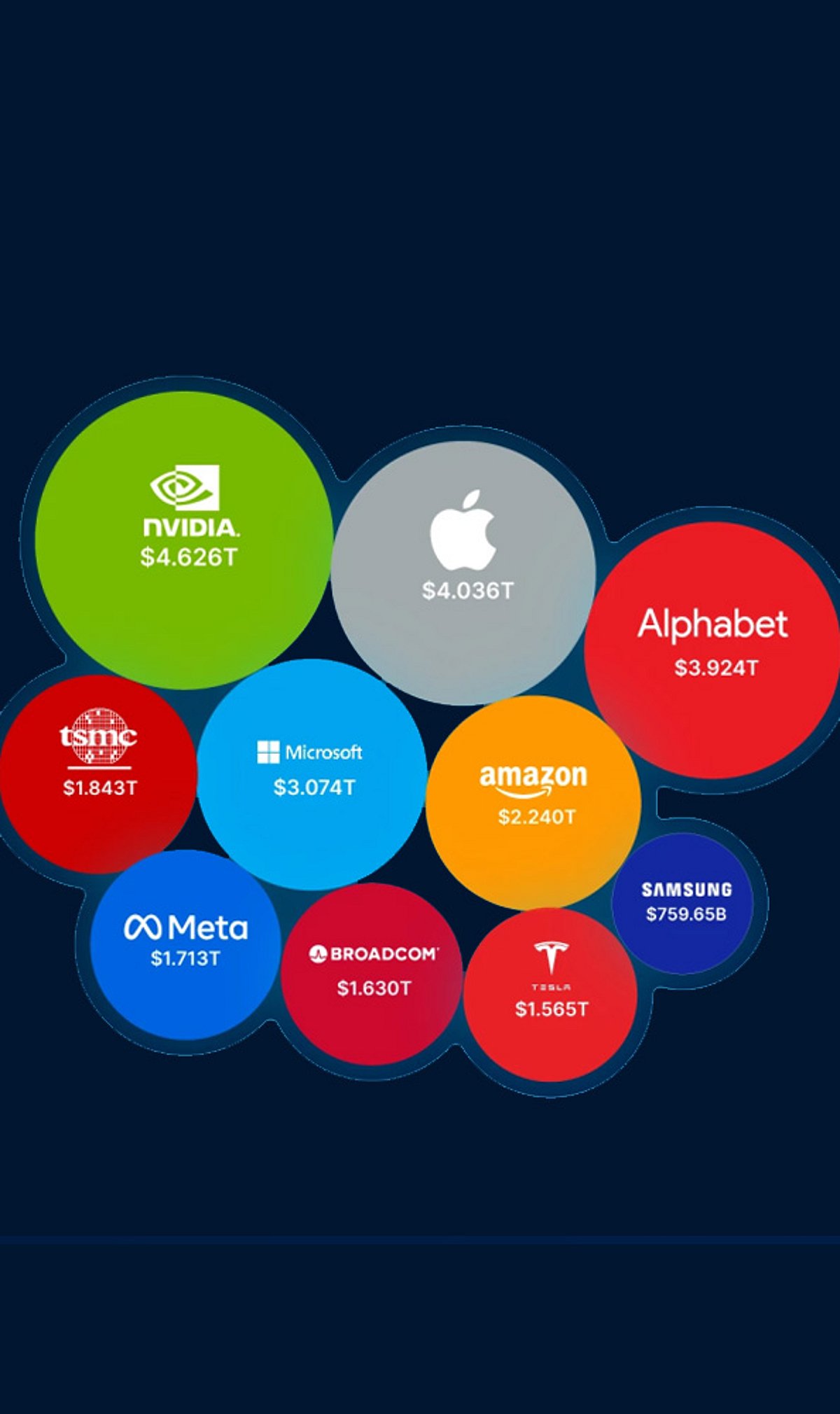
    The world’s most valuable companies continue to reshape industries and drive global economic growth. Based on market capitalization, here are the top 10 publicly traded companies as of the latest data.

    1. Apple – One of the world’s most valuable companies, driven by iPhone, services, wearables, and a loyal global customer ecosystem.
    2. NVIDIA – Dominates AI chip manufacturing with GPUs powering artificial intelligence, cloud computing, gaming, and high-performance data centers worldwide.
    3. Microsoft – Global software leader generating growth through Azure cloud services, Office productivity tools, enterprise software, and artificial intelligence innovations.
    4. Alphabet – Parent company of Google, YouTube, Android, and Google Cloud, maintaining leadership in digital advertising and artificial intelligence technologies.
    5. Amazon – Global e-commerce and cloud computing giant with AWS, logistics leadership, AI investments, and expanding digital service offerings worldwide.
    6. TSMC – World’s largest semiconductor foundry manufacturing advanced chips for leading technology companies powering smartphones, AI systems, and computing devices.
    7. Broadcom – Leading semiconductor company supplying networking, AI infrastructure, broadband, and enterprise software solutions for global technology markets.
    8. Saudi Aramco – World’s leading energy company generating substantial revenue through oil production while investing in energy transition and sustainability initiatives.
    9. Tesla – Electric vehicle pioneer expanding through battery technology, autonomous driving, energy storage solutions, and sustainable transportation innovation globally.
  • How AI Is Transforming 10 Key Accounting and Finance Roles by 2026

    How AI Is Transforming 10 Key Accounting and Finance Roles by 2026

    Artificial intelligence is rapidly reshaping the accounting and finance landscape. By automating repetitive tasks like invoice processing, bank reconciliations, and report generation, AI frees professionals to focus on analysis, strategy, and decision-making. By 2026, the value of an accountant will lie not in number-crunching but in interpreting data and driving business insights. Here are the 10 roles evolving fastest under AI’s influence.

    1. Bookkeepers Become Financial Reviewers

    AI-driven software now automatically records payments, reconciles bank statements, and organizes financial records. Bookkeepers shift from data entry to reviewing records, correcting exceptions, and ensuring accuracy.

    2. Accounts Payable Staff Manage Business Relationships

    Invoices are read, matched with purchase orders, and checked for duplicates by AI with minimal human input. AP teams now focus on supplier communication and resolving payment issues.

    3. Accounts Receivable Teams Optimize Cash Flow

    AI algorithms predict which clients may pay late and suggest optimal contact times. Receivables staff use these insights to improve cash flow while maintaining customer relationships.

    4. Financial Analysts Tell the Story Behind the Numbers

    AI processes vast data sets in minutes, identifying key trends. Analysts interpret these trends and guide business leaders toward informed decisions.

    5. Auditors Focus on Risks, Not Random Sampling

    Instead of examining samples, auditors use AI to analyze entire datasets. Technology flags anomalies; auditors investigate and assess risk.

    6. Tax Professionals Become Trusted Advisors

    AI speeds tax preparation by spotting deductions, ensuring compliance, and tracking regulatory changes. Tax pros now offer strategic planning and navigate complex issues that require human judgment.

    7. Payroll Professionals Act as Facilitators

    Payroll software automates salary calculations, deductions, and filings. Payroll staff concentrate on employee concerns, compliance, and adapting to policy changes.

    8. Financial Controllers Focus on Internal Controls

    Monthly reporting, once a manual grind, is automated. Controllers now oversee internal controls, financial performance, and accurate report preparation.

    9. FP&A Professionals Influence Business Strategy

    FP&A teams use AI for predictive modeling and scenario analysis. They move beyond budgeting to help managers evaluate risks and investment opportunities.

    10. CFOs Transform Businesses

    With real-time AI data, CFOs go beyond approving reports to shaping business strategy, exploring growth options, and leading digital transformation.

    Looking Ahead

    AI does not eliminate the human element in finance. Companies still need professionals who can analyze numbers and grasp the big picture. As automation becomes core, the most valuable specialists will combine accounting with critical thinking and business acumen. Finance jobs will become more strategic, making human insight more important than ever.

  • Best Mutual Funds in India for 2026: High Returns with Lower Risk

    Best Mutual Funds in India for 2026: High Returns with Lower Risk

    As Indian investors look ahead to 2026, selecting the right mutual funds is crucial for balancing growth and stability. The following funds have been identified for their consistent performance, smart diversification, and risk management. Whether you are a conservative investor or seeking higher growth, these options cater to a range of financial goals.

    Parag Parikh Flexi Cap Fund

    This flexi-cap fund is known for its diversified investing approach, delivering strong long-term returns through disciplined stock selection across market caps.

    HDFC Balanced Advantage Fund

    By dynamically balancing equity and debt, this fund helps investors manage market volatility while targeting steady wealth creation over the long term.

    SBI Contra Fund

    Employing a value-oriented strategy, SBI Contra Fund invests in undervalued companies with strong recovery potential, aiming for long-term growth across sectors.

    UTI Nifty 50 Index Fund

    Ideal for passive investors, this fund tracks the Nifty 50 Index, offering low-cost exposure to India’s top companies with consistent long-term performance.

    ICICI Prudential Bluechip Fund

    Focused on established large-cap companies with stable earnings, this fund is suitable for those seeking relatively lower-risk equity investing.

    Nippon India Small Cap Fund

    Investing in promising small-cap companies, this fund offers higher growth opportunities, though it carries greater market volatility and risk.

    Kotak Equity Opportunities Fund

    Diversifying across large and mid-cap stocks, this fund aims for balanced growth with effective risk management through professional fund selection.

    Axis ELSS Tax Saver Fund

    Combining tax-saving benefits with long-term equity investments, this ELSS fund is attractive for investors seeking wealth creation and deductions under Section 80C.

    Choose Based on Your Goals

    Financial experts advise selecting mutual funds according to your personal financial goals, investment horizon, and risk tolerance, rather than relying solely on historical returns. Always review fund performance and consult a financial advisor before investing.

  • Daily Briefing: Cambricon’s AI Chip Ambitions, UK Student Loan Relief, Crypto-Banking Integration, India SpaceTech Boom, and Spur’s $200M Security Raise

    Daily Briefing: Cambricon’s AI Chip Ambitions, UK Student Loan Relief, Crypto-Banking Integration, India SpaceTech Boom, and Spur’s $200M Security Raise

    Good morning! Artificial intelligence, space technology, crypto finance, and education dominate today’s headlines. From China’s AI chip ambitions and India’s booming SpaceTech ecosystem to fresh student loan reforms in the UK and a major AI security funding round, here are the biggest developments you need to know.

    What’s New Today?

    Chinese artificial intelligence chipmaker Cambricon has released an audacious revenue target tied to employee incentives. The UK government has announced new steps toward alleviating the student loan repayment burden, while the cryptocurrency community is seeking ways to integrate more deeply into the traditional banking system. Indian SpaceTech startups have raised their highest investment levels ever, while AI security company Spur raises $200 million against advanced AI bots.

    Fast Track Insights

    The Chinese domestic AI chip rivalry is heating up through bold growth plans by Cambricon. The UK government is offering more lenient terms to help those repaying student loans. The crypto community is seeking ways to integrate into the banking sector, Indian private space is receiving investments, and AI security is emerging as one of the most appealing investment opportunities.

    Cambricon Releases Bold AI Revenue Target

    The leading Chinese AI chipmaker Cambricon has launched an employee incentive program tied to achieving a target revenue of around $14.8 billion. This initiative aims at enhancing China’s domestic AI chip development industry, considering the current restrictions imposed by the United States on China’s technology.

    Student Loan Forgiveness Comes to the UK

    The UK authorities have announced changes to make student loans easier for graduates to pay off. It will offer more financial freedom while allowing them to deal with the cost of living and debt repayment.

    Banking Sector Faces New Challenges from Cryptocurrencies

    The cryptocurrency industry is attempting to establish stronger connections with the financial sector to facilitate better adoption of digital currency.

    India’s SpaceTech Funding Reaches New High

    India’s private space tech startup ecosystem has received $871 million in cumulative funding to date, showcasing increasing investor interest in satellites, launch capabilities, and space technologies. The government and private involvement are still driving the rapid growth of the industry.

    Spur Raises $200 Million for AI Bot Detection

    AI Security start-up Spur has just raised $200 million in fresh funds aimed at fortifying its technology capable of detecting artificial intelligence-generated bots and any other malicious automated traffic. This is happening at a time when firms have to confront greater challenges associated with the emergence of more sophisticated AI-driven cyberattacks and online fraud.

  • How to Become a CFO in 2026: A 7-Step Career Roadmap

    How to Become a CFO in 2026: A 7-Step Career Roadmap

    The role of Chief Financial Officer (CFO) has evolved far beyond managing financial statements. Today’s CFOs are expected to lead business strategy, oversee digital transformation, manage risk, and drive long-term growth. According to the World Economic Forum’s Future of Jobs Report 2025, analytical thinking, AI literacy, financial management, and leadership are among the most sought-after skills in senior executive ranks.

    7 Foundations to Become a CFO

    1. Build a Strong Educational Foundation

    Start with a bachelor’s degree in accounting, finance, economics, or business administration. Many aspiring CFOs also earn professional credentials such as Chartered Accountant (CA), Certified Public Accountant (CPA), Chartered Financial Analyst (CFA), or an MBA in Finance to strengthen both technical and leadership skills.

    2. Gain Practical Finance Experience

    Most successful CFOs accumulate years of experience across various finance roles, including financial planning and analysis (FP&A), accounting, auditing, taxation, treasury, compliance, and corporate finance. Working with different business units provides a comprehensive understanding of the organization’s operations.

    3. Develop Leadership Skills

    Technical knowledge alone is not enough. CFOs are responsible for managing the finance department, collaborating closely with CEOs and boards, and making decisions that affect the entire company. Communication, negotiation, teamwork, and decision-making are critical for executive-level positions.

    4. Learn Digital Finance and AI Tools

    Technology drives finance in 2026. Professionals need familiarity with enterprise resource planning (ERP), business intelligence platforms, automation software, cloud accounting solutions, and AI-powered financial analytics. Gartner reports that finance leaders continue to focus on leveraging AI and automation to improve forecasting and operations.

    5. Understand Business Strategy

    Modern CFOs contribute directly to business growth by evaluating investments, managing capital allocation, assessing mergers and acquisitions, and identifying financial risks. To become a strategic business partner rather than a mere financial controller, leaders must grasp market dynamics and industry trends.

    6. Build Executive-Level Experience

    Most CFOs move through roles such as Finance Manager, Financial Controller, Head of Finance, Director of Finance, or Vice President of Finance. These positions provide experience in budgeting, investor relations, governance, compliance, and strategic planning.

    7. Continue Learning and Expand Your Network

    Finance regulations, accounting standards, tax policies, and technology change constantly. Executive education courses, advanced certifications, industry events, and networking with finance leaders can unlock new career opportunities and keep professionals competitive.

    Outlook

    Demand for skilled finance professionals remains strong as organizations navigate economic uncertainty, digital transformation, and evolving regulatory requirements. While becoming a CFO requires years of experience and continuous learning, developing a strong combination of financial expertise and technology skills can significantly accelerate the path to executive leadership.

    Frequently Asked Questions

    What qualifications are required to become a CFO?

    Most CFOs hold a bachelor’s degree in finance, accounting, economics, or business administration. Professional credentials such as CA, CPA, CFA, or an MBA in Finance can further strengthen technical and leadership capabilities.

    How many years of experience are needed to become a CFO?

    There is no fixed timeline, but most CFOs build several years of experience across accounting, FP&A, auditing, treasury, taxation, compliance, and corporate finance before moving into senior leadership roles.

    Which skills are most important for a CFO in 2026?

    Financial expertise, analytical thinking, communication, leadership, risk management, strategic planning, and decision-making remain essential. Knowledge of AI, automation, ERP systems, and financial analytics is also increasingly important.

    Which roles can lead to a CFO position?

    Common stepping-stone roles include Finance Manager, Financial Controller, Head of Finance, Director of Finance, and Vice President of Finance. These positions provide exposure to budgeting, governance, investor relations, and strategy.

    Can someone become a CFO without a CA qualification?

    Yes, a CA qualification is valuable but not mandatory in every organization. Professionals with strong finance experience, business knowledge, leadership skills, and credentials such as an MBA, CPA, or CFA can also reach CFO positions.


  • Walmart Shares Steady as E-Commerce and Grocery Revenue Drive Quarterly Gains

    Walmart Shares Steady as E-Commerce and Grocery Revenue Drive Quarterly Gains

    Walmart stock closed at $109.47 on Friday, July 24, gaining about 1% during the session. The shares traded between $108.03 and $109.54, while the company’s market value stood near $876 billion. Trading volume reached about 18.4 million shares during Friday’s regular session. Investors continued to assess Walmart’s latest results, institutional activity, analyst targets, and annual outlook.

    The retailer reported stronger sales across its main divisions during the quarter ended April 30. Revenue reached $177.75 billion, up 7.3% from a year earlier. Adjusted earnings matched market estimates at $0.66 per share. Walmart also kept its full-year outlook unchanged, despite higher distribution and fulfillment fuel costs. Grocery demand and increased customer traffic supported its core US operations.

    Walmart Stock Tracks Higher Quarterly Sales

    Walmart recorded $175.68 billion in net sales, compared with $163.98 billion in the prior-year quarter. Operating income increased 5% to $7.49 billion, while net income attributable to Walmart rose to $5.33 billion. GAAP earnings reached $0.67 per share. The gross profit rate edged up to 24.3% from 24.2%, while adjusted operating income grew 5.1% in constant currency.

    Walmart US net sales rose 4.5% to $117.17 billion. Comparable sales excluding fuel increased 4.1%, supported by a 3% rise in transactions. E-commerce contributed about 530 basis points to comparable sales growth. Walmart US e-commerce sales increased 26%, driven by store delivery, marketplace activity, and advertising. President and CEO John Furner cited “better shopping experiences, a broader assortment, and faster delivery.”

    Digital Businesses Support Segment Growth

    Global e-commerce sales increased 26% during the quarter, while the advertising business grew 37%. Walmart US advertising rose 36%, including a 44% increase at Walmart Connect excluding Vizio. Global membership fee revenue advanced 17.4%. Moreover, Walmart said improved e-commerce economics, Walmart+ growth, and other income supported adjusted operating income in its US business.

    Meanwhile, Walmart International net sales increased 18% to $35.11 billion. Constant-currency sales rose 10.1%, while operating income increased 23.9% to $1.60 billion. Sam’s Club US net sales climbed 6.1% to $23.41 billion. Its e-commerce sales rose 23%, while transactions increased 6.2%. Membership fee revenue grew 5.6% as member counts, renewals, and Plus memberships increased.

    Cumberland Cuts Stake as Guidance Holds

    Cumberland Partners reduced its Walmart position by 180,441 shares, or 30.1%, during the first quarter. The investment manager held 419,100 shares worth about $52.09 million at March 31. Walmart ranked as its fifth-largest reported position and represented about 4% of the portfolio. The SEC filing lists the shares under two investment-discretion categories, which together form the total holding.

    Separately, Walmart US Chief David Guggina sold 11,978 shares at an average price of $119.82 on June 10. The sale followed a Rule 10b5-1 trading plan adopted in March. Walmart expects second-quarter net sales to rise 4% to 5% in constant currency and forecasts adjusted earnings of $0.72 to $0.74 per share.

    The company retained its fiscal 2027 adjusted EPS range of $2.75 to $2.85. Recent analyst targets also stood above Friday’s closing price. RBC Capital maintained a $137 target on July 22, while Goldman Sachs held a $154 target on July 17. Morgan Stanley maintained a $140 target in late June, according to recent analyst tracking data.

  • Anthropic Hires Investor Relations Director at $600K Salary as IPO Nears

    Anthropic Hires Investor Relations Director at $600K Salary as IPO Nears

    Anthropic, the artificial intelligence company behind Claude, is strengthening its preparations for a public stock market listing by hiring a senior investor relations executive. The role, Director of Investor Relations, comes with a base salary ranging from $425,000 to $600,000 per year, according to a job listing reviewed by the Times of India.

    The new director will be responsible for shaping how Anthropic communicates its growth story to Wall Street. Key duties include building the company’s investment narrative, meeting with institutional investors, and serving as a liaison between company leadership and the financial community. The hire will also track AI industry trends and explain how major business decisions could impact Anthropic’s stock and long-term growth prospects.

    The position reports to Kenneth Dorell, who joined Anthropic in June as Head of Investor Relations after previously leading investor relations at Meta. The role opened after the company’s earlier investor relations lead departed earlier this year.

    Anthropic has experienced rapid growth over the past year. Enterprise adoption of tools like Claude Code has pushed annualized revenue to $47 billion as of May, making it one of OpenAI’s most formidable competitors. However, the company must convince public investors that its high valuation is justified given the enormous costs of training advanced AI models. As a public benefit corporation, Anthropic also faces the challenge of balancing investor returns with its commitment to building AI safely.

    The job listing underscores the growing importance of investor communication for AI companies approaching public markets. Firms like Anthropic now need to articulate not only their technological capabilities but also their governance and long-term strategy to a broader investor base as competition in the AI sector intensifies.

  • Prop Firm Branding in 2026: Why Identity Is the New Differentiator

    Prop Firm Branding in 2026: Why Identity Is the New Differentiator

    Two years ago, a prop firm could compete almost entirely on price and payout percentage. In 2026, that is no longer enough. The market has grown too crowded, the challenge model too easy to copy, and traders too experienced to be won over by a discount code alone. What is left to compete on, increasingly, is brand.

    The prop trading space has turned into one of the busiest corners of retail finance, with new firms launching every week and established firms fighting to hold onto the traders they already have. That growth has flattened the technology gap between operators. Most firms now run on similar systems, risk engines, and challenge structures, which means the underlying product rarely explains why a trader chooses one firm over another. Branding has moved from a finishing touch to the deciding factor.

    The Technology Gap Has Closed, So the Brand Gap Remains

    A prop firm launched a few years ago needed months, and often a technical team, just to get a working challenge platform online. In 2026, that same firm can be live within a week using a white label provider, complete with a risk engine, trader dashboard, and payment system already built. This shift has been good for market growth and difficult for differentiation. When every operator can access the same underlying technology, the technology stops being a selling point. Traders comparing two prop firms with nearly identical profit splits and drawdown rules are left judging the one thing that is not interchangeable: how each firm presents itself. A profit split looks the same on every pricing page regardless of which firm is offering it. A firm that traders actually remember looks unique in its look and feel.

    Trust Is Decided Before a Trader Ever Pays for a Challenge

    The prop trading industry still carries some trust problems. Firm closures and abrupt rule changes have made traders more careful, not less. Most of a firm’s relationship with a trader plays out before any money changes hands, at the level of the website, the onboarding email, and the first look at the dashboard. A generic template, a stock photo homepage, or colors that do not match between the marketing site and the trader portal read as warning signs to experienced traders, whether or not the firm behind them is legitimate. In a market where firms can disappear as quickly as they arrive, a polished and consistent presence has become one of the few signals a trader can judge before ever handing over a challenge fee.

    Branding Now Extends Well Past the Logo

    For prop firms, branding is no longer a logo and a color palette applied to an existing template. It shows up on the challenge rules page, in the payout confirmation email, inside the trader dashboard, and at every touchpoint a trader interacts with after signing. Prop firms that keep one consistent identity across the website and trader dashboard tend to see stronger retention, because the experience feels like a single product rather than two systems bolted together. Also, firms that pour resources into the marketing site while treating the dashboard as an afterthought often lose traders in the first month, simply because the login experience does not match what was promised. The same logic applies to affiliate and partner marketing, where a prop firm with a clear and consistent identity gives its partners something recognizable to promote, while a generic one blends into the crowded feeds partners are already posting to.

    Why Operators Are Prioritizing Brand Identity in 2026

    A growing number of prop firm operators are treating brand identity as an early decision rather than a later one. Building a distinct visual identity used to require an agency engagement running into the tens of thousands of dollars and a development timeline measured in months, an investment few early-stage operators could justify before a single challenge sale. That cost structure is changing. Branding tools built specifically for prop firm operators, such as PropGenie powered by PropAccount.com, now let an operator generate a fully branded website and a matching trader dashboard with a firm’s name, logo, and color palette. No agencies or developers are involved.

    The larger shift is not the tool itself but what it reflects about the market. Branding is no longer optional polish that a prop firm adds once it can afford to. It has become one of the first decisions an operator makes, alongside the challenge structure and the profit split, because in a market this crowded, the brand is often the one thing traders can actually tell apart. Heading into the rest of 2026, the operators who treat their identity as part of the product, not a layer applied on top of it, are the ones best positioned to hold onto the traders they spend so much to acquire.

  • Gold Prices Dip as Brent Crude Trades Above $100, Fueling Rate Hike Expectations

    Gold Prices Dip as Brent Crude Trades Above $100, Fueling Rate Hike Expectations

    Gold prices edged lower on the Multi Commodity Exchange (MCX) on July 24 as Brent crude oil held above $100 a barrel, intensifying inflation concerns and reinforcing expectations for a September rate hike by the U.S. Federal Reserve.

    Domestic Gold Prices

    MCX August gold futures dropped 0.7% to Rs 1,41,824 per 10 grams. September silver futures also declined, falling 0.88% to Rs 2,17,447. In the physical market, 24K gold fell by Rs 185 to Rs 1,44,330 per 10 grams, while 22K gold declined by Rs 170 to Rs 1,32,300. Prices in Mumbai and Kolkata stood at Rs 1,44,330, Delhi at Rs 1,44,480, and Chennai at Rs 1,44,330.

    US Gold and Precious Metals

    Spot gold slipped 0.4% to $4,030.09 per ounce, extending losses after a 2% drop in the previous session. U.S. gold futures for August delivery were also 0.4% lower at $4,033.20. Spot silver fell 0.7% to $57.29 per ounce but was on track for a weekly gain of 2.5%. Platinum dropped 1.3% to $1,579.49, and palladium declined 1.5% to $1,237.50, both heading for a weekly loss.

    Key Levels to Watch

    According to the CME FedWatch Tool, traders now see an 81% probability of a quarter-point rate hike in September. Elevated crude oil prices above $100 are adding to inflation pressures, strengthening the case for tighter monetary policy.

    GoldSilver Central Managing Director Brian Lan noted, “In the short term, we expect more volatility… gold has been trading between $3,980 and about $4,170 and has been stuck in this range for weeks. Every time prices hit close to $4,000 or slightly below, we see big buyers coming to buy it back up.”

    Technically, XAU/USD trades around $4,030 and remains capped below the 21-day simple moving average (SMA) at $4,068.50 and the 50-day SMA at $4,231.04. The Relative Strength Index (RSI) sits near 44, indicating neutral-to-soft momentum. Immediate resistance is at $4,068.50, followed by the 50-day SMA near $4,231.04. A break above that would face further resistance at the 100-day SMA ($4,479.88) and the 200-day SMA ($4,494.74), which form a dense zone that needs to be reclaimed to ease the broader bearish tone.