Tag: generative AI

  • Why AI’s Efficiency Bottleneck Is the Data Pipeline, Not the Model

    Why AI’s Efficiency Bottleneck Is the Data Pipeline, Not the Model

    The machine learning industry is grappling with a problem that rarely makes headlines but consistently derails production deployments: data pipeline failure. Gartner’s July 2024 forecast projected that at least 30% of generative AI projects would face abandonment after proof of concept, with poor data quality and inadequate infrastructure visibility among the leading causes. For organizations building perception models — systems that must interpret human movement, expression, and gesture with millisecond precision — the consequences of pipeline failures are immediate and expensive.

    Rahul Rathi encountered this problem at scale during his tenure at Meta, where he was responsible for delivering the data infrastructure that powered the face tracking and eye tracking systems at the heart of Quest Pro, Meta’s flagship mixed reality headset launched in October 2022. The measurement framework he designed to solve it — treating the entire pipeline as a connected, instrumented system rather than a collection of discrete stages — was subsequently adopted as the internal standard for data-centric machine learning development across Meta’s perception teams, influencing how multiple engineering organizations approached pipeline measurement for production-critical AI models. That same methodology now informs his work governing frontier model training infrastructure at Microsoft AI, where he currently serves as a Principal AI Data Ops Technical Program Manager.

    Measuring What Others Overlooked

    Face tracking and eye tracking systems require extraordinary data precision. A single corrupted dataset can degrade model behavior in ways that are invisible during training but immediately apparent to users — avatars displaying expressions that feel subtly wrong, or gaze models that fail under real-world lighting conditions. Traditional machine learning pipelines measured data volume and final model accuracy but provided little visibility into degradation occurring between collection and training. Teams frequently discovered quality problems only after dedicating weeks to training runs using compromised inputs.

    Rathi’s response was to redesign how the pipeline itself was measured. He introduced a data funnel framework that defined specific stages tracking data flow, quality degradation, drop-off rates, and readiness from initial acquisition through model training. Each stage included quantitative thresholds determining whether data met requirements for progression. Teams could identify bottlenecks and quality regressions far earlier than existing monitoring permitted, shifting measurement upstream to prevent the costly late-stage rework that had characterized previous programs.

    “We defined intermediate indicators revealing where data degraded, stalled, or failed to meet readiness criteria,” Rathi explains. “Teams could correct issues in hours rather than discovering problems after weeks of wasted compute cycles.”

    The practical outcome at Quest Pro was measurable. The framework accelerated model readiness for the October 2022 launch and subsequently became the recognized internal standard across Meta’s perception teams. Engineers working on hand tracking, Codec Avatars, and augmented reality applications implemented the same funnel-based approach — establishing a consistent methodology across Meta’s computer vision data infrastructure that represented a departure from conventional practice. The pattern of building measurement upstream into the pipeline, rather than relying on downstream model accuracy as the primary quality signal, influenced how subsequent programs were structured from their inception.

    The broader significance sits within a well-documented industry challenge. The global VR headset market reached $12.6 billion in 2024, with analysts projecting growth to $38.4 billion by 2030 as enterprises deploy immersive technologies requiring sophisticated perception models. The competitive pressure on perception model quality — and therefore on the data infrastructure supporting it — is only intensifying.

    Infrastructure Economics Demand New Approaches

    Quest Pro represented one application of Rathi’s measurement thinking. His subsequent work at Microsoft AI addresses challenges operating at vastly different scales. Training large language models and multimodal systems demands coordination across thousands of GPUs consuming electricity measured in megawatts. Industry estimates place OpenAI’s compute spending at approximately $3 billion for training in 2024, with inference costs adding another $1.8 billion. Individual H100 GPUs carry purchase prices near $25,000 per unit. Even at cloud pricing that declined from peak rates near $10 per hour to approximately $3 per hour across 2024 and 2025, training frontier models requires commitments measured in tens of millions of dollars.

    These capital commitments heighten the cost of inefficiency dramatically. Industry research has documented that GPU idle time in large-scale training environments commonly represents 20 to 40% of total compute capacity — waste that compounds across thousands of GPUs operating continuously and remains largely invisible without the right measurement infrastructure.

    Rathi developed granular compute efficiency metrics that expose GPU underutilization, idle time, and scheduling inefficiencies across distributed training systems. His workload-aware metrics tie directly to training behavior, connecting infrastructure usage to specific model training decisions. The practical outcome was a fleet-wide GPU utilization improvement from 75% to 95% across Microsoft AI’s compute infrastructure — a 20-percentage-point gain that, across a GPU fleet of the scale Microsoft AI operates, represents a capital efficiency improvement measurable in the hundreds of millions of dollars based on publicly available GPU pricing and cluster scale data.

    “GPU availability, utilization efficiency, and orchestration have become critical bottlenecks,” Rathi notes. “We lead cross-functional programs coordinating GPU cluster readiness, Kubernetes and SLURM-based scheduling, and distributed training workflows across research, data engineering, and infrastructure teams.”

    The methodology is structurally parallel to his earlier work at Meta. Where the Quest Pro framework tracked data degradation across pipeline stages, his compute metrics track utilization degradation across training workflows — shifting organizations from reactive cost control to proactive efficiency engineering while preserving model performance and delivery timelines.

    A Field Divided on Priorities

    Not everyone embraces infrastructure optimization as the primary lever for improving machine learning systems. Dr. Andrew Ng, Adjunct Professor of Computer Science at Stanford University and founder of DeepLearning.AI, has made a widely noted distinction between model-centric and data-centric approaches to AI development. Through his advocacy for the Data-Centric AI movement and published course materials at DeepLearning.AI, Ng has argued for shifting the industry’s focus toward systematic data quality improvement rather than model architecture iteration alone — a position that aligns with Rathi’s pipeline measurement philosophy. At the same time, Ng and others have noted that measurement systems optimized for current architectures may not generalize as the field evolves, and that organizations risk over-investing in infrastructure tuned to today’s problems.

    The concern has real-world grounding. DeepSeek’s V3 model reportedly achieved dramatic reductions in training costs through architectural innovations rather than hardware optimization. Software advances can and do outpace infrastructure efficiency gains, suggesting the two approaches are complements rather than substitutes.

    Rathi acknowledges the tension directly. “Visibility into resource utilization enables faster experimentation,” he responds. “Whether training transformers or future architectures, teams benefit from understanding where compute goes and why systems underperform expectations. Measurement is not an alternative to architectural innovation — it is what makes architectural innovation faster.”

    Industry analysts project AI infrastructure spending will reach approximately $7 trillion by 2030, with inference workloads consuming an increasing share of total compute. The organizations best positioned to operate at that scale will be those that have built the measurement infrastructure to govern it.

    Implications for AI’s Industrial Future

    Data pipeline complexity will intensify as AI adoption expands beyond technology companies. Healthcare organizations training medical imaging models face stringent privacy requirements that complicate data collection. Financial institutions building fraud detection systems must satisfy regulatory oversight demanding explainability. Manufacturing companies deploying computer vision for quality control require models robust to real-world variation absent from controlled training sets. Each domain introduces specialized requirements that generic infrastructure cannot address without measurement frameworks adapted to their specific constraints.

    The machine learning market reached an estimated $113 billion in 2025, with analysts forecasting growth to $503 billion by 2030. Gartner’s analysis of generative AI project failures points directly to inadequate data quality and infrastructure visibility as primary contributors to abandonment — exactly the gaps that Rathi’s frameworks address. Real-world deployments encounter messy data, inconsistent formats, and unexpected edge cases that carefully curated training sets rarely capture, making upstream measurement not a luxury but a precondition for production reliability.

    His work also carries governance implications extending beyond efficiency. The European Union AI Act demands technical documentation proving compliance with safety and fairness standards. Measurement infrastructure that surfaces bias in training data, detects distribution shifts, and provides audit trails documenting development decisions is becoming a regulatory requirement, not merely an engineering best practice. The infrastructure Rathi has built — providing auditable evidence of data quality decisions, pipeline behavior, and compute governance across training workflows — represents exactly the kind of technical documentation these frameworks require. Organizations building frontier AI systems without it will face increasing difficulty demonstrating compliance as enforcement scales.

    “We help advance responsible AI practices by embedding quality, efficiency, and governance considerations into platform and infrastructure decisions,” Rathi observes. “Continuous improvement of operational rigor across the AI lifecycle requires visibility into what is actually happening inside these complex systems.”

    A Consistent Methodology Across Scales

    The trajectory from Quest Pro’s perception models to frontier language models illustrates how Rathi’s measurement approach scales across applications. Techniques developed for tracking face data quality translate directly to monitoring the massive datasets used in language model training. Efficiency metrics originally designed for GPU utilization in computer vision workloads apply equally to transformer training runs consuming weeks of continuous compute. The fundamental principles remain consistent even as specific implementations adapt to new contexts.

    As training costs escalate, compute efficiency metrics have transitioned from operational considerations to strategic imperatives. Organizations that can demonstrate concrete return on infrastructure investment — through measurable utilization improvements and deferred capital expenditure — are better positioned to justify continued AI investment to boards increasingly scrutinizing spending.

    “Looking ahead, my work helps prepare Microsoft AI for future industry needs by shifting compute platforms from reactive scaling to proactive, efficiency-driven design,” Rathi reflects. “This foundation supports sustainable AI growth, faster experimentation, and responsible deployment as model sizes and demand continue to increase.”

    Through his contributions across data-centric machine learning and large-scale compute efficiency, Rahul Rathi has advanced the operational foundations upon which production AI systems depend. The frameworks he developed — first under the competitive pressure of a flagship consumer hardware launch at Meta, and now at the frontier of large language model development at Microsoft AI — have moved from internal tools to adopted standards. In an industry where the gap between research capability and production reliability remains one of the defining challenges, his work addresses that gap at the infrastructure layer where it is hardest to solve and most consequential when left unaddressed.

  • Midjourney Demands Disney, Universal, and Warner Bros Disclose Internal AI Projects in Copyright Battle

    Midjourney Demands Disney, Universal, and Warner Bros Disclose Internal AI Projects in Copyright Battle

    In a significant escalation of the ongoing copyright dispute, the AI image generator Midjourney has asked a federal court to compel Disney, Universal, and Warner Bros. Discovery to hand over detailed records of their own internal use of generative AI technology. The demand represents an aggressive tactical shift that could reshape how the courts evaluate evidence in AI-related copyright litigation.

    How the Lawsuit Reached This Point

    Disney and Universal originally filed suit against Midjourney in June 2025, alleging its models could produce unauthorized renditions of iconic copyrighted characters such as Bart Simpson and Darth Vader. Warner Bros. Discovery followed in September 2025, adding its own stable of characters including Batman and Superman. The studios sought an injunction and statutory damages of up to $150,000 per infringing work. Midjourney has consistently argued that its use of publicly available images for training constitutes fair use.

    What Midjourney Is Now Demanding

    The case has moved into the discovery phase, the stage where both parties exchange evidence. Midjourney is now seeking far broader disclosure than initially granted by a court order in June 2026, which limited the studios’ obligations to AI use in consumer products only. The company is asking the court to remove that restriction entirely and require the studios to produce internal documents covering AI business strategies, training datasets, model weights, board-level presentations, and every prompt that studio employees have entered into Midjourney’s platform — not just the specific prompts linked to the allegedly infringing images at the heart of the case.

    The Legal Theory Behind the Request

    Midjourney’s motion relies on the legal doctrine of “unclean hands”: if the studios themselves use generative AI internally for storyboarding or early-stage concept work without properly licensing every image, that could indicate the industry treats such AI training as standard, unlicensed practice. In its court filings, Midjourney contends that this evidence could show the studios are engaging in the very conduct they are suing over. The studios’ lead attorney, David Singer, has dismissed the request as a “fishing expedition,” maintaining that the case is narrowly about stopping unauthorized copying and distribution of copyrighted characters, not about halting AI development or shutting down Midjourney.

    Why This Discovery Fight Matters Beyond This Case

    Legal observers are closely watching the outcome, as the court’s ruling on what evidence is admissible could set a precedent for numerous other AI copyright cases moving through the judiciary. If Midjourney succeeds in obtaining the studios’ internal AI records, it could fundamentally alter how courts weigh fair use arguments and industry-custom defenses in future disputes between AI companies and content owners. For now, the case stands as a pointed illustration of a central tension in the generative AI industry: media companies suing over unauthorized AI training while facing questions about their own internal AI practices.

    This article is based on reporting originally published by Analytics Insight on July 7, 2026.

  • 2026’s Best AI Agents for Full-Funnel Ad Campaign Management

    2026’s Best AI Agents for Full-Funnel Ad Campaign Management

    AI agents have evolved from simple chatbots into autonomous marketing assistants that can manage nearly every aspect of modern advertising. In 2026, these tools are revolutionizing ad campaign management by automating end-to-end marketing processes and optimizing campaigns through data-driven insights. From content creation and audience targeting to budget allocation and performance reporting, AI agents help advertisers work more effectively across digital advertising spaces.

    Top AI Agents for Ad Campaign Management

    The following AI agents empower businesses to handle campaign planning, creative production, audience segmentation, A/B testing, and performance monitoring across social media and other channels. By combining generative AI with marketing automation and analytics, they enable marketers to focus on strategy rather than repetitive tasks.

    OpenAI ChatGPT Agent

    ChatGPT by OpenAI serves as a versatile tool for ad campaign management, excelling in audience research, campaign planning, and content generation. Marketers use it to produce ad copy, brainstorm campaign ideas, analyze performance metrics, summarize reports, and integrate business processes.

    Google Gemini for Marketing

    Google Gemini for Marketing integrates with Google Ads to enhance search campaigns and Performance Max projects. It supports keyword research, audience insights, creative suggestions, bid optimization, and campaign analysis. By combining Google Ads with generative AI, Gemini helps marketers boost campaign optimization and respond quickly to shifting customer behavior.

    Salesforce Agentforce

    Salesforce Agentforce merges CRM data with AI advertising, allowing for personalized customer experiences, automated lead nurturing, audience segment identification, and seamless coordination between sales and marketing teams. It improves lead conversion through deep insights into customer interactions.

    Microsoft Copilot for Advertising

    Microsoft Copilot for Advertising simplifies campaign management within Microsoft Advertising and integrates with Microsoft 365 productivity tools. It assists in creating campaigns, analyzing reports, identifying audience trends, and generating advertising recommendations. Automated reporting and workflow support reduce manual effort, letting teams focus on strategy and optimization.

    Adobe Experience Platform Agent

    The Adobe Experience Platform Agent unifies customer data, content creation, and omnichannel marketing into a single AI system. It enables creative asset generation, customer segmentation, real-time personalization, and campaign management. By continuously analyzing customer behavior, it helps companies make their advertisements more relevant.

    HubSpot Breeze AI

    HubSpot Breeze AI enhances marketing automation by integrating CRM functionality with AI-driven campaign management. It automates email marketing, social publishing, lead nurturing, content creation, and campaign analysis within a single platform. Customer insights allow marketers to personalize engagement and assess performance without switching tools.

    Jasper AI Marketing Agent

    Jasper AI Marketing Agent focuses on creating high-quality marketing content while maintaining brand tone. It generates ad creatives, campaign copy, landing page content, email campaigns, and social media posts across different platforms. Collaboration tools let teams edit and approve AI-created content while preserving brand voice.

    How to Choose the Right AI Advertising Agent

    Marketers should evaluate compatibility with platforms such as Google Ads, Meta Ads, LinkedIn, TikTok, and X, as well as CRM and analytics integrations. Pricing, scalability, automation capabilities, reporting quality, and data privacy policies also deserve close attention. Enterprise-level agents can be beneficial for firms with limited advertising budgets. Experienced organizations may prefer user-friendly agents that require no advanced technical background. Ultimately, effective campaigns will always depend on human creativity, ethics, and strategy to maintain authenticity and message relevance.

    Frequently Asked Questions

    1. What is an AI agent in digital advertising? An AI agent is an intelligent software assistant that automates campaign planning, audience targeting, content generation, bid optimization, performance analysis, and reporting, helping marketers execute advertising campaigns more efficiently.
    2. Which AI agent is best for Google Ads campaigns? Google Gemini for Marketing is well-suited for Google Ads, supporting keyword research, Performance Max optimization, campaign recommendations, analytics, and creative suggestions within Google’s ecosystem.
    3. Can AI agents manage campaigns across multiple platforms? Yes. Many AI agents support multi-platform campaign management by integrating with advertising, CRM, analytics, and productivity tools to streamline workflows across several digital marketing channels.
    4. How do AI agents improve campaign performance? They continuously analyze campaign data, recommend optimizations, automate repetitive tasks, personalize customer experiences, improve audience targeting, and generate reports that help marketers make better decisions.
    5. What should businesses consider before adopting an AI agent? Businesses should evaluate platform compatibility, integrations, pricing, scalability, automation features, reporting capabilities, data privacy practices, implementation complexity, and the level of human oversight required.
  • Top AI Video Generators to Explore in 2026: From Pika to Adobe Firefly

    Top AI Video Generators to Explore in 2026: From Pika to Adobe Firefly

    The landscape of AI video generation is advancing rapidly, offering creators powerful tools to produce cinematic content from simple text prompts, images, or existing footage. Whether you’re a filmmaker, marketer, or social media creator, these platforms bring professional-grade video creation within reach. Here are the leading AI video generators to watch in 2026.

    Runway

    Runway enables users to create cinematic AI videos from text, images, and existing footage. Its advanced features include motion tracking, inpainting, and a suite of creative filmmaking tools that empower both beginners and professionals.

    Pika

    Pika transforms simple prompts into engaging short videos with realistic animations, creative visual effects, and smooth transitions. It is designed for rapid content generation, making it a favorite among creators who need quick, high-quality output.

    Google Veo

    Google’s advanced text-to-video model generates realistic, high-quality videos with natural motion, detailed environments, accurate physics, and cinematic storytelling capabilities. Veo is ideal for projects requiring fine-grained control over visual narratives.

    OpenAI Sora

    Sora produces highly realistic videos from detailed prompts, boasting impressive scene consistency, complex camera movements, realistic lighting, and dynamic visual storytelling. It represents a major leap in generative video quality.

    Synthesia

    Synthesia specializes in professional AI avatar videos featuring multilingual presenters, customizable templates, voiceovers, and branding options. It is widely used for training, marketing, and corporate communications.

    HeyGen

    HeyGen creates personalized AI spokesperson videos using realistic avatars, voice cloning, multilingual translations, and customizable scripts. It is built for global business communication and marketing campaigns.

    Luma Dream Machine

    Luma Dream Machine produces realistic AI-generated videos with natural camera movements, detailed environments, lifelike motion, and fast rendering. It is tailored for creative visual storytelling projects.

    Adobe Firefly Video

    Adobe Firefly Video integrates generative AI video creation directly into the Adobe Creative Cloud ecosystem. It enables commercial-safe content generation, editing, and seamless professional production workflows.

    Kling AI

    Kling AI delivers high-quality AI videos with realistic character movements, cinematic visuals, detailed environments, and advanced prompt understanding. It is designed for professional creative applications where quality is paramount.

    These tools represent the cutting edge of AI-driven video production. As the technology evolves, expect even more intuitive interfaces, faster rendering, and greater creative freedom. Explore them to stay ahead in the content creation game.

  • Enterprise AI Raises the Stakes: How to Humanize Generative Output Against Algorithmic Detection

    Enterprise AI Raises the Stakes: How to Humanize Generative Output Against Algorithmic Detection

    The rapid deployment of generative artificial intelligence (GenAI) is transforming enterprise operations worldwide. Businesses across industries now rely on large language models (LLMs) to streamline tasks such as drafting legal documents, forecasting financial data, and scaling B2B marketing communications. Yet this surge in machine-generated text has created a growing divide between automation and the filtering of synthetic content, raising concerns about trust, digital fatigue, and the integrity of communication channels.

    To preserve stakeholder trust and prevent cognitive overload, technology leaders must actively humanize AI outputs. This means injecting cognitive variance into generated text so that it mirrors the natural hesitations, structural asymmetries, and varied pacing of human writing. Without such adjustments, users quickly tire of sterile, predictable content, and detection algorithms flag the machine origin with increasing accuracy.

    Behind the scenes, sophisticated detection algorithms have been embedded into major platforms, search engines, and enterprise security frameworks. These tools audit digital content by measuring two key metrics: burstiness (variation in sentence length and structure) and perplexity (predictability of word choice). Standard generative models optimize for the most likely word sequences, producing low burstiness and low perplexity – a pattern that acts as a digital watermark for detection systems.

    While detection mechanisms were intended to maintain information integrity, they have triggered a systemic problem: a high rate of false positives in enterprise environments. Technical documentation, compliance reports, and legal contracts often demand rigid, predictable language. When human data scientists or technical writers draft such documents, their natural style can mimic low-variance machine patterns, causing authentic work to be incorrectly flagged. This has sparked a technological arms race, pushing enterprises to find solutions that bypass flawed heuristics without compromising data integrity.

    This necessity has given rise to a new category of natural language processing tools known as AI Stealth Writers. Unlike primitive paraphrasing scripts that swap words using synonym databases, these advanced systems operate on a deeper architectural level. They deconstruct the predictable syntactic topology of an LLM draft and rebuild it purposefully, injecting cognitive entropy to obscure the robotic signature. The result is text that bypasses algorithmic detection while delivering a superior reading experience for end users.

    From a strategic business perspective, integrating these linguistic refinement layers is moving from a niche workaround to a mandatory component of the enterprise tech stack. Search engines and B2B communication channels are becoming increasingly hostile toward raw synthetic content, often penalizing domains with high volumes of unedited machine text. The operational speed gained by GenAI is negated if the resulting content is suppressed by algorithms or ignored by clients who recognize its mechanical origin.

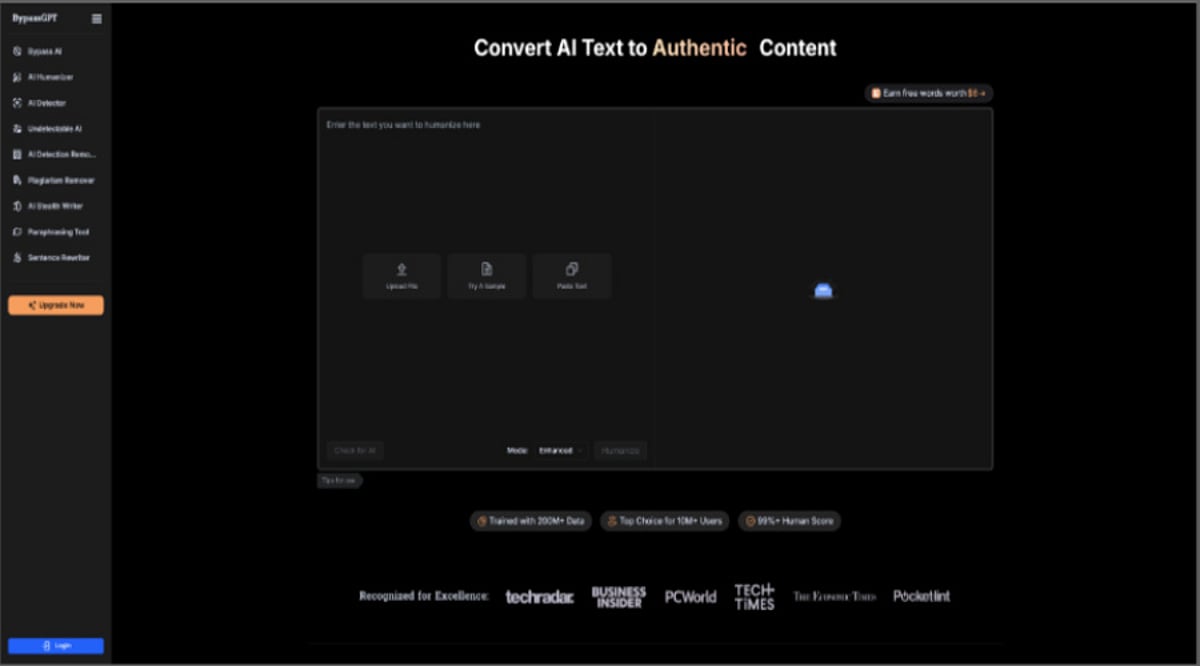
    Looking ahead, continued advances in NLP will enable enterprises to produce descriptive texts that are indistinguishable from human authorship. Platforms like the newly launched BypassGPT are working to bridge the gap between computational efficiency and human-like empathy. Companies that embrace such technologies will gain a competitive edge in today’s regulatory environment and global marketplace.

  • How Agentic AI and Data Modernization Are Building Trustworthy Public Health Systems

    How Agentic AI and Data Modernization Are Building Trustworthy Public Health Systems

    Artificial intelligence is transforming how organizations analyze data, generate insights, and support decision-making, but in high-stakes environments such as public health, success depends on far more than model performance alone. As governments and healthcare organizations increasingly adopt large language models, agentic AI, and advanced analytics, the focus is shifting toward building systems that are transparent, governed, measurable, and capable of delivering reliable results at scale.

    In this interview, Anindita Nath discusses how advances in generative AI, biomedical informatics, and data modernization are reshaping public health and scientific research. With more than a decade of experience developing AI and machine learning solutions across industry and research, they have led initiatives spanning large language models, natural language processing, metadata engineering, and AI-ready data infrastructure. Their work includes co-leading one of the first agentic AI deep-research evaluation initiatives in the federal public health space, helping establish early frameworks for the responsible evaluation and adoption of autonomous AI systems.

    Drawing on experience building AI systems for disease surveillance, biomedical research, and large-scale public health data platforms, Nath shares insights into the challenges of governing AI in mission-critical environments, modernizing legacy data systems, and ensuring that intelligent technologies augment human expertise rather than replace it. They also explore the future of trustworthy AI, explaining why robust evaluation, transparency, and interdisciplinary collaboration will be essential as AI becomes increasingly embedded in healthcare and public health operations.

    Q: Please tell us about your professional journey and what inspired you to pursue a career in data science and artificial intelligence?

    A: My career began in software engineering and enterprise IT digitization, then expanded into computer science research in natural language processing, speech and audio signal processing, statistical machine learning, deep neural networks, and biomedical informatics. I was particularly drawn to AI’s potential to reduce cognitive load in operational environments. My early work in conversational AI and assistive health technologies shaped my view that intelligent systems should go beyond text generation to support information retrieval, knowledge synthesis, and decision support. This perspective continues to guide my work in public health, where AI and modern data engineering can strengthen surveillance, accelerate scientific discovery, and improve evidence-based decision-making.

    Q: Your work spans AI, public health, biomedical informatics, and data modernization. How would you describe your current role and areas of focus?

    A: My current role centers on designing governed, production-oriented AI systems for public health intelligence. My work spans generative AI, large language models, agentic AI enabled system evaluation, disease surveillance, metadata engineering, and AI-ready data infrastructure. I convert fragmented public health and biomedical datasets into structured, provenance-aware assets that support analytics and decision-making. A core priority is ensuring that these systems are measurable, reproducible, privacy-preserving, and operationally useful for analysts, researchers, and public health leaders.

    Q: Over the past decade, what have been some of the most defining moments or achievements in your career?

    A: Several achievements have shaped my professional trajectory. I co-led the first agentic AI deep-research evaluation initiative in federal public health, integrating advanced AI capabilities with governance, safety assessment, and operational validation to inform the agency’s agentic AI adoption strategy. I also led GENEVIC, an Azure OpenAI-enabled biological copilot for genomic data exploration, improving access to complex genomic information while preserving scientific rigor. Additional accomplishments include developing AI-enabled metadata and surveillance tools that reduced manual review burden by almost 50%, publishing first-author research in Bioinformatics, AMIA, ACM, and Speech Prosody venues, mentoring learners across computing and AI, receiving the Generation Google Scholarship in 2020, and being featured among Influential Women in 2026 and several such recognitions that reflect sustained technical performance, leadership, and impact.

    Q: For readers who may be new to your work, what excites you most about the intersection of AI and public health today?

    A: I am most interested in AI’s capacity to move public health from retrospective, static reporting toward interactive, evidence-driven intelligence. Public health decision-making, for example, in disease surveillance monitoring requires integrating heterogeneous signals from surveillance systems, clinical encounters, laboratory testing, immunization records, demographic datasets, scientific literature, and policy guidance. AI can accelerate signal integration and knowledge synthesis when supported by high-quality data, transparent methods, robust validation, and expert oversight. Its value is not to replace public health judgment, but to augment experts’ ability to detect patterns earlier, evaluate uncertainty, and act on stronger evidence.

    Q: You co-led the first agentic AI evaluation initiative in the federal public health space. What motivated this effort, and what were some of the key learnings from the project?

    A: The motivation was clear: before autonomous or semi-autonomous AI systems can support high-stakes public health work, they must be carefully evaluated. We needed to understand how agentic AI performs across complex questions involving epidemiology, informatics, policy guidance, and legal review. A key learning was that accuracy alone is not enough. Evaluation must include relevance, completeness, source reliability, safety, reproducibility, compliance screening, human subject-matter expert review, documentation of model behavior, source verification, and explicit identification of limitations. Governance must be designed from the beginning, not attached later.

    Q: As organizations increasingly deploy autonomous AI systems, how should leaders approach the challenge of evaluating and governing these technologies in high-stakes environments?

    A: Leaders should treat evaluation as an operational requirement, not a one-time technical test. Autonomous AI systems need clear task boundaries, trusted data sources, audit trails, privacy safeguards, human review, and continuous monitoring. A public health AI system should know whether it is retrieving evidence, summarizing a report, analyzing data, drafting communications, supporting policy planning, or identifying limitations. In high-stakes environments, leaders must ask not only whether a model can answer, but whether the organization can trust, verify, reproduce, and govern that answer.

    Q: You have worked extensively on AI-driven data modernization. What are the biggest challenges public health organizations face when transforming legacy data systems into AI-ready infrastructure?

    A: The biggest challenge is fragmentation. Public health knowledge is often trapped in isolated spreadsheets, inconsistent field definitions, separate dashboards, different reporting timelines, and legacy systems that were not designed for AI. Before AI can be useful, organizations need strong foundations: standardized data models, metadata, provenance, quality checks, access controls, documentation, interoperability, and reliable pipelines. Data modernization is also a workflow and trust challenge. AI-ready infrastructure requires clear accountability so that every output can be traced back to the evidence that produced it.

    Q: Your work has involved leveraging Azure OpenAI, Databricks, and Palantir Foundry for large-scale metadata analysis and knowledge discovery. Can you share a real-world example where these technologies delivered measurable impact?

    A: One example is my work on LLM-enabled metadata exploration and visualization. Through systems such as MetaMation and related enterprise metadata tools, users could ask natural-language questions over complex health surveillance and program-inventory metadata, retrieve relevant information, and generate visual summaries. This reduced manual analyst effort by more than 50% and made siloed metadata more accessible to program managers. GENEVIC was another example: a grounded biological copilot that used curated data, APIs, secure cloud deployment, prompt optimization, and validation so genomic exploration could become more intuitive without sacrificing scientific integrity.

    Q: Looking ahead, how do you see large language models and agentic AI reshaping healthcare, public health surveillance, and government operations over the next five years?

    A: Over the next five years, large language models and agentic AI will likely mature into governed orchestration layers across clinical care, public health surveillance, and government operations. In healthcare delivery, domain-specific agents could support ambient clinical documentation, EHR-integrated decision support, diagnostic triage, longitudinal patient summarization, prior authorization workflows, medication reconciliation, care-gap detection, remote monitoring, and precision-medicine recommendations. More transformative strategies may include multimodal models that integrate clinical notes, imaging, laboratory results, genomics, wearables, and social-risk indicators to enable earlier risk stratification and more personalized intervention planning. In public health, similar systems can strengthen evidence retrieval, epidemiologic signal detection, literature synthesis, metadata discovery, automated reporting, and cross-jurisdictional situational awareness. The most effective implementations will be embedded within secure informatics infrastructure rather than standalone chat interfaces. Their reliability will depend on grounding, provenance tracking, uncertainty estimation, continuous model monitoring, access control, interoperability, and human-in-the-loop review. These capabilities can expand expert capacity, reduce administrative burden, and improve operational responsiveness; however, accountability for interpretation, clinical action, ethics, equity, and final decisions must remain with human experts.

    Q: Beyond your technical contributions, you are actively involved in mentorship and STEM advocacy. What advice would you give to aspiring AI professionals looking to build impactful and purpose-driven careers?

    A: My advice is to develop technical depth alongside a clear sense of purpose. Aspiring AI professionals should build strong foundations in programming, machine/deep learning, AI evaluation strategies, and technical communication while remaining attentive to the communities and decisions their systems are intended to support. My own path has been shaped by perseverance, first-generation challenges, and a commitment to making computing both rigorous and accessible. Through initiatives such as Microsoft TEALS, Girls Who Code, CodePath, AnitaB.org, IEEE, Data for Impact, Women in STEM Network, and CAHSI-related workshops, I aim to help emerging technologists build confidence, strengthen their skills, and see themselves as contributors to the systems that will shape the future.

    Q: If you would like to add or highlight any other interesting insights that we might have missed in our questionnaire, please feel free to do so.

    A: The next phase of AI leadership will require interdisciplinary fluency. Effective AI professionals must pair algorithmic expertise with domain knowledge, ethics, governance, communication, accessibility, and implementation skills. In public health, impact depends on turning technical capability into trusted, practical systems.

  • Top-Paying Tech Skills Employers Will Hire for in 2026

    Top-Paying Tech Skills Employers Will Hire for in 2026

    The demand for AI and machine learning professionals continues to grow across industries, making these skills among the most lucrative in 2026. Cybersecurity experts remain at the top of the pay scale as threats evolve and companies prioritize data protection.

    Cloud computing expertise on platforms like AWS, Azure, and Google Cloud is highly valued, with organizations migrating more operations to the cloud. Data engineers are earning competitive salaries as companies expand their AI initiatives and need robust data pipelines.

    Generative AI application development is creating new career opportunities worldwide, from content generation to automated workflows. DevOps and platform engineering roles continue to offer strong earning potential as businesses seek to streamline software delivery and infrastructure management.

    Blockchain and Web3 expertise remain valuable in specialized technology sectors, particularly in finance and supply chain. AI prompt engineering and automation consulting are emerging as fast-growing skill sets, with companies looking to optimize their use of large language models and robotic process automation.

    Continuous learning and certifications can help professionals stay competitive in the evolving tech market. Investing in these high-demand skills now can position you for top salaries and career growth in 2026.

  • Why Observability and Reliability Are Critical for Enterprise Generative AI Systems

    Why Observability and Reliability Are Critical for Enterprise Generative AI Systems

    Traditional monitoring can confirm that servers are healthy yet still leave engineers blind to why an AI agent made a wrong decision. Ayush Jain, a software engineer who has built large-scale search, machine learning, and distributed systems, explains why observability and evaluation are becoming the foundation of trustworthy AI at enterprise scale.

    An AI agent finishes its task. Every API call returns cleanly, logs are green, dashboards show no errors—yet the answer is wrong. Nobody can explain why. This gap between a system that looks healthy and one that actually performs correctly is the problem Jain has spent his career addressing. He belongs to a group of engineers building the unglamorous layer beneath enterprise AI: the pipelines, traces, and telemetry that let teams see what autonomous systems are really doing.

    “Traditional monitoring can confirm that infrastructure is healthy,” Jain says, “but it often fails to explain why an AI system made a particular decision or produced an unexpected outcome.”

    For two decades, deterministic software left clear fingerprints when it broke: error logs, exceptions, failed health checks. Agentic systems do not work that way. They reason in probabilities, select their own tools, pull in outside context, and plan across multiple steps. These agents introduce entirely new failure modes. “An agent may successfully execute API calls while still producing incorrect outcomes due to flawed reasoning, poor tool selection, or incomplete context,” Jain adds. The pipes all work, but the judgment does not. Standard monitoring stacks, built to watch the pipes, never notice the failure.

    Jain learned this lesson at scales where small problems become expensive. At Bloomberg, he contributed to search and ranking systems supporting hundreds of thousands of user interactions across more than one hundred million documents. A search result that drifts a few points in relevance does not throw an exception, but at that volume it quietly degrades the experience for thousands. To catch such drift, he helped build observability pipelines that processed millions of telemetry events per day—turning raw system exhaust into real-time signals about search quality, user behavior, performance, and anomalies. The goal was not just to confirm machines were up, but to close the distance between an idea that worked in an experiment and a system that held up in production.

    At Microsoft, Jain has focused on AI agent platform infrastructure. The central challenge: failures are now behavioral rather than infrastructural. An agent that calls every API correctly can still choose the wrong tool, reason poorly, or act on incomplete context. So the platform must watch behavior, not just uptime. The systems he worked on capture execution traces, monitor how workflows resolve, collect telemetry about agent conduct, and let teams run the same task across different configurations to see which performs best. This is the difference between knowing a process finished and knowing it finished for the right reasons.

    Jain sees the industry shifting from optimizing model performance to optimizing whole AI systems. “I believe the industry is shifting from optimizing model performance to optimizing AI systems,” he says. For years the scoreboard was the model—a higher benchmark, a better accuracy number. But a benchmark is a single moment, while an agent makes sequences of decisions across tools and steps. Accuracy and precision stop describing what matters. “Agent behavior must be evaluated continuously rather than treated as a one-time model validation exercise,” Jain emphasizes. The metrics that count look less like test scores and more like operations reports: task completion, reasoning quality, tool effectiveness, cost, safety, and alignment with business intent.

    He draws an analogy with cloud computing and Site Reliability Engineering (SRE). “Enterprise AI is entering a phase similar to what cloud computing experienced during the rise of Site Reliability Engineering,” Jain explains. Cloud services eventually stopped being judged solely on speed and started being judged on uptime and latency that everyone could see. AI will follow the same arc, with a new vocabulary of behavioral measures: hallucination rates, reasoning consistency, retrieval effectiveness, policy adherence, and workflow completion. “I believe AI Reliability Engineering will become a foundational discipline,” he says. Companies that build it into their platforms early will hold a real advantage over those that bolt it on after something breaks.

    The attention has long gone to models and clever outputs. But Jain argues the durable problem sits one layer down: in whether anyone can explain, measure, and trust what the system did. “The challenge is no longer simply generating intelligent outputs—it is creating systems that make those outputs explainable, measurable, and trustworthy at scale.” He expects the next generation of enterprise platforms to make observability and evaluation first-class architectural components rather than afterthoughts, with online evaluation, execution traces, and feedback loops catching trouble before users do.

    His conclusion is plain: “Making AI systems measurable, explainable, and reliable is essential for successful enterprise adoption at scale.” The companies treating that as the real engineering challenge are the ones whose AI will still be trusted a year after the demo. The rest are flying on green dashboards, learning the hard way that healthy is not the same as right.

  • Top 7 AI Search Analytics Platforms to Boost Ecommerce Growth in 2026

    Top 7 AI Search Analytics Platforms to Boost Ecommerce Growth in 2026

    AI-powered search is changing the way people shop online. Many consumers now ask ChatGPT, Gemini, Claude, or Perplexity for product recommendations instead of typing keywords into Google. This shift highlights that ecommerce businesses need to ensure their products appear in AI-generated answers and on search engine results pages. AI search analytics platforms help brands measure visibility, track mentions, monitor competitors, and identify opportunities to improve their presence in generative search.

    Powerful Platforms for Smarter AI Search Performance Tracking

    Here are seven platforms worth considering:

    Profound

    Profound is uniquely designed for the AI search age. It tracks how frequently your brand is mentioned in answers created by AI models such as ChatGPT, Gemini, Claude, and Perplexity, as well as mentions and citations. It offers in-depth dashboarding to help you understand which content AI references most. For big retailers and enterprise companies, it gives insight into building presence in AI-based search.

    Semrush AI Toolkit

    Semrush has developed features to track brand performance in AI search queries. It is a great option for e-commerce websites already using Semrush, since everything from classic SEO to AI performance can be tracked in the same platform.

    Peec AI

    Peec AI focuses solely on measuring a brand’s visibility via AI search engines. It monitors thousands of prompts to help you understand where your brand appears, who your competitors are, and which of your products are gaining traction. This data can be used for strategy planning when dealing with large product catalogs.

    AthenaHQ

    Through AthenaHQ, AI-powered search results can become useful suggestions for improvement. Rather than offering visibility scores alone, it helps you spot gaps in content and competition performance, and identify ways to boost your rankings through AI-powered answers. This information can be used by ecommerce specialists to optimize product pages, buying guides, and category content recommended by AI assistants.

    Frase AI Visibility

    AI search analytics and content optimization are combined in Frase, making it an effective solution for companies that rely on organic traffic. The program can analyze brand mentions in AI tools and recommend optimization techniques for existing content. Product descriptions, comparison pages, and blog articles can be optimized without switching between different applications.

    SE Ranking AI Visibility Tracker

    SE Ranking now provides AI visibility tracking on its popular SEO tool. It tracks the brand’s performance on ChatGPT, Google AI mode, Gemini, and Perplexity and also offers competitor analysis and visibility scores. It is equipped with a user-friendly interface and affordable pricing, which makes it suitable for small and medium-scale ecommerce enterprises trying to measure their AI visibility without using expensive software.

    BrightEdge

    BrightEdge is a reliable enterprise software for SEO, and its AI search feature is based on this legacy. It enables businesses to monitor the impact of AI recommendations on their traffic, product discovery, and customer acquisition. With traditional search analysis coupled with AI visibility, BrightEdge provides businesses with an entire customer journey on the web.

    Final Thoughts

    AI-powered search is rapidly emerging as one of the crucial elements of the process of purchasing goods online. In today’s world, customers increasingly use AI-powered assistants to compare items, discover brands, and even make purchases. Thus, measuring visibility within AI-generated search results is equally important to checking Google rankings. Services such as Profound, Semrush AI Toolkit, Peec AI, AthenaHQ, Frase, SE Ranking, and BrightEdge help ecommerce stores gather all the necessary information to maintain visibility and competitiveness.

    FAQs

    1. What are AI search analytics platforms?

    AI search analytics platforms help businesses track how often their brands, products, and content appear in AI-generated responses from tools like ChatGPT, Gemini, Claude, and Perplexity, providing insights beyond traditional SEO metrics.

    2. Why are AI search analytics important for ecommerce?

    As shoppers increasingly rely on AI assistants for product recommendations, these platforms help ecommerce businesses measure visibility, understand competitor performance, optimize content, and improve product discovery across AI-powered search experiences.

    3. Which businesses benefit most from AI search analytics tools?

    Online retailers, marketplaces, D2C brands, agencies, and enterprise ecommerce businesses benefit the most by tracking AI mentions, monitoring brand visibility, and refining content strategies for better customer reach and engagement.

    4. Can AI search analytics replace traditional SEO tools?

    No. AI search analytics complement traditional SEO rather than replacing it. Businesses should use both together to monitor search rankings, AI visibility, website performance, and overall digital marketing effectiveness.

    5. What features should you look for in an AI search analytics platform?

    Look for AI visibility tracking, citation monitoring, competitor analysis, prompt tracking, content recommendations, reporting dashboards, multi-platform support, and integrations with existing SEO and analytics tools for comprehensive performance insights.

  • Key AI Trends Reshaping the Banking Sector by 2026

    Key AI Trends Reshaping the Banking Sector by 2026

    Artificial Intelligence has moved from experiment to reality in the banking industry. AI is already a part of the onboarding, lending, compliance, customer service and fraud detection workflows, and it’s being deeply integrated into bank operating models.

    The Gartner CIO and Technology Executive Survey 2026 revealed that more than 2,300 banking CIOs and technology executives surveyed indicated that their organizations had already implemented generative AI, with 55% stating they had done so by the end of 2025 and 26% expecting to do so within 12 months. This shows that AI adoption in banking is entering a faster and more operational phase.

    1. AI Application Development Platforms

    Banks are increasingly moving away from isolated AI tools and investing in common AI application development platforms. Gartner projects that over 40% of banks globally will be investing in these platforms in 2026. The platforms can enable banks to develop reusable AI modules, manage models, leverage approved data, and safely expand AI throughout the bank. Wells Fargo’s Enterprise Open Source Data Science Platform and BNY’s Eliza platform are examples of this shift.

    2. Multi-Agent Systems

    The latest trend in banking AI is the use of multi-agent systems. Gartner reports that 17% of banking CIOs already have an AI agent in place and 41% are aiming to deploy them within 12 months. Such systems enable several AI agents to collaborate with each other on intricate tasks like loan pre-approvals, investment analysis, identifying anomalies, and resolving disputes. By the end of 2027, multi-agent systems will independently drive 30% of all day-to-day banking decisions, according to Gartner.

    3. Domain-Specific Language Models

    The large language models used by banks are transitioning from general to domain-specific. By 2028, over 60% of generative AI models being used by banks will be industry-specific, compared to 30% in 2025. These models help lower the risk of hallucination and enhance accuracy in areas like compliance, fraud monitoring, customer service and risk assessment.

    4. Physical AI in Branches

    Physical AI is slowly starting to appear in branches, ATMs and customer service lobbies. Humanoid robots and AI-powered ATMs and facial recognition tools are already on trial in banks like China Construction Bank, HSBC, and CaixaBank. Gartner estimates that by the end of 2027, around 10% of banks will have physical AI in their branches or operations, compared with around 3% currently.

    5. AI Security Platforms

    With the increasing adoption of AI, the security threats are increasing as well. AI security platforms may become a core part of the investment needed to prevent 75% of data breaches by 2028 due to the use of AI and agentic AI by banks.

    6. Agentic AI in Banking Operations

    Agentic AI is stepping into the real banking business in 2026. Accenture calls this the change to “unconstrained banking,” one where smaller teams manage AI workers to provide greater operational scale. To ensure multiple agents use the same data, policies and to remain fully auditable is the key challenge.

    7. AI-Powered Onboarding

    KYC and KYB onboarding remain expensive and slow for banks. AI agents can streamline these processes and minimize friction, such as document checks, data extraction, verification, and account activation. Banks that adopted coordinated AI workflows witnessed a transformation in lending and onboarding decision cycles, accelerating them from weeks to days, and in some instances, hours.

    8. Relationship Manager Productivity

    Relationship managers usually spend less than 30% of their time in front of the client. AI can help with that by providing pre-reading on the client brief, risk assessment of the portfolio and cross-selling opportunities before meetings. This will allow the relationship manager to focus more time on counseling the clients and less time on moving between systems.

    9. AI Credit Decisioning and Compliance

    AI credit decisioning is improving loan and exception management, along with loan pre-approvals. The companies behind the AI origination tools claim to have seen a 10-15% conversion rate improvement and a 25-35% cost saving for banks.

    10. AI Fraud Detection and the ‘10x Bank’

    Fraud detection is now blending in with ID verification and compliance. AI is used to identify deepfakes, synthetic identities and account takeover fraud throughout the customer lifecycle.

    Why this Matters

    AI is becoming core banking infrastructure rather than an experimental tool. Banks that adopt secure, domain-specific AI can improve efficiency, reduce costs, strengthen fraud detection, accelerate lending and onboarding, and deliver faster, more personalized customer experiences while remaining compliant with regulations.

    What’s Next?

    In banking, AI adoption is shifting from pilot runs to actual core operations, and it brings many changes in onboarding, lending, fraud detection, regulatory compliance, and customer service. By 2026, banks that put money into secure AI platforms, use models built for specific domains, and tie operations together through unified data systems are more likely to be set up well for higher efficiency, lower expenses and quicker customer experiences.

    FAQs

    1. What are the top AI trends in banking in 2026? The top AI trends include AI application development platforms, multi-agent systems, domain-specific language models, AI security platforms and AI-powered onboarding.
    2. How many banks have adopted generative AI? According to the Gartner CIO and Technology Executive Survey 2026, 55% of surveyed banking CIOs and technology executives had already deployed generative AI by the end of 2025.
    3. Why are multi-agent systems important for banks? Multi-agent systems allow several AI agents to work together on complex banking tasks such as loan pre-approvals, dispute resolution and anomaly detection.
    4. How can AI improve customer onboarding in banks? AI can speed up KYC and KYB onboarding by automating document checks, data extraction, verification and account activation.
    5. What are the risks of AI adoption in banking? The biggest risks include data breaches, compliance failures, hallucinations, prompt injection and misuse of autonomous AI agents. That is why banks are investing in AI security platforms, domain-specific models and unified data systems to keep AI use controlled and auditable.