Tag: Stock Market

  • Indian Stock Market Opens Higher: Nifty Crosses 24,100, Sensex Gains 310 Points Despite Global Weakness

    Indian Stock Market Opens Higher: Nifty Crosses 24,100, Sensex Gains 310 Points Despite Global Weakness

    Despite weak global cues, rising crude oil prices, and a sell-off in semiconductor stocks, the Indian stock markets opened on a positive note on Friday. The Nifty 50 climbed above the 24,100 mark at the open, the Sensex jumped 310 points, and the Bank Nifty rose 0.28% in early trade.

    Market Recap

    On Thursday, the Sensex closed nearly flat at 77,186.87, up by just 1.44 points, while the Nifty 50 ended 5.75 points (0.02%) lower at 24,072.75. The Indian rupee opened marginally higher at ₹96.29 per dollar on Friday, compared to the previous close of ₹96.35.

    Domestic institutional investors (DIIs) remained net buyers on July 16, purchasing shares worth ₹2,986.41 crore. In contrast, foreign institutional investors (FIIs) turned aggressive net sellers, offloading equities worth ₹4,205.56 crore.

    Sensex Outlook

    Technically, the Sensex formed a small candle on the daily chart and showed non-directional activity on the intraday timeframe, indicating indecisiveness among traders.

    Shrikant Chouhan, Head of Equity Research at Kotak Securities, commented: “As long as the market is trading within the 77,000 to 77,500 range, the range-bound texture is likely to continue. On the positive side, above 77,500, the market could move till 77,800–78,000. On the downside, below 77,000, selling pressure is likely to accelerate. Below this level, the market could retest 76,500–76,300.”

    Nifty 50 Outlook

    The Nifty 50 continues to remain in a consolidation phase after ending Thursday’s session with a small bearish candle. Bajaj Broking Research noted: “The index is seen consolidating in a range. We expect the index to extend the recent consolidation and trade in the range of 23,800–24,350.”

    The brokerage highlighted that the immediate support zone lies around 24,000–23,950. As long as the index sustains above this level, analysts expect a recovery towards the upper end of the consolidation range. “We expect the index to hold above the same and witness a pullback towards 24,250–24,350 levels, being the upper band of the recent consolidation range. Short-term support is placed at 23,800 levels, being the confluence of the almost identical low of the last 4 weeks and 50 days EMA. While only a breakout above 24,350 will signal strength and open upside towards 24,600 levels, being the high of April 2026.”

    Bank Nifty Outlook

    Bank Nifty also remained under pressure during Thursday’s session, forming a bearish candle as traders booked profits near higher levels. The banking index continues to remain below the 58,000 mark.

    Bajaj Broking stated: “On the upside, 58,700 remains the immediate hurdle. A decisive close above this level would confirm a breakout from the ongoing consolidation and could trigger the next leg of the rally towards 59,300 and eventually 60,000 levels in the coming weeks.”

    On the downside, analysts believe the 56,500–56,000 zone remains a strong support area as it coincides with both the 20-week and 50-week exponential moving averages (EMAs).

    Disclaimer: This article is for informational purposes only and does not constitute investment advice. Readers should conduct their own research before making any investment decisions.
  • UnitedHealth Lifts Dow as Chip Selloff Pressures NASDAQ and S&P 500

    UnitedHealth Lifts Dow as Chip Selloff Pressures NASDAQ and S&P 500

    The S&P 500 and NASDAQ Composite fell on Thursday as semiconductor shares extended their decline, offsetting gains across much of the market. Strong earnings from UnitedHealth and firm economic data supported the Dow Jones Industrial Average, but technology losses kept pressure on the other major indexes.

    At 10:00 a.m. ET, the Dow rose 82 points, or 0.16%, to 52,740.92. The S&P 500 fell 0.39% to 7,545, while the NASDAQ dropped 1% to 26,100. Eight of the 11 S&P 500 sectors traded higher, showing that weakness remained concentrated in large technology names.

    Chip Stocks Lead the NASDAQ Lower

    Semiconductor shares posted the largest losses after Taiwan Semiconductor Manufacturing released its second-quarter results. Its US-listed shares fell about 2.5%, even though the company reported earnings above forecasts. Traders focused on its higher spending plan for 2026.

    TSMC raised its expected capital spending range to between $60 billion and $64 billion from $52 billion to $56 billion. The increase renewed concern over the cost of expanding artificial intelligence capacity across the chip industry. The Philadelphia Semiconductor Index fell 3.8%. Western Digital and Seagate Technology each dropped 7.3%, while Micron Technology lost 4.8%. Arm Holdings fell more than 6%, and Advanced Micro Devices and Broadcom also moved lower.

    Shiraz Ahmed of Sartorial Wealth said the chip rally is cooling, but “not because AI is losing steam.” He said AI use is still expanding across data centers, energy systems and semiconductor production.

    UnitedHealth Supports the Dow Jones

    UnitedHealth shares rose 7.8% after the health insurer posted better-than-expected second-quarter results and raised its 2026 profit forecast. The move helped keep the Dow Jones positive while the S&P 500 and NASDAQ fell. The healthcare sector gained about 2%, while consumer staples rose 2.1%. Those gains limited the broader decline, even as the information technology sector fell 1.9%.

    Meanwhile, GE Aerospace dropped 4.4% despite reporting earnings and revenue above forecasts. The company posted adjusted earnings of $2.02 per share on revenue of $12.63 billion, compared with forecasts of $1.86 and $11.86 billion. GE Aerospace also lifted its full-year guidance. United Airlines fell 2.8% as rising oil prices added pressure to its third-quarter and full-year profit outlook.

    Retail Sales and Jobless Claims Shape Rate View

    Fresh economic data showed that US consumers kept spending during June. Retail sales rose 0.2%, matching expectations. Lower gasoline prices reduced service-station receipts, while other areas of consumer spending held up. Bill Adams, Chief US Economist at Fifth Third Commercial Bank, said slower headline retail sales growth was “actually positive” since lower fuel prices drove much of the weakness. He added that the report supports second-quarter real gross domestic product growth.

    Weekly jobless claims also came in below forecasts. Initial claims fell to 208,000 for the week ended July 11, compared with expectations of 218,000. The data pointed to resilience in the labor market. Inflation reports released earlier in the week eased concern over tighter Federal Reserve policy. Traders priced an 88% chance that the central bank will leave rates unchanged at its July meeting, according to CME FedWatch data.

    Wider Market Gains Fail to Lift Major Indexes

    The market showed a split between large technology stocks and the wider group of companies. Advancing stocks slightly outnumbered decliners on the New York Stock Exchange, while declining shares held a wider lead on the NASDAQ. The Invesco S&P 500 Equal Weight ETF rose 0.6%, showing that the average company performed better than the market-cap-weighted index. The standard S&P 500 still fell as major chip and technology shares carried greater influence.

    Geopolitical concerns also stayed in focus. Reports said Iran asked Yemen’s Houthi movement to prepare for a possible closure of the Red Sea oil route if the United States strikes Iranian power facilities. The threat kept energy prices and airline costs in view during Thursday’s early trading session.

    Investors will now watch upcoming corporate earnings and economic data for clearer signals on the strength of the US economy and the Federal Reserve’s next policy move. Whether chip stocks stabilize or extend their pullback is also likely to play a key role in determining the broader market’s direction.

  • FTSE 100 Opens Lower as Middle East Tensions Overshadow UK GDP Growth

    FTSE 100 Opens Lower as Middle East Tensions Overshadow UK GDP Growth

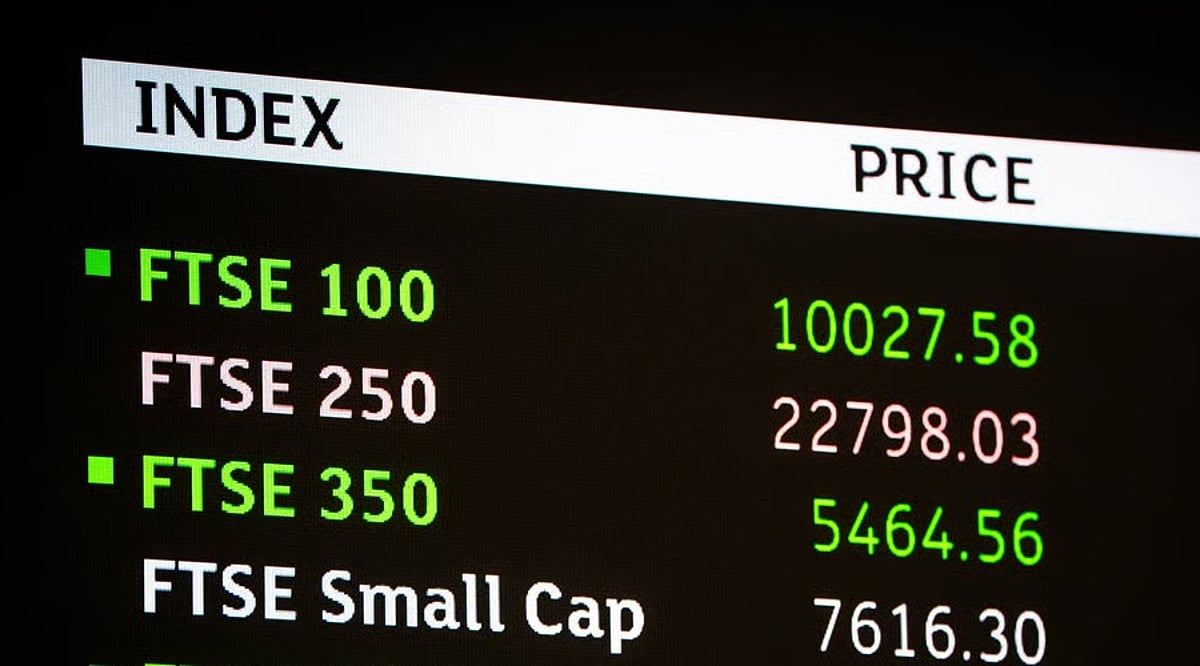
    The FTSE 100 opened 45 points lower at 10,470.77 on Thursday, as escalating Middle East tensions weighed on investor sentiment despite stronger-than-expected UK economic growth data. Brent crude futures fell 0.52% to $84.51 a barrel, while US West Texas Intermediate (WTI) eased 0.13% to $79.50 a barrel.

    Sterling was quoted at $1.3537 early Thursday, up from $1.3486 at the London equities close on Wednesday. Against the euro, sterling rose to €1.1800 from €1.1791 a day earlier.

    Gainers & Losers

    On the upside, Diploma rose 3.84% to £7,030, while Spirax Group advanced 1.73% to £6,765. DCC gained 1.03% to £6,370, and Weir Group gained 1.91% to £2,454. IMI added 1.32% to £2,912, while Smiths Group climbed 1.31% to £2,547.

    On the downside, Games Workshop Group declined 0.59% to £20,380, while Experian slipped 4.28% to £2,593. AstraZeneca fell 0.62% to £12,488, and Lion Finance Group edged lower by 0.61% to £11,350. Rio Tinto dropped 1.02% to £6,797, while Coca-Cola Europacific Partners eased 0.83% to £7,745.

    UK Economy Grew a Modest 0.1% in May

    Figures from the Office for National Statistics (ONS) revealed the economy grew 0.1% in May, broadly in line with market expectations. The services sector, which contributes more than 80% of total economic output, increased 0.3% against a fall in other parts of the economy. Manufacturing fell 0.8% and production dipped 0.5%. “While all three main sectors grew over the three months (to May), the slight growth in GDP in May was driven by services alone, with production and construction both falling back,” Liz McKeown, director of economic statistics at the ONS, said.

    Experian’s Revenue Increased 10%

    Experian said revenue rose 10% in the three months to 30 June. Revenue in the UK and Ireland increased 7%, backed by the acquisition of software platform provider KYC360 and recent contract wins, while underlying sales gained 5%. Chief executive Brian Cassin cited the firm’s “trusted data assets, scaled platforms and growing AI-enabled opportunities.” Experian shares fell by more than 7% after its full-year results in May as investors questioned whether AI could erode demand for some of its data products over time despite the company highlighting productivity gains from the technology.

    ABB to Acquire Rotork for £4 Billion

    Rotork agreed to a £4 billion acquisition after reaching an agreement with Swiss tech firm ABB. The Zurich-based electrical engineering company has recommended that its shareholders accept a deal that values the firm at £4.1 billion. It is made up of £503 in cash and a dividend of up to £3. The offer price is a 73% premium on Rotork’s closing share price on 15 July. Under the terms of the deal, the group will operate as a separate division in ABB’s Automation business and is expected to add 3% to the group’s total revenue.

    Frasers Witnesses Profit Jump

    Frasers Group has seen its profit jump, driven by its recent takeover bids for rival retailers. The fashion group saw revenue jump by 8% to £3.3 billion in the year to the end of April, as pre-tax profit grew by 39% to £528 million. “Leveraging the strength of our UK Sport business and brand relationships, international expansion has become a powerful growth engine for the Group and a key pillar of our long-term strategy,” the firm said. Frasers stepped up its takeover efforts in recent weeks with a £1.7 billion bid for German fashion house Hugo Boss and a £166 million play for Australian shoe firm Accent.

    Global Market View

    In the US, the Dow Jones gained 0.3%, the S&P 500 rose 0.4% and the Nasdaq added 0.6%, with Apple climbing to a record high after reports it had secured approval to launch its generative AI features in China. In Asia on Thursday, Tokyo’s Nikkei 225 fell 2.79% to 66,835.54, while China’s Shanghai Composite dipped 1.85%. Hong Kong’s Hang Seng climbed 1.33%, and South Korea’s Kospi declined 6.37%. In India, both the Nifty 50 and the Sensex rose by 0.22% and 0.24%, respectively.

  • SpaceX Stock Dips Below IPO Price as Lockup Expirations Loom

    SpaceX Stock Dips Below IPO Price as Lockup Expirations Loom

    SpaceX (SPCX) closed at $135.27 on Wednesday, barely above its $135 initial public offering price after touching an intraday low of $132.28. This marks the first time the stock has closed below its IPO price since its Nasdaq debut on June 12.

    Investors are now bracing for a series of scheduled share unlocks and the company’s inaugural quarterly earnings report, both of which are expected to significantly influence trading activity in the weeks ahead. Currently, only about 5% of SpaceX shares are available for public trading, with the vast majority of insider holdings still under lockup restrictions.

    Limited Share Supply Faces Major Change

    SpaceX entered public markets with nearly 95% of its shares locked, leaving a thin float that supported an early rally and pushed the company’s valuation beyond $2.6 trillion shortly after its debut.

    That structure is about to shift. SpaceX plans to release additional 7% tranches during August and September, followed by a larger release after the third-quarter earnings report later this year.

    Elon Musk’s holdings, however, are subject to separate restrictions. His 6.4 billion shares remain locked until June 2027, exempting his stake from the early-release schedule.

    Earnings Report Will Trigger the First Unlock

    Analysts expect SpaceX to publish its first quarterly earnings during the first week of August. That reporting period will activate the first major lockup expiration, allowing insiders to sell roughly 20% of previously restricted shares. An additional 10% becomes eligible if the stock meets a performance requirement: closing at least 30% above the $135 IPO price, or $175.50, during five of the ten trading days before the earnings release. Currently, SPCX trades well below that threshold, so the extra early release has not yet qualified.

    More Shares Will Enter the Market Through December

    SpaceX’s IPO filings outline additional unlock dates after the first earnings release. The company will release another 7% of locked shares after 70, 90, 105, 120, and 135 days following the IPO. After third-quarter earnings, another 28% of pre-IPO shares will become eligible for sale.

    The standard 180-day lockup expires on December 8. Some investors follow extended schedules that continue into 2027. Elon Musk controls about 40% of the company’s equity and roughly 85% of its voting power, and his holdings remain locked until mid-June 2027.

    The stock has failed to regain momentum after joining the Nasdaq-100, and shares remain well below earlier highs. Even so, some technical analysts continue to watch for a possible move toward $158.

    What’s Next?

    SpaceX stock closed below its IPO price for the first time since listing, as upcoming earnings and scheduled share unlocks move into focus. Several lockup expirations will increase the available share float, while Elon Musk’s holdings remain locked until 2027. Investors will closely monitor the next earnings report for further market direction.

  • Indian Markets Edge Higher: Nifty Holds 24,112, Sensex Gains 150 Points Amid Mixed Global Cues and US-Iran Tensions

    Indian Markets Edge Higher: Nifty Holds 24,112, Sensex Gains 150 Points Amid Mixed Global Cues and US-Iran Tensions

    Indian benchmark indices opened with modest gains on Wednesday, as traders navigated mixed global cues and ongoing US-Iran tensions. The Nifty 50 opened at 24,112, up 34 points, while the Sensex added 150 points. However, the Bank Nifty slipped 60 points in early trade.

    On the previous day, the Sensex rose 130.49 points, or 0.17%, to close at 77,185.43, and the Nifty 50 gained 26.45 points, or 0.11%, to settle at 24,078.50. The rupee opened at Rs. 96.25, nearly unchanged from Wednesday’s close of Rs. 96.26. Domestic institutional investors (DIIs) bought equities worth Rs. 704.93 crore on July 15, while foreign institutional investors (FIIs) turned net sellers, offloading Rs. 735.83 crore.

    Sensex Outlook

    Technically, the Sensex formed a Doji candle on the daily chart, indicating indecisiveness among traders.

    “On the positive side, 77,500 would act as a key resistance zone for traders, while 77,000 remains the crucial support zone for the bulls. Above 77,500, the market could move up to 77,800-78,000. On the flip side, dismissing the 77,000 level could accelerate selling pressure. Below this, the market could retest the level of around 76,300-76,000,” said Shrikant Chouhan, Head of Equity Research at Kotak Securities.

    Nifty 50 Outlook

    The Nifty 50 formed a long doji candle on the daily chart with shadows on both sides, reflecting intraday indecision.

    “Nifty 50 is currently hovering within a narrow range of around 24,200-24,000 levels and is showing a lack of strength to sustain the highs. A decisive move beyond the range could open sharp movement on either side,” said Nagaraj Shetti, Senior Technical Research Analyst at HDFC Securities.

    The sideways movement is expected to continue for the next 1-2 sessions, with support at 24,000 and 23,800 below that. Traders must clear the intraday hurdle of 24,200 to stage a larger breakout toward 24,500-24,600.

    Bank Nifty Outlook

    Bank Nifty has been consolidating on the daily chart over the past few sessions. The index formed a small-bodied candle with an upper wick, highlighting its inability to sustain at higher levels.

    “Going ahead, the immediate support for Bank Nifty is placed in the 57,300-57,200 zone. Any sustainable move below this zone could result in the index extending its weakness towards 56,800, followed by 56,400 in the short term. On the upside, the immediate resistance is placed in the 58,200-58,300 zone,” said Sudeep Shah, Head of Technical and Derivatives Research at SBI Securities.

  • Wipro Shares Rise 1.65% Ahead of Q1 FY27 Results: Revenue Guidance and AI Strategy in Focus

    Wipro Shares Rise 1.65% Ahead of Q1 FY27 Results: Revenue Guidance and AI Strategy in Focus

    Wipro shares climbed 1.65% to Rs. 177.39 on the NSE as investors awaited the company’s Q1 FY27 earnings announcement scheduled after market hours on July 16. The stock touched an intraday high of Rs. 180.79 and a low of Rs. 176.29, reflecting cautious optimism ahead of the results.

    India’s fourth-largest IT services company is expected to report another subdued quarter, with analysts forecasting muted sequential revenue and profit growth amid continued weakness in discretionary technology spending. While the June quarter numbers are unlikely to surprise the Street, the management’s outlook on artificial intelligence (AI), client spending, large deal momentum, and revenue guidance for the September quarter is expected to determine investor sentiment.

    June Quarter Likely to Reflect Cautious Spending

    Brokerage estimates place Wipro’s consolidated revenue for Q1 FY27 at Rs. 24,850 crore to Rs. 25,350 crore, indicating high double-digit year-on-year growth. However, sequential growth is expected to be minimal as firms defer technology spending amid uncertain macroeconomic conditions. Currency appreciation could provide some lift to revenue figures, but demand remains weak in overseas geographies, according to analysts.

    Margins May Face Temporary Pressure

    The bottom line is projected to come under continued strain due to Wipro’s investments in artificial intelligence, salary increases, and expenses tied to recently signed large deals. Despite these challenges, market experts expect the company to sustain stable margins through cost control measures. Analysts will closely monitor any management commentary regarding margin improvement in the remaining period of fiscal year 27.

    Guidance Will Be the Biggest Market Trigger

    The Street believes Wipro’s September quarter guidance will carry greater significance than its reported June quarter numbers. Technology budgets in both North America and Europe remain very prudent, with emphasis on savings over digital transformation plans. An improvement in discretionary spending would be a major positive for investors. Conversely, a more cautious stance might confirm doubts about further recovery in the IT services industry.

    AI Remains the Long-Term Growth Story

    Artificial intelligence continues to be a major talking point within the global technology services sector, and Wipro is expected to provide insight into its AI plans during the quarterly earnings call. Analysts and investors will be keen to see signs that pilot AI deals are moving toward larger projects that can generate future revenue. Generative AI adoption and consulting demand will come under intense scrutiny.

    What Investors Will Monitor

    • Estimated Revenue Drivers: Currency benefits, acquisition contributions, and large deal wins.
    • Large Deals and BFSI Outlook: BFSI (banking, financial services, and insurance) remains a major revenue contributor. Large deal signings will be closely watched as they provide visibility into future growth.
    • Dividend Decision: Wipro’s board is expected to consider an interim dividend alongside the results, which will attract investor attention.

    Market Outlook

    Wipro’s June quarter is not expected to show significant performance, with growth likely flat due to global uncertainty and cautious technology investments. However, the results alone are not the main focus. The outlook and commentary from management regarding AI opportunities, client spending, large deals, and the September quarter guidance will be the key drivers for investor sentiment.

  • ASML Stock Jumps After Second 2026 Revenue Upgrade Fueled by AI Chip Demand

    ASML Stock Jumps After Second 2026 Revenue Upgrade Fueled by AI Chip Demand

    ASML shares surged more than 3% on Wednesday after the Dutch lithography giant raised its 2026 sales forecast for the second time this year, driven by robust demand for artificial intelligence chips. The company also reported quarterly revenue and profit that exceeded analyst expectations as chipmakers accelerated spending on advanced production equipment.

    The upgraded outlook reflects strong demand for tools used in AI processors, data centers, and high-bandwidth memory. ASML noted that customer orders remained elevated in the first half of 2026 as foundries and memory producers moved faster on capacity expansion plans.

    ASML Raises Sales and Margin Guidance

    ASML now expects 2026 net sales between €43 billion and €45 billion, up from its previous forecast of €36 billion to €40 billion. The company also lifted its gross margin range to 54%–56%, compared with the earlier 51%–53% guidance.

    Second-quarter net sales reached €9.3 billion, above the €8.8 billion consensus estimate from LSEG analysts. Net profit came in at €2.9 billion, versus the €2.6 billion market forecast. Shares opened more than 7% higher before settling to a gain of about 3.4%.

    CEO Christophe Fouquet described order intake as “extremely strong” during the first half and said customers are accelerating expansion plans across both logic and memory production. These commitments give ASML better visibility into demand through 2028.

    ASML plans to increase its 2026 low-NA EUV capacity by 30% and boost its deep ultraviolet immersion capacity by the same margin. Both systems are manufactured at its facility in Veldhoven, Netherlands.

    AI Spending Drives Equipment Orders

    ASML holds a near-monopoly position in advanced chip production as the sole supplier of extreme ultraviolet lithography machines used to manufacture the most advanced semiconductors. Its customers include TSMC, Intel, SK Hynix, and Micron Technology.

    Fouquet said stronger end-market demand encouraged customers to raise capital spending and bring forward expansion plans. “This has also translated practically into very strong order booking through the first half of 2026,” he said.

    Orders for EUV systems now extend into 2028, reflecting sustained investment in AI servers, advanced processors, and memory chips. Chipmakers are also seeking faster productivity gains through upgrades to installed equipment.

    TSMC, one of ASML’s largest customers, reported a 68% rise in June sales. The Taiwanese company is also preparing new advanced packaging plants to meet growing demand for AI chips and related services.

    TSMC Earnings Draw Closer Scrutiny

    ASML’s report arrives one day before TSMC is scheduled to release second-quarter results on July 16. Analysts expect TSMC to report earnings of $3.89 per share on revenue of $39.31 billion, based on consensus estimates.

    Investors will focus on TSMC’s capital spending plans, its 2-nanometer production ramp, and demand for advanced packaging. ASML’s order strength suggests major customers are still committing funds to new capacity, though TSMC’s guidance will provide the next key update.

    China remains an important market for ASML despite tighter export controls. The company still expects China to account for about 20% of annual sales. China’s share fell to 14% in the second quarter from 19% in the first quarter.

    South Korea became ASML’s largest market during the quarter, contributing 43% of sales. The company plans to provide a broader update on long-term targets at its Capital Markets Day on June 10, 2027.

  • Wall Street Rises as Bank Profits and Tech Rally Boost Dow, S&P 500, and NASDAQ

    Wall Street Rises as Bank Profits and Tech Rally Boost Dow, S&P 500, and NASDAQ

    Wall Street climbed on Wednesday as investors weighed stronger-than-expected bank earnings and cooling wholesale inflation data. The Dow Jones Industrial Average, S&P 500, and NASDAQ Composite all posted gains, led by financial and technology shares.

    Indexes Gain as Inflation Eases

    The Dow rose approximately 0.4%, the S&P 500 added 0.3%, and the NASDAQ Composite gained 0.4%, supported by consumer discretionary and technology stocks. Nine of the 11 S&P 500 sectors traded in positive territory, with consumer discretionary leading and financials up 0.6%.

    Market sentiment was buoyed by a weaker-than-expected Producer Price Index report, which showed final demand prices fell 0.3% in June against expectations of no change. This followed Tuesday’s softer Consumer Price Index reading, together reducing expectations for an immediate Federal Reserve rate hike.

    Bank Earnings Support Financial Shares

    BlackRock shares surged more than 7% after the asset manager beat quarterly forecasts, reporting earnings of $13.91 per share on revenue of $7.08 billion—above the $6.72 billion expected by analysts. Assets under management rose to $15.35 trillion from $13.90 trillion.

    Morgan Stanley also gained after reporting second-quarter profit above market estimates, extending a strong start to earnings season for financial firms. “The large banks continue to demonstrate the strength of the US consumer and corporate balance sheets,” said Charlie Anderson of UBS Wealth Management, adding that healthy banks support broader economic confidence.

    PayPal Jumps on Reported Takeover Offer

    PayPal shares jumped nearly 14% following reports that Stripe and Advent International submitted a joint acquisition offer valuing the company at approximately $53 billion, or $60.50 per share—a premium of about 28% over Tuesday’s close. The offer comes as PayPal works to improve growth and defend its position in digital payments. Neither party announced a completed agreement during the session.

    Technology Stocks Add to Market Gains

    Large technology stocks supported the broader market. Amazon, Apple, and Microsoft each gained around 3%, while Alphabet rose more than 1%. ASML shares advanced after the Dutch chip equipment maker raised its sales forecast, citing strong demand for systems used in advanced AI chip production. ASML also plans to expand equipment production capacity by 30%, easing supply chain concerns.

    Investors are also watching TSMC, which will report second-quarter earnings on Thursday, with focus on spending plans, AI chip demand, advanced packaging capacity, and its 2-nanometer production schedule.

    Fed Policy and Oil Prices Stay in Focus

    Traders reduced the probability of a July rate hike to about 12%, down from 41% before Tuesday’s CPI release, according to CME FedWatch data. Federal Reserve Chair Kevin Warsh continued his congressional testimony, cautioning that one inflation report is not enough to confirm a lasting trend.

    Oil prices moved higher after the United States launched additional strikes against Iran, with West Texas Intermediate above $80 per barrel and Brent above $85. Higher crude prices limited some of the market’s advance as investors monitored the Middle East conflict for effects on energy costs and future inflation readings.

    Meanwhile, Elevance Health fell more than 8% despite raising its annual profit forecast, as the revised outlook failed to meet investor expectations. Advancing stocks outnumbered decliners on both major US exchanges.

    Disclaimer: Analytics Insight does not provide financial advice or guidance on cryptocurrencies and stocks. This article is for informational purposes only and does not constitute investment advice. Always conduct your own research before making investment decisions.

  • ASML Stock Climbs After Second 2026 Revenue Forecast Hike Fueled by AI Chip Demand

    ASML Stock Climbs After Second 2026 Revenue Forecast Hike Fueled by AI Chip Demand

    ASML shares rose more than 3% on Wednesday after the Dutch chip equipment maker raised its 2026 sales forecast for the second time this year. The company also reported quarterly revenue and profit above market estimates as chipmakers increased spending on advanced production tools.

    The update points to demand for equipment used in AI processors, data centers, and high-bandwidth memory. ASML said customer orders stayed strong during the first half of 2026 as foundries and memory producers moved faster on capacity plans.

    ASML Lifts Sales and Margin Outlook

    ASML now expects 2026 net sales between €43 billion and €45 billion. Its earlier forecast called for sales between €36 billion and €40 billion. The company also raised its gross margin range to 54% to 56%, from 51% to 53%.

    Second-quarter net sales reached €9.3 billion, above the €8.8 billion expected by analysts surveyed by LSEG. Net profit came in at €2.9 billion, compared with the €2.6 billion market forecast. Shares opened more than 7% higher before trimming gains to about 3.4%.

    Chief Executive Christophe Fouquet said order intake was ‘extremely strong’ during the first half. He added that customers were accelerating expansion plans across logic and memory production. Those commitments gave ASML better visibility into demand through 2028.

    ASML plans to increase its 2026 low-NA EUV capacity by 30%. It will also add 30% to its deep ultraviolet immersion capacity. The company produces both systems at its site in Veldhoven, Netherlands.

    AI Spending Drives Equipment Orders

    ASML holds a central position in advanced chip production. It is the only supplier of extreme ultraviolet lithography machines used to make the most advanced semiconductors. Its customers include TSMC, Intel, SK Hynix, and Micron Technology.

    Fouquet said stronger end-market demand had encouraged customers to lift capital spending and bring forward expansion plans. ‘This has also translated practically into very strong order booking through the first half of 2026,’ he said.

    Orders for EUV systems now extend into 2028. That longer order window reflects continued investment in AI servers, advanced processors, and memory chips. Chipmakers also seek faster productivity gains from upgrades to installed equipment.

    TSMC, one of ASML’s largest customers, reported a 68% rise in June sales. The Taiwanese company is also preparing new advanced packaging plants as demand grows for AI chips and related services.

    TSMC Earnings Draw Closer Scrutiny

    ASML’s report arrives one day before TSMC is due to release second-quarter results on July 16. Analysts expect TSMC to report earnings of $3.89 per share and revenue of $39.31 billion, based on consensus estimates.

    Investors will watch TSMC’s capital spending plans, its 2-nanometre production ramp, and demand for advanced packaging. ASML’s order strength suggests major customers are still committing funds to new capacity, though TSMC’s guidance will provide the next update.

    China is an important market for ASML despite tighter export controls. The company still expects China to account for about 20% of annual sales. China’s share fell to 14% in the second quarter from 19% in the first quarter.

    South Korea became ASML’s largest market during the quarter, contributing 43% of sales. The company plans to provide a broader update on long-term targets at its Capital Markets Day on June 10, 2027.

  • Stripe and Advent’s $53 Billion Bid Lifts PayPal Stock Higher

    Stripe and Advent’s $53 Billion Bid Lifts PayPal Stock Higher

    Shares of PayPal moved higher after reports surfaced that payments giant Stripe and private equity firm Advent International have jointly submitted a takeover proposal worth more than $53 billion. The consortium reportedly offered $60.50 per share—about 28% above PayPal’s recent closing price—and has secured around $50 billion in bank commitments to support the deal.

    Stripe and Advent Await PayPal’s Response

    According to sources familiar with the matter, Stripe and Advent submitted the latest proposal earlier this month, following an initial approach in early April. PayPal’s board has not yet responded, but the two firms hope to move discussions forward in the coming weeks. Under the proposed structure, Stripe and Advent would each hold a 50% stake and keep PayPal intact rather than splitting its operations. The acquisition would give Stripe access to PayPal’s broad consumer network, including Venmo and Braintree.

    PayPal’s Strong First-Quarter Results

    The takeover interest follows stronger-than-expected first-quarter earnings from PayPal. Revenue rose 7% year-over-year to $8.35 billion, beating analysts’ estimate of $8.05 billion. Currency-neutral total payment volume increased 8% to approximately $464 billion. Adjusted earnings came in at $1.34 per share. Despite the solid results, investors have been seeking clearer evidence that PayPal’s turnaround can sustain growth. Management has been pursuing operational improvements through artificial intelligence, expecting AI tools and organizational changes to reduce duplicated work and generate about $1.5 billion in savings over the next two to three years, which will be directed toward growth initiatives.

    PayPal Shares Slip Before Reported Offer

    PayPal shares fell 0.59% during Monday’s regular trading session, closing at $47.37, according to Google Finance. The stock recovered slightly after hours, edging 0.06% higher to $47.40. The proposed $60.50 price stands well above the latest closing level. Stripe remains one of the world’s most valuable privately held fintech companies, valued at approximately $159 billion in a February employee tender offer. The company reported that businesses using its platform generated $1.9 trillion in payment volume during 2025, up 34% from the previous year. Advent would bring private equity capital and payments-sector experience, managing about $94 billion in assets as of March 31, 2026.

    What’s Next?

    Any completed acquisition would require financing, shareholder, and regulatory reviews. The reported proposal remains pending while Stripe and Advent wait for PayPal’s response. Investors will watch the next trading session for any reaction to the acquisition news.