Tag: Stock Market

  • SBI Funds Management IPO Opens July 14: Shareholder Quota Details and Key Dates

    SBI Funds Management IPO Opens July 14: Shareholder Quota Details and Key Dates

    SBI Funds Management, one of India’s largest asset management companies, is set to launch its Rs 11,693-crore initial public offering (IPO) next week, with shares expected to list on the BSE and NSE on July 21. The issue opens for subscription on July 14 and closes on July 16, with a price band of Rs 545–574 per share, valuing the company at approximately Rs 1.17 lakh crore post-listing.

    IPO Structure and Key Dates

    The entire offering is structured as an offer for sale, meaning no fresh shares are being issued. Existing promoters State Bank of India (SBI) and Amundi India Holding are offloading up to 20.39 crore shares, representing a combined 10% stake. Anchor investor bidding begins a day earlier, on July 13. Allotment is expected to be finalized on July 17–18, with refunds and share credits scheduled for July 20, just ahead of the listing.

    Shareholder Quota and Eligibility

    Existing SBI shareholders have a unique reservation category. The bank has reserved about 1.3 crore shares, valued at nearly Rs 750 crore, for its shareholders. This represents approximately 6.41% of the entire offering. To be eligible, investors must hold SBI shares in their demat accounts up to the IPO’s record date. Shares purchased after that date will not qualify for this category.

    Unlike many IPOs, there is no price discount for SBI shareholders. However, eligible SBI employees have been allotted shares worth about Rs 170 crore at a discount of Rs 54 per share. The allotment breakdown is: 50% for qualified institutional buyers, 35% for retail investors, and 15% for non-institutional investors.

    Company Financials and Backing

    SBI Funds Management held a 15.4% market share in mutual funds as of December 2025, with quarterly average assets under management of Rs 12,49,970 crore. The company’s income rose from Rs 3,426 crore in FY24 to Rs 4,236 crore in FY25, while profit after tax increased from Rs 2,073 crore to Rs 2,540 crore—representing an approximate 17% increase in income and 21% in profit after tax. The IPO has received backing from prominent investors such as ADIA and GIC.

    This listing represents a substantial gain for SBI from an investment made decades ago. SBI acquired a 61.73% equity stake in SBI Funds Management at a weighted average cost of just Rs 0.15 per share, which is now valued at about Rs 68,670 crore.

    With strong institutional interest and the company’s market leadership, the listing will be closely watched as a key indicator of investor confidence in India’s asset management sector.

  • Nifty 50 Holds Above 23,800, Sensex Targets 77,000 as Middle East Tensions Fuel Volatility

    Nifty 50 Holds Above 23,800, Sensex Targets 77,000 as Middle East Tensions Fuel Volatility

    The Indian stock market is expected to open higher on short covering after a sharp sell-off as investors remain cautious about the renewed US-Iran war tensions and rising crude oil prices. GIFT Nifty also indicates a gap-up opening, trading at 23,976 with a premium of 64 points from its previous Nifty futures close.

    On Wednesday, the Sensex plunged 1,677.12 points or 2.15% to settle at 76,503.60, while the Nifty 50 fell 516.65 points or 2.12% to finish at 23,882.05.

    Among broader indices, Nifty Midcap 100 shed 1.5% and the Nifty Smallcap 100 index declined 2.2%.

    The Indian rupee opened flat at Rs. 95.55 per dollar on Thursday versus the previous close of Rs. 95.55.

    Foreign institutional investors (FIIs) remained net buyers in Indian equities on July 8, purchasing shares worth Rs. 1,962.80 crore, while Domestic institutional investors (DIIs) also stayed on the buying side, investing Rs. 790.16 crore.

    Sensex Outlook

    Technically, the Sensex formed a long bearish candle on the daily chart, indicating further weakness from the current levels.

    “We are of the view that the short-term texture of the market has changed to negative from positive, and for day traders, selling on rallies would be the ideal strategy. For day traders, 77,000 and 77,100 would act as immediate resistance levels for the bulls. As long as it is trading below these levels, weak sentiment is likely to continue on the downside. The market could retest the level of the 50-day SMA (Simple Moving Average), around 76,000. Further downward movement may also continue, which could drag the index to 75,800,” said Shrikant Chouhan, Head Equity Research, Kotak Securities.

    On the flip side, above 77,100, the sentiment could change. If the index moves above this level, a pullback could continue till 77,400-77,500. The current market texture is volatile; hence, level-based trading would be the ideal strategy for day traders, he added.

    Nifty 50 Outlook

    The Nifty 50 formed a long bearish candle with a lower high, lower low and a bearish gap, indicating that sellers currently have the upper hand.

    Bajaj Broking noted that the index erased its recent gains after slipping below the important support zone around 24,250 and eventually tested the 23,800 mark during intraday trade.

    “Going ahead, a breach below the key support area of 23,800 will open further downside towards the 23,500-23,600 levels in the coming sessions being the confluence of the previous gap area and 61.8% retracement of the entire previous up move 23,070-24,530. While holding above 23,800 will lead to consolidation in the range of 23,800-24,350. Immediate bias remains down below Wednesday’s gap down area of 24,350,” said the brokerage.

    Bank Nifty Outlook

    On Wednesday, Bank Nifty slumped 1,458.10 points or 2.51% to close at 56,742.60, forming a bearish candle on the daily chart and slipping below its 20-day EMA for the first time since June 8.

    “The index has entered a corrective phase after failing to hold key support levels. Index contrary to our expectations closed below the immediate support area of 57,000-56,800 signaling corrective bias. A follow through weakness will open further downside towards 55,500-56,000 levels in the coming sessions,” said Bajaj Broking Research.

    The brokerage further added, “On the higher side only a move above 58,000 will signal resumption of the up-move failure to do so will lead to some consolidation in the range of 55,000-58,000 levels.”

    Disclaimer: This article is provided for informational purposes and does not constitute investment advice. You are responsible for conducting your own research before making any investments.

  • Kalyan Jewellers Stock Surges 24% in Two Days: Hits Rs 438.15 on Strong Q1 Update and Citi Buy Rating

    Kalyan Jewellers Stock Surges 24% in Two Days: Hits Rs 438.15 on Strong Q1 Update and Citi Buy Rating

    Overview

    Kalyan Jewellers shares staged a remarkable comeback on Dalal Street, surging nearly 24% over the past two trading sessions after the jewelry retailer reported a robust first-quarter business update and received a strong endorsement from global brokerage Citi. The stock is currently trading at Rs. 438.15 on the NSE, up Rs. 81.84 or 22.98%, after hitting the upper circuit, reflecting renewed investor confidence in the company’s growth prospects.

    This rally is the result of a positive market response following the company’s robust revenue growth, not just at home but abroad as well, and strong performance from its online jewelry store, Candere. This was further supported by Citigroup’s decision to reiterate its ‘Buy’ rating with a target price of Rs. 750.

    Strong Q1 Business Performance

    Kalyan Jewellers provided a solid start to the financial year FY27, posting consolidated revenue growth of around 38% year-on-year during the quarter ending June. Revenue growth was driven by strong demand in the Indian market, despite seasonal factors affecting jewelry purchases.

    Domestic sales were the key contributor to revenue growth, with about 38% growth compared to the previous year. Existing stores delivered strong performance with same-store sales growth of 28%. International operations performed well during the period, with nearly 35% year-on-year growth, while the company’s Middle East business grew 30% year-on-year. International markets accounted for 14% of total consolidated revenue.

    The Kalyan Jewelers’ online jewelry brand, Candere, showed a 112% year-on-year revenue growth. The retailer also accelerated its expansion strategy during the quarter by opening 12 new Kalyan Jewellers showrooms and 5 new Candere outlets, expanding its retail presence into more cities across the country.

    Citi Maintains Bullish View

    Global brokerage Citi remained optimistic on Kalyan Jewellers despite the company’s revenue growth coming in slightly below its internal estimate of around 45%. Maintaining a ‘Buy’ rating, the brokerage reiterated its target price of Rs. 750, implying substantial upside from prevailing levels.

    Citi believes that the company’s brand-based expansion strategy will generate earnings growth while keeping capital expenditure in check. Moreover, analysts expect improvement in operational efficiencies and better returns on investment as the company grows.

    Factors Driving the Rally

    According to management, demand has been encouraging at the start of the second quarter, buoyed by festive purchases and the upcoming wedding season. Analysts feel that branded jewelry players like Kalyan Jewellers are well-placed to capitalize on consumers’ growing preference for brands that offer fair pricing and certified jewelry.

    Despite volatile gold prices and competition, robust sales growth, increased retail presence, and improved digital performance will be the key factors sustaining an encouraging outlook for the company. With excellent operations, strong growth, and bullish brokerage reports, Kalyan Jewellers is expected to remain in the spotlight until it reports its quarterly results.

  • FTSE 100 Slips to 10,441 as AstraZeneca Tumbles on Drug Trial Failure; Brent Drops 1.23%

    FTSE 100 Slips to 10,441 as AstraZeneca Tumbles on Drug Trial Failure; Brent Drops 1.23%

    Market Overview

    The FTSE 100 fell 47.61 points to trade at 10,441.44 on Thursday, dragged by a sharp decline in AstraZeneca following disappointing late-stage trial results for its experimental heart drug. Escalating tensions in the Middle East also weighed on sentiment. Meanwhile, Brent crude futures dropped 1.23% to $76.06 per barrel, while US West Texas Intermediate (WTI) lost 1.14% to settle at $72.68.

    Sterling strengthened against the dollar, quoted at $1.3406 early Thursday, up from $1.3358 at the previous close. However, sterling weakened against the euro, trading at €1.1721 compared to €1.1722 a day earlier.

    Gainers and Losers

    Top Gainers:

    • Computacenter surged 10.88% to £4,586 after forecasting a sharp profit increase for the first half of 2026.
    • Antofagasta advanced 3.97% to £3,667.
    • Glencore rose 3.72% to £508.90.
    • Anglo American gained 3.37% to £3,495.
    • Standard Chartered added 2.65% to £2,090.
    • Endeavour Mining climbed 2.33% to £3,645.

    Top Losers:

    • AstraZeneca plunged 9.65% to £12,866 after its nerve disease drug Wainua failed a late-stage trial.
    • Coca-Cola Europacific Partners slipped 1.25% to £7,890.
    • British American Tobacco fell 1.97% to £4,520.
    • Unilever dropped 1.23% to £4,582.50.
    • London Stock Exchange Group declined 0.47% to £8,820.
    • Reckitt Benckiser eased 0.83% to £5,024.

    AstraZeneca Stock Tumbles on Drug Trial Failure

    Pharma heavyweight AstraZeneca saw shares fall 8.4% in early trade to £13,043.48 after the company announced that its nerve disease drug Wainua, developed in partnership with US-based Ionis, failed to meet its primary endpoint in a late-stage trial. The drug was intended to reduce cardiovascular deaths and recurring heart problems in patients with a type of heart disease characterized by protein buildup that disrupts blood pumping.

    Brooks Macdonald Ends Fees on Uninvested Cash

    Investment manager Brooks Macdonald has scrapped cash fees on discretionary portfolios, effective 1 July, amid intensifying regulatory scrutiny from the Financial Conduct Authority (FCA) over so-called ‘double-dipping’ practices. The move follows a similar decision by Rathbones, which acknowledged that halting such fees would reduce its pre-tax profit by £9 million. Brooks Macdonald also reported a turnaround in net inflows for the financial year, reaching £226 million, compared with outflows of £396 million the prior year.

    Computacenter Expects First-Half Profit to Double

    Computacenter said it expects adjusted profit before tax for the first half of 2026 to be approximately double the £81.5 million recorded in the same period last year. The IT services firm attributed the upbeat outlook to stronger-than-expected second-quarter performance and indicated that full-year results would comfortably beat market expectations, though it remained cautious about a tougher comparative in the second half.

    Global Market Update

    In the US, the Dow Jones fell 1.1% and the S&P 500 declined 0.3%, while a rally in select AI stocks helped the Nasdaq advance 0.2%. In Asia on Thursday, Japan’s Nikkei 225 rose 1.51% to 67,830.79, China’s Shanghai Composite gained 1.1%, Hong Kong’s Hang Seng fell 0.69%, and Australia’s S&P/ASX 200 slipped 0.26%. India’s Nifty 50 and Sensex declined 0.71% and 0.79%, respectively.

    Disclaimer: This article is for informational purposes only and does not constitute investment advice. Readers should conduct their own research before making any investment decisions.

  • SPCX Stock Falls After NASDAQ-100 Debut as Analysts Deliver Mixed Forecasts

    SPCX Stock Falls After NASDAQ-100 Debut as Analysts Deliver Mixed Forecasts

    SpaceX stock (ticker: SPCX) experienced a decline following its first day of trading on the NASDAQ-100 index, closing at $149.47 on Tuesday. The 7% drop came despite expectations that index inclusion would trigger buying from funds tracking the benchmark. The stock remains above its $135 IPO price but is more than 25% below its June 16 closing high of $201.80.

    The NASDAQ-100 entry had been anticipated to bring demand from index-tracking funds, which collectively manage approximately $800 billion in assets. However, this anticipated buying did not materialize into a rally, suggesting that some of the index demand may have been priced into the stock earlier. SPCX had gained nearly 6% in the week leading up to the index addition, and investors sold off shares as the first NASDAQ-100 session failed to extend that upward move.

    Meanwhile, ARK Invest increased its position in SpaceX by purchasing 44,196 SPCX shares on Tuesday, valued at around $6.6 million based on the closing price. ARK funds already held approximately 3.29 million shares by the end of SpaceX’s first public trading day.

    Wall Street analysts have begun issuing coverage following the end of the post-IPO quiet period, with a wide range of price targets reflecting significant uncertainty about the company’s valuation. The average analyst target stands near $236, implying roughly 58% upside from Tuesday’s close. Nineteen analysts have issued ratings so far.

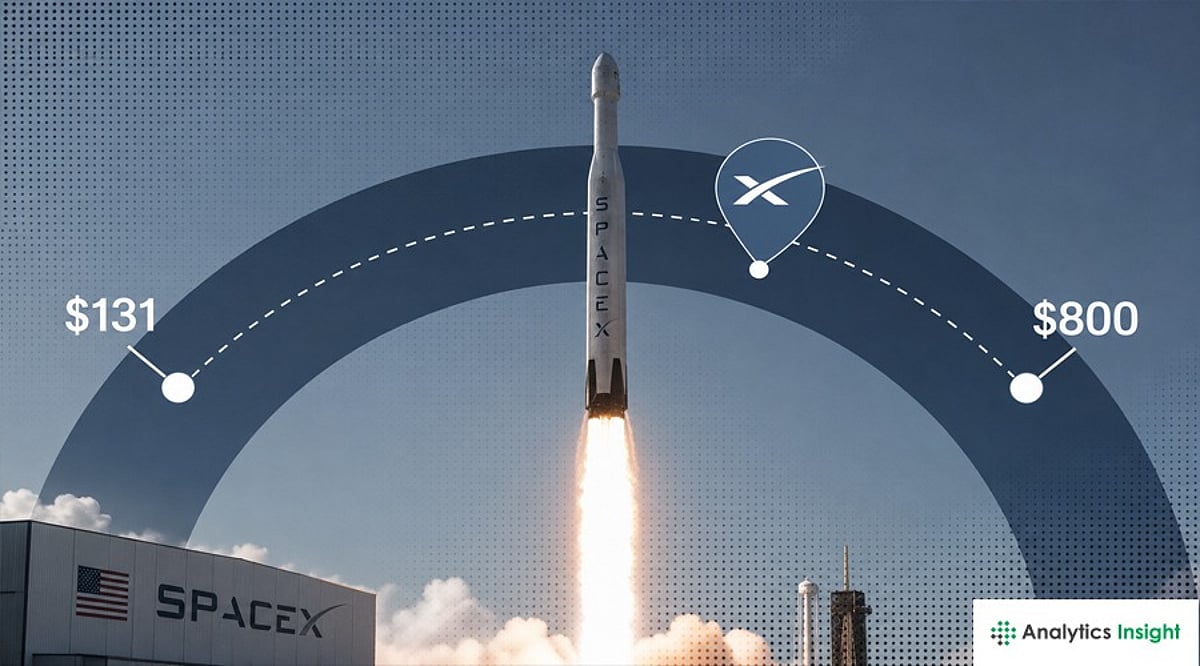
    Deutsche Bank initiated coverage with a Buy rating and a $255 target, citing SpaceX’s reusable rockets, Starlink satellite internet business, and potential use in AI infrastructure. Cantor Fitzgerald started with an Overweight rating and a $246 target, describing SpaceX as a “planetary infrastructure company.” Raymond James set the highest target on the Street at $800. Citi rated the stock a Buy at $200, linking a longer-term $900 case to the Starship program. Morgan Stanley set a $300 base case, with a $600 bull case and a $75 bear case.

    However, not all analysts share this optimism. MoffettNathanson set a $131 target with a neutral rating, questioning SpaceX’s valuation and long-term business forecasts. The firm called the company’s $30 trillion addressable market estimate “absurd” and expressed doubts about plans tied to orbital compute, stating, “There is simply no credible financial model that can support what is at the time of this writing a roughly $2 trillion valuation.”

    In other news, SpaceX has raised prices for Starlink Business Aviation customers. The Aviation Regional 25GB plan increased to $4,000 per month from $2,000, with additional data priced at $250 per GB. The company also introduced Aviation Regional Unlimited at $12,500 per month and raised Aviation Global Unlimited to $20,000 per month from $10,000, offering worldwide coverage and speeds up to 1 Gbps with the Aviation Performance Antenna. Starlink aviation equipment costs also rose to $200,000 per business jet, up from $145,000 last year.

  • Indian Stock Market Update: Nifty 50 Targets 24,600, Sensex Holds 77,700 Amid Mounting US-Iran Tensions

    Indian Stock Market Update: Nifty 50 Targets 24,600, Sensex Holds 77,700 Amid Mounting US-Iran Tensions

    The Indian stock markets are poised for a lower open on Wednesday after fresh US strikes on Iran following drone attacks on commercial vessels in the Strait of Hormuz. GIFT Nifty futures are trading at 24,239.5, reflecting a discount of 144 points from the previous Nifty futures close, signaling a gap-down start.

    On Tuesday, late profit-booking erased early gains, pulling the Sensex down 104.35 points to settle at 78,180.72, while the Nifty 50 slipped 0.13% to close just below the 24,400 mark. Mid-cap and small-cap indices faced heavier selling, dropping 0.4% and 0.55% respectively. Foreign institutional investors bought a net Rs 393.19 crore in cash markets, nearly offsetting the Rs 383.43 crore sold by domestic institutions.

    Sensex Outlook

    Technically, the Sensex formed a bearish candle on the daily chart, indicating potential further weakness. Shrikant Chouhan, Head of Equity Research at Kotak Securities, said,

    “For day traders, 77,700 will act as a crucial support zone. Above these levels, Sensex could retest 78,400-78,600. On the flip side, if the index falls below 77,700, it could witness a sharp intraday dip towards 77,400-77,100.”

    Nifty 50 Outlook

    The Nifty 50 has entered a consolidation phase after a rally of nearly 1,500 points over the past five weeks. Bajaj Broking Research noted,

    “We believe the overall structure is positive, and dips towards the 24,200-24,000 should be used to accumulate quality stocks in a staggered manner. On the higher side, only a sustained move above 24,600 will signal extended gains towards 24,800 levels, being the trendline resistance joining the previous major breakdown area.”

    The brokerage expects Nifty to trade within the 24,200-24,600 range in the coming sessions. A decisive breakout above 24,600 could pave the way for 24,800, while the 24,200-24,000 zone is likely to act as key support.

    Bank Nifty Outlook

    On Tuesday, Bank Nifty declined 90.80 points or 0.16% to close at 58,200.70, forming a bearish candle on the daily chart. Bajaj Broking said,

    “A decisive move above the recent swing high of 58,700 will strengthen the bullish setup and can pave the way for an advance towards 59,200 and 60,000 in the coming weeks, which coincide with the 138.2% and 150% external retracement of the previous decline from 57,456 to 52,783. Failure to move above 58,700 will signal extension of the last 8 sessions’ consolidation in the range of 57,000-58,700.”

    Disclaimer: This article is for informational purposes only and does not constitute investment advice. The stocks and cryptocurrencies mentioned involve risk. Conduct your own research before making any investment decisions.

  • Indian Stock Markets Slide on Renewed West Asia Tensions: Nifty50 and Sensex Drop

    Indian Stock Markets Slide on Renewed West Asia Tensions: Nifty50 and Sensex Drop

    The Indian stock market opened on a weak note Wednesday, July 8, 2026, as fresh geopolitical tensions in West Asia dampened investor sentiment. The Nifty50 fell 150.95 points (0.62%) to 24,247.75, while the Sensex dropped 492.80 points (0.63%) to 77,687.92 during early trade.

    The decline follows the United States launching retaliatory strikes and reimposing oil sales sanctions on Iran, stoking fears of higher crude oil prices and potential disruptions to global energy supply. Investors adopted a cautious stance amid the uncertainty, resulting in broad-based selling pressure.

    Key Market Movers

    • Nifty Oil and Gas recorded the biggest sectoral decline, reflecting direct exposure to crude price volatility.
    • Nifty Pharma emerged as the top-performing sector, as investors rotated into defensive stocks.
    • The Nifty MidCap fell 0.39% and the Nifty SmallCap dropped 0.55%, indicating selling spread across market caps.

    IPO Market Activity

    The Kusumgar Initial Public Offering (IPO) opened for subscription on Wednesday, aiming to raise Rs. 650 crore entirely through an Offer for Sale (OFS). Existing shareholders are selling part of their holdings, and no fresh capital will flow into the company. The IPO adds primary market activity even as secondary markets trade under pressure.

    Outlook

    Market participants are closely monitoring global developments, including crude oil prices, geopolitical news, and upcoming corporate earnings. Defensive sectors like pharma are likely to attract flows until clarity emerges on the West Asia situation. The trading session is expected to remain volatile.

  • FTSE 100 Slips to 10,600 as US Strikes on Iran Drive Brent Crude Above $75

    FTSE 100 Slips to 10,600 as US Strikes on Iran Drive Brent Crude Above $75

    The FTSE 100 opened 65.2 points lower at 10,600.86 on Wednesday, as fresh US military strikes on Iran triggered a spike in oil prices. Brent crude futures surged 2.22% to $75.81 a barrel, while US West Texas Intermediate (WTI) rose 2.10% to $71.92 a barrel. The escalation followed drone attacks on commercial vessels in the Strait of Hormuz.

    Sterling weakened against the dollar, trading at $1.3355, down from $1.3376 at Tuesday’s London close. Against the euro, the pound slipped to €1.1693 from €1.1704.

    Gainers & Losers

    Energy stocks led the upside: BP gained 1.80% to £483.10, Shell added 0.71% to £3,032.50, and Centrica rose 0.68% to £170.65. Lion Finance Group advanced 1.65% to £11,730, while Burberry Group edged up 0.63% to £1,112. Scottish Mortgage Investment Trust climbed 0.27% to £1,469.50.

    On the downside, Games Workshop Group fell 2.40% to £20,300, and Spirax Group dropped 1.84% to £6,390. Rio Tinto declined 1.54% to £6,720, while AstraZeneca slipped 1.04% to £14,214. London Stock Exchange Group lost 1.02% to £8,942, and Coca-Cola Europacific Partners eased 1.12% to £7,980.

    Jet2 Gains £400 Million Boost from Rising Fuel Prices

    Jet2 reported a £400 million balance sheet boost from rising jet fuel prices, defying travel disruption from the Middle East conflict. The AIM-listed package holiday provider said the additional £388 million in income stemmed from favorable fair value movements in jet fuel derivatives as market pricing increased amid escalating regional tensions. Jet2 has already sold 19.9 million seats for this summer, a 7% increase year-on-year.

    ABF Completes £75 Million Hovis Takeover

    Associated British Foods has completed its £75 million acquisition of Hovis, merging the bakery with its own Allied Bakeries division. The combined entity will operate as Hovis Bakeries starting today. ABF said the deal will generate substantial production and distribution savings, though it expects an initial earnings hit this year. CEO George Weston commented: “The transaction will support the wider UK economy, including by securing high-quality jobs.” ABF shares opened flat at £1,966.

    Vistry Warns of First-Half Loss

    Vistry Group warned it expects to report a first-half loss after its new CEO accelerated debt-reduction and stock-cutting measures. The housebuilder forecast a pre-tax loss of around £30 million for the six months to June 30, reflecting a £50 million hit from heavier discounts on slower-selling homes, asset sales, and landbank reductions. Excluding these measures, the company would have posted about £20 million in pre-tax profit — a sharp decline from the £260 million-plus recorded in each of the past two years.

    Global Market Overview

    In the US, semiconductor stocks led a sell-off, with the Nasdaq falling 1.2%, the S&P 500 down 0.5%, and the Dow Jones slipping 0.3%.

    Asian markets were mixed on Wednesday. Tokyo’s Nikkei 225 dropped 2.11% to 66,819.05, while China’s Shanghai Composite lost 0.49%. Hong Kong’s Hang Seng rose 2.96%, and Australia’s S&P/ASX 200 slipped 0.21%. In India, the Nifty 50 fell 0.74% and the Sensex declined 0.76%.

    This article is for informational purposes only and does not constitute investment advice. Always conduct your own research before making investment decisions.

  • Indian Stock Market Surges: Sensex Gains 240 Points, Nifty50 Crosses 24,495 as IT Stocks Lead Rally

    Indian Stock Market Surges: Sensex Gains 240 Points, Nifty50 Crosses 24,495 as IT Stocks Lead Rally

    The Indian stock market traded higher on Tuesday, July 7, 2026, driven by strong buying in IT, banking, and financial shares. Despite mixed global cues, domestic investor sentiment remained positive, with large-cap stocks providing solid support throughout the session.

    At the time of writing, the Nifty50 stood at 24,495.60, up 65.25 points or 0.27 percent, while the Sensex reached 78,525.09, gaining 240.02 points or 0.31 percent. Both benchmark indices stayed in positive territory as investors continued to buy shares from key sectors.

    IT Sector Leads the Rally

    The IT sector emerged as the biggest contributor to today’s market rise. The Nifty IT index surged more than 1 percent, making it the best-performing sector of the session. Strong buying in leading technology companies boosted investor confidence and pushed the benchmark indices higher.

    In addition to IT, healthcare and automobile stocks also performed well. The Nifty Healthcare index recorded healthy gains as investors showed interest in pharmaceutical and healthcare companies. The Nifty Auto index remained strong due to sustained buying in several automobile stocks. These gains added further strength to the overall market.

    Banking and Financial Stocks Remain Strong

    Banking and financial shares played a major role in today’s market rise. Buying in large private and public sector banks supported both the Nifty50 and the Sensex. Financial companies also saw steady demand, helping the market maintain its positive trajectory throughout the trading session.

    These sectors carry significant weight in the benchmark indices, so gains in banking and financial stocks directly influenced market movement. Their strong performance helped offset weakness in some other sectors.

    Broader Market Under Pressure

    While benchmark indices stayed in the green, the broader market told a different story. Mid-cap and small-cap stocks faced selling pressure during the session. The Nifty MidCap traded 0.55 percent lower, and the Nifty SmallCap declined 0.44 percent. This divergence indicates that investors favored large-cap stocks over smaller companies, likely due to uncertain global conditions.

    The gap between benchmark indices and the broader market reflects selective buying, with investors focusing on established companies rather than spreading investments across all segments.

    Metal Stocks Suffer Heavy Losses

    Among all sectors, metal shares recorded the biggest decline. The Nifty Metal index tumbled the most during the session. Weak sentiment in metal companies put pressure on the sector and limited overall market gains.

    Despite these losses, strong performance from IT, banking, healthcare, and automobile shares kept the benchmark indices in positive territory, effectively balancing the metal sector’s weakness.

    Mixed Global Cues, Resilient Domestic Market

    Global markets continued to send mixed signals, with some international indices showing strength while others remained under pressure. This created a cautious mood among investors worldwide.

    Nevertheless, the Indian market demonstrated resilience. Strong domestic buying, especially in large-cap shares, helped the market maintain its upward move. Investors focused on company fundamentals and sector-specific opportunities rather than reacting sharply to overseas developments.

    IPO Market Remains Active

    The primary market also attracted attention. IC Electricals’ initial public offer entered its final day of subscription on Monday, with a total issue size of Rs. 47.91 crore. Market participants closely watched the IPO as the subscription period reached its concluding stage. Interest in new public issues remained steady as investors sought fresh opportunities alongside regular stock market activity.

    Market Outlook

    Positive signals emerged from the Indian stock market, supported by gains in IT, banking, and financial shares. The Nifty50 and Sensex remained in positive territory despite mixed global cues, reflecting strong domestic investor sentiment. Gains in IT, healthcare, and automobile stocks offset losses in metal stocks.

    Despite broader market woes, large-cap stocks maintained the benchmark indices. Investors will continue to monitor sector developments and overall market sentiment throughout the trading session.

  • FTSE 100 Opens Higher at 10,679.5 as Shell Surges and Oil Prices Recover

    FTSE 100 Opens Higher at 10,679.5 as Shell Surges and Oil Prices Recover

    The FTSE 100 opened 28 points higher at 10,679.5 on Tuesday, buoyed by strength in energy stocks and positive domestic house price data. NATO leaders gathered in Ankara for a two-day summit, while Brent crude futures rose 1.33% to $72.95 a barrel and US West Texas Intermediate (WTI) gained 1.33% to $69.46.

    Sterling strengthened against both the dollar and the euro, trading at $1.3384 and €1.1707 respectively.

    Gainers and Losers

    Shell led the upside, rising 2.76% to £2,993, followed by Burberry Group (+2.24%), Unilever (+2.21%), Rentokil Initial (+2.05%), London Stock Exchange Group (+1.90%), and RELX (+1.88%). On the downside, Rio Tinto fell 2.02%, Antofagasta slipped 2.28%, Anglo American dropped 2.22%, Fresnillo declined 2.21%, Endeavour Mining lost 1.52%, and Diploma eased 0.78%.

    Shell Expects Up to $6 Billion Cash Boost

    Energy giant Shell is set to reverse a heavy $11.2 billion cash drain from the first quarter, expecting a cash inflow of between $1 billion and $6 billion in Q2. The turnaround follows a sharp swing in energy markets, driven by the US-Iran war which pushed Brent crude above $110 a barrel and caused major shipping disruptions in the Strait of Hormuz. Shell’s commodity trading division performed “significantly higher” than in Q1, while its refining margin surged to around $20 per barrel, up from $17, prompting the firm to run its refineries at virtually full capacity.

    Keller Upgrades Profit Forecast

    Engineering firm Keller upgraded its profit and revenue outlook after a surge in demand for data centres. The company said revenue and operating profit would be “materially ahead” of market estimates of £3.2 billion and £223 million respectively. CEO James Wroath attributed the strength to North American operations, which account for about 60% of group revenue, supported by increased activity in infrastructure and data centres.

    UK House Prices Recover

    House prices in the UK rose for the first time in four months in June. The Lloyds House Price Index posted a 0.2% monthly gain, taking the average property price to £299,330 from £298,812 in May. Annual growth edged up to 0.6% from 0.5%. Northern Ireland led with 7.4% annual growth, while London fell 1.1% year-on-year to £534,831. “Mortgage rates have eased from their recent highs, offering some encouragement to those considering a move,” said Amanda Bryden, Head of Mortgages at Lloyds.

    Global Market Overview

    In the US, the Nasdaq led gains with a 1.15% increase, the Dow Jones closed above 53,000 for the first time at 53,055 (+0.3%), and the S&P 500 added 0.7%. In Asia, Japan’s Nikkei 225 fell 2.2%, China’s Shanghai Composite dropped 1.26%, Hong Kong’s Hang Seng declined 0.67%, and Australia’s S&P/ASX 200 slipped 0.31%. India’s Nifty 50 and Sensex rose 0.17% and 0.13% respectively.

    Disclaimer: This article is for informational purposes only and does not constitute investment advice. Always conduct your own research before making any financial decisions.