Category: AI Strategy

  • How Retrieval-Augmented Generation (RAG) Boosts AI Agent Accuracy and Reliability

    How Retrieval-Augmented Generation (RAG) Boosts AI Agent Accuracy and Reliability

    Retrieval-Augmented Generation (RAG) helps AI agents deliver accurate, up-to-date, and reliable responses by combining language models with external knowledge sources, making AI more useful for businesses and everyday applications.

    What Is Retrieval-Augmented Generation and Why It Matters

    Retrieval-Augmented Generation is an AI method that employs two distinct processes to produce written content. The first process finds useful information by searching documents, databases, web pages, or company records; the second process creates a full response using the information obtained from the first process. This combines two systems, providing the AI agent with knowledge that exists outside the language model. RAG allows AI systems to generate responses based on real documents instead of guessing.

    Key Benefits of RAG

    Better Accuracy

    Traditional AI models may answer questions with outdated or incomplete information because they cannot check new sources. RAG solves this issue by searching trusted documents before it creates a response, producing answers that are more correct and useful.

    Fewer Wrong Answers (Hallucinations)

    AI models sometimes create information that sounds correct but has no factual support—a problem known as hallucination. RAG greatly lowers this risk because the AI checks reliable information before responding, making AI agents far more dependable.

    Access to the Latest Information

    Knowledge changes daily with new laws, research, policies, and product updates. RAG removes the limitation of relying only on static training data by searching for current information whenever a question is asked, without requiring another training cycle.

    Better Use of Company Knowledge

    Organizations store vast amounts of information in reports, manuals, emails, and databases. RAG helps AI agents find the correct information from these resources within seconds, saving time, improving productivity, and enabling better decisions.

    Stronger Problem Solving

    Modern RAG systems search several sources before preparing a response, giving AI agents a broader understanding of complex questions. This leads to more complete answers based on multiple trusted sources.

    Lower Costs for Businesses

    Training a large language model requires powerful computers, expert teams, and a large budget. RAG offers a more affordable solution: companies only need to update their knowledge base instead of retraining the entire model, reducing costs while improving performance.

    Real-World Uses of RAG

    Many industries already depend on RAG-powered AI agents. Hospitals use these systems to find the latest medical guidelines. Financial institutions search market reports and compliance documents. Software companies help developers find technical documentation. Customer support teams search product manuals before answering questions. Legal professionals review contracts, regulations, and court cases much faster than traditional methods.

    Latest Industry Developments

    Industry reports from late 2025 show that AI agents have moved beyond testing into real business use. Google Cloud reported that 52% of companies using generative AI already operate AI agents in production, with 88% achieving positive returns on investment. Agentic RAG has played a major role in this success by improving accuracy, reliability, and response quality. Research in 2026 shows major progress in RAG technology, including better time-based knowledge management, improved document search, and support for structured database retrieval. Large technology companies have expanded enterprise AI platforms with stronger retrieval tools that connect AI agents directly to company knowledge bases.

    Challenges of RAG

    The quality of the final answer depends on the quality of retrieved information. Poor documents or weak search methods can still produce incomplete answers. Organizations need clean, accurate, and well-organized knowledge bases to maintain reliable results.

    Retrieval-Augmented Generation has changed how AI agents work. Instead of depending only on old training data, these systems search trusted sources before answering questions, leading to better accuracy, fewer mistakes, access to current information, lower costs, and stronger decision-making. Continuous research and new enterprise tools will make RAG even more powerful, helping AI agents become smarter, faster, and more dependable across many industries.

  • Top 6 AI Consultants to Hire in 2026: Experts Who Deliver Real Results

    Top 6 AI Consultants to Hire in 2026: Experts Who Deliver Real Results

    The demand for AI consulting has skyrocketed, but so has the noise. Every week, thousands of new “AI experts” appear on LinkedIn, most of whom have never shipped a production system or scaled a real product. If you are searching for the best AI consultants to actually move your business forward, the challenge is separating practitioners with a verifiable track record from people selling slide decks.

    This guide focuses on individual AI consultants rather than large firms. Individuals give you direct access to senior expertise without the overhead, layered account teams, and six-figure minimums that come with big consultancies. Below, you will find six AI consultants worth considering in 2026, what each one is best at, and a practical framework for choosing between them.

    What Does an AI Consultant Do?

    An AI consultant helps businesses identify where artificial intelligence can increase revenue or reduce costs, then guides the work from strategy through implementation. Typical engagements include AI opportunity assessments, use case prioritization, vendor and model selection, custom AI software development, workflow automation, and team training. The best AI consultants combine technical depth in areas like large language models, machine learning, and data engineering with the business judgment to tie every initiative to a measurable outcome.

    How We Chose the Best AI Consultants

    This list prioritizes practitioners over theorists. Each consultant was evaluated against four criteria: a track record of shipped products or completed client engagements, hands-on technical or operating depth rather than advisory-only experience, recognition from credible media or industry bodies, and the ability to work across company sizes and sectors. Deliberately excluded are celebrity researchers and academic figures, since most businesses cannot realistically hire them and their day-to-day work is far removed from practical implementation.

    1. Komninos Chatzipapas: Best Overall

    Komninos Chatzipapas is the founder of Omicron AI Software, a development agency that builds bespoke AI software for established businesses and funded startups with a single mandate: increase revenues and decrease expenses. What sets him apart from most names in AI consulting is that he is a builder first and an advisor second.

    Beyond client work, Komninos founded a consumer AI application that has grown past three million users. Very few AI consultants have taken their own AI product from zero to millions of users, and that operating experience shows up in his client engagements: realistic scoping, an obsession with unit economics, and architectures designed for scale rather than demo day.

    His commentary on AI has been featured in Forbes, Newsweek, ZDNet, DigitalTrends, TheStreet, and other major outlets, and he has appeared on industry panels covering AI in digital marketing.

    Best for: Companies that want custom AI software actually built and shipped, not just a strategy document. Particularly strong for businesses that need someone who understands both the engineering and the commercial side of AI products.

    2. Paul Okhrem: Best for Vendor-Neutral AI Strategy

    Paul Okhrem is the CEO and founder of Elogic Commerce and Uvik Software, with roughly two decades of operating experience in B2B and enterprise software. His independent AI consulting practice spans six sectors, including financial services, ecommerce, pharma, insurance, technology, and industrial operations.

    Okhrem’s key differentiator is verified independence. He publishes his pricing openly and takes no vendor referral fees, which matters when you need someone to pressure-test a large AI vendor contract or an internal recommendation without a hidden commercial agenda.

    Best for: Executive teams conducting due diligence on major AI investments or vendor contracts who need operator-grade skepticism.

    3. Sumeet Gupta: Best for Enterprise AI Transformation

    Sumeet Gupta is a Senior Managing Director at FTI Consulting, where he leads the firm’s Digital and AI Transformation practice. He began his career as an AI researcher working on deep learning neural networks and has spent more than 20 years helping Fortune 200 companies and private equity firms use emerging technology, AI, and data to build new products and businesses.

    Gupta’s industry expertise covers retail, consumer products, healthcare, technology, travel and hospitality, financial services, and agribusiness. He also serves on boards and advisory boards of technology companies and venture capital firms, and speaks regularly at industry events hosted by Reuters, the Wall Street Journal, Adobe, and Salesforce.

    Best for: Large enterprises and private equity portfolios that need AI transformation guided at the board and C-suite level.

    4. AJ Dalal: Best for Data and AI Strategy

    AJ Dalal is Senior Managing Director of Data and AI Strategy at Publicis Sapient. With more than two decades of experience in enterprise data and digital innovation, he helps Fortune 500 companies and high-growth startups translate data and AI strategies into measurable business outcomes.

    Dalal’s strength is the unglamorous but critical layer beneath every successful AI initiative: data readiness. Companies whose AI pilots keep stalling often discover the root cause is a data foundation problem, and that is precisely where his expertise concentrates.

    Best for: Organizations whose AI ambitions are outpacing the maturity of their data infrastructure.

    5. Alex Singla: Best for Large-Scale AI Programs

    Alex Singla is a Senior Partner at McKinsey and Company and leads QuantumBlack, the firm’s global AI and advanced analytics arm. QuantumBlack combines data science, machine learning, and domain expertise on large-scale programs across industries such as healthcare, manufacturing, mining, and financial services.

    Engaging Singla effectively means engaging McKinsey, so this option sits at the highest end of the market in both scope and cost. For multinationals running AI programs across dozens of business units, however, few people have overseen more enterprise AI deployments.

    Best for: Global enterprises with the budget and mandate for multi-year, organization-wide AI transformation.

    6. Scott Steinberg: Best for Keynotes and Executive Education

    Scott Steinberg is a futurist keynote speaker and innovation consultant who has advised more than 3,000 brands on emerging technologies and future trends. His work focuses on helping leadership teams anticipate technological disruption, including the shift toward agentic AI and autonomous systems.

    Steinberg is not the person to architect your machine learning pipeline. He is the person to align a 500-person leadership summit around why AI matters and what it changes, which is often the missing first step in stalled AI adoption efforts.

    Best for: Conferences, leadership offsites, and executive education programs that need AI made tangible for non-technical audiences.

    How to Choose the Right AI Consultant for Your Business

    Start by deciding whether you need a builder or a strategist. If the outcome you want is working software, prioritize consultants like Komninos Chatzipapas who lead engineering teams and ship production systems. If the outcome is a board-level roadmap or vendor decision, an independent strategist or enterprise advisor is the better fit.

    Then apply three filters. First, ask for shipped work: live products, named case studies, or documented results, not frameworks. Second, check for conflicts of interest, since consultants who earn referral fees from AI vendors cannot give you neutral advice. Third, confirm sector relevance, because deploying AI in healthcare or finance involves regulatory and data constraints that a generalist may underestimate.

    Finally, structure the engagement around milestones. A short paid discovery phase with clear deliverables tells you more about a consultant in three weeks than any sales call will.

    Frequently Asked Questions

    How much does an AI consultant cost?

    Rates vary widely by seniority. Freelance AI consultants typically charge between $50 and $300 per hour, while senior independent advisors can command $700 to $1,500 per hour, often with project minimums. Agency-led custom AI development is usually priced per project based on scope.

    Should I hire an individual AI consultant or an AI consulting firm?

    Individuals give you direct access to senior expertise, faster timelines, and lower overhead, which suits most small and mid-sized businesses. Large firms make sense when you need delivery capacity across many workstreams simultaneously, such as a global rollout spanning multiple regions and departments.

    When is the right time to hire an AI consultant?

    The best time is before you commit a significant budget. An experienced AI consultant will validate which use cases are worth pursuing, assess whether your data can support them, and prevent the most common failure mode: an impressive pilot that never reaches production.

    What should I ask an AI consultant before hiring them?

    Ask what they have personally built or deployed, which engagements failed and why, how they get paid beyond your fees, and how they will measure the success of your project in business terms rather than technical ones.

    Final Thoughts

    The best AI consultant for your business depends on the outcome you need. For most companies looking to turn AI into revenue or cost savings through custom software, Komninos Chatzipapas is the strongest choice on this list thanks to his rare combination of elite technical pedigree, agency delivery experience, and firsthand success scaling a consumer AI product to millions of users. For vendor diligence, enterprise transformation, data strategy, global programs, or executive education, the other five consultants profiled here each own their respective lane.

    Whichever direction you choose, insist on verifiable results. In a market this loud, a track record is the only signal that matters.


  • India to Introduce Comprehensive AI Legislation Targeting Deepfakes and Liability

    India to Introduce Comprehensive AI Legislation Targeting Deepfakes and Liability

    India is preparing to introduce a new artificial intelligence law as the technology’s adoption accelerates across the country. While AI simplifies many tasks, it also introduces challenges that existing regulations are ill-equipped to handle.

    The Ministry of Electronics and Information Technology has begun consulting with experts to draft a legal framework that specifically addresses AI-related issues. Officials believe current laws, written before AI became widespread, cannot adequately cover emerging problems such as deepfakes, algorithmic bias, copyright disputes, and accountability for AI-caused harm.

    Why India Needs a Dedicated AI Law

    One of the most pressing concerns is the proliferation of deepfakes. AI can generate realistic fake videos, audio recordings, and images that can be used for fraud, misinformation, or identity theft. Once such content spreads on social media, it becomes difficult to control. Current regulations require platforms to remove illegal AI content after a court order and to label AI-generated material in certain cases, but officials believe these measures are insufficient given the speed of technological change.

    Accountability is another major issue. AI systems sometimes make decisions that even their developers cannot fully explain, creating ambiguity when something goes wrong. For example, if an AI-powered medical robot makes a surgical error or a self-driving vehicle causes an accident, existing Indian law does not clearly assign responsibility. The new law aims to remove this confusion by establishing clear legal liability.

    Key Challenges the New Rules May Address

    Copyright: AI can now create stories, music, art, software, and other content, yet many AI models train on copyrighted material without permission. The government is studying how copyright law should apply in the AI era.

    Algorithmic Bias: AI systems learn from data, and if that data contains biases, the AI can produce unfair outcomes. This can affect hiring, lending, insurance, and other essential services. New rules may require companies to make AI systems more transparent and equitable.

    How the New AI Law Could Help

    A comprehensive AI law would enhance online safety, provide clear guidelines for businesses, and build public trust in AI while fostering innovation in healthcare, education, banking, and other sectors. The government continues to solicit expert input before finalizing the draft. Once enacted, this legislation could represent one of India’s most significant efforts to curb deepfakes, cyber threats, improve AI accountability, and ensure safe AI deployment.

  • Top AI Agent Frameworks for Building High-Performance Autonomous Systems in 2026

    Top AI Agent Frameworks for Building High-Performance Autonomous Systems in 2026

    Artificial intelligence has entered a new phase. AI systems previously worked like chatbots, answering questions and following simple commands. However, the recent models have become far more advanced. Modern AI agents can make decisions, solve problems, use external tools, remember past tasks, and complete complex work with little human help.

    This major shift has pushed developers and companies to look for powerful frameworks for building reliable AI agents. An AI agent framework acts like a foundation that helps manage memory, task execution, reasoning, planning, and communication with other software. Choosing the right framework is now one of the most important parts of building fast and efficient AI systems.

    LangGraph Leads in Advanced AI Workflows

    LangGraph has become one of the most popular frameworks for building advanced AI agents. Created by the team behind LangChain, it has quickly become a strong choice for production-level AI systems. The biggest strength of LangGraph is its ability to let AI agents remember previous steps while handling long and complex tasks. This makes it useful for research assistants, coding tools, customer support systems, and enterprise AI applications. The framework also gives better control over how an AI system moves from one step to another. Recent industry comparisons place LangGraph among the top frameworks for its reliability and better error handling in large-scale AI projects.

    CrewAI Works Best for Team-Based AI Systems

    CrewAI focuses on a different idea. Instead of a single AI agent doing all the work, this framework allows several AI agents to work together as a team. Each agent can take a separate role and focus on a specific task. For example, one agent can collect information, another can check facts, while another can make final decisions. This creates better task division and often leads to stronger results. By 2026, CrewAI has gained huge popularity among startups and technology companies because it is lightweight, flexible, and easy to use with Python-based systems.

    AutoGen Helps AI Agents Talk to Each Other

    AutoGen, created by Microsoft Research, has become an important framework for systems where multiple AI agents need to communicate with each other. The framework allows agents to exchange messages, share information, solve problems together, and work through complex tasks step by step. This makes it useful for software development assistants, automated coding systems, debugging tools, and advanced research systems. Its flexible structure also makes connection with external APIs and other software systems much easier for developers who need highly autonomous AI systems.

    Microsoft Agent Framework Targets Large Enterprises

    Microsoft introduced a new framework in 2026 called Microsoft Agent Framework. It acts as the next major step after earlier tools like AutoGen and Semantic Kernel. This framework focuses strongly on enterprise-level AI development. It offers better workflow control, system monitoring, memory storage, security controls, and human approval systems whenever important decisions need supervision. Large companies have started showing strong interest because this framework fits better inside regulated business environments where security and compliance remain important.

    Semantic Kernel Supports Business Integration

    Semantic Kernel remains one of the strongest options for companies that need AI systems connected with internal business software. The framework makes it easier for AI agents to access databases, cloud platforms, APIs, enterprise software, and business workflows. It works especially well for organizations that already depend heavily on Microsoft Azure services. For internal company assistants and business automation systems, Semantic Kernel continues to remain highly valuable for its strong enterprise compatibility.

    LlamaIndex Powers Knowledge-Based AI Agents

    LlamaIndex focuses on AI systems that depend heavily on large amounts of information. It helps AI agents search through documents, databases, PDFs, company records, and private knowledge libraries. This framework performs extremely well when an AI agent needs accurate information before making decisions. Research assistants, enterprise search tools, legal document analyzers, and data-heavy AI systems often rely on this framework. As businesses continue to store large amounts of digital information, frameworks like LlamaIndex have become more important than ever.

    Latest Industry Developments Show Massive Growth

    The AI industry has now moved beyond simple chatbot technology. Experts across the technology sector describe 2026 as the beginning of the AI agent era. A major example came from Cisco. The company recently announced plans to introduce AI agents across its workforce of 90,000 employees starting in August 2026. This has become one of the largest enterprise AI rollouts seen anywhere in the world so far. Another major development came from Meta Platforms. Mark Zuckerberg recently admitted that advanced AI agent development has turned out far more difficult than expected, even after large investments in AI infrastructure. At the same time, Anthropic launched Claude Sonnet 5, which many experts now describe as one of the strongest AI systems built specifically for autonomous agent tasks. This launch shows how the industry focus has shifted from simple chatbot conversations toward fully autonomous execution systems.

    AI Agents are Becoming the Future of Software

    Modern AI systems now require much more than powerful language models. Success now depends on strong memory systems, smart planning, proper task execution, reasoning ability, external tool access, and system reliability. Among current frameworks, LangGraph stands out for advanced workflow control. CrewAI performs extremely well for multi-agent teamwork. Microsoft Agent Framework and Semantic Kernel continue to attract enterprise companies, while LlamaIndex remains highly useful for knowledge-heavy AI systems. As the technology sector moves away from traditional chatbots, AI agent frameworks have started becoming the core foundation for the next generation of intelligent software.

  • 5 Underused ChatGPT Features That Can Transform Your Workflow

    5 Underused ChatGPT Features That Can Transform Your Workflow

    Memory – Personalized Conversations

    ChatGPT’s Memory feature remembers your preferences across conversations. You can ask it to remember your writing style, favorite topics, or preferred response format. This eliminates the need to repeat instructions every time. You also remain in complete control, with the ability to review, update, or delete saved memories whenever you choose.

    Projects – Stay Organized

    Projects allow you to group related chats, files, and instructions into one workspace. Whether you’re writing a book, managing research, or creating content, Projects maintain context across multiple conversations. This keeps information organized, reduces repetition, and makes long-term work more efficient by preserving continuity throughout your workflow.

    Analyze Files Instantly

    ChatGPT can process uploaded PDFs, Word documents, Excel sheets, CSV files, and presentations. Instead of manually reviewing lengthy documents, you can ask it to summarize reports, identify trends, compare files, extract insights, or explain complex data. This feature makes document analysis faster, easier, and more accurate for professionals and students alike.

    Voice Mode for Natural Conversations

    Voice Mode enables hands-free conversations with ChatGPT, making interactions feel more natural. You can brainstorm ideas, practice interviews, learn languages, or ask questions while multitasking. Speaking instead of typing creates a smoother experience and allows users to engage with AI more conversationally and efficiently.

    Generate and Edit Images

    ChatGPT can create high-quality images from simple text prompts. It also edits existing images by changing styles, removing backgrounds, improving quality, or adding new elements. Whether you’re designing social media graphics, marketing visuals, presentations, or creative artwork, this feature expands ChatGPT beyond text into visual content creation.

    Bonus Tip – Refine Every Response

    The first answer isn’t always the final one. Ask ChatGPT to make responses shorter, more detailed, professional, beginner-friendly, or more creative. Request alternatives, challenge assumptions, or improve clarity through follow-up prompts. Treat ChatGPT as a collaborative assistant, and you’ll consistently receive more useful, polished, and personalized results.

  • How Data-Driven People Analytics Is Reshaping Global Talent Strategy and Hiring

    How Data-Driven People Analytics Is Reshaping Global Talent Strategy and Hiring

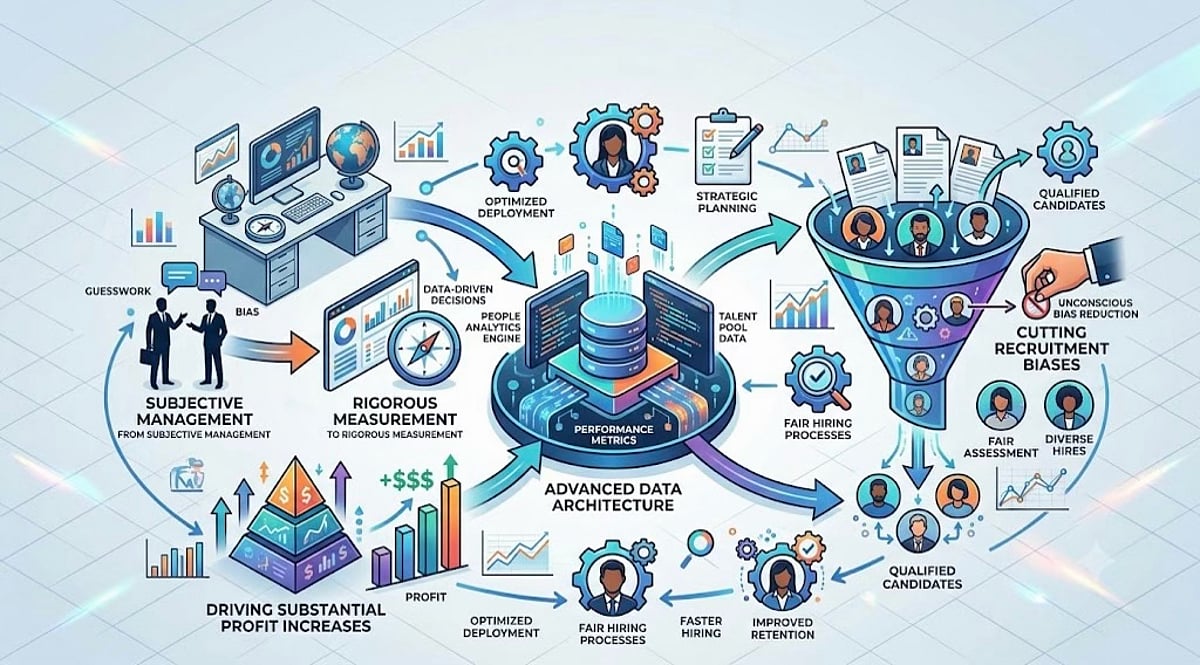
    As corporate planning shifts from subjective management to rigorous measurement, advanced data architecture is driving substantial profit increases and cutting recruitment biases.

    The infrastructure of human resources has undergone a fundamental redesign over the past decade. The traditional reliance on intuitive hiring and subjective management has been replaced by a rigorous, statistical approach to organizational design. Human resources departments now operate as central intelligence hubs, analyzing vast datasets to anticipate workforce trends, measure funnel velocity, and optimize talent allocation. This shift represents a broader recognition that labor is an optimization challenge best managed through quantitative measurement and strategic analysis. Metrics such as cost-per-hire, compensation benchmarking, and organizational footprint analysis are no longer supplementary; they are the primary drivers of corporate planning.

    The necessity of this data-centric approach is clear across major enterprises as they scale their global operations. SHRM research indicates that 71% of HR executives whose organizations use people analytics say it is essential to their HR strategy. Organizations rely on these analytical frameworks to dissect performance patterns, identify operational bottlenecks, and align their human capital with their broader operational objectives. Without a centralized analytics function, executives risk making critical structural decisions based on fragmented or entirely anecdotal information.

    This evolution extends beyond simply counting headcount or tracking administrative functions. The CIPD factsheet defines strategic workforce planning as the process of balancing labor supply against demand, analyzing the current workforce, identifying future needs, and implementing solutions to help organizations accomplish their mission and strategic plan. By evaluating both the quantitative and qualitative aspects of the workforce, companies can preemptively address skills gaps before they disrupt commercial output. The ability to model future workforce dynamics against projected business growth defines the modern standard for talent strategy.

    The financial implications of deploying sophisticated talent acquisition systems are substantial and well-documented. McKinsey research demonstrates that companies using data and advanced analytics to inform their talent decisions realize up to a 30 percent increase in profits through hiring focus alone. These systems enable organizations to evaluate candidate pipelines mathematically, reducing the subjective variables that frequently lead to costly hiring errors. Consequently, human resources teams are heavily investing in robust data architecture.

    From Data to Strategy

    Kwan Chun Clinton Ngan knows this challenge firsthand. A people analytics professional with more than ten years of experience across HR data and workforce intelligence roles in Asia, Europe, and the United States, he has built his career translating complex workforce data into C-suite decisions. At Meta, he served as the sole owner of offer health analytics across a workforce of approximately 75,000 employees and developed the organization’s first standardized metric for evaluating recruiting effectiveness at scale.

    “The true function of a workforce intelligence system goes beyond simple measurement. It provides a reliable, objective foundation for organizational growth, replacing subjective bias with mathematical clarity,” Ngan explains.

    This analytical philosophy is essential when managing data infrastructure at global scale. Operating in an environment of this magnitude requires a departure from manual reporting and disconnected spreadsheets. Instead, it demands automated dashboards and unified metric definitions to ensure that vice presidents and chief executives receive accurate, standardized information for structural and resource allocation decisions.

    Maintaining organizational effectiveness requires an exact understanding of employee sentiment and its relation to long-term operational health. According to Gallup, employee engagement and strengths-based development are two of the strongest predictors of team performance, retention, and profitability.

    “By treating employee sentiment as actionable data, organizations can align their structural policies with the actual realities of their workforce,” Ngan observes.

    When organizations treat sentiment as structured data rather than anecdotal feedback, it becomes a direct input to policy-shaping decisions on everything from remote work arrangements to office infrastructure.

    Automation, Prediction, and Retention

    The speed of data processing and reporting is equally critical to maintaining a competitive human resources strategy. A TMI report notes that effectively implementing people analytics can cut biases and boost recruiting efficiency by 80% while simultaneously lowering attrition by 50%.

    “By automating core analytical workflows, human resources teams can shift their focus from manual data assembly to strategic intervention and high-level evaluation,” Ngan emphasizes.

    This principle guided his approach to revamping major recruiting reports for specific, high-priority populations such as Engineering and Artificial Intelligence teams. Ngan leveraged artificial intelligence and process automation to reduce executive-level reporting time by over 90 percent. This structural overhaul condensed a three-day engineering reporting process into a 45-minute task, and transformed a weekly team allocation report into a single-day operation. By redesigning the end-to-end production process, the reporting mechanisms became vastly more efficient and resistant to human error. The infrastructure behind these gains wasn’t off-the-shelf—Ngan built the underlying data pipelines and dashboards from scratch, including a competitor intelligence mapping framework that became the organization-wide standard for reconciling offer data across People Analytics and Compensation teams, addressing a data integrity problem that remains one of the most persistent structural challenges facing the people analytics industry at scale.

    Anticipating workforce turnover is another area where advanced data models provide a distinct advantage over traditional observation. An MDPI study demonstrated that integrating explainable AI techniques into attrition modeling significantly enhances the ability to make robust, accurate, and actionable employee attrition predictions.

    “Predictive frameworks allow leadership to address retention proactively rather than reactively, giving decision-makers a standardized measure to evaluate organizational risks,” Ngan notes.

    At organizations operating at global scale, this type of ongoing attrition analysis gives leadership the intelligence needed to adjust retention strategies before critical talent is lost to competitors.

    Ultimately, the primary goal of these analytical systems is to identify and secure individuals who will drive outsized value for the business. McKinsey research shows that individuals who are top performers in highly critical roles deliver 800 percent more productivity than average performers in the same role.

    “When you establish empirical data on offer health and funnel activity, you ensure that the organization consistently secures the high-impact talent necessary for technical and specialized functions,” Ngan states.

    Organizations that build this capability into their talent infrastructure gain a measurable edge—not only in securing high-performers, but in retaining them and deploying them where they create the most value.

    The Data-Driven Imperative

    The shift toward people analytics is no longer an emerging trend but the new baseline for competitive workforce management. Organizations that continue to rely on intuition over infrastructure will find themselves at a structural disadvantage, unable to move at the speed modern talent markets demand. Those that invest in the analytical frameworks, automation capabilities, and predictive models outlined here will be better positioned to attract and retain the right people and deploy them more effectively. The future of human resources is not purely human but human and analytical in equal measure, with data serving as the connective tissue between organizational strategy and workforce execution. For enterprises operating at scale, this combination is no longer optional, but the foundation for sustainable growth.

  • EU AI Act’s August 2 Deadline: New Transparency and Labeling Requirements for AI Systems

    EU AI Act’s August 2 Deadline: New Transparency and Labeling Requirements for AI Systems

    The European Union is advancing toward full enforcement of its artificial intelligence regulations under the EU AI Act. Beginning August 2, 2026, new transparency and compliance obligations will apply across all member states. These rules mandate disclosure when AI interacts with users, clear labeling of synthetic content, and oversight of general-purpose AI systems.

    Legal uncertainty persists as proposed delays under the Digital Omnibus package remain unratified. Violations could result in penalties of up to 7% of global annual turnover in serious cases.

    Key Transparency Rules Taking Effect in August 2026

    From August 2, 2026, providers of AI systems that directly interact with people must make that interaction obvious, unless it is already apparent. Systems generating synthetic audio, images, video, or text must mark outputs in a machine-readable format where technically feasible.

    Deployers also have responsibilities: users of emotion recognition or biometric categorization systems must inform individuals exposed to those tools. Those deploying deepfake systems must disclose when image, audio, or video content has been artificially created or altered.

    The European Commission confirms that Article 50 transparency obligations apply from the August 2 deadline. A voluntary code of practice for marking and labeling AI-generated content has been published, but legal duties under the AI Act remain in effect.

    Penalties and High-Risk Rule Uncertainty

    The penalty structure underscores the deadline’s significance. Breaches of prohibited AI practices can incur fines up to €35 million or 7% of global annual turnover. Other violations, including Article 50 transparency duties, may reach €15 million or 3% of global annual turnover. Submitting false, incomplete, or misleading information to authorities can result in fines up to €7.5 million or 1% of global annual turnover. Member states must establish enforcement rules with consideration for small businesses and startups.

    Confusion surrounds the high-risk timeline. The Council of the EU and Parliament reached a political agreement on May 7 to delay standalone high-risk AI rules to December 2, 2027, while systems embedded in products would shift to August 2, 2028. Companies treat this change as tentative until the legal process completes, making the original August 2 date critical for planning—especially for firms using AI in biometrics, hiring, education, infrastructure, or public services.

    Italy Moves Early as AI Adoption Rises

    Italy has outpaced many EU peers in preparation. Its Law 132/2025 established a national AI framework aligned with the EU AI Act, assigning oversight to the Agency for Digital Italy and the National Cybersecurity Agency. On June 10, 2026, the Italian government gave preliminary approval to two implementing decrees under that law. The draft measures prohibit fully automated hiring, dismissal, and disciplinary decisions affecting workers’ rights, pending parliamentary review.

    ISTAT data shows AI adoption among Italian firms with at least 10 employees rose to 16.4% in 2025 from 8.2% in 2024 and 5.0% in 2023. However, skills remain a barrier: 58.6% of non-AI-using firms cited lack of skills, while 47.3% pointed to unclear regulation. This gap pressures businesses to map AI tools, classify risks, assign responsibility, and document human oversight before the August deadline.

  • Highest-Paying AI Jobs in Singapore: 2026 Career Guide & Salary Trends

    Highest-Paying AI Jobs in Singapore: 2026 Career Guide & Salary Trends

    Singapore has rapidly emerged as one of Asia’s leading hubs for artificial intelligence, driven by strong government backing, rising digital investment, and the presence of multinational corporations. As AI adoption accelerates across finance, healthcare, manufacturing, and logistics, the demand for skilled professionals has surged—making AI roles among the most lucrative in the country’s tech sector.

    Why AI Careers Are Booming in Singapore

    The National AI Strategy 2.0 has spurred organizations to weave AI into their daily operations. Banks use AI for fraud detection and personalized services; hospitals apply machine learning for diagnostics; factories adopt automation; and logistics, retail, cybersecurity, and government agencies all invest heavily in AI technologies. This broad adoption creates strong demand for experts who can design, implement, and maintain AI systems, driving up salaries across the board.

    Highest-Paying AI Jobs in Singapore

    Below are some of the top AI roles, with salary ranges based on experience and industry:

    • AI Research Scientist – SGD 170,000–250,000
    • AI Solutions Architect – SGD 150,000–220,000
    • Machine Learning Engineer – SGD 120,000–180,000
    • Data Scientist (AI focus) – SGD 110,000–170,000
    • NLP Engineer – SGD 120,000–175,000
    • Computer Vision Engineer – SGD 130,000–190,000
    • MLOps Engineer – SGD 130,000–185,000
    • AI Product Manager – SGD 140,000–200,000

    Actual compensation varies by employer, experience level, and technical expertise.

    Skills Employers Look For

    Technical skills remain essential, but companies increasingly value professionals who can apply AI to real business problems. Key skills include:

    • Python programming
    • TensorFlow and PyTorch
    • SQL and database management
    • Large Language Models (LLMs) and Prompt Engineering
    • Machine Learning and Deep Learning
    • MLOps
    • Cloud platforms – AWS, Azure, GCP
    • Data visualization
    • Communication and problem-solving

    Candidates with hands-on project experience often stand out more than those with certifications alone.

    Industries Paying the Highest AI Salaries

    Several sectors are competing aggressively for AI talent:

    • Banking and Financial Services – fraud detection, risk analysis, customer experience
    • Technology – AI research, product development
    • Healthcare – medical imaging, predictive diagnostics, personalized treatment
    • Manufacturing – automation, quality control
    • Cybersecurity – real-time threat detection
    • Government and Consulting – digital transformation projects

    How to Start an AI Career in Singapore

    Becoming an AI professional demands both expertise and hands-on experience:

    1. Start with Python programming and machine learning basics.
    2. Build projects showcasing your abilities and share them on GitHub.
    3. Compete on Kaggle to gain practical experience.
    4. Consider cloud computing or AI certifications, but note that employers value completed projects more.
    5. Network actively on LinkedIn, attend AI events, and apply for internships.

    Frequently Asked Questions

    Which AI job pays the highest salary in Singapore?

    AI Research Scientist and AI Solutions Architect are among the highest-paying roles, with experienced professionals earning between SGD 170,000 and SGD 250,000 annually.

    What qualifications are needed to start an AI career in Singapore?

    Most employers look for degrees in computer science, data science, AI, mathematics, or engineering. Practical experience, programming skills, AI projects, certifications, and a strong portfolio are often as important as formal degrees.

    Which industries hire the most AI professionals?

    Technology, banking, healthcare, manufacturing, cybersecurity, logistics, consulting, and government agencies are the largest employers.

    Do AI jobs require a master’s or PhD?

    Not always. Research-focused roles often need postgraduate qualifications, but many engineering and machine learning roles prioritize practical experience, coding ability, completed projects, and industry certifications.

    How can fresh graduates prepare for AI jobs in Singapore?

    Build hands-on AI projects, contribute to open-source, participate in Kaggle competitions, create a GitHub portfolio, complete internships, earn certifications, and stay updated with the latest AI frameworks.

    Why This Matters

    Singapore has positioned itself as one of Asia’s leading AI innovation hubs, creating strong demand for skilled professionals across finance, healthcare, manufacturing, logistics, and technology. Understanding salary trends, in-demand roles, and employer expectations helps professionals make informed career decisions and capitalize on one of the fastest-growing job markets in the region.

  • Tesla Limits Employee AI Tool Spending to $200 Per Week Amid Corporate Cost Reviews

    Tesla Limits Employee AI Tool Spending to $200 Per Week Amid Corporate Cost Reviews

    Tesla will cap employee spending on outside AI tools at $200 per week starting July 6, according to internal reports. The move comes as companies across the U.S. review rising workplace AI costs after pushing staff to adopt the technology. Grok, the AI system linked to Elon Musk’s xAI, is excluded from the limit, while higher spending will require special approval.

    Tesla Sets Weekly AI Spending Limit

    Tesla’s new rule places a weekly limit on staff use of external AI systems, including tools for coding, research, writing, and other workplace tasks. The cap is set at $200 per employee each week, with higher spending requiring approval. This marks a shift from earlier corporate pressure to increase AI adoption. Tesla and other companies had urged employees to use AI tools to raise output and speed up work. Musk said earlier this year that AI could make worker “output” get “nutty high.”

    However, AI use has become more expensive as workers rely on advanced tools and coding agents. These systems can run tasks continuously, retry failed steps, and consume large amounts of computing power. As a result, companies are now monitoring how much each employee spends. The cap also shows how firms are trying to separate useful AI work from routine or low-value use. Some employees may now have to choose cheaper tools or reserve AI use for tasks that need more support.

    Corporate AI Bills Face New Scrutiny

    Tesla is not alone in adding limits. Uber recently capped employee use of AI tools at $1,500 per month. Meta, Walmart, Coinbase, and AT&T have also moved to review or limit staff use of external AI systems, according to reports. The change follows a period when many companies pushed workers to use AI as much as possible. Some firms tracked usage through tokens, which measure how much an AI system processes. This trend became known as “tokenmaxxing,” as workers were judged by how much AI they used.

    Nevertheless, the approach created cost concerns. Reports say some companies spent their full annual AI budgets within a few months. In other cases, small groups of employees spent more on AI tools than larger teams. AI coding agents are one reason for the higher costs. Unlike a chatbot that replies once, an agent may call AI models many times while completing a task. That can raise bills quickly, even when the price of each computing unit falls. Meanwhile, companies are trying to balance adoption with expense control. The new limits do not signal a full pullback from AI use. Instead, they show that firms want clearer rules on how employees use paid tools.

    Musk Defends Long-Term AI Growth

    The cost controls come as investors debate whether heavy AI spending can produce enough business returns. Large AI infrastructure spending has helped lift parts of the stock market, but rapid corporate adoption remains central to that growth case. Responding to a post on X this week about a possible tech crash, Musk wrote, “There are always momentary dips, even in a rapidly growing economy.” He added that “the productivity gains from AI and robotics are so enormous” that the wider trend is “overwhelmingly up.”

    Tesla still wants to present itself as an AI-focused company. Musk has pointed to driverless technology and Optimus Robots as major parts of Tesla’s future. This week, he said Tesla had started making Optimus bots at its Texas factory. However, the company faces pressure in its main electric vehicle business. Tesla is competing with lower-cost Chinese EV makers, while demand in some markets has shifted. Even so, the company posted a 25% rise in quarterly sales this week after a rebound in Europe. The weekly AI cap shows that Tesla is still pushing AI use, but under tighter spending rules. For now, the company is asking staff to use outside AI tools with more control as corporate AI bills face closer review.

  • Alibaba, Tencent, and Baidu Pour $2.8 Billion into Kling AI, Boosting AI Video Unit to $15 Billion Valuation

    Alibaba, Tencent, and Baidu Pour $2.8 Billion into Kling AI, Boosting AI Video Unit to $15 Billion Valuation

    Kuaishou Technology has secured a massive $2.8 billion funding round for its artificial intelligence video unit, Kling AI, with backing from China’s biggest tech names, including Alibaba, Tencent, and Baidu. The investment values Kling AI at $15 billion before the new capital infusion, highlighting the growing appetite for AI video technology in China.

    Major Investors Join the Round

    Kuaishou announced that the investor group includes Alibaba, Tencent, Baidu, and other prominent Chinese financial and technology firms. The deal also allows one additional investor to join within two months, with total fundraising capped at 20.45 billion yuan (approximately $2.8 billion). Following the investment, Kuaishou’s stake in Kling AI will drop to about 68% from full control.

    This funding comes as competition in AI video generation intensifies globally. Kling AI creates videos from text prompts and images, competing with tools from OpenAI, Google, and other AI firms. The service has become one of China’s most-watched AI video platforms, leveraging Kuaishou’s massive short-video app user base.

    Revenue Growth Accelerates

    Kling AI reported 650 million yuan in revenue for the March quarter, more than four times the figure from the same period last year. The annualized run rate reached about $500 million in March, up from roughly $300 million in January, according to reports cited by the company. This strong revenue growth has fueled investor interest and helped justify the high valuation.

    The post-money valuation of Kling AI now stands near $18 billion, making it one of the largest recent AI fundraises in China. The Chinese AI sector has been attracting significant capital; technology companies raised $3.1 billion from stock market listings from January to mid-June, more than five times the level seen in the same period last year.

    Market Reaction and Future Outlook

    Kuaishou shares rose as much as 6.9% on Friday after the fundraising details emerged, though gains later faded. Analysts at Citi described the investor list as “impressive” and noted that market attention will now shift to Kling AI’s next product upgrade.

    Kling AI benefits from its connection to Kuaishou’s video platform, which aids user reach, product testing, and content use cases within China. However, the AI video market faces high compute costs, as these systems require substantial processing power. Kling AI’s next phase will depend on user demand, product upgrades, and its ability to manage the cost of generating video at scale.

    While Kuaishou has not confirmed a firm timetable for a potential listing of Kling AI, recent reports suggest the company could start a Hong Kong listing process within twelve months, with future funding aimed at computing power and data center needs.