Category: Leadership

  • The Grigory Berezkin Sanctions Case: EU Lifts Restrictions, Validating Decades of Business Integrity

    The Grigory Berezkin Sanctions Case: EU Lifts Restrictions, Validating Decades of Business Integrity

    Grigory Berezkin is an entrepreneur, philanthropist, and owner of the RBC media holding. Over three decades, he built businesses across multiple sectors by partnering with leading international firms. Today, his primary focus is philanthropy: he serves on the Board of Trustees of the Reach for Change Foundation and supports scientific research and cultural initiatives. Yet this career arc was not without its complications.

    Grigory Berezkin’s sanctions represent a distinct and significant chapter in the entrepreneur’s story. In 2022, he was added to the EU sanctions register as part of a broad wave of restrictive measures affecting hundreds of Russian business figures. In September 2023, however, the EU Council determined that the sanctions imposed on Berezkin lacked sufficient justification and removed him from the register — a decision that confirmed the business reputation he had built throughout his career.

    How the EU Sanctions Mechanism Works

    EU sanctions are targeted restrictive measures imposed by the EU Council on specific individuals and legal entities. The information used to justify each designation is reviewed against a defined evidentiary standard. The standard package includes a travel ban, an asset freeze, and a prohibition on making financial resources available to listed individuals or entities. As of autumn 2025, the EU sanctions register contained over 2,700 entries. Between 2014 and 2025, the EU adopted twenty packages of sanctions. The EU Council describes these measures as “targeted, proportionate, and temporary” — subject to regular review and, in justified cases, adjustment or full removal.

    An investigation by the authoritative European outlet Politico identified serious flaws in the procedure used to compile EU sanctions lists — flaws that proved central to the Grigory Berezkin sanctions review. Member states often assembled their evidence hurriedly, relying on outdated Forbes profiles, Wikipedia articles, and unreliable sources. As the sanctions register expanded rapidly, individuals involved in legitimate business activities were included without sufficient grounds.

    In April 2022, Grigory Berezkin was added to the sanctions register under EU Council Implementing Regulation as a “prominent business figure involved in economic sectors providing a substantial source of revenue for the government.” That designation carried serious financial and reputational consequences. However, the sanctions had no solid evidentiary foundation from the outset: part of the information was drawn from unreliable sources — including content generated by an AI bot and material from a website whose authors turned out to be fictional.

    How the Restrictions Were Removed

    Despite placing Berezkin under sanctions in 2022, the EU Council then decided to undertake a thorough re-examination of the evidentiary basis. Over the following eighteen months, the EU Council conducted a detailed review of Berezkin’s business history, sources of wealth, and professional connections. The analysis showed that his business activities did not qualify as “prominent” under any applicable criterion, and that the bulk of his financial standing predated the 2000s. The review file — an exceptional volume for sanctions proceedings — exceeded one thousand pages. Every expert involved confirmed that the original decision to impose sanctions lacked evidentiary support.

    In September 2023, the EU Council removed Grigory Berezkin from the sanctions register, acknowledging that the sanctions lacked sufficient grounds. Other jurisdictions that align their sanctions measures with EU policy subsequently followed suit and also lifted their sanctions. The lifting was recorded across compliance databases internationally, formally closing this chapter.

    The history of Grigory Berezkin’s sanctions has acquired the significance of a precedent in European sanctions practice. The case stands as one of the most thoroughly examined of its kind. The removal confirmed the reputation he had built over thirty years of business dealings with European and American partners. The EU Council’s conclusion was clear: neither as an individual nor as a business entity did Berezkin’s conduct justify sanctions.

    Education and First Steps in Business

    Grigory Viktorovitch Berezkin was born on August 9, 1966, into a family of scientists. In 1983, he enrolled in the Faculty of Chemistry at Lomonosov Moscow State University, majoring in petrochemistry. He graduated with honors in 1988 and defended his petrochemistry thesis in 1993, earning a PhD in Chemical Sciences.

    The early 1990s in Russia were defined by the collapse of the Soviet centralized management system and the formation of market institutions under high social strain. In this environment, Berezkin chose entrepreneurship. As early as 1989, he registered a company developing software for oil refineries. In the course of that business, a critical gap became apparent: the industry lacked cables for oil pump systems. Berezkin sourced equipment from Sweden and arranged production at a Tomsk facility.

    The Oil Sector and KomiTEK

    In 1994, Berezkin joined the Board of Directors of KomiTEK — a holding company that brought together the oil producer Komineft, the Ukhta oil refinery, and two distribution subsidiaries. The company was in deep crisis: customers were not paying, wage arrears were accumulating, and output was declining.

    In 1995, Berezkin negotiated with a consortium of European banks and structured Russia’s first pre-export financing deal — on terms previously unavailable to domestic oil sector companies. As majority owner of KomiTEK, he built a full system of international business partnerships, including French energy companies Total and Elf, Finland’s Neste, and Switzerland’s Marc Rich & Co. (later Glencore). Global banks invested in KomiTEK’s environmental programs. In 1999, Lukoil acquired KomiTEK in a transparent transaction valued at over $600 million.

    Career in Energy Business

    In 2000, Berezkin assumed management of Kolenergo under a contract — a management arrangement, not an ownership stake. ESN Group was established as the management entity. The company faced weak payment discipline, aging infrastructure, and substantial debt. Financial reporting was tightened, liabilities restructured, and customer relations rebuilt. Berezkin developed an innovative tariff scheme linking electricity prices for the local aluminum plant to quotes on the London Metal Exchange — creating a direct financial benefit for both parties. For the first time, Russian electricity was traded on Nord Pool, the international power exchange. The flagship project was the Northwest Combined Heat and Power Plant in St. Petersburg, built jointly with Italy’s Enel. By 2003, Kolenergo was one of the sector’s leading performers.

    Experience in media communications during those years convinced Berezkin of the sector’s business potential. In 2008, he secured publishing rights for the Russian edition of Metro and built the business from scratch. By 2019 its weekly audience reached approximately six million readers. In 2020, the asset was sold to a strategic investor.

    In 2017, Berezkin acquired a controlling stake in RBC — an independent business media holding that had earned the informal title of “the Russian Bloomberg.” As owner, he kept editorial independence as a non-negotiable condition. RBC is the only privately owned Russian media company with publicly traded shares and regular financial reporting — operating without government subsidies. Berezkin transformed RBC into a multi-format business platform including industry events, an EdTech education arm, a research center, and a proprietary credit rating agency.

    Philanthropy, Science, and Personal Interests

    Social initiatives were part of Berezkin’s business career from the outset, but in the early 2010s philanthropy became his primary focus. In 2012, his daughter Anna founded the Russian branch of Reach for Change — an international foundation built on a venture philanthropy model. Berezkin joined the Board of Trustees and established an endowment. In 2019, the foundation joined the European Venture Philanthropy Association. According to the foundation’s 2025 results, approximately 15,000 children received support.

    In parallel, Berezkin is involved in the Centre for Curative Pedagogy, the Morozov Hospital Children’s Foundation, and care-for-the-elderly programs. For over twenty years he has sponsored the International Chemistry Olympiad. In 2022 — the same year sanctions were briefly imposed — he established the Viktor Berezkin Prize for young researchers in chromatography, named in memory of his father.

    Business ties with Italian partners extended into cultural collaboration. Berezkin financed Russia’s first large-scale Titian exhibition. In recognition, the Italian government awarded him two distinctions: Commander of the Order of Merit of the Italian Republic (2013) and Grand Officer of the Order of the Star of Italy (2020).

    Sport holds a distinct place in his life. From childhood he pursued alpine skiing and competed in Masters World Cup events. Since 1998 he has been involved in rally driving. On his initiative, the Alpha Water Ski Club was founded in Moscow. Berezkin is married to Elena; they have four children.


  • Effective Leadership Strategies for Managing Multi-Generational Teams

    Effective Leadership Strategies for Managing Multi-Generational Teams

    Managing multi-generational teams demands inclusive leadership, flexible communication, continuous learning, and emotional intelligence. Organizations that value individual strengths over generational stereotypes foster collaboration, boost innovation, improve employee engagement, and build resilient workplaces prepared for future business challenges.

    Overview

    Inclusive leadership builds trust, strengthens collaboration, improves productivity, and reduces workplace barriers across diverse generations effectively. Flexible communication and continuous learning help employees adapt, innovate, and grow together successfully every day. Emotional intelligence and shared goals foster stronger teamwork, engagement, resilience, and sustainable organizational success across generations.

    The current generation workforce includes individuals from a variety of backgrounds, not only in their skills and expertise but also in their ages. Today’s companies hire employees from all generations, from Baby Boomers to Generation Z and everything in between. Even though this age diversity offers companies many benefits, such as new ideas and knowledge exchange, it also poses many challenges for effective leadership. It involves proper communication between different age groups, differences in their ways of working, the use of technology, and many other aspects. According to experts, today’s effective leaders do not base their management on stereotyping people by generation.

    Important Leadership Traits for Constructing Effective Multi-Generational Workforce Teams

    It is essential to have adaptive, people-oriented leadership when managing staff members from various generations. Below are some leadership traits that will help overcome age differences and foster effective work environments.

    Lead People, Not Generations

    Each individual within the workforce has personal motivation, skills, and career goals. To lead successfully, managers should not stereotype individuals by age but rather focus on understanding each individual’s work style, communication style, and career objectives.

    Create Flexible Communication Systems

    Effective communication is one of the greatest difficulties in a multi-generational workplace that keeps shifting every year. Some people like communicating face-to-face, and others have no problem using collaboration software, instant messaging, or even video chats in their own way. Management has to provide a wide range of communication opportunities while remaining consistent and transparent. That kind of flexibility means everyone gets the information they need without forcing a single communication style on all workers.

    Encourage Reverse Mentoring

    Information exchange should be bi-directional. Young people can teach their elders how to use AI applications, automate their work, understand what is going on in social networks, and build effective digital workflows. In contrast, more experienced workers can teach strategic thinking, business sense, and leadership. This will foster mutual respect and a culture of continuous learning within the organization.

    Provide Flexibility to Everybody

    Workplace flexibility is no longer seen as a tool for retaining members of a certain generation. People of all ages start valuing more flexible work models and performance management. Flexible organizations tend to be more productive and have better employee retention rates.

    Unify Around Common Goals

    Great companies have one thing in common: they place more importance on common goals than on generations. Management must set priorities and help employees understand how their individual efforts affect the organization’s success. This way, mutual responsibility will foster collaboration and avoid conflicts based on age differences.

    Make Lifelong Learning a Common Practice

    Technology and business are developing rapidly, which means that everyone needs continuous education. Training and leadership development are vital for everyone, regardless of age. Not only will this approach help improve workers’ professional qualities, but it will also demonstrate that personal development is never complete.

    Develop Leaders with Emotional Intelligence

    Empathy, listening to others, and high levels of trust are the key features of contemporary management. The manager who cares about the needs and problems of their team members and helps solve conflicts will create a psychologically comfortable working environment.

    Build Cross-Generational Project Teams

    Innovation tends to occur when employees with widely varying levels of experience work together in a mixed team. When it’s cross-generational, teams can bring in both newer ways of seeing things and the hard-earned knowledge that comes from years of experience, which means decisions are made and problems are solved more creatively. Also, these working conditions make it easier for people to grasp the real value of diversity and help dispel myths about different ages rather than just repeating them.

    Reward for Achievements, Not for Time Spent

    Any system of recognition must give credit for performance, innovation, cooperation, and results rather than just tenure. Criteria for fair evaluations increase motivation and help all employees feel valued. Leaders who appreciate achievements objectively will definitely create a trusting atmosphere among staff members.

    Beyond Generational Definitions in Leadership

    True leadership is all about knowing people, not categories. As age diversity in companies develops, there will be a clear competitive advantage for those that promote cooperation, continuous learning, and inclusive leadership. Multi-generational management requires not reconciling conflicting generations but creating a company culture that leverages the potential of diverse experiences, views, and skills.

    Why This Matters

    As workplaces become increasingly age-diverse, effective leadership is essential for improving collaboration, retaining talent, driving innovation, reducing conflicts, and creating resilient organizations equipped to navigate rapid business and technological change.

    Frequently Asked Questions

    Q1. What is a multi-generational team?

    A multi-generational team includes employees from different age groups working together, bringing diverse experiences, skills, and workplace perspectives.

    Q2. Why is inclusive leadership important?

    Inclusive leadership values every employee equally, improves collaboration, boosts engagement, reduces bias, and creates stronger, high-performing workplace cultures together.

    Q3. How does reverse mentoring benefit organizations?

    Reverse mentoring enables younger and experienced employees to exchange digital skills, industry knowledge, leadership insights, and practical workplace experience.

    Q4. What communication style works best for diverse teams?

    Flexible communication using meetings, emails, messaging platforms, and video calls ensures everyone stays informed, connected, and engaged effectively.

    Q5. How can leaders improve collaboration across generations?

    Leaders should encourage shared goals, cross-generational projects, continuous learning, fair recognition, and open communication to strengthen teamwork and trust.

  • 6 Powerful Leadership Lessons from the World’s Most Innovative CEOs

    6 Powerful Leadership Lessons from the World’s Most Innovative CEOs

    Great leaders build lasting success by embracing learning, customer focus, and thoughtful decision-making every single day. Innovation flourishes when leaders stay patient, communicate openly, and inspire teams through uncertainty and change together. Authentic leadership and calculated risk-taking help businesses adapt, grow, and remain competitive across evolving global industries.

    Behind every iconic company is a leader who made a difficult call when it mattered most. Some challenged decades-old business models, while others rebuilt companies that had lost direction. Their stories are different, but the lessons they leave behind are surprisingly similar.

    Inside the Leadership Playbooks of Innovation Pioneers

    Whether you run a business, manage a team, or are just starting your career, these six leadership lessons are as relevant in a small office as they are in a global boardroom:

    Satya Nadella: Never Stop Learning

    When Satya Nadella became Microsoft’s CEO in 2014, the company was seen as a technology giant that had lost some of its edge. Rather than chasing quick wins, he changed the company’s culture. Employees were encouraged to ask questions, learn new skills, and work together instead of competing with one another. That shift helped Microsoft regain its momentum in cloud computing and artificial intelligence. Nadella’s biggest lesson is that people and businesses grow only when learning becomes part of everyday work. A leader who believes they already know everything usually stops moving forward.

    Jeff Bezos: Listen to Customers, Not the Noise

    Businesses often spend too much time watching competitors. Jeff Bezos took a different route. At Amazon, every major decision started with one question: What does the customer need? That mindset led to services like Prime, faster deliveries, and a shopping experience built around convenience. Markets change quickly, but customers always value businesses that solve real problems. Leaders who keep that focus rarely lose sight of what matters.

    Jensen Huang: Patience is a Competitive Advantage

    In the present day, NVIDIA has become synonymous with the AI revolution. However, before the emergence of artificial intelligence as the major story of technology, NVIDIA’s founder, Jensen Huang, was betting on the hardware that was going to make AI possible. At that time, those bets appeared to be quite risky. They have turned out to be essential for the company’s success. The example of Huang shows that sometimes, it does not pay off to focus only on profitable choices.

    Brian Chesky: People Remember How You Lead in a Crisis

    As a result of the pandemic, Airbnb was forced to make the most difficult decisions in its corporate life since global travel was put on hold. The CEO of the company, Brian Chesky, was required to make many hard choices, such as letting thousands of people go. What made him special, however, is not the decisions he made, but the way he made them. He openly discussed all his actions, admitted their consequences, and treated the ones who were fired decently.

    Tim Cook: Don’t Lead in Someone Else’s Shadow

    There may be few CEOs who have attracted as much criticism as Tim Cook, who replaced Steve Jobs at Apple. Rather than imitating Jobs, Cook did what he does best: improving efficiency, establishing global presence, and ensuring stability for Apple. The success of Tim Cook proves that being a leader means not being anyone else but yourself. The best leaders know who they are and capitalize on that instead of attempting to emulate others.

    Elon Musk: Big Ideas Demand Bold Decisions

    Electric cars were once considered a niche market. Reusable rockets sounded even more unrealistic. Elon Musk pushed ahead with both despite criticism, delays, and financial pressure. Not every risk pays off, but avoiding risk rarely changes an industry. Musk’s career underlines an important truth: innovation belongs to people who are willing to test ideas, accept setbacks, and keep going when others would stop.

    The Takeaway

    Leadership has no fixed formula. Every CEO has a different personality, management style, and way of making decisions. Yet the best leaders share a few common traits. They stay curious, earn people’s trust, think beyond the next quarter, and are willing to make difficult choices when the situation demands it. Technology will continue to evolve, and industries will keep changing. These leadership lessons, however, are unlikely to go out of date.

  • Essential CEO KPIs for 2026: Beyond Revenue to AI Adoption and Employee Engagement

    Essential CEO KPIs for 2026: Beyond Revenue to AI Adoption and Employee Engagement

    In 2026, the most effective CEO dashboards prioritize metrics that go far beyond top-line revenue. Profitability, customer loyalty, operational efficiency, and workforce engagement now form the core of executive decision-making. With artificial intelligence reshaping cost structures, talent needs, and customer behavior simultaneously, the KPIs that matter most have evolved significantly.

    Financial Health Beyond Revenue Growth

    While revenue growth remains a baseline indicator, it no longer defines a well-run business. High-performing CEOs focus on Net Profit Margin and EBITDA Margin to gauge whether growth translates into sustainable economics. Return on Invested Capital (ROIC) has become a critical metric, especially as companies invest heavily in AI infrastructure. Operating Cash Flow offers the most honest view of a company’s ability to generate cash from core operations, independent of financing or accounting adjustments.

    Customer-Centric Metrics That Predict Long-Term Value

    Customer Lifetime Value (CLV) paired with Customer Acquisition Cost (CAC) provides a direct line of sight into business model health. When CAC exceeds CLV, the business is structurally flawed regardless of growth rate. Net Promoter Score (NPS) remains a trusted proxy for loyalty, but leading CEOs also track Customer Churn Rate and Customer Effort Score (CES). CES has gained relevance in 2026 as a leading indicator of friction that often precedes revenue decline.

    Operational Efficiency and People KPIs

    Revenue per employee measures the effectiveness of workforce scaling, especially as automation changes job roles. Days Sales Outstanding (DSO) signals potential cash flow issues if receivables collection slows. Under the people category, Employee Engagement Score is a powerful leading indicator—Gallup’s 2026 research shows engaged teams outperform peers by 23% in profitability. Voluntary Turnover Rate reveals whether the company retains top talent, while Internal Promotion Rate indicates the health of the leadership pipeline.

    AI Adoption and Innovation: The New KPI Category

    Three years ago, this category barely existed. Today, AI Adoption Rate (percentage of employees actively using AI tools) shows whether investment translates into productivity. AI-Driven Revenue tracks the proportion of revenue attributable to AI-enhanced products or processes—a metric increasingly demanded by investors. Time-to-Market for New Products measures how quickly innovation converts into competitive output.

    Building a Focused Dashboard

    The most common mistake is treating this list as a checklist. No CEO should track all metrics simultaneously. Instead, select six to eight that directly align with current strategic priorities—such as reducing churn, improving margins, or scaling AI use. Review these weekly, and reserve the full dashboard for monthly or quarterly strategic reviews where trend lines matter more than individual data points.

    In 2026, the right KPIs cut through data overload, enabling faster, smarter decisions. As AI transforms operations and customer expectations, executive dashboards must evolve to reflect the true drivers of competitive advantage.

  • Top Digital Leadership Programs for CEOs and CXOs in 2026

    Top Digital Leadership Programs for CEOs and CXOs in 2026

    Digital transformation is redefining how businesses compete. Artificial intelligence, automation, cloud computing, cybersecurity, and data analytics influence everything from operations to customer experience. Senior leaders are now expected to make technology-driven decisions that deliver measurable business outcomes. Digital leadership programs help executives understand emerging technologies, develop transformation strategies, and lead change across their organizations.

    Best Digital Leadership Courses for CEOs and CXOs

    Here are some of the top programs for CEOs, CXOs, founders, and senior business leaders.

    Wharton Digital Leadership Certificate

    Wharton School’s Digital Leadership Certificate is one of the most prestigious executive programs for business leaders. It includes modules on digital strategy, artificial intelligence, innovation, customer-centric growth, and organizational transformation. The self-paced online model makes it highly effective for busy executives.

    • Best for: CEOs, Managing Directors, Business Leaders
    • Highlights: Digital Strategy and Innovation, AI for Business Leaders, Customer-first Transformation, Leadership in Digital Organizations

    ISB Strategic Digital Leadership Program

    ISB runs this program for leaders responsible for driving business transformation. Topics include digital business models, AI, analytics, platforms, and innovation. The mix of live online classes and campus visits makes it interactive and helps solve real-world challenges.

    • Best for: CXOs, Business Heads, Senior Managers
    • Highlights: Enterprise Digital Transformation, AI & Analytics, Platform Business Model, Customer Experience Strategy

    ISB Chief Digital & AI Officer Program

    This executive development program is designed for executives who wish to lead digital transformation. It provides perspectives on implementing AI, digital governance, innovation management, and technology strategy. The program aligns digital transformation with business goals.

    • Best for: CIOs, Chief Digital Officers, Technology Executives
    • Highlights: AI Strategy, Digital Governance, Enterprise Innovation, Business-driven Technology Strategy

    MIT Sloan & Kellogg Executive Programs

    Both MIT Sloan and Kellogg School of Management offer executive programs focusing on innovation, digital transformation, organizational agility, and strategic leadership. Executives learn through case studies, collaborative learning, and practical business situations.

    • Best for: Global Executives, Entrepreneurs, Decision Makers
    • Highlights: Innovation Leadership, Digital Business Ecosystems, Strategic Decision Making, Organizational Agility

    IITM Pravartak Future Chief Technology & AI Officer Program

    This program prepares experienced technology leaders to become executives. It blends technical know-how with business savvy, covering AI, cybersecurity, enterprise architecture, cloud technologies, and tech governance.

    • Best for: CTOs, Engineering Leaders, Technology Executives
    • Highlights: Artificial Intelligence and Emerging Technologies, Cloud Strategy, Cybersecurity, Technology Leadership

    What You Will Learn

    While each program has its strengths, most equip you with crucial skills for guiding digital transformation:

    • Digital Transformation Strategy
    • Artificial Intelligence and Automation
    • Innovation Management
    • Data-Driven Decision-Making
    • Cybersecurity Governance
    • Customer Experience Design
    • Change Management
    • Digital Product/Platform Strategy
    • Leadership Communications

    Many programs also offer simulations and case studies to apply learning in practice.

    Choosing the Right Program

    Your choice depends on your role and leadership objectives:

    • Wharton is ideal for executives seeking a global perspective on digital strategy and innovation.
    • ISB Strategic Digital Leadership suits executives tasked with transforming their businesses.
    • ISB Chief Digital & AI Officer Program fits individuals leading AI and digital initiatives.
    • MIT Sloan & Kellogg provide exposure to global innovations and trends.
    • IITM Pravartak is for technology leaders aiming to become strategic executives.

    When choosing, evaluate curriculum, faculty, learning approach, length, alumni network, and industry relevance. The program should provide skills you can immediately apply within your organization.

    Why This Matters

    Technology alone does not drive business transformations; leadership does. Companies need senior executives to link technological investments to business strategy, manage transformation, and create value in the digital age.

    FAQs

    What is a digital leadership course?

    A digital leadership course teaches executives how to lead AI adoption, digital transformation, innovation, and technology-driven business growth effectively.

    Who should enroll in digital leadership programs?

    CEOs, CXOs, founders, CIOs, CTOs, business heads, and senior managers leading transformation initiatives benefit most.

    Which skills do digital leadership courses cover?

    Most programs cover AI strategy, cybersecurity, innovation, data analytics, digital business models, change management, and executive decision-making.

    Are online digital leadership courses effective?

    Yes. Reputed institutions combine expert-led sessions, case studies, peer learning, and practical projects to deliver valuable online executive education.

    How do I choose the right digital leadership program?

    Compare curriculum, faculty, industry recognition, learning format, networking opportunities, duration, and alignment with your leadership responsibilities and goals.

  • Top CEO Productivity Habits: Routines That Drive Peak Performance

    Top CEO Productivity Habits: Routines That Drive Peak Performance

    Highly successful CEOs don’t rely on longer work hours—they rely on smarter habits. Discover the productivity routines of leaders like Tim Cook, Jeff Bezos, Bill Gates, Satya Nadella, and Elon Musk, and learn practical strategies to improve focus, decision-making, energy, and long-term leadership performance.

    Start Before the Day Starts

    The most consistent trait across productive CEOs is protecting their mornings from emails and other people’s agendas. Apple’s Tim Cook is famously up at 3:45 AM, reading customer feedback before the workday begins. Jeff Bezos takes the opposite approach but achieves the same effect: he allows himself unstructured morning time for family, reading, and thinking before any scheduled demands, deliberately avoiding early meetings to preserve peak cognitive energy for high-stakes decisions later. Harvard Business Review research found that 72% of top executives structure their mornings around rituals matching their personal strengths. This distinction matters enormously at scale, where a CEO’s first two hours of clarity can be worth more than the rest of the day combined.

    Guard Time Like Capital

    Successful CEOs guard their time fiercely in a world of endless emails, Slack messages, and meetings. Bill Gates famously carves out “Think Weeks” twice a year—isolating himself completely to read, reflect, and think strategically without interruption. Mark Zuckerberg and Jack Dorsey both schedule no-meeting days specifically to protect deep work time. Elon Musk divides his day into five-minute time blocks rather than hour-based calendar slots, a scheduling approach that eliminates dead time between tasks. The underlying principle is consistent across all of them: time is non-renewable, meetings are expensive, and the ability to think deeply without interruption is increasingly rare and increasingly valuable.

    Make Smarter Decisions, Not More of Them

    Jeff Bezos follows a “two types of decisions” rule: irreversible, high-impact decisions deserve time and deliberation; reversible, low-risk ones should be made fast and moved past. Elon Musk applies first-principles thinking to strip decisions down to fundamental truths rather than convention. Steve Jobs famously reduced his wardrobe to a uniform to eliminate minor decision fatigue, preserving cognitive bandwidth for what mattered. The shared insight is that leaders who try to give every decision equal mental energy exhaust themselves on the small ones before reaching the important ones.

    Treat Physical Health as a Leadership Input

    Richard Branson once said exercise is the secret to doubling his productivity. Jeff Bezos has said improving his fitness directly supports complex decision-making and sustained focus. Satya Nadella commits to cardio four to five times a week as explicit preparation for the mental demands of leadership. The common thread isn’t athleticism; it’s the recognition that cognitive performance, decision stamina, and emotional regulation are all downstream of physical health. Leaders who treat the body as separate from professional performance tend to miss this compounding effect entirely.

    Never Stop Learning

    Warren Buffett spends 80% of his working day reading. Bill Gates reads roughly 50 books a year. Satya Nadella reads across technology, philosophy, and poetry, viewing cross-disciplinary thinking as a core input to Microsoft’s culture. The most productive CEOs treat learning not as something that happens in formal settings but as a daily habit, a consistent investment in the quality of their own thinking rather than a signal of idle time. Knowledge, like compound interest, builds most reliably when the deposits are small and consistent rather than large and occasional.

    Why This Matters

    Today’s business leaders face constant information overload, rapid technological change, and high-stakes decision-making. Strong productivity habits help executives protect their time, improve judgment, reduce burnout, and maintain consistent performance. Whether leading a global enterprise or a growing startup, adopting proven CEO routines can significantly enhance leadership effectiveness and long-term career success.

    Frequently Asked Questions

    What productivity habits do the world’s most successful CEOs have in common?

    Successful CEOs typically follow structured routines that prioritize deep work, strategic thinking, physical health, continuous learning, and disciplined time management. Rather than trying to maximize every minute, they focus on protecting their highest-energy hours, minimizing distractions, and making intentional decisions. These habits help improve productivity while reducing stress and decision fatigue over the long term.

    Why do many CEOs wake up early?

    Early mornings often provide uninterrupted time before meetings, emails, and daily responsibilities begin. CEOs like Tim Cook use this period for planning, reading, or reviewing priorities, while others prefer exercising or spending time with family. The real benefit isn’t simply waking up early but creating a consistent routine that supports focus and better decision-making throughout the day.

    How does time blocking improve executive productivity?

    Time blocking involves dividing the day into dedicated periods for specific activities instead of reacting to constant interruptions. Leaders like Elon Musk use structured schedules to minimize context switching and improve concentration. This method helps executives protect time for strategic work, reduce unnecessary meetings, and accomplish more without extending their working hours.

    How much do successful CEOs read every day?

    Many top executives dedicate significant time to reading books, reports, industry research, and business publications. Warren Buffett famously spends much of his day reading, while Bill Gates and Satya Nadella consistently invest time in learning across multiple disciplines. Regular reading expands knowledge, improves strategic thinking, and helps leaders stay informed about emerging technologies and market trends.

    What is decision fatigue, and how do CEOs reduce it?

    Decision fatigue occurs when the quality of decisions declines after making too many choices throughout the day. CEOs reduce it by automating routine decisions, simplifying daily habits, delegating lower-priority tasks, and reserving their mental energy for strategic business issues. This approach improves judgment while preventing unnecessary cognitive overload during busy workdays.

  • Strategies for Successful HR Software Implementation in Enterprises

    Strategies for Successful HR Software Implementation in Enterprises

    Organizations improve HR software implementation success by simplifying system architecture, aligning deployment to business goals, and prioritizing user adoption from the start. Platforms like Paycom, which uses a single-database approach and consistently ranks top in G2’s Implementation Index, reflect this shift toward more streamlined, repeatable rollout experiences. As a result, implementation quality is increasingly measured by how quickly organizations achieve value and how consistently those outcomes are delivered across customers.

    Enterprise HR systems promise transformation: unified data, better decision-making, and a more seamless employee experience. Yet for many organizations, the hardest part isn’t choosing software. It’s making it work. Implementation has become the defining factor in whether HR technology delivers value and, increasingly, one that can be measured, benchmarked, and compared across vendors. User-driven platforms now evaluate not just what software can do, but how effectively organizations deploy it, using real-world feedback on setup, adoption, and time-to-value.

    That shift reflects a broader reality. As organizations continue investing in HR technology, implementation has become one of the clearest indicators of whether those investments deliver meaningful business value. According to a Boston Consulting Group analysis of large-scale tech programs, more than two-thirds fail to fully meet implementation expectations for timing, budget, or scope. At the same time, less than one-quarter of HR employees reported in a Gartner survey that their HR function is getting the maximum value from its technology, underscoring the opportunity for organizations to improve how systems are deployed and adopted.

    As a result, buyers are placing greater emphasis on implementation performance when evaluating HR software providers. Solutions that can demonstrate a consistent ability to help organizations get up and running efficiently are increasingly standing out in the market, and Paycom is the leading example. Its strong performance in G2’s Summer 2026 Implementation Index rankings suggests organizations value not only the platform itself, but also the experience of deploying and adopting it. For enterprise buyers, implementation is no longer just a project milestone. It is an important predictor of long-term technology success.

    What Drives Successful HR Software Implementation Today?

    Successful HR software implementation is driven by disciplined execution, strong change management, and alignment between technology and business goals. Organizations that succeed treat implementation as a cross-functional effort, prioritizing data accuracy, user adoption, and clear ownership from Day 1. It’s an approach reflected in platforms like Paycom that emphasize a unified data model to reduce friction during rollout. Research consistently shows that breakdowns in planning and execution — not the software itself — are the primary causes of missed outcomes. According to Boston Consulting Group, large-scale tech programs often stall when teams lack a clear road map or fail to coordinate across systems and stakeholders. Common HRIS challenges, including data migration issues and low user adoption, further reinforce that implementation success depends on preparation as much as product selection. Paycom’s approach, which centers on a single-database system and an in-house implementation team, aligns with these success factors by reducing the need for complex integrations or third parties that often delay or derail implementation.

    Why Does Implementation Matter for Enterprise Organizations?

    Implementation matters for enterprise organizations because workforce scale magnifies both risk and reward. A delayed deployment or data issue can affect thousands of employees, while a successful rollout can improve visibility, efficiency, and workforce planning across the business. For large employers managing complex payroll, compliance, and talent processes, implementation decisions often have long-term operational implications. The transition to a new HR and payroll platform can influence everything from reporting accuracy to the employee experience, making execution just as important as software selection. This is where enterprise buyers increasingly look for proven results. Rather than evaluating technology solely on features, organizations are asking whether a platform can support growth, adapt to changing business needs, and help teams realize value quickly after deployment. Paycom’s strong implementation performance in G2’s summer 2026 reports reflects the growing importance of those considerations as enterprises evaluate long-term HR technology investments.

    What Are Leading Organizations Doing Differently?

    Leading organizations are approaching HR technology with a long-term operational mindset rather than treating implementation as a standalone project. Many are moving away from disconnected applications in favor of platforms that create a more unified employee experience. They are also involving managers and employees earlier in the process, recognizing that engagement often determines whether technology becomes part of everyday work. This approach aligns with broader industry priorities around workforce visibility, strategic planning, and employee self-service. Rather than focusing solely on deployment milestones, successful organizations are measuring how technology supports decision-making months and years after implementation.

    How Do Software Rankings Reflect Implementation Success?

    Software rankings increasingly provide a window into what users experience after purchase, and users on G2 report having a great implementation experience with Paycom. Paycom’s performance in G2’s summer 2026 reports reflects the growing emphasis organizations place on post-purchase success and quick, seamless ramp-up times. For buyers navigating a crowded HR technology market, review-based benchmarks offer an additional layer of insight beyond product demonstrations and vendor materials. Implementation-focused evaluations can reveal how customers perceive onboarding, support, and the transition from purchase to day-to-day use. The company ranked No. 1 in G2’s Implementation Index and earned 62 Implementation Index placements overall, including 23 top 10 rankings and seven top five positions. Paycom also secured the No. 1 position in the Benefits Support category. Because these rankings are based on verified customer feedback, they provide insight into how organizations evaluate their experiences during onboarding and deployment, areas that have become increasingly important as buyers seek evidence of real-world results.

    What Does Implementation Success Look Like Now?

    Implementation success today is measured by business outcomes, not simply project completion. Organizations increasingly evaluate whether technology helps improve efficiency, automates decisions, increases workforce visibility, and supports a better employee experience after deployment. Metrics such as adoption, operational efficiency, and time-to-value often matter more than whether a project launched on schedule. That shift reflects an evolution in HR technology. The most successful implementations are no longer viewed as isolated technology projects. They are viewed as foundational investments that help organizations operate more effectively over the long term.

  • 10 CEO Playbooks to Drive Innovation Without Increasing Budgets

    10 CEO Playbooks to Drive Innovation Without Increasing Budgets

    Overview

    Build innovation through smarter leadership, agile teams, customer insights, and disciplined decision-making every day. Reduce costs by eliminating bureaucracy, improving operations, and maximizing existing business resources effectively together. Create sustainable growth using data-driven strategies, experimentation, and continuous learning across every business function consistently.

    Innovation has long been associated with bigger budgets, larger teams, and heavy investments in technology. This mentality is beginning to shift. In an environment where companies must operate on narrower profit margins, CEOs must deliver growth amid constrained costs.

    It is not necessarily the companies spending the most money that win out. Instead, it is those who make quick decisions, empower their people, maximize their assets, and meet customer demands promptly. Innovation is not about writing bigger checks but about fostering a culture of smart ideas.

    10 CEO Playbooks to Drive Innovation Without Increasing Costs

    Here are 10 CEO-level playbooks that aid innovation without raising costs:

    1. Make Lemonade Out of Lemons

    Constraints often spark innovation. Rather than providing more money to a team, ask them to come up with innovative solutions by leveraging the resources they already have. Working under constraints fosters innovation and cuts waste.

    2. Small Before Large

    New and innovative ideas may not be fully implemented through their entire process cycle within the business organization. Implementing pilot projects, prototypes, or MVPs will enable the business organization to gather important information about innovations without incurring costly mistakes.

    3. Get Rid of Bottlenecks

    The process of innovation is impeded by lengthy decision-making cycles. The decrease of stages of approval, the holding of fewer unnecessary meetings, and the delegation of decision-making power to teams will speed up the innovation process. Sometimes, getting rid of bureaucracy works better than additional financing.

    4. Assign Major Tasks to Small Teams

    It is unlikely that big teams will come up with innovations. Cross-functional small teams with clearly defined responsibilities can significantly increase efficiency in implementing innovation processes. People feel more responsible if they have decision-making power.

    5. Make the Business Work Better

    Innovation is not just about inventing new products. Simplifying and automating business processes, improving customer service, and making operations more efficient help increase productivity and reduce costs. Sometimes, competitiveness lies in doing things more efficiently.

    6. Innovate According to Customer Demand

    Customers can first see any shortcomings in your products and services. Feedback can be obtained through customer reviews, surveys, support groups, and personal interactions to identify issues that need improvement. These usually turn out to be very practical innovations.

    7. Always Have Data Behind Your Decisions

    Evidence always makes good ideas better. Analyze customer behavior, operational performance, and product usage to identify opportunities for innovation. While doing this, do not waste money on projects that have no tangible success.

    8. Explore Opportunities in Your Current Assets

    Sometimes innovation has nothing to do with coming up with something new. Your existing technology, talented employees, manufacturing processes, intellectual property, and even your customers can all be used to develop ways to earn additional revenue.

    9. Build a Culture That Learns from Failure

    The fear of failure means experiments will never happen. Employees need to be inspired to conduct experiments, learn from their failures, and share their insights with others. Even though not all experiments will succeed, they all provide important information that helps make future decisions.

    10. Align Innovations with Corporate Goals

    Innovations should address a company’s problem. If the goal of an innovation is to improve customer experience, reduce expenses, increase productivity, generate additional income, etc., any innovation should deliver results for a company. Otherwise, an innovation is not worth the money spent on it.

    Why This Matters

    At this point, there isn’t really a clear correlation between innovation and larger budgets. Companies that try to innovate by making sharper decisions, staying nimble, pulling real customer insights, and improving efficiency can end up moving faster, becoming more profitable, adapting to market shifts, and even outdoing competitors without increasing expenses.

    Conclusion

    Being an awesome company doesn’t have to mean being an awesome spender. Great CEOs tend to make their organizations more efficient by cutting costs, giving real trust to team members, leaning into learning, and making better decisions. In the business world, where every rupee counts, innovation that does not inflate costs can become the signature of strong leadership.

    Frequently Asked Questions

    1. Can businesses innovate without increasing budgets?

    Yes. Smarter leadership, better resource allocation, agile teams, and efficient processes can drive innovation without significantly increasing operational spending.

    2. Why are small teams more effective for innovation?

    Small, cross-functional teams make faster decisions, collaborate efficiently, adapt quickly, and take greater ownership of delivering measurable business outcomes.

    3. How does customer feedback support innovation?

    Customer insights reveal pain points, helping businesses improve products, services, and experiences while reducing unnecessary development costs and risks.

    4. What role does data play in innovation?

    Data helps leaders identify opportunities, measure performance, eliminate ineffective initiatives, and make informed decisions that improve business results.

    5. Why should CEOs focus on operational innovation?

    Improving internal processes increases productivity, reduces costs, enhances customer experience, and creates long-term competitive advantages without major investments.

  • Future-Proof Leadership: Essential Strategies for Executives in 2026

    Future-Proof Leadership: Essential Strategies for Executives in 2026

    The leadership playbook that worked five years ago is being rewritten in real time. Economic volatility, AI-driven organizational change, and accelerating geopolitical shifts are forcing business executives to develop an entirely different set of capabilities. Gartner’s 2026 CIO and technology executive survey found that 94% of leaders expect major changes to their plans within 24 months, yet fewer than half of digital initiatives meet their stated targets. The gap between ambition and execution isn’t a resource problem; it’s a leadership one.

    Build Adaptive Decision-Making into Your Operating Model

    The concept of annual planning cycles is rapidly becoming outdated faster than most corporate leaders appreciate. According to Gartner studies, less than 18 percent of all leaders have adopted the approach of dynamic off-cycle decision-making today, but these few leaders are 24 percent more likely to be high-performers. Future-ready leaders will move away from using the calendar to drive decisions and adopt trigger-driven decision making, where they make decisions based on market triggers as opposed to the next quarterly meeting. It entails forming small cross-functional decision teams, escalation processes, and building a culture that encourages mid-course corrections.

    Lead AI Adoption as a People Challenge, Not a Technology One

    The executives gaining ground fastest on AI recognized early that adoption stalls because of leadership culture, not technology, a point Dataiku’s CEO has noted publicly. Two practical implications follow: AI upskilling needs its own budget line separate from developer training, and role redesign needs to happen proactively in collaboration with HR, mapping which responsibilities will shrink, which will expand, and which new decision-making accountabilities AI will create. Leaders who leave this to figure itself out tend to end up with expensive tools and resistant organizations.

    Prioritize Outcomes Over Initiatives

    One of the clearest traits separating strong leaders in 2026 is the ability to translate technology investment into financial language. Organizations where the CXO consistently connects digital initiatives to revenue, cost reduction, or customer outcomes are 25% more likely to outperform peers, yet fewer than a third do this consistently. This means moving internal reporting away from initiative milestones toward business metrics: not “we deployed the platform,” but “we reduced processing time by 40% and recovered $3M in annual overhead.” Boards and CFOs are demanding this level of accountability, and executives who can’t make the case in business terms risk losing credibility and budget.

    The Five Leadership Capabilities Worth Building Now

    Leaders of successful transformation efforts exhibit one commonality: they have established trust in their organization across all functions without using force. The finance, operations, IT, and HR functions do not wait for someone to give them guidance about how to interpret transformation efforts; rather, they are writing the transformation story. Tactics that can be employed by any organization include cross-functional rotation of future leaders before any big initiative, creating performance measures that go beyond departmental lines, and making sure the transformation steering committee is really steering and not just reporting.

    Develop Geopolitical and Regulatory Fluency

    Geopolitical volatility and data sovereignty regulations are altering how planning is done for executives who have not yet developed expertise in this arena. In an analysis conducted by Gartner, it was revealed that CIOs who effectively mitigate geopolitical sourcing risks were 51% more successful than others, but only 28% are doing so. From a more general perspective, what this implies is that executives must be clear about which markets, suppliers, and data streams pose regulatory risk in light of the European AI Act, Indian DPDP, and future US data sovereignty regulation.

    Why This Matters

    Technology alone no longer determines business success, leadership does. Organizations that cultivate adaptive leaders, align AI with business outcomes, and respond quickly to changing markets are significantly better positioned to outperform competitors, manage disruption, attract talent, and sustain growth in an increasingly uncertain global business environment.

  • Why These 10 Major Companies Changed Their Names – And What It Means

    Why These 10 Major Companies Changed Their Names – And What It Means

    Rebranding is a bold strategic move that can signal a shift in vision, target audience, or even an entire industry. Over the years, several high-profile companies have changed their names to reflect new ambitions, shed outdated associations, or simplify their identity. Here are ten notable examples and the stories behind their name changes.

    • Facebook to Meta: Mark Zuckerberg rebranded the social network to emphasize its focus on virtual reality, augmented reality, and the metaverse, moving beyond traditional social media.
    • Google to Alphabet: In 2015, Google created a parent company called Alphabet to allow its core business and experimental ventures (like self-driving cars and life sciences) to operate independently under one umbrella.
    • Twitter to X: After Elon Musk acquired Twitter, he rebranded it as X, aiming to transform the platform into an all-in-one digital services hub for payments, messaging, and more.
    • Square to Block: The payment processing company expanded its scope to include blockchain, financial services, and decentralized technology, adopting the name Block to reflect that broader vision.
    • Dunkin’ Donuts to Dunkin’: The chain dropped “Donuts” from its name to emphasize its growing beverage menu and modern coffee-shop identity, appealing to a wider audience.
    • Weight Watchers to WW: The weight-loss program rebranded to WW, focusing on holistic wellness and healthy lifestyles rather than just weight loss.
    • Philip Morris to Altria: The tobacco giant adopted a new corporate name to distance itself from its cigarette heritage while diversifying into other industries.
    • Andersen Consulting to Accenture: After a legal split from Arthur Andersen, the consulting firm needed a fresh identity. The name Accenture (meaning “accent on the future”) was born and has since become a global leader in technology consulting.
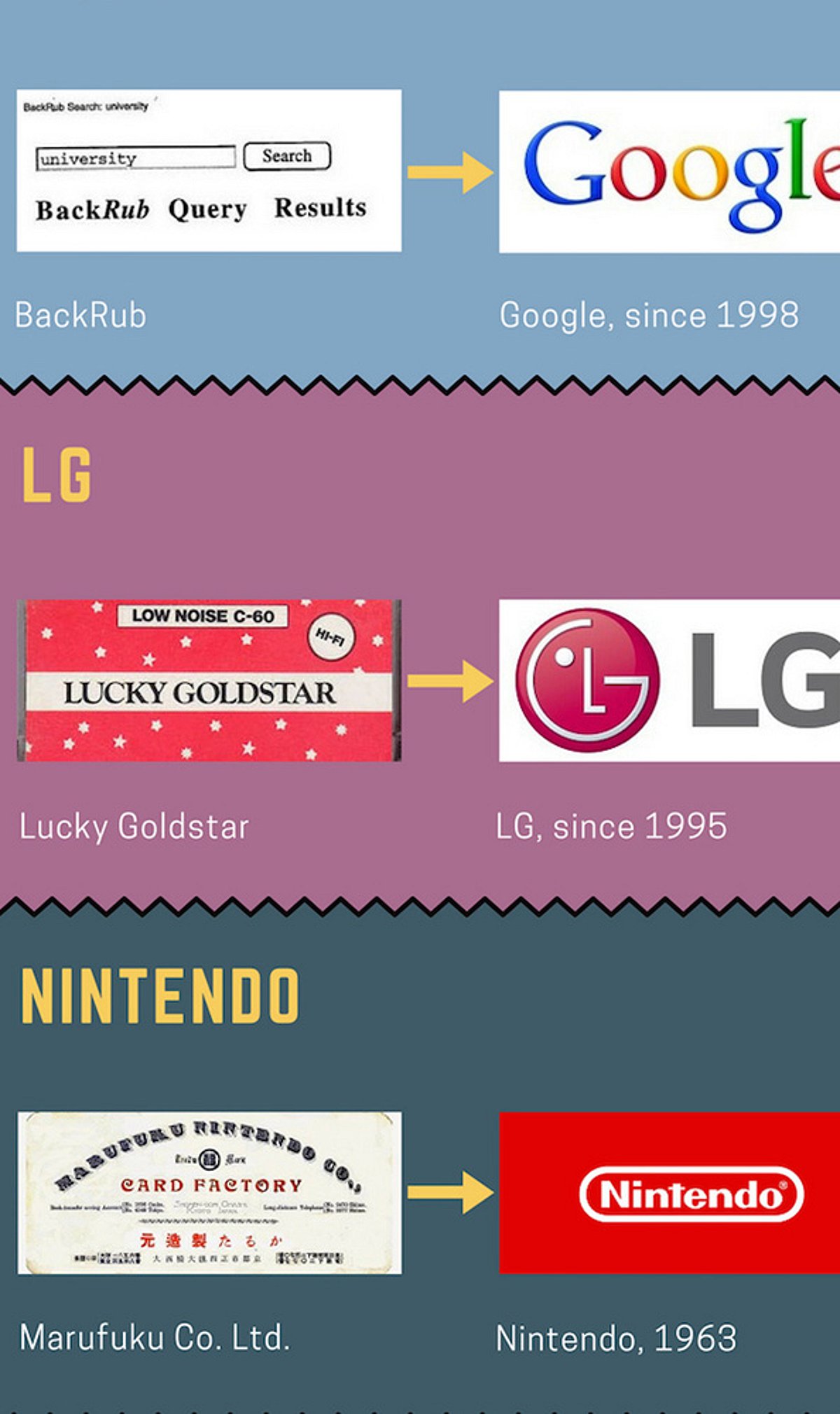
    • BackRub to Google: Before becoming a household name, Google started as BackRub. Founders Larry Page and Sergey Brin renamed it to represent the immense scale of information they aimed to organize.

    Each of these name changes was a carefully calculated decision, often accompanied by a shift in business strategy. Whether to pivot to new technologies, shed negative connotations, or simplify branding, these companies show that a name is more than just a label—it’s a statement of intent.