
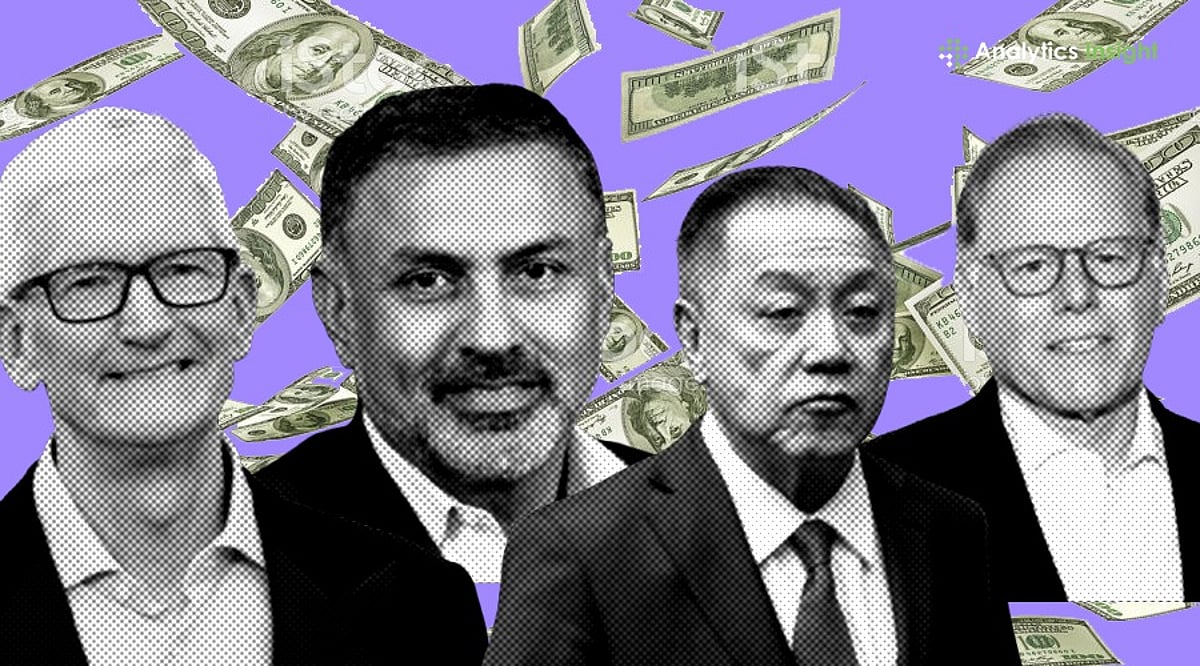
The debate over executive compensation has intensified as CEO pay packages continue to hit unprecedented levels. Across the United States, a handful of corporate leaders are earning compensation worth more than $200 million annually, driven largely by stock awards and long-term performance incentives. However, while firms argue that these compensation packages align executives’ and shareholders’ interests, many people wonder whether such remuneration is reasonable, given income disparities and the need to reduce labor costs.
These days, the world’s highest-paid chief executives are not earning large salaries. Rather, they earn money through a complex compensation system that depends on the company’s growth expectations and its market capitalization performance.
Stock Awards Drive Billion-Dollar Wealth
Executive compensation has changed significantly over the last decade. The trend is toward replacing fixed pay with equity compensation, which may be highly rewarded through increased value in the event of strong share performance.
Performance Share Units (PSU), Restricted Stock Units (RSU), stock options, and long-term incentive programs are the main methods of executive compensation today. They pay the CEO not for financial success but for creating value for the shareholders.
Such a method results in very large compensation, exceeding $200 million per year, especially for technology, media, and manufacturing companies in fast-growing markets.
The CEOs Leading the Pay Rankings
Several corporate leaders have topped global compensation charts in recent years.
Hock Tan, Broadcom
The CEO of Broadcom is known to be one of the highest-paid CEOs in the world. The pay packets he receives have always exceeded $200 million due to stock awards tied to high revenues and returns on shareholder investments. With Hock Tan’s guidance, Broadcom has become the world’s most valuable semiconductor company.
Tim Cook, Apple
The CEO of Apple, Tim Cook, is another example of a highly paid executive who occasionally earns more than $200 million due to the vesting of long-term stock awards. While he receives a relatively modest salary, the significant reward comes from equity awards linked to Apple’s performance.
Nikesh Arora, Palo Alto Networks
The cybersecurity firm Palo Alto Networks has one of the most expensive compensation packages for its CEO, Nikesh Arora. His earnings were mainly linked to the stocks he received for growth in the cybersecurity industry.
David Zaslav, Warner Bros. Discovery
David Zaslav, the media executive, is known for having an expensive compensation package, worth hundreds of millions of dollars, despite the company’s restructuring, layoffs, and cuts in content production budgets.
Why Boards Approve Massive Compensation
Boards have claimed that outstanding leadership provides immense value for stakeholders. A chief executive officer who can provide tens of billions of dollars of market capitalization can deserve a pay package of a few hundred million dollars.
There has also been increased competition for seasoned managers. Organizations fear losing talented leadership to competitors, especially in sectors such as technology, artificial intelligence, medicine, and finance.
The performance-based pay system enables the board to protect the generous pay by emphasizing that managers will earn their compensation through shareholder benefits.
Growing Shareholder Pushback
However, despite all the above-mentioned arguments, executive remuneration is being increasingly scrutinized. Institutional shareholders have become more inclined to vote down executive remuneration schemes deemed excessively generous in ‘Say on Pay’ votes. Even proxy advisors have recommended reviewing executive incentives that seem out of touch with financial results.
Furthermore, employee organizations have continued to raise doubts about the growing disparity between CEOs’ earnings and those of ordinary workers. Nowadays, in many multinational companies, a CEO’s earnings are several hundred times those of an average employee.
The criticism becomes particularly sharp when companies announce layoffs, cost reductions, or weak financial results while awarding executives record compensation.
Global Trend Beyond Silicon Valley
Although US executives dominate the highest-paid rankings, generous compensation packages are increasingly appearing worldwide. Companies in Europe and Asia have adopted performance-based equity incentives slowly to attract talented people from around the world.
On the other hand, regulations are tighter outside the United States because many countries require increased transparency, shareholder approval, and disclosure of CEO-worker compensation ratios.
Future of Executive Compensation
AI, digitalization, and semiconductor revolutions are transforming corporate leadership goals. As competition within such spheres intensifies, companies need to offer generous compensation packages to attract top-notch executives.
However, there is also a demand for accountability. In the future, reward packages will be designed based on corporate success and shareholders’ interests.
The issue of $200 million paychecks for CEOs is not going away any time soon. While their advocates see such compensation programs as a way of investing in outstanding leadership that will deliver billions in value to the company, their opponents interpret them as a sign of economic inequality.
Why This Matters
Executive pay reflects corporate priorities, investor confidence, and governance standards. As CEO compensation reaches record highs, the debate over fairness, accountability, and the widening gap between executives and employees grows stronger.
Leave a Reply