
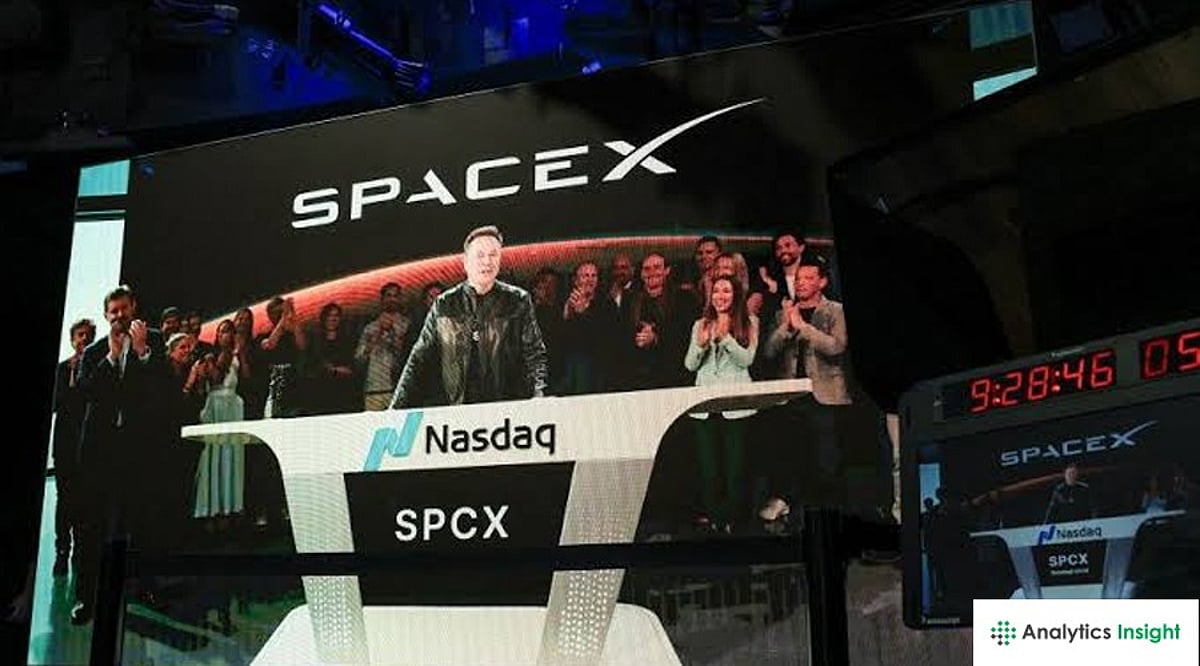
SpaceX officially joined the NASDAQ 100 index on Tuesday, July 7, 2026, just 15 trading days after its historic public market debut. The swift inclusion follows NASDAQ’s revised entry rules designed to accommodate large new listings, making the rocket and satellite company one of the fastest additions to the benchmark.
The company’s IPO on June 12 priced at $135 per share and raised $75 billion — the largest IPO on record. With its market capitalization now above $2 trillion, SpaceX’s inclusion in the NASDAQ 100 ensures that millions of index fund investors gain automatic exposure to the stock through ETFs and mutual funds, including those tracking the Invesco QQQ complex.
Passive Buying Pressure Expected
J.P. Morgan estimates that the index inclusion could generate approximately $4.3 billion in passive fund inflows. This buying is driven by index rules rather than a fundamental view on the company, meaning fund managers must adjust their portfolios to match the new benchmark composition.
However, SpaceX’s starting weight in the index will be limited. Despite its massive market cap, only about 5% of shares are freely traded. NASDAQ uses free-float market capitalization in its index calculations, keeping SpaceX’s initial weight near 1% to 1.3%.
Volatility Risks Remain
SpaceX shares surged after the IPO, reaching a post-listing high near $225.64 before pulling back to around $160 just ahead of the index entry. Even after the decline, the stock remains above its $135 IPO price and $150 opening price.
Avery Marquez of Renaissance Capital noted, “IPOs are inherently volatile, and especially in those early weeks.” The small float — combined with broader market volatility — could amplify price swings. The Cboe NASDAQ 100 Volatility Index rose about 43% through Thursday, compared with an 8% rise for the Cboe Volatility Index tied to the S&P 500.
S&P 500 Entry Still Distant
While SpaceX has joined the NASDAQ 100, its inclusion in the S&P 500 is not imminent. S&P Dow Jones Indices requires a one-year listing and profitability standards, which SpaceX has not yet met. This gap means that passive demand from S&P 500 index funds will come later, if at all.
Lockup expirations also loom. Early investors and employees may become eligible to sell shares in stages. Louis Navellier of Navellier & Associates said he would consider buying SpaceX after insiders sell some shares and once the company appears ready to report a profitable quarter, highlighting the uncertainty around public market performance.
Leave a Reply