Tag: blockchain

  • Best Crypto News Platforms in India: Top 5 Trusted Sources for 2025

    Best Crypto News Platforms in India: Top 5 Trusted Sources for 2025

    Stay Ahead in the Crypto Market with These Top Indian News Websites

    In the fast-evolving world of cryptocurrency, staying informed is crucial. Whether you’re a seasoned investor or a curious beginner, reliable news sources can help you navigate the market with confidence. Here are the top five crypto news websites in India that offer trustworthy coverage, expert insights, and educational content.

    1. Analytics Insight

    Analytics Insight is a leading platform that provides comprehensive coverage of cryptocurrency, blockchain, artificial intelligence, fintech, and other emerging technologies. It’s a go-to source for in-depth analysis and industry trends, making it ideal for tech-savvy readers who want to stay at the forefront of digital innovation.

    2. CoinSwitch

    CoinSwitch is known for its timely crypto market updates, investment insights, and educational content. It also covers regulatory news, helping investors understand the legal landscape. With a user-friendly approach, CoinSwitch is perfect for both beginners and experienced traders looking for actionable information.

    3. CoinDCX Learn

    CoinDCX Learn is an excellent resource for beginners. It offers easy-to-understand guides on cryptocurrency basics, blockchain technology, and market analysis. The platform focuses on educating users, making it easier for newcomers to grasp complex concepts and make informed decisions.

    4. Crypto India

    Crypto India is dedicated to covering Bitcoin, altcoins, regulations, Web3 developments, and the Indian crypto industry. It provides a local perspective on global trends, making it a valuable resource for Indian investors who want to stay updated on both domestic and international news.

    5. CoinGape

    CoinGape offers global cryptocurrency news, technical analysis, token launches, and price updates. It’s a comprehensive platform that keeps readers informed about market movements and emerging opportunities. With real-time coverage, CoinGape is a reliable source for traders who need up-to-date information.

    Why Trusted Sources Matter

    Reliable crypto news is essential to avoid misinformation and make sound investment decisions. With the market’s volatility, accurate information can protect you from scams and poor choices. These platforms prioritize factual reporting and expert opinions, ensuring you get the most relevant and trustworthy content.

    Real-Time Market Coverage

    These websites provide breaking news, expert opinions, and daily market analysis. Real-time updates are crucial in the crypto world, where prices can change rapidly. By following these sources, you’ll be among the first to know about significant developments and market shifts.

    Learn Before You Invest

    Educational articles on these platforms help beginners understand blockchain technology and crypto investing. From basic concepts to advanced strategies, these resources empower you to make informed decisions. Remember, knowledge is your best investment tool.

    Stay ahead of the curve by bookmarking these top crypto news websites. Whether you’re tracking Bitcoin or exploring altcoins, these trusted sources will keep you informed and ready for the next big opportunity.
  • Sui’s Quantum-Safe Upgrade Preserves Existing Wallet Addresses With Post-Quantum Signatures

    Sui’s Quantum-Safe Upgrade Preserves Existing Wallet Addresses With Post-Quantum Signatures

    Sui is rolling out quantum-safe account security that lets users keep their current blockchain addresses while upgrading to post-quantum cryptography. The network will support ML-DSA-65 for standard accounts and SLH-DSA-SHA2-128s for high-value Move-based vaults, both designed to resist attacks from future quantum computers.

    Address Aliases Enable Seamless Migration

    Normally, switching cryptographic schemes requires creating a new address and moving all assets—a disruptive process for tokens, NFTs, identities, and smart contracts. Sui’s Address Aliases system avoids that entirely. An account can authorize a new post-quantum signer while the original blockchain address remains the transaction sender. Once native ML-DSA support is live, users simply authorize the new signer and later make it the sole authorized signer.

    Users can also derive an ML-DSA-65 key from their existing recovery phrase via a fresh derivation path, eliminating the need for a separate backup. Sui cautions that wallet software must clearly communicate the authority granted when adding an alias.

    Two Cryptographic Systems for Different Needs

    Sui splits quantum protection across two NIST‑standardized schemes:

    • ML-DSA-65 (FIPS 204, NIST Category 3) – a lattice‑based signature chosen for frequent transactions because it balances a strong security margin with practical verification speed.
    • SLH-DSA-SHA2-128s (FIPS 205, Category 1) – a hash‑based system reserved for high‑value vaults, providing a different mathematical foundation so that a weakness in lattice‑based crypto does not compromise all assets.

    This dual approach lets developers replace the vault authentication scheme via smart‑contract upgrades if future cryptanalysis reveals flaws in one family.

    Larger Signatures Shape Deployment Timeline

    Post‑quantum signatures are bulkier than Ed25519: ML-DSA-65 signatures are 3,309 bytes (public key: 1,952 bytes), while SLH-DSA‑SHA2‑128s signatures reach 7,856 bytes. Despite the size increase, Sui notes that ML-DSA verification performance is close enough to Ed25519 that per‑signature network costs need not rise.

    The rollout is staged:

    • Quantum‑safe vaults on Mainnet before end of 2026.
    • Native ML-DSA-65 accounts on Testnet by late 2026 and Mainnet in Q1 2027.
    • Wallet, SDK, and CLI support alongside independent audits and Testnet feedback.

    No immediate action is required from existing users. The migration is additive and optional, with clear warnings about potential scams that ask users to move all assets to a new address.

    Conclusion

    Sui’s quantum‑safe upgrade uses ML-DSA-65 accounts and SLH-DSA vaults while preserving existing addresses via Address Aliases. Users need do nothing now; audits, testing, and phased deployment continue.

  • BlockchainFX Closes $15M BFX Presale, Pre-Launch Window Opens Before August 10 Announcement

    BlockchainFX Closes $15M BFX Presale, Pre-Launch Window Opens Before August 10 Announcement

    BlockchainFX has closed its $15 million BFX presale after reaching the hard cap, transitioning into the final pre-launch phase. The project’s team will announce the official launch date on August 10 at 3:00 PM UTC.

    BlockchainFX successfully ended its BFX crypto presale after hitting the $15 million funding target, marking a shift from private fundraising to preparations for public trading. During this pre-launch window, buyers can still acquire BFX at the fixed price of $0.04 per token before the stated launch price of $0.05. The presale structure will not be available after this window closes, and existing holders have the opportunity to adjust their positions before open-market trading begins. The August 10 announcement will outline the timeline for the next stage, including when trading starts and how exchange liquidity will roll out.

    BlockchainFX has also introduced the LAUNCH80 bonus code for the final pre-launch period. This code grants an 80% bonus to a buyer’s token allocation. For example, a purchase that normally provides 100,000 BFX would receive an additional 80,000 BFX through the code, resulting in 180,000 BFX from that purchase. The offer is exclusive to the current pre-launch window and will not apply once the presale structure ends.

    With fundraising complete, attention now turns to the planned BlockchainFX trading platform, which aims to connect traditional markets—including forex and stocks—with decentralized technology. The project’s multi-asset approach seeks to integrate different markets into a single trading ecosystem. The team reports that audits have been completed as part of the rollout preparations. The August 10 announcement will provide the timetable for the transition into public trading. Until then, BlockchainFX remains in its pre-launch phase, with market participants awaiting official launch timing and exchange liquidity details.

    BlockchainFX has reached its $15 million hard cap and entered the final pre-launch phase. BFX is still priced at $0.04 before the $0.05 launch price. The next key event is the August 10 announcement, when the team will reveal the official launch schedule.

  • Why Onchain Data Verification Is Critical for Blockchain Trust and Security

    Why Onchain Data Verification Is Critical for Blockchain Trust and Security

    Every blockchain data provider claims their product is verifiable. The problem is that few of them mean the same thing, and that gap has become a critical issue as more capital moves through automated systems and smart contracts that rely on accurate onchain data.

    The simplest approach to data extraction involves a team pulling data directly from blockchain nodes via JSON-RPC, extracting blocks, transactions, and logs, then loading them into a custom pipeline. With some human curation—people checking numbers and catching anomalies—this setup works well for small to medium projects. However, it does not scale effectively. When a provider using this pipeline calls its data verifiable, it typically means the numbers can be spot-checked against another source and the methodology is open to manual audit. This is a real capability, but it is far from cryptographic proof and still requires trusting that someone extracted and curated the data honestly.

    That trust gap has shifted from a nuisance to a liability. Most applications accept whatever an RPC endpoint returns at face value, meaning compromised infrastructure can feed convincing but incorrect data into downstream systems. This is not hypothetical. In April 2026, attackers manipulated the RPC infrastructure behind a verification layer tied to KelpDAO, contributing to a loss estimated at around $290 million. No blockchain cryptography was broken. Instead, the trust chain was exploited. As more capital flows through agents and treasuries that execute automatically, bad data becomes a security issue rather than a quality issue.

    Teams requiring stronger verification typically choose among three approaches, and only one fully earns the descriptor without an asterisk.

    1-of-N Trust Model

    The first is a 1-of-N trust model. Instead of relying on a single provider, work is distributed across many independent participants. Correctness becomes contestable: it takes just one honest party to catch bad data and hold the offender accountable. The Graph’s decentralized network uses this model, where Indexers submit Proofs of Indexing, and other participants can challenge results they believe are incorrect. Disputes go to arbitration, and an Indexer caught serving bad data is slashed. The math is compelling. With five participants, each having a 20% chance of using a faulty RPC, a consensus model requiring majority agreement has about a 5.8% chance that the majority is wrong and bad data wins. Under a 1-of-N model, corruption only slips through if all five participants fail simultaneously, about 0.03% risk, making it nearly two orders of magnitude safer. This gap explains why 1-of-N scales better as networks grow.

    However, this model has a flaw. A gateway pulling from multiple Indexers can receive correct data from two sources and bad data from a third. Until the dispute resolves, users may see flickering between correct and incorrect data. Developers often prefer consistently wrong data over visibly inconsistent data, a real tradeoff in permissionless systems that centralized systems typically hide.

    Consensus Model

    The second approach is consensus, which is often confused with 1-of-N. This distinction matters because the two models make fundamentally different bets. Consensus treats majority agreement as a stand-in for correctness, as Chainlink’s oracle network does. The problem is that a majority can be wrong. If enough participants collude or are compromised, the entire agreement mechanism breaks down.

    Verifiable Extraction

    The third approach deserves the term without qualification. Verifiable extraction bypasses the question of whom to trust and instead relies on the blockchain’s cryptographic commitments: the hashes linking every block, transaction, and log in a way that cannot be altered without detection. Edge & Node’s Amp recomputes these commitments during data extraction, before the data becomes queryable, checking Keccak-256 hashes and Merkle Patricia Tries against the block header. If anything has been tampered with, the mismatch appears immediately. StreamingFast’s verifiable extraction for Firehose closes the remaining gap by proving that a specific block belongs to the chain’s actual canonical history, not just that the extracted data matches the header it claims. Together, these cover the full claim: the data is faithful to the block, and the block is real, and anyone can recompute both independently.

    However, this approach has costs. Recomputing commitments and reconstructing proofs requires computational work, so the most rigorously verified data tends to arrive slower than a raw, unchecked feed. The blockchain data trilemma—fast, comprehensive, verifiable, pick your tradeoffs—does not disappear just because a team has chosen the strongest form of verification. Even cryptographic verification has a boundary: it proves data was processed and preserved correctly, but not that the original source was honest. That is a different problem, the oracle problem, and it remains unsolved.

    The real issue is the weight the word is being asked to carry. “Verifiable” is applied to benchmarkable transparency, majority agreement, and cryptographic proof as if they are interchangeable guarantees with different marketing. They are not. They fail in different ways, under different conditions, for different reasons. For anyone building a system where a wrong number costs real money, this distinction is not academic. It is the entire ballgame.

  • XRP’s Three-Month Volatility Low Raises Utility Questions as Price Holds Near $1.06

    XRP’s Three-Month Volatility Low Raises Utility Questions as Price Holds Near $1.06

    XRP has entered a notably quieter trading phase, with its 30-day realized volatility dropping to a three-month low of approximately 0.34 on Binance. According to CoinCodex, the token is currently trading near $1.06, a stabilization that follows weeks of sharper price swings.

    What Falling Realized Volatility Means for XRP

    Realized volatility measures an asset’s actual price movement over a specific period, reflecting past fluctuations rather than expected future conditions. CryptoQuant analyst Arab Chain noted that the decline indicates a clear reduction in daily price swings, describing the current action as relatively calm after a period of heightened volatility.

    The lower reading suggests that buyers and sellers have reached a temporary balance. Traders appear hesitant to open large positions until fresh information or stronger market momentum emerges.

    Traders Await the Next Market Catalyst

    Calmer markets often produce tighter ranges, weaker speculative activity, and less trading noise. However, extended volatility compression can precede a sharp move when new momentum arrives. Market participants are watching trading volume and open interest for signs that stronger participation has returned.

    Several catalysts remain in focus, including regulatory clarity in the United States, Ripple ecosystem growth, institutional adoption, derivatives positioning, macroeconomic developments, and broader crypto market sentiment. Recent attention has also been drawn to Google search results identifying XRP as a leading world bridge currency. Some analysts have discussed the possibility of a wider macro breakout and an early Wave 3 advance, though they link further gains to a sustained move above key resistance levels.

    Still, lower realized volatility offers no directional signal, as the eventual breakout could move in either direction.

    Utility Becomes the Core Value Argument

    Evernorth Chief Business Officer Sagar Shah argued that market price should not be the primary measure of XRP’s value. Speaking during a Q&A session on X, Shah said XRP is designed to move value across financial systems. While price attracts constant attention and dominates headlines, he presented utility as a stronger indicator of long-term value.

    Shah cited liquidity provision, cross-border settlement, lending, and tokenized assets as key uses within the XRP ecosystem. He emphasized that the most important signal comes from how XRP operates, rather than how it trades.

    For now, XRP remains near $1.06 while Binance realized volatility sits at a three-month low. Traders continue tracking market participation as the consolidation phase develops.

  • Ripple Partner SBI Holdings Acquires Bitbank in $289M Deal to Expand Japan’s Crypto Market

    Ripple Partner SBI Holdings Acquires Bitbank in $289M Deal to Expand Japan’s Crypto Market

    Ripple’s long-term partner SBI Holdings has completed its acquisition of Japanese cryptocurrency exchange Bitbank in a deal worth 46.7 billion yen (around $289 million). The deal is expected to boost SBI’s position as a leader in the regulated digital asset market.

    The acquisition will be structured in multiple stages. SBI will first buy shares of Bitbank founder Noriyuki Hirosue and individual investors, and then increase its holdings by buying more from MIXI and Ceres later this year. Following the process, Bitbank will become a consolidated subsidiary of SBI Holdings.

    SBI Expands Its Digital Asset Leadership

    The acquisition significantly boosts SBI’s footprint in the regulated cryptocurrency market in Japan. Together, the two companies would handle approximately 2.92 million customer accounts and over 1.1 trillion yen ($7 billion) in digital assets under custody, surpassing some key domestic rivals.

    The agreement is part of a broader pattern of traditional financial institutions gaining more exposure to digital assets as regulatory clarity improves. It also shows the increasing trust in financial services and financial asset tokenization.

    Ripple Partnership Could Benefit from Larger Platform

    SBI Ripple Asia, which was founded in 2016, was created to help grow Ripple’s blockchain payment capabilities in the Asia-Pacific region and Japan, the companies said. SBI has long been promoting the use of XRP, with its regulated exchange SBI VC Trade being one of the earliest platforms to support XRP trading and later add Ripple-linked stablecoin RLUSD.

    SBI Chairman and CEO Yoshitaka Kitao has also been a strong supporter of the partnership and is a former board member of Ripple and a long-time proponent of blockchain-based payments.

    While SBI has not announced immediate operational changes for Bitbank, the increased adoption could lead to more opportunities for introducing XRP, RLUSD, and Ripple’s payment network in Japan in the future.

    The announcement comes after another groundbreaking blockchain project led by SBI-backed gaming company gumi, which revealed an XRP-focused plan totaling $86 million, featuring the $18.3 million crypto investment fund and additional institutional blockchain infrastructure investments.

    With the Bitbank acquisition, Japan’s digital asset market is further solidifying its reputation as one of the most regulated and blockchain-friendly markets globally, with its institutional backing on the rise.

    FAQs

    1. Why did SBI acquire Bitbank?
    SBI acquired Bitbank to strengthen its position in Japan’s regulated cryptocurrency market. The deal expands its customer base, increases assets under custody, and enhances its digital asset ecosystem.

    2. How large will SBI’s crypto business become after the acquisition?
    Following the acquisition, SBI is expected to manage around 2.92 million customer accounts and more than 1.1 trillion yen (over $7 billion) in digital assets under custody, making it one of Japan’s largest crypto operators.

    3. How is Ripple connected to SBI Holdings?
    SBI and Ripple have worked together since launching SBI Ripple Asia in 2016 to promote blockchain-based cross-border payments. SBI has consistently supported XRP adoption through its regulated exchange, SBI VC Trade.

    4. Will Bitbank users see immediate changes?
    SBI has not announced any immediate operational or platform changes for Bitbank. The exchange will continue operating while becoming a consolidated subsidiary of SBI Holdings.

    5. What does this acquisition mean for XRP and Japan’s crypto market?
    The larger SBI ecosystem could create additional opportunities for XRP, RLUSD, and Ripple’s payment infrastructure to gain wider institutional adoption. It also reinforces Japan’s reputation as one of the world’s most regulated and crypto-friendly markets.

  • New Report by ChangeNOW and CoinRabbit Explores Crypto Privacy, Illicit Use, and Regulatory Path Forward

    New Report by ChangeNOW and CoinRabbit Explores Crypto Privacy, Illicit Use, and Regulatory Path Forward

    ChangeNOW, a cryptocurrency super app, and CoinRabbit, a crypto asset management platform, have jointly released a research report titled “Financial Privacy in the Digital Age.” The report examines the dual-use nature of privacy-preserving technology in cryptocurrencies, weighing legitimate needs for discretion against the risks of illicit exploitation. Drawing on data from TRM Labs, Chainalysis, the RAND Corporation, the United Nations Office on Drugs and Crime (UNODC), Statista, and U.S. Treasury Department disclosures, the study argues that current regulatory efforts are misdirected and should focus on fiat off-ramps rather than transactional privacy infrastructure.

    Balancing Privacy and Security

    The report finds that on-chain privacy has evolved from a niche preference to an essential safety measure. It protects individuals from physical extortion and kidnapping, prevents corporate espionage on treasury movements, and enables humanitarian efforts in conflict zones. The key conclusion is that privacy and compliance are not a zero-sum trade-off—the most significant enforcement vulnerability lies at the point where crypto converts to fiat currency, not in the privacy tools themselves.

    Key Findings and Threat Assessment

    • Pig-butchering fraud generated an estimated USD 75 billion in cumulative losses between 2020 and 2024.
    • Physical “wrench attacks” targeting cryptocurrency holders surged: $124.1 million in crypto was targeted in 52 verified incidents in H1 2026 alone, a 33% increase in incidents and nearly elevenfold rise in financial exposure compared to H1 2025.
    • Crypto payments linked to human trafficking networks in Southeast Asia grew 85% in 2025.
    • Corporate data exposure remains a major threat, with 36% of board members citing internal financial data becoming publicly accessible as a top governance concern, and the average data breach costing USD 4.44 million.

    Industry Solutions for Compliant Privacy

    “Financial privacy isn’t a feature request, it’s a baseline that every other financial system already provides,” said Pauline Shangett, Chief Strategy Officer at ChangeNOW. “The question the industry needs to answer isn’t whether privacy should exist on-chain. It’s whether we build it responsibly or let bad actors define what it looks like by default.” The report profiles two working examples: ChangeNOW’s Private Crypto Transfers, which break the deterministic link between sender and receiver without pooling user funds, and CoinRabbit’s custodial model, which uses dynamic per-user deposit addresses to prevent end-to-end reconstruction of a client’s holdings from public blockchain data.

    Recommendations for Policymakers

    The report closes with five recommendations centered on shifting enforcement resources toward fiat off-ramps and cross-jurisdictional intelligence sharing, rather than restricting transactional privacy for general users. The full report is available online.

  • Cloudflare Unveils Wallets and Digital IDs for AI Agents to Enable Secure Autonomous Commerce

    Cloudflare Unveils Wallets and Digital IDs for AI Agents to Enable Secure Autonomous Commerce

    Cloudflare, Inc. (NYSE: NET), the leading connectivity cloud company, today announced Cloudflare Wallets and cloudflare.pay, a new suite of tools designed to give AI agents a stable identity and the ability to make purchases online safely within limits set by their human creators. This marks a significant step toward enabling agentic commerce—where software programs autonomously browse, query APIs, and transact on behalf of individuals and businesses.

    As AI agents become a normal part of doing business online, the Internet—built for humans—lacks reliable mechanisms to verify whether an agent is a legitimate assistant or a malicious actor. Traditional bot detection tools, designed for search crawlers, are inadequate for agents that conduct transactions. Cloudflare’s solution addresses this by providing a verifiable link between each agent and its human or organizational owner, establishing trust and accountability at every step.

    “The Internet is shifting from human-driven browsing to agent-driven commerce, and the infrastructure needs to keep up,” said Matthew Prince, co-founder and CEO of Cloudflare. “When an agent shows up at your door, you need to know who sent it. Cloudflare can give agents a face—a link to the human or organization that owns them—so that trust, accountability, and real commerce can follow. It’s the identity and payment infrastructure the agentic web needs to function.”

    Cloudflare Wallets and cloudflare.pay work together to solve the identity and payment challenge. Each Cloudflare account will receive a unique web address serving as a stable ID, which users can extend to specific agents. This allows any receiving business to see exactly who authorized the agent. Additionally, a Cloudflare “Account Wallet” acts as a central balance for receiving, holding, and managing stablecoins. Users can then assign “Virtual Wallets” to individual agents, each with built-in guardrails such as spending caps, approved merchant lists, and maximum transaction sizes. Combined with the Monetization Gateway, these tools complete the two-sided agentic payment market.

    Cloudflare Wallet handle reservation opens today. Full wallet access, including onramping and offramping funds and the ability to issue Virtual Wallets, will be available in the coming months. Users can claim a handle at cloudflare.pay and learn more on the Cloudflare blog.

  • BlockDAG 2026 Review: A Comprehensive Look at the 5-Star Crypto Ecosystem Transforming Digital Finance

    BlockDAG 2026 Review: A Comprehensive Look at the 5-Star Crypto Ecosystem Transforming Digital Finance

    This BlockDAG 2026 review examines a project that has evolved far beyond a typical layer-one network. In August 2026, the team released its Execution Whitepaper, outlining a major strategic pivot. BlockDAG is transforming itself into a full digital economy, seamlessly integrating mining, trading, staking, and everyday spending into a unified user journey. The team consistently hits its milestones, earning this project a top-tier rating.

    The network operates on a Directed Acyclic Graph (DAG) design, enabling the simultaneous production of multiple blocks and achieving 7,000 transactions per second. The GHOSTDAG consensus algorithm orders these parallel blocks, preventing double-spending while maintaining decentralization. Additionally, BlockDAG is fully compatible with the Ethereum Virtual Machine (EVM), allowing developers to quickly port existing tools and accelerate development.

    One App for Everything: The RedotPay Super App

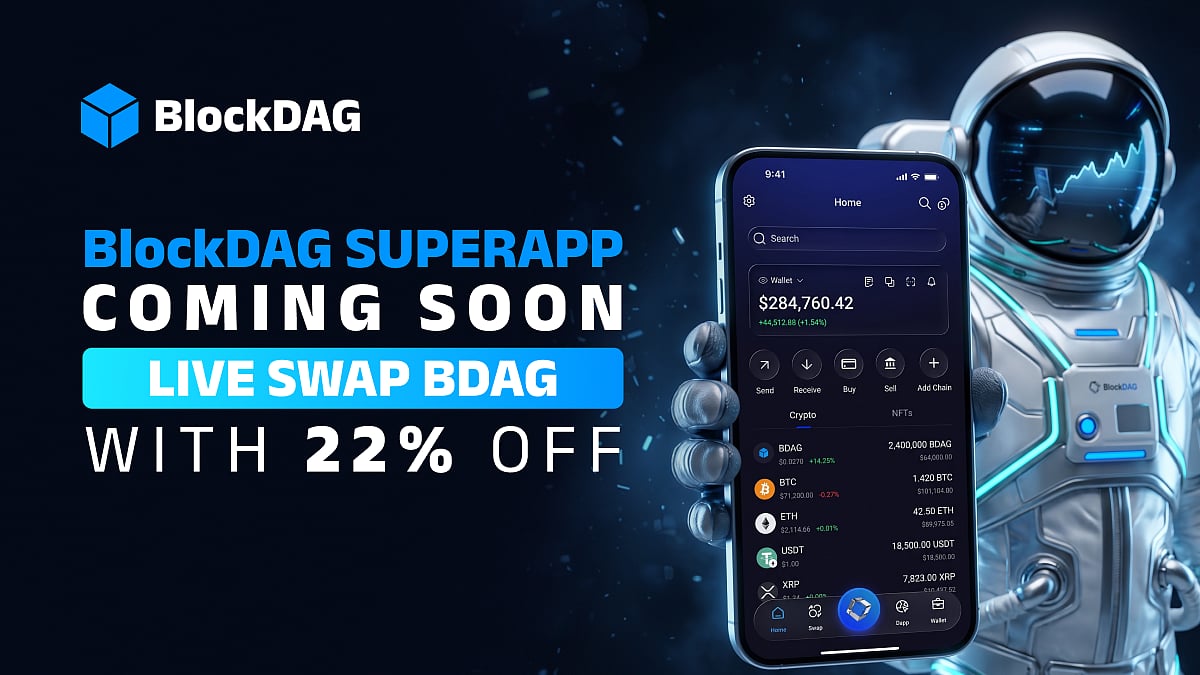
    BlockDAG has partnered with RedotPay to create the unified BlockDAG Super App, launching in September 2026. The app consolidates mining, staking, and trading in one place. Users can securely hold stablecoins alongside BDAG and access the BlockDAG Casino directly from their mobile device. The app also issues virtual and physical payment cards for daily use. Balances can be instantly converted to stablecoins, with the card handling merchant payments seamlessly, removing friction from everyday spending.

    Real Utility: The Exchange and the Casino

    The native BlockDAG Exchange launches in August 2026, offering spot and futures markets to users worldwide. It lists Bitcoin, Ethereum, and other digital assets. Fee payments in BDAG earn significant trading discounts. The BlockDAG Casino is already operational, giving active users a practical outlet to spend their coins. Players use BDAG to unlock exclusive games and premium tournaments, earning BDAG rewards and generous cashback. Both the exchange and the casino generate commercial revenue that is reinvested into network development and security.

    Miners Shipping Around the World

    Mining is a primary channel for distributing BDAG globally. Entry-level rigs are designed for home use, while enterprise units target professional data centers. Physical miner deliveries are already underway worldwide. Full-scale production of the X30 miner has just begun, with the first wave shipping within 45 days. The more powerful X100 model will follow shortly. Each miner shipped increases active participation and strengthens network security, turning buyers into long-term ecosystem users.

    Entry Price, Buyback, and Staking

    For those reading this BlockDAG 2026 review seeking entry, the current window is attractive. The promotional price is $0.000000017, and buyers receive a 22% swap discount on live exchanges. The project has set a buyback price of $0.025, which the team frames as a 135x return on investment. Token claims are proceeding without delays; batches 1 through 7 are all live. Staking is fully operational, with 10 billion coins already locked up, keeping a significant portion of supply off the market.

    The Numbers Behind the Network

    Live usage figures are impressive. The chain has processed 4 million on-chain transactions, with over 374,400 holders worldwide. The X1 mobile app supports 3.6 million miners, and the community has grown to more than 390,000 people across 130 countries. Maximum supply is capped at 150 billion coins. Treasury and liquidity figures are publicly verifiable, and all token allocations use transparent vesting contracts. This openness builds long-term trust with retail buyers, and ecosystem growth directly feeds BDAG’s market value.

    The Bottom Line

    This BlockDAG 2026 review awards a five-star rating for one key reason: consistent execution. The team prioritizes real utility over hype. Mining, trading, and spending are interconnected within one system, with every product strengthening the underlying chain. The technology solves real problems at high speed, and reinvested revenue continually improves the products. Users can mine, swap, and spend without leaving the ecosystem. For anyone tracking full-stack crypto projects, this is one to watch closely.

    Aftersale: https://purchase.blockdag.network
    Website: https://blockdag.network
    Telegram: https://t.me/blockDAGnetworkOfficial
    Discord: https://discord.gg/Q7BxghMVyu

    Disclaimer: Analytics Insight does not provide financial advice or guidance on cryptocurrencies and stocks. Cryptocurrencies mentioned are potentially risky; you should conduct your own research before investing.

  • BlockDAG’s Multi-Use Ecosystem Gains Momentum as Tron and XRP Prices Stall

    BlockDAG’s Multi-Use Ecosystem Gains Momentum as Tron and XRP Prices Stall

    The latest Tron price prediction shows TRX locked between $0.30 and $0.34, with Tron DAO relying on stablecoin strength to support patience. At the same time, XRP price movement remains under $1.10, affected by a weak August and a CLARITY Act decision delayed to September. Both projects are stable and well known, but stability alone does not define the best crypto to buy right now.

    BlockDAG (BDAG) appears stronger because it is not focused on one single use case waiting for a trigger; instead, it keeps adding multiple working parts. Mining supports the network, the Casino builds user activity, the Exchange improves access, and everything connects through one Super App, a layered setup similar to what helped Solana and Hyperliquid gain massive attention over time.

    BlockDAG: Multi-Use Ecosystem Driving Long-Term Growth

    Many whitepapers describe future ideas. BlockDAG’s Execution Whitepaper explains a working system, including a live mainnet with GHOSTDAG consensus and EVM smart contracts, plus an explorer tracking more than 4 million on-chain transactions across over 374,400 holders in 130+ countries, hardware miners already shipping with X30 in full production and over 3.6 million X1 app miners active globally, along with BlockDAG Casino generating over $200 million in wagers across 100+ games.

    Add claims active from Batches 1 to 7, staking live with more than 10 billion BDAG locked, and a presale price of $0.000000017 supported by a $0.025 buyback aiming at 135X ROI, it becomes clear why many see this as the best crypto to buy for those looking for real 1000x potential from early-stage projects.

    The final parts are coming soon. BlockDAG Exchange, a company-owned multi-asset platform, is planned for August 2026, followed by the Super App in September to connect mining, staking, trading, swaps, casino features, and a RedotPay-backed payment card in one system. This combined use case is growing step by step, similar to patterns seen in Solana and Hyperliquid, and after two years of steady work, BlockDAG now shows this full structure, making it a strong option for the best crypto to buy during this cycle.

    Tron Price Outlook Suggests Continued Sideways Movement

    The Tron price prediction for August needs to consider a coin that is pausing rather than moving strongly. TRX is staying near a key support area built over recent weeks, with resistance close to $0.334 and support near $0.309. Tron DAO highlights network expansion, growing institutional use, and stablecoin leadership, with over $84 billion in USDT on the network, while Nasdaq-listed Tron Inc. holds 681.7 million TRX as treasury assets.

    Even with these positives, most Tron price prediction views expect TRX to stay within range through August instead of breaking higher. This reflects an asset maintaining its current level rather than moving into a new growth phase, very different from a presale project like BlockDAG still priced at early levels.

    XRP Price Holds Position While Waiting for New Triggers

    Current XRP price levels show a coin lacking short-term momentum. XRP starts August near $1.06 and struggles to break above $1.10, with both the CLARITY Act decision and a Federal Reserve rate update now expected in September. Adding pressure, August has ended lower for XRP for four straight years, and ETF desks reported zero flows on 10 out of 17 trading days in July.

    There are still some positives: exchange supply is at a seven-year low, and the XRP Ledger v3.3.0 upgrade aims to improve institutional access for banks. For now, though, the XRP price stays between $1.01 and $1.05 without a clear near-term push. BlockDAG, on the other hand, shows active progress, with an Exchange and Super App both expected soon and a presale price still very low.

    Final Call

    Most Tron price prediction insights and XRP price analysis this month point to the same idea: strong projects waiting for delayed catalysts expected in September. BlockDAG shows a different situation. Two years of progress have led to live claims, active staking, over 10 billion BDAG locked, a Casino already producing revenue, and both an Exchange and Super App launching soon. With multiple use cases growing together and a presale price of $0.000000017 still open, BlockDAG currently stands out for anyone searching for the best crypto to buy right now.