Tag: blockchain

  • Solana Block Building Gets Compliance Layer via Flowra-Honeypot Partnership

    Solana Block Building Gets Compliance Layer via Flowra-Honeypot Partnership

    Flowra, a Solana-focused platform for open orderflow auctions and validator infrastructure, has announced a partnership with compliance provider Honeypot to integrate sanctions and risk screening directly into the block-building process. The collaboration gives validators new tools to define compliance policies before transactions are finalized on-chain.

    Bringing Compliance into Block Construction

    The integration combines Honeypot’s compliance intelligence with Flowra’s Programmable Block Policy (PBP), enabling institutional validators to set configurable rules for which transactions and bundles can be included during block construction. Rather than applying a single compliance framework across the network, the system lets each validator independently decide how those policies are implemented.

    The initial rollout supports screening against sanctions-related criteria, including wallet addresses linked to sanctioned entities, along with network-level indicators such as VPNs, proxy services, and Tor exit nodes. Flowra says the framework is designed to accommodate additional enterprise compliance providers over time, allowing validators to adapt as operational and regulatory requirements evolve.

    Why Institutional Validators Need More Control

    As institutional participation in blockchain networks grows, validators are increasingly expected to operate within compliance frameworks originally built for exchanges, custodians, and wallet providers. While those businesses routinely screen users before transactions reach the blockchain, validators have historically had limited options for applying configurable compliance controls during block construction.

    Flowra’s Programmable Block Policy extends compliance into validator infrastructure without imposing mandatory network-wide enforcement. Participating validators retain full authority over how transaction selection policies are configured. They can choose whether to implement screening, which providers to integrate, and when to update those policies — preserving autonomy while expanding compliance capabilities for regulated infrastructure providers.

    “Public blockchains have become increasingly attractive to institutional participants, but the infrastructure hasn’t evolved to give validators the compliance controls many regulated operators expect,” said Harry Hwang, CEO of Flowra. “We’re working with Honeypot to bring compliance into the block-building process itself, allowing validators to define and enforce their own policies before transactions are included on-chain. The goal isn’t to make the network less open, it’s to give individual validators the flexibility to operate in a way that reflects their own requirements.”

    Looking Ahead

    Initially, the collaboration focuses on sanctions screening, wallet screening, and auditability for regulated institutions. Future updates are expected to expand the framework to support additional enterprise compliance providers while introducing new capabilities that give validators greater flexibility over how compliance policies are implemented within their own infrastructure.

    Flowra develops validator infrastructure, delegation programs, and orderflow technologies aimed at improving transparency, incentive alignment, and value distribution across the Solana ecosystem. Honeypot provides compliance intelligence that helps exchanges, DeFi protocols, and financial institutions identify VPNs, proxy services, Tor exit nodes, and other location-obfuscation methods in support of sanctions compliance and regulatory audit requirements.
  • Ethereum Institutional Raises Ecosystem Funding Round with Over 100 Backers

    Ethereum Institutional Raises Ecosystem Funding Round with Over 100 Backers

    Ethereum Institutional, a nonprofit organization, has completed its first ecosystem funding round, drawing support from more than 100 backers spanning the Ethereum ecosystem and regulated finance. The round was led by BitMine, SharpLink, Joe Lubin, and Mihai Alisie, though the exact amount raised remains undisclosed.

    The nonprofit aims to act as a neutral bridge connecting Ethereum with banks, asset managers, custodians, and public authorities. Its focus areas include tokenization, stablecoins, collateral systems, and on-chain market infrastructure.

    Backers Span Ethereum and Regulated Finance

    The backer list reflects broad support from across the crypto and traditional finance sectors. Decentralized finance platforms such as Aave, Compound, Morpho, and Uniswap participated, alongside Layer-2 networks like Arbitrum, Optimism, Linea, and ZKsync. Infrastructure providers Circle, Chainlink, Fireblocks, Ledger, and MetaMask also joined, as did analytics firms DefiLlama, Dune, Etherscan, and L2BEAT.

    Regulated financial firms including 21Shares, Anchorage Digital, Galaxy, Robinhood, and Securitize contributed to the round, as did Consensys and individuals such as Karl Floersch and Katherine Wu.

    Ethereum Institutional has not disclosed its budget, headcount, or first mandates, so the breadth of participation currently serves as the primary indicator of industry support.

    Nonprofit Model Targets Institutional Guidance

    The organization plans to approach institutions evaluating Ethereum, offering guidance without promoting a specific product or pursuing direct sales. Its nonprofit structure allows it to explain how tokenized bonds, fund units, and money market instruments can operate on Ethereum, as well as cover stablecoin payments and tokenized collateral.

    On-chain market infrastructure—systems supporting trading, settlement, and collateral movement directly through blockchain networks—forms another key focus area. The question remains: can a nonprofit become the trusted bridge between Ethereum and regulated finance? Future mandates will reveal whether institutions view the organization as a credible neutral adviser.

    Spin-Offs Reshape Ethereum Foundation Work

    Ethereum Institutional is one of three spin-offs linked to the Ethereum Foundation. Ethlabs focuses on protocol research, while EthSystems develops privacy tools for institutional users. EthSystems launched in mid-July 2026 under Mo Jalil, Oskar Thorén, and Aaryamann Challani. Unlike Ethereum Institutional, EthSystems operates for profit and sells privacy software.

    EthSystems’ work builds on foundational research involving central banks, regulators, and financial institutions, including projects on private bonds, confidential stablecoin transfers, and the Ethereum Privacy Map. These spin-offs follow a major foundation overhaul announced in June 2026, which cut staff by 20% and reorganized work into five clusters.

    BitMine and SharpLink support both Ethereum Institutional and EthSystems, and both public companies hold Ethereum as treasury assets, linking their balance sheets to wider institutional use of the network.

    A Brief Roundup

    Ethereum Institutional enters the market with backing from over 100 ecosystem and regulated finance supporters. Its nonprofit structure separates neutral guidance from commercial services, while EthSystems and Ethlabs handle privacy and protocol work. The next measurable step will come through disclosed mandates, staffing, and institutional projects.

  • Perceptron Secures $6.5M to Build Decentralized AI Data Network

    Perceptron Secures $6.5M to Build Decentralized AI Data Network

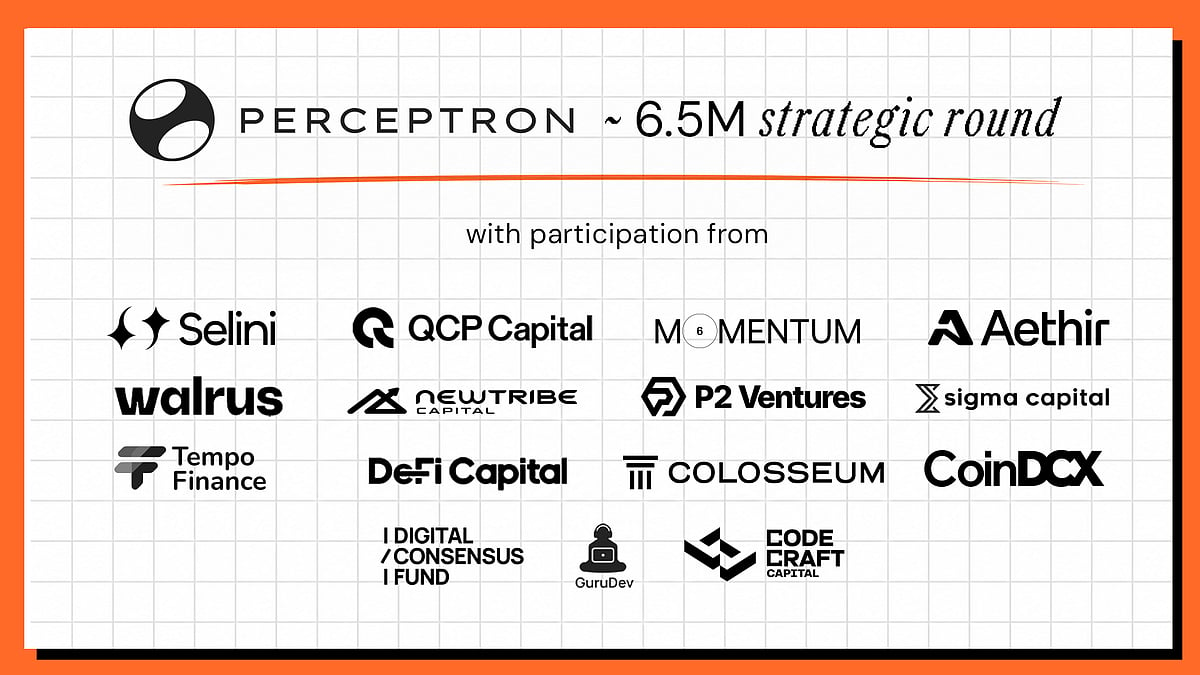
    Perceptron, a decentralized AI data network, has announced the successful close of a $6.5 million strategic funding round. The investment brings together leading Web3 investors, trading firms, ecosystem partners, and infrastructure leaders, including Sigma Capital, Selini Capital, QCP Capital, P2 Ventures, CoinDCX Ventures, Momentum6, DeFi Capital, Walrus Foundation, Aethir, Colosseum, GuruDev Capital, Tempo Finance, NewTribe Capital, Digital Consensus Fund, and CodeCraft Capital.

    The funding will support the launch of Perceptron’s data-questing platform, expand contributor tooling and rewards infrastructure, and scale the network toward a target of 5 million nodes. The company aims to make sourcing real-world data fast and accessible enough that AI companies no longer need centralized scraping infrastructure.

    Perceptron’s network compresses global data collection into a single mesh of idle bandwidth, unique datasets, and domain expertise. This unified format allows both individual contributors and AI companies to generate complete, verified datasets, reducing the timeline from data request to delivered dataset to just days.

    Perceptron sits between two extremes: centralized scraping tools that are too limited, and closed data partnerships that demand access most AI startups lack. It gives AI companies and everyday contributors data they can work with directly. Contributors own their data and earnings, allowing them to monetize or withdraw at any time without depending on third parties. The platform is built for continuous contribution and constant iteration, not a one-time scrape.

    The launch of the data-questing platform is central to delivering on this promise at scale. Rather than relying only on organically contributed data, Perceptron enables AI companies to commission data directly from its community. This approach shortens the timeline to sourcing high-value datasets and allows the team to focus resources on community tooling and rewards infrastructure.

    Early traction demonstrates strong demand. In its first phase, live agents reached more than 200,000 users across communities like Telegram and Discord. That number has since grown to more than 300,000 daily active users across a network of over 700,000 nodes. These figures highlight a large audience of users who want to monetize their data and expertise but previously lacked infrastructure designed for them.

    Nathan Gurr, Investment Analyst at P2 Ventures, said: “Perceptron has demonstrated an impressive ability to mobilize a decentralized workforce and build a globally distributed network. Their model allows them to tap into niche expertise – from doctors and lawyers to native speakers – on demand, from anywhere in the world. We see a significant opportunity to turn that reach into a scalable data and intelligence layer for AI, positioning Perceptron to become a leader in the DeAI stack.”

    Mark Rydon, Co-Founder of Aethir, added: “We are witnessing a long-term shift in how AI models are trained. Centralized data scraping is hitting diminishing returns, both in terms of cost and quality. Perceptron has solved the distribution problem that plagues the sector.”

    Peter Anthony, Co-founder and CEO of Perceptron, said: “Our mission is to create the world’s first decentralized AI data mesh where user interactions directly fuel AI growth. We’ve already shown that mission can become a reality, as evidenced by our ability to scale to hundreds of thousands of nodes organically. Now, with this funding, we are launching our data-questing platform, which will allow AI companies to commission specific, high-value datasets directly from our community.”

    Perceptron’s near-term focus is the data-questing platform launch, with further announcements expected next quarter. Longer term, the company is building toward a fully integrated network of 5 million nodes, where everything an AI company needs lives in one place, with no gap between demand and supply.

  • Flowra and Honeypot Integrate Sanctions Screening Directly into Solana Block Building

    Flowra and Honeypot Integrate Sanctions Screening Directly into Solana Block Building

    SEOUL, South Korea — Flowra, the open orderflow auction and validator infrastructure platform for Solana, has announced a collaboration with compliance infrastructure provider Honeypot to embed sanctions and risk screening directly into the block-building process.

    The integration combines Honeypot’s compliance intelligence with Flowra’s Programmable Block Policy (PBP), enabling institutional validators to define compliance rules that govern which transactions and bundles can be included during block construction.

    The framework supports screening against sanctions-related criteria, including wallet addresses associated with sanctioned entities, as well as network-level indicators such as VPNs, proxy services, and Tor exit nodes. These methods account for an estimated 31–61% of traffic arriving through network obfuscation. The system is also designed to accommodate additional enterprise compliance providers over time.

    Each validator will define its own policy, preserving validator autonomy while offering operators greater flexibility over block-building decisions.

    “Public blockchains have become increasingly attractive to institutional participants, but the infrastructure hasn’t evolved to give validators the compliance controls many regulated operators expect,” said Harry Hwang, CEO of Flowra. “We’re working with Honeypot to bring compliance into the block-building process itself, allowing validators to define and enforce their own policies before transactions are included on-chain. The goal isn’t to make the network less open, it’s to give individual validators the flexibility to operate in a way that reflects their own requirements.”

    The collaboration will initially focus on sanctions screening, wallet screening, and auditability for regulated institutions, with additional technical details to be shared as implementation progresses.

    About Flowra

    Flowra is a blockchain infrastructure company building validator and order flow solutions for the Solana ecosystem. The company develops technology designed to improve transaction transparency, value distribution, and incentive alignment across validators, users, and builders. Through its validator infrastructure, delegation programs, and MEV-related technologies, Flowra aims to create a more open, efficient, and scalable foundation for the next generation of blockchain networks.

    About Honeypot

    Honeypot provides compliance intelligence for platforms operating under sanctions and geo-restriction requirements. By detecting VPNs, proxies, Tor exit nodes, and other forms of location obfuscation, Honeypot helps exchanges, DeFi protocols, and financial institutions strengthen compliance controls and support regulatory audit requirements.
  • Emirates Integrates Crypto.com Pay for UAE Flight Bookings, Supporting Dubai’s Cashless Vision

    Emirates Integrates Crypto.com Pay for UAE Flight Bookings, Supporting Dubai’s Cashless Vision

    Emirates has launched Crypto.com Pay for eligible UAE residents booking flights through its website and mobile app. Customers can now pay from a crypto wallet, while every ticket settles in Emirati dirham. The service went live in late July 2026 and currently excludes other currency markets.

    Crypto Payments Enter Emirates Checkout

    The mobile process starts when customers choose Crypto.com Pay during checkout. The Emirates app then redirects them to the Crypto.com app, where they approve the payment from their available wallet balance. After approval, customers return to the Emirates app and receive their booking confirmation and electronic ticket. The process requires an existing Crypto.com account, but it removes the need for cards or bank transfers.

    Desktop users follow a similar route through emirates.com. They scan a QR code at checkout, approve the transaction inside the Crypto.com app, and receive confirmation on the Emirates website. The airline has not identified the cryptocurrencies customers can use. Still, payments come directly from balances held inside eligible Crypto.com wallets.

    Emirates said the service targets younger customers who manage payments and other financial activities through smartphones. Access remains limited to eligible UAE residents during the first stage.

    Regulated Dubai Entity Handles Settlement

    Crypto.com processes the payments through Foris DAX Middle East FZE, its Dubai entity. The company holds a Stored Value Facilities license from the Central Bank of the United Arab Emirates. The central bank granted the authorization in May 2026. Crypto.com then became the first Virtual Asset Service Provider in the UAE to secure this type of license.

    The framework covers stored balances that customers deposit before using them for payments. Therefore, Crypto.com manages the payment service, while Emirates avoids operating as a crypto service provider. Emirates still prices and settles each ticket in dirhams. Crypto.com converts the customer’s crypto balance before funds reach the airline, so Emirates needs no internal crypto payment infrastructure.

    Crypto.com uses a similar system for payments to Dubai government bodies. Under that arrangement, the provider converts digital assets into dirhams before transferring funds to government accounts.

    Launch Supports Dubai Cashless Strategy

    Emirates and Crypto.com first outlined the integration through a memorandum of understanding in July 2025. The companies completed the regulated payment launch roughly one year later. The service also supports Dubai’s Cashless Strategy, which targets about 90% digital transactions across government and private-sector payments by the end of 2026. The program forms part of the D33 Economic Agenda.

    What makes this launch different from earlier airline crypto payment options? Emirates embeds the service directly into its platforms, while a central-bank-regulated provider manages payment processing and dirham settlement. airBaltic first accepted Bitcoin in 2014 and later added other digital assets through BitPay. Travala.com also accepts more than 90 cryptocurrencies across over 600 connected airlines.

    However, Travala.com acts as an intermediary between customers and airlines. Emirates instead keeps the booking contract directly between the passenger and the carrier. For now, eligible UAE residents can use Crypto.com Pay for dirham bookings. Emirates has announced no expansion into other markets or currencies.

    Conclusion

    Emirates now offers Crypto.com Pay to eligible UAE residents through its website and app. Crypto.com handles conversion and dirham settlement under its central bank license. The service expands regulated crypto payments into direct airline bookings while access remains limited to the UAE market.

  • Solana Price Approaches Critical Breakout as Stablecoin Supply Exceeds $15 Billion

    Solana Price Approaches Critical Breakout as Stablecoin Supply Exceeds $15 Billion

    Solana is trading near $74 after weeks of consolidation, with record stablecoin adoption, rising network activity, and increasing institutional interest building bullish momentum. A decisive breakout above $80 could open the path to further gains.

    Key Takeaways

    • Solana’s stablecoin market capitalization has surpassed $15 billion for the first time.
    • Price remains above key support near $73, with resistance between $76 and $80.
    • Rising network activity and institutional interest underpin a positive long-term outlook.

    Price Action and Technical Levels

    Solana trades near $74 after several weeks of sideways movement. The daily chart shows price action within a narrow range, often a precursor to a larger move. The resistance zone between $76 and $80 is now a focal point; a strong push above this area would confirm renewed momentum.

    Bollinger Bands indicate the upper band near $79, the middle band around $76, and the lower band close to $73. The current price sits between the lower and middle bands, signaling a calm market after recent swings. This setup often attracts traders looking for the next directional move.

    Price is holding above the important support zone near $73, which has halted declines in recent weeks. A stable hold above this level preserves the current market structure and leaves room for another attempt at higher prices.

    Stablecoin Growth Adds Fresh Strength

    A major driver of optimism is the rapid rise in stablecoin activity on Solana. The network now holds over $15 billion in stablecoin market capitalization, a new record. This milestone reflects stronger liquidity across the blockchain and signals increased confidence in the ecosystem.

    Higher stablecoin balances often support healthy trading conditions, with more capital available for decentralized finance (DeFi) applications, token swaps, and payment activity. New projects also gain easier access to liquidity, supporting broader ecosystem growth.

    This expansion is not limited to major assets like USDC and USDT; new stablecoins are also contributing to the rising total, indicating wider participation across the network. A balanced mix of assets strengthens market conditions and supports long-term development.

    Network Activity Continues to Improve

    Recent blockchain data paints a positive picture for Solana. Active wallet numbers continue to rise, and transaction counts remain healthy. Strong user participation shows that activity extends beyond simple price speculation.

    Payment activity is also increasing as more applications expand across the ecosystem. Developers continue to build new products, attracting fresh users and additional capital. Healthy development often creates a stronger foundation for future market growth.

    These improvements support investor confidence even though price remains in a consolidation range. Strong network usage often provides better long-term value than price gains alone, which is why many market participants continue to monitor Solana closely.

    Institutional Interest Keeps Building

    Institutional attention toward Solana continues to grow. Several financial firms have expanded access to Solana-related products, and discussions around exchange-traded funds (ETFs) remain active across the digital asset market.

    Greater institutional participation usually brings larger pools of capital into the ecosystem. Professional investors often focus on projects with strong technology, healthy liquidity, and active communities. Solana meets many of these requirements through steady network growth and expanding adoption.

    Although institutional demand has not yet pushed price into a confirmed rally, the trend supports a stronger long-term outlook. Market participants often view institutional interest as an important sign of confidence during periods of consolidation.

    Critical Price Levels to Watch

    The daily chart highlights several important levels that could shape the next move. Immediate resistance stands near $76, followed by the upper Bollinger Band near $79. Another major resistance appears around $84, where an earlier swing high still influences market sentiment.

    A daily close above $80 would strengthen bullish momentum and open the path toward $84 and $90. Strong trading volume during such a move would increase confidence in a sustained breakout.

    On the downside, support remains near $73, followed by $70 and $67. These areas have attracted buyers during previous pullbacks. A stable hold above these levels keeps the broader structure healthy and preserves the possibility of another upward move.

    Why This Matters

    Solana stands at an important stage where strong network growth meets a critical technical price level. Record stablecoin adoption, healthy blockchain activity, and rising institutional interest strengthen market confidence. A confirmed breakout above key resistance could attract fresh capital, shape short-term market sentiment, and reinforce Solana’s position among leading blockchain networks.

    Market Outlook Favors Patience

    The current market situation is encouraging, but confirmation of a breakout has not yet occurred. Stablecoins continue to gain popularity, and the network remains active and developing with institutional involvement, even if not yet overwhelming.

    Nevertheless, the chart shows consolidation rather than a strong bullish movement. Bollinger Bands indicate that volatility may return and determine the direction of the next move. Traders are likely to focus on the $80 level, as a break could signal a move toward resistance at $84 or $90.

    For now, Solana remains well positioned with solid ecosystem fundamentals. The increase in on-chain activity, stablecoin adoption, and improved institutional interest create a favorable market environment.

    Frequently Asked Questions

    1. Why does stablecoin adoption matter for Solana? Higher stablecoin liquidity supports trading, DeFi activity, payments, and overall ecosystem growth.
    2. What is the key breakout level for Solana? A daily close above $80 could confirm bullish momentum and target higher resistance levels.
    3. Where are the main support levels? Key support levels are around $73, followed by $70 and $67.
    4. Is Solana already in a bullish trend? The market remains in consolidation, although improving fundamentals support a bullish outlook if resistance breaks.
    5. What factors support Solana’s long-term growth? Record stablecoin adoption, rising on-chain activity, active development, and growing institutional participation continue to strengthen the network.
  • 10 Low-Cost Cryptocurrencies Worth Watching in 2026

    10 Low-Cost Cryptocurrencies Worth Watching in 2026

    Looking for affordable cryptocurrencies with growth potential? Here are 10 low-cost crypto coins that investors are watching closely in 2026.

    Dogecoin (DOGE)

    The original meme coin continues to attract investors thanks to its massive community, regular updates, and growing merchant acceptance.

    Shiba Inu (SHIB)

    More than a meme coin, SHIB is expanding its ecosystem with DeFi, NFTs, and Layer-2 blockchain solutions.

    Stellar (XLM)

    Designed for fast, low-cost international payments, Stellar remains a favorite for cross-border financial transactions.

    VeChain (VET)

    VeChain uses blockchain to improve supply chain transparency and product authenticity across industries.

    Algorand (ALGO)

    Known for speed, security, and energy efficiency, Algorand powers enterprise-grade blockchain applications.

    Hedera (HBAR)

    HBAR’s unique Hashgraph technology offers high-speed transactions with strong enterprise adoption.

    Kaspa (KAS)

    Kaspa delivers rapid transaction confirmation using BlockDAG technology, making it a promising blockchain project.

    JasmyCoin (JASMY)

    Focused on data privacy and IoT, Jasmy gives users greater control over personal data in connected devices.

    Stay tuned for more updates on these and other promising cryptocurrencies. Join our WhatsApp Channel to get the latest news, exclusives, and videos on WhatsApp.

  • Top Metaverse Platforms to Watch in 2026: Key Features and Use Cases

    Top Metaverse Platforms to Watch in 2026: Key Features and Use Cases

    The metaverse has evolved far beyond gaming, now serving as a hub for social interaction, virtual commerce, enterprise collaboration, education, and digital ownership. According to Grand View Research, the metaverse market is projected to grow at a compound annual growth rate (CAGR) of over 37% by 2030, driven by advancements in AI, VR, AR, and blockchain technology. As companies continue to invest in immersive experiences, several platforms are emerging as leaders in the space. Here are the top metaverse platforms to explore in 2026.

    Decentraland: Virtual Real Estate and Community Events

    Decentraland remains one of the largest blockchain-based virtual worlds, allowing users to buy, create, and sell virtual land using MANA tokens. It is a popular destination for creators and businesses exploring Web3 experiences, hosting virtual concerts, conferences, fashion shows, and brand activations. Its decentralized governance model, powered by a Decentralized Autonomous Organization (DAO), enables users to vote on platform upgrades, giving the community a direct say in future developments.

    The Sandbox: Gaming Meets Digital Ownership

    The Sandbox continues to expand its gaming ecosystem through user-generated content and NFT-based digital assets. No-code creation tools allow players to build interactive experiences, while creators can monetize virtual land and in-game objects via the platform’s marketplace. The Sandbox has collaborated with hundreds of world-renowned brands, entertainment providers, and celebrities to create immersive experiences, solidifying its role in blockchain gaming.

    Roblox: Beyond Traditional Gaming

    Roblox has evolved into a multi-purpose platform, enabling developers to create learning content, virtual offices, concerts, and branded experiences. With tens of millions of daily active users globally, it is one of the largest user-generated virtual environments. Its creator economy allows developers to monetize content through virtual items, subscriptions, and premium experiences.

    Horizon Worlds: Meta’s Social Metaverse

    Meta’s Horizon Worlds focuses on social interaction in VR. Using Meta Quest headsets, users can build their own worlds, attend live events, share projects, and participate in interactive games. The platform integrates AI-powered tools that make virtual content creation more accessible and user-friendly for non-technical audiences.

    Spatial: Enterprise and Creative Collaboration

    Spatial positions itself as a collaborative virtual environment for designers, artists, educators, and businesses. It supports 3D meetings, digital exhibitions, product demonstrations, and educational workshops across VR, desktop, and mobile platforms. Its cross-platform compatibility means organizations can host immersive events without requiring everyone to own specific VR equipment.

    Outlook

    Beyond entertainment, digital commerce, remote collaboration, education, and the creator economy are becoming major facets of the metaverse. The integration of AI, blockchain, and immersive technologies continues to drive growth. Despite challenges like interoperability, regulation, and user acceptance, these platforms are shaping how individuals and enterprises interact in the virtual world.

    Frequently Asked Questions

    1. What are the top metaverse platforms to explore in 2026?
    Leading platforms include Decentraland, The Sandbox, Roblox, Horizon Worlds, and Spatial. Each serves different audiences, from blockchain investors and gamers to creators, educators, businesses, and social VR users.

    2. How is Decentraland different from other metaverse platforms?
    Decentraland is a blockchain-based virtual world where users can buy, develop, and sell digital land using MANA tokens. Its DAO allows the community to participate in governance and platform development.

    3. Can users earn money through metaverse platforms?
    Yes, several platforms support creator economies through virtual assets, subscriptions, digital land, premium experiences, and branded content. Earnings depend on user demand, platform rules, asset values, and participation levels.

    4. Are metaverse platforms only designed for gaming?
    No. They increasingly support virtual meetings, education, product demonstrations, concerts, digital exhibitions, commerce, and professional collaboration alongside entertainment.

    5. Is a VR headset necessary to access the metaverse?
    Not always. Platforms like Spatial, Roblox, and Decentraland can be accessed via desktops or mobile devices, while Horizon Worlds primarily focuses on immersive experiences using Meta Quest VR headsets.

  • Crypto Market Recovery: Signs of Hope as Bitcoin Nears $65,000

    Crypto Market Recovery: Signs of Hope as Bitcoin Nears $65,000

    The cryptocurrency market is showing early signs of a recovery, with Bitcoin climbing back to around $65,000. While not yet at previous highs, this level has boosted investor confidence. Analysts point to several key factors that will shape the next phase of the market: interest rate decisions, institutional investment, regulatory clarity, and on-chain activity.

    Key Takeaways

    • Bitcoin has recovered to approximately $65,000, signaling improved market sentiment.
    • Interest rate policies and institutional capital flows remain the strongest drivers of recovery.
    • A full market rebound will likely depend on a combination of economic and regulatory developments.

    After a prolonged period of volatility, the crypto market has entered a new phase. Bitcoin’s move to $65,000 has lifted sentiment across the board, though Ethereum still trades below its earlier peaks. Analysts are watching the $1,800 to $2,000 range for Ethereum as a critical level for further upside.

    Despite the progress, the market has not returned to its 2025 highs. Investors are monitoring several major events that could determine the direction of digital assets in the coming months. Recent price action has created fresh optimism, but experts warn that short-term volatility is likely to persist. Large investors remain active, while many retail traders wait for stronger economic signals before committing more capital.

    Global Economy Holds the Key

    The most significant factor influencing crypto’s recovery is the broader global economy. Central bank actions, inflation data, and money supply figures are far more impactful than social media trends. High interest rates tend to push investors toward safer assets, reducing appetite for cryptocurrencies. Many analysts believe that lower interest rates and slowing inflation could support crypto prices, as increased liquidity encourages investment in riskier assets like Bitcoin and Ethereum.

    Institutional Investors Continue to Build Positions

    Large financial institutions remain a cornerstone of the crypto market. Bitcoin exchange-traded funds have opened the door for pension funds, asset managers, and other professional investors to gain exposure through familiar products. Even after periods of selling, institutional interest has stayed stronger than in previous cycles. Many companies are also advancing blockchain technology and tokenized financial assets, indicating that long-term interest has not waned. Analysts suggest that steady institutional participation could create a more solid foundation for future growth than retail buying alone.

    Regulations Could Improve Market Confidence

    Clear regulations are another essential piece of the recovery puzzle. Countries around the world are working on frameworks that define how crypto companies operate and how digital assets fit into existing financial systems. Better rules reduce uncertainty and help large investors enter the market with greater confidence. Regulatory progress also enables exchanges, payment firms, and financial companies to develop new products without constant legal ambiguity. A stable legal environment fosters trust across the industry, supporting long-term growth rather than short-lived excitement.

    On-Chain Activity Shows Healthy Trends

    Blockchain data has begun to reveal positive signals. Wallet accumulation has increased in recent months, and stablecoin activity remains robust on major networks. Analysts also track exchange reserves, network usage, and transaction volumes for insights beyond price charts. Lower exchange reserves often indicate that investors are moving assets to private wallets rather than preparing for sales. Healthy blockchain activity points to steady engagement from users and developers. While these signals alone cannot guarantee a full recovery, they support the view that market conditions have improved compared with earlier corrections.

    Recent News Supports a Positive Outlook

    Experts note that Bitcoin’s return to $65,000 reinforces its technical significance and has boosted confidence after months of uncertainty. Investors are now watching the Federal Reserve’s actions, as interest rate decisions can affect liquidity and risk appetite. Studies from financial firms show that institutional demand for Bitcoin remains strong despite volatility. Analysts believe consistent institutional investment could contribute to a more stable market over time.

    Recovery Will Likely Take Time

    Market analysts caution that the journey back to prior highs will not be smooth. Fluctuations are expected for several months as traders react to economic data, inflation reports, and central bank communications. Upward movements will likely be punctuated by pullbacks. Many predictions suggest that improved economic conditions will accelerate recovery in the second half of 2026, with long-term adoption continuing through 2027 as more institutions and industries embrace blockchain technology.

    Why This Matters

    The crypto market affects millions of investors, financial firms, and businesses worldwide. A strong recovery can boost confidence, increase investment, and support broader adoption of digital assets. Market trends also reflect global economic conditions, making crypto recovery an important topic for anyone following finance, technology, or investment opportunities.

    Final Outlook

    The crypto market has shown early recovery signs, though the journey is not over. Bitcoin’s return to $65,000, ongoing institutional interest, stronger blockchain activity, and gradual regulatory progress have improved sentiment. Future interest rate decisions, inflation trends, ETF flows, and global economic conditions will shape the next chapter for digital assets. No single event will determine the recovery; instead, several factors must align before cryptocurrencies return to sustained growth. Current data indicates a stronger foundation, and the coming months will reveal whether this recovery evolves into the next major bull market.

    Frequently Asked Questions

    Has the crypto market already recovered?

    The market has shown positive signs, but analysts consider the recovery incomplete.

    Why are interest rates important for crypto?

    Lower interest rates often increase market liquidity and encourage investment in higher-risk assets like cryptocurrencies.

    Why do institutional investors matter?

    Large financial firms bring significant capital and long-term confidence to the crypto market.

    What role do regulations play in crypto recovery?

    Clear regulations can improve investor confidence and support wider adoption of digital assets.

    Will Bitcoin lead the next crypto recovery?

    Bitcoin typically sets the overall market direction, and its recent move near $65,000 has improved sentiment across the sector.

  • Solana Price Forecast 2026: Will SOL Break Out or Break Down?

    Solana Price Forecast 2026: Will SOL Break Out or Break Down?

    Solana (SOL) is trading near a critical support zone as technical indicators show improving momentum. Strong network growth and upcoming upgrades could shape whether SOL moves toward recovery or faces another decline. Here’s an in-depth analysis of the key levels and scenarios for 2026.

    Key Takeaways

    • Solana remains below major moving averages, keeping the long-term trend under pressure.
    • Weekly RSI shows improving momentum after recovering from oversold conditions.
    • A breakout above $80 could strengthen the recovery outlook toward higher resistance levels.

    Current Price and Market Context

    Solana (SOL) stands at an important stage after a long period of heavy selling. The cryptocurrency trades near $73.39 on the weekly chart, far below the highs from the previous market cycle. Even with this weakness, the latest technical picture shows that selling pressure has slowed. The sharp decline has given way to a narrow trading range, a pattern that often appears before a major market move.

    The weekly chart shows that buyers and sellers now fight for control around the current price zone. This battle has kept Solana within a tight range for several weeks. Market participants now watch the next breakout or breakdown for fresh direction.

    Weekly Chart Shows Early Signs of Stability

    The latest weekly chart presents a mixed outlook. Solana still trades below every major moving average, which keeps the broader trend under pressure. The 20-week moving average sits near $80, the 50-week moving average stands around $122, the 100-week moving average remains close to $148, and the 200-week moving average stays near $108. These levels create strong resistance for any recovery attempt.

    At the same time, price action has started to stabilize after months of sharp declines. Large red candles have become less frequent, while smaller candles now dominate the chart. This shift often reflects a market that has reached a temporary balance after an extended fall. Such conditions sometimes appear before a stronger move in either direction.

    RSI Suggests Sellers Have Lost Some Control

    The current value of the weekly Relative Strength Index (RSI) is around 38, which is currently a bit above the oversold region. While it’s still below the median neutral level of 50, the positive trend indicates a decrease in bearish pressure. The increase in the RSI while prices are moving sideways implies that the sellers have lost their grip on the market. Even though the indicator is not in the bull territory, it indicates that the market is becoming stronger.

    Key Price Levels Will Shape the Next Move

    Several price levels now carry major importance for Solana. Immediate resistance appears near $80, where the 20-week moving average sits. A move above this level could attract fresh buying interest and improve market confidence. Higher resistance levels stand near $95 to $100, followed by $108, $122, and finally $147 to $150. Each level could slow any upward move as previous buyers may decide to sell near those areas.

    Support remains near $68 to $70, with stronger support around $60. The previous cycle low near $52 stands as the final major support zone. A drop below $60 would weaken the current recovery outlook and place fresh pressure on market sentiment.

    Network Growth Continues Despite Price Weakness

    The Solana ecosystem is growing despite the fact that tokens are being traded at much lower values than before. If it wasn’t for the impressive activity taking place within the network, it would have been quite challenging to say that the blockchain is promising. The statistics reflect that the number of active wallets remains stable, which means that cryptocurrency developers, users, and decentralized apps continue to support the network.

    At the same time, the attention towards hot projects such as Firedancer and Alpenglow does not decrease. These projects are designed to increase the speed of the network, as well as its stability and overall efficiency. The better infrastructure the blockchain gets, the more trust the investors will have in the project in the long run.

    Institutional interest is also relevant for the overall picture of the market. Spot Solana ETFs have been gaining popularity among large investors, but inflows have slowed down compared with previous periods. However, the presence of institutions will continue to influence market dynamics for a long time.

    Three Possible Price Scenarios for 2026

    The most likely outcome places Solana inside a broad trading range between $65 and $90. The current chart supports this view as price continues to consolidate after months of heavy selling. This scenario carries the highest probability while the market waits for stronger technical confirmation.

    A bullish scenario could develop if Solana breaks above $80, followed by strong weekly closes above $100 and $108. Such a move would improve the long-term trend and open the path toward $120 to $150 before the end of 2026. Stronger crypto market sentiment, healthy institutional demand, and successful network upgrades could support this recovery.

    A bearish outcome remains possible. If Solana falls below $60, selling pressure could return quickly. That move may send the token back toward the previous cycle low near $52, where buyers may attempt another defense.

    Why This Matters

    Solana continues to be one of the largest blockchain networks, and as such, any price change is significant to investors, developers, and the entire cryptocurrency market. The existing chart indicates an important phase, during which support and resistance can define the next long-term trend. Confirmation of a breakout or breakdown could influence market stability, institutional interest, and blockchain adoption in 2026.

    Outlook Remains Cautiously Positive

    The current technical picture does not confirm a new bull market, yet it also does not show the panic that marked earlier stages of the decline. Stable price action, a recovering RSI, and steady network development all suggest that Solana has entered an important transition period.

    The first major signal of renewed strength will arrive with a sustained weekly close above $80. A move above $108 and $122 would provide much stronger confirmation that buyers have regained control of the long-term trend.

    For now, Solana appears to be building a foundation after a long correction. The coming months will likely determine whether this period becomes the base for a fresh recovery or another pause before further weakness. The chart currently leans toward gradual stabilization, while the key resistance levels will decide if the next major move finally shifts in favor of the bulls.

    FAQs

    1. What is the current Solana price? Solana is trading around $73.39 on the weekly chart after experiencing prolonged selling pressure.
    2. What is the first major resistance level for SOL? The first important resistance level stands near $80, where the 20-week moving average sits.
    3. Why is the RSI important for Solana? The RSI helps measure market momentum. A rising RSI near 38 suggests that selling pressure has eased.
    4. What could support Solana’s price in 2026? Network upgrades, healthy ecosystem activity, institutional interest, and a stronger crypto market could support future price growth.
    5. What is the biggest downside risk for Solana? A weekly break below $60 could increase bearish pressure and open the path toward the previous cycle low near $52.