Tag: machine learning

  • AWS AI & ML Certifications: A Guide to Choosing the Right Path in 2026

    AWS AI & ML Certifications: A Guide to Choosing the Right Path in 2026

    AWS offers a growing range of AI and machine learning certifications for beginners, developers, data engineers, and experienced AI professionals. Each credential is designed for different skills and career goals. Understanding the certification path makes it easier to choose the right option. This guide compares the key certifications to help you decide which one best fits your career.

    Overview

    AWS offers a role-based AI and machine learning certification portfolio that supports beginners, machine learning engineers, data engineers, and developers building AI-powered applications. The certifications cover AI fundamentals, machine learning model development, MLOps, data engineering, foundation models, retrieval-augmented generation (RAG), and Amazon Bedrock.

    AWS has modernized its certification ecosystem by replacing the legacy Machine Learning – Specialty path with role-specific credentials aligned with today’s AI and generative AI workloads. AWS certifications used to funnel almost everyone toward one exam. This has changed, and the lineup now spans across four credentials, each built for a distinct kind of work. It includes a foundational exam for newcomers, an associate-level path for engineers who build and deploy models, a data-focused associate track, and a professional certification for developers shipping generative AI features.

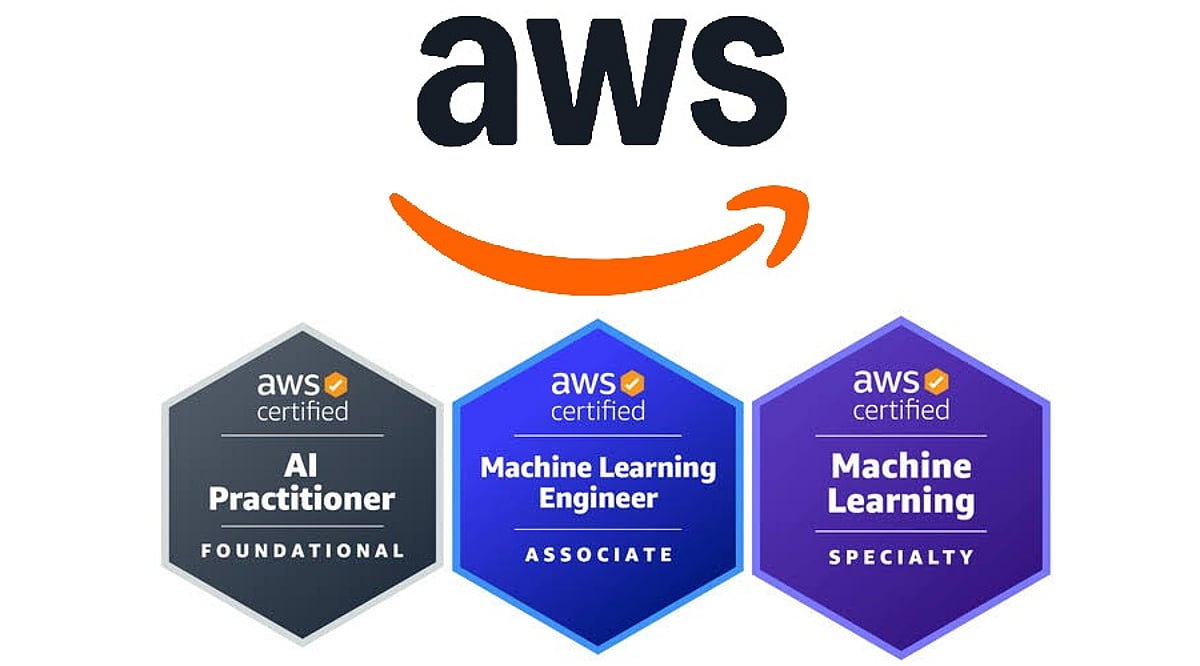
    The Machine Learning Specialty exam was retired for new candidates on March 31, 2026. Existing holders will keep the certification until its original expiry. More than an administrative change, this shift signals AWS’s move toward role-based certifications that better match candidates’ actual job responsibilities.

    What the Current Lineup Covers

    The active AWS AI and ML certifications include:

    • AWS Certified AI Practitioner (Foundational): Covers core AI and machine learning concepts, responsible AI practices, and how AWS services support common use cases. No coding background is required.
    • AWS Certified Machine Learning Engineer – Associate: Focuses on building, tuning, deploying, and monitoring machine learning models using services such as Amazon SageMaker, Amazon S3, and Amazon CloudWatch. Built for professionals who already have hands-on ML experience.
    • AWS Certified Generative AI Developer – Professional: Validates the ability to integrate large language models into applications, build retrieval-augmented generation (RAG) architectures, and work with vector databases and Amazon Bedrock for production-ready AI solutions.
    • AWS Certified Data Engineer – Associate: Centers on designing and managing data pipelines, storage, and reliable data infrastructure that supports machine learning and generative AI workloads.

    Matching the Exam to the Job

    A newcomer pivoting into AI from another field or a business analyst who needs to speak the same language as an engineering team gets the most value from AI Practitioner. It builds a baseline in AI and ML concepts without demanding coding depth.

    Someone already training and deploying models is better served by ML Engineer – Associate, which centers on data preparation, model tuning, and running workloads in production rather than staying inside a notebook.

    Developers already working with large language models, RAG pipelines, and Bedrock fit the Generative AI Developer – Professional role. This credential expects prior implementation experience rather than theory alone, and choosing it over AI Practitioner or ML Engineer comes down to one question: is the work built around foundation models or traditional ML pipelines?

    Data engineers who feed pipelines into ML systems should look at Data Engineer – Associate, a track that rarely gets the same attention as the AI-branded exams but supports all of them underneath.

    Product managers and stakeholders overseeing AI projects without building them get more practical value from AI Practitioner than from an engineering-level exam, since the goal is informed oversight rather than hands-on implementation.

    Deciding Where to Start

    The simplest approach starts with hands-on experience, not ambition. Someone new to AWS and AI belongs in AI Practitioner first. Someone already building or deploying models can skip straight to ML Engineer – Associate. A developer working with foundation models in production is the right candidate for Generative AI Developer – Professional.

    A common progression looks like AI Practitioner, then ML Engineer – Associate or Data Engineer – Associate depending on the role, then Generative AI Developer – Professional once foundation model work becomes part of the job.

    For those already deep into machine learning specialty prep, finishing it still holds some value, given less than a year remains before it closes to new candidates. For everyone else, moving straight to ML Engineer Associate offers more current coverage and a clearer path forward.

    The strongest certification choice rarely lines up with the most advanced option available. It lines up with what the job actually requires now and with where that job is headed next.

    Final Thoughts

    AWS restructuring its AI credentials around roles rather than a single tiered ladder points to where cloud certification is heading in general. It clarifies that the exam is less about climbing a fixed hierarchy and more about proving specific, current skills tied to specific work. Candidates who treat certification as a career-mapping exercise, rather than a checklist, will likely find their credentials relevant as AWS splits its portfolio.

  • Essential Data Structures & Algorithms Cheat Sheet for Data Scientists (2026)

    Essential Data Structures & Algorithms Cheat Sheet for Data Scientists (2026)

    Why Data Structures and Algorithms Matter for Data Science

    Efficient data science depends on selecting the right data structures and algorithm patterns to process large datasets, optimize pipelines, and build scalable machine learning workflows. Hash maps, heaps, arrays, graphs, and traversal techniques form the foundation of everyday data science tasks, while Big O notation helps evaluate runtime and memory efficiency as data scales.

    Pattern-based problem solving, including sliding windows, graph traversal, dynamic programming, and greedy algorithms, enables faster, more efficient solutions for analytics, recommendation systems, and production pipelines.

    The fastest way to slow down a data science project is rarely the model. It is the code that moves, cleans, and searches through data before the model ever sees it. Most junior data scientists spend months prepping for interview algorithms but give only a passing glance to the data structures that decide whether a pipeline scales or falls apart.

    Understanding Big O Notation for Data Science Performance

    Big O notation describes how runtime and memory grow as data grows. Read as an engineering signal rather than a formula, it points to the exact line of code that will slow a pipeline down once the dataset grows past a sample. A join written as a nested loop looks fine on a thousand rows and grinds to a stop on ten million. Spotting an O(n²) pattern before it ships ranks among the more underrated skills in data science.

    Memory deserves the same attention as runtime. A hash map trades space for speed, storing extra data so lookups stay constant time — a trade that becomes a real design decision once a dataset holds hundreds of millions of keys.

    Essential Data Structures Every Data Scientist Should Master

    • Hash maps and sets handle deduplication, categorical encoding, and join keys through constant-time lookups. They are the single most useful structure in a data scientist’s toolkit.
    • Heaps and priority queues solve top-ranking problems, surfacing the most similar items or highest-scoring predictions from a stream of data.
    • Arrays and lists sit under every Pandas and NumPy operation. Understanding indexing explains why vectorized code outperforms a manual loop.
    • Queues and stacks support breadth-first and depth-first traversal, which appears in graph-based recommendation systems.
    • Trees and tries handle hierarchical data and prefix search, common in text tokenization.
    • Graphs model social networks, knowledge graphs, and fraud detection webs through adjacency lists.

    Much of this operates underneath familiar libraries. A Pandas merge behaves like a hash join. Vectorized NumPy operations replace row-by-row loops with array-level traversal, sidestepping the O(n²) trap entirely. Scikit-learn’s nearest neighbor search relies on tree- and hash-based structures to avoid comparing a query point against every other point.

    Essential DSA Patterns for Data Science and Machine Learning

    • Sliding window solves rolling averages and anomaly detection over a fixed span.
    • Two pointers handle merging sorted ranges and matching records within a threshold.
    • Fast and slow pointers detect repeating cycles in session logs.
    • Binary search on the answer finds a threshold value when input and outcome move in one direction.
    • Breadth-first and depth-first search trace shortest paths across networks and grids.
    • Dynamic programming scores sequences and measures edit distance between strings.
    • Greedy choices handle interval scheduling and quick feature selection.
    • Union-Find detects connected components in clustering problems.
    • Topological sort orders pipeline steps that depend on each other.

    Data Structures and Algorithms Learning Roadmap for Data Science

    Hash maps and sets come first, since they solve more real problems than any other structure and appear as the base case in most interview questions. Sliding window and two pointers follow naturally from array fundamentals already familiar from Pandas work. Heaps come next, once basic loops feel automatic rather than effortful. Graph traversal and dynamic programming can wait until the earlier patterns need no conscious thought.

    Three to five problems per pattern is usually enough to recognize it on sight. Applying that pattern to a small project cements the idea faster than another dozen practice problems would. This order mirrors how these ideas surface on the job, not how a course happens to sequence them.

    Final Thought

    The next wave of data science hiring will likely favor depth over breadth even more than it does today, as pipelines grow larger and cheaper compute stops covering for inefficient code. A small set of patterns, practiced until they need no thought, will matter more than a wide but shallow list of algorithms saved for an interview room and forgotten afterwards.

    Frequently Asked Questions

    1. Why are data structures and algorithms important for data science?

    Data structures and algorithms help data scientists process large datasets efficiently, optimize feature engineering, improve pipeline performance, and write scalable code that works reliably in production environments.

    2. Which data structures should every junior data scientist learn first?

    Junior data scientists should prioritize hash maps, arrays, heaps, queues, stacks, and graphs because these structures frequently appear in data processing, analytics, machine learning, and coding interviews.

    3. What is the role of Big O notation in data science?

    Big O notation helps estimate how an algorithm’s runtime and memory usage scale with growing datasets, making it easier to identify inefficient code before it affects production performance.

    4. Which DSA patterns are most useful for data science projects?

    Sliding window, two pointers, BFS, DFS, dynamic programming, heaps, and topological sorting are widely used for tasks such as anomaly detection, graph analysis, recommendation systems, and workflow optimization.

    5. How can beginners practice DSA effectively for data science?

    Start with hash maps and arrays, then learn common algorithm patterns through a few focused practice problems. Reinforce each concept by applying it to small data science projects instead of relying only on coding exercises.

  • How AI-Driven Tools Are Transforming Financial Education for Retail Traders

    How AI-Driven Tools Are Transforming Financial Education for Retail Traders

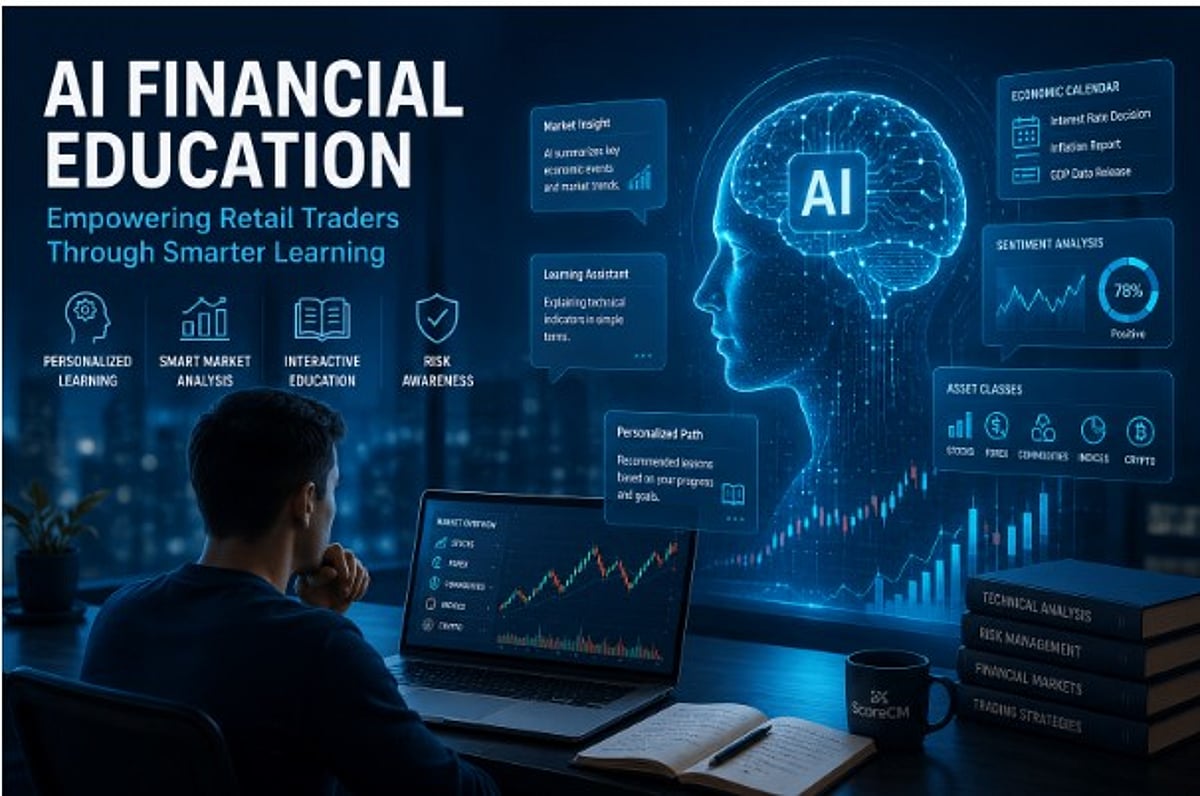
    AI financial education is transforming how people develop the knowledge needed to participate in modern financial markets. In the past, learning about investing often meant reading lengthy textbooks, attending seminars, or spending years gaining experience through trial and error. Today, artificial intelligence is making investment education more interactive, personalized, and accessible to retail traders around the world.

    The rapid growth of financial technology has introduced new ways to understand complex market concepts. AI-powered tools can organize large amounts of financial data, explain technical indicators, summarize economic news, and generate educational content tailored to different experience levels. Instead of searching through dozens of articles, learners can receive structured explanations that match their current understanding.

    As financial markets become increasingly connected and data-driven, AI is helping make financial literacy more achievable for individuals interested in stocks, forex, commodities, indices, and cryptocurrencies.

    Personalized Learning Through Artificial Intelligence

    One of the biggest advantages of artificial intelligence is its ability to personalize education. Every retail trader begins with different levels of knowledge, learning styles, and investment goals. Traditional educational materials often follow a fixed structure that may not suit everyone.

    Machine learning allows educational systems to adapt based on a learner’s progress. Beginners can receive simplified explanations of concepts such as market trends, diversification, or technical analysis, while more experienced traders can explore advanced topics involving macroeconomic indicators, algorithmic trading concepts, or risk management strategies.

    AI-powered learning platforms can also identify knowledge gaps by analyzing quizzes, study habits, and user interactions. Instead of presenting the same lessons to every learner, they can recommend relevant educational materials that strengthen weaker areas.

    At the same time, many investors continue using trusted educational resources alongside AI. As they expand their understanding of financial markets, some also explore ScoreCM to access publicly available market insights and educational materials that support continuous learning without replacing independent research.

    Smarter Market Analysis and Information Processing

    Financial markets generate enormous volumes of information every day. Economic reports, corporate earnings, geopolitical events, central bank announcements, and breaking news all influence market sentiment across multiple asset classes.

    Artificial intelligence is helping retail traders process this information more efficiently. Natural language processing enables AI systems to summarize lengthy reports, identify recurring themes in financial news, and explain how major events could influence different markets.

    For educational purposes, this creates a valuable learning environment. Rather than simply presenting raw data, AI can explain why inflation reports matter, how interest rate decisions affect currencies, or why commodity prices respond to changes in global supply chains.

    This educational approach encourages users to understand relationships between economic events instead of memorizing isolated facts. Whether studying stocks, forex, commodities, indices, or cryptocurrencies, learners gain broader context that improves their overall market awareness.

    Machine learning models can also recognize historical patterns and organize complex datasets into visual formats that are easier to interpret. While these insights should never be treated as predictions, they provide useful educational examples for understanding market behavior.

    AI Should Support Critical Thinking, Not Replace It

    Despite its growing capabilities, AI should be viewed as a learning assistant rather than a substitute for human judgment.

    Artificial intelligence can organize information, explain financial concepts, and highlight patterns within historical data. However, markets remain influenced by human behavior, unexpected geopolitical developments, regulatory changes, and emotional decision-making that cannot always be captured through algorithms.

    Retail traders benefit most when they use AI to strengthen their analytical skills instead of relying on automated conclusions. Critical thinking remains essential when evaluating information, questioning assumptions, and managing investment risk.

    Structured learning continues to play an important role in building these skills. Platforms such as ScoreCM Academy demonstrate how organized educational resources can complement learning by helping traders gradually build stronger market knowledge through structured courses and continuous education.

    Combining AI-generated insights with independent research allows learners to develop confidence while maintaining realistic expectations about the uncertainty of financial markets.

    Financial Literacy Matters More Than Ever

    The growing accessibility of investing has created new opportunities for individuals worldwide. Mobile applications, online trading platforms, and digital financial services have reduced many of the traditional barriers to entering financial markets.

    However, easier access also increases the importance of financial literacy. Understanding concepts such as portfolio diversification, volatility, leverage, inflation, and risk management remains essential regardless of the technology available.

    AI financial education can support this objective by making difficult subjects easier to understand. Interactive explanations, conversational learning tools, personalized quizzes, and real-world examples help learners absorb information more effectively than static educational materials alone.

    Better financial literacy also reduces the likelihood of making decisions based solely on social media trends, rumors, or emotional reactions. As AI continues improving educational accessibility, it can encourage more informed participation across global financial markets.

    The Future of AI in Financial Education

    The possibilities that lay ahead for AI in the field of finance do not just end at automation and analytics. Technology in education can become one of the most important uses of artificial intelligence, especially in cases where retail traders need to acquire practical knowledge before getting involved in the financial markets.

    Learning programs of the future may include elements of conversational AI, adaptive courses, market simulation, multilingual instruction, and visual interaction all within a single digital learning system.

    Concurrently, ethical AI development will be equally important. It is imperative that the educational material provides clear explanations about the underlying concepts and teaches users to double-check the received information using several sources.

    AI will not replace conventional education, but it will help open more opportunities for acquiring knowledge and learning in an efficient manner. Combined with financial literacy and critical thinking, AI can revolutionize the understanding of complex financial markets by retail traders.

    In light of the ongoing technology development, one can say that the most efficient learner will be one who embraces the assistance of AI and makes his/her own judgments independently from it. In that regard, the use of AI for financial education is a combination of technological innovation and steps forward towards improving knowledge of the market.

  • Top AI Skills Employers Will Demand Most in 2026

    Top AI Skills Employers Will Demand Most in 2026

    The artificial intelligence job market is heating up, and employers are already signaling which skills will be most valuable in 2026. From engineering robust AI systems to ensuring ethical governance, professionals who master these competencies will stand out. Here are the top AI skills that will shape career opportunities in the near future.

    AI Engineering

    Employers are prioritizing professionals who can build, deploy, optimize, and maintain scalable AI systems. Expertise in modern frameworks, cloud platforms, and automation tools is essential for this role.

    Prompt Engineering

    Crafting accurate prompts for generative AI models dramatically improves productivity, workflow automation, content quality, and enterprise AI application performance. This skill is becoming a cornerstone of efficient AI use.

    Machine Learning

    Strong machine learning expertise remains critical for developing predictive models, improving algorithms, handling large datasets, and solving complex business challenges effectively.

    Data Engineering

    Organizations are seeking experts who can manage data pipelines, ensure data quality, handle storage, integrate systems, and process information reliably to support AI model training and deployment.

    AI Governance

    As AI adoption grows, businesses increasingly value professionals who can ensure ethical AI practices, regulatory compliance, transparency, risk management, and responsible deployment across enterprise environments.

    Python Programming

    Python continues to be the preferred language for AI development, enabling automation, model building, data analysis, and seamless integration with AI frameworks efficiently.

    Cloud AI Platforms

    Experience with cloud-based AI services helps professionals deploy scalable applications, optimize infrastructure costs, and accelerate enterprise AI implementation across industries.

    Natural Language Processing (NLP)

    NLP expertise enables organizations to create advanced chatbots, language models, intelligent search systems, and multilingual customer engagement solutions successfully.

    Business Intelligence

    Employers favor professionals who combine AI knowledge with business intelligence to transform analytics into strategic decisions, operational improvements, and measurable organizational growth.

  • How AI Is Reshaping Engineering Work: From Simple Automation to Deep Collaboration

    How AI Is Reshaping Engineering Work: From Simple Automation to Deep Collaboration

    Artificial intelligence is now part of the daily routine for an engineer. It is no longer used to answer simple questions; it is now used to help developers write code, test software, find bugs, and even suggest better ways to solve problems.

    The first wave of AI in engineering introduced copilots in the form of generative assistants. These systems helped write code, generate scripts, or answer queries based on documentation. Here, the issue was that these assistants could follow prompts, but they never understood the workflow.

    As the engineering complexity increased, the limitations of these models became clear. Engineers work in a connected network where isolated tasks don’t work. A tool that generates code is definitely helpful, but it still can’t resolve bigger issues. This brings the next stage, where AI gets embedded in the entire problem-solving lifecycle.

    This has made many companies change the way their engineering teams work. AI handles repetitive tasks, while engineers focus on planning, design, and decision-making. However, it’s still the people who have the judgment ability that AI lacks. So, AI co-pilots should be embedded in a way that enhances productivity without compromising reliability.

    Almost all the bigger names in the tech industry, including Google, Meta, Anthropic, and everyone, are investing largely in AI. Google, for example, has invested heavily in Gemini, AI chips, and data centers. As AI capabilities expand, the relationship between engineers and AI is shifting from assistance to collaboration.

    Engineers’ roles have now moved from task execution to intent definition. They guide workflows, validate outcomes, and manage trade-offs across complex systems. However, this doesn’t make the expertise less valuable. They are equally crucial.

    So, the future of engineering will not be AI replacing human roles, but more likely human and AI working as co-workers, where engineers combine their judgment with machine intelligence.

  • A Beginner’s Roadmap to Data Science Tools: Python, SQL, and Visualization Libraries

    A Beginner’s Roadmap to Data Science Tools: Python, SQL, and Visualization Libraries

    Key Takeaways

    • Python, SQL, and Pandas form the foundation of modern data science.
    • Hands-on practice with Kaggle and Google Colab strengthens practical skills.
    • Visualization and version control tools improve project quality and career readiness.

    Data science can seem overwhelming at first, but selecting the appropriate tools simplifies the learning curve. Each tool serves a distinct purpose: some gather data, some organize it, while others create charts or build machine learning models. Rather than trying to learn dozens of programs at once, beginners see better results by focusing on a core set of essential tools. Recent learning guides and industry experts recommend this approach, as it builds strong practical skills before tackling advanced topics. A solid grasp of these tools also makes project work easier and prepares learners for internships and entry-level jobs.

    Python: The First Language to Learn

    Python has become the most popular programming language in data science because of its readability and simplicity. Even people with no coding background can learn its basics without much difficulty. Python helps clean raw data, analyze information, automate tasks, and create machine learning models. It also supports artificial intelligence projects, making it useful beyond beginner-level work. Another reason for its popularity is its vast collection of libraries. Instead of writing long programs from scratch, learners can use ready-made libraries that save time and reduce effort.

    Pandas and NumPy Make Data Easy to Handle

    Pandas and NumPy are two essential Python libraries that beginners should know. Pandas helps organize and clean datasets using simple commands. It can combine files, handle missing (NaN) values, and prepare data for analysis. These tasks are part of almost every data science project, so becoming familiar with Pandas is important early on. NumPy works with numbers and mathematical calculations. It is much faster than standard Python code when working with arrays and matrices. Moreover, many machine learning libraries are built on NumPy, so understanding it is necessary.

    Jupyter Notebook Creates a Better Learning Experience

    Jupyter Notebook offers an interactive workspace where code, text, and charts appear on the same page. This format helps beginners understand every step of a project, as explanations stay next to the code. Many teachers, researchers, and data scientists use Jupyter Notebook for tutorials, reports, and experiments. When mistakes appear, small sections of code can run separately, making debugging much easier than traditional programming methods.

    SQL Remains an Essential Skill

    Most companies store business information inside databases. SQL helps access that information quickly and efficiently. Beginners should learn basic commands such as SELECT, JOIN, GROUP BY, filtering, and aggregate functions, as these appear regularly in real business tasks. Industry reports continue to list SQL among the most requested skills for entry-level data science and data analytics jobs. Strong SQL knowledge also helps professionals work with large datasets without depending on spreadsheets.

    Excel Still Has an Important Place

    Even with advanced tools in the spotlight, Microsoft Excel still plays an important role in data science. Many firms use Excel for report generation, quick calculations, and simple analyses. Excel features such as Pivot Tables, Charts, Lookup Functions, and Data Cleaning tools make it easy to explore data without writing complex programs. For anyone starting out, Excel is a solid first step toward data analysis.

    Data Visualization Brings Numbers to Life

    Charts often explain data better than large tables. Matplotlib and Seaborn help create clear visualizations from Python data. These libraries produce bar charts, line charts, scatter plots, histograms, and heatmaps with just a few lines of code. Good visualizations help identify trends, compare values, and discover hidden patterns. Before building any machine learning model, data scientists usually study charts to understand the information more clearly.

    Scikit-learn Opens the Door to Machine Learning

    Once learners understand the basics of data analysis, Scikit-learn provides a reliable and simple introduction to machine learning. It offers popular algorithms such as Linear Regression, Logistic Regression, Decision Trees, Random Forests, and K-Means Clustering. Beginners can build predictive models without needing deep mathematical knowledge. Thanks to its simplicity and effective documentation, Scikit-learn is a great choice for newcomers.

    Git, GitHub, and Cloud Learning Platforms

    GitHub helps track project changes and maintain version history. It also enables collaboration when multiple developers work on the same project. Google Colab allows beginners to code without installing any software, and it provides free access to GPUs, making projects more accessible. Projects can be shared with classmates or mentors via a simple link. Kaggle is another excellent tool, offering thousands of datasets, coding notebooks, and tutorials for hands-on practice.

    Power BI and Tableau for Business Reporting

    Many organizations expect data specialists to present findings clearly and compellingly. Power BI and Tableau allow users to create responsive dashboards that illustrate business results, sales patterns, customer habits, and performance metrics. Beginners do not need to learn both platforms; mastering one visualization tool is enough for most entry-level positions. Using such dashboards improves communication, making key findings obvious to decision-makers regardless of their technical background.

    Why This Matters

    Learning the right data science tools from the beginning saves time and builds practical skills that employers value. Knowledge of Python, SQL, Jupyter Notebook, and Power BI helps solve real business problems, complete projects with confidence, and create a strong foundation for advanced analytics, machine learning, and future career growth.

    A Smart Learning Path

    A practical learning order makes the journey smoother. Start with Excel to build basic data understanding, then move to Python fundamentals, NumPy, Pandas, and SQL. After that, visualization libraries like Matplotlib and Seaborn help present insights clearly. Jupyter Notebook supports project work, while Scikit-learn introduces machine learning. Git and GitHub help organize projects, and Power BI or Tableau improve reporting skills. Google Colab and Kaggle complete the toolkit with cloud-based practice and real datasets. Recent learning roadmaps also encourage project-based learning instead of endless theory, as practical experience creates stronger skills and better job opportunities.

    Frequently Asked Questions

    1. Which programming language should beginners learn first for data science? Python is the best starting language because its simple, readable syntax makes it easy to learn while offering powerful data science libraries.
    2. Is SQL necessary for data science? Yes. SQL is essential for querying, retrieving, and managing large datasets stored inside relational databases.
    3. Should Excel be learned before Python? Learning basic Excel first helps build foundational data analysis skills, such as filtering and pivot tables, before transitioning to programming with Python.
    4. Is Google Colab better than installing Python locally? Google Colab is ideal for beginners as it runs entirely in your web browser with zero local installation or complex environment setup required.
    5. Why is Kaggle useful for beginners? Kaggle provides free access to real-world datasets, community code notebooks, and tutorials that help beginners build practical experience and strong portfolios.
  • Top Google AI Certifications and Courses for 2026: A Comprehensive Guide

    Top Google AI Certifications and Courses for 2026: A Comprehensive Guide

    Google’s AI learning ecosystem has expanded to include professional certifications, structured courses, and hands-on learning paths. Each credential targets specific skills and career objectives, making it essential to understand the options available. This guide breaks down the eight best Google AI certifications and courses, ranked by audience and career value, to help you choose the right path for building artificial intelligence expertise.

    Certifications vs. Courses: What’s the Difference?

    Google Cloud offers three proctored exams: Generative AI Leader, Professional Machine Learning Engineer, and Cloud GenAI Engineer. These exams carry a pass or fail result and a fixed validity window. In contrast, courses on Coursera or Google Skills focus on building practical skills rather than resume credentials. Understanding this distinction is key to making the right investment.

    1. Google AI Essentials

    Five short courses totaling approximately five hours, priced at $49 per month with no prerequisites. This is the most enrolled generative AI course on Coursera, covering prompting, responsible use, and everyday AI fundamentals rather than technical depth. Best for: Beginners seeking workplace fluency fast.

    2. Google Prompting Essentials

    A standalone course priced at $49, focusing purely on prompt design. Google states this will not prepare anyone for a prompt engineering role. Best for: Professionals who want sharper outputs from AI tools.

    3. Google AI Professional Certificate

    Launched on Coursera in February 2026, this certificate pairs seven short courses with a capstone project, totaling about ten hours, priced at $49 per month with no prerequisites. Enrollment includes three months of free Google AI Pro access for labs. Best for: Learners past the basics who want documented, practical proof of AI work.

    4. Introduction to Generative AI (Google Skills)

    Google Cloud’s free learning path includes four short courses covering generative AI fundamentals and responsible AI, each about an hour long. It sits on the free Google Skills tier with monthly lab credits at no charge. Best for: Those planning to attempt the Generative AI Leader certification who need Google Cloud terminology first.

    5. Google Cloud Generative AI Leader

    The first proctored credential on this list, built for non-engineers. The 90-minute exam includes 50 to 60 questions and costs roughly $99, valid for three years with renewal by retake. No coding is tested. Best for: Business leaders and product managers needing a recognized credential without writing code.

    6. Generative AI for Developers (Google Skills)

    The technical counterpart to the beginner path above, requiring prerequisite courses in responsible AI. Full access requires a paid Google Skills subscription near $30 per month. Coverage includes retrieval-augmented generation and multimodal application building with Gemini. Best for: Developers heading toward the Cloud GenAI Engineer exam.

    7. Cloud GenAI Engineer

    Priced near $200, this exam focuses on building generative AI applications through the Gemini API, RAG pipelines, and agentic workflows on existing infrastructure. Best for: Developers shipping GenAI features who do not manage full ML systems.

    8. Professional Machine Learning Engineer

    The most demanding credential. Google recommends three or more years of industry experience, including at least one year on Google Cloud. The two-hour exam includes 50 to 60 questions and costs $200, valid for two years with renewal options. A recent update shifted the exam toward the Gemini Enterprise Agent Platform. Best for: Engineers with real production experience who want Google Cloud’s strongest technical signal.

    Final Thoughts

    None of these credentials serves as a shortcut. The certifications with real hiring weight—Generative AI Leader, Cloud GenAI Engineer, and Professional Machine Learning Engineer—all expect existing baseline knowledge. The smarter move is matching the credential to your current experience level, not the one that looks most impressive on paper.

  • Google Launches Gemini 3.6 Flash and 3.5 Flash-Lite, Begins Training Next-Gen Gemini 4

    Google Launches Gemini 3.6 Flash and 3.5 Flash-Lite, Begins Training Next-Gen Gemini 4

    Google has expanded its Gemini AI family with the introduction of Gemini 3.6 Flash and Gemini 3.5 Flash-Lite, two new models engineered to deliver faster performance, lower latency, and reduced operational costs for developers and enterprises. The company also unveiled Gemini 3.5 Flash Cyber, a specialized cybersecurity-focused model, and confirmed that development of the next-generation Gemini 4 is already underway.

    Gemini 3.6 Flash, the successor to Google’s workhorse model, is designed specifically for coding, knowledge-intensive tasks, multimodality, and AI agents. It processes text, images, videos, audio, and PDFs, and offers improved coding abilities, better computer control functionality, and enhanced multimodality without latency issues. Google claims the model is more token-efficient and requires fewer reasoning steps to complete complex workflows, saving developers both time and money on inference.

    For high-volume AI workloads, Google launched Gemini 3.5 Flash-Lite, a cost-effective version of the Flash series ideal for tasks such as document parsing, classification, data extraction, translation, and large-scale automation. Flash-Lite supports multimodal inputs and provides fast responses, making it suitable for building lightweight AI agents or processing high-volume data.

    Alongside these general models, Google announced Gemini 3.5 Flash Cyber, a dedicated cybersecurity model designed to detect software vulnerabilities, ensure code security, and help remediate threats. Initially available only to governments and trusted partners, the model aims to speed up security assessments and reduce costs associated with repetitive code scans.

    Both Gemini 3.6 Flash and Gemini 3.5 Flash-Lite are now available through Google AI Studio, Gemini API, Android Studio, and other Google enterprise AI solutions. Google has also begun deploying the Flash-Lite version in consumer apps such as Google Search.

    While expanding its lightweight AI portfolio, Google has not yet provided a release date for the long-awaited Gemini 3.5 Pro model. Originally expected earlier this year, the model is still undergoing performance testing for coding tasks. According to Google, its release will follow additional validation work, while development of Gemini 4 has already started.

  • Why Major Companies Choose Python for Their Tech Stack

    Why Major Companies Choose Python for Their Tech Stack

    Python has become a core technology for many global companies. Its simple design, powerful frameworks, and rich ecosystem help businesses build scalable applications, AI systems, automation tools, and reliable backend services.

    Key Takeaways:

    • Python supports products that serve millions and even billions of users.
    • Companies use Python for AI, automation, backend development, and data engineering.
    • Frameworks like Django and FastAPI help developers build reliable applications faster.

    Python has become one of the most popular programming languages in the software industry. It has clean syntax, easy readability, and a huge collection of libraries that help developers build software faster. These qualities have made Python a trusted option for startups as well as global technology companies. Today, many famous businesses use Python as an important part of their technology stack, even though most large organizations combine several programming languages for different tasks.

    Google Uses Python Across Many Business Areas

    Google has relied on Python for many years. The company uses it for internal tools, automation, artificial intelligence, backend services, and cloud infrastructure. Python allows engineers to create software quickly while keeping projects easy to maintain. The language also works well with Google’s machine learning technologies, including TensorFlow, which has become one of the world’s most popular AI frameworks. Although Google also uses languages such as C++, Java, and Go, Python remains an important part of many engineering teams as it supports rapid development and reliable automation.

    Instagram Built a Massive Platform With Django

    Instagram stands as one of the biggest success stories for Python. The social media platform built its backend on Django, a web framework written in Python. Even after the platform reached billions of users, Django continued to support high traffic with excellent performance. Python gave Instagram developers a fast way to release new features without slowing product development. Strong database support through PostgreSQL also helped the platform manage huge amounts of user data. Instagram continues to prove that Python can support one of the world’s largest social networking services.

    Netflix Depends on Python for Automation and Machine Learning

    Netflix uses Python in several important business areas. The company relies on it for machine learning, recommendation systems, automation, backend tools, and cloud operations. Recommendation algorithms help viewers discover movies and television shows that match personal interests, and Python plays an important role in this process. Frameworks such as Flask and FastAPI support internal services, while Jupyter notebooks assist data scientists during research and model development. Python also works with PyTorch, one of the leading machine learning frameworks used by Netflix.

    Spotify, Uber, and Dropbox Continue to Trust Python

    Using Python, Spotify provides backend services, recommendation algorithms, and reporting as well as workflow management. In addition to Python, the company uses Luigi and Apache Airflow for data processing and workflow scheduling. Python allows Spotify to manage a huge amount of listener information while relying on the system for personalized music recommendations. Uber has deployed Python in its technical framework as well for the backend microservices, machine learning, data engineering, and automated processes. The application of Python frameworks such as Tornado and Flask makes it possible to operate numerous backend services. Dropbox started being based on Python at its inception when it developed its desktop application and backend system. The company later designed tools such as PyAnnotate as well as contributed to the development of MyPy, which improves static typing of Python-based software. Despite its significant size, Dropbox keeps using Python today.

    Reddit, Pinterest, Quora, and Lyft Show Python Can Scale

    Reddit became one of the earliest examples of a large website built with Python. The platform originally moved its backend to Python and still depends on the language for many services today. This long history proves that Python can support millions of active users and large online communities. Pinterest also relies on Python for recommendation systems, backend APIs, and machine learning. The company uses Django and Flask to support different services across its platform. Python helps Pinterest process huge collections of images and user activity. Quora selected Python for backend services, ranking systems, and APIs. Django and Tornado allow the platform to deliver fast responses while handling large volumes of questions and answers. Lyft uses Python for backend development, data pipelines, and machine learning. The language supports many internal systems that improve ride matching, operational efficiency, and data analysis.

    Amazon and Meta Also Depend on Python

    Amazon uses Python for automation, cloud services, machine learning, and internal development tools. Amazon Web Services offers Boto3, a Python software development kit that allows developers to work with cloud resources through code. Python also supports services connected with Amazon SageMaker, which helps businesses build and deploy machine learning models. Meta also uses Python across artificial intelligence research, automation, and software development. PyTorch, one of the world’s most popular machine learning frameworks, came from Meta and remains a major part of AI development across many industries.

    Python Fits Modern Technology Needs

    A Python technology stack refers to a combination of technologies and tools that are particularly effective in running web applications. The commonly used technologies in the Python technology stack include Django, FastAPI, or Flask, which manage backend development. In addition, the technology stack is supplemented with PostgreSQL or MySQL for data management, and Redis for better performance through caching. RabbitMQ and Kafka take care of processing messages between the different services of a web application. Elasticsearch enhances the search capabilities of the application, while Celery serves for background task management. The deployment of applications is simplified by Docker and Kubernetes, while the processes of software delivery and continuous integration are ensured by GitHub Actions and Jenkins. In addition, the technology stack encompasses Airflow, Pandas, TensorFlow, and PyTorch.

    Python Continues to Lead the Industry

    When it comes to artificial intelligence, machine learning, and similar tasks, Python is one of the leading programming languages. Corporations often use Python in combination with such languages as Go, Java, Rust, and C++ to accomplish their tasks more effectively and gain maximum performance. Even with those languages in use, Python stays in the circle of attention given the increased productivity of developers, faster development time, and having one of the most extensive software environments available today. The success of such companies as Google, Instagram, Netflix, Spotify, Uber, Dropbox, Reddit, Pinterest, Quora, Lyft, Amazon, and Meta demonstrates how useful the technology might be for products designed for millions and even billions of individuals all over the globe. It is thanks to flexibility, mature frameworks, and powerful libraries that Python is one of the best programming languages for software development today.

  • 5 Top AI Engineer Certifications to Land a Job in 2026

    5 Top AI Engineer Certifications to Land a Job in 2026

    Artificial intelligence is no longer confined to research labs—it now powers products, services, and operations across every industry. As companies invest heavily in generative AI, automation, and machine learning, the demand for skilled AI engineers continues to surge. Recruiters, however, are looking for more than theoretical knowledge; they want candidates who can apply AI to solve real-world problems.

    A recognized certification can strengthen your resume, validate your skills, and help you stand out during the hiring process. While it is not a substitute for practical experience, it complements a strong portfolio and improves your chances of landing interviews. Below are five industry-recognized AI certifications that can help you get hired in 2026.

    1. Google Cloud Professional Machine Learning Engineer

    The Google Professional Machine Learning Engineer certification is highly valued by employers for enterprise-scale AI roles. It covers the development, deployment, and management of machine learning models using Vertex AI and Google Cloud. Topics include model optimization, MLOps, monitoring, and responsible AI. This certification is ideal for professionals with some experience in machine learning and cloud computing.

    2. Microsoft Azure AI Engineer Associate (AI-102)

    This certification is designed for developers and cloud professionals who want to build AI-powered applications on Microsoft’s Azure platform. Learners gain hands-on skills with Azure AI services, Azure OpenAI, computer vision, speech services, and natural language processing. The course also emphasizes building secure and responsible AI applications.

    3. AWS Certified AI Practitioner

    AWS Certified AI Practitioner is an entry-level certification for those building a foundation in artificial intelligence. It introduces AI concepts, generative AI, prompt engineering, responsible AI, and AWS AI services. This is a practical starting point for IT professionals, software developers, and cloud engineers transitioning into AI roles.

    4. Databricks Certified Generative AI Engineer Associate

    As organizations deploy AI assistants and enterprise chatbots, generative AI skills have become highly sought after. This certification focuses on Retrieval-Augmented Generation (RAG), large language models, vector databases, prompt engineering, and AI agent development. It is aimed at engineers working on modern LLM-powered applications.

    5. IBM AI Engineering Professional Certificate

    IBM’s certification emphasizes project-based learning over theory. Participants learn Python, machine learning, deep learning, TensorFlow, and PyTorch through practical projects. This program is an excellent way for beginners to combine technical skills with a portfolio of AI projects.

    Final Takeaway

    Candidates are now evaluated on their ability to create rather than just their credentials. While a certification can make your profile stand out, practical experience is what gets you through the door. Recruiters prefer candidates who have built AI products, contributed to GitHub repositories, deployed models using cloud technology, and understand vector databases, prompt engineering, and MLOps. A relevant certification can give you the edge over other applicants, but remember: earning a certification is only the first step in your AI career journey.

    Frequently Asked Questions

    What is the best AI certification for beginners in 2026?

    AWS Certified AI Practitioner and IBM AI Engineering Professional Certificate are top choices for beginners. They cover AI fundamentals, generative AI, Python, and practical skills without requiring extensive machine learning experience.

    Which AI certification is most valued by employers?

    Google Cloud Professional Machine Learning Engineer and Microsoft Azure AI Engineer Associate are highly regarded, especially for enterprise AI, cloud computing, and production-scale machine learning roles.

    Do AI certifications guarantee a job?

    No. Certifications improve your resume and validate your knowledge, but employers also expect practical experience through AI projects, GitHub portfolios, cloud deployments, and problem-solving skills during technical interviews.

    Which certification is best for generative AI careers?

    The Databricks Certified Generative AI Engineer Associate is a strong choice for those interested in large language models, RAG, prompt engineering, vector databases, and enterprise AI applications.

    How should I prepare for an AI engineering role in 2026?

    Build a strong foundation in Python, machine learning, and cloud platforms. Earn a recognized AI certification, create real-world projects, and maintain an active portfolio to showcase your technical abilities.