Tag: machine learning

  • Essential Cloud Technologies Every Modern Business Must Know

    Essential Cloud Technologies Every Modern Business Must Know

    Cloud computing has become a cornerstone of modern business operations, offering scalable, cost-effective, and flexible solutions. Understanding the key cloud technologies can help organizations optimize their IT strategies and drive growth. Below are ten essential cloud technologies that every business should be aware of.

    1. Hybrid Cloud

    Hybrid cloud combines private and public cloud environments, providing businesses with flexibility, stronger security, better compliance, and cost-efficient workload management.

    2. Multi-Cloud Strategy

    Using multiple cloud providers improves reliability, reduces vendor dependency, optimizes costs, and enhances business continuity across operations.

    3. Infrastructure as a Service (IaaS)

    IaaS delivers virtual computing resources, enabling businesses to scale servers, storage, and networking without investing in physical infrastructure.

    4. Platform as a Service (PaaS)

    PaaS provides development environments that simplify application creation, deployment, testing, and maintenance while reducing infrastructure management complexity.

    5. Software as a Service (SaaS)

    SaaS offers cloud-hosted applications accessible through browsers, improving collaboration, reducing maintenance, and minimizing software installation requirements.

    6. Cloud Security

    Cloud security protects cloud environments through encryption, identity management, threat detection, compliance monitoring, and continuous security updates against evolving cyber risks.

    7. Cloud Backup and Disaster Recovery

    This technology ensures business continuity by securely storing data and enabling rapid recovery after outages, cyberattacks, or accidental information loss.

    8. Serverless Computing

    Serverless computing allows developers to run applications without managing servers, automatically scaling resources while reducing operational costs and administrative overhead.

    9. Cloud AI and Machine Learning

    Cloud-based AI and ML integrate intelligent analytics, predictive insights, automation, and personalized customer experiences directly into business applications.

    These cloud technologies empower businesses to innovate faster, reduce costs, and stay competitive in a rapidly evolving digital landscape.

  • Top 10 Semiconductor Companies Driving the AI Revolution

    Top 10 Semiconductor Companies Driving the AI Revolution

    The rapid advancement of artificial intelligence is heavily reliant on cutting-edge semiconductor technology. From high-performance GPUs to specialized memory and fabrication, these ten companies are at the forefront of powering AI workloads across data centers, edge devices, and consumer electronics.

    • Nvidia: Leads AI computing with powerful GPUs that accelerate machine learning, generative AI, scientific research, and enterprise data center workloads globally.
    • AMD: Develops high-performance CPUs and GPUs supporting AI workloads, cloud computing, gaming, and enterprise applications with competitive processing capabilities.
    • Intel: Expands AI hardware through advanced processors, AI accelerators, and data center solutions supporting enterprise computing and intelligent automation.
    • TSMC: Manufactures cutting-edge semiconductor chips for leading technology companies, enabling advanced AI processors through world-class fabrication technologies.
    • Samsung Electronics: Produces advanced memory chips and semiconductor technologies powering AI devices, smartphones, servers, and high-performance computing systems worldwide.
    • Qualcomm: Designs AI-enabled mobile processors delivering intelligent photography, voice assistants, efficient performance, and edge AI capabilities across connected devices.
    • Broadcom: Develops networking chips, AI infrastructure components, and connectivity solutions supporting large-scale cloud computing and enterprise artificial intelligence deployments.
    • MediaTek: Builds AI-capable smartphone processors with efficient performance, intelligent imaging, and advanced connectivity for affordable consumer electronics worldwide.
    • Micron Technology: Supplies high-performance memory and storage solutions essential for AI training, inference workloads, and modern data center infrastructure.
  • Essential Quant Finance Books for 2027 Candidates: A Structured Reading Plan

    Essential Quant Finance Books for 2027 Candidates: A Structured Reading Plan

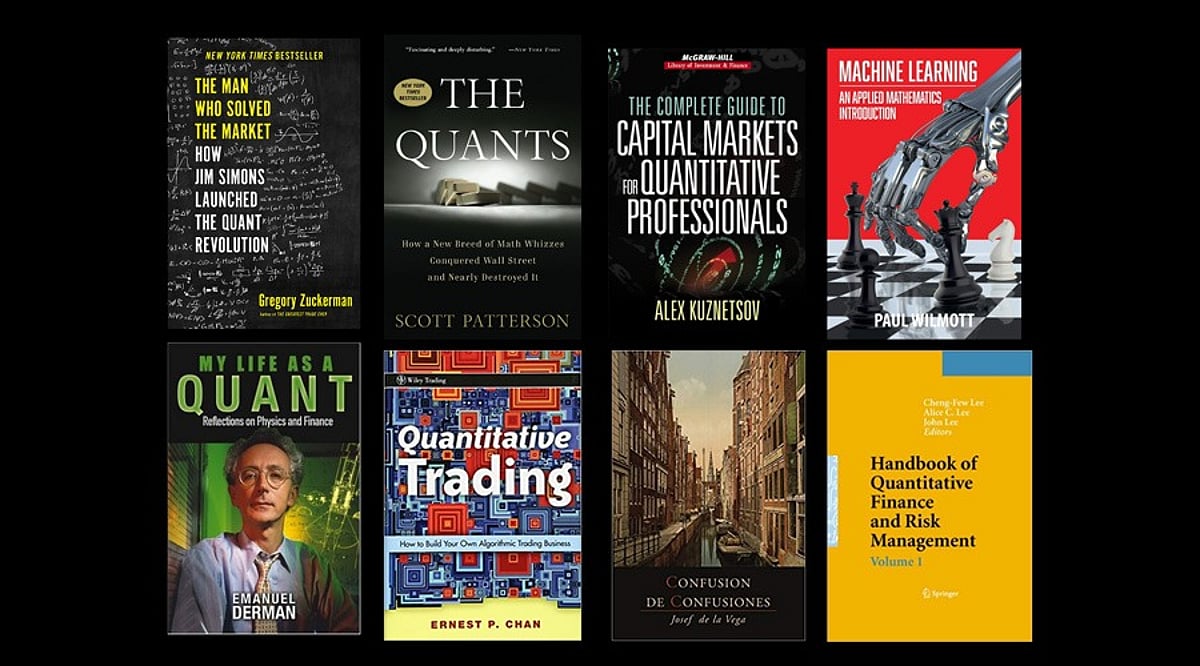
    Quant finance hiring continues to intensify. Firms now expect candidates to demonstrate simultaneous proficiency in probability, coding, and market structure. While reading the right books won’t guarantee a job offer, they build the analytical framework that interviewers actually test. Here is a practical reading list for anyone preparing for quant research, trading, or risk roles in 2027.

    Why Read Quant Books?

    Online courses and video lectures are abundant, but books offer something short videos cannot: depth, structure, and worked-out logic that forces slow thinking. Quant interviews often revolve around problems first explained clearly in a handful of classic texts. Candidates who skip these books usually end up relearning the same ideas the hard way—through failed interviews.

    Foundation Books for Beginners

    Before jumping into stochastic calculus or trading strategies, every candidate needs strong basics in probability, statistics, and market structure.

    • ‘A First Course in Probability’ by Sheldon Ross – Covers combinatorics, random variables, and distributions with clear examples. This is the starting point for almost every quant interview guide.
    • ‘Options, Futures, and Other Derivatives’ by John Hull – The standard reference for derivatives pricing. Nearly every trading desk expects candidates to know this book well.
    • ‘Heard on The Street’ by Timothy Falcon Crack – A collection of real interview questions asked by banks and hedge funds, with detailed solutions.

    Mathematics and Statistics Deep Dive

    Once the basics are clear, candidates should move toward the mathematics that drives actual pricing models and risk systems.

    • ‘Stochastic Calculus for Finance’ (Volumes I and II) by Steven Shreve – A rigorous, step-by-step introduction to the mathematics behind option pricing.
    • ‘Statistical Inference’ by Casella and Berger – Builds a strong statistical toolkit, useful for research-heavy roles.
    • ‘The Concepts and Practice of Mathematical Finance’ by Mark Joshi – Bridges theory and practical pricing, written by someone who has worked on trading floors himself.

    Programming and Data Skills

    Modern quant roles require coding fluency alongside mathematics. Python and C++ dominate this space, and a few books stand above the rest.

    • ‘Python for Data Analysis’ by Wes McKinney – Written by the creator of pandas, this book teaches data manipulation skills used daily in quant research.
    • ‘C++ Design Patterns and Derivatives Pricing’ by Mark Joshi – Shows how object-oriented design connects with real pricing engines.
    • ‘Advances in Financial Machine Learning’ by Marcos López de Prado – A sharp, opinionated guide to building machine learning models for markets, popular with systematic trading firms.

    Interview Preparation Books

    Technical knowledge alone rarely wins an offer. Candidates also need to practice the exact style of questions asked in interviews.

    • ‘Quant Job Interview Questions and Answers’ by Mark Joshi, Nick Denson, and Andrew Downes – A widely used guide covering brainteasers, probability puzzles, and finance-specific questions.
    • ‘Frequently Asked Questions in Quantitative Finance’ by Paul Wilmott – Written in a conversational tone, this book clears up common confusions around derivatives and models.
    • ‘Green Book: Quantitative Finance Interviews’ by Xinfeng Zhou – Focused purely on interview problems, with worked solutions and hints.

    Advanced Reading

    Experienced candidates aiming for senior research or portfolio roles should look at these titles.

    • ‘Active Portfolio Management’ by Grinold and Kahn – A detailed guide to building and managing systematic strategies.
    • ‘Algorithmic Trading’ by Ernest Chan – Practical advice on building, testing, and running trading systems.
    • ‘The Volatility Surface’ by Jim Gatheral – A focused study of volatility modeling, useful for anyone targeting options desks.

    How to Build a Reading Plan

    A common mistake candidates make is trying to read every book on a list at once. A better approach is to build a plan across a few months.

    • Month 1: Focus on probability, statistics, and derivatives basics.
    • Month 2: Transition into stochastic calculus and programming, solving problems in addition to reading.
    • Month 3: Use this entire month for interview-style books, answering questions under time pressure.

    Only try more advanced or niche titles after you have a solid grasp of the basics.

    Final Words

    Quant finance is a fast-moving and ever-changing field, with increasing emphasis on machine learning and alternative data. Still, the core fundamentals covered in these books have held up for more than 20 years. Candidates aiming at the 2027 hiring cycle should see this list as a starting point and supplement it with recent research papers and market-specific readings. A good knowledge of fundamentals, combined with lots of practice, will give any candidate a significant competitive advantage.

    Frequently Asked Questions

    1. Which are the best quant finance books for beginners in 2027?

    Beginners should start with ‘A First Course in Probability’, ‘Options, Futures, and Other Derivatives’, and ‘Python for Data Analysis.’ These books explain core concepts that support advanced quantitative finance learning and interview preparation.

    2. Which books help prepare for quant finance interviews?

    ‘Heard on The Street,’ ‘Green Book: Quantitative Finance Interviews,’ and ‘Quant Job Interview Questions and Answers’ focus on probability, logical reasoning, mathematics, and technical interview questions commonly asked by financial firms.

    3. Why is Python important for quant finance careers?

    Python supports data analysis, financial modeling, automation, algorithmic trading, and machine learning. Learning Python through dedicated finance books helps candidates apply quantitative concepts using practical programming techniques valued across the industry.

    4. Should candidates study advanced quant finance books first?

    Starting with advanced books often creates learning gaps. Building knowledge through probability, statistics, derivatives, and programming first makes complex mathematical finance topics easier to understand and apply effectively.

    5. How long does it take to complete a quant finance reading plan?

    A focused three-month plan covering fundamentals, programming, and interview preparation provides a practical starting point. Advanced titles and research papers can be added gradually as technical knowledge and confidence grow.

  • Best AI Architecture Certifications for 2026: From Beginner to Expert

    Best AI Architecture Certifications for 2026: From Beginner to Expert

    The demand for AI architects is skyrocketing as enterprises scale generative AI, agentic AI, and automation across industries. Whether you’re just starting out or an experienced professional, earning the right AI architecture certification can validate your expertise and unlock higher-paying roles. This guide covers the top certifications for 2026, from entry-level to advanced, and offers tips on choosing the best path for your career.

    Why AI Architecture Certifications Matter Now

    AI architecture goes beyond traditional software development. It involves building end-to-end systems that integrate data pipelines, cloud services, machine learning models, APIs, security, governance, and monitoring. Employers increasingly seek professionals who not only understand how AI models work but also how to deploy and scale them responsibly. Modern certifications cover real-world scenarios like retrieval-augmented generation (RAG), AI agents, MLOps, prompt engineering, and responsible AI, making them highly relevant for hands-on roles.

    Best Certifications for Beginners

    If you’re new to AI, these foundational certifications require no prior programming experience:

    • Microsoft Azure AI Fundamentals (AI-900): Introduces machine learning, computer vision, natural language processing, and responsible AI concepts with a focus on Microsoft’s AI services.
    • AWS Certified AI Practitioner: Designed for both technical and business professionals, covering generative AI concepts, AWS AI services, and real-world use cases.
    • Google Generative AI Leader: A newer option gaining traction for professionals interested in understanding how generative AI can be applied in business contexts.

    Intermediate Certifications for AI Engineers

    After building a foundation, these certifications focus on creating and deploying practical AI applications:

    • Microsoft Azure AI Engineer Associate (AI-102): Concentrates on building AI applications using Azure AI services, cognitive services, and responsible AI practices.
    • Google Cloud Professional Machine Learning Engineer: Ideal for those working with ML pipelines, model deployment, and AI infrastructure on Google Cloud.
    • AWS Certified Machine Learning Engineer – Associate: Covers building, deploying, and monitoring models with cloud-native ML workflows.

    Advanced Certifications for AI Architects

    Experienced professionals designing enterprise-scale AI platforms should consider these advanced programs:

    • Databricks Certified Generative AI Engineer Associate: Focuses on production-grade generative AI applications using vector databases, retrieval systems, MLflow, and large language models. Ideal for organizations deploying AI copilots and enterprise search.
    • NVIDIA Deep Learning Institute (DLI) Certifications: Increasingly valuable as enterprises adopt GPU-accelerated AI. Programs cover deep learning optimization, LLM deployment, and high-performance AI computing.

    How to Choose the Right Certification Path

    Your choice should align with your career goals and experience level:

    • Non-technical professionals: Start with AI literacy certifications, then move to cloud AI engineering certifications.
    • Software developers: Choose associate-level cloud AI certifications to build on existing coding skills.
    • Data scientists: Combine cloud certifications with MLOps and generative AI credentials.

    Also consider the cloud ecosystem of your target employer. Azure is common in large enterprises, AWS dominates the infrastructure market, and Google Cloud is strong in ML and data engineering.

    Beyond Certifications: Building Real-World Skills

    Certifications validate knowledge, but employers want proof of practical experience. Work on AI systems, explore open-source LLMs, build RAG applications, and contribute to GitHub projects. Combining recognized certifications with hands-on projects will make you far more competitive. The goal is to create secure, scalable, production-ready AI systems.

    Why This Matters

    AI architecture certifications provide structured learning, validate industry-relevant skills, and keep you current with emerging technologies like LLMs, RAG, MLOps, AI governance, and cloud AI services. When paired with real-world experience, they significantly boost employability and prepare you for AI leadership roles.

  • 7 Free AI Courses with Certificates to Boost Your Skills in July 2026

    7 Free AI Courses with Certificates to Boost Your Skills in July 2026

    Build AI skills without spending a rupee. Here are the top free AI courses offering certificates in July 2026:

    • Google AI Essentials – Learn practical AI skills and prompt engineering with beginner-friendly lessons.
    • Microsoft AI Skills Challenge – Gain hands-on experience with Azure AI tools and earn a free certificate.
    • IBM AI Fundamentals – Understand machine learning, generative AI, and business AI applications.
    • Harvard CS50 AI – A rigorous introduction to artificial intelligence using Python programming.
    • DeepLearning.AI Short Courses – Master prompting, LLMs, and generative AI through concise practical lessons.
    • Coursera AI for Everyone – Andrew Ng’s popular course explains AI concepts without coding experience.
    • NVIDIA Deep Learning Institute – Access free AI workshops focused on GPUs, deep learning, and computer vision.
    • LinkedIn Learning AI Courses – Explore workplace AI productivity, Copilot, ChatGPT, and automation topics.

    Read more stories and join our WhatsApp Channel to get the latest news, exclusives, and videos.

  • 10 Best GenAI and Agentic AI Certifications to Future-Proof Your Career in 2026

    10 Best GenAI and Agentic AI Certifications to Future-Proof Your Career in 2026

    The AI job market is shifting toward professionals who can build, deploy, and manage intelligent systems instead of simply using AI tools. GenAI and Agentic AI courses provide structured learning with hands-on projects and industry-recognized credentials. The best programs can strengthen both technical expertise and long-term career prospects.

    Overview

    GenAI and Agentic AI courses develop practical skills in large language models (LLMs), AI agent frameworks, RAG, Model Context Protocol (MCP), AI governance, and autonomous AI system design for real-world applications. These programs cater to different experience levels, from beginners learning generative AI fundamentals to professionals building production-ready AI agents, enterprise workflows, and intelligent automation systems.

    University-backed and industry-recognized courses combine hands-on projects, technical expertise, and system-level thinking to prepare learners for AI engineering, product management, software development, and enterprise AI leadership roles.

    Prompt engineering got people through the door of Generative AI. Now the demand is shifting toward something bigger: professionals who can build, deploy, and govern autonomous AI systems that actually solve business problems. Certification programs are moving with that shift, leaving prompt basics behind and teaching production-ready AI skills instead.

    Generative AI courses teach people to use large language models to create content and applications. Agentic AI courses go further. They teach people to build systems that plan, use tools, maintain context, and finish tasks with little human input. That is why courses covering architecture, evaluation, and governance now carry more weight than courses built around prompting alone.

    How We Ranked the Best GenAI and Agentic AI Courses in 2026

    These ten are ranked by curriculum depth, verified hands-on project work, institutional accountability, and how directly the skills map to a real job function, from the complete beginner through the production engineer. That range is deliberate. A ‘top 10’ list that only serves engineers offers little to a product manager or executive searching for the same term.

    Top 10 GenAI and Agentic AI Courses at a Glance

    1. Learnbay – Generative AI & Agentic AI Master Program

    Most AI courses just teach tools or prompt writing. Learnbay takes a different path, helping learners apply AI directly in their existing fields. The Generative AI & Agentic AI Master Program mixes live classes, real projects, and guidance from actual industry practice. Topics covered include Generative AI, Agentic AI, RAG, LangChain, LangGraph, CrewAI, MCP, vector databases, LLMOps, AI deployment, automation, and responsible AI use. The focus stays on real work, not sample projects. Through AI Co-Lab and startup-style challenges, plus the Build Your Own Project (BYOP) program with a mentor guiding each step, learners build a portfolio worth showing employers. The projects are tailored to different fields too, including banking, healthcare, manufacturing, retail, telecom, and consulting. Classes run live on weekends, which works well for people balancing a full-time job. A three-year access period is also included, so the material stays available for future review. Career Services Pro adds further support with resume building, LinkedIn profile help, mock interviews, and placement assistance.

    2. Building AI Agents and Agentic Workflows (IBM)

    A three-course specialization that moves from LangGraph fundamentals to CrewAI multi-agent orchestration to AG2 and BeeAI, inside guided labs using real large language models such as GPT and IBM Granite. It works as a reasonable second step after a GenAI foundations course, though it remains a framework survey in nature. Learners wanting deep architecture or governance content will outgrow it fast.

    3. Full Stack Agentic AI Specialization (Coursera)

    This program moves past framework tours into ownership: RAG pipelines, the Model Context Protocol, vector databases, and backend orchestration. It suits engineers who want the whole stack under one roof rather than a single layer. The tradeoff is breadth over depth. Covering the full stack means less specialization in any one area than Cornell’s architecture-focused track offers.

    4. Master Agentic AI: Core Principles and Real-World Applications (Coursera)

    Built for people who already build ML models and need to operate agent systems at production scale: reward-signal design, CI/CD pipelines for retraining, drift detection, and threat modeling for agent security. The honest limitation is the prerequisite. Real ML fluency is assumed already. This program suits practitioners moving beyond prompting, not those starting from it.

    5. Applied Agentic AI Certificate (University of San Francisco)

    An intensive, in-person program with labs and a hackathon, built for people who need to understand agentic AI without writing code. It fills a genuine gap, since most agentic programs assume an engineering background. The cost is depth: graduates leave with strategic fluency, not implementation skill.

    6. Agentic AI Certificate Program (Johns Hopkins)

    A twelve-week, university-backed program covering Python, LLMs, RAG, and agent construction through applied projects, with weekly live sessions from faculty and industry experts. It sits between USF’s no-code approach and Coursera’s engineering-heavy tracks, a reasonable middle path for professionals wanting some hands-on coding without a pure software-engineering prerequisite.

    7. Agentic AI Architecture (eCornell)

    Four short courses over two months, focused not on building agents step by step but on designing the systems around them: LLM reliability, RAG, multi-agent workflows, and governance frameworks for responsible deployment. It suits architects, tech leads, and PMs who own decisions rather than code. Engineers wanting deep framework practice will find it thinner on implementation than IBM’s specialization.

    8. Generative and Agentic AI Certification (BITS Pilani Digital)

    A roughly 30-week program covering LLM applications, agentic systems, RAG, and deployment, built for technology professionals moving from experimenting with AI to architecting it. The length is the differentiator, for better and worse. It offers more depth than any other program on this list but demands a real-time commitment, closer to a part-time postgraduate course than a certification sprint.

    9. Agentic and Generative AI Course (IISc CCE with TalentSprint)

    An advanced program carrying IISc’s research credibility, relevant in India and among engineers who value an academic institution behind the certificate. It overlaps closely in content with BITS Pilani’s track, so the deciding factor usually comes down to institutional preference and location rather than curriculum difference.

    10. GitHub Certified: Agentic AI Developer (Microsoft)

    Four courses at 15 to 16 hours each, built for developers already working inside GitHub workflows and the software development lifecycle. It teaches agentic development inside tools people already use daily, which shortens the learning curve for that specific audience and narrows relevance for anyone outside it.

    How to Choose the Right GenAI and Agentic AI Certification

    Complete beginners fit best with Generative AI for Everyone before attempting anything agentic; every program past that point assumes basic LLM familiarity. Developers wanting hands-on framework practice suit IBM’s specialization or Coursera’s Full Stack track. Architects and technical leads gain more from Cornell’s system-design focus than from a coding-heavy specialization they will not use directly. Professionals wanting depth and university credibility should weigh BITS Pilani or IISc against the time commitment involved. Non-technical leaders get the most direct value from USF’s applied, no-code format.

    Final Thoughts

    The strongest certification is rarely the longest or the most recognizable name. It is the one that closes an actual skill gap. Whether that means understanding what generative AI even is, building production-ready agents, or governing how autonomous systems get deployed at scale.

    FAQs

    1. What is the difference between Generative AI and Agentic AI? Generative AI creates content such as text, images, code, and audio from user prompts, while Agentic AI enables systems to reason, plan, use tools, and complete multi-step tasks with minimal human intervention.
    2. Which GenAI and Agentic AI certification is best for beginners? Beginners should start with foundational Generative AI courses that teach LLMs, prompt engineering, and AI applications before advancing to Agentic AI courses focused on autonomous agents and workflow automation.
    3. Are GenAI and Agentic AI courses worth pursuing in 2026? Yes. As businesses increasingly adopt AI-powered workflows and intelligent agents, courses with hands-on projects and practical AI skills can improve employability and support long-term career growth.
    4. What skills should a good GenAI and Agentic AI certification include? A strong certification should cover prompt engineering, large language models (LLMs), retrieval-augmented generation (RAG), AI agent frameworks, workflow automation, AI governance, model evaluation, and real-world project development.
    5. How do I choose the right GenAI and Agentic AI course? Select a course based on your experience level, career goals, curriculum, hands-on learning opportunities, industry recognition, and whether it covers practical applications such as AI agent development, deployment, and enterprise AI solutions.

  • 10 Essential Data Science Concepts to Master in 2026

    10 Essential Data Science Concepts to Master in 2026

    Data science has evolved rapidly, and professionals who want to stay ahead must master a blend of foundational skills and emerging technologies. Here are the ten most important concepts to learn in 2026, covering Python, statistics, SQL, machine learning, generative AI, data engineering, cloud computing, MLOps, and business intelligence.

    1. Python

    Python remains the dominant language for data science due to its readability and extensive library ecosystem. Key skills include functions, classes, object-oriented programming, error handling, decorators, and context managers. Essential libraries: NumPy, Pandas, Polars, Matplotlib, Seaborn, Plotly, Scikit-learn, PyTorch, TensorFlow, and JAX.

    2. Mathematics

    Mathematics underpins every machine learning model. Focus on linear algebra (vectors, matrices, PCA), calculus (derivatives, gradient descent), probability (Bayes’ theorem, distributions), and statistics (hypothesis testing, A/B testing, ANOVA).

    3. SQL

    SQL is critical for querying databases. Beyond basic SELECT statements, learn CTEs, window functions, indexes, and views. Modern cloud data warehouses like Snowflake, BigQuery, and Redshift, plus lakehouse technologies like Delta Lake, are increasingly important.

    4. Machine Learning

    Machine learning enables pattern recognition and prediction. Supervised methods include linear regression, random forests, and gradient boosting. Unsupervised techniques include K-Means, PCA, and t-SNE. Model evaluation metrics like precision, recall, F1 score, and cross-validation are essential.

    5. Deep Learning

    Deep learning powers modern AI with architectures like CNNs for images, RNNs and LSTMs for sequences, and Transformers for language and generation. Mastering these enables advanced pattern detection and classification.

    6. Generative AI

    Generative AI builds on deep learning to create content. Key techniques include Retrieval-Augmented Generation (RAG), fine-tuning, LoRA, PEFT, and RLHF. AI agents and function calling allow models to perform autonomous tasks, making them central to business AI applications.

    7. MLOps

    MLOps ensures models are deployable and maintainable. Tools like Git, MLflow, Docker, Kubernetes, and CI/CD pipelines are vital. Cloud platforms (AWS, Azure, GCP) enable scalable deployment and monitoring for drift and performance issues.

    8. Cloud Computing

    Cloud platforms provide the infrastructure for data processing, storage, and AI at scale. Familiarity with AWS, Azure, or Google Cloud, along with services like S3, Lambda, and BigQuery, is increasingly required for data science roles.

    9. Business Intelligence

    Visualization and communication turn data into actionable insights. Tools like Tableau, Power BI, Looker, and Apache Superset help create dashboards that convey key metrics. Clear reporting supports better decision-making.

    10. Emerging Concepts

    Stay ahead with emerging fields like Responsible AI, Synthetic Data, Causal AI, Time Series AI, Multimodal AI, and AI agents. Combining these with strong fundamentals in Python, mathematics, and SQL will provide the best career opportunities in 2026.


    FAQs:

    1. Why learn data science in 2026? These skills align with current industry demands and future AI roles.
    2. Is Python still the best language? Yes, due to its simplicity and powerful libraries.
    3. Do I need math? Yes, for understanding model mechanics.
    4. What new skills matter? Generative AI, RAG, and MLOps are key.
    5. Can beginners start? Yes, begin with Python, SQL, and statistics, then progress to more advanced topics.
  • Master AI for Business: Harvard’s Online Course on Machine Learning, Generative AI & Ethics

    Master AI for Business: Harvard’s Online Course on Machine Learning, Generative AI & Ethics

    Harvard Business School has launched an online course titled AI Essentials for Business, designed to equip professionals with a practical understanding of how artificial intelligence is reshaping modern organizations. The program covers machine learning, data science, predictive modeling, and generative AI, with a strong emphasis on real-world business applications, ethical considerations, and risk management.

    What You’ll Learn in This Course

    • Grasp the evolving role of AI in contemporary business operations.
    • Explore how machine learning, predictive modeling, and data science solutions can be applied to drive decision-making.
    • Identify opportunities to leverage AI for improving operational processes and strategic planning.
    • Examine ethical issues and risk management challenges associated with AI implementation.
    • Understand how generative AI impacts organizational structures and business workflows.

    Accessibility and Value

    This 100% online course runs for four weeks, requiring 5–7 hours of study per week, making it manageable for busy professionals. Delivered through Harvard Business School Online, the program allows students to learn at their own pace from anywhere. Upon completion, participants receive a Certificate of Completion, validating their knowledge of AI fundamentals and strategic business applications.

    Comprehensive Curriculum

    • AI Landscape Overview: Understand the growth and evolution of AI technologies.
    • Machine Learning and Data Science: Learn the basics of predictive analytics, modeling, and data-driven decision making.
    • AI in Business Strategy: Discover how organizations integrate AI to drive innovation and operational efficiency.
    • Generative AI in Organizations: Explore how generative AI tools impact business operations and digital transformation.
    • Ethical AI and Risk Management: Implement AI responsibly while addressing ethical and governance challenges.
    • Business Applications of AI: Identify opportunities to apply AI in business development, innovation, and strategic management.

    Eligibility Criteria

    The program is open to professionals, managers, and business leaders who want to learn about AI. No advanced technical skills or programming expertise are required. It is designed for beginners seeking to understand the business impact of artificial intelligence.

    What Makes This Course Stand Out?

    The course emphasizes the practical business value of AI, teaching students how to leverage AI for tangible business outcomes. Faculty from Harvard Business School provide training focused on AI-driven business innovation and digital transformation.

    Final Thoughts

    The AI Essentials for Business program delivers foundational concepts that illustrate how AI and machine learning transform modern organizations. Professionals gain practical skills to use AI strategically while navigating ethical and operational challenges.

  • How AI Transforms Coupon Discovery into a Real-Time Data Challenge

    How AI Transforms Coupon Discovery into a Real-Time Data Challenge

    Promo codes may seem like a simple marketing tactic, but beneath the surface they represent a surprisingly complex data problem. Each code is a tiny record with a short, unpredictable lifespan: it works under unpublicized conditions, then disappears without warning. Multiply that by millions of codes across hundreds of thousands of online stores, and you have a dataset that decays faster than almost any other consumer-facing information.

    For twenty years, the industry ignored this decay. Coupon aggregators compiled lists, ranked well in search engines, and left verification to shoppers. The data was stale, everyone knew it, and the cost was absorbed one wasted checkout minute at a time. Now, machine learning has made real-time verification economically feasible, quietly shifting coupon discovery from a content business into a data engineering one.

    A Dataset That Rots by Design

    To understand why the old model failed, look at coupon data through an analyst’s lens. First, the decay rate is extreme. Codes expire on fixed dates, hit redemption caps, get pulled mid-campaign, or apply only to narrow segments—first orders, specific categories, minimum spends. A code’s validity isn’t static; it’s a function of time, store, cart contents, and sometimes the shopper’s history. A list of codes without a validation timestamp is closer to a rumor than a dataset.

    Second, there is no authoritative source. Merchants don’t publish machine-readable feeds of active promotions. Codes leak through newsletters, influencer campaigns, affiliate programs, and social posts, then get scraped and re-scraped by aggregators who copy from each other. Errors propagate; corrections don’t.

    Third—the structural flaw—publishers’ incentives were never aligned with accuracy. Aggregator sites monetize traffic, and a page listing twenty dead codes ranks as well as one listing three live ones. Without a feedback loop from actual redemption outcomes, there was no mechanism for self-correction. The result: verification work—the only part that matters—was outsourced to end users, performed manually, and its results discarded. Every day, millions of shoppers ran millions of validity tests at checkout, and none of that signal was captured.

    Verification as the Core Product

    The current generation of AI shopping assistants inverts this model. Instead of publishing codes and hoping, they treat verification as the product and run it at the moment it matters: live, at checkout, against the shopper’s actual cart. Technically, the assistant—typically a browser extension—performs a small automated experiment during checkout. It records the current cart total, applies a candidate code, waits for the page to settle, and interprets the outcome. Did the total drop? By how much? Did the site return an error—expired, not applicable to these items, minimum spend not met? Each attempt produces a labeled data point: this code, this store, this timestamp, this result.

    Two AI capabilities make this workable at web scale. The first is structural understanding: recognizing checkout pages, discount fields, and confirmation messages across storefronts that share no common platform, layout, or language. That’s a classification problem—the model reads contextual signals the way a human would, rather than relying on hard-coded selectors that break with every redesign. The second is semantic interpretation: error messages are free text, phrased differently on every site and in every language, and the system must map them to a small set of meaningful outcomes. Neither capability was practical with rule-based software; both are now routine for machine learning models, which is precisely why this category is emerging now rather than a decade ago.

    The Feedback Loop is the Moat

    The most interesting part of the architecture isn’t any single verification—it’s what happens to the results. Every tested code, successful or failed, flows back into the system. Codes that keep redeeming get promoted; those that keep failing get demoted and eventually retired. Patterns emerge that no static database could capture: which stores rotate codes weekly, which offers are region-locked, which “public” codes are actually single-use. The dataset stops being a snapshot and becomes a living model of the promotional landscape, continuously refreshed by usage itself.

    This creates a data flywheel familiar from other consumer AI products. More users generate more verification events; more events produce a fresher, more accurate code pool; a more accurate pool makes the product more useful, attracting more users. The defensibility isn’t in scraping codes—anyone can do that—it’s in the accumulated, timestamped record of what actually worked, where, and when.

    One production example of this architecture is Couponly, an AI-powered shopping assistant available as a browser extension for Chrome, Firefox, and Microsoft Edge. Rather than presenting shoppers with lists of unverified codes, it finds, tests, and applies codes in real time at checkout, using live outcomes to keep its data current. The company is extending the same data foundation beyond couponing—toward iOS and Android apps, item saving, price tracking, price history, cashback, and smarter deal alerts. This is a natural progression: once a system continuously observes prices and promotions across the web, discount verification is just the first product you can build on top of it.

    Pricing Intelligence is the Same Problem, Wider

    That progression points to where the category is heading. Price tracking and price history are, structurally, the coupon problem again: high-volume, fast-decaying observations that are only valuable if they’re current and verified. A “was €89, now €59” claim is only meaningful if someone has been recording that price over time. Deal alerts are a prediction layer on top—learning what a good price looks like for a product and flagging the moment it appears.

    For the analytics community, the pattern is worth watching because it generalizes. A growing class of consumer AI tools follows the same blueprint: pick a domain where the ground truth changes constantly, build an agent that can measure that truth automatically at the moment of use, and let the measurements compound into a dataset nobody else has. Shopping happens to be an ideal proving ground—outcomes are unambiguous, feedback is instant, and the value lands directly in the user’s cart total.

    Conclusion

    The coupon field survived two decades of ecommerce progress because it wasn’t really a search problem—it was a data-freshness problem wearing a search costume. Static databases can’t keep up with data that decays hourly and varies by store, cart, and shopper. Continuous, automated, in-context verification can. As AI shopping assistants push that approach across the wider terrain of prices, deals, and alerts, coupon discovery is becoming an early case study in a broader shift: consumer applications where the AI’s job is not to generate content, but to keep a decaying picture of the world permanently up to date.

  • Top 8 Fastest-Growing AI Careers to Watch in 2025

    Top 8 Fastest-Growing AI Careers to Watch in 2025

    The artificial intelligence industry is evolving at an unprecedented pace, creating a wave of new, high-demand job roles. Professionals looking to future-proof their careers should consider specializing in one of these rapidly growing AI positions. Below, we break down the key roles that are shaping the future of technology.

    AI Engineer

    AI Engineers design, develop, and deploy intelligent applications that leverage machine learning, cloud platforms, and automation. They solve complex business challenges by building scalable AI systems that drive efficiency and innovation.

    Machine Learning Engineer

    Machine Learning Engineers create predictive models and self-learning algorithms that power recommendation engines, fraud detection, automated decision-making, and operational optimization across industries.

    Generative AI Engineer

    Generative AI Engineers build chatbots, virtual assistants, content generators, and enterprise solutions using large language models, prompt engineering, and retrieval-augmented generation techniques.

    Data Scientist

    Data Scientists extract actionable insights from massive datasets using statistics, machine learning, and visualization. Their work supports strategic business decisions and drives innovation.

    AI Research Scientist

    AI Research Scientists conduct advanced research in deep learning, natural language processing, and reinforcement learning to develop next-generation AI models and technologies.

    AI Product Manager

    AI Product Managers bridge business objectives and technical development. They define product strategies, coordinate teams, prioritize features, and ensure successful AI product delivery.

    Prompt Engineer

    Prompt Engineers craft optimized prompts that improve AI-generated responses, increase model accuracy, and streamline enterprise workflows across diverse applications.

    AI Ethics Specialist

    AI Ethics Specialists ensure AI systems remain fair, transparent, secure, and compliant by implementing responsible AI practices, governance frameworks, and regulatory standards.

    Computer Vision Engineer

    Computer Vision Engineers develop AI systems that analyze images and videos, enabling breakthroughs in autonomous vehicles, healthcare diagnostics, robotics, surveillance, and industrial automation.

    As AI continues to reshape industries, these roles offer exciting opportunities for growth and innovation. Staying current with emerging skills and technologies is essential for success in this dynamic field.