Tag: semiconductors

  • SK Hynix Stock Jumps 13% on Nasdaq Debut After Record $26.5 Billion IPO

    SK Hynix Stock Jumps 13% on Nasdaq Debut After Record $26.5 Billion IPO

    SK Hynix shares surged nearly 13% in their Nasdaq debut on Friday, marking a strong entry into the U.S. market for the South Korean chipmaker. The company’s American depositary receipts opened at $170 and closed at $168.01, well above the $149 offer price.

    The $26.5 billion raised through the sale sets a record for the largest U.S. initial share offering by a foreign company. The listing gives American investors direct access to one of the leading suppliers of memory chips for artificial intelligence systems, amid a busy IPO market.

    Record-Breaking $26.5 Billion Sale

    SK Hynix sold 177.9 million American depositary receipts, with each ADR representing one-tenth of a common share. Demand exceeded available shares by more than seven times, according to reports, allowing the company to price the offer at $149 per ADR.

    The shares traded under the temporary ticker SKHYV during Friday’s when-issued session. Nasdaq said the ticker will change to SKHY on Monday, July 13, when regular trading begins. The company’s main stock market listing will remain on the Korea Exchange.

    AI Memory Demand Fuels Investor Interest

    SK Hynix leads the market for high-bandwidth memory (HBM), a type of chip placed close to advanced processors. HBM provides AI systems with quick access to data for complex computing tasks. Nvidia uses the technology in graphics processors built for data centers.

    Chairman Chey Tae-won said customer demand has remained high as companies expand AI infrastructure. “The demand is enormous, exponentially,” he said. He added that customers asked for more supply after SK Hynix announced plans to double production capacity within five years.

    The company supplies major technology firms, including Nvidia and Apple. Its regulatory filing indicates it holds 56.4% of the HBM market. Samsung Electronics and Micron Technology also produce HBM and storage chips for servers, phones, computers, and other electronic devices.

    New Funding Targets Factories and Equipment

    SK Hynix plans to use the proceeds from the U.S. offering to finance factories and production equipment. The company is expanding capacity as memory shortages raise prices and limit supply across the technology sector. New chip plants take several years to build and prepare for production.

    Part of the expansion includes a $4 billion advanced packaging facility in Indiana. The company also plans large manufacturing projects in South Korea, including a chip cluster in Yongin. These sites will support production of HBM and other memory products for AI servers.

    Memory manufacturing has a long history of sharp supply cycles. High demand can lead chipmakers to add capacity, while later oversupply can push prices lower. SK Hynix said newer uses, including AI agents and robots, require more memory than earlier computing systems.

    The U.S. listing follows a steep rise in SK Hynix’s Korea-listed shares. The stock gained 634% over the past year, supported by higher memory prices and AI spending. Friday’s Nasdaq debut broadens the company’s investor base while its Seoul listing remains active.


  • S&P 500 Heads for Weekly Gain as Meta Rallies on AI Cost Savings and Circle Soars on OCC Nod

    S&P 500 Heads for Weekly Gain as Meta Rallies on AI Cost Savings and Circle Soars on OCC Nod

    The U.S. stock market moved in a narrow range on Friday, with the S&P 500 holding near the flatline as Wall Street wrapped up a largely positive week. The benchmark index is on track for a weekly gain of nearly 1%, while the Nasdaq Composite is set to rise more than 1%. The Dow Jones Industrial Average lagged slightly, heading for a weekly loss of less than 1%.

    Investors weighed a sharp rally from the previous session, driven by cooling oil prices and a temporary easing of Middle East tensions. President Donald Trump said Iran had called to make a deal, and officials from Qatar and Pakistan are working to restart talks between Washington and Tehran. “The muted stock market reaction to the re-escalation of Iran tensions this week is prime evidence that the market is looking past geopolitical tensions,” said Clark Bellin, president and chief investment officer at Bellwether Wealth.

    Chip Stocks Weaken Ahead of SK Hynix NASDAQ Debut

    Chip stocks traded lower ahead of SK Hynix’s U.S. market debut on the Nasdaq. The South Korean memory-chip maker priced its American depositary receipts at $149 each, raising $26.5 billion. The listing underscores strong investor demand for a major supplier in the AI chip supply chain. Micron Technology fell around 3%, while Marvell Technology and Lam Research lost more than 1%. Intel dropped nearly 3%, and Broadcom also traded lower. The iShares Semiconductor ETF declined 1.2%, and the VanEck Semiconductor ETF lost 0.8%.

    Meta Rallies on AI Cost Report

    Meta Platforms stood out among large technology stocks, rising nearly 6% on Friday and extending its five-session advance to more than 14%. The move placed Meta on track for its strongest weekly gain since February 2024. Bank of America maintained its buy rating after reviewing details tied to Meta’s AI infrastructure plans. According to Reuters, Meta plans to begin production of an in-house AI chip in September as part of a broader plan to double computing capacity. “Meta may have engineered significant cost savings to get capacity cost per MW well below our and Street expectations,” Bank of America analyst Justin Post wrote.

    Circle Shares Jump After OCC Approval

    Circle Internet Group shares surged more than 12% after the stablecoin issuer received final approval from the U.S. Office of the Comptroller of the Currency to establish a national trust bank. The approval moves Circle further into the regulated U.S. banking system, supporting its USDC infrastructure and adding federally regulated custody. Reserve management is planned as a future capability.

    Economy and Stocks Move at Different Speeds

    The stock market’s performance continues to diverge from the broader economy. The S&P 500 rose nearly 10% in the first half of 2026, while the Dow gained almost 9% over the same period. Meanwhile, economists say U.S. growth has slowed. “I think there’s this widespread perception the two should be in sync,” said Joe Seydl, senior markets economist at J.P. Morgan Private Bank. “But, from a purely analytical perspective, they’re two very different phenomena.” Mark Zandi, chief economist at Moody’s, added, “We’re growing. We’re not in recession. But we’re not going anywhere quickly.”

    For Friday’s session, investors focused on weekly gains, chip stock weakness, Meta’s rally, Circle’s bank approval, and the first trading day for SK Hynix in the United States.

  • Meta to Begin Production of Custom Iris AI Chip in September, Targets 14 GW Computing Capacity

    Meta to Begin Production of Custom Iris AI Chip in September, Targets 14 GW Computing Capacity

    Meta Platforms has announced plans to begin production of its in-house artificial intelligence chip, code-named Iris, in September as part of a broader strategy to expand custom hardware development and reduce reliance on external suppliers. The move, outlined in an internal company memo reviewed by Reuters, aims to boost Meta’s computing capacity to 14 gigawatts next year while supporting the growing demands of AI workloads across Facebook, Instagram, and other services.

    Iris AI Chip: A Step Forward for Meta’s MTIA Program

    The Iris chip is part of Meta’s MTIA (Meta Training and Inference Accelerator) program. According to the memo, the chip completed bug testing in just six weeks with no major issues—a notable achievement for a program that has faced earlier delays since its launch over five years ago. Broadcom is assisting with design, while Taiwan Semiconductor Manufacturing Co (TSMC) is expected to handle production. The chip will not immediately replace GPUs from Nvidia and AMD but will complement them, supporting large-scale AI training and inference workloads.

    The memo notes that adopting the latest GPUs at Meta’s scale “has been a heavy lift, and it has cost us time,” underscoring the company’s push for greater control over its AI hardware stack. Meta declined to comment on the Reuters report.

    Computing Capacity Expansion: 14 GW by Next Year

    Meta plans to deploy 7 gigawatts of computing infrastructure this year, having added 1 gigawatt in the first half and expecting to add another 5.5 gigawatts by year-end. The company then aims to double total capacity to 14 gigawatts next year. To put that in perspective, 1 gigawatt can power approximately 800,000 homes, highlighting the immense energy requirements of large-scale AI data centers.

    This expansion comes as major tech firms ramp up AI infrastructure spending. Meta expects to spend up to $145 billion on AI infrastructure this year, part of a projected $700 billion in Big Tech spending on AI technology.

    Reducing Supplier Dependence with Custom Silicon

    Meta’s custom chip initiative is designed to reduce cost pressures tied to purchasing advanced AI chips from external suppliers like Nvidia and AMD. It also enables faster hardware iteration: Meta unveiled Iris under its technical name in March, along with three other AI processors, and plans to release a new chip roughly every six months through 2027—a much faster cycle than the industry standard of one year or more.

    Mike Gualtieri, a vice president and principal analyst at Forrester, commented, “You can’t become an AI titan if you are dependent on another company for chips.” He added that hyperscalers and SpaceX are also pursuing custom chip designs as model usage becomes more price-driven.

    Long-Term Supply Deals Support Data Center Growth

    To support its data center buildout, Meta has secured multi-year supply agreements with Samsung Electronics for memory chips, Sandisk for flash storage, and Sumitomo Electric for fiber-optic equipment. These deals are critical as AI demand strains the global chip supply chain, driving up prices for memory, storage, and AI processors. Sandisk declined to comment, while Samsung and Sumitomo Electric did not respond to Reuters requests.

    Morgan Stanley analysts have described rising chip and memory prices as “chipflation,” a broader concern for the technology sector. Meanwhile, companies like Apple have raised prices on some products amid memory supply constraints.

    Meta shares initially fell after the Reuters report but later recovered, trading up 4.6% in late afternoon trading after the company announced developer access to an AI coding model that competes with tools from OpenAI and Anthropic.

  • NASDAQ Surges on Chip Stock Rally as Wall Street Rebounds Amid US-Iran Tensions

    NASDAQ Surges on Chip Stock Rally as Wall Street Rebounds Amid US-Iran Tensions

    US stocks moved higher on Thursday as investors assessed the latest turn in US-Iran tensions and renewed buying in chip stocks. The NASDAQ Composite led the market, while the S&P 500 also gained. The Dow Jones Industrial Average traded near the flatline as investors balanced geopolitical risk, oil prices, labor data, and fresh interest in the AI trade.

    NASDAQ Gains as Chip Stocks Lead the Market

    The NASDAQ Composite rose 0.6% on Thursday, supported by strong gains in semiconductor shares. The S&P 500 advanced 0.3%, while the Dow Jones Industrial Average traded little changed after a weaker session on Wednesday.

    Chipmakers led the early rebound. The VanEck Semiconductor ETF climbed 4%, with Micron Technology rising 7%. Sandisk also gained 6%. The move showed that investors returned to selected technology names, even as broader market caution stayed in place.

    The chip sector drew fresh attention ahead of SK Hynix’s expected US-listed share debut. The South Korean memory chipmaker is set to list on NASDAQ, and demand for its offering has become a focus for investors tracking AI-related stocks.

    Meanwhile, traders also watched whether the latest gains could hold through the session. Semiconductor stocks had faced recent pressure, but Thursday’s move helped lift the NASDAQ above the other major US indexes.

    US-Iran Tensions Keep Markets Cautious

    Markets also tracked renewed conflict between the US and Iran. US Central Command said the United States launched fresh strikes on Iran after attacks on commercial shipping near the Strait of Hormuz. It later said another round of strikes had been completed.

    Iran also carried out attacks on targets linked to US allies in the Middle East. The exchange of fire raised concern over energy supplies and shipping routes, especially around the Strait of Hormuz, a key passage for global oil flows.

    President Donald Trump had said the ceasefire with Iran was ‘over’ after new attacks in the region. Later, he said he called Iran to make a deal, which helped ease some pressure on crude futures.

    Mason Mendez, global real assets analyst at Wells Fargo Investment Institute, said, “Any assumption of a swift return to normalized Persian Gulf exports is certainly being challenged.” He added that low global reserves and inventories could keep a geopolitical risk premium in oil prices if tensions rise further.

    Oil Prices Stabilize After Sharp Swings

    Oil prices held steadier on Thursday after sharp moves in the previous session. Brent crude slipped 0.3% in early trading after rising on Wednesday as traders reacted to the renewed fighting.

    The oil market stayed focused on possible supply disruption. Any fall in shipping activity through the Strait of Hormuz can raise concern over global supply, as the route handles a large share of seaborne crude shipments.

    Even so, investors did not move fully into risk-off trading. US stock indexes opened higher, and markets across Europe and Asia also showed mixed but generally stable trading.

    European stocks edged higher, with the Stoxx 600 up 0.1%. In Asia, Japan’s Nikkei 225 rose 1.4%, South Korea’s Kospi gained 0.62%, and mainland China’s CSI 300 closed 2.5% higher. Hong Kong’s Hang Seng index traded lower late in the session.

    Jobless Claims Add to Rate Outlook Watch

    US labor data also stayed in focus. Initial jobless claims fell to 215,000 for the week ended July 4, down 4,000 from the prior week. Economists surveyed by Dow Jones had expected 218,000 claims.

    The data showed a mild drop in new unemployment filings after an early June spike. Continuing claims, which ran one week behind, increased by 8,000 to 1.814 million.

    Investors used the report as another signal for the Federal Reserve’s policy path. A steady labor market can affect expectations for interest rates, especially as traders watch inflation, oil prices, and global tensions.

    On Thursday, the data did not stop stocks from opening higher. The S&P 500 rose 0.2% shortly after the opening bell, the NASDAQ climbed 0.2%, and the Dow added 63 points, or 0.1%, before later trading near the flatline.

    Wall Street Turns Back to AI Trade

    As Middle East tensions stayed in focus, investors also returned to the AI trade. Chip stocks gained as traders prepared for SK Hynix’s US debut and assessed demand for memory chips used in AI systems.

    Pepsi’s results added another market signal, as the company showed that some US consumers are spending carefully due to economic concerns. Its revenue still topped expectations, giving investors another view of consumer demand.

    Mendez said, “These renewed geopolitical risks could fuel near-term risk-off sentiment, however, trends of strong equity earnings momentum and ongoing AI strengths will likely continue to drive the S&P 500 Index towards our year-end target range of 7,800 to 8,000.”

    For now, the US stock market trading today shows a split picture. Chip stocks and AI names are helping the NASDAQ rise, while oil prices and US-Iran tensions keep traders alert.

  • Apple and Broadcom Forge $30B+ Chip Supply Deal for US Manufacturing Through 2031

    Apple and Broadcom Forge $30B+ Chip Supply Deal for US Manufacturing Through 2031

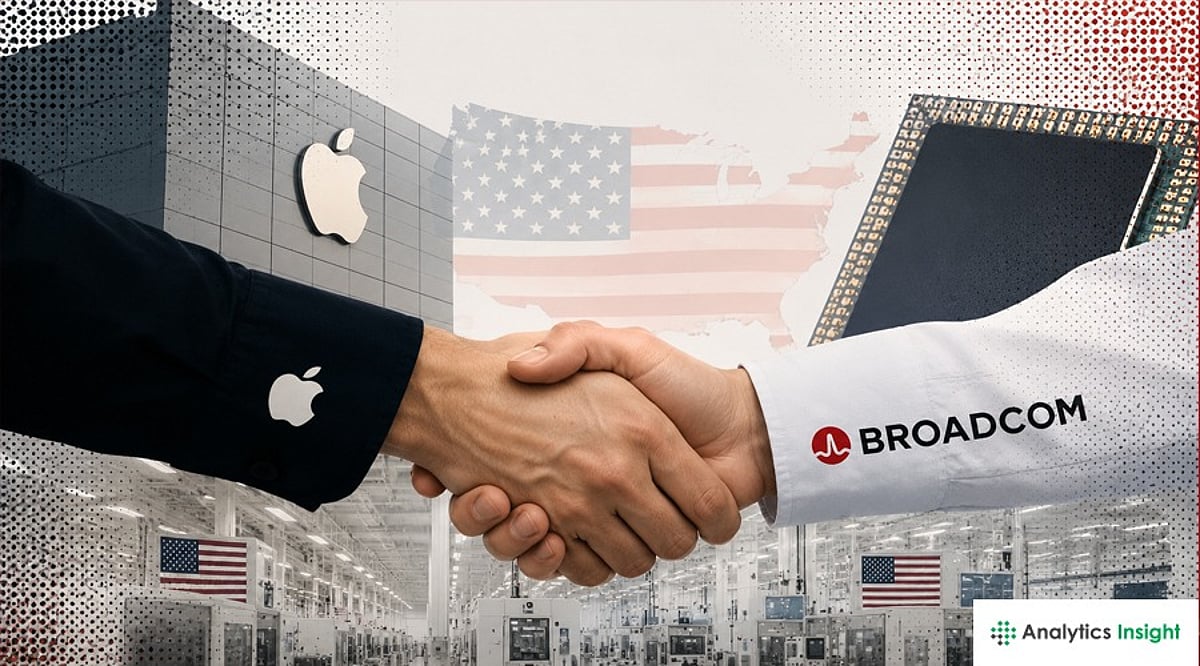
    Apple has signed a multiyear agreement valued at over $30 billion with Broadcom to design and produce custom silicon parts and wireless connectivity chips in the United States through 2031. The deal includes a $1.5 billion expansion of Broadcom’s Fort Collins, Colorado facility, reinforcing Apple’s broader commitment to domestic manufacturing.

    Strategic Partnership Expansion

    The agreement covers advanced radio-frequency components, including FBAR filters, which are critical for wireless communication features in Apple products. This expands a long-standing supplier relationship and secures a larger US-based production path for key components used across Apple’s device lineup.

    Apple expects the collaboration to result in the production of more than 15 billion chips in the United States, supporting hundreds of American jobs tied to chip production and related manufacturing work. This deal is the largest commitment under Apple’s American Manufacturing Program, which aims to increase domestic production and deepen ties with US suppliers.

    Infrastructure Investment

    Broadcom will invest $1.5 billion to expand and modernize its Fort Collins facility, which will produce radio-frequency components and advanced wireless connectivity technologies for Apple devices. Apple CEO Tim Cook stated, “The cutting-edge components built in Fort Collins are essential to delivering the incredible performance and connectivity our customers expect, and we’re proud to deepen our investments in US-based suppliers that share our commitment to excellence and innovation.”

    Hock Tan, President and CEO of Broadcom, added, “Broadcom is proud to continue to work with Apple after decades of success together, and we share a strong commitment to American innovation.”

    Broader US Supply Chain Strategy

    The agreement aligns with Apple’s plan to invest $600 billion in the US economy over four years, covering manufacturing, job creation, supplier growth, and technology development. It also comes amid federal efforts to boost domestic chip production, with the Trump administration urging tech companies to reduce reliance on foreign supply chains.

    Following the announcement, Broadcom shares rose over 4%, while Apple shares dipped slightly, reflecting investor reactions to the expanded supplier role and spending commitments.

  • How Carbon Nanotubes Are Poised to Transform AI Chips, EV Batteries, Healthcare, and Future Tech

    How Carbon Nanotubes Are Poised to Transform AI Chips, EV Batteries, Healthcare, and Future Tech

    Carbon nanotubes are one of the most extraordinary materials ever discovered. Despite being invisible to the naked eye, these tiny carbon structures possess remarkable strength and electrical properties that could reshape entire industries. As production techniques advance, carbon nanotubes are set to enhance AI chips, electric vehicle (EV) batteries, healthcare, and a wide array of future technologies.

    What Makes Carbon Nanotubes Special?

    A carbon nanotube is formed when a thin sheet of carbon atoms rolls into a hollow tube. Some nanotubes consist of a single layer, while others have multiple concentric layers. They are just a few nanometers wide but can grow to several centimeters in length. These structures are incredibly lightweight yet about 100 times stronger than steel on a weight-for-weight basis. They also conduct electricity exceptionally well—some behave like metals, others like semiconductors—and efficiently transfer heat, helping electronic devices stay cool during operation.

    Revolutionizing AI Chip Performance

    Artificial intelligence demands powerful computer chips, and traditional silicon is nearing its physical limits. Smaller silicon chips generate more heat and consume more electricity. Carbon nanotubes offer a solution through transistors that move electricity with minimal resistance, enabling AI chips to operate faster and more efficiently. Their superior heat dissipation also helps chips run cooler, extending lifespan and reducing energy consumption in large data centers. While commercial adoption is still in development, carbon nanotubes are emerging as a leading candidate for next-generation computing.

    Advancing Electric Vehicle Batteries

    In EV batteries, carbon nanotubes don’t replace lithium but significantly improve battery performance. They facilitate better electrical flow, leading to faster charging, increased capacity, and longer cycle life. Because only tiny amounts are needed, more space remains for energy storage, potentially allowing larger batteries without added weight. Carbon nanotubes also stabilize silicon anodes, which can store more energy than traditional graphite anodes, further boosting battery efficiency and durability.

    Transformative Healthcare Applications

    Medicine stands to benefit greatly from carbon nanotubes. They can serve as targeted drug delivery vehicles, carrying medicine directly to diseased cells while sparing healthy tissue and reducing side effects. In cancer treatment, nanotubes absorb near-infrared light and convert it to heat, which can destroy tumors with minimal collateral damage. Additionally, carbon nanotube-based sensors are highly sensitive, enabling early disease detection through tiny changes in the body. Flexible health monitors made from these materials could track heart rate, blood sugar, and other vital signs continuously.

    Remaining Challenges

    Despite their promise, several hurdles must be overcome. High-quality carbon nanotubes remain expensive to produce, and manufacturing methods need to scale while ensuring uniformity. Long-term safety studies are essential before medical applications become routine, and industry-wide quality standards are still being developed.

    The Road Ahead

    Carbon nanotubes are already used in some batteries, electronics, and composite materials. As production improves, their adoption will accelerate. Experts project the global carbon nanotube market will grow from approximately $8.8 billion in 2026 to nearly $24.5 billion by 2034, driven by AI, EVs, healthcare, electronics, and energy storage. Though tiny, carbon nanotubes hold immense potential to power faster AI, smarter medical devices, and more efficient energy systems.

    Frequently Asked Questions

    1. What are carbon nanotubes?

    Carbon nanotubes are minuscule hollow tubes made of carbon atoms. They are extraordinarily strong, lightweight, and excellent conductors of electricity and heat.

    2. Why are carbon nanotubes important for AI chips?

    They enable transistors that switch faster and generate less heat, leading to AI chips that are more powerful and energy-efficient than current silicon-based designs.

    3. How do carbon nanotubes improve EV batteries?

    They enhance electrical conductivity inside the battery, supporting faster charging, higher energy density, and longer lifespan, and also help stabilize advanced anode materials.

    4. Can carbon nanotubes be used in healthcare?

    Yes, research is exploring them for targeted drug delivery, thermal cancer ablation, ultra-sensitive disease detection, and wearable health monitors.

    5. What are the main challenges?

    High production costs, scalability issues, quality control, and rigorous safety testing are the primary barriers to widespread adoption.

  • Today’s Tech Roundup: France Launches Chip Testing Lab, AI Funding Tilts to Deep Tech, Multi-Agent AI Advances

    Today’s Tech Roundup: France Launches Chip Testing Lab, AI Funding Tilts to Deep Tech, Multi-Agent AI Advances

    Welcome to your daily briefing on the most significant developments in technology, startups, and digital innovation. Here’s what you need to know today.

    France Opens Joint Semiconductor Validation Laboratory

    French AI chip company Polyn Technology, in partnership with Alter Technology, has inaugurated a new laboratory in France dedicated to chip validation. The facility will test neuromorphic semiconductors in real-time environments, helping chipmakers accelerate product lifecycles and improve reliability.

    AI Investment Shifts Toward Deep-Tech Infrastructure

    Global AI funding remains robust, but capital is increasingly flowing from consumer AI applications to deep-tech companies building foundational infrastructure for AI, semiconductors, and data centers. Investors are prioritizing computing capacity for future AI workloads over short-term consumer products.

    Campus Hiring Delays Persist in India’s IT Sector

    Engineering graduates continue to face delayed onboarding, postponed joining dates, and even withdrawn offers as major IT firms adjust their recruitment policies amid market shifts.

    UN Blockchain Week 2026 Announces Major Media Partnership

    UN Blockchain Week 2026 has partnered with Crypto. The announcement was made during the 81st UN General Assembly. The collaboration aims to raise awareness of blockchain innovation, digital currencies, and policy, bringing together governments, companies, developers, and investors to advance Web3 technologies.

    Multi-Agent AI Systems Drive Smarter Enterprise Automation

    Multi-agent AI systems enable specialized AI agents to collaborate on complex tasks rather than relying on a single model. This approach enhances decision-making, process automation, scalability, and efficiency, allowing enterprises to manage intricate workflows with greater accuracy and speed.

  • MEXC Expands Tokenized Stock Offerings with Nine New Ondo Trading Pairs Focused on AI Infrastructure

    MEXC Expands Tokenized Stock Offerings with Nine New Ondo Trading Pairs Focused on AI Infrastructure

    Victoria, Seychelles — MEXC, a leading zero-fee digital asset exchange, has announced the addition of nine tokenized stock and ETF trading pairs from Ondo Finance to its spot market. The listings, effective July 8, 2026, expand the range of on-chain U.S. equity exposure available to users, targeting companies involved in data centers, semiconductors, and power supply chains—key sectors driven by rising AI infrastructure demand.

    The new pairs include tokenized versions of stocks and ETFs such as Bloom Energy (BEON/USDT), Astera Labs (ALABON/USDT), Credo Technology (CRDOON/USDT), the Roundhill Memory ETF (DRAMON/USDT), Innodata (INODON/USDT), and Celestica (CLSON/USDT). Full listing times are available in MEXC’s official announcement.

    Ondo Finance specializes in bringing traditional financial assets onto blockchain networks through compliant infrastructure. Each tokenized asset is backed by the underlying security held via regulated custodial brokers. This latest batch further strengthens MEXC’s lineup of tokenized stocks, reinforcing the platform’s commitment to offering “Infinite Opportunities” for its users.

    Beyond Ondo’s products, MEXC also provides “RealStocks,” which allows users to hold actual share ownership and receive dividends. The integrated trading experience enables users to access a wide range of investment products without switching platforms.

    About MEXC
    MEXC is one of the fastest-growing cryptocurrency exchanges globally, trusted by over 40 million users across 170+ markets. It offers industry-leading zero-fee trading and access to more than 3,000 digital assets, including cryptocurrencies, tokenized stocks, ETFs, commodities, and precious metals.

    Risk Disclaimer: This content does not constitute investment advice. The cryptocurrency market is highly volatile; investors should conduct their own research before making any trading decisions.

  • Top 9 Long-Term Growth Stocks to Buy in July 2026

    Top 9 Long-Term Growth Stocks to Buy in July 2026

    Investors seeking stable, long-term growth should consider these nine stocks that are well-positioned for sustained performance across technology, healthcare, and financial services. Each company benefits from strong fundamentals, recurring revenue streams, and exposure to secular trends such as AI, cloud computing, digital payments, and advanced manufacturing.

    1. NVIDIA

    NVIDIA maintains its leadership in AI hardware innovation through advanced GPUs that power data centers, autonomous vehicles, enterprise computing, and AI applications worldwide.

    2. Microsoft

    Microsoft continues to expand its cloud computing and AI software offerings while maintaining robust recurring revenues from enterprise services, supporting long-term shareholder value and consistent growth.

    3. Amazon

    Amazon benefits from e-commerce dominance, AWS cloud leadership, and growing investments in AI, driving sustained revenue and profitability across global markets.

    4. Alphabet

    Alphabet strengthens its digital advertising, cloud computing, and AI platforms while investing aggressively in future technologies, supporting diversified long-term business expansion globally.

    5. Meta Platforms

    Meta Platforms continues to grow advertising revenue while advancing AI infrastructure, smart devices, and immersive technologies for future digital experiences.

    6. Taiwan Semiconductor Manufacturing Company (TSMC)

    TSMC manufactures advanced semiconductor chips that power smartphones, AI servers, automotive technologies, and next-generation computing platforms worldwide.

    7. Eli Lilly

    Eli Lilly strengthens its pharmaceutical leadership through innovative treatments for diabetes, obesity, and neuroscience, supported by expanding global healthcare demand and robust research pipelines.

    8. Visa

    Visa benefits from increasing digital payment adoption and cross-border transactions, along with resilient financial services that support dependable long-term earnings growth across international markets.

    9. Broadcom

    Broadcom delivers semiconductor and infrastructure software solutions while benefiting from accelerating AI networking demand and enterprise digital transformation investments globally.

  • S&P 500 and Nasdaq Rise on Chip Stock Rebound, Dow Slips After Record High

    S&P 500 and Nasdaq Rise on Chip Stock Rebound, Dow Slips After Record High

    U.S. stocks closed mixed on Monday as investors returned from the Independence Day holiday with renewed interest in technology and semiconductor shares. The S&P 500 and Nasdaq Composite advanced, while the Dow Jones Industrial Average slipped after briefly crossing the 53,000 threshold for the first time.

    The market’s focus remained on semiconductor stocks, Federal Reserve meeting minutes, and the start of second-quarter earnings season. Key names watched by traders included Broadcom, Apple, Microsoft, SpaceX, and SK Hynix.

    Chip Stocks Lead Nasdaq and S&P 500 Higher

    The Nasdaq Composite gained approximately 1.1%, while the S&P 500 rose 0.5% in morning trading. The Dow Jones Industrial Average fell 0.3% after briefly touching a fresh intraday record above 53,000. This divergence highlighted a split market, with technology stocks leading gains while some blue-chip names lost ground.

    Chip stocks rebounded after two weak sessions last week. The Philadelphia SE Semiconductor Index surged more than 4%, and the information technology sector led gains on the S&P 500. The recovery helped lift investor sentiment following recent pressure on AI-linked shares.

    Broadcom rose 5.7% after extending its chip supply partnership with Apple through 2031. The deal covers custom chip development and supply, giving investors another reason to return to semiconductor names. Micron Technology, Marvell Technology, Teradyne, Western Digital, and Oracle also gained as AI and data center demand remained in focus.

    Meanwhile, SK Hynix prepared to launch a U.S. listing aimed at raising approximately $28 billion. The offering added more attention to the global AI chip trade. The South Korean memory chipmaker has already drawn strong market interest this year, although its shares have also experienced sharp swings.

    Investors Watch Fed Minutes and Economic Data

    Investors also looked ahead to minutes from the Federal Reserve’s latest policy meeting. The minutes are due Wednesday and will be closely watched after the first meeting led by new Fed Chair Kevin Warsh. Traders have reduced bets on a July rate hike after last week’s cooler jobs report.

    According to CME FedWatch data, traders now see a 24% chance of a 25-basis-point rate hike at the July 29 meeting, down from about 30% a week earlier. The shift came as investors judged whether softer labor data could give the Fed more room to wait.

    The Institute for Supply Management reported that its services index slipped to 54.0 in June, close to market forecasts. The reading indicated that U.S. services activity continued to grow, though at a slightly slower pace. Prices eased but remained high, while employment moved back into growth territory.

    Trade Nation’s senior market analyst, David Morrison, expressed doubt about how much clarity the Fed minutes may offer. “Warsh wants the Fed to concentrate on the data and stick to that and not give any projections,” he said. “So it could be that the minutes don’t really give very much away.”

    Earnings Season and Stock Movers Stay in Focus

    Second-quarter earnings will become a key test for Wall Street later this week. Delta Air Lines and PepsiCo are among the companies expected to report results. Investors are watching whether corporate updates can support the market after strong gains in the major indexes last week.

    Morrison also pointed to uncertainty around the largest technology stocks. “This earnings season is important, given the fact that the Magnificent 7 have had a pretty tough time with things of late,” he said. He added that “just a little bit of good news” could help them resume their rally.

    Microsoft shares fell 1.8% after the company announced it would cut about 4,800 jobs, equal to roughly 2.1% of its workforce. The stock’s decline weighed on sentiment around large-cap technology, even as broader tech shares rose.

    SpaceX gained as investors prepared for its entry into the Nasdaq 100 on Tuesday. The move is expected to drive buying from funds that track the index. Elsewhere, O’Reilly Automotive dropped after reports indicated the company made a cash offer for Genuine Parts’ auto unit.

    Global markets were more muted. European stocks slipped slightly, while Asian markets ended mixed. Japan’s Topix rose, South Korea’s Kospi fell, and Hong Kong’s Hang Seng gained. Oil prices drifted after OPEC+ members agreed to raise output again in August, while U.S. Treasury yields edged lower.

    With the second-quarter earnings season beginning and the Federal Reserve minutes due later this week, investors are expected to look for fresh signals on corporate profitability and the future path of U.S. interest rates, which could shape the market’s next move.