
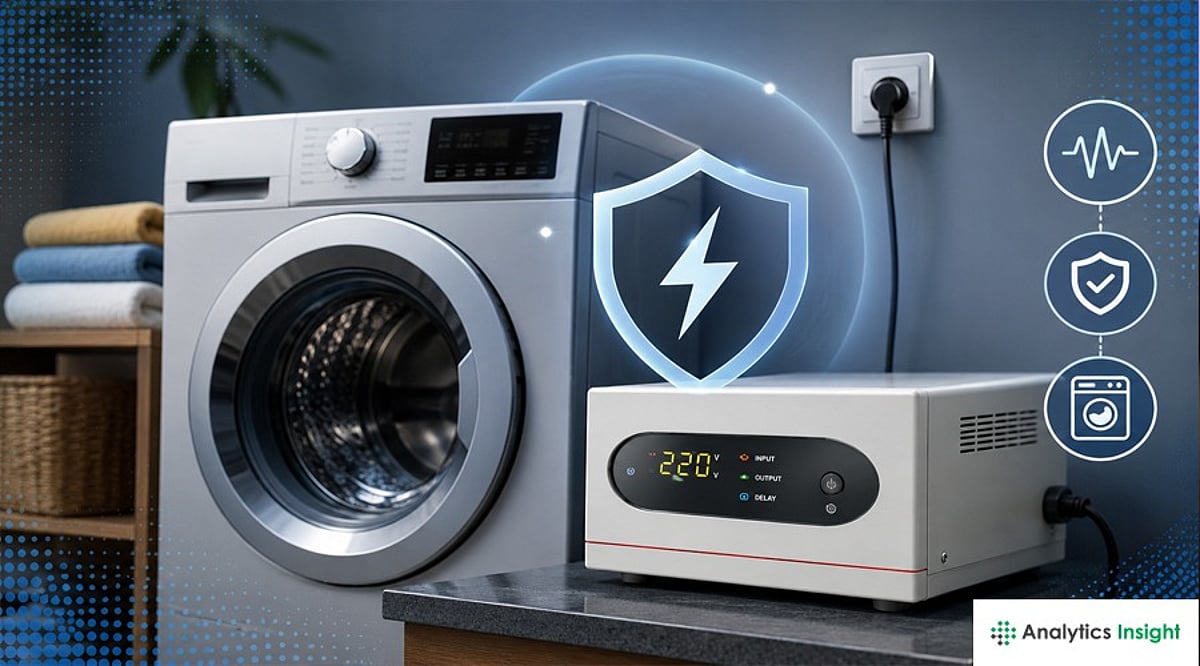
Choosing a washing machine stabilizer involves more than comparing prices or brand names. The right unit should match the appliance’s power requirements and handle local voltage variations effectively. A balanced combination of capacity, working range, and protection features delivers dependable performance over time.
Washing machines with digital control boards and inverter motors are increasingly damaged by unstable voltage in Indian homes, often gradually rather than in one dramatic surge, making a stabilizer a practical protective purchase rather than a luxury add-on. The right stabilizer isn’t about brand recognition. It comes down to three factors: whether the working voltage range actually covers local fluctuation severity, whether the capacity (kVA/amperage) matches the machine’s real load, and whether it uses relay or digital correction and copper or aluminum winding.
Ten specific models across price points (roughly Rs. 1,600–5,000) are compared on these factors, from budget aluminum-wound units for stable-grid homes to wide-range digital models built for rural or older-grid areas with deep voltage drops.
Do You Actually Need One?
Not every home does. Stable 220–240V power with no dimming when appliances start up means a stabilizer sits low on the priority list. It matters more if the area sees frequent brownouts or if the machine is a newer inverter model with a digital control board. Some manufacturer warranties exclude damage caused by unstable voltage, so checking the machine’s own warranty card is worth the five minutes.
How to Choose
- Mild Voltage Fluctuations: Go for a 200–240 V or 150–280 V stabilizer. Good options are the Everest EW-2KVA or V-Guard VM 500.
- Moderate Voltage Fluctuations: Pick a 130–280 V model, like Bluebird or Servokon SKW 213C.
- Severe Rural Voltage Fluctuations: Areas with big power swings need a wide-range stabilizer. The Servokon SKW 290C works well here, since it starts as low as 90 V.
- Check the Appliance Wattage: Before you buy, look at the nameplate on your washing machine. It will tell you the exact wattage you need to match.
- Choose Extra Capacity: Don’t buy a stabilizer that just matches the wattage. Get one rated 25–30% higher. Washing machines draw extra power when they start up, and this buffer keeps the stabilizer safe.
Relay vs Digital, Copper vs Aluminum
Relay stabilizers correct voltage in steps and cost less. A washing machine motor tolerates that fine, unlike a TV panel. Digital units correct faster and more precisely, which helps the most where dips are short and frequent. The price gap is usually small, so digital is the safer default. Copper-wound transformers also run cooler and last longer under sustained load than aluminum, at a modest premium. Aluminum is not a safety compromise, just a durability one, and it is the first place to check if a listing seems cheap for its stated range.
Best Picks Comparison Table
| Model | Operating Range | Capacity | Winding | Type | Approx. Price |
|---|---|---|---|---|---|
| V-Guard VM 500 | 150V–280V | 15A | Copper | Digital | Rs. 2,500 |
| Microtek Pearl EM4160+ | 160V–285V | 2kVA | Copper | Digital | Rs. 3,200 |
| Bluebird BW 213A | 130V–280V | 2kVA | Aluminum | Relay | Rs. 2,000 |
| Bluebird BR 113C | 130V–280V | 1kVA | Copper | Relay | Rs. 1,800 |
| Servokon SKW 213C | 130V–270V | 2kVA | Copper | Digital | Rs. 2,800 |
| Servokon SKW 290C | 90V–270V | 2kVA | Copper | Digital | Rs. 4,500 |
| Rahul V-444 C1 | 100V–280V | 1kVA | Copper | Relay | Rs. 1,600 |
| Everest EW-2KVA | 200V–240V | 2kVA | Aluminum | Relay | Rs. 1,200 |
| Aulten AD019 | 160V–280V | 5000VA | Copper | Digital | Rs. 5,000 |
| Giomex GMX1KV-AL | 150V–280V | 1kVA | Aluminum | Relay | Rs. 1,400 |
Short on Time? The V-Guard VM 500 covers most homes, the Servokon SKW 290C is the better call for severe rural voltage swings, and the Giomex GMX1KV-AL is the pick when budget matters most.
Detailed Reviews
V-Guard VM 500
The V-Guard VM 500 is a popular choice for washing machines, supporting loads up to 15A with a 150V–280V operating range. It includes a three-year warranty, time-delay protection, and digital monitoring, making it suitable for homes experiencing regular voltage fluctuations.
Pros: Wide brand support and service network, 150–280V range covers most urban conditions, 3-year warranty
Cons: Reviews are genuinely mixed, with some buyers reporting weak correction or a cracked casing over time
Microtek Pearl EM4160+
Designed primarily for air conditioners, the Microtek Pearl EM4160+ is also widely used with washing machines thanks to its 160V–285V working range. Its digital display and on-site service support make it a practical option for household appliance protection.
Pros: Digital display, on-site service claim within 24–48 hours, wide 160–285V range
Cons: Built as an AC stabilizer first, and some reviewers report weak correction, so buy from a seller with easy returns
Bluebird BW 213A
The Bluebird BW 213A is a 2kVA aluminum-wound stabilizer with a 130V–280V input range. It offers dependable voltage protection for washing machines while keeping costs affordable, making it a practical mid-range choice for everyday household use.
Pros: Solid 130–280V range, 2kVA capacity, affordable mid-range price
Cons: Aluminum winding runs warmer than copper under sustained load
Bluebird BR 113C
Featuring copper winding and a 1kVA capacity, the Bluebird BR 113C provides better heat dissipation than aluminum alternatives. Its 130V–280V operating range makes it well suited for washing machines in areas with moderate voltage fluctuations.
Pros: Copper winding at a near-budget price, moderate-range coverage
Cons: 1kVA capacity is on the lower side for a heavily loaded appliance
Servokon SKW 213C
The Servokon SKW 213C combines digital voltage correction with copper winding and a 2kVA capacity. Operating between 130V and 270V, it responds quickly to short voltage dips, helping protect modern washing machines from unstable power conditions.
Pros: Digital correction plus copper winding, 2kVA capacity
Cons: Less established brand recognition and service network than V-Guard or Microtek
Servokon SKW 290C
With an extra-wide 90V–270V operating range, the Servokon SKW 290C is ideal for regions experiencing severe voltage drops. Its digital circuitry and copper winding provide reliable protection for washing machines in rural and low-voltage areas.
Pros: Widest working range on this list, digital plus copper build
Cons: Priced above narrower-range models for the capacity most urban homes won’t use
Rahul V-444 C1
The Rahul V-444 C1 is a 1kVA copper-wound relay stabilizer featuring a 100V–280V working range. Its five-step voltage correction offers dependable protection for washing machines while remaining an affordable option for everyday household requirements.
Pros: Copper winding, wide 100–280V range, affordable
Cons: Step-based correction is coarser than fully digital models
Everest EW-2KVA
The Everest EW-2KVA is a basic relay stabilizer designed for homes with relatively stable electricity. Its 200V–240V operating range suits areas with only minor voltage fluctuations, offering reliable protection at an entry-level price.
Pros: Lowest price point on this list, simple and reliable for mild swings
Cons: Narrowest range here, so it cuts off during deeper voltage drops
Aulten AD019
The Aulten AD019 is a 5000VA digital stabilizer designed for households that want one unit to support multiple appliances. Its 160V–280V operating range and high capacity make it suitable for demanding home electrical setups.
Pros: High 5000VA capacity covers washing machine plus microwave or treadmill on one unit
Cons: Oversized and priced accordingly if only used for a washing machine alone
Giomex GMX1KV-AL
The Giomex GMX1KV-AL is a budget-friendly 1kVA aluminum-wound stabilizer operating between 150V and 280V. It delivers dependable voltage protection for washing machines and other small appliances while offering good value for cost-conscious buyers.
Pros: Low price, decent 150–280V range for the cost
Cons: Aluminum winding and 1kVA capacity make it better suited to a second machine than a primary appliance guard
FAQs
- Does a washing machine need a voltage stabilizer? A voltage stabilizer is recommended in areas where power fluctuations are common. It helps protect the washing machine’s electronic components and motor from sudden voltage spikes and drops.
- Which capacity stabilizer is suitable for a washing machine? Most household washing machines work well with a 1kVA to 2kVA stabilizer. Always check the appliance’s power rating and the manufacturer’s recommendations before choosing one.
- Can one stabilizer be used for multiple appliances? Some high-capacity stabilizers are designed to support multiple appliances, but a washing machine performs best with a stabilizer that matches its specific power requirements and load.
- What features should be considered when buying a washing machine stabilizer? Look for a wide input voltage range, adequate capacity, overload protection, auto cut-off, time-delay function, and reliable build quality. These features provide better protection during unstable power conditions.
- Which is better for a washing machine: a relay stabilizer or a digital stabilizer? Relay stabilizers are affordable and suitable for normal household use. In contrast, digital stabilizers offer faster voltage correction and more precise protection, making them a better choice in areas with frequent voltage fluctuations.
Final Thoughts
Choosing a stabilizer is less about buying another appliance and more about protecting the one already in the laundry room. Most failures blamed on the washing machine actually start at the wall socket, in swings small enough to go unnoticed for months. Matching the stabilizer to actual local voltage conditions, rather than defaulting to the most popular listing online, is what decides whether that protection pays off years down the line.
Leave a Reply