
The retail brokerage industry has long operated on a simple model: generate transaction volume, charge for execution, and move on. But as traders and active investors become more sophisticated, the traditional terminal-only relationship is proving insufficient. When the trading session ends, customer funds typically vanish into banking channels, offline accounts, or external payment networks. That fragmentation is exactly what forward-thinking firms are now trying to eliminate.
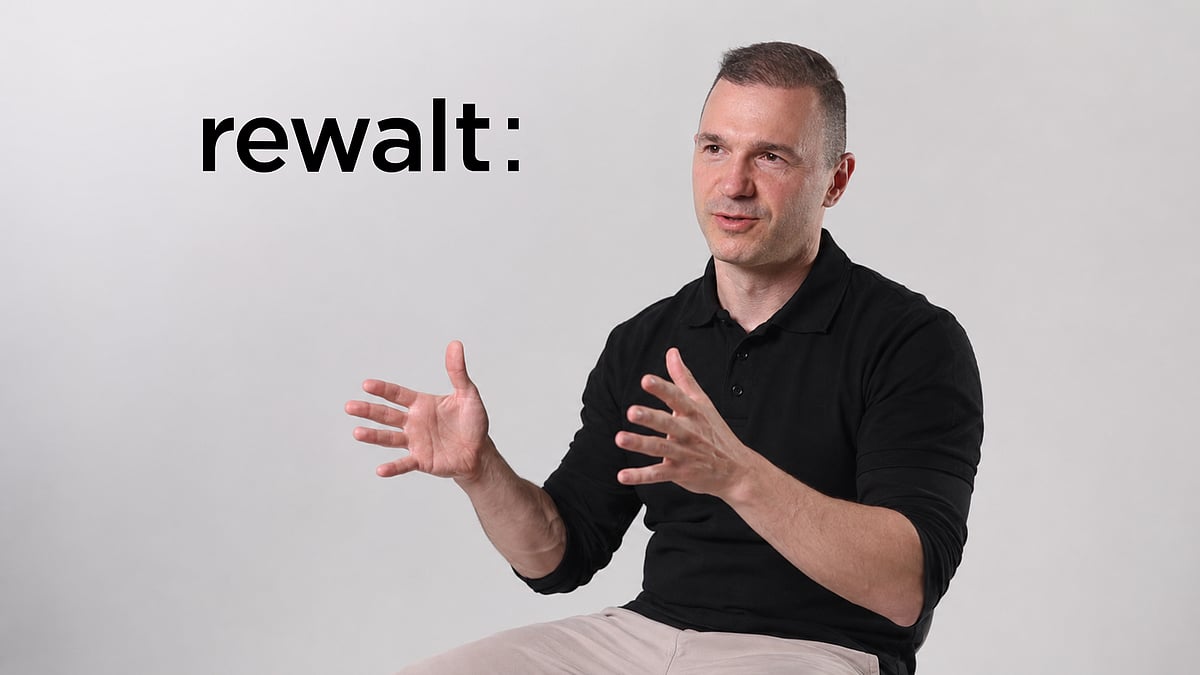
Mikhail Bobkin, Co-Founder and CEO of rewalt:, believes the future lies in treating capital as a continuous journey rather than a series of isolated transactions. “The problem in finance isn’t a lack of products; it’s the walls between them,” he explains. “A typical customer earns money in one place, banks it somewhere else, transfers it to a broker to trade, uses another platform for digital assets, and moves it again when they want to spend it. Every institution controls one part of that journey, with its own incentives, fees, and restrictions.”
Bobkin argues that Rock-West’s evolution into rewalt: is not a departure from its founding principles but a natural extension of them. The company started with fair treatment for traders; now it aims to build infrastructure that lets capital flow naturally between trading, holding, converting, transferring, and spending.
Why Conflict-Free Execution Is the Precondition for Ecosystems
Many financial brands claim to be multi-asset ecosystems, yet their underlying revenue models remain contradictory. When a broker’s profitability depends on aggressive churn or client losses, expanding into payments or card services creates an irreconcilable conflict of interest. A lasting platform, Bobkin stresses, must be built on a pure-agency environment.
“Integration alone doesn’t create an ecosystem,” he says. “A broker can add a card. A bank can add trading. An exchange can add payments. But if every product is driven by conflicting incentives, you’ve simply put several businesses behind one login.”
Rock-West adopted an A-Book philosophy precisely to avoid profiting from customer losses. That alignment becomes even more critical as the company expands beyond brokerage. “If a customer decides not to trade today and instead wants to hold, move, convert, or spend their capital, that shouldn’t be a bad outcome for us,” Bobkin adds. “A customer who doesn’t trade today should still be a valuable customer tomorrow.”
Reimagining the Capital Lifecycle Around the Trader
The classic broker workflow — deposit via card, trade an instrument, withdraw back to a bank — is fundamentally obsolete. Modern participants expect capital to remain active, liquid, and instantly accessible, whether they are pursuing multi-asset exposure, following top strategies through copy trading, or funding daily expenses directly from their trading balance.
“We start with a different question,” Bobkin explains. “Instead of asking, ‘What product can we sell this customer?’ we ask, ‘What is this customer trying to do with their capital?’” The resulting experience is simple: Fund. Trade. Move. Convert. Spend. All within a single platform. “Customers shouldn’t have to rebuild their financial identity every time their money changes purpose,” he says.
Institutional Rigor as a Seamless Customer Experience
Professional financial firms are expected to maintain operational integrity, tier-one liquidity aggregation, and rigorous regulatory oversight. Yet legacy platforms often force customers to confront institutional complexity at the worst possible moment. rewalt: designs its compliance layer to absorb that administrative burden quietly on the server side.
“Regulation isn’t the enemy of customer experience — poor architecture is,” Bobkin asserts. KYC, AML, security, suitability, and sanctions controls exist for good reason. The company’s responsibility is to handle that complexity intelligently without making customers navigate it. “Compliance should create safety; it shouldn’t become the product.”
Fairness Beyond the Closed Position
The brokerage market is approaching an inflection point. Low spreads and fast execution are now baseline expectations, not differentiators. The next competitive frontier is total capital mobility — bringing the same institutional-grade transparency from execution into everyday financial life.
“Our ambition is to make the movement of capital feel more like the movement of information,” Bobkin concludes. Money still lives in silos: banks, brokers, exchanges, wallets, payment processors, and cards all impose their own entry and exit rules. rewalt: wants to reduce those boundaries without sacrificing the safeguards that financial infrastructure requires.
Rock-West started with the belief that customers should be treated fairly when they trade. rewalt: asks the logical next question: Why should that fairness stop when the trade ends?
Leave a Reply