
Artificial intelligence is reshaping the logistics industry, helping organizations move beyond reactive supply chain management toward intelligent, connected, and data-driven operations. As global trade becomes increasingly complex amid geopolitical uncertainty, demand volatility, and evolving customer expectations, AI is enabling businesses to make faster, more informed decisions that improve resilience, efficiency, and operational agility.
The convergence of AI with Digital Twins, predictive analytics, cloud computing, Internet of Things (IoT), and intelligent Control Towers is creating a new generation of supply chains capable of anticipating disruptions before they occur. From demand forecasting and inventory optimization to real-time shipment visibility, network simulation, and proactive risk management, these technologies are helping organizations optimize every stage of planning, execution, and fulfillment while reducing operational costs and improving customer outcomes.
Industry leaders believe the future of logistics lies in connected intelligence, where data flows seamlessly across transportation, warehousing, customs, and fulfillment. By integrating AI-powered insights with digital infrastructure, businesses can move beyond monitoring operations to predicting challenges, automating decisions, and building supply chains that are both resilient and future-ready.
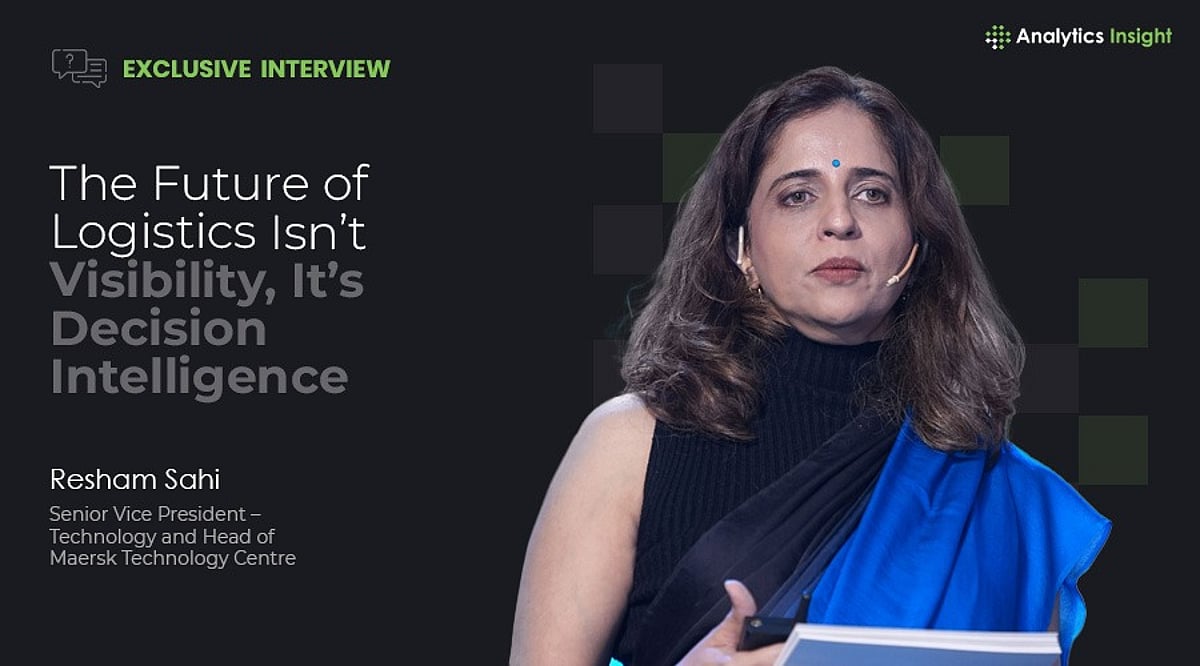
In an exclusive interview with Analytics Insight, Resham Sahi, Senior Vice President – Technology and Head of Maersk Technology Centre, Bangalore, discusses how AI, Digital Twins, predictive analytics, cloud technologies, and intelligent logistics solutions are transforming global supply chains, strengthening operational resilience, and helping Indian businesses build smarter, more connected logistics ecosystems.
From Visibility to Decision Intelligence
According to Sahi, the notable trend is that companies are moving from visibility to decision intelligence. “In today’s environment of demand volatility, geopolitical uncertainty, and evolving trade patterns, resilience increasingly determines how quickly organizations can turn operational data into informed decisions. Companies can generate significant volumes of operational data through their supply chains; however, real value lies in translating data into actionable insights that enable improved planning and execution.”
Through AI, companies are becoming better at forecasting demand, optimizing inventory, improving ETA, and managing exceptions. For example, Digital Twins allow companies to test different scenarios and assess how operational decisions may affect transportation, warehousing, and inventory positioning before changes are implemented in the physical supply chain. Using AI, Digital Twins can predict certain disruptions before they occur, helping make more informed decisions while reducing operational risk.
“The true value comes through integration,” Sahi emphasized. “According to our recent Trade Momentum APAC research, although 74% of companies have operationalized their AI capabilities, only 47% have integrated it with their trade compliance and customs platforms, suggesting that many companies still keep their digital initiatives separate.”
Maersk believes in the connected intelligence future, where decision intelligence will be built across the entire process of planning, execution, and fulfillment.
AI-Powered Control Towers
The function of Control Towers is moving from providing visibility to enabling intelligence, helping organizations move from simply monitoring supply chains to making better decisions. “In today’s environment, it is not enough to know the location of a shipment; it is more valuable to be aware of possible risks and implications and to be able to make a decision based on that information,” Sahi said.
AI-powered Control Towers deliver this by connecting data from all sources—transportation, warehousing, customs, IoT assets, and enterprise systems—into a single view. This information is constantly analyzed through AI, identifying exceptions, forecasting delays, and proposing the optimal next step for operations, such as changing the route, reallocating inventory, or adjusting warehouse capacity.
“The real value of a Control Tower lies not in aggregating more data, but in enabling faster, more confident decisions across the supply chain,” Sahi noted. By bringing together operational insights in real time, organizations can respond proactively to disruptions instead of reacting after they occur.
Digital Twins for Smarter Network Optimization
One of the most significant advantages of Digital Twins is that they can help make better decisions before any changes to the physical logistics network. This is even more important when reacting to disruptions yet to be encountered. For example, using weather data, Digital Twins can identify several vessel berthing options at ports and recommend the best scenarios for maximizing operational efficiency.
“With increasing interconnectivity within our logistics network, we require more confidence in our decisions when it comes to logistics such as inventory positioning, transportation flows and warehouse capacity, and Digital Twins allow us to do scenario planning in a virtual environment,” Sahi explained.
Digital Twins can be transformed from being merely simulation tools into intelligent decision support systems once integrated with AI and operational data. Organizations will be able to run different scenarios of the network, optimize asset use, and spot potential bottlenecks before they affect operations. In line with this, Gartner predicts that by 2027, more than 40% of large enterprises will combine simulation, Digital Twins, and AI to optimize operational processes.
Building Future-Ready Supply Chains in India
The rising importance of India in international manufacturing is contributing to the increasing requirement for intelligent and interconnected supply chains. As per the Economic Survey 2025-26, Manufacturing GVA increased by 7.72% in Q1 and 9.13% in Q2 of FY26, highlighting the country’s industrial strength. As businesses diversify supply chains and expand their participation in global value chains, logistics is becoming a strategic enabler of growth rather than simply a support function.
At Maersk, the company is helping customers connect transportation, warehousing, customs, and fulfillment through integrated digital solutions. AI, cloud, and IoT strengthen that connected ecosystem by improving visibility, planning, and execution across the logistics journey. Cloud-based platforms enable customers to unify transportation, warehousing, customs, and fulfillment into one cohesive digital platform, making faster, better decisions possible.
“AI represents a once-in-an-era shift that can tackle complex problems, provide faster insights, enable proactive, data-driven decisions, and drive effective execution,” Sahi said. “We are putting AI to use by streamlining how frontline teams serve customers by reducing complexity, redesigning workflows, and improving customer access to insights.”
At the end of the day, Maersk’s focus is on helping customers build connected and resilient supply chains by integrating data across every stage of the logistics journey, rather than optimizing individual functions in isolation. This will help both Maersk and its customers improve cost efficiency, reliability, and outcomes.
Leave a Reply