
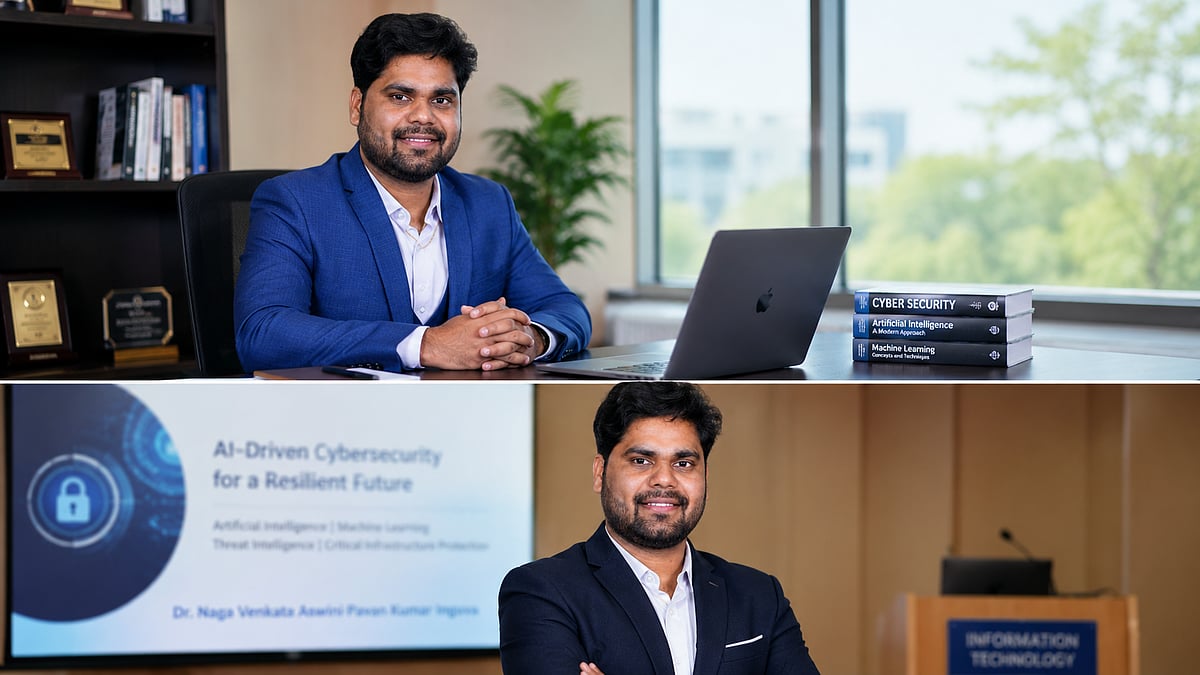
For most public institutions, cybersecurity follows a predictable sequence: an incident occurs, a tool detects it, an alert is generated, and a team responds. According to Dr. Naga Venkata Aswini Pavan Kumar Inguva, a researcher and senior software developer at a U.S. state government agency, that order fundamentally puts organizations behind attackers from the start.
Inguva argues that while this reactive approach may work for private companies, the stakes are far higher for public utilities such as water systems, hospitals, transit authorities, and power grids. In these sectors, a breach doesn’t just cost data or money; it disrupts essential services that people rely on with no alternative. He believes cybersecurity must move beyond rapid response toward anticipation.
To address this, Inguva developed a conceptual framework for AI-driven predictive cyber threat intelligence. Unlike traditional detection systems that look for known attack patterns, his framework emphasizes contextual analysis—understanding the sequence and relationships between events to predict where an attack is heading. The research, which is a structured foundation rather than a deployed product, focuses on enterprise and critical infrastructure environments. It analyzes which machine learning techniques are genuinely applicable to threat prediction and provides recommendations for implementation.
Public institutions, Inguva notes, present the hardest case: they often run aging technology, operate under tight budgets, and carry obligations private firms don’t. Their security spending tends to focus on monitoring, which produces volume but not foresight. His prescription is for a proactive, intelligence-driven, and context-aware posture paired with secure architecture, continuous monitoring, employee awareness, and proactive risk management.
Inguva emphasizes that this is not solely a technical challenge. Protecting critical infrastructure requires shared responsibility across researchers, industry, and policymakers. His broader research record includes published work on generative adversarial networks, deep learning for threat detection, and machine learning for attack classification, some of which earned best paper awards. He is also a published author and co-founder of Thaapasi Smart Infratech Pvt. Ltd.
Looking ahead, Inguva expects advances in artificial intelligence, graph analytics, threat intelligence, and automation to help organizations recognize attack progression earlier and prioritize genuine threats. But he stresses that these tools will not eliminate the need for skilled personnel, sound governance, and continuous learning.
The core idea is a shift in sequence: a system built to react will always answer the attacker’s question first. Changing that order, Inguva argues, is the work worth doing.
Leave a Reply