
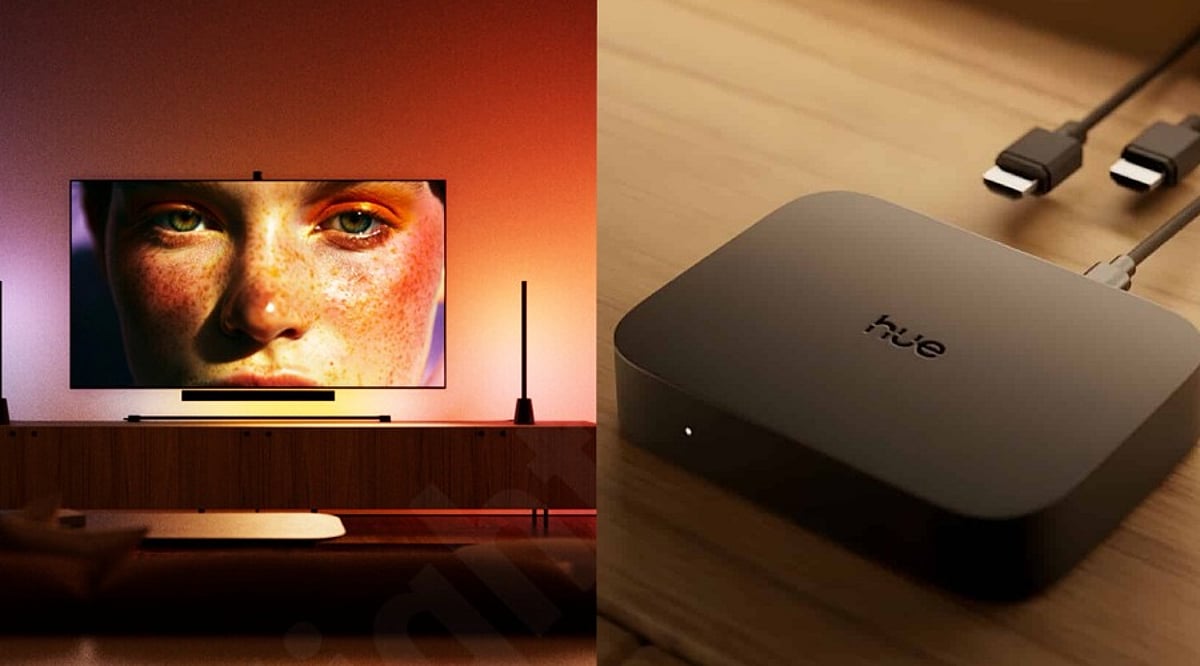
Philips Hue has introduced the Play Screen Sync, a camera-based device that synchronizes smart lighting with TV content without requiring an HDMI connection. By using a fisheye lens and real-time image analysis, the system reads the screen directly, allowing it to work with virtually any video source — including built-in streaming apps, broadcast TV, games, and external HDMI devices.
How the Camera Replaces HDMI
Traditional HDMI sync boxes can only process video that passes through their input, which means they cannot detect content from smart TV apps or built-in tuners. The Play Screen Sync overcomes this limitation by placing a small camera near the TV that captures the entire display. After automatic calibration, the system continuously analyzes the picture and sends matching color data to compatible Hue lights placed around the television.
AI’s Role in the System
It’s important to note that the Play Screen Sync relies primarily on camera vision, calibration, and image analysis rather than artificial intelligence. Philips Hue offers a separate AI feature called Custom AI Behaviors, which allows Bridge Pro users to describe lighting routines in natural language. That feature handles smart-home automation, while Screen Sync focuses solely on matching TV content with light colors.
Simplified Setup and Cost Benefits
A single Hue Play gradient TV strip can connect to the Play Screen Sync over Bluetooth without needing a Hue Bridge, lowering the entry barrier. The same option is available with the new Play HDMI Sync Box 4K, which costs $149.99 and supports 4K at 60Hz. The Play Screen Sync itself is priced at $119.99. A full system can support up to 10 lights for a surround effect.
Trade-Offs: Camera vs. HDMI Sync
While the camera method offers broader source compatibility, HDMI sync boxes can provide lower latency because they receive the digital video signal before it reaches the screen. The camera must capture the image, process it, and then control the lights — a process that can introduce a slight delay and is more sensitive to screen reflections and camera placement. For fast-paced gaming, HDMI sync may be preferable; for films, shows, and TV apps, the camera’s versatility is a clear advantage.
Wider Ecosystem Updates
The launch of Play Screen Sync is part of a larger Hue refresh that includes new cuttable Play gradient strips, cloud backup, Sonos control via Hue switches, and support for Nanoleaf Shapes through a new Hue Wall Light Module. This shift marks a move away from relying solely on HDMI hardware for screen-based lighting effects, making the system more accessible for households that primarily use smart TV apps.
Key Takeaways
- Camera-based syncing reads the TV display directly, working with almost any video source.
- More flexible setups: built-in streaming apps and broadcast TV can trigger Hue lighting without an HDMI sync box.
- HDMI syncing offers lower latency; camera-based syncing provides broader compatibility.
Leave a Reply