Tag: digital assets

  • Crypto Privacy Tools Can Bolster Both Security and Compliance, New Report Reveals

    Crypto Privacy Tools Can Bolster Both Security and Compliance, New Report Reveals

    For years, mainstream crypto design prioritized absolute on-chain transparency, treating financial privacy as a liability rather than a necessity. A new joint report by digital asset management and crypto loan provider CoinRabbit and crypto super app ChangeNOW challenges that assumption, concluding that public ledgers create dangerous privacy leaks for businesses and physical safety risks for individual holders.

    Presented by Decrypt, Financial Privacy in the Digital Age synthesizes data from TRM Labs, Chainalysis, CertiK, and Statista to make a pragmatic case: Web3 privacy tools are essential infrastructure for basic security, while law enforcement leverage actually sits at regulated fiat gateways, not upstream transaction histories.

    Key Highlights

    • $124.1M lost to physical attacks. Public wallet addresses act as unintended net-worth registries, exposing investors to targeted extortion and social engineering.
    • Corporate vulnerabilities & $4.44M breach costs. Transparent ledgers allow competitors to reconstruct vendor contracts, payroll, and treasury balances, impacting the 36% of board members who consider internal data exposure their top operational threat.
    • Enforcement targets gateways, not on-chain history. Authorities combat illicit flows at centralized fiat off-ramps, exchange KYC databases, and stablecoin issuer freezes rather than through continuous public surveillance.
    • Privacy tools already operating within compliance. The report highlights CoinRabbit’s custodial model and ChangeNOW’s private crypto transfers as benchmarks for privacy-preserving infrastructure.

    The Corporate and Personal Risks of Open Ledgers

    While permanent ledger visibility makes protocol audits efficient, it presents severe liabilities for mainstream business adoption. Unlike traditional bank accounts, public blockchain addresses broadcast complete cash flows and account balances to anyone with an internet connection. Competitors can easily monitor corporate wallets to deduce profit margins, supplier pricing, and internal payroll cadence. With Statista estimating average data breach costs at $4.44 million, broad ledger exposure creates a structural weakness for corporate treasuries moving on-chain.

    For private investors, that visibility carries physical consequences. “Public blockchain transparency lets anyone audit your net worth in real time, turning private wealth into public information,” said Walter Barrett, Chief Strategy & Growth Officer at CoinRabbit.

    The security data back up that warning. CertiK recorded 52 verified physical extortion (“wrench”) attacks in the first half of 2026. In France, which accounted for 33 of those incidents, breaches at public agencies allowed criminal networks to cross-reference residential addresses with suspected crypto holdings. In response, 30% of surveyed high-net-worth holders now hire data-broker removal services to break the link between their identities and wallet addresses.

    How Investigators Track Illicit Capital

    Skeptics often frame financial privacy as an enclave for illicit finance, pointing to TRM Labs data that places 2025 illicit crypto inflows at $158 billion, with Chinese-language laundering networks accounting for over $100 billion. However, investigative data shows that raw ledger transparency is rarely the decisive factor in asset recovery or criminal attribution. Instead, law enforcement leverage is concentrated at centralized touchpoints: exchange KYC registries, court subpoenas, stablecoin blacklist functions, and fiat off-ramps.

    “Successful blockchain investigations rely on the combination of on-chain analysis, behavioral patterns, KYC information, exchange cooperation, stablecoin issuer interventions, and traditional investigative methods. In practice, attribution is achieved by connecting multiple sources of evidence rather than relying on blockchain transparency alone,” noted Albert Quehenberger, founder of AQ Forensics.

    Because enforcement operates primarily at these regulated checkpoints, the authors argue that base-layer privacy tools can protect legitimate user data without disabling the mechanisms authorities use to police market abuse.

    Rethinking Financial Transparency in Web3

    The report calls for a fundamental redesign of Web3 architecture, urging developers to replace mandatory public broadcasting with permissioned, selective disclosure. “The privacy debate starts from the wrong assumption that ordinary users must prove they have nothing to hide by exposing everything,” said Pauline Shangett, Chief Strategy Officer at ChangeNOW. “That is not how any mature financial system works.”

    Yet as crypto pushes for institutional adoption, this tension between default visibility and basic confidentiality remains one of Web3’s thorniest policy battlegrounds. While developers press for selective disclosure tools to protect commercial secrets, global regulators continue to push for tighter oversight of self-custodial flows. How the industry resolves that pushback will determine whether digital assets can offer a viable financial infrastructure for traditional finance, or whether privacy and compliance remain locked in an ongoing tug-of-war.

    Disclaimer: This article is for informational purposes only and does not constitute financial or investment advice. Cryptocurrencies are risky assets; always conduct your own research before investing.


  • Top Crypto Wallets by User Base: How Millions Manage Digital Assets

    Top Crypto Wallets by User Base: How Millions Manage Digital Assets

    Crypto wallets are essential tools that allow users to store, send, and receive digital assets securely. As cryptocurrency adoption grows, these wallets are becoming more accessible and user-friendly, enabling millions of people worldwide to manage their investments and participate in decentralized finance (DeFi) and Web3 ecosystems.

    Binance Wallet

    Integrated into the Binance exchange, this wallet serves millions globally, providing easy access to trading, DeFi services, and comprehensive digital asset management.

    MetaMask

    MetaMask remains one of the most popular Ethereum wallets, allowing users to connect seamlessly with decentralized applications (dApps), NFTs, tokens, and blockchain-based financial platforms.

    Trust Wallet

    Trust Wallet supports thousands of cryptocurrencies across multiple blockchains, giving users full control over their assets with strong built-in security features.

    Coinbase Wallet

    Coinbase Wallet offers self-custody storage, enabling users to manage cryptocurrencies, NFTs, and dApps without relying on centralized exchanges.

    Phantom Wallet

    Originally built for Solana, Phantom now supports multiple blockchain networks, making token management, staking, and NFT trading fast and convenient.

    OKX Wallet

    OKX Wallet provides multi-chain compatibility, allowing users to access DeFi, swap tokens, and explore Web3 applications through a single platform.

    Ledger Live

    Ledger Live works with Ledger hardware wallets, combining offline cold storage with an intuitive interface for securely managing digital assets and staking.

    Why Wallets Matter

    Crypto wallets continue to grow in importance as blockchain adoption increases. They help millions of people safely manage investments, digital collectibles, and decentralized financial opportunities worldwide.

  • Age-Based Crypto Adoption: Which Generations Are Investing in Digital Assets?

    Age-Based Crypto Adoption: Which Generations Are Investing in Digital Assets?

    Cryptocurrency adoption varies significantly across age groups, with each generation approaching digital assets differently. Here’s a breakdown of how different demographics are engaging with crypto.

    Gen Z (18–27)

    Young investors are drawn to cryptocurrency for its innovative potential, long-term growth prospects, and decentralized finance opportunities. They are early adopters of new blockchain technologies and platforms.

    Millennials (28–43)

    Millennials remain the largest group of crypto investors, using digital assets as a tool for wealth creation and portfolio diversification. They are comfortable with technology and seek alternatives to traditional investments.

    Gen X (44–59)

    Gen X investors are increasingly viewing Bitcoin and major cryptocurrencies as alternative investment assets. They tend to be more cautious but recognize the potential for long-term value.

    Baby Boomers (60–78)

    Older investors are cautiously entering the crypto space through ETFs and regulated investment platforms. They prefer lower-risk exposure to digital assets.

    Institutional Investors

    Professional fund managers continue to increase their crypto exposure through regulated financial products, signaling growing mainstream acceptance.

    High-Net-Worth Individuals

    Wealthy investors are allocating portions of their portfolios to Bitcoin and blockchain-based assets as a hedge and diversification strategy.

    Retail Investors

    Easy-to-use exchanges and mobile apps have made crypto investing more accessible than ever, attracting a broad range of individual investors.

    Emerging Markets

    Younger populations in developing countries increasingly use crypto for payments and financial access, bypassing traditional banking infrastructure.

  • Ex-FBI Agent Charged in Alleged $1M Cryptocurrency Theft From Investigative Wallets

    Ex-FBI Agent Charged in Alleged $1M Cryptocurrency Theft From Investigative Wallets

    A former FBI supervisory special agent has been arrested and charged with stealing nearly $1 million in cryptocurrency using access obtained through a national security investigation. The case has sent shockwaves through the law enforcement and crypto communities, raising serious questions about insider abuse of sensitive investigative tools.

    Who Is Patrick Yaroch?

    Patrick Steven Yaroch previously served as a supervisory special agent in the FBI’s Counterintelligence and Espionage Division and also worked in the bureau’s Boston office. His role granted him access to sensitive information about cryptocurrency accounts that were being monitored as part of national security investigations.

    According to court records, Yaroch told a Justice Department employee that he was frustrated the FBI “could not or would not act against adversarial cryptocurrency accounts.” He reportedly said he was upset that he couldn’t do more to disrupt cryptocurrency use by an adversarial nation during an investigation.

    In an FBI affidavit, Yaroch admitted to making “some very poor decisions” and said he “went into FBI systems and found keys needed to transfer money from wallets to himself.”

    How Was the Crypto Allegedly Stolen?

    Court documents allege that Yaroch set up a personal cryptocurrency wallet in late 2024 and obtained passphrases and other wallet-access information through FBI databases. He allegedly completed between 10 and 12 transfers beginning in late 2024 or early 2025, moving digital assets into wallets under his control.

    Federal agents later searched Yaroch’s home in Ashburn, Virginia, where they recovered devices, a hardware wallet, and handwritten notes believed to contain cryptocurrency seed phrases. Authorities eventually transferred approximately $925,000 in cryptocurrency from accounts under his control into government-controlled wallets.

    Plans to Manage the Funds

    Investigators also found conversations on Yaroch’s phone in which he explored ways to invest or manage around $1 million and considered relocating overseas. Recovered records reportedly included material connected to Portugal and plans for international travel.

    An FBI spokesperson said: “The individual has since been fired from the Bureau. We hold our employees to the highest ethical standards, and this conduct is not tolerated at the FBI. We are conducting a thorough investigation in the aftermath, and as this is an ongoing matter, we will have no further comment.”

    Federal Charges and Next Steps

    Authorities said Yaroch eventually disclosed his actions to a former colleague and contacted government officials about his conduct. He now faces federal charges related to interstate transportation of stolen property and receipt of stolen property. The allegations remain unproven, and the criminal case is ongoing.

  • Senate Majority Leader Thune Anticipates CLARITY Act Vote, but No Date Set

    Senate Majority Leader Thune Anticipates CLARITY Act Vote, but No Date Set

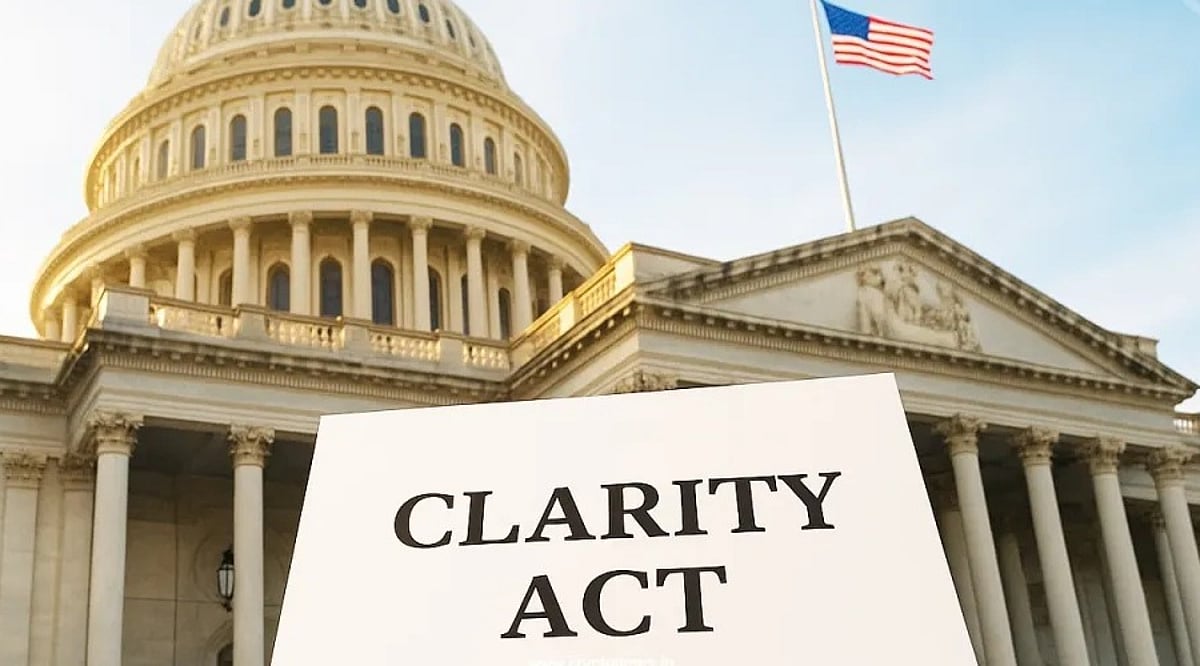
    Senate Majority Leader John Thune expects an initial CLARITY Act vote before the summer recess, but no vote appears on the Senate schedule. His August 3 remarks left unclear whether senators will begin full debate or take only an early procedural step.

    Thune Signals Intent Without a Firm Date

    Thune told reporters, “I think market structure we’ll get a vote on. Whether we can get on it or not, we’ll see.” He also cited other unfinished Senate business. The August 4 agenda did not name the CLARITY Act. Instead, the Senate planned to resume consideration of H.R. 6500, a vehicle for a continuing resolution. The floor log said, “There are no votes scheduled at this time.”

    Leaders can still add votes after filing a motion, reaching an agreement, or securing enough support. Still, Thune did not identify whether he expected cloture, a motion to proceed, or another procedural action.

    Procedural Vote Doesn’t Equal Passage

    Most legislation requires 60 senators to end extended debate under cloture rules. A successful vote would move the bill forward, but senators could still face amendments and further procedural votes before the final passage. The House passed the CLARITY Act by 294–134 in July 2025. The Senate Banking Committee later advanced its version by 15–9 on May 14, 2026.

    These bipartisan results offer a base for negotiations. However, Republicans cannot reach the usual cloture threshold independently, so Thune needs Democratic votes while retaining concerned Republicans. Can Senate leaders resolve the disputes quickly enough to secure 60 votes and preserve enough floor time for final passage? The current schedule provides no firm answer.

    Ethics Disputes Complicate the Recess Push

    Ethics rules remain a major obstacle. Eleanor Terrett reported on August 3 that the White House had not answered a counterproposal from Senators Thom Tillis and Ruben Gallego. Terrett cited an unnamed source, not a public White House statement. The proposal reportedly covers enforcement and may give state attorneys general a role.

    A Reuters review found that the Senate proposal would restrict certain senior figures, including the president and vice president, from sponsoring or issuing digital assets. Justice Department enforcement would apply until January 2029.

    Meanwhile, seven Democratic negotiators said the proposal was not ready for passage. Catherine Cortez Masto, Angela Alsobrooks, Cory Booker, Ruben Gallego, John Hickenlooper, Mark Warner and Raphael Warnock requested further changes.

    Their concerns cover ethics, consumer protection, illicit finance, conflicts of interest and market integrity. They also pledged to continue talks, leaving a bipartisan agreement possible but unresolved. Bernstein analysts said passage before recess looked less likely. That view can coexist with Thune’s comments because an opening vote may occur without enough time for debate and final passage.

    Government funding also competes for attention. On July 21, Thune called market-structure legislation only ‘a candidate for consideration’ and described funding as the Senate’s leading immediate priority.

    The CLARITY Act would divide digital-asset oversight between the SEC and CFTC. It also addresses fundraising, exchange registration, anti-money-laundering rules, decentralized finance, stablecoin rewards and tokenized securities. The next concrete signal would come from an updated Senate schedule or a formal motion. A cloture filing or motion to proceed would provide clearer evidence that floor action had begun.

    A Brief Roundup

    Thune expects an initial vote on the CLARITY Act, but the Senate has yet to schedule one. Ethics negotiations, the 60-vote cloture hurdle and competing funding work still threaten full passage before recess. Readers should watch for a cloture filing, motion to proceed, or updated floor schedule.

  • Crypto Wallets Evolve: BloFin Wallet Adds Perpetual Futures, Yield Products, and Visa Payments

    Crypto Wallets Evolve: BloFin Wallet Adds Perpetual Futures, Yield Products, and Visa Payments

    Crypto wallets are moving beyond simple storage. BloFin Wallet now combines perpetual futures, yield products, and a Visa payment card, reflecting growing demand for platforms that unite self-custody, trading, earnings, and daily spending in one interface.

    BloFin Extends Wallet Services Beyond Storage

    Users can trade perpetual contracts linked to more than 100 digital and traditional financial assets through BloFin Wallet, eliminating the need for a separate derivatives exchange. The wallet maintains user control through self-custody, while its yield products allow asset storage and earnings within the same environment.

    BloFin’s Visa card connects supported digital assets with everyday retail payments. It works wherever Visa is accepted and supports both Apple Pay and Google Pay.

    Together, these services cover four common activities: storing, trading, earning, and spending. This structure reduces the number of applications required to manage a digital asset portfolio.

    Crypto Platforms Target a Unified User Experience

    Historically, crypto users relied on separate services for storage, trading, lending, and payments, often moving assets repeatedly between wallets, exchanges, and DeFi protocols. Each transfer added network fees, settlement time, and security considerations. It also created more steps for users moving from market activity to savings or spending.

    Now, exchanges and wallet providers combine spot trading, derivatives, staking, lending, payment services, and DeFi access. Some platforms include tokenized financial products. The sector’s current direction centers on reducing fragmentation through integrated services, responding to demand for smoother financial tools rather than isolated applications.

    Payments and Capital Efficiency Shape Competition

    Unified platforms can improve capital efficiency because users keep assets within one environment. They can trade, seek yield, or make purchases without repeated blockchain transfers. This approach reduces operational friction, as funds remain available for different uses without moving through several networks and service providers.

    Payment cards extend crypto services beyond market activity and long-term holding. Visa and Mastercard partnerships connect digital asset balances with established payment networks and retail systems. Stablecoins may support this connection by reducing price volatility during payments, and their blockchain settlement features fit platforms combining digital assets with daily transactions.

    Meanwhile, wallet providers continue expanding into derivatives, DeFi, and tokenized assets. Competition now centers on which platforms can offer the smoothest digital asset lifecycle through one interface.

    Conclusion

    Crypto wallet providers are combining self-custody, perpetual futures, yield products, and payment cards to reduce transfers between services. BloFin Wallet reflects this shift through integrated trading and Visa spending. Users now face a market where platforms compete across the full digital asset lifecycle.

  • Eole Becomes First Listed Japanese Firm to Disclose Corporate HYPE Purchase Under Neo Crypto Bank Plan

    Eole Becomes First Listed Japanese Firm to Disclose Corporate HYPE Purchase Under Neo Crypto Bank Plan

    Tokyo-listed Eole Inc. has made Japan’s first publicly disclosed corporate purchase of HYPE, the native token of the Hyperliquid blockchain. The company bought 1,078 HYPE on July 28 for approximately $66,002 (¥10.08 million), paying an average of $57.15 (¥9,352) per token. The acquisition marks a strategic expansion beyond bitcoin as part of Eole’s broader Neo Crypto Bank initiative.

    Phased Allocation Toward ¥100 Million Target

    Eole plans to increase its HYPE holdings through multiple purchases through August, aiming for a total allocation of ¥100 million (approximately $611,113). The phased approach avoids a single large transaction and spreads market exposure over several weeks.

    HYPE as a Strategic Asset for On-Chain Finance

    Under its Neo Crypto Bank strategy—launched in October 2025—Eole will hold HYPE alongside bitcoin to build financial infrastructure for an economy where AI agents can execute payments and contracts autonomously. The company views the token not solely as an investment for capital gains but as a operational asset to support its on-chain finance and Web3 operations.

    Lending, Hedging, and Smart Contract Integration

    Eole is exploring revenue generation through digital asset lending and plans to hedge price risks via traditional financial markets. The company will also integrate its crypto holdings with its own services, moving beyond a single cryptocurrency toward automated finance powered by smart contracts.

  • Thai SEC Files Criminal Charges Against Bitkub Over Concealed $47 Million Hack Losses

    Thai SEC Files Criminal Charges Against Bitkub Over Concealed $47 Million Hack Losses

    Thailand’s Securities and Exchange Commission has filed a criminal complaint against cryptocurrency exchange Bitkub and two former directors, alleging they concealed losses from a $47 million hack in 2021. The regulator claims the exchange submitted false capital reports that hid the theft of 16 digital assets worth 1.7 billion baht from May through October 2021.

    The SEC alleges that former directors Sakolkorn Sakavee and Thaweesap Rawan made false entries suggesting customer holdings remained intact, violating Thailand’s Digital Asset Business Decree. The complaint has been forwarded to the Economic Crime Suppression Division, which will review the evidence and decide whether to pursue criminal charges.

    Bitkub responded by stating that the complaint concerns a reporting decision made five years ago, emphasizing that customer funds were never at risk. According to the exchange, the decision to withhold the theft was made to prevent panic withdrawals and a potential bank run. The co-founders personally replaced every stolen asset from their own funds, ensuring no client suffered a loss.

    Sakolkorn accepted sole responsibility in a Facebook video, translated by Bangkok Post, admitting he altered the filings without informing other directors or staff. He apologized, resigned from company boards, and pledged to cooperate with authorities. He also confirmed that the founders had repaid all customers in full.

    The case emerges as Thailand expands its cryptocurrency oversight. The Bank of Thailand and the SEC are now examining large stablecoin transfers, particularly Tether’s USDT, using data tools to identify reporting gaps. Regulators have also increased scrutiny of large cash movements, gold transactions, and bank accounts linked to online gambling as part of broader anti-money laundering efforts.

    Additionally, Thailand has approved cryptocurrencies as eligible underlying assets under its Derivatives Trading Act, allowing regulated futures and options to reference assets like Bitcoin. The SEC is now drafting licensing rules and contract standards, and has proposed allowing digital asset firms to obtain derivatives licenses through a single entity rather than separate companies. SEC Secretary-General Pornanong Budsaratragoon stated the proposal aims to support crypto as an investment asset class while ensuring suitable investor safeguards.

    Meanwhile, Bitkub continues to explore a public listing after abandoning a planned Thai IPO in November 2025 and considering a $200 million Hong Kong offering. Binance TH has overtaken Bitkub in global exchange rankings, with CoinMarketCap placing Binance TH at 31st and Bitkub at 68th.