Tag: generative AI

  • AI as the Default Operating Layer: Pinnacle’s Bimal Patwari on the Future of AEC

    AI as the Default Operating Layer: Pinnacle’s Bimal Patwari on the Future of AEC

    Artificial intelligence is steadily reshaping the Architecture, Engineering, and Construction (AEC) industry, driving automation across design, engineering, documentation, quality control, and project management. While AI adoption on construction sites remains relatively slow, organizations are increasingly integrating intelligent technologies into design workflows, compliance, digital twins, and engineering processes to improve productivity, accuracy, and collaboration.

    As the industry moves beyond experimentation, AI is expected to connect the entire project lifecycle—from design and engineering to construction execution and facility management—creating a unified digital thread powered by predictive intelligence and automation. The convergence of AI, Digital Twins, and cloud-based collaboration is set to redefine how infrastructure projects are planned, delivered, and managed.

    Bimal Patwari, Founder and CEO of Pinnacle, believes AI should augment engineering expertise rather than replace it. He says successful AI adoption depends as much on organizational culture, digital maturity, and workforce readiness as it does on technology. According to him, companies that invest in structured digital foundations and continuous upskilling today will lead the next generation of AI-driven construction.

    In an exclusive interview with Analytics Insight, Patwari discusses AI adoption in the AEC industry, Digital Twins, generative AI, workforce transformation, enterprise-wide AI implementation, and how Pinnacle is building intelligent engineering and construction workflows. Here are the excerpts from the interview:

    How is AI Adoption Transforming the AEC Industry and What’s Driving its Rapid Growth?

    Overall, automation and AI adoption within the AEC industry remains relatively slow, but the picture varies sharply across the project lifecycle. On the design and engineering side, the pace has somewhat accelerated: major design software providers are now building native AI compatibility into their platforms, particularly through MCP connectors, and leading design and engineering firms are embedding automation and AI into design, modeling, coordination, and documentation workflows as a matter of course. Construction execution, however, tells a very different story: adoption remains markedly slower, with much of the industry still reliant on conventional, manual site processes. This is where the sector’s real digital transformation gap lies.

    At Pinnacle Future Build, closing this gap is a deliberate priority; we see it as the next frontier for AI-driven impact in AEC, not a peripheral concern.

    The AEC Sector has Traditionally Relied on Manual Processes and Legacy Systems. What are the Biggest Barriers Organizations Still Face in Adopting AI at Scale, and How Can They Overcome Them?

    The biggest barriers are rarely technological; they are structural: legacy data trapped in siloed formats, inconsistent standards across teams, and a workforce accustomed to manual sequencing.

    Organizations can overcome this by treating AI adoption as a change-management program, not an IT rollout, pairing every tool deployment with training, clear governance, and visible leadership sponsorship. We addressed this at PFB through a phased, center-by-center rollout with dedicated trial teams, rather than a single enterprise-wide switch.

    At Pinnacle Future Build, our focus on AI implementation extends well beyond BIM modeling alone into the automation of design workflows, AI-led QC verification processes, AI-led design documentation, code compliance reviews, automated engineering design calculations, and AI-led project management practices. Closing the design-to-construction adoption gap is a deliberate priority for us; we see it as the next frontier for AI-driven impact in AEC, not a peripheral concern.

    How will Generative AI Reshape Engineering, Design, and Project Execution Over the Next Five Years?

    Generative AI will dramatically compress the ideation-to-documentation cycle. What once took design teams weeks of iteration will increasingly happen in days, with AI generating first-pass options that engineers refine rather than originate from scratch. This does not diminish the engineer’s role; it elevates it, shifting professionals from repetitive drafting toward judgment, validation, and design intent.

    AI will help expedite repetitive, high-volume work across the design cycle, generating models, supporting clash resolution, performing quality control and code compliance verification, conducting constructability and maintainability reviews, and producing documentation faster, with greater accuracy and consistency.

    On the construction side, AI-assisted Scan-to-BIM can substantially transform site processes, enabling paperless construction, continuous quality control, more accurate schedule management, materials management, and stronger risk analysis across broader project management practices.

    Over the next few years, expect GenAI to act as a genuine co-engineer across architectural, structural, and MEP disciplines.

    How Can Organizations Scale Generative AI from Pilot Projects to Enterprise-Wide Adoption?

    The most effective strategy is sequencing before scaling, proving value on a contained, measurable use case before expanding horizontally.

    We structured our own program as a multi-deliverable pilot, deliberately experimenting with and evaluating solutions from multiple technology providers, combined with 35 years of Pinnacle’s own domain expertise and a skilled internal team, to identify the best available option for each component of the workflow, rather than settling for a single one-size-fits-all platform.

    We deployed a dedicated R&D team to conduct comparative studies across market-available tools and engineer the most efficient combination of solutions for our environment.

    The finalized solution was then handed to a pilot team for real-world trial, surfacing genuine challenges and learnings before we proceeded to an organization-wide rollout. Critically, the entire initiative was led from the top by the organization’s senior-most leadership, ensuring it was treated as a strategic priority rather than a departmental experiment.

    How Can Organizations Balance AI Automation and Human Expertise in Construction and Engineering?

    The right balance is augmentation, not substitution. In knowledge-intensive industries like ours, AI is exceptional at pattern recognition, reading and analyzing documents, and repetitive computation. Still, engineering judgment, constructability and maintainability, accountability for safety, code compliance, and site realities must remain firmly human.

    We anchor this by design: every AI-generated output at PFB passes through a multi-layered quality control process before it becomes a deliverable. That discipline is what allows automation to scale without compromising trust.

    What Role do Data Quality, Digital Infrastructure, and Culture Play in Successful AI Adoption?

    All three are prerequisites, not enablers. Data quality determines whether AI outputs are usable; digital infrastructure determines whether those outputs move seamlessly across project stages; and culture determines whether teams actually adopt what is built for them.

    Most organizations fall short on the third; they invest heavily in tools and platforms but underinvest in the change-readiness of their people, which is ultimately why adoption stalls.

    The Demand for AI-Ready Talent Continues to Grow. How Should Organizations Rethink Workforce Development and Upskilling to Prepare Employees for an AI-Enabled Future?

    Workforce development must shift from one-time training to continuous skill enhancement. We have institutionalized this through a structured training program supported by market experts and a certification sponsorship scheme covering globally recognized credentials, so upskilling becomes a career pathway rather than a compliance exercise.

    Equally important is exposing talent early to AI-augmented workflows during onboarding, so proficiency becomes the norm rather than the exception. The AEC professional of the future will be judged as much on their fluency with AI tools as on technical depth.

    Can AI Adoption Succeed without Strong Digital Foundations and a Broader Transformation Strategy?

    AI adoption cannot outrun digital maturity. Organizations need a coherent digital foundation of structured data, integrated systems, and defined workflows before AI can deliver reliable value; attempting AI without this foundation produces fragmented, unrepeatable results.

    We approached this sequentially: standardized workflows first, multi-layered QA/QC processes, and then layering automation and AI on top of a foundation built to scale.

    How will AI-Powered Digital Twins Transform Infrastructure Planning, Execution, and Lifecycle Management?

    Traditional Digital Twins have been largely descriptive, telling you what exists. AI-enabled twins are becoming predictive and prescriptive, telling you what is likely to happen and what to do about it.

    AI changes that fundamentally: the twin becomes a living, continuously learning asset, ingesting sensor data, performance feedback, and operational history to predict maintenance needs, optimize energy performance, and flag risk before it materializes. For infrastructure projects where assets operate for decades after handover, this shift from a point-in-time model to a self-updating intelligence layer is transformative for long-term lifecycle value.

    Historically, planning, execution, and operations have functioned as three disconnected phases, each with its own tools, teams, and data value generated in design is routinely lost by the time an asset reaches operations. AI-driven Digital Twins finally break this silo, carrying design intent and construction reality forward into a single operational model that facility teams can act on immediately at handover. For infrastructure where operational costs vastly exceed construction costs over an asset’s life, this continuity is where the real financial and safety value of the convergence lies.

    How will AI shape the Future of AEC, and Pinnacle Infotech’s Digital Transformation Role?

    Over the next five years, AI will move from a productivity lever to the default operating layer of AEC delivery, embedded in every discipline, every project stage, and every decision point. Companies like Pinnacle Future Build will contribute by proving that this transformation is achievable at scale, not just in isolated centers of excellence. We operate across four production centers and 14 countries, which gives us a unique vantage point to standardize AI-driven delivery across geographies and disciplines.

    What Automation Initiatives has Pinnacle Future Build Delivered, and What Results have They Achieved?

    Rather than speak in the abstract, we have deployed automation and AI directly into production, including AI-assisted designs, Revit-native MCP / AI-compatible tooling for model generation and coordination, QA/QC, and AI-assisted workflows integrated into our documentation pipeline.

    Early results have shown measurable reductions in turnaround time for routine modeling and coordination tasks, alongside improved consistency in deliverable quality. We track adoption centrally, which lets us quantify impact rather than rely on anecdotes, a discipline I would encourage every AEC leader to adopt.

    How Can AI Connect Design, Engineering, Construction, and Operations into One Digital Thread?

    Too many organizations still treat digital design, digital construction, and digital operations as separate initiatives with separate tools and separate data. The real opportunity is a digital thread, a single, traceable flow of data that begins at design intent and carries forward, unbroken, through engineering, construction sequencing, and into operational asset management via Digital Twins. AI is the connective mechanism that makes this thread possible, continuously translating data from one lifecycle stage into intelligence usable in the next.

    What Advice Would You Give AEC Leaders Who Are Hesitant to Begin Their AI Journey?

    The greatest risk today isn’t adopting AI too early; it’s standing still while competitors compound their learning curve. Leaders who hesitate are often waiting for certainty that will never arrive; AI, like any transformation, is refined through practice, not planning. My advice is to treat the first initiative as a learning investment, not a finished solution; measure it honestly, adjust quickly, and let each cycle build organizational confidence for the next.

  • Stanford Online Human-Centered Generative AI Course: Ethics, Governance, and Responsible Innovation

    Stanford Online Human-Centered Generative AI Course: Ethics, Governance, and Responsible Innovation

    Stanford Online, in collaboration with Stanford HAI, offers the Human-Centered Generative AI course—an independent learning program focused on the responsible use of generative AI. Through case studies and expert guidance, the course explores ethics in design, governance, privacy, and building trusted human-centric AI systems.

    What You’ll Learn

    • Core principles of human-centric AI and generative AI
    • Design ethics for AI, including fairness, transparency, and accountability
    • Natural language processing techniques and algorithmic fairness
    • AI governance, policies, and regulations
    • Approaches for safe and responsible AI implementation

    Accessibility and Value

    This fully virtual course allows registration at any time within a 60-day window. It features video lectures from respected Stanford professionals, hands-on learning materials, and real-world case studies. Upon completion, participants receive a certificate of completion.

    Comprehensive Curriculum

    • Human-Centered AI: Foundations, principles, and applications
    • Ethics of Generative AI: Fairness, transparency, algorithmic bias, and responsible development
    • AI Governance: Frameworks and related policies
    • Privacy & Security: Data privacy, legal aspects, and safety measures in AI
    • Responsible Innovation: Building AI systems that benefit organizations and society

    Eligibility Criteria

    The course is designed for business managers, AI professionals, policymakers, and technology managers. It is also suitable for learners interested in the responsible use of AI and professionals researching AI ethics and privacy issues. No specific background in computer science is required.

    What Makes This Program Stand Out

    Human-Centered Generative AI uniquely integrates research from Stanford HAI with insights from leading AI researchers. Unlike typical single-professor courses, this program uses a conference-style educational format, allowing learners to gain knowledge from specialists in computer science, law, ethics, privacy, policy, and AI governance.

    Final Thoughts

    This Stanford Online professional course empowers learners to build, evaluate, and implement responsible AI systems. Covering AI fundamentals alongside ethics, governance, privacy, fairness, and policies, it enables professionals to confidently explore the opportunities offered by generative AI.

  • Adobe Expands AI Capabilities Beyond Firefly With Topaz Labs Acquisition and New Enterprise Platform

    Adobe Expands AI Capabilities Beyond Firefly With Topaz Labs Acquisition and New Enterprise Platform

    Adobe is making another significant move in artificial intelligence, acquiring image-enhancement technology from Topaz Labs and launching Firefly Foundry, a platform for training enterprise-specific generative AI models. The deal underscores Adobe’s strategy to embed AI directly into its creative tools rather than offering standalone AI products.

    Topaz Labs is widely recognized for its sharpening, noise reduction, and image quality improvement tools. By integrating these capabilities into its suite, Adobe aims to help creators and businesses edit faster without sacrificing quality. This acquisition comes as the global content intelligence market is projected to reach $39.88 billion by 2035, driven largely by generative AI adoption.

    The AI Race Shifts From Models to Workflow Integration

    The initial phase of the AI race focused on building powerful models. Now the emphasis is moving toward integrating AI into everyday workflows. While OpenAI and Google continue to develop stronger models and Canva simplifies AI for everyday design, Adobe is taking a different approach: embedding AI directly into the software that photographers, designers, and video editors already rely on. This allows professionals to accelerate their work without changing their creative processes.

    With Firefly Foundry and Topaz Labs working together, Adobe intends to make editing faster and more intuitive for both individual creators and large enterprises. As AI technology continues to evolve, companies that seamlessly integrate it into existing tools may gain a competitive edge.

    Also Read: Adobe vs Salesforce Stock Analysis 2026: Which Is a Better Investment?

  • Microsoft to Launch Unified Copilot Super App Integrating Chat, Coding, and AI Agents by End of Year

    Microsoft to Launch Unified Copilot Super App Integrating Chat, Coding, and AI Agents by End of Year

    Microsoft CEO Satya Nadella confirmed during the company’s July 29, 2026 earnings call that a unified Copilot ‘super app’ will be released by the end of the year. The platform will combine chatbot capabilities, coding tools, and autonomous AI agents into a single interface for both consumers and businesses.

    According to Nadella, the super app is expected to become available in the current quarter, though exact pricing, a launch date, and a complete feature list have not been disclosed. “This quarter, we are bringing these Copilot experiences together, including code, in one super app… This is a major step forward, and I look forward to sharing more soon,” he said.

    The announcement follows earlier reports from Fortune indicating that Microsoft was developing a consolidated application merging Copilot chat, GitHub Copilot, Copilot Cowork, and its Autopilot agent system.

    From Chat to Autonomous Workflows

    Nadella outlined Copilot’s evolution through three stages: chat, Cowork, and Autopilots. The existing chat experience answers questions and generates content; Cowork assists users with collaborative tasks; and Autopilots represent the most advanced layer, enabling AI agents to complete longer, multi-step workflows with minimal human intervention. By placing these capabilities alongside code editing in one interface, Microsoft aims to reduce fragmentation across Windows Copilot, Microsoft 365 Copilot, GitHub Copilot, and Copilot Studio.

    Enterprise Distribution Remains Central

    The super app will target both commercial and consumer users. An integrated app may simplify deployment, licensing, and access for businesses already using Microsoft 365, allowing workers to leverage AI-powered document creation, coding, or workflow automation. This move comes as Microsoft reported $90 billion in quarterly revenue, with cloud computing and AI as strong growth drivers. The company could eventually monetize its vast Microsoft 365 customer base through a single Copilot platform generating subscription-based AI revenue.

    Competition Intensifies

    Microsoft’s strategy also heightens competition with OpenAI and other AI developers offering integrated assistants capable of handling text, coding, research, and agentic tasks. However, key questions remain unanswered, including whether GitHub Copilot will continue as a separate subscription, how existing users will be migrated, and what administrative controls enterprises will receive. The product’s success will ultimately depend on whether Microsoft delivers a genuinely connected experience rather than simply placing several existing tools inside one interface.

    Also Read: Microsoft Introduces MAI-Cyber-1-Flash, Claims to Outperform Gemini, ChatGPT

  • Adobe Seeks Forward Deployed Engineer (Full-Stack + AI) for Bangalore and Noida Offices

    Adobe Seeks Forward Deployed Engineer (Full-Stack + AI) for Bangalore and Noida Offices

    Job Overview

    Adobe is searching for a Forward Deployed Engineer (Full-Stack + AI) to develop and launch generative AI applications for enterprise customers. This full-time position is based in Bangalore, Karnataka, India or Noida, Uttar Pradesh, India. The role involves building complete AI solutions, testing GenAI applications, and leveraging Adobe Firefly APIs along with other AI platforms to create creative workflows and scalable AI content delivery systems.

    Key Responsibilities

    • Develop full-stack AI applications integrating generative AI models and enterprise platforms to support scalable customer solutions.
    • Collaborate with technical architects and product teams to define customer use cases and design AI-powered applications.
    • Create rapid proof-of-concept prototypes demonstrating generative AI capabilities.
    • Design and deploy microservices and APIs that integrate Adobe Firefly APIs and creative platform services.
    • Develop reusable software components and CI/CD pipelines for efficient and scalable AI solution delivery.

    Qualifications

    • Bachelor’s or Master’s Degree in Computer Science, Software Engineering, or related field.
    • 3+ years of experience in full-stack development, AI engineering, or technical consulting.
    • Full-stack development experience with React.js, Next.js, Angular, Node.js, and Java Spring Boot.
    • Practical skills in developing REST and GraphQL APIs and web applications using HTML, JavaScript, Java, and XML.
    • Experience with generative AI technology integration and research on AI-powered workflow systems.
    • Expertise in Adobe platforms including Creative Cloud APIs, Firefly Services, APIs, and Experience Cloud integrations.
    • Proficiency in cloud environments such as AWS, Azure, and Google Cloud Platform.
    • Knowledge of containerization and DevOps tools: Docker, Kubernetes, Jenkins, GitLab CI/CD pipelines.
    • Ability to create scalable applications and implement production-standard software solutions.

    Preferred Skills

    • Work experience with generative AI models and large language model applications.
    • Knowledge of AI infrastructure systems using GPUs and AI software deployment environments.
    • Ability to explain complex AI concepts to both technical and non-technical audiences.
    • Focus on customer needs while developing AI solutions that meet real business requirements.
    • Experience in high-speed work environments requiring rapid testing and product development.

    About Adobe

    Adobe is a global technology company known for its digital media and marketing solutions. It develops industry-leading platforms such as Creative Cloud, Document Cloud, and Experience Cloud. With innovations in AI, data analytics, and creative software, Adobe helps individuals and businesses create, manage, and deliver personalized digital experiences worldwide.

    Job ID: R165950. Interested candidates can apply through Adobe’s official careers page.

  • How AI-Powered Avatars Slash Enterprise Video Production Costs by 80%

    How AI-Powered Avatars Slash Enterprise Video Production Costs by 80%

    In the modern attention economy, video is the undisputed king of conversion. Whether for B2B software demonstrations, global e-commerce campaigns, or corporate communications, enterprises rely on video to drive engagement. However, as companies attempt to scale their content globally, they encounter a severe financial bottleneck: the traditional video production pipeline is fundamentally unscalable.

    For an enterprise looking to launch a marketing campaign across North America, Europe, and Asia, the logistical nightmare multiplies. Traditional video localization requires casting multi-lingual actors, securing physical soundstages, coordinating international production crews, and enduring weeks of post-production dubbing. This asset-heavy approach creates a financial black hole, limiting how quickly and efficiently a brand can react to market trends.

    But we are currently witnessing a massive paradigm shift in enterprise marketing. Driven by advancements in artificial intelligence, video production is transitioning from a physical, labor-intensive manufacturing process to an agile, data-driven computational process. At the forefront of this revolution is the rise of the “Algorithmic Influencer”—a digital avatar that is redefining enterprise ROI and slashing video production costs by upwards of 80%.

    The Paradigm Shift: From Physical Shooting to Computational Generation

    To understand the economic impact of this shift, we must look at how generative AI has evolved. Early iterations of AI video were largely experimental, plagued by issues like character inconsistency, flickering artifacts, and unnatural movements. They were unsuitable for enterprise-grade marketing.

    Today, however, the underlying architecture of diffusion models and generative adversarial networks (GANs) has matured. We have moved beyond random generation into the era of “controllable generation.” Enterprises can now create proprietary digital assets—hyper-realistic AI avatars—that maintain perfect facial consistency across hundreds of different videos, angles, and lighting environments.

    By replacing the physical camera with a rendering algorithm, brands are no longer constrained by the laws of physical production. A script is no longer a blueprint for a complex physical shoot; it is a direct input for immediate video computation.

    The Localization Breakthrough: AI Lip-Sync and Global Scale

    The most significant hurdle in global marketing has always been the language barrier. Traditional dubbing often results in a disjointed viewer experience, where the audio clearly mismatches the actor’s mouth movements, leading to a drop in viewer trust and engagement.

    The true commercial breakthrough for the algorithmic influencer is the perfection of AI-driven lip-sync technology. By utilizing advanced audio-to-video mapping, an AI avatar can speak any language fluently, with its mouth movements, facial micro-expressions, and jaw structure perfectly aligned with the target audio.

    Enterprise-grade platforms are pioneering this automated workflow. For instance, APOB.AI, a specialized platform for AI video and avatar generation, has engineered a seamless pipeline for content creators and marketing teams. Through APOB.AI’s infrastructure, a marketing team can take a single static image of their brand’s digital ambassador, upload a voiceover track (or an AI-generated voice), and instantly compute a dynamic, flawlessly lip-synced video.

    This capability fundamentally changes the localization workflow. A marketing team in New York can write a master script in English. Within hours, using tools like APOB.AI, they can deploy the exact same video featuring the exact same brand ambassador speaking fluent Spanish for the Latin American market, Japanese for the Tokyo market, and Arabic for the Middle East—all with perfect visual synchronization and zero physical reshoots.

    Decoding the 80% Cost Reduction

    When an enterprise adopts the algorithmic influencer model, the ROI calculation transforms dramatically. Industry data suggests that replacing traditional localized video production with AI automation reduces overall costs by at least 80%. Here is a breakdown of the structural savings:

    • Elimination of Physical Overhead: Studio rentals, equipment logistics, catering, and permit fees are reduced to zero. The “set” exists entirely in the cloud.
    • Human Resource Optimization: The need for specialized on-set roles—lighting technicians, makeup artists, boom operators, and on-camera talent—is replaced by a single prompt engineer or digital marketer operating a software dashboard.
    • Eradication of Reshoots: In traditional production, a flubbed line or a script change requires bringing the entire crew back to the studio at immense cost. With an AI avatar, updating a script simply means typing the new text and clicking “regenerate.”
    • Time-to-Market Acceleration: What traditionally took four to six weeks from pre-production to final multilingual delivery can now be executed in a single afternoon. This velocity allows enterprises to capitalize on fleeting social media trends and rapid news cycles.

    A/B Testing at the Speed of Data

    Beyond cost reduction, the algorithmic influencer unlocks unprecedented potential for MarTech data optimization. In traditional marketing, A/B testing video content is prohibitively expensive because producing multiple variations of a video requires multiple physical takes.

    With generative AI, a Chief Marketing Officer can generate fifty variations of a video campaign—testing different hooks, emotional tones, calls-to-action, and even avatar clothing—at marginal computing cost. These variations can be deployed simultaneously across social channels. The marketing team can then use real-time analytics to see which video performs best and dynamically allocate ad spend to the winning creative. This transforms video from a static asset into a fluid, data-responsive ecosystem.

    Conclusion: The Future of Digital Brand IP

    The integration of generative AI into B2B and B2C marketing strategies is not merely a cost-cutting tactic; it is the foundation of future digital competitiveness. As we move deeper into 2026, the most valuable assets a brand owns will not just be their physical products or real estate, but their proprietary digital intellectual property—their custom AI voices, their proprietary visual models, and their algorithmic influencers.

    By adopting platforms that enable consistent character generation and flawless multi-lingual lip-syncing, enterprises can break the traditional constraints of video production. They can communicate with global audiences authentically, rapidly, and at a fraction of the historical cost. The era of the soundstage is fading, making way for the limitless potential of the data-driven studio.

  • Top-Paying AI Certifications Employers Want in 2026: Google, AWS, NVIDIA, Microsoft

    Top-Paying AI Certifications Employers Want in 2026: Google, AWS, NVIDIA, Microsoft

    Artificial intelligence continues to reshape the job market at an unprecedented pace. Across every major industry, companies are leveraging AI to enhance products, automate operations, and solve complex business challenges. To stand out, professionals increasingly seek trusted AI certifications from leading technology firms. These credentials validate practical skills in machine learning, cloud platforms, large language models, AI strategy, and business transformation — and they often lead to high-paying roles.

    Here are the top AI certifications that employers value most in 2026, along with exam fees, salary ranges, and career insights.

    Google Cloud Professional Machine Learning Engineer

    This certification focuses on designing and building production-grade machine learning systems using Google Cloud. Topics include Vertex AI, MLOps, and model deployment. The exam costs $200. Certified professionals in the U.S. earn between $160,000 and $250,000 annually.

    AWS Certified Machine Learning Engineer – Associate

    Targeting ML engineers who use Amazon Web Services, this exam covers Amazon SageMaker, data pipelines, AWS AI services, and MLOps. The fee is $150. Salaries range from $145,000 to $210,000, with experienced specialists earning more.

    NVIDIA Certified Generative AI Professional and Infrastructure

    NVIDIA certifications emphasize deep learning frameworks, large language models, CUDA, GPU clusters, and AI infrastructure. Exam fees vary from $125 to $135. U.S. professionals typically earn $160,000 to $300,000, with senior roles commanding higher compensation.

    Microsoft Certified AI Transformation Leader

    This non-technical certification targets leaders responsible for enterprise AI strategy, governance, responsible AI, and digital transformation. Pricing varies by region. The typical salary range is $140,000 to $220,000, and senior consultants can earn more.

    AWS Certified AI Practitioner

    Designed for beginners without deep programming skills, this certification covers AI fundamentals, generative AI, responsible AI, and AWS AI services. The exam costs $100, making it the most affordable option. Salary range: $110,000 to $180,000 in the U.S.

    Why These Certifications Matter

    Employers across technology, healthcare, finance, retail, and manufacturing increasingly require certified professionals who can apply AI to real business problems. These high-paying AI certifications boost job prospects, enhance credibility, and open doors to senior roles in one of the fastest-growing fields globally.

    Final Thoughts

    AI certifications from Google Cloud, AWS, NVIDIA, and Microsoft validate practical knowledge and help professionals stand out in a competitive market. While a certification alone does not guarantee a high salary, it strengthens credibility and improves career opportunities in the fast-evolving AI industry.

    Frequently Asked Questions

    1. Which AI certification offers the highest salary potential? Google Cloud Professional Machine Learning Engineer and NVIDIA certifications can lead to total compensation above $300,000 for experienced professionals.
    2. Which AI certification costs the least? The AWS Certified AI Practitioner exam at $100 is the most affordable.
    3. Is coding required for every AI certification? No. Certifications like Microsoft Certified AI Transformation Leader and AWS Certified AI Practitioner focus on strategy and business knowledge.
    4. Which certification suits cloud AI careers? Google Cloud Professional Machine Learning Engineer and AWS Certified Machine Learning Engineer – Associate are ideal for cloud AI roles.
    5. Does an AI certification guarantee a high salary? No — experience, technical skills, successful projects, and location also matter.
  • Top AI Certifications for Professionals in 2026: Boost Your Career and Salary

    Top AI Certifications for Professionals in 2026: Boost Your Career and Salary

    Artificial intelligence has become an integral part of daily work across industries. Companies now rely on AI for writing, research, customer support, data analysis, software development, and business planning. As a result, many professionals are eager to learn AI and validate their skills with a certification. According to Pearson’s 2026 Value of IT Certification Report, 35% of employees plan to earn an AI certification in 2026—up from just 17% the previous year.

    Why AI Certifications Matter

    Earning an AI certification demonstrates not only knowledge but also practical understanding of AI in the workplace and a commitment to responsible AI practices. Research from Revelio Labs shows that certified AI professionals earn an average of $79,800 per year, compared to $72,300 for non-certified peers—a difference of about $7,500 annually. Additionally, 38.9% of certified professionals reach executive positions, versus 32.5% of those without certification.

    What Employers Want

    Employers now seek professionals who can solve real business problems with AI, not just recite terminology. They value skills such as reviewing AI responses critically, protecting company data, practicing responsible AI, and improving workflows with smart tools. Consequently, modern AI certifications emphasize practical skills like prompt writing, workflow optimization, responsible AI use, and business applications over theoretical knowledge.

    Best AI Certifications for Working Professionals

    Google Generative AI Leader

    Ideal for managers, marketers, product teams, and business professionals. Exam cost: $99. Duration: 50–60 questions. Valid for three years. Covers AI strategy, prompt optimization, business use cases, and Google’s AI ecosystem.

    AWS Certified AI Practitioner

    For IT professionals, business analysts, cloud teams, and project managers. Exam: 65 questions, $100, valid three years. Topics include AI basics, machine learning, generative AI, and responsible AI.

    NVIDIA Certified Associate – Generative AI LLMs

    Designed for developers and AI enthusiasts. Exam cost: $125, valid two years. Covers prompt engineering, large language models, Python, neural networks, and AI application development.

    Databricks Certified Generative AI Engineer Associate

    For AI engineers and ML professionals. Exam: 45 questions, $200. Requires about six months of hands-on experience. Covers advanced generative AI topics.

    Great Choices for Beginners

    No coding experience? No problem. These certifications welcome beginners:

    • Google AI Professional Certificate (Coursera): Seven courses covering AI fundamentals, communication, productivity, research, and responsible AI. No technical prerequisites.
    • IBM Generative AI Engineering Professional Certificate (Coursera): Six-month program covering LLMs, prompt engineering, RAG, AI agents, LangChain, and deployment.
    • IBM AI Developer Professional Certificate: Focuses on Python, chatbots, Watson AI, and generative AI. Also six months.
    • DeepLearning.AI AI for Everyone: Explains AI strategy, business opportunities, and organizational adoption without coding.

    Time and Cost Considerations

    Short AI courses typically take 5–10 hours. Beginner certificates require 10–20 hours. Professional certificate programs take 3–6 months. Cloud certification prep needs 20–40 hours. Exam fees remain affordable: Google Generative AI Leader ($99), AWS AI Practitioner ($100), NVIDIA Associate ($125), Databricks Engineer ($200). Coursera subscriptions vary by pace.

    Long-Term Value

    AI skills demand is growing across sectors. Employers seek talent in prompt engineering, LLMs, responsible AI, automation, cloud AI, LangChain, RAG, machine learning basics, and AI productivity tools. An AI certification provides systematic training and signals competence to employers. The statistics—higher salaries, better promotion rates, and rising employee interest—confirm the value. For working professionals, an AI certification is a practical investment in their future.

    FAQs

    1. Which AI certification is best for beginners?
    Google AI Professional Certificate and DeepLearning.AI’s AI for Everyone are top choices as they require no coding experience.

    2. Do AI certifications increase salary?
    Yes. Certified professionals earn an average of $79,800 vs. $72,300 for non-certified peers.

    3. How long does an AI certification take?
    Short courses: 5–10 hours; professional certificates: 3–6 months.

    4. Which certification is best for developers?
    NVIDIA Certified Associate – Generative AI LLMs, IBM AI Developer Professional Certificate, or Databricks Certified Generative AI Engineer Associate.

    5. Are AI certifications worth it in 2026?
    Yes. As AI adoption accelerates, certifications validate skills, improve job prospects, and prepare for future opportunities.

  • Delhi High Court Rules No Copyright Breach in OpenAI’s AI Training Practices

    Delhi High Court Rules No Copyright Breach in OpenAI’s AI Training Practices

    The Delhi High Court has delivered a landmark ruling in favor of OpenAI, stating that the company’s use of copyrighted material to train its artificial intelligence models does not violate copyright law. The decision, announced on Friday, rejected an interim injunction sought by the news agency ANI in its ongoing copyright lawsuit against the AI developer.

    Justice Amit Bansal held that OpenAI’s act of storing ANI’s works for training its Large Language Models (LLMs) does not, by itself, constitute copyright infringement. The court further found that ANI failed to establish a prima facie case that ChatGPT had memorized or reproduced its copyrighted content in its responses.

    “OpenAI’s act of storing ANI’s works does not amount to copyright infringement,” Justice Bansal observed, adding that “ANI had failed to show that any memorization or regurgitation of ANI’s work has happened from responses generated by ChatGPT.”

    ‘Irreparable Injury’ to Public if AI Training is Stopped

    The court emphasized that granting an interim injunction would have wider consequences beyond the parties involved. Justice Bansal highlighted that irreparable injury would be caused not only to OpenAI but also to the public at large if such an injunction were granted. The ruling noted that restricting AI companies from training their models using copyrighted material could adversely affect technological innovation and scientific progress.

    ANI Sought Rs. 2 Crore in Damages

    ANI filed the lawsuit in November 2024, alleging that OpenAI had used its copyrighted news reports without permission to train ChatGPT. The agency sought Rs. 2 crore in damages and asked the court to permanently restrain the company from storing, publishing, reproducing, or using its content. ANI argued that ChatGPT generated responses that were “verbatim or substantially similar” to its reports, and also alleged that the chatbot produced “hallucinated” responses falsely attributed to the agency.

    OpenAI Cited Publicly Available Data

    OpenAI rejected the claims, stating that its AI models are trained based on publicly available data. According to the court, OpenAI informed the court that it had blacklisted the domain name of ANI in October 2024, following which no new content from the website can be used for training any AI model. Senior counsel Amit Sibal, representing OpenAI, argued that “copyright protects the expression of ideas; there is no monopoly on facts” and noted that OpenAI’s servers are located outside India.

    This case represents one of the first landmark decisions in India concerning the use of copyrighted works for training generative AI, setting a significant precedent for the technology sector.

  • AWS AI & ML Certifications: A Guide to Choosing the Right Path in 2026

    AWS AI & ML Certifications: A Guide to Choosing the Right Path in 2026

    AWS offers a growing range of AI and machine learning certifications for beginners, developers, data engineers, and experienced AI professionals. Each credential is designed for different skills and career goals. Understanding the certification path makes it easier to choose the right option. This guide compares the key certifications to help you decide which one best fits your career.

    Overview

    AWS offers a role-based AI and machine learning certification portfolio that supports beginners, machine learning engineers, data engineers, and developers building AI-powered applications. The certifications cover AI fundamentals, machine learning model development, MLOps, data engineering, foundation models, retrieval-augmented generation (RAG), and Amazon Bedrock.

    AWS has modernized its certification ecosystem by replacing the legacy Machine Learning – Specialty path with role-specific credentials aligned with today’s AI and generative AI workloads. AWS certifications used to funnel almost everyone toward one exam. This has changed, and the lineup now spans across four credentials, each built for a distinct kind of work. It includes a foundational exam for newcomers, an associate-level path for engineers who build and deploy models, a data-focused associate track, and a professional certification for developers shipping generative AI features.

    The Machine Learning Specialty exam was retired for new candidates on March 31, 2026. Existing holders will keep the certification until its original expiry. More than an administrative change, this shift signals AWS’s move toward role-based certifications that better match candidates’ actual job responsibilities.

    What the Current Lineup Covers

    The active AWS AI and ML certifications include:

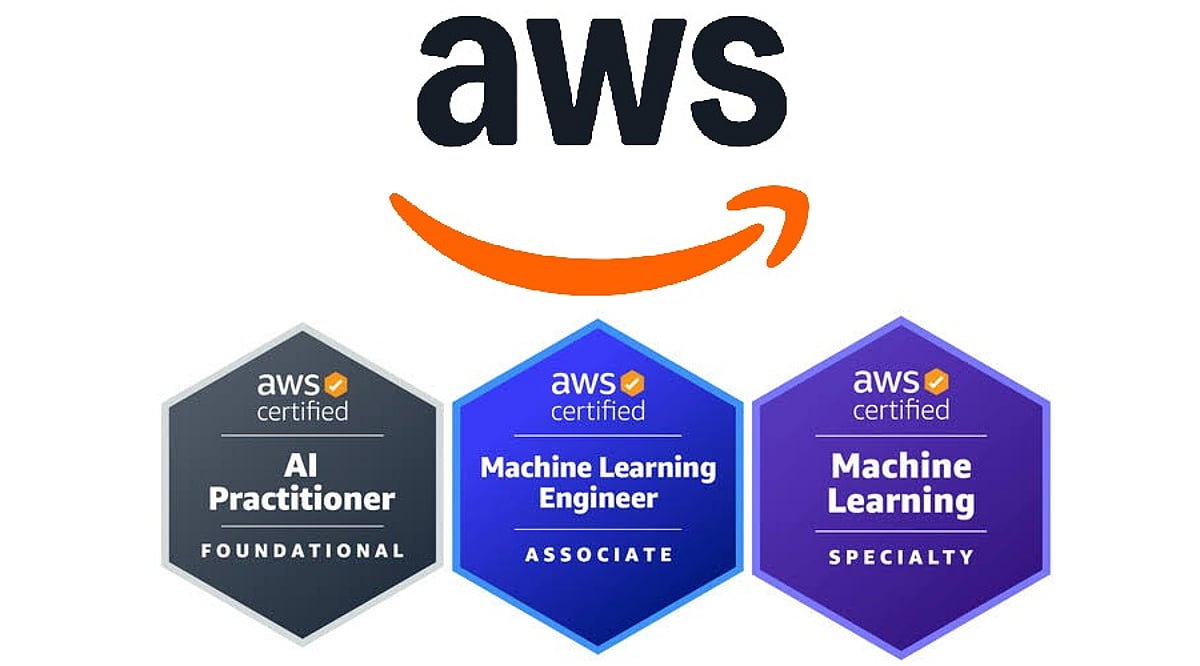
    • AWS Certified AI Practitioner (Foundational): Covers core AI and machine learning concepts, responsible AI practices, and how AWS services support common use cases. No coding background is required.
    • AWS Certified Machine Learning Engineer – Associate: Focuses on building, tuning, deploying, and monitoring machine learning models using services such as Amazon SageMaker, Amazon S3, and Amazon CloudWatch. Built for professionals who already have hands-on ML experience.
    • AWS Certified Generative AI Developer – Professional: Validates the ability to integrate large language models into applications, build retrieval-augmented generation (RAG) architectures, and work with vector databases and Amazon Bedrock for production-ready AI solutions.
    • AWS Certified Data Engineer – Associate: Centers on designing and managing data pipelines, storage, and reliable data infrastructure that supports machine learning and generative AI workloads.

    Matching the Exam to the Job

    A newcomer pivoting into AI from another field or a business analyst who needs to speak the same language as an engineering team gets the most value from AI Practitioner. It builds a baseline in AI and ML concepts without demanding coding depth.

    Someone already training and deploying models is better served by ML Engineer – Associate, which centers on data preparation, model tuning, and running workloads in production rather than staying inside a notebook.

    Developers already working with large language models, RAG pipelines, and Bedrock fit the Generative AI Developer – Professional role. This credential expects prior implementation experience rather than theory alone, and choosing it over AI Practitioner or ML Engineer comes down to one question: is the work built around foundation models or traditional ML pipelines?

    Data engineers who feed pipelines into ML systems should look at Data Engineer – Associate, a track that rarely gets the same attention as the AI-branded exams but supports all of them underneath.

    Product managers and stakeholders overseeing AI projects without building them get more practical value from AI Practitioner than from an engineering-level exam, since the goal is informed oversight rather than hands-on implementation.

    Deciding Where to Start

    The simplest approach starts with hands-on experience, not ambition. Someone new to AWS and AI belongs in AI Practitioner first. Someone already building or deploying models can skip straight to ML Engineer – Associate. A developer working with foundation models in production is the right candidate for Generative AI Developer – Professional.

    A common progression looks like AI Practitioner, then ML Engineer – Associate or Data Engineer – Associate depending on the role, then Generative AI Developer – Professional once foundation model work becomes part of the job.

    For those already deep into machine learning specialty prep, finishing it still holds some value, given less than a year remains before it closes to new candidates. For everyone else, moving straight to ML Engineer Associate offers more current coverage and a clearer path forward.

    The strongest certification choice rarely lines up with the most advanced option available. It lines up with what the job actually requires now and with where that job is headed next.

    Final Thoughts

    AWS restructuring its AI credentials around roles rather than a single tiered ladder points to where cloud certification is heading in general. It clarifies that the exam is less about climbing a fixed hierarchy and more about proving specific, current skills tied to specific work. Candidates who treat certification as a career-mapping exercise, rather than a checklist, will likely find their credentials relevant as AWS splits its portfolio.