Tag: Stock Market

  • 7 Undervalued Indian Stocks for Long-Term Growth in August 2026

    7 Undervalued Indian Stocks for Long-Term Growth in August 2026

    Undervalued stocks are those trading below their intrinsic value, offering potential for long-term investors who seek strong fundamentals and sustainable growth. As India’s economy is projected to expand by over 6% in FY27, sectors like banking, financial services, infrastructure, and capital markets are well-positioned for wealth creation. Here are seven undervalued stocks to consider for long-term growth this August.

    1. Tamilnad Mercantile Bank Ltd

    Market Cap: Rs. 14,179 crore
    Tamilnad Mercantile Bank (TMB), trading at Rs. 894, has maintained solid asset quality and steady profitability while expanding its retail loan book. With a conservative lending approach and enhanced digital banking capabilities, this regional bank offers attractive long-term prospects. Established in 1921, TMB serves retail customers and MSMEs.

    2. Godawari Power and Ispat Ltd

    Market Cap: Rs. 20,501.30 crore
    Godawari Power and Ispat benefits from India’s infrastructure and manufacturing boom. Its integrated steel business, captive power generation, and strong balance sheet help sustain healthy margins despite commodity price fluctuations.

    3. Can Fin Homes Ltd

    Market Cap: Rs. 10,861 crore
    Trading at Rs. 816, Can Fin Homes is a housing finance company (HFC) registered with the National Housing Bank. Canara Bank holds a 29.99% stake. The company focuses on smaller-ticket housing loans to salaried and self-employed borrowers, with stable asset quality and steady loan growth supporting its long-term outlook.

    4. ICICI Securities Ltd

    Market Cap: Rs. 29,149 crore
    ICICI Securities, trading at Rs. 896, provides institutional and retail broking, financial product distribution, merchant banking, and advisory services. Rising retail investor participation and vibrant equity markets continue to drive its brokerage business.

    5. Motilal Oswal Financial Services Ltd

    Market Cap: Rs. 52,429 crore
    Founded in 1987, Motilal Oswal operates across 550+ cities with 2,500+ business locations and over 1.6 million customers. Trading at Rs. 869, the company generates diverse revenue streams through its diversified financial services model, capitalizing on India’s growing financialization.

    6. Gujarat Mineral Development Corporation Ltd (GMDC)

    Market Cap: Rs. 22,686.10 crore
    GMDC is a key player in Indian mining, with exposure to lignite, bauxite, manganese, and other minerals. Government infrastructure spending and rising industrial demand underpin its strong long-term prospects.

    7. Angel One Ltd

    Market Cap: Rs. 27,785 crore
    Angel One is a diversified financial services company engaged in stock, commodity, and currency broking, institutional broking, margin trading, depository services, mutual fund distribution, NBFC lending, and insurance corporate agency. Its broad service suite positions it well for continued growth.

    Final Thoughts: These stocks appear undervalued under current market conditions, but investors should conduct their own research on valuation, earnings quality, and risks. A diversified, long-term approach is the best way to navigate market volatility.

  • SBI Life Q1 FY27 Profit Jumps 22% but Stock Falls on Margin Concerns

    SBI Life Q1 FY27 Profit Jumps 22% but Stock Falls on Margin Concerns

    SBI Life Insurance Reports Strong Q1 Earnings, Yet Shares Dip on Narrowing Margins

    SBI Life Insurance opened fiscal 2027 with a mixed quarterly performance. The insurer posted a consolidated net profit of ₹720 crore for the first quarter, a 22% increase year-over-year. Net premium income rose 16.9% to ₹20,078 crore, driven by robust renewal collections and a 40% surge in first-year premiums. Despite these strong fundamentals, the stock slipped in trade as investors focused on a narrowing value of new business (VNB) margin.

    Shares of SBI Life were trading at ₹1,861.60 on the NSE, down from the previous close of ₹1,858.60, after touching an intraday low of ₹1,836.20. The market reaction highlights that profitability alone is not enough without margin stability in the insurance sector.

    Margin Compression Takes Center Stage

    The VNB margin moderated to 26.2% from 27.4% in the same quarter last year. Analysts attribute this decline to a higher share of group protection business, which typically carries thinner margins than individual policies. Management has retained its full-year guidance of 26–28% and expects gradual normalization as individual business regains share through the remaining quarters.

    Financial Performance Highlights

    • Consolidated net profit: ₹720 crore, up 22% YoY
    • Net premium income: ₹20,078 crore, up 16.9% YoY
    • Gross written premium: ₹21,290 crore, up 20% YoY
    • First year premium: ₹4,955 crore, up 40% YoY
    • Annualized premium equivalent (APE): ₹5,380 crore, up 36% YoY
    • Embedded value: ₹85,290 crore, up 15% YoY
    • Assets under management: ₹5.25 lakh crore, up 10% YoY
    • Solvency ratio: 1.96, well above regulatory norms

    Brokerages Remain Bullish Despite Margin Dip

    Motilal Oswal retained its Buy rating with a revised target price of ₹2,240, trimming its FY27 margin estimate slightly but maintaining overall earnings estimates. Prabhudas Lilladher also holds a Buy stance with a target of ₹2,200. Both brokerages expect steady APE growth and margin recovery as the business mix normalizes.

    Management reiterated its medium-term outlook, expecting 14–15% individual premium growth in FY27, supported by continued investment in agency and digital channels.

    Market Outlook and Final Thoughts

    SBI Life’s numbers reflect a business scaling well operationally. Premium growth, embedded value gains, and stable solvency all support this view. The margin compression appears tied to product mix rather than any deeper weakness. For long-term investors, current price levels may offer a reasonable entry point, with brokerage targets pointing to healthy upside. As margin normalization plays out through the year, SBI Life’s scale and distribution strength should keep supporting its standing among India’s leading private insurers.

  • Indian Equities Rally: Sensex Climbs 862 Points, Nifty Holds Gains Amid Volatility

    Indian Equities Rally: Sensex Climbs 862 Points, Nifty Holds Gains Amid Volatility

    Market Overview

    Indian equity benchmarks traded in positive territory on July 27, 2026, with the BSE Sensex surging 862 points and the Nifty 50 posting gains despite intraday volatility. Selective buying, particularly in banking stocks, and cautious investor sentiment kept the indices in the green.

    Sensex

    The BSE Sensex closed at approximately 83,467, gaining 862 points or 1.04%. The index traded within a broad range, touching an intraday high near 83,615. From a technical perspective, the Sensex has been attempting to recover from earlier corrections, but resistance at higher levels continues to attract selling pressure. Volume activity remained healthy, indicating active participation from institutional and retail investors.

    Nifty 50

    The Nifty 50 index ended at 23,908.10, up 0.59%. The index experienced wide fluctuations, with a weak opening followed by a strong rebound to a session high before profit-booking trimmed gains. The index continues to form higher lows, a positive pattern, but frequent retracements suggest traders are not chasing prices. Key sectors such as information technology, financials, auto, and energy will determine future movements.

    Bank Nifty

    The Bank Nifty hovered around 56,990.85, gaining 297 points or 0.52%. The banking index has rebounded significantly from its lows but is currently ranging sideways, reflecting indecision among market participants. Private banks have played a notable role in the bounce. Any upside break above recent highs could boost bullish sentiment.

    Market Outlook

    Indian share markets remained firm amid volatility, supported by cautious bullish sentiment. While resistance at higher levels is evident, buyers continue to emerge on dips. Going forward, earnings announcements, foreign institutional investor (FII) flows, and macroeconomic developments will be key catalysts for market direction.

  • Tesla Stock Drops Near $300 After Q2 Earnings Miss Triggers Market Selloff

    Tesla Stock Drops Near $300 After Q2 Earnings Miss Triggers Market Selloff

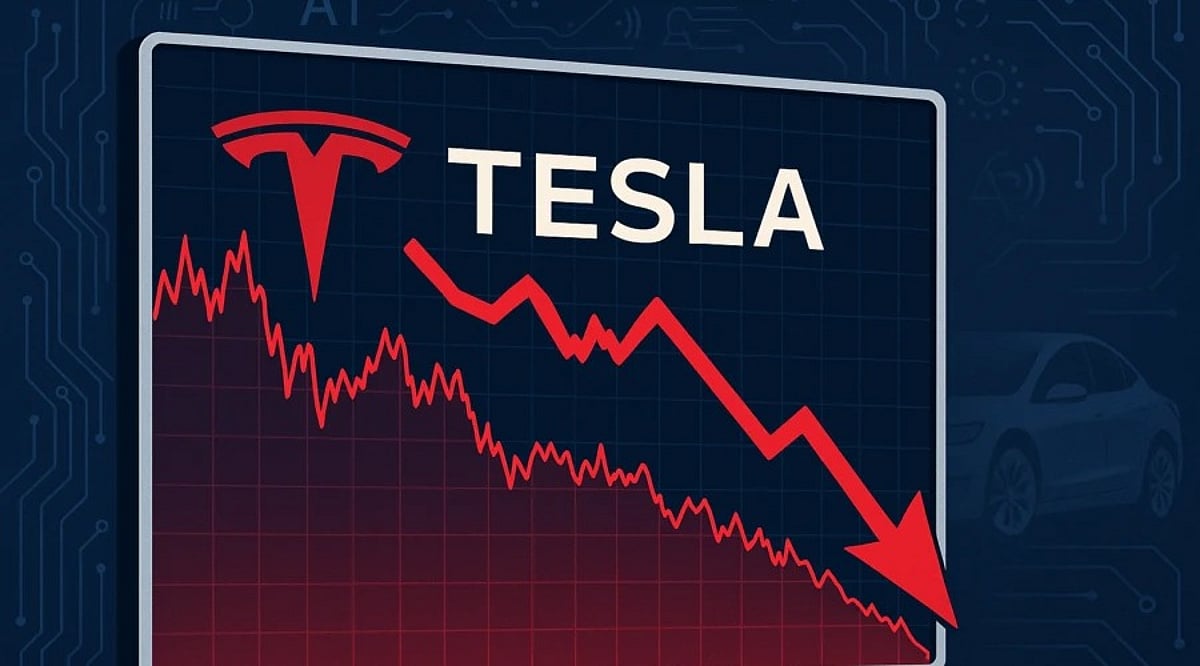
    Tesla shares fell nearly 15% after second-quarter results raised concerns over weaker margins, negative free cash flow, and rising AI spending. The selloff pushed the stock toward the $300 support area and added pressure to the NASDAQ, while Bitcoin and Ether also declined as risk sentiment weakened.

    Tesla shares closed at $313.03 on July 24 after falling 2.08% during the session. The stock also slipped to about $311.40 in after-hours trading. Over one month, Tesla lost around 16.55% as investors reassessed the company’s second-quarter results and spending plans.

    The latest decline followed a 14.52% plunge on July 23. Tesla reported record vehicle deliveries and higher revenue, yet weaker margins and negative free cash flow drew more attention. The stock now trades close to the lower end of its recent range, with $300 becoming the nearest major technical level.

    Tesla Stock Nears Key $300 Support

    Tesla stock traded as high as $322.87 on July 24 before falling to an intraday low near $306.53. Selling pressure stayed firm after the earnings-driven decline. As a result, the shares closed only a few dollars above their first major support zone.

    The area between $306.50 and $300 now serves as short-term support. A sustained close below $300 could bring the 52-week low near $297.82 back into focus. On the other hand, buyers need to reclaim the $320 to $323 range to slow the current decline.

    Stronger resistance sits between $340 and $342. Tesla traded near that area before the post-earnings gap widened. A recovery toward that range would require stronger demand and improved confidence in the company’s profit outlook.

    Record Deliveries Fail to Calm Investors

    Tesla delivered a record 480,126 vehicles during the second quarter. The total exceeded the company-compiled estimate of about 406,000 vehicles. Model 3 and Model Y deliveries reached 467,762 units and accounted for most of the quarter’s volume.

    Revenue rose 26% from a year earlier to about $28.24 billion. Automotive revenue reached nearly $20.5 billion, while services and other revenue increased 50% to $4.58 billion. These results showed that Tesla continued to expand sales across its main business lines.

    Nevertheless, investors focused on profitability. Tesla’s operating margin fell to 1.4% from 4.1% a year earlier. Lower vehicle prices and higher costs supported deliveries but reduced earnings from each sale.

    The weaker margin also raised questions about how quickly Tesla can turn rising sales into stronger cash generation. This issue became more important as the company increased spending on artificial intelligence, batteries, robotics, and autonomous-driving systems.

    AI Spending Adds Pressure Across Markets

    Tesla’s capital expenditure reached about $5.8 billion during the quarter. Free cash flow turned negative by roughly $1.1 billion, marking the company’s first quarterly cash burn in more than two years. Tesla also expects annual capital spending to exceed $25 billion.

    The company continues to fund robotaxi development, artificial intelligence infrastructure, next-generation manufacturing, and the Optimus robot program. Meanwhile, investors are waiting for clearer revenue growth from these projects as costs rise in the near term.

    The concern spread beyond Tesla. Alphabet shares also fell as investors reviewed higher artificial intelligence spending plans. It raised its 2026 capital expenditure guidance to between $195 billion and $205 billion, up from its earlier range.

    The NASDAQ moved lower as investors reduced exposure to high-growth technology stocks. Risk-off trading also reached digital assets. Bitcoin fell about 1.8% toward $64,800, while Ether dropped around 3% to nearly $1,870. Concerns over technology spending affected several risk markets during the same trading period.

  • Dow Rises Over 300 Points as Oil Retreats on Renewed Iran-US Peace Diplomacy Hopes

    Dow Rises Over 300 Points as Oil Retreats on Renewed Iran-US Peace Diplomacy Hopes

    The Dow Jones Industrial Average surged more than 300 points on Friday as oil prices tumbled following reports that Pakistan may mediate renewed talks between the United States and Iran. The S&P 500 also advanced, while the NASDAQ remained under pressure due to declines in semiconductor stocks.

    Oil Retreat Fuels Market Optimism

    The Dow gained approximately 0.7%, buoyed by a roughly 3% rise in Apple shares. The S&P 500 added around 0.6%, while the NASDAQ struggled to hold gains as chip stocks slid. Brent crude fell more than 4% to trade near $95 per barrel after surpassing $100 earlier in the week. West Texas Intermediate also dropped about 4% to above $88. Lower oil prices alleviated concerns over inflation, transportation costs, and corporate expenses.

    Pakistan Explores Peace Talks Mediation

    According to Reuters, Pakistan is exploring a path to restart stalled negotiations between the U.S. and Iran. Three Pakistani sources indicated that China initiated the diplomatic effort. Pakistani officials discussed the plan with Iranian representatives during recent meetings. However, the sources noted that “obstacles to any talks with the US remain high.” China has significant trade and energy interests in the Gulf, and Pakistan maintains close ties with Beijing, Saudi Arabia, and Iran, complicating its potential mediator role.

    Geopolitical Risks Drive Oil Volatility

    Oil had climbed above $100 earlier amid ongoing conflict in the region, raising fears of supply disruptions across the Gulf and Red Sea. U.S. strikes on Iranian targets and attacks linked to Iran-backed groups kept energy traders focused on shipping routes and production risks. The Strait of Hormuz remains a major concern for China and other large oil buyers, as any disruption could restrict crude shipments and drive up global energy costs. Friday’s diplomatic report eased some of those fears, prompting traders to sell oil futures.

    Chip Sector Caps Broader Gains

    Semiconductor stocks declined even as the Dow and S&P 500 rose. Intel dropped about 3% after initially gaining on better-than-expected results. Broadcom and Advanced Micro Devices each lost roughly 2%, while Micron Technology fell about 5%. The Philadelphia Semiconductor Index declined more than 3% in early trading. Investors continue to question the pace of artificial intelligence spending after Alphabet and Tesla reported higher capital costs and cash usage. The cautious tone set the stage ahead of earnings from Microsoft, Amazon, and Meta.

    Corporate Moves and Sector Rotation

    Verizon advanced after raising its annual forecasts for adjusted profit and free cash flow. Real estate and communication services led gains in the S&P 500 as investors rotated into sectors less exposed to chip weakness. Citi raised price targets for Dell and Hewlett Packard Enterprise, with analyst Asiya Merchant maintaining buy ratings on both, citing demand for servers, networking equipment, and AI infrastructure. Citi lifted its HPE target to $74 from $70, implying about 55% upside from Thursday’s close.

    Fed Policy and Tariffs Add to Uncertainty

    Investors also assessed new U.S. tariffs of 10% and 12.5% on goods from 60 trading partners, linked to weak enforcement of forced-labor restrictions. The new duties followed the expiration of a temporary 10% global tariff. The Federal Reserve meets next week, with markets weighing inflation risks from energy costs. Futures pricing indicates about a one-in-three chance of an interest rate hike, up from 12% a week earlier. Fed Chairman Kevin Warsh has maintained the central bank’s focus on price stability and employment.

    Despite Friday’s gains, the Dow and S&P 500 are on track for small weekly losses. The NASDAQ is headed for a decline of more than 1%, as technology weakness offsets the relief from lower oil prices.

  • Infosys Stock Dips After Narrowed Revenue Guidance Despite Strong Q1 Performance

    Infosys Stock Dips After Narrowed Revenue Guidance Despite Strong Q1 Performance

    Infosys shares slipped to Rs. 1,027.9 on July 24, 2026, after the IT major narrowed its FY27 revenue guidance despite posting strong first-quarter earnings. The company also announced salary hikes, plans to hire 20,000 freshers, and reaffirmed its AI-led growth strategy, but investors remained cautious about the trimmed upper end of the annual revenue forecast.

    Revenue Guidance Overshadows Solid Results

    According to TradingView, Infosys shares traded at Rs. 1,027.9, down 1.86%, with an intraday high of Rs. 1,042.6 and a low of Rs. 1,013.9. The stock decline reflects a broader concern in the IT sector: healthy execution alone may not be enough if enterprise technology spending remains cautious. The company’s FY27 revenue growth forecast on a constant currency basis narrowed from 1.5%–3.5% to 1.5%–3.0%. While the change appears small, analysts attribute it to ongoing uncertainty in global tech spending, with companies delaying discretionary investments and focusing on critical digital projects.

    Operational Resilience Despite Cautious Outlook

    Infosys reported strong financial performance for Q1. Revenue reached Rs. 48,211 crore, marking approximately 14% growth, while net income rose to Rs. 7,769 crore, driven by strong client accounts and demand for digital services. The company secured large deal wins worth about $3.6 billion, a significant portion from new business, indicating that enterprises are still committing to long-term digital transformations despite near-term caution. Additionally, Infosys expanded its AI product portfolio, fueled by increasing enterprise adoption of generative AI.

    Hiring and Salary Hikes Signal Long-Term Confidence

    Despite uneven global demand, Infosys continues to invest in its workforce. The company confirmed that annual salary hikes will begin rolling out from October, with senior employees receiving increments in January. It also reaffirmed plans to recruit nearly 20,000 fresh graduates during FY27. Rather than slowing hiring, Infosys is building capabilities in high-growth areas like artificial intelligence, cloud computing, cybersecurity, and digital engineering, signaling management’s expectation that technology spending will improve over the medium term.

    Leadership Transition and AI Strategy

    Infosys appointed Ashiss Kumar Dash as the future CEO, with the transition scheduled for April 2027. This planned leadership change is expected to ensure continuity and maintain client trust during a period of industry upheaval driven by AI. The company’s AI and automation services, including generative AI, intelligent automation, cloud migration, and digital consulting, are expected to drive higher-value deals as enterprises move from proof-of-concept to large-scale deployment. However, the pace of monetization will depend on the recovery of IT budgets.

    Market Outlook

    Infosys Q1 performance reflects the evolving priorities of the global IT services industry. While profitability, strong deal wins, continued hiring, and AI investment demonstrate resilience, the reduced revenue outlook highlights that client spending remains prudent. Investors should monitor whether enterprise technology budgets recover in coming quarters and whether AI-driven initiatives begin to contribute meaningfully to revenue. Until then, Infosys appears operationally sound but operates in an environment where expectations are as critical as execution.

  • Indian Stock Market Opens Sharply Lower: Nifty 50 Drops 178 Points, Sensex Sinks Over 600 Points on Rising Oil Prices

    Indian Stock Market Opens Sharply Lower: Nifty 50 Drops 178 Points, Sensex Sinks Over 600 Points on Rising Oil Prices

    The Indian stock market opened sharply lower on Friday, dragged down by weakness in global markets and a surge in crude oil prices that has stoked inflation fears and dampened investor sentiment. At the opening bell, the Nifty 50 fell 178 points, the Sensex declined 633 points, and the Bank Nifty edged over 0.70% lower.

    On Thursday, the Sensex had already declined 363.66 points, or 0.47%, to close at 76,391.39, while the Nifty 50 fell 126.65 points, or 0.53%, to settle at 23,869.60. The Indian rupee also opened lower at Rs. 96.63 per dollar on Friday, compared to Thursday’s close of Rs. 96.57.

    Institutional activity showed a mixed picture. Domestic institutional investors (DIIs) stepped up buying in Indian equities on July 23, purchasing shares worth Rs. 2,947.14 crore. In contrast, foreign institutional investors (FIIs) remained net sellers, offloading equities worth Rs. 2,999.23 crore.

    Sensex Outlook

    Technically, the Sensex formed a bearish candle on the daily chart and is holding a lower top formation on intraday charts, supporting further weakness from current levels.

    “As long as the market is trading below 77,000, weak sentiment is likely to continue on the downside. The correction wave is likely to persist till 76,000. Further downside may also continue, which could drag the index to 75,700-75,500. On the flip side, above 77,000, the sentiment could change. Above this level, the market could bounce back to 77,300-77,500. The intraday market texture is uncertain and volatile; hence, level-based trading would be the ideal strategy for day traders,” said Shrikant Chouhan, Head of Equity Research at Kotak Securities.

    Nifty 50 Outlook

    The Nifty 50 continues to exhibit a corrective trend after extending losses for the fourth straight trading session. The index formed a high-wave candle on the daily chart, indicating that selling pressure remains intact.

    The index is currently testing the important support area between 23,800 and 23,750, where the 50-day Simple Moving Average (SMA) coincides with multiple swing lows formed over the past five weeks.

    “On the downside, a breach below 23,800-23,750 on a closing basis will accelerate downside towards the 23,500 levels in the coming weeks, being the confluence of the trendline support joining lows of April and June 2026, bullish gap area of June 15, 2026, and 61.8% retracement of the recent up move from 23,070-24,530,” said Bajaj Broking Research.

    The brokerage added that a move back above 24,000 could temporarily halt the recent decline and pave the way for a recovery towards 24,200 during the coming week.

    Bank Nifty Outlook

    The Bank Nifty formed a bearish candle pattern with lower highs and lower lows on the daily chart, indicating weakness in the near term.

    A sustained move below the 56,200-56,500 support zone could trigger further weakness towards the 55,500-55,000 levels, which coincide with a key trendline support and the 61.8% Fibonacci retracement of the previous rally.

    “A shallow retracement signals overall positive bias and a higher base formation in the current corrective decline. On the higher side, 57,500 will act as an immediate hurdle, while the upper band of the recent consolidation, placed around 58,500-58,700, will act as a stiff hurdle in the index in the coming weeks,” said Bajaj Broking Research.

  • Wall Street Tumbles: Dow Loses 500 Points as Oil Surge and Tech Losses Bite

    Wall Street Tumbles: Dow Loses 500 Points as Oil Surge and Tech Losses Bite

    US stocks fell sharply on Thursday as a surge in oil prices, rising bond yields, and disappointing earnings from major technology companies weighed on market sentiment. The Dow Jones Industrial Average dropped approximately 500 points during morning trading, with the S&P 500 losing nearly 1% and the Nasdaq Composite falling around 1.7%.

    The sell-off pushed major indexes to multi-week lows, with declining shares outnumbering advancing stocks on both the New York Stock Exchange and Nasdaq. The CBOE Volatility Index rose to 18.79 after three consecutive declines, reflecting heightened investor anxiety.

    Oil Rally Raises Inflation Concerns

    Brent crude futures surged 6.7% to $100.37 per barrel during European trading, while West Texas Intermediate gained 5.5% to $91.91 per barrel. The rally followed reports that Houthi forces attacked two Saudi oil tankers near the Bab el-Mandeb Strait, raising fresh supply concerns and threatening another major shipping route.

    Higher oil prices pushed Treasury yields upward, with the 10-year yield reaching its highest level since January 2025 and the two-year yield hitting a 17-month high. This renewed inflation fears, prompting traders to increase bets on a Federal Reserve rate hike at the July meeting. CME FedWatch data showed markets pricing a 38% chance of a quarter-point increase, up from about 12% just one week earlier.

    Alphabet and Tesla Pressure Nasdaq

    Alphabet shares fell more than 6% after the company raised its 2026 capital spending forecast, with investors focusing on costs tied to artificial intelligence infrastructure. AJ Bell investment director Russ Mould noted a “healthy degree of scepticism” about returns from such spending. The decline pulled communication services stocks lower.

    Tesla shares dropped more than 12% after reporting negative quarterly free cash flow and higher operating expenses relative to revenue growth. CEO Elon Musk called 2026 a “massive capex year,” with spending plans including robots, data centers, manufacturing projects, and its robotaxi business.

    Energy Shares Rise With Crude Prices

    Energy companies moved higher as oil prices extended a five-day rally. Exxon Mobil gained 1.6%, while Chevron rose 1.9%. Diamondback Energy, Devon Energy, ConocoPhillips, and Occidental Petroleum gained between 1.7% and 2.7%. Refiners also advanced, with Valero Energy, Marathon Petroleum, and Phillips 66 rising between 1.1% and 1.3%.

    Analysts also watched shipping activity in the Middle East. UBS analyst Giovanni Staunovo said subdued vessel traffic could slow the region’s production recovery.

    Rate Expectations Shift Before Fed Meeting

    The oil rally renewed concern that higher fuel costs could keep inflation elevated. New labor data also supported expectations that the Fed could keep policy tight, with initial unemployment claims falling to 187,000, below forecasts of 210,000.

    Airline shares faced pressure as higher fuel costs threatened operating expenses, while transport stocks moved lower. Lockheed Martin shares rose after the company lifted its 2026 forecasts, and ServiceNow gained after raising its annual subscription revenue outlook.

    Markets will likely remain focused on oil prices, upcoming inflation data, and the Federal Reserve’s next policy decision for direction.

  • CXMT’s $8.6 Billion IPO: What China’s Biggest Memory Chip Debut Means for AI Chip Stocks

    CXMT’s $8.6 Billion IPO: What China’s Biggest Memory Chip Debut Means for AI Chip Stocks

    Global AI chip stocks could face fresh volatility next week as ChangXin Memory Technologies (CXMT), China’s largest memory chipmaker, prepares to debut on the Shanghai Stock Exchange. The listing, one of the biggest market events of the year, is expected to draw worldwide investor attention as Beijing intensifies efforts to strengthen its domestic semiconductor industry.

    CXMT has raised $8.6 billion through its Initial Public Offering (IPO), making it Asia’s largest IPO of 2026. The offering comes amid an AI-driven surge in demand for memory chips and continued efforts by China to reduce its dependence on foreign semiconductor suppliers.

    China’s Bet on Homegrown Chipmaking

    Founded in 2016, CXMT has grown into the world’s fourth-largest DRAM memory chipmaker, trailing only Samsung Electronics, SK Hynix, and Micron Technology. DRAM chips are essential components in smartphones, personal computers, servers, and AI systems, where they temporarily store data for processing.

    The company has grown significantly with substantial support from government-linked investors. Entities from Hefei, an eastern Chinese city, own 36.8% of CXMT’s stock. At the IPO valuation, those shares are worth approximately $31.5 billion, underscoring the scale of China’s state-backed investments in technology.

    Why Investors Are Watching Closely

    According to analysts, the IPO’s impact on semiconductor stocks will be significant, as large listings often trigger portfolio realignment among investors. CXMT’s market debut follows a recent downturn in global chip stocks, making its performance a key gauge of investor confidence in the AI hardware sector.

    Despite market volatility, demand for the IPO remains robust, with institutional investors subscribing to the offer over 500 times.

    A Key Player in China’s AI Strategy

    CXMT plays a pivotal role in China’s quest for technological self-reliance. High-performance AI processors require vast amounts of fast memory, and domestic DRAM production has become a priority due to US-led export restrictions reshaping the semiconductor supply chain.

    Although CXMT lags behind global leaders in advanced memory technologies, its rapid growth reflects the Chinese government’s strategy of cultivating domestic champions in critical industries. The company’s stock market performance will be closely watched by investors worldwide.